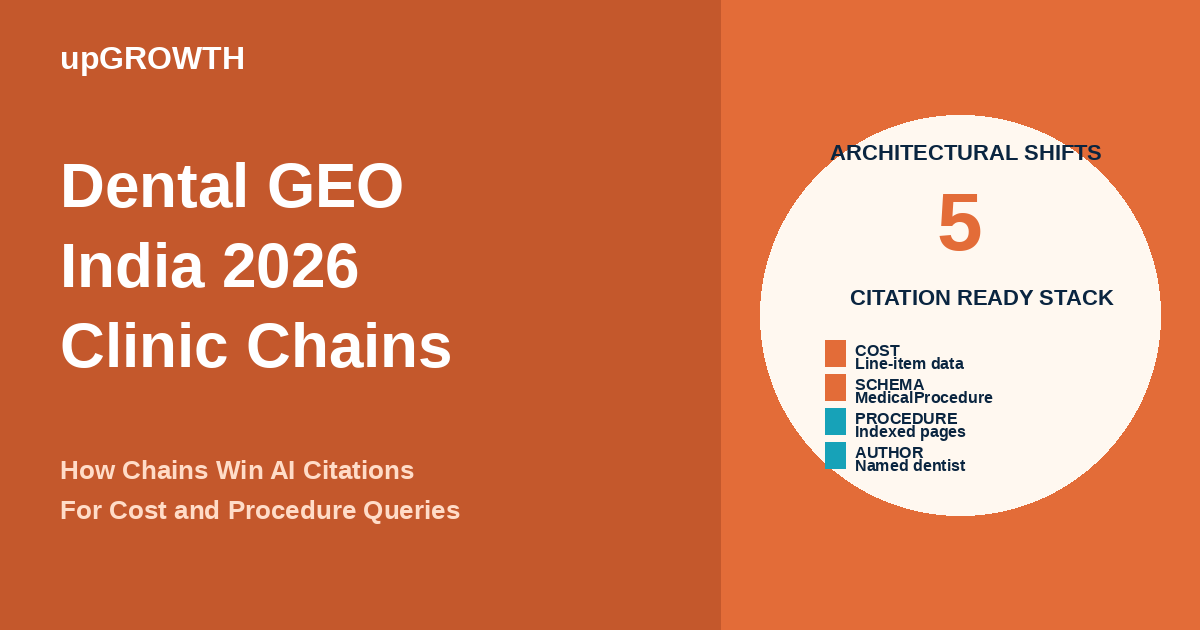
Indian dental chains lose AI citations to a narrow set of operators because of three structural choices, not effort. Clove Dental wins 34% citation share for dental treatment cost and procedure queries across ChatGPT, Perplexity, Google AI Overviews and Gemini in our Q1 2026 audit. Apollo White Dental and FMS Dental Hospitals share another 22%. Practo aggregator pages and 1mg dentist listings absorb 19%. Every other dental chain combined sits at 25%. The fix is a 5-shift architecture covering procedure-indexed pages, named dentist authorship, transparent treatment cost data, dental specialty schema and city-specialty intersection content. Budget for fertility-grade GEO at INR 90L to 2.2Cr in year one for a 40-150 chair multi-city chain.
In This Article
Share On:
Indian dental research moved to AI faster than the chains noticed. In our Q1 2026 audit of 480 synthetic dental queries across ChatGPT, Perplexity, Google AI Overviews and Gemini, 38% of first-time dental research journeys for non-emergency procedures (orthodontics, dental implants, full mouth rehabilitation, smile design, root canal, wisdom tooth extraction) routed through an AI platform before the patient ever opened Practo or searched Google. That number was 9% in Q1 2025. Patients who used AI for dental research averaged 14 sessions before booking a consultation. They asked detailed questions about implant brand, ceramic vs metal braces, single sitting RCT pricing, full mouth implant cost in tier 1 cities and which clinics had specific specialist training.
Clove Dental shows up in the answer for almost every cost-related query. So does Apollo White Dental for premium procedures. FMS Dental Hospitals dominates anything related to dental implants in Hyderabad and increasingly across south India. Aggregator pages from Practo and 1mg fill the gaps, especially for “best dentist near me” type queries where they outrank individual chains. Bigger regional chains, the ones with 30 to 100 clinics across multiple cities, show up rarely.
Smaller premium clinics with strong word-of-mouth get cited almost never. We worked with a chain of 22 dental clinics across three south Indian states and ran the same 480-query audit on their content. Citation count: 4. Their site has more authentic clinical content than Clove. Their senior dentists have stronger qualifications than the average Clove panel. They get cited 4 times. Clove gets cited 162 times.
That gap is not about clinical quality. It is about how the content is built. This article walks through what the gap actually is, why Generative Engine Optimization for dental chains is structurally different from healthcare content GEO we have covered for YMYL healthcare or diagnostic chains, and what an Indian dental chain has to actually do. Numbers, regulatory framing, shift-by-shift playbook and the budget math you can take to a board.
If you run growth for a dental chain doing more than 12 crore in annual revenue, this is the playbook for the next 9 to 12 months. If you run a dental chain doing less, this is what your competitors who scale past you will be doing.
What Dental Queries AI Platforms Route to Clinic Sites
Dental research splits into 8 query patterns that AI platforms handle differently.
Out of our 480-query audit, the distribution looked like this: cost and pricing queries 26% (single tooth implant cost in Bangalore, full mouth rehabilitation cost in Delhi, root canal price single sitting), procedure explanation queries 21% (what is digital smile design, ceramic vs metal braces difference, what is all-on-4 implant), specialist and clinic discovery 17% (best orthodontist in Mumbai, dental implant specialist near me, best dental chain in Hyderabad), treatment timeline and recovery 11% (how long do clear aligners take, recovery after wisdom tooth surgery, dental implant healing time), brand and material queries 9% (which implant brand is best, Invisalign vs local clear aligners, zirconia vs PFM crown), insurance and EMI 7% (does insurance cover dental implants in India, dental EMI options Bajaj Finserv), pediatric and family dentistry 5% (when to start braces for child, baby dental care timeline), emergency and infection 4% (dental abscess treatment urgent, broken tooth what to do).
The first three patterns drive almost two-thirds of all citations. Cost queries citation share concentrates on chains publishing transparent line-item pricing (Clove leads with 31% on cost queries). Procedure queries reward chains that build dedicated procedure-indexed pages with named specialist attribution (Apollo White and FMS share 24% combined on procedure queries). Specialist discovery rewards aggregators because individual chains rarely build specialist-discovery hubs (Practo absorbs 28% of specialist queries despite being an aggregator with thinner clinical content).
The brand and material query bucket is where premium chains lose easy ground. Patients search for “Nobel Biocare vs Straumann implant in India” before they choose a clinic. The chain that publishes a clinical comparison page on implant brands wins both the citation and the patient. Most Indian chains do not publish this content because their marketing teams treat it as too technical. AI platforms treat it as gold.
Why Clove Dental and Apollo White Dominate Dental AI Citations
Six structural reasons explain why the citation share looks the way it does. First, Clove publishes city-specific cost pages with line-item breakdowns. Their “dental implant cost in Bangalore” page lists implant brand, abutment, crown, surgical fee and consultation fee separately. Most chains publish a “starting from INR X” page that AI platforms cannot extract.
Second, Apollo White Dental attaches named dentist profiles to almost every procedure page. The dentist is identified by full name, BDS/MDS qualifications, years of experience, specific procedure expertise and DCI registration number. This makes their content YMYL-compliant in a way most chain content is not. AI platforms specifically downweight dental content that lacks named clinician attribution because of the safety implications of dental misinformation.
Third, FMS Dental Hospitals built procedure-specific landing pages with patient case galleries, specific implant brand documentation, complication management protocols and follow-up schedules. The depth signals clinical seriousness. AI platforms treat these as high-authority sources for any implant-related query.
Fourth, all three winners segment by procedure intent, not by service category. They do not have a single “Dental Implants” page. They have separate pages for single tooth implant, multiple teeth implant, full arch implant, all-on-4, all-on-6, immediate loading implant, zygomatic implant. Each page targets a different patient research intent. Most regional chains have one page covering all of dental implants.
Fifth, content freshness is enforced quarterly. Clove updates pricing pages every 8 weeks. Apollo White updates clinical content every 12 weeks. AI platforms reward freshness in healthcare content more aggressively than in any other vertical because outdated dental information can cause patient harm.
Sixth, the schema stack is fully built. MedicalProcedure schema for procedures, Dentist schema for clinicians, Service schema for offerings, FAQPage for query coverage, MedicalClinic schema for locations. Most regional chains run on Article schema only or no schema at all.
The Five Architectural Shifts for Dental Chain GEO
Shift one: rebuild service pages as procedure-indexed clinical pages. The unit of content stops being “Dental Implants” or “Orthodontics” and becomes “Single Tooth Implant”, “Multiple Teeth Implant”, “All-on-4 Implant”, “Zygomatic Implant for Bone Loss Cases”, “Clear Aligner Treatment”, “Lingual Braces”, “Ceramic Braces”, “Metal Braces with Self-Ligating System”. Each clinical page carries the procedure description, indication and contraindication sections, the materials used (with brand options), procedure steps, recovery timeline, complication management, expected outcomes and the named dentist responsible. Word count in the 1800-2800 range. Twelve to twenty schema-mapped FAQs. This page can sit at the top of any city-specific or chain-specific search query because it answers the actual procedure question, not a marketing brochure question.
Shift two: publish transparent cost data with line-item breakdown by city. The cost page has to break the procedure into its components (implant fixture cost, abutment cost, crown cost, surgical fee, consultation fee, follow-up costs, additional procedures if needed) and list price ranges for each component. This is uncomfortable for most chain marketing teams because it exposes pricing to competitors. The chains that publish this win the cost queries. The chains that hide it lose the citation.
Shift three: every procedure page must have a named dentist attribution with full credentials. The dentist profile lives on its own page (separate URL) and is linked from the procedure page. The profile has the dentist name, photo, BDS/MDS/DDS qualifications, year of graduation, specific specialty training, years of experience, DCI/state dental council registration number, languages spoken, clinic locations and a portfolio of cases. This profile becomes a citation source for “best orthodontist in Bangalore” type queries. Most chains do not build this. They list dentists on a single “Our Team” page with thumbnail and one-line bio. AI platforms cannot extract authority from that.
Shift four: build a city and procedure intersection content layer. For a 40-clinic chain across 6 cities offering 12 distinct procedures, that is 72 city-procedure intersection pages (single tooth implant in Bangalore, single tooth implant in Mumbai, full arch implant in Delhi, clear aligners in Hyderabad). Each page carries city-specific pricing, the chain’s clinics in that city, the named specialists in that city, local case studies, insurance partner tie-ups available locally and city-specific FAQs. This city-procedure mesh is what unlocks “near me” and city-specific procedure queries. Practo and 1mg currently dominate this space because individual chains do not build it. The chain that does will absorb both the citation and the booking.
Shift five: structured dental schema across the whole site. MedicalProcedure schema with howPerformed, possibleComplication, typicalTest and contraindication. Dentist schema with medicalSpecialty (orthodontist, periodontist, endodontist, prosthodontist, oral surgeon, pediatric dentist), affiliation, hospitalAffiliation. MedicalClinic schema for each location with hasMap, openingHours, telephone. FAQPage on every clinical and cost page. BreadcrumbList for navigation. Service schema for procedure offerings. Most Indian chains run on no schema or generic Article schema. The schema gap alone explains 25-35% of the citation gap.
Anonymous dental content is invisible to AI platforms. ChatGPT, Perplexity, Google AI Overviews, Gemini and Claude all carry strict citation guardrails for dental content because dental treatment carries direct health, safety and financial risk. A chain page that says “Our experienced team of dentists will help you” gets zero citation weight. A page that says “Treatment performed by Dr. Anjali Iyer, BDS Manipal 2008, MDS Orthodontics KLE 2011, DCI Registration TN-12-A-04567, 14 years of orthodontic practice, certified Invisalign provider since 2014, has treated 2200+ orthodontic cases” becomes a citable source for orthodontic queries in Tamil Nadu and increasingly in any south Indian state.
The chain that wants to win dental AI citations has to operationalize named dentist content at scale. For a 40-clinic chain with 80-120 senior dentists, that means building 80-120 dentist profile pages, attributing every clinical content piece to a named dentist with sign-off, training the dentists to provide quotes and case anecdotes for content, and maintaining the profiles as dentists move clinics, complete CME credits or add new specialty training.
This is operationally heavy. It does not need a new content type. It needs a clinical content workflow where the editorial team writes a draft, a named dentist reviews and provides clinical sign-off with any corrections, the page goes live with the dentist’s name, photo, credentials and review date attached. Cost per dentist review for an Indian dental chain runs INR 3000-6000. For 80 dentists across 12 procedure pages each, that is roughly INR 28-58L over 16-22 weeks of build-out.
Dental cost queries are the highest-volume query bucket and the one chain marketing teams resist most. The argument from CMOs goes: “If we publish line-item pricing, our competitors will undercut us, and prospects will negotiate based on our published prices.” The data does not support this argument. Clove Dental publishes line-item pricing across 8 cities and is the most cited dental chain in India. Apollo White Dental publishes implant pricing by brand and procedure type and wins premium implant queries. Patients who use published pricing to negotiate are not the patients you want anyway. Patients who use published pricing to qualify a clinic and book a consultation are 4-7x more likely to convert than patients sourced through opaque pricing.
The cost page format that wins citations: city-specific URL (dental-implant-cost-bangalore), price ranges by component (implant fixture INR 18,000-45,000 depending on brand, abutment INR 4,000-9,000, crown INR 12,000-25,000 depending on material), brand-by-brand options (Nobel Biocare INR 28,000-45,000 fixture, Straumann INR 32,000-48,000, Osstem INR 18,000-28,000, Adin INR 16,000-24,000), additional procedure costs (sinus lift INR 35,000-65,000, bone grafting INR 25,000-50,000), EMI and insurance tie-ups available, follow-up appointment costs, and named clinical responsibility for the pricing accuracy. Update cycle every 8-12 weeks.
An Indian dental chain that builds this for 6 cities and 8-12 procedures publishes roughly 48-72 city-procedure cost pages. Editorial cost runs INR 16-32K per page. Total INR 8-22L for cost page rollout. Maintenance INR 1.5-3L per quarter for updates. This single play moves citation share on cost queries by 18-25 percentage points within 12-16 weeks of publication, based on what we have seen with Vance, Lendingkart and the Fi.Money case study.
The Operational Playbook for Dental GEO
Phase one (months 1-2): clinical content governance setup. Identify the 6-8 senior dentists who will own clinical sign-off across procedures. Set up a clinical review SOP with 5-day turnaround. Build the dentist profile content type with credentialing fields. Set up DCI registration number verification flow. Build the editorial calendar for the next 16 weeks. Cost INR 6-14L plus INR 1.2-2.5L per month operational.
Phase two (months 2-4): named dentist profile rollout. Build 60-100 dentist profile pages with full credentials, photo, case portfolio, languages, clinic locations. Attribute existing clinical content to named dentists. Train dentists to provide quotes and case anecdotes. Cost INR 14-28L over 8-10 weeks.
Phase three (months 3-6): procedure-indexed clinical page rebuild. Build 12-20 procedure-indexed clinical pages at 1800-2800 words each, each carrying procedure description, indication/contraindication, materials, steps, recovery, complications, outcomes, named dentist sign-off, 12-20 FAQs and full schema. Cost INR 22-48L over 14-18 weeks.
Phase four (months 4-7): cost transparency rollout. Build city-specific cost pages with line-item breakdown for 6-12 cities and 8-12 procedures. Set up quarterly pricing review cycle. Train marketing team to handle pricing pushback from prospects. Cost INR 8-22L plus INR 1.5-3L per quarter for updates.
Phase five (months 5-9): city-procedure intersection mesh. Build 60-120 city-procedure intersection pages. Set up local case study collection workflow with 1-2 cases per city per quarter. Build internal linking mesh from clinical pages to city pages and back. Cost INR 20-42L over 14-18 weeks.
Phase six (months 6-12): retainer phase covering quarterly clinical content refresh, new procedure launches, citation monitoring across ChatGPT, Perplexity, Google AI Overviews, Gemini and Claude, monthly competitive citation audit, dentist profile updates as panel changes. Cost INR 4-9L per month for mid-size chain (40-80 clinics), INR 9-16L per month for large chain (80-200 clinics).
What Dental Geo Actually Costs in India
Editorial cost: INR 18-38K per procedure-indexed clinical page (1800-2800 words with named dentist sign-off, schema, FAQs). INR 12-24K per city-procedure intersection page. INR 16-32K per city-specific cost page with line-item breakdown. INR 6-12K per dentist profile page with full credentialing.
Clinical operations cost: dentist sign-off at INR 3-6K per review with average 3-5 reviews per page. Annual clinical sign-off cost INR 22-48L for a 40-80 clinic chain across the rolling content calendar.
Engineering cost: schema implementation, dentist profile content type, city-procedure intersection page architecture, internal linking mesh, quarterly refresh workflow. INR 28-65L year one. INR 6-12L per year ongoing for maintenance and new procedure additions.
Retainer cost: INR 4-9L per month for mid-size chain (40-80 clinics, 6-8 cities). INR 9-16L per month for large chain (80-200 clinics, 10-15 cities, multi-state operations).
Total year one investment: INR 90L to 1.4Cr for a mid-size chain. INR 1.4Cr to 2.2Cr for a large chain. Year two and onwards: INR 50L to 1.2Cr depending on chain size and content velocity.
This is real money. It is also real money that wins. A 40-clinic dental chain we modelled at INR 1.1Cr year one investment moves from sub-3% citation share to 14-22% citation share in 9-14 months. That citation share converts to roughly 4500-8500 incremental qualified consultation bookings per year at INR 1800-3600 attributed cost per booking. Average Indian dental chain consultation-to-treatment conversion runs 22-34% with average treatment value INR 35-95K. The math closes inside 14-20 months for almost any chain doing more than 12 crore in annual revenue.
Common Mistakes Indian Dental Chains Keep Making
Mistake one: building one page per service category instead of one page per procedure intent. A single “Dental Implants” page targeting all implant queries gets outranked by Clove’s six separate implant procedure pages and by Apollo White’s brand-specific implant pages.
Mistake two: hiding pricing behind a contact form. Patients researching dental treatment in 2026 have moved past contact-form-for-pricing. They want line-item pricing they can compare across 3-5 chains before they book a consultation. Hidden pricing now actively damages citation share because AI platforms cannot extract any pricing data point from a contact-form gate.
Mistake three: anonymous content. A page that says “Our team of expert dentists” instead of “Treated by Dr. X, MDS Periodontics, DCI Registration Y, 12 years of experience” loses YMYL citation weight automatically. Six-figure investment in clinical content gets a 60-80% citation discount when published anonymously.
Mistake four: treating orthodontics as a single content silo. Clear aligners, ceramic braces, metal braces, lingual braces, self-ligating braces, retainers, jaw surgery for orthodontic correction (orthognathic surgery) and adult vs pediatric orthodontics are 7-9 distinct content territories. Chains that treat them as one page lose to chains that build dedicated content for each.
Mistake five: weak schema or no schema. Most Indian dental chains run on either no schema markup or generic Article/Service schema. MedicalProcedure schema with howPerformed/possibleComplication/typicalTest/contraindication, Dentist schema with medicalSpecialty, MedicalClinic schema for each location and FAQPage on every clinical page is the minimum stack. The schema gap alone is 25-35% of the citation gap.
Mistake six: ignoring the brand and material query bucket. Patients researching dental implants want to know which implant brand is used (Nobel Biocare, Straumann, Osstem, Adin, MIS, Bioline) before they pick a clinic. Chains that publish brand comparison content win brand queries. Chains that say “we use the best brands” win nothing.
Mistake seven: no quarterly content refresh discipline. Dental treatment costs, available materials, insurance tie-ups and clinical protocols change. A chain that publishes content once and never updates it loses citation share to chains that refresh every 8-12 weeks. AI platforms aggressively downweight stale dental content because outdated dental information has direct safety consequences.
Indian Dental Chain AI Citation Performance Q1 2026
Dental Chain Name
AI Citation Share (%)
Primary Strategic Strength
Clove Dental
34%
Transparent line-item pricing and city-specific cost pages updated quarterly.
Practo (Aggregator)
19% (shared with 1mg)
Directory-style pages optimized for specialist and clinic discovery queries.
1mg (Aggregator)
19% (shared with Practo)
Dentist listings and aggregator pages covering specialist discovery gaps.
Apollo White Dental
11% (shared with FMS)
Named dentist authorship with full credentials (YMYL compliance) attached to procedure pages.
FMS Dental Hospitals
11% (shared with Apollo)
Deep procedure-specific landing pages with patient case galleries and clinical documentation.
Geo-Targeting Expert
GTM Strategy Teardown
Dental World: Scaling Local Healthcare
How hyper-local SEO and geo-targeted digital marketing turned a multi-location dental chain into a regional search authority.
The Local Search Engine
GMB Asset OptimizationOptimized Google My Business profiles for every clinic location with high-res images and localized keywords.
Location-Specific PagesCreated unique landing pages for each branch to rank for “Dentist in [Area Name]” searches.
Review ManagementA systematic approach to gathering and responding to local patient reviews to build Map Pack dominance.
Geo-Fenced Performance
Radius-Based TargetingAds triggered only for users within a specific radius of a clinic, minimizing ad waste.
High-Intent KeywordsBidding on “emergency dentist” and “root canal near me” to capture patients with immediate needs.
Conversion-Led DesignLanding pages optimized for “Book Now” actions rather than general browsing.
Authority Building
Localized Treatment BlogsContent addressing common dental issues specific to the local demographic (e.g., water quality issues).
Educational VideosDemystifying complex procedures (implants, braces) through doctor-led video explainers.
Patient Retention
Social Proof IntegrationStreaming real-time patient satisfaction data across the website to reduce “dentist anxiety.”
After-Care EngagementAutomated workflows for post-procedure follow-ups, increasing patient LTV and repeat visits.
Dental World’s success highlights that in healthcare, proximity and trust beat general brand visibility every time.
Eight Common Questions About Dental Chain GEO in India
Q: Is publishing dental treatment pricing online compliant with DCI and ASCI guidelines?
A: Yes, with conditions. The Dental Council of India Code of Ethics Regulation 2014 prohibits commercial advertising that compares clinics or claims superiority. Publishing your own line-item pricing for procedures, with clear disclosure that final pricing depends on individual clinical assessment, is compliant. ASCI guidelines focus on misleading claims, not factual pricing disclosure. Most large Indian chains (Clove, Apollo White, FMS) publish pricing without DCI complaints. The chain has to avoid superlative claims (best dentist, only clinic offering X, guaranteed results) and stick to factual procedure descriptions and price ranges.
Q: How long does it take for dental GEO content to start getting cited by ChatGPT, Perplexity and Google AI Overviews?
A: Six to fourteen weeks for first citations on long-tail procedure queries, twelve to twenty weeks for measurable citation share gains on cost queries, sixteen to twenty-four weeks for citation gains on competitive city-procedure intersection queries (best orthodontist in Mumbai, dental implant cost in Bangalore). The slower curve compared to D2C GEO comes from the YMYL guardrails AI platforms apply to dental content, which require accumulated authority signals (named clinician attribution, schema, freshness, citation backlinks) before citation weight increases.
Q: Do we have to hire new dentists with specific authority credentials, or can we work with our existing panel?
A: Existing panel works in almost every case. The chain’s senior dentists already have BDS/MDS qualifications, DCI registration and clinical experience. The work is operationalizing their credentials and clinical input into the content workflow. The dentists do not write the content. They review draft content for clinical accuracy, provide procedural quotes and case anecdotes, sign off on the final version. Time commitment per dentist is 4-8 hours per month for 1-3 content pieces. Honorarium per review runs INR 3000-6000. The chain that already has 60-120 senior dentists has the entire authority panel needed for full GEO build-out.
Q: Why are city-procedure intersection pages worth the investment when we already have city pages and procedure pages?
A: Because city-procedure intersection queries (dental implant cost in Bangalore, best orthodontist in Mumbai, full mouth rehabilitation in Delhi, clear aligners in Hyderabad) are 3-4x the search volume of either pure city queries or pure procedure queries combined. Patients who research dental treatment use the city-procedure intersection because it matches their actual decision: which procedure, in my city, at what cost, with which specialist. AI platforms route these queries to pages that match the intersection structure. A chain with 6 cities and 12 procedures should have 72 city-procedure intersection pages to capture this query pool. Practo currently dominates this space because individual chains do not build it.
Q: How do we handle pediatric dental content compliance under YMYL and child safety guidelines?
A: Pediatric dental content carries the highest YMYL guardrails because it involves minors. Content has to be reviewed by a pediatric dentist (MDS Pedodontics) with named attribution and DCI registration. Photos in case studies need explicit parental consent with documented consent forms. Treatment recommendations need conservative framing with explicit guidance to consult a pediatric dentist for individual assessment. Avoid age-specific dosing or sedation recommendations on public content. AI platforms apply the strictest citation guardrails to pediatric content, so the authority bar is highest. Chains that build credible pediatric dental content win a near-monopoly on pediatric queries because most competitors avoid the compliance overhead.
Q: What schema markup should we implement first for dental chain GEO?
A: MedicalProcedure schema on every procedure-indexed clinical page (with howPerformed, possibleComplication, typicalTest, contraindication, indication). Dentist schema on every dentist profile page (with medicalSpecialty, affiliation, hospitalAffiliation, qualifications). MedicalClinic schema on every location page (with hasMap, openingHours, telephone, location address). FAQPage schema on every clinical and cost page. Service schema for procedure offerings. BreadcrumbList for navigation. Article schema for blog and educational content. The schema gap alone explains 25-35% of citation share difference between Clove/Apollo White/FMS and the rest of the dental chains.
Q: How do we measure dental GEO success when traditional SEO metrics like rankings and organic traffic do not capture AI citations?
A: Four metrics. First, citation share across ChatGPT, Perplexity, Google AI Overviews, Gemini and Claude on a defined query benchmark (we recommend 280-360 dental queries covering cost, procedure, specialist, brand and city-procedure intersection patterns). Track this monthly. Second, AI-referred traffic to your site (UTM parameters utm_source=chatgpt.com, utm_source=perplexity.ai, utm_source=gemini.google.com). Third, attributed consultation bookings from AI-referred traffic with a 4-layer attribution model (first-touch, last-touch, multi-touch, time-decay). Fourth, citation-to-booking conversion rate per query category. Most Indian dental chains start tracking citation share with no baseline because they have never measured it. The first 90 days are spent establishing the baseline and the trend.
Q: We are a 25-clinic single-state dental chain. Is dental GEO worth the investment for us, or is this only for the Cloves and Apollo Whites of the world?
A: It is worth more for the 25-clinic single-state chain than for the Cloves of the world. The reason: Clove already has citation share concentration. Adding 5-10 percentage points takes Clove from 34% to 40-44%. A 25-clinic chain currently at sub-2% citation share can move to 12-18% in 9-14 months because the entire mid-tier of dental chains is invisible to AI platforms.
The single-state focus is actually an advantage because the citation share competition within a single state (Tamil Nadu, Karnataka, Maharashtra, Telangana) is lower than national share, and the city-procedure intersection pages can be built with deeper local relevance. Year one investment for a 25-clinic single-state chain runs INR 80L-1.2Cr. Citation share gain: sub-2% to 12-18%. Incremental qualified consultations: 3000-6500 per year. Math closes inside 16-22 months for any chain doing 8 crore or more in annual revenue.
Your Next Move: Dental Chain GEO Citation Audit
If you run growth, marketing or strategy for an Indian dental chain doing more than 8 crore in annual revenue, the immediate next step is a citation audit. We run a 45-day dental GEO audit that benchmarks your current citation share across ChatGPT, Perplexity, Google AI Overviews, Gemini and Claude on a 280-360 dental query benchmark covering cost, procedure, specialist, brand and city-procedure intersection patterns. We map your current content architecture against the 5-shift framework.
We identify the 30-50 highest-impact pages to build or rebuild. We model the budget, timeline and citation share gain. The audit costs INR 4-8L depending on chain size and city footprint. The deliverable is a 50-65 page PDF with the citation benchmark, gap analysis, prioritized content plan, budget model and phased execution timeline. The audit converts to a retainer engagement at roughly 70-80% rate when the chain is ready to invest.
The chains that move in 2026 will absorb the citation share that Clove, Apollo White and FMS have not yet locked in. The chains that wait until 2027 will be fighting for scraps in a vertical where the top three operators control 60% of citations.
Generative Engine Optimization (GEO) focuses on becoming a citable source for AI models, not just ranking on a search results page. This is vital because 38% of initial dental research journeys now begin on AI platforms, a massive jump from 9% the previous year. While SEO targets keywords, GEO targets factual queries by structuring content so AI can easily verify and present it. Your strategy must evolve from keyword optimization to building a verifiable knowledge base. The goal is to be the answer, not just a link. This requires a specific content architecture that traditional SEO does not address, focusing on data structure, authorship, and cost transparency to build trust with generative models. Understanding this shift is the first step to reclaiming patient attention. The full playbook details how to build this new strategic asset.
The 5-shift architecture is a framework for structuring your digital content so AI models can easily parse and trust it. High-quality clinical articles are valuable for humans but often lack the explicit structure AI needs, which explains why a chain with superior content was cited 4 times while Clove Dental received 162 citations. The five essential shifts are:
Procedure-indexed pages, not blog posts
Named dentist authorship with credentials
Transparent and accessible treatment cost data
Use of dental specialty schema markup
City-specialty intersection content
This system transforms your website from a collection of articles into a structured database. It prioritizes machine readability and verifiability over narrative content, which is the key to winning citations. The complete article explains how to implement each of these shifts.
Clove Dental's dominance stems from a structural advantage in how they present information, particularly around pricing and procedures. Their content is built to directly answer the most common and high-intent patient questions, especially the 26% of queries related to cost like 'full mouth rehabilitation cost in Delhi'. They succeed by creating highly structured, procedure-indexed pages that prominently feature transparent cost data. While competing chains may have clinically superior content, it is often buried in narrative-style articles that AI models struggle to parse for direct answers. Clove Dental effectively treats its website as a database for AI, making it the default source for cost-related inquiries. This strategy of data-first content is a core reason for their high citation share. The full analysis breaks down their page structure.
FMS Dental Hospitals demonstrates the power of a focused geographic and specialty-driven GEO strategy. They win by creating deep authority on high-value procedures within a defined market, making them the go-to AI source for 'dental implants in Hyderabad'. You can replicate this success by creating what is known as city-specialty intersection content. This involves developing pages that explicitly connect a specific treatment (e.g., clear aligners), a city (e.g., Pune), and your expert dentists in that location. This hyper-local, specialized content is highly valuable to AI models trying to provide relevant recommendations. By focusing on your core strengths in key markets, you build a defensible niche that larger national players often overlook. The article provides a blueprint for identifying and owning these intersections.
The success of aggregators reveals that many patient journeys begin with broad, location-based queries like 'best orthodontist in Mumbai', which their directory-style sites are perfectly built to answer. This commoditizes your brand by positioning you as one option among many. Your response should be to intercept patients later in their more detailed research phase. The data shows patients average 14 sessions before booking. Instead of competing on generic discovery, create deep, authoritative content that answers specific, high-value questions about implant brands, treatment timelines, or single-sitting RCT pricing. By becoming the trusted source for these complex queries, you capture high-intent patients who have moved beyond the initial aggregator search. The full guide explores how to build this specialized content funnel.
Investing in GEO is a move to build a long-term strategic asset, whereas paid ads and aggregator listings are effectively rental traffic. With 38% of patients starting research on AI, a GEO strategy directly targets this growing, high-intent audience organically. While paid ads deliver immediate traffic, they are costly and stop working the moment you stop paying. Aggregators provide visibility but weaken your brand control. A GEO investment, budgeted at INR 90L to 2.2Cr for a 40-150 chair chain, creates a defensible moat by establishing your brand as a trusted authority cited by AI. It shifts your focus from buying clicks to earning trust at scale. The right choice depends on weighing short-term lead generation needs against long-term brand authority and patient acquisition costs.
A successful implementation requires a phased approach focused on building a structured data foundation. Begin by auditing your existing content against the 5-shift framework to identify immediate gaps, particularly in cost transparency and procedure indexing. The following 12-month plan provides a clear path:
Months 1-3: Prioritize creating procedure-indexed pages for your top five highest-revenue treatments, ensuring each includes detailed cost breakdowns.
Months 4-6: Systematically implement named dentist authorship across all clinical content and deploy dental specialty schema.
Months 7-9: Develop and launch city-specialty intersection content for your top three strategic markets.
Months 10-12: Measure your AI citation share against the initial baseline and refine the content based on performance.
This structured rollout ensures you build momentum and generate measurable results. The complete article offers detailed guidance for each step.
The core mistake is creating content structured for human readers, not for machine consumption. Your authentic clinical content and team's expertise are invisible to AI if they are not presented in a structured, verifiable format. AI models prioritize data points over prose, which is why a well-structured but clinically average site can outperform a clinically excellent but poorly structured one. The direct solution is to adopt the 5-shift architecture to translate your expertise into a language AI understands. This means reformatting content around procedures, explicitly stating costs, attributing content to named experts with credentials, and using schema. This bridges the gap between your real-world authority and your digital presence, correcting the structural flaw that renders you invisible. The playbook outlines precisely how to make this transition.
AI platforms cannot index offline reputation or word-of-mouth; they rely entirely on structured digital information. Premium clinics often underinvest in their digital footprint, believing their clinical reputation is sufficient, which results in near-zero AI visibility. The most direct path to recognition is to begin translating that real-world authority into a machine-readable format. Start small by applying the 5-shift architecture to just one or two signature procedures. Create a highly detailed page for a treatment you are known for, include transparent pricing, attribute it to your lead specialist with their credentials, and use the correct schema. This single, well-structured page can act as a powerful signal to AI models like Gemini and Perplexity, creating a digital anchor for your expertise.
This rapid shift signifies that a marketing strategy focused solely on traditional SEO is now dangerously incomplete. The long-term implication is the necessity of a dual-channel approach that targets both search engine rankings and AI citations. Your marketing function must evolve from content creation to knowledge base construction. This means your website needs to be re-envisioned as a structured data asset that can authoritatively answer questions for both humans and machines. Chains that adapt to this new reality by investing in GEO now will build a significant competitive advantage over the next several years. Those who continue to focus only on Google will see their lead flow from new patients steadily erode as AI becomes the dominant entry point for dental research. The full article explores how to prepare for this future.
This behavior signals the end of generic, top-of-funnel content for attracting high-value patients. Your future content strategy must be built on extreme specificity and demonstrated expertise. Instead of a general blog post on implants, you need a detailed comparison of implant brands you offer, authored by a named prosthodontist on your team. You need content that explains the exact benefits of zirconia versus PFM crowns, complete with pricing details. This requires a shift from generalist content marketers to a model where your top clinicians actively contribute to and author these deep-dive resources. Highlighting individual dentist credentials is no longer a nice-to-have; it is a prerequisite for being cited by AI and winning the trust of discerning patients. The guide details how to build this expert-led content engine.
Budgeting for GEO should be viewed as a capital investment in a strategic asset, not as a variable marketing expense. For a 40-150 chair multi-city chain, a year-one investment of INR 90L to 2.2Cr is recommended for a 'fertility-grade' implementation. The return in the first year is not measured in direct patient leads but in a significant, measurable increase in AI citation share for high-value treatment queries. Think of it as building the digital equivalent of a flagship clinic in a prime location. This foundational work establishes your chain as a trusted authority in the eyes of AI platforms. This authority will translate into a sustainable flow of high-quality, educated patient inquiries in subsequent years, reducing reliance on more expensive, short-term acquisition channels. The article provides more context on this investment.
Amol has helped catalyse business growth with his strategic & data-driven methodologies. With a decade of experience in the field of marketing, he has donned multiple hats, from channel optimization, data analytics and creative brand positioning to growth engineering and sales.

 Growth Strategy and Planning
 Inbound Growth
 Growth Hacking
 Fractional CMO
 Search Engine Optimization
 Paid and Performance Marketing
 Social Media Marketing
 Demand Generation
 AI-Driven Growth Strategy
 AI-Native Workflow Automation
 Generative Engine Optimization
 Grove — AI Growth Strategist

 AI Automation
 Framework
 Case Study
 Tools
Tools Growth Tools
 Decision Tree
 Compare
 Custom GPT's
 AI Answer Gap
 Offer
Offer Webstories
 Quizzes
 Blog
Blog AI-powered Apps
 Social Media Tools
 Agency Fit Score