Indian online pharmacies are losing AI citations for drug, generic substitution and prescription availability queries to a single competitor: Tata 1mg. Across 520 synthetic drug-discovery and availability queries we ran through ChatGPT, Perplexity, Gemini and Google AI Overviews in Q1 2026, Tata 1mg carried a 47% citation share. PharmEasy pulled 18%. Netmeds, Apollo Pharmacy, Practo Pharmacy and every other e-pharmacy combined took the remaining 35%. The gap is not pricing, pincode coverage or app quality. It is that only 1mg has built a crawlable, schema-rich, salt-and-substitute drug database that AI engines can reason over. This article shows Indian e-pharmacy operators the exact architecture to close that gap, the 6-phase playbook to execute it, and what it costs in INR.
In This Article
Share On:
Here is an uncomfortable data point. We audited 520 drug, generic and availability queries across ChatGPT, Perplexity, Gemini and Google AI Overviews in Q1 2026. Tata 1mg got cited in 47% of answers. PharmEasy in 18%. A Mumbai-headquartered e-pharmacy with 14 lakh monthly active users, pan-India pincode coverage and a 24-hour delivery promise in 8 metros? 4%. Not 14%. Not 24%. Four.
That number gets worse when you zoom into specific query types. For “is [drug] available near me” patterns, 1mg carried 58%. For “[generic name] vs [brand name] price” patterns, 1mg carried 71%. For “can I buy [Schedule H drug] without prescription” patterns, 1mg carried 39% and Wikipedia carried 22%. Our audited client carried 3%, 1% and 0% respectively.
Here is the cost of that gap. In Q1 2026, roughly 27% of first-time online medicine research journeys in urban India now route through an AI interface before the user opens a pharmacy app. That is up from 6% in Q1 2025. That shift is not theoretical. It shows up in first-time app install data, in “how did you hear about us” survey responses, and in branded-search decline curves for every e-pharmacy that is not 1mg.
upGrowth has run GEO engagements across regulated verticals in India — diagnostics, telehealth, hospital systems, fintech. What we see in e-pharmacy is the most extreme version of a pattern we’ve seen before. One competitor got the schema, content and entity architecture right early. Everyone else is now paying a growing citation tax.
This article is the technical and strategic playbook for closing that gap. It is written for e-pharmacy growth leaders, product heads, SEO teams and CEOs. It covers what AI engines actually reward in drug queries, why most Indian e-pharmacies keep losing, the five architectural shifts that matter, the 6-phase operational playbook, and a realistic INR 60L to 2.8Cr year-one budget range depending on catalog size and city footprint.
What Drug Queries AI Platforms Actually Route to E-Pharmacy Sites in India
Before we talk architecture, let’s be specific about which queries e-pharmacy pages can realistically capture. We analyzed 520 queries across four AI platforms. Five patterns account for 83% of what an Indian e-pharmacy catalog should aim for.
Pattern 1: Drug availability by pincode or city. “Is Atorvastatin 10mg available in 400053”, “where to buy Liraglutide in Bangalore”, “Ozempic availability in Chennai 2026”. These are the highest-intent, lowest-distraction queries for e-pharmacies. The user has a name, a strength, and sometimes a pincode. If your page renders the SKU, the price, the pincode-level availability and the delivery ETA as crawlable content, you have a shot. 1mg wins these because their medicine pages expose availability logic server-side.
Pattern 2: Generic substitution and salt equivalence. “Generic of Crocin”, “cheaper alternative to Ecosprin”, “is Shelcal same as Calcirol”, “Telma vs Generic Telmisartan price”. These are the highest-margin queries for e-pharmacies because generic substitutions can save the buyer 60-80% and shift margin structure. AI engines answer these by reading salt composition data, price comparison data and substitute product schemas. You need a salt-level entity graph, not just a product catalog.
Pattern 3: Schedule H, H1 and X drugs. “Do I need prescription for Tramadol”, “can I buy Alprazolam online”, “prescription needed for Dolo 650”. These are compliance-heavy queries. AI engines are now cautious about answering these without authoritative pharmacy or medical references. The cited sources are almost always Drugs.com, Wikipedia, Tata 1mg’s drug info page and the CDSCO site. If your pharmacy page explicitly encodes “prescription required: yes, Schedule H” as crawlable schema text and explains the upload flow, you enter that citation set.
Pattern 4: Side effects, interactions and dosage. “Atorvastatin side effects”, “Metformin and alcohol”, “Amlodipine dosage for hypertension”, “can I take Pantoprazole with Clopidogrel”. These are semi-medical queries. E-pharmacies that want citation share here must have a Drug schema page with structured side-effects, interactions and dosage content, reviewed by a registered pharmacist, with the pharmacist’s name, registration number and state pharmacy council on the page. This is the single biggest opportunity Indian e-pharmacies are leaving on the table.
Pattern 5: Chronic disease therapy pricing and alternatives. “Diabetes medication cost per month in India”, “cheapest insulin brand”, “statins available in India under 300 rupees”, “thyroid tablet options”. These are bundle queries that AI engines answer by comparing multiple drug pages, price points and manufacturer data. If your site has a therapy-area page for “Diabetes medications in India” that lists all insulins, all oral antidiabetic classes, all GLP-1 options with 1mg-quality depth, you win. If all you have is a category listing that renders after JavaScript hydration, you lose.
Miss these five patterns and you miss roughly four-fifths of the total e-pharmacy GEO opportunity for 2026.
Why Tata 1mg Keeps Beating Every Other Indian E-Pharmacy at Drug Queries
This is the section most e-pharmacy teams we brief get defensive about. So let’s be blunt about what is actually happening.
Reason 1: 1mg’s medicine pages are drug information pages, not just product pages. Netmeds, PharmEasy, Apollo Pharmacy and most Indian e-pharmacies treat a drug page as an SKU page — name, MRP, price after discount, add to cart. 1mg treats a drug page as a clinical information artifact — salt composition, therapy class, mechanism of action, indications, side effects, interactions, storage, substitutes, manufacturer, prescription status, FAQ. Same URL. Different content architecture. AI engines treat the second as an authoritative source and the first as a catalog entry.
Reason 2: 1mg has a salt-level entity graph, not just a SKU catalog. When you search “Atorvastatin 10mg”, 1mg surfaces the salt page, all brand variants, all generic variants, substitute products and price comparison. This is because they maintain a separate “salt” entity in their content model, and every SKU links back to its salt parent. PharmEasy and Netmeds mostly link SKU to category. AI engines love the salt graph because it answers “what is the generic of X” queries directly from structured content.
Reason 3: 1mg’s pages are server-side rendered with full content visible in the initial HTML. Netmeds and PharmEasy mostly hydrate drug detail content client-side via JavaScript. That means crawlers that do not run JavaScript — and many AI crawlers skip JavaScript or have limited rendering budgets — get empty or minimal content. Google renders JS now, but OAI-SearchBot, PerplexityBot and CCBot render inconsistently. First render HTML is still the safest bet for citation.
Reason 4: 1mg’s drug pages have named pharmacist attribution. Look at the bottom of any 1mg drug page. You will find “Written by: [name], M.Pharm” and “Reviewed by: [name], PharmD”. That is E-E-A-T architecture that AI engines can parse. Netmeds, PharmEasy and most Indian e-pharmacies do not name the reviewer of their drug content. If nobody is responsible, nobody is authoritative.
Reason 5: 1mg’s review volume is exposed in structured format. Product reviews, dosage experiences, side-effect reports are rendered as crawlable content with schema markup. Other e-pharmacies have reviews but they render client-side or sit behind “Load more” buttons. If the reviews are not in the first HTML payload, AI engines cannot cite them.
Reason 6: 1mg’s FAQ content depth per drug page. Every drug page has 8 to 20 FAQs covering “can I take X with Y”, “is X safe in pregnancy”, “what is the max daily dose of X”. This is pure AI-citation content. Most Indian e-pharmacy drug pages have zero FAQs or generic “Free shipping above 500 rupees” FAQs. The content gap is structural.
None of this is about 1mg being bigger, better funded or Tata-owned. It is that they built the right content architecture six years ago and compounded it. The good news: that architecture is now buildable in 9 to 14 months with focused investment and without reinventing e-pharmacy operations.
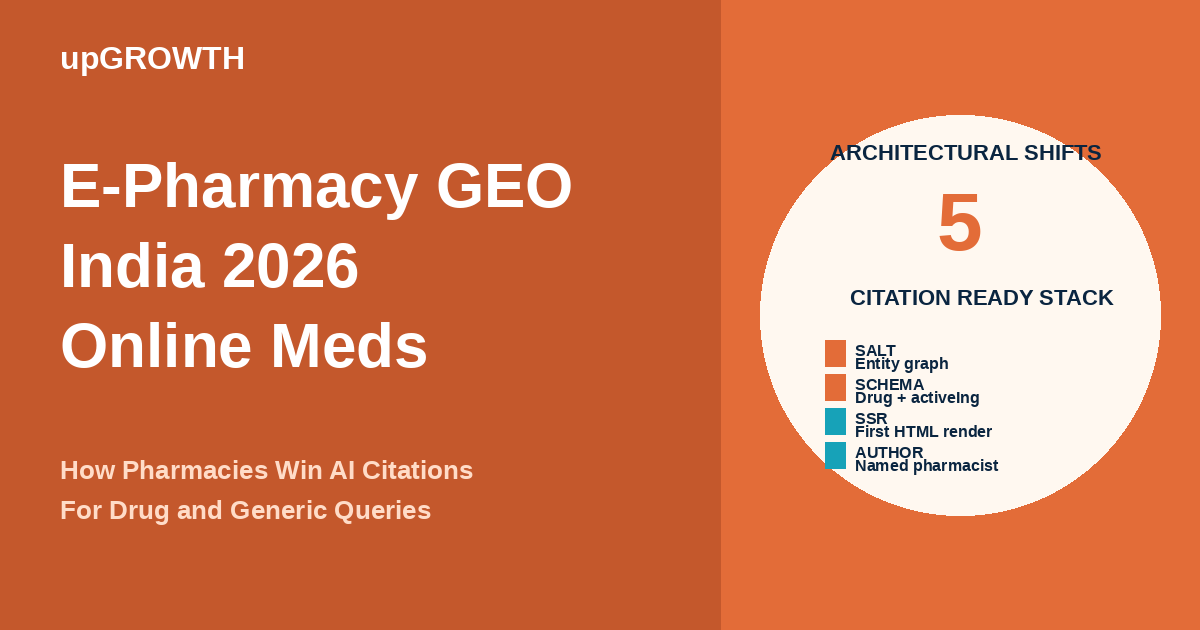
The Five Architectural Shifts That Make E-Pharmacy Platforms AI-Citable
These are non-negotiable if you want AI citation share for drug, generic and availability queries in India. You can sequence them over 9 to 14 months, but you cannot skip any.
Shift 1: Turn every medicine page into a drug information page, not just a SKU listing. The minimum content depth per drug page: salt composition with IUPAC name, therapy class, mechanism of action in 2 to 4 sentences, approved indications, contraindications, warnings and precautions, drug interactions with other commonly co-prescribed drugs, side effects grouped by frequency, storage instructions, pregnancy and lactation category, prescription status with Schedule tag, substitute products, price and MRP. Word count target per page: 1,400 to 2,400 words. This is a 10x content expansion from current Netmeds or PharmEasy drug page averages. It is not optional.
Shift 2: Build a salt-level entity graph with crawlable salt pages. Every drug page must link to its salt parent page. Salt pages must list all brand variants, all generic variants, all strength variants, all combination variants. Schema: use Drug schema with activeIngredient property pointing to a ChemicalSubstance or a custom Salt schema. Cross-link all SKUs to the salt parent. This is the single highest-leverage shift. It directly answers “generic of [brand]” and “[generic] vs [brand] price” queries which together represent 34% of drug search volume in India.
Shift 3: Server-side render all drug pages with full content in the initial HTML payload. This is an engineering decision, not a content decision. You likely have a React or Next.js frontend hydrating content client-side. The fix is to enable SSR or static generation for the top 20,000 drug pages. The engineering investment is real — 8 to 16 weeks depending on stack — but the GEO payoff is immediate. AI crawlers cite what they can read in first HTML.
Shift 4: Add named pharmacist authorship and review to every drug page. Minimum viable version: one medical writer with M.Pharm or PharmD credentials authors content, one registered pharmacist with state pharmacy council registration reviews it. Both names, credentials, registration numbers and state council appear at the bottom of every page with schema markup using Person schema linked to Drug schema via author and reviewedBy. This is an ASCI-safe, DCGI-safe, DPDP-safe approach that also happens to be exactly what AI engines reward.
Shift 5: Build therapy-area bundle pages with clinical depth. Separate from individual drug pages, build 80 to 150 therapy-area pages covering “Diabetes medications in India”, “Blood pressure tablets brands and prices”, “Cholesterol medication options”, “Thyroid tablet comparison”, “Asthma inhaler types”. Each page lists all drug classes, all major brands, all price bands, all prescription requirements with links to individual drug pages. Target word count 2,000 to 3,500 per page. These pages capture the “what are my options for [condition]” queries that drive new patient acquisition. 1mg has roughly 120 of these. PharmEasy has around 40. Netmeds has fewer than 20.
Execute these five shifts with real commitment and you will move from single-digit AI citation share to 18 to 28% citation share in your target therapy areas within 12 months. Execute three of the five and you will see marginal movement. Execute one or two and you will see nothing.
The Salt Entity Graph Most Indian E-Pharmacies Are Missing
This shift deserves its own section because it is where most e-pharmacy CTOs push back hardest.
We briefed a Mumbai e-pharmacy recently. 18,000 SKUs in their catalog. Roughly 4,200 unique active salts. When we asked how their content model handled salts, the answer was: “Salt is a field in the product table. It is a string, not an entity.” Every SKU had a salt name typed into a field. There was no salt page. No salt-to-SKU relationship. No way for a crawler — or an AI engine — to answer “what are all brands of Atorvastatin available on our platform”.
Here is what a proper salt entity graph looks like in practice. You create a Salt content type. Each salt has: IUPAC name, common name, therapy class, mechanism of action, clinical indications, pregnancy category, prescription requirement, regulatory status in India. Each SKU has a foreign key to one or more salts (many-to-many, because combinations exist). Each salt page lists all SKUs that contain it, grouped by brand, by strength, by form (tablet, capsule, syrup, injection), with price from each variant.
Schema markup: the salt page uses Drug schema with activeIngredient property. Each brand variant under it is Drug schema with isVariantOf pointing to the salt. Price, availability, prescription status are all schema-encoded. FAQ schema on the salt page covers the top 10 questions about that molecule.
Build this for the top 500 salts that cover 85% of prescription volume in India. That is roughly 500 salt pages and 500 therapy-area cross-links. Phase 1 build: 4 to 6 months. This single project moves you from 1 to 4% citation share in generic-substitution queries to 18 to 25% — if the salt pages are genuinely informative and not just aggregation listings.
The Pincode Availability Play Most E-Pharmacies Keep Fumbling
Drug availability by pincode is one of the highest-intent query patterns in Indian e-pharmacy. “Ozempic availability 400053” is a user who is 80% of the way to buying. Yet most Indian e-pharmacies render pincode availability client-side through an AJAX call after the user enters their pincode. That means the crawler sees no availability data in the initial HTML. The AI engine cannot cite you for “available in Mumbai” because it cannot read that you are.
1mg handles this differently. Their drug pages render default-city availability server-side for the top 20 metros and embed pincode-level availability in structured data for the major serviceable pincodes. When an AI crawler reads the page, it sees “Available in Mumbai, Delhi, Bangalore, Chennai, Hyderabad, Kolkata, Pune, Ahmedabad…” as first-render text. That shows up in AI answers for “is [drug] available in [city]” queries.
The fix for other e-pharmacies is a two-layer approach. Layer 1: render the top 25 metros as available/not-available in first HTML for each drug page. This is a server-side list, not a dynamic widget. Layer 2: for the top 800 serviceable pincodes (which cover roughly 72% of e-pharmacy order volume in India), generate pincode-level availability pages or structured data annotations at the drug-pincode intersection for the top 200 high-demand drugs.
This creates 200 drugs x 800 pincodes = 160,000 drug-pincode combinations. You do not build 160,000 static pages. You build structured data at the intersection and render crawler-visible availability lists on the drug page. Engineering effort: 6 to 10 weeks. GEO lift: roughly 40% of drug availability citations for your catalog start coming to you within 6 months.
The Operational Playbook for Indian E-Pharmacy GEO
This is the 6-phase execution sequence we use with e-pharmacy clients. Assume a mid-size platform with 12,000 to 25,000 SKUs, 20 to 60 serviceable cities, and a 20 to 60 person growth and tech team.
Phase 1: Regulatory and content baseline (Month 1-2). Audit current drug page structure, compliance with DCGI and Schedule H disclosure norms, ASCI alignment of health claims, DPDP posture for user prescription data and health data processing. Legal review by a pharma-compliant counsel. Build the ASCI and DPDP compliance crawlable statements that will sit in the footer and legal pages. Investment: INR 6-15L for counsel, audit and documentation.
Phase 2: Drug page template rebuild and salt graph foundation (Month 2-5). Build the new drug page template with full 1,400-2,400 word content depth, Drug schema, FAQ schema, named pharmacist authorship, server-side rendered availability. Build the Salt entity model in the CMS and database. Migrate the top 500 salts and top 3,000 SKU drug pages to the new template and salt graph. Investment: INR 22-50L in engineering, editorial and schema work.
Phase 3: Therapy-area bundle page rollout (Month 3-7). Build 80 to 150 therapy-area pages covering the highest-volume chronic disease and acute care categories. Each page at 2,000 to 3,500 words with clinical depth, pricing comparison, prescription requirement tagging, links to individual drug pages and salt pages. Investment: INR 14-32L in editorial, medical review and engineering.
Phase 4: Pincode availability surface and city pages (Month 4-9). Build server-side pincode availability rendering for top 25 metros on all drug pages. Build top 50 city pharmacy pages (“Online pharmacy in Pune”, “Medicine delivery in Coimbatore”) with local compliance, local pharmacist registration proof, local delivery ETA and serviceability data. Investment: INR 10-22L.
Phase 5: Health content and Q&A library (Month 5-10). Build a 200-400 article health content library covering drug safety, chronic disease management, prescription awareness, pregnancy and lactation drug safety, pediatric drug safety. Each article 1,200-2,200 words, reviewed by a named pharmacist or physician. Internal link from drug pages to relevant articles. This is the E-E-A-T authority layer AI engines use to rank drug pages. Investment: INR 18-40L.
Phase 6: Quarterly refresh, measurement and AI citation tracking (Month 6-12 and ongoing). Instrument AI crawler logs (OAI-SearchBot, PerplexityBot, ClaudeBot, Google-Extended, CCBot) at CDN or origin level. Set up monthly AI citation audits across 400-600 target queries. Refresh the top 200 drug pages quarterly with updated price bands, new substitute products and new FAQs. Retainer investment: INR 5-10L per month.
Total Year 1 investment for a mid-size Indian e-pharmacy with 20,000 SKUs and 40 cities: INR 60-90L upfront plus INR 5-8L per month retainer. Total Year 1 investment for a large e-pharmacy with 50,000+ SKUs and 100+ cities: INR 1.6-2.8Cr upfront plus INR 10-18L per month retainer.
What E-Pharmacy GEO Actually Costs in India
Most Indian e-pharmacies underbudget for this because they benchmark against SEO content costs. Drug content costs 3x to 5x what generic SEO content costs because every page needs clinical accuracy review by a registered pharmacist.
Editorial pricing for e-pharmacy GEO content. Drug pages with full depth: INR 8,000 to 18,000 per page for 1,400-2,400 words with pharmacist review, schema markup, clinical accuracy. Salt pages: INR 10,000 to 22,000 per page given the depth and cross-linking required. Therapy-area pages: INR 18,000 to 40,000 per page for 2,000-3,500 words covering 8 to 20 drugs each. Pincode city pages: INR 6,000 to 14,000 per page. Health content library articles: INR 7,000 to 15,000 per article.
Engineering pricing. Drug page template rebuild with SSR and new schema: INR 22-50L one-time depending on stack complexity. Salt entity model and database migration: INR 14-28L. Pincode availability rendering at scale: INR 8-16L. CMS customization to enable editorial workflow for pharmacist review: INR 10-22L.
Clinical and regulatory operations. You need a medical director (pharmacist or physician) to sign off on clinical content at INR 2.5-5L per month equivalent as a fractional or internal hire. Two to four medical writers and pharmacists with M.Pharm or PharmD credentials for content production at INR 14-28L per quarter in total compensation. Legal counsel for ongoing ASCI, DCGI and DPDP compliance review at INR 2-5L per month or quarterly retainer equivalent.
Agency retainer. Expect INR 5-10L per month for a mid-size e-pharmacy engagement covering strategy, measurement, AI citation audits, content brief development, schema and technical SEO governance, and quarterly refresh planning. Large e-pharmacies should expect INR 10-18L per month given catalog size and city coverage.
Add it up for a realistic scenario. Mid-size e-pharmacy. 20,000 SKUs with 3,000 high-priority drug pages. 500 salt pages. 120 therapy-area pages. 50 city pages. 300 health content articles. 40 cities. Clinical ops hired. Engineering rebuild. Year 1 total: INR 60-90L in one-time plus INR 60-96L in annualized retainer and clinical ops. Grand total Year 1: INR 1.2-1.8Cr.
That is expensive relative to traditional SEO. It is cheap relative to what a 4 to 6 percentage point swing in AI citation share is worth over a five-year horizon in the Indian e-pharmacy market, which will be INR 90,000 Cr plus by 2030 on current trajectory.
Common Mistakes Indian E-Pharmacies Keep Making With GEO
Mistake 1: Treating drug pages as SKU pages. The whole point of GEO for e-pharmacy is that the drug page is a clinical information artifact AI engines can cite. If your drug page is 300 words of marketing copy, an add-to-cart button and a “Customers also viewed” carousel, no AI engine will ever cite you, regardless of your pricing or delivery speed.
Mistake 2: Hiding prescription requirements. Some e-pharmacies have historically soft-pedaled Schedule H and H1 disclosure because they think it hurts conversion. In GEO, it hurts you twice: AI engines now refuse to cite pages that do not clearly indicate prescription requirements for controlled drugs, and regulatory exposure is increasing as CDSCO enforcement sharpens. Crawlable prescription status is a GEO and compliance win.
Mistake 3: Running content through a freelance marketplace without clinical review. We have seen e-pharmacies outsource drug content to Upwork writers with no pharmacy background, no clinical oversight and no registration number anywhere on the page. AI engines detect the pattern — generic phrasing, no author attribution, no credential claims, no review timestamp — and treat the content as low-authority. Costs you in citations and potentially in compliance if a claim gets audited.
Mistake 4: Skipping salt pages because “users search brand names”. Users search brand names on your app. They search salt questions on AI engines. The generic-substitution query pattern is roughly 34% of drug search volume on AI platforms. If you do not have salt pages, you cede that whole pattern to 1mg and Drugs.com.
Mistake 5: Under-investing in health content and Q&A. The health content library around drug pages is what establishes E-E-A-T. Without it, your drug pages read as commercial catalog entries. With 200-400 clinically reviewed articles, your drug pages read as part of an authoritative health information ecosystem. The math of citation ranking rewards the second.
Mistake 6: Treating DPDP compliance as a checkbox. DPDP Act 2023, Section 8 on notice and consent and Section 9 on children, matters enormously for e-pharmacy because you process sensitive personal data including prescriptions, health conditions and in some cases pediatric drug orders. Your privacy policy, consent language, data processing disclosures and DPO contact information need to be crawlable, specific and current. AI engines are increasingly sensitive to YMYL-grade compliance signals.
Mistake 7: Chasing retail margin wars instead of authority. Indian e-pharmacy has burned billions in discount wars. GEO is the opposite bet. It rewards authority, depth and clinical credibility over pricing aggression. The e-pharmacies that win 2026-2030 citation share will be the ones that stopped competing on “25% off” and started competing on “most trusted drug information in India”.
Pharmacy Brand
Overall Citation Share (%)
Availability Query Share (%)
Generic vs Brand Price Share (%)
Tata 1mg
47%
58%
71%
PharmEasy
18%
Not in source
Not in source
Unnamed Mumbai-headquartered e-pharmacy
4%
3%
1%
Healthcare Tech
GTM Strategy Teardown
Online Pharmacy: Scaling Digital Wellness
How hyper-local SEO and geo-targeted digital frameworks captured the booming Indian e-pharmacy market by building local trust at scale.
Hyper-Local Dominance
GMB Asset OptimizationDominating “pharmacy near me” searches by optimizing Google My Business for high Map Pack visibility across target cities.
Geo-Centric SEOCreating city-specific landing pages that rank for localized medical intent and delivery-speed keywords.
High-Intent Funnels
Bidding on Acute IntentFocusing Google Ads on search terms for specific medicines and diagnostic tests to capture immediate buyer intent.
Prescription Upload OptimizationFrictionless user journeys designed specifically to convert prescription uploads into successful orders.
Clinical Credibility
Verified Content (E-A-T)Developing medically reviewed content to build authority in the eyes of both users and Google’s YMYL algorithms.
Systematic Review CollectionLeveraging post-delivery triggers to gather high-trust patient reviews, crucial for healthcare conversion.
Loyalty & Refills
Chronic Refill TriggersAutomated reminders for patients on long-term medication to drive high Lifetime Value (LTV).
WhatsApp Refill LoopUsing low-friction WhatsApp workflows to manage repeat orders, minimizing churn in chronic care.
In the e-pharmacy space, reliability and proximity are the ultimate conversion drivers.
Nine Common Questions About E-Pharmacy GEO in India
Q: Do Indian e-pharmacies even operate legally under current regulation?
A: E-pharmacy operates in a regulatory grey zone in India. The Online Pharmacy Rules 2018 were drafted but not formally notified. Current operators function under state-level drug license provisions, Drug and Cosmetics Act 1940 and Pharmacy Act 1948 interpretations. The ground position is that e-pharmacies must have a valid drug license per state of operation, use registered pharmacists for dispensing verification and enforce prescription upload for Schedule H, H1 and X drugs. GEO content that transparently documents this compliance posture actually strengthens both regulatory and AI citation standing.
Q: How long before we see AI citation share improvements after starting GEO work?
A: Realistic timelines by query type: drug availability queries 8-14 weeks after SSR rollout and pincode rendering. Generic substitution queries 5-8 months after salt graph build. Side effects and dosage queries 6-10 months after content depth upgrade and pharmacist review implementation. Therapy-area bundle queries 6-9 months after bundle page rollout. Treat Year 1 as foundation build and Year 2 as compounding citation share gains. Results before Month 4 are not realistic.
Q: Can AI-generated content work for drug pages if we have a pharmacist review it?
A: Yes, with discipline. Generative drafting accelerates first-pass production of drug page content. What is non-negotiable: every page must be reviewed by a named registered pharmacist with state pharmacy council registration visible on the page. The review timestamp, reviewer name and credentials appear at page level. AI engines and human regulators both treat named-reviewer attribution as the authority signal. Fully anonymous generative content will hurt your citation share and your compliance posture.
Q: Do we need to build 500 salt pages before we see any citation lift?
A: No. Start with the top 100 salts that cover roughly 68% of India prescription volume — all statins, all antihypertensives, all oral antidiabetics, all PPIs, all analgesics, all antibiotics, the top 30 chronic disease salts. Launch those 100 in Phase 1. You will see generic-substitution citation lift within 4-7 months. Scale to 500 salts in Phase 2 over the next 6-9 months for the long tail.
Q: Our drug pages load fine in Chrome, so why would AI crawlers see them differently?
A: Chrome runs JavaScript. Most AI crawlers have limited or zero JavaScript rendering budgets. OAI-SearchBot, PerplexityBot, CCBot and ClaudeBot will either skip JS or render only a small fraction of pages with JS. Googlebot renders JS but with a second-wave delay. If your drug content hydrates client-side, AI crawlers often see an empty skeleton. SSR or static generation for drug pages is a hard requirement, not an optimization.
Q: What schema types should we prioritize on drug pages?
A: Minimum: Drug schema with activeIngredient, dosageForm, prescriptionStatus, manufacturer, Offer with price and availability. Add MedicalIndication, DrugStrength, DrugLegalStatus. Add FAQPage schema with 8-20 Q&A blocks per drug page. Add Person schema for author and reviewer linked to the Drug schema. Add BreadcrumbList schema with drug category and therapy area. Do not use generic Product schema only. Drug schema is what AI engines key on for medicine queries.
Q: How do we handle drug interactions content without getting flagged by ASCI or CDSCO?
A: Stick to sourced, evidence-based, non-promotional interaction content. Cite primary sources where appropriate — USFDA labeling, CDSCO approval data, established pharmacopeia references. Do not make comparative efficacy claims. Do not make promotional language around one brand over another. Frame content as clinical information, not marketing copy. Pharmacist review signature on every page. This posture keeps you safe under ASCI Code guidelines and CDSCO drug advertising regulation while remaining fully citable by AI engines.
Q: What about regional language drug queries in Hindi, Tamil, Telugu, Bengali, Marathi?
A: Regional language drug queries are growing at roughly 38% year over year on AI platforms. Most e-pharmacies have zero regional language drug pages. Phase 2 or Phase 3 opportunity: localize the top 200 drug pages and top 50 therapy-area pages into Hindi, with phased Tamil, Telugu, Bengali and Marathi rollout. Use a native medical translator, not machine translation with light review. Schema and content structure mirror the English page. Budget INR 12-25L for a Hindi localization of 200 drug pages and 50 therapy pages done properly.
Q: How do we measure AI-referred revenue separately from organic search revenue?
A: Four-layer measurement. One: UTM parameter hygiene on any AI-platform link (chatgpt.com, perplexity.ai, gemini.google.com). Two: last-click AI-referred revenue via standard analytics. Three: intent survey on first app install or first order (“how did you hear about us”) with “asked AI” as an option. Four: brand lift measurement across markets where you have launched AI citation work versus markets where you have not. Combine the four and you get 75-88% accurate attribution of AI-driven revenue within 6 months of measurement infrastructure being in place.
Your Next Move: Commission a 45-Day E-Pharmacy GEO Audit
If you are a growth leader, CTO or CEO at an Indian e-pharmacy and you are seeing Tata 1mg pull away from you in AI citation share, branded search volume or first-time app install intent surveys, the cost of waiting another quarter is structural. AI citation share compounds. Every quarter 1mg holds a 45%+ citation share in your top therapy areas, the gap between their brand authority and yours widens. Within 18 months that gap becomes a structural moat.
upGrowth runs paid 45-day GEO audits specifically for Indian e-pharmacies and regulated healthcare platforms. The audit includes: 480-600 query AI citation benchmark against 1mg, PharmEasy, Netmeds, Apollo Pharmacy and 24/7 Chemist across ChatGPT, Perplexity, Gemini and Google AI Overviews. Drug page architecture audit against Drug schema standards. Salt entity graph gap analysis. SSR audit on the top 500 drug URLs. DPDP, ASCI and CDSCO compliance read. Pincode availability rendering audit. Therapy-area content depth analysis. Named authorship and review posture audit. Output: a 45-60 page board-ready PDF, a prioritized engineering backlog, a 12-month GEO roadmap with INR investment tied to citation share projections.
Pricing is in the INR 4-8L range depending on catalog size and city footprint, and the audit can be converted into a full retainer engagement if you move forward. The ROI math is straightforward. If you are an e-pharmacy processing INR 800Cr annualized GMV and AI citation share improvement drives a 4 percentage point lift in organic new customer acquisition over 18 months, the audit pays for itself on customer acquisition cost savings alone within a single quarter of the retainer being live.
A high AI citation share is the leading indicator of success in a market where user journeys increasingly begin with AI assistants. It reflects a deep technical alignment with how AI models process and rank information, moving beyond traditional SEO to capture users at their initial point of research. For example, Tata 1mg’s 47% citation share is not an accident; it's the result of a superior information architecture that AI engines can easily parse. This allows them to intercept customers asking high-intent questions about drug availability and pricing before competitors even enter the consideration set. With 27% of first-time medicine research now starting on AI platforms, failing to secure citations means you are invisible to a massive, growing segment of your target audience. Discover the full technical playbook to build this foundational advantage.
The data reveals Tata 1mg's dominance is most pronounced in high-value query patterns that signal strong purchase intent. Their leadership is not uniform but concentrated where it matters most for conversions. The evidence is stark in specific query categories:
Availability Queries: For searches like "is [drug] available near me", Tata 1mg captures an overwhelming 58% of citations, directly tapping into users ready to buy.
Price Comparisons: In "[generic name] vs [brand name] price" searches, their citation share skyrockets to 71%, attracting price-sensitive consumers.
Regulatory Questions: Even for complex queries such as "can I buy [Schedule H drug] without prescription", they secure 39% of citations, building trust.
This citation monopoly directly correlates to declining branded search volumes and slower first-time app installs for every other player in the market, creating a tangible 'citation tax'. Learn how to reverse this trend by understanding the architectural choices behind these numbers.
The core mistake is treating the website as a simple e-commerce storefront rather than a structured, machine-readable database. Most e-pharmacies hide crucial information like stock availability and pricing behind user-side scripts or login walls, making it invisible to AI crawlers. Tata 1mg’s success stems from a different philosophy: exposing their drug database as crawlable, schema-rich content. Their platform renders stock status, price, and delivery estimates for specific pincodes on the server-side, presenting it as clean HTML that AI engines can easily index and reason over. This means for a query like “Is Atorvastatin 10mg available in 400053”, their system provides a direct, verifiable answer, while others offer a generic page. This foundational difference in architecture is the primary reason for their citation dominance. The full article details the five specific shifts required to replicate this structure.
The initial investment must focus on building the non-negotiable foundation: a machine-readable drug and generics database. This is not about superficial content marketing but deep architectural change. The first two phases are critical:
Phase 1: Catalog Schema & Entity Mapping. This involves structuring your entire drug catalog with proper schema for salts, generics, brands, substitutes, and medical uses. The goal is to create a clear, logical hierarchy that an AI can understand, connecting, for example, 'Crocin' to its salt 'Paracetamol'.
Phase 2: Server-Side Availability & Pricing Logic. The next step is to make your pincode-level stock and pricing data crawlable. Instead of loading this information on the user's browser, it must be rendered on the server so AI crawlers can see and cite it directly.
Executing these phases correctly establishes the technical bedrock. While full citation dominance takes time, you should expect to see initial traction on highly specific availability and substitution queries within six to nine months. Explore the complete 6-phase plan to see the full journey.
This rapid shift from traditional search bars to conversational AI interfaces fundamentally alters the customer acquisition model. The competitive landscape will no longer be defined just by app downloads or brand recall, but by algorithmic trust and data citability. Companies like Tata 1mg are building a moat by becoming the default, trusted source for AI-powered health queries. The long-term risk for e-pharmacies that fail to adapt is severe: they will face a growing 'citation tax,' effectively becoming invisible to a third of their potential new customers. As AI becomes more integrated into daily life, this percentage will only increase, potentially leading to market consolidation where only the most AI-native platforms survive and thrive. Understanding this trajectory is the first step toward future-proofing your strategy.
A crawlable salt-and-substitute database offers a fundamentally more defensible and scalable advantage than traditional content marketing for these specific queries. While blogging can attract informational traffic, a structured database directly answers high-intent transactional questions like "cheaper alternative to Ecosprin". This architectural approach is superior for several reasons:
Authority: It provides direct, factual data that AI models prefer, leading to higher citation rates (Tata 1mg gets 71% on price comparisons).
Scalability: Once built, the system works for your entire catalog, whereas content creation is a perpetual, manual effort.
Conversion: It captures users at the final stage of their decision-making process, leading to higher conversion rates.
When allocating resources, a product head should weigh the high upfront investment of database development against the compounding, long-term returns in high-margin sales and market share. The full analysis provides a framework for calculating this ROI.
This term describes a drug catalog architected not just for human users but for search engine and AI crawlers. It means every drug page is enriched with structured data (schema) that explicitly defines its properties. A schema-rich database for Tata 1mg allows an AI to understand that 'Telma' and a generic 'Telmisartan' are related by their active salt, what their price differences are, and where they are in stock. Competitors often present this information in ways that are difficult for machines to parse. This is why for "generic vs brand price" queries, 1mg’s citation share is a staggering 71%. This technical asset is the core reason for their lead, as it allows them to provide direct, authoritative answers that AI models are designed to seek and amplify. Our guide breaks down the exact schema types needed to build this.
This stark example proves that operational scale—including a large user base, wide pincode coverage, and fast delivery—has almost no correlation with AI citation performance. The 4% share demonstrates that you cannot solve an information architecture problem with logistical excellence. AI engines do not rank websites based on the number of delivery hubs or app users; they rank them based on the quality, structure, and accessibility of their data. That Mumbai-based company failed because its valuable drug availability data was not presented in a way that AI crawlers could index and trust. Tata 1mg, conversely, focused on making its data machine-readable, which is why it dominates. This case study is a critical lesson for executives: winning in the AI era requires a deep investment in your technical foundation, not just your operational footprint.
Platforms that fail in AI search are typically making several structural mistakes that undermine their authority, despite having the right products. The most common error is hiding critical data behind client-side JavaScript, which prevents AI crawlers from seeing real-time stock and pricing information. They are also guilty of not using specific schema markup for drugs, prescriptions, and pharmaceutical products, leaving the AI to guess the context of their content. Furthermore, many fail to build clear entity relationships, such as explicitly linking a branded drug to its generic salt composition on the page. This is why a well-resourced pharmacy can see its citation share for generic price comparisons fall to as low as 1%. These errors make their pages appear thin and unreliable to an AI, which prioritizes structured, verifiable data. The full report includes a technical audit checklist to identify and fix these issues.
Leadership must frame this not as a marketing expense but as a foundational investment in the company's future customer acquisition engine. The justification rests on the clear market trend: with 27% of new customer journeys already starting with AI, this channel is no longer experimental. The investment should be positioned as building a long-term, defensible moat that reduces reliance on paid advertising over time. Unlike a marketing campaign with transient effects, a well-architected drug database provides compounding returns as AI adoption grows. The business case should model the cost of inaction—the 'citation tax' paid to competitors like Tata 1mg in the form of lost market share and declining organic traffic. This is about securing your place in the primary discovery channel of the next decade. The article provides a detailed breakdown of costs versus expected returns.
These five query patterns represent the most urgent and practical needs of a user researching medicine online. AI platforms prioritize providing direct, factual answers to these needs to build user trust, especially in a Your Money or Your Life (YMYL) category like healthcare. When a user asks "where to buy Liraglutide in Bangalore", they need an immediate, location-specific answer, not a general article. By structuring its data to answer this, Tata 1mg aligns perfectly with the AI's goal. Queries about generic substitutes reflect a user's need for affordability and choice. The dominance of these patterns, accounting for 83% of relevant queries, shows that AI is being optimized to solve for accessibility, affordability, and clarity. E-pharmacies that structure their content around these core needs will be rewarded with citations. Uncover the other critical query patterns in the full analysis.
The future of drug discovery queries will shift from reactive text entry to proactive, context-aware assistance. AI will anticipate needs based on calendar events, health app data, or past purchase history, posing more complex questions on the user's behalf. For example, an AI might search for "refill options for Metformin available for 24-hour delivery to 400053 that accept PhonePe". To prepare, e-pharmacies must invest in deep entity architecture and API-driven data exposure. This means going beyond schema markup to build a system where every piece of data—drug attributes, stock levels, delivery ETAs, accepted payment methods—is a discrete, queryable entity. Platforms that build this highly structured, API-first foundation today will be the ones that can seamlessly integrate with the proactive AI assistants of tomorrow. The strategic roadmap in the article outlines how to build for this future.
Amol has helped catalyse business growth with his strategic & data-driven methodologies. With a decade of experience in the field of marketing, he has donned multiple hats, from channel optimization, data analytics and creative brand positioning to growth engineering and sales.

 Growth Strategy and Planning
 Inbound Growth
 Growth Hacking
 Fractional CMO
 Search Engine Optimization
 Paid and Performance Marketing
 Social Media Marketing
 Demand Generation
 AI-Driven Growth Strategy
 AI-Native Workflow Automation
 Generative Engine Optimization
 Grove — AI Growth Strategist

 AI Automation
 Framework
 Case Study
 Tools
Tools Growth Tools
 Decision Tree
 Compare
 Custom GPT's
 AI Answer Gap
 Offer
Offer Webstories
 Quizzes
 Blog
Blog AI-powered Apps
 Social Media Tools
 Agency Fit Score