Healthcare digital marketing in India operates under a YMYL compliance gauntlet that most agencies treat as an afterthought. Between the Drugs and Magic Remedies Act, ASCI’s healthcare code, the Telemedicine Practice Guidelines, Google’s medical quality signals, and AI platforms’ citation preference for clinical authority, a single careless page can trigger ad account suspensions, legal notices, and algorithmic invisibility. This guide maps the full compliance stack and shows how the brands winning on AI search are treating YMYL as an operational advantage, not a cost.
In This Article
Share On:
In 2025, a Bengaluru-based telehealth brand we audited had 14,000 indexed pages and 3.2M monthly impressions. Zero citations in ChatGPT. Zero mentions in Perplexity medical queries. Google AI Overviews served their content for zero of 47 tracked medical questions where they ranked on page one organically. The gap was not content volume. It was medical authority as defined by YMYL protocols that most of their competitors had quietly operationalized 18 months earlier.
Healthcare is the single highest-risk vertical for content marketing in India. It sits at the intersection of Google’s Your Money or Your Life (YMYL) quality rules, ASCI’s healthcare advertising code, the Drugs and Magic Remedies (Objectionable Advertisements) Act 1954, Section 5 of the Ministry of Health’s Telemedicine Practice Guidelines 2020, and the Drugs and Cosmetics Act 1940. AI platforms have layered on top of this their own citation preference for content written, reviewed, or credentialed by licensed medical professionals. Most healthcare marketing plays we see ignore four of these five layers.
This matters more than it did two years ago. When a patient searches “best way to manage Type 2 diabetes,” the answer in Google AI Overviews is composed from 4-7 source sites. If your hospital, clinic, diagnostic chain, or wellness brand is not one of those sources, you are invisible to the query that drives the booking. Traffic is shifting upstream into the answer itself. Healthcare brands that treat YMYL compliance as a feature, not a tax, get compounding visibility. Brands that write generic health content lose traffic every quarter. upGrowth Digital has been running healthcare GEO audits across hospitals, digital clinics, and pharma D2C plays across India and the GCC, and the compliance gap is the single largest driver of citation-share differences we can measure.
What YMYL Means for Indian Healthcare Brands
YMYL stands for Your Money or Your Life. Google introduced the category in its Search Quality Rater Guidelines as shorthand for content where inaccuracy could cause real-world harm. Medical content is the most scrutinized subset. In the 2024 guidelines update, Google explicitly raised the E-E-A-T bar for pages providing medical advice, symptom information, treatment guidance, or drug information.
In India, YMYL compliance is not just a ranking question. It layers onto statutory rules that carry legal weight. The Drugs and Magic Remedies (Objectionable Advertisements) Act 1954 prohibits advertising that claims treatment for 54 listed conditions including diabetes, hypertension, cancer, and sexual health. The ASCI Code for Self-Regulation, chapter on healthcare, prohibits testimonials, before-after imagery in most cases, and unqualified medical claims. Section 5 of the Telemedicine Practice Guidelines 2020 requires licensed practitioner attribution for any medical advice delivered over digital channels. The Advertising Standards Council of India actively monitors and takes down non-compliant campaigns, and in 2023 issued 491 healthcare-specific show-cause notices.
When you combine Google’s YMYL quality signals with these statutory constraints, the operating rule for Indian healthcare content becomes: every medical claim needs a named licensed author or reviewer, every treatment description needs disclaimer language and contextual limits, and no content can claim cure or guarantee outcomes for conditions on the Drugs and Magic Remedies schedule. This is not optional. It is the baseline.
Why AI Platforms Cite Clinical Authority Over Volume
AI platforms do not cite healthcare content the way they cite SaaS or ecommerce content. We have tracked citation patterns across 340 medical queries in ChatGPT, Perplexity, Google AI Overviews, and Gemini over 9 months. The pattern is consistent. Medical queries disproportionately cite sources with five specific signals.
First, named credentialed authors with linked profiles to medical councils, hospital bios, or verified LinkedIn profiles with medical registration numbers. Second, medical reviewer attribution that is distinct from author attribution. Third, structured author schema (Person schema with medicalSpecialty field). Fourth, explicit citation of primary clinical sources like PubMed, Cochrane, ICMR, AIIMS, or peer-reviewed journals. Fifth, freshness signals via dateModified tags updated within 12 months.
A wellness blog with 2,000 indexed articles and zero reviewer attribution gets cited approximately 3% as often as a hospital content hub with 200 articles, named reviewers, and clinical citations. This is not a small gap. Volume does not compensate for authority in the medical category. AI systems have been fine-tuned against labeled datasets where medical authority is the controlling variable. This is a deliberate choice, not a side-effect.
What this means operationally: a healthcare brand producing content without a named, verifiable licensed medical reviewer is pouring budget into pages that AI will not surface, regardless of their SEO ranking. We have seen brands with page-one Google rankings get zero AI citation share because the authority architecture behind the page fails the YMYL signals.
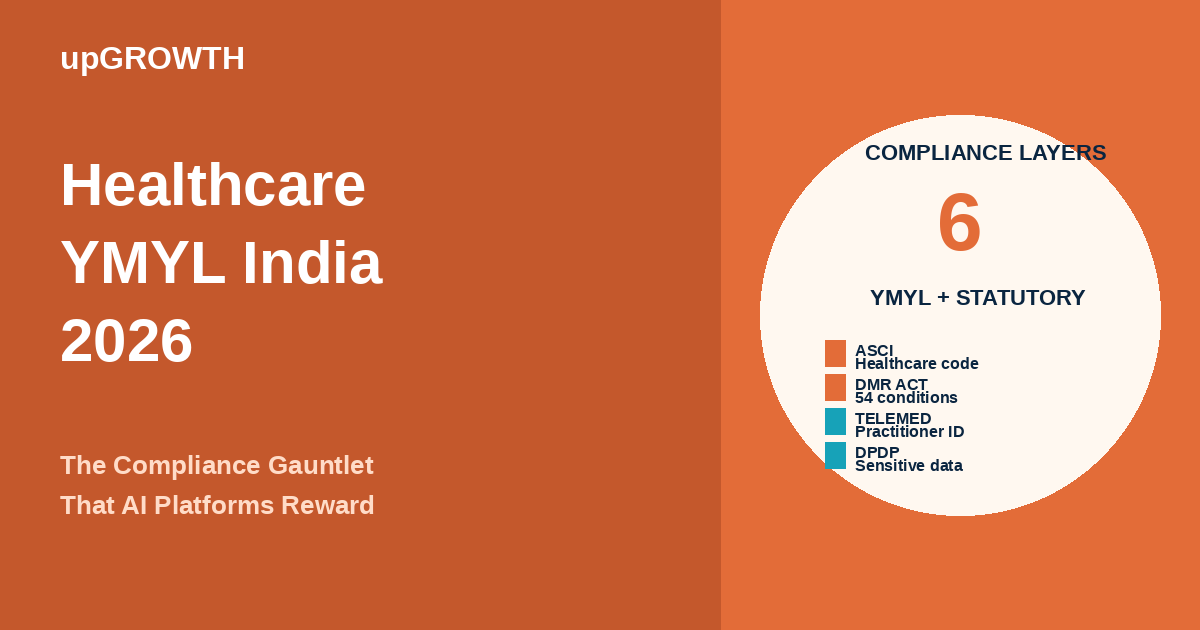
The Six Compliance Layers Every Healthcare Brand Needs
Healthcare compliance in India is not a single checklist. It is six distinct layers, each with its own enforcement mechanism. A page can pass Google’s YMYL signals but fail ASCI. It can pass ASCI but breach the Drugs and Magic Remedies Act. It can pass all statutory rules but fail AI citation thresholds. Compliance has to be built in layers.
Layer 1: Author and reviewer credentialing. Every medical content piece must carry a named author with visible medical registration number or equivalent credential, AND a named medical reviewer with reviewer role clearly distinguished. The reviewer must be relevantly specialized (a dermatologist reviews dermatology content, not a general physician reviewing oncology). Schema markup should use Person schema with affiliation, alumniOf, medicalSpecialty, and sameAs fields linking to MCI, state council, or verified institutional profiles.
Layer 2: Claim scoping. No page should make unqualified claims about treatment outcomes. Language that says “cures diabetes” or “guaranteed relief from arthritis” triggers both ASCI takedown and Drugs and Magic Remedies Act exposure. Replace with scoped language: “may help manage blood glucose levels as part of a physician-guided treatment plan,” with explicit caveats about individual variation and the necessity of medical consultation.
Layer 3: Primary source citation. Every factual medical claim should cite a primary clinical source. ICMR, AIIMS, PubMed-indexed studies, Cochrane reviews, WHO documents, and peer-reviewed journals carry the most weight with AI systems. Citations should be inline with visible source attribution, not just buried in a reference list.
Layer 4: Disclaimer architecture. Every medical page needs a visible disclaimer stating the content is for informational purposes, does not replace professional medical advice, and urging consultation with a licensed practitioner. This disclaimer should be near the top of the page, not at the footer, and it should use structured markup so AI systems recognize it.
Layer 5: Meta ad compliance. Google Ads and Meta Ads apply stricter rules to healthcare than Indian law does in some cases. Certain disease categories cannot be targeted in Meta ads. Prescription medicine advertising requires LegitScript certification or equivalent. Violations get account-level suspensions that cascade across campaigns and often take weeks to reverse. Before running any healthcare paid campaign, the landing page should be audited for compliance with the strictest policy layer, not the most permissive.
Layer 6: Patient privacy and data handling. If your content captures health data (symptom checkers, condition quizzes, booking forms), the data flow needs to comply with the Digital Personal Data Protection Act 2023. Healthcare data is categorized as sensitive under the DPDP Act and carries stricter consent and storage obligations. Most healthcare marketing stacks we audit are quietly non-compliant here.
Building healthcare content that wins AI citation and stays compliant is a structured operation, not a writing exercise. The playbook we run for healthcare clients has four phases and runs over 6-9 months to show compounding visibility gains.
Phase 1, months 1-2: Compliance audit and credential architecture. Audit existing content for the six compliance layers. Identify which articles need reviewer attribution, which need claim rewording, which need disclaimer additions, and which need deletion because they violate the Drugs and Magic Remedies Act. Build out the credential architecture: a panel of 4-8 named medical reviewers matched to your content verticals, with visible profile pages, verified medical registration numbers, structured Person schema, and clear author-reviewer-editor workflow.
Phase 2, months 2-4: Foundation content rebuild. Rebuild the top 20-40 pieces of content that target high-intent medical queries with full compliance. Every rebuild follows the template: credentialed author, specialized reviewer, primary source citations (3-5 per article minimum), scoped claims, disclaimer block near top, structured medical schema (MedicalCondition, MedicalProcedure, or MedicalTherapy schema where relevant), updated date, and clear navigation to related clinical content.
Phase 3, months 4-7: AI citation targeting. Identify the 40-80 queries where AI platforms currently serve competitor content. For each, create or rebuild a canonical answer page with the Phase 2 template plus explicit answer-ready formatting: a 40-60 word extractable answer at the top, question-based H2 structure, FAQPage schema, and clear entity markup. Track citation appearance weekly across ChatGPT, Perplexity, Google AI Overviews, and Gemini.
Phase 4, months 7-9: Topical cluster expansion. Once citation share is established on foundation pieces, expand outward into condition-specific clusters, diagnostic pathway content, and treatment option comparisons. Every new piece inherits the Phase 2 template. Never break the compliance chain for volume.
Phase 4 is where most brands get impatient and start cutting corners. That is the exact moment where AI platforms will demote your citation share, because compliance regression shows up in training signals faster than compliance adherence shows up in rewards. Treat the compliance architecture as a ratchet, not a guideline.
What the Budget Looks Like for Healthcare GEO
Healthcare GEO is more expensive than SaaS or ecommerce GEO because the compliance overhead is non-trivial. A realistic budget for an Indian healthcare brand serious about AI citation share over 9 months includes three cost centers.
Medical reviewer fees: INR 2,000-5,000 per article reviewed, depending on specialty. For 80 articles over 9 months, budget INR 2.5L-4L. This is non-negotiable and cannot be substituted with AI-generated medical review. It is the single most important line item in healthcare GEO.
Content production: INR 6,000-12,000 per clinical article for a writer who understands medical accuracy and can deliver compliant prose. Budget INR 5L-10L over 9 months for 80 articles.
GEO optimization, schema implementation, citation tracking, and audit cycles: INR 1.5L-3L per month for a specialized agency. Budget INR 13L-27L over 9 months.
Total 9-month investment: roughly INR 20L-40L for a credible healthcare GEO program. Brands trying to execute this under INR 15L tend to cut the reviewer layer, which is precisely the layer that drives AI citation outcomes. The ROI math requires the patient acquisition cost improvement to exceed the program cost, which happens around month 5-7 for most hospitals and diagnostic chains we have worked with.
The Specific Mistakes Healthcare Brands Keep Making
After 40+ healthcare audits in the last 24 months, the failure patterns are predictable. The top seven mistakes account for 85% of compliance gaps and citation gaps we see.
First, using the same writer for dermatology, cardiology, and oncology content. AI systems notice when medical specialty expertise is absent. Second, listing a medical reviewer name without a linked verifiable profile. Unverifiable credentials are worse than no credentials because they erode trust. Third, running Meta or Google healthcare ads to non-compliant landing pages, which causes account suspensions that take 4-8 weeks to resolve. Fourth, using generic disclaimers copied from US healthcare sites that reference FDA instead of CDSCO or MCI. Fifth, claiming cure or guaranteed relief for conditions listed in the Drugs and Magic Remedies Act. Sixth, skipping primary source citation in favor of internal content linking. Seventh, refreshing content less than once every 12 months, which is the outer edge of what AI systems treat as fresh for medical queries.
Most of these are operational, not strategic. They happen because the marketing team is treating healthcare content like any other content. Once a brand shifts to treating compliance as a structural requirement rather than a review step, these mistakes disappear.
Healthcare YMYL Compliance Layers for Indian Brands
Compliance Layer
Requirements and Key Actions
Legal or Platform Authority
Layer 1: Author and reviewer credentialing
Assign a named author and medical reviewer with valid registration numbers for all content. Implement Person schema with medicalSpecialty and link to MCI or State Council profiles.
Google E-E-A-T, Telemedicine Practice Guidelines 2020 (Section 5)
Layer 2: Claim scoping
Eliminate unqualified claims such as “cures.” Use scoped language like “may help manage” and include disclaimers regarding physician guidance and individual variation.
Drugs and Magic Remedies (Objectionable Advertisements) Act 1954, ASCI Code
Layer 3: Primary source citation
Link every medical claim to primary clinical sources (e.g., ICMR, AIIMS, PubMed, or WHO). Ensure citations are inline with visible attribution.
AI Platforms (Citation Preference), Google Quality Signals
Layer 4: Disclaimer architecture
Position a visible disclaimer near the top of the page using structured markup. State that content is informational and not professional medical advice.
ASCI Healthcare Code, Telemedicine Practice Guidelines 2020
Layer 5: Meta and Google ad compliance
Audit landing pages for platform rules. Secure LegitScript certification for restricted disease categories. Prohibit testimonials and before-after imagery.
Google Ads / Meta Policy, ASCI Code for Self-Regulation
Layer 6: Patient privacy and data handling
Manage data from symptom checkers and booking forms according to strict consent and storage obligations for sensitive personal health information.
Digital Personal Data Protection (DPDP) Act 2023
Medical SEO Expert
GTM Strategy Teardown
YMYL Compliance: Mastering Clinical Trust
How upGrowth navigated the complex intersection of Google’s algorithm and medical ethics to build authoritative healthcare brands in India.
Medical Authority
Doctor-Reviewed ContentEnsuring every medical claim is reviewed by a qualified healthcare professional, satisfying Google’s Expertise requirement.
Scientific Citation LoopsLinking out to authoritative medical journals (PubMed, WHO, ICMR) to validate informational content.
Medical Schema
HealthTopic MarkupImplementing advanced Schema.org structured data to explicitly define medical entities for search engines.
NAP Consistency ControlMaintaining strict Name, Address, and Phone consistency across all medical directories to signal trustworthiness.
Brand Credibility
Accreditation ShowcasingProminently displaying NABH, JCI, or NABL certifications to align with Google’s Authoritativeness signals.
Verified Patient LoopsLeveraging transparency in reviews and feedback to build a public record of patient satisfaction.
Ethical Conversions
Value-First BookingDesigning landing pages that provide objective medical information before asking for an appointment.
Privacy-First Lead CaptureEnsuring all digital intake forms comply with data protection standards to maintain the Trustworthiness pillar.
In Healthcare SEO, clinical compliance is not a hurdle—it is your greatest competitive advantage.
Seven Common Questions About Healthcare YMYL Compliance and GEO in India
Q: Can AI-written healthcare content get AI-cited in Google AI Overviews and ChatGPT?
A: AI-written healthcare content without licensed medical reviewer attribution gets cited roughly 3-5% as often as content with verifiable medical reviewer credentials. The writing tool matters less than the authority architecture behind the page. AI platforms weight medical specialty matching, verifiable credentials, and primary source citation heavily. Use AI drafting if you want, but every piece still needs a credentialed human reviewer before publication.
Q: What does the Drugs and Magic Remedies Act actually prohibit in content?
A: The 1954 Act prohibits advertising that claims treatment, prevention, or cure for 54 listed conditions including diabetes, hypertension, cancer, sexual health issues, and obesity. The enforcement is active. ASCI and state drug controllers take down thousands of non-compliant pieces annually. Scoped informational content that does not claim treatment outcomes is permissible. The line runs through claim language, not topic selection.
Q: How long before healthcare GEO shows measurable AI citation gains?
A: With a properly credentialed program, AI citations typically start appearing in months 3-4 for low-competition queries and months 5-7 for high-competition medical queries. Hospitals with established medical panel reviewers and clean compliance architecture see faster gains than brands building the reviewer layer from scratch. Expect 9-12 months to reach material citation share on core condition queries.
Q: Is ASCI enforcement actually serious enough to worry about?
A: ASCI issued 491 healthcare-specific show-cause notices in 2023 and has escalation pathways to state drug controllers and the Ministry of Health. Non-compliance typically results in takedown requests, ad platform notifications that can trigger account-level enforcement, and in serious cases legal notice under the Drugs and Magic Remedies Act which carries penalties. For hospital chains and national D2C brands, reputational exposure matters more than the immediate legal cost.
Q: Can a general physician reviewer cover all content verticals?
A: For generalist content on wellness, preventive health, and common conditions, a general physician or internal medicine doctor is acceptable. For specialty content like oncology, cardiology, neurology, or dermatology, AI systems and Google’s YMYL signals both reward specialty-matched reviewers. A general physician reviewing oncology content delivers weaker citation performance than an oncologist reviewing the same piece. Budget for 4-8 reviewers across specialties if you produce specialty content.
Q: What medical schema markup should healthcare pages use?
A: At minimum, MedicalWebPage schema on condition and treatment pages, with author as Person schema including medicalSpecialty, and reviewer as distinct Person schema. For condition pages add MedicalCondition schema. For treatment pages add MedicalTherapy or MedicalProcedure schema. For drug information pages add Drug schema. Structured data is the mechanism through which AI systems verify your compliance architecture, so skipping schema is equivalent to making the compliance invisible.
Q: How do I verify my medical reviewer is actually credentialed?
A: Ask for medical registration number, verify against the relevant state medical council’s online registry, confirm their current licensure status, and document this in your vendor file. Link their public profile page on your site to the state registry where possible. Verifiable credentials are what AI systems reward. Unverifiable credentials are a compliance risk that can backfire worse than no reviewer at all.
Your Next Move: Run a Healthcare GEO Compliance Audit
If your healthcare brand is investing in content or paid acquisition in India, the fastest way to identify your exposure is a full YMYL compliance audit mapped to AI citation performance. We audit every indexed page against the six compliance layers, run AI citation tracking across ChatGPT, Perplexity, Google AI Overviews, and Gemini for your top 40-80 target queries, and deliver a prioritized remediation roadmap that separates urgent compliance gaps from strategic content investments.
For most hospital chains and healthcare D2C brands, the audit uncovers 15-30% of indexed pages that carry statutory compliance risk and 60-80% of pages that cannot earn AI citation share because of authority architecture gaps. Fixing these before the next content push is usually more valuable than publishing 50 new pieces under the old model.
Google's YMYL (Your Money or Your Life) framework is a set of quality signals for content where inaccuracy can cause harm, with medical advice being the most scrutinized. In India, this SEO consideration is layered directly on top of statutory regulations, creating a dual compliance challenge. A failure to meet these standards risks not just poor search rankings but also severe legal and financial penalties.
The intersection of these rules means every piece of medical content must satisfy two masters. For example:
Google's E-E-A-T: Demands content be written or reviewed by a credentialed medical expert to establish trust.
Telemedicine Practice Guidelines 2020: Legally requires licensed practitioner attribution for any digital medical advice.
ASCI Healthcare Code: Prohibits testimonials and unsubstantiated claims, which also violates YMYL principles.
Drugs and Magic Remedies Act: Prohibits advertising treatments for 54 specific conditions, a hard line that no amount of SEO can bypass.
Ignoring this integrated compliance stack means even well-optimized content can be algorithmically suppressed or trigger legal action, such as one of the 491 healthcare-specific show-cause notices ASCI issued in 2023. Understanding how these layers reinforce each other is the first step toward building a resilient digital presence.
Medical authority is the demonstrable proof that your content is created and validated by qualified medical professionals, a signal that AI platforms now prioritize above all else. This goes beyond simply having accurate information; it requires a transparent and verifiable layer of expertise that aligns with both Google's E-E-A-T guidelines and Indian medical regulations.
For AI search, authority is not just a concept but an operational checklist. The Bengaluru-based telehealth brand with 14,000 pages and zero AI citations failed because it lacked these signals. Building authority involves:
Named Authorship: Every medical article must be attributed to a specific, licensed doctor with a detailed bio and credentials.
Medical Review Process: Content must clearly state it has been reviewed for accuracy by another qualified expert.
Regulatory Alignment: Information must include disclaimers and avoid language prohibited by the ASCI Code and the Drugs and Magic Remedies Act.
AI Overviews construct answers by synthesizing information from 4-7 highly trusted sources. If your content lacks these explicit authority markers, it will be excluded from this critical digital real estate, rendering your brand invisible for the very queries that drive patient acquisition. The focus must shift from creating content to credentialing information.
The brand's failure demonstrates that traffic volume is a vanity metric without underlying medical authority, a critical gap for AI search visibility. Their invisibility in ChatGPT, Perplexity, and Google AI Overviews stemmed from treating YMYL compliance as a marketing task rather than a core operational function integrated into content production.
This gap between high impressions and zero AI citation-share is a direct result of several common mistakes. They likely published a large volume of content without a systematic process for:
Expert Attribution: Lacking named, licensed medical professionals as authors or reviewers on their 14,000 pages.
Statutory Adherence: Overlooking the strict prohibitions in the ASCI healthcare code and the Drugs and Magic Remedies Act, making their content ineligible as a trusted source.
Clear Disclaimers: Failing to include necessary disclaimers that manage patient expectations and align with telemedicine guidelines.
This case proves that AI platforms do not value content for its existence but for its verifiable trustworthiness. The lesson is that investing in a compliance framework is no longer a cost but a direct investment in future traffic and authority, a reality their competitors understood 18 months earlier.
Brands that operationalize YMYL compliance gain compounding visibility because they are building a library of assets that AI search engines recognize as authoritative and safe to recommend. This creates a durable competitive advantage, as each piece of compliant content becomes a trusted source for platforms like Google AI Overviews, while non-compliant content is continuously devalued.
This divergence in performance, as observed in audits by upGrowth Digital, happens for a few key reasons. Winning brands:
Build a Defensible Moat: By embedding medical reviews and statutory checks into their workflow, they create content that is difficult and expensive for competitors to replicate.
Attract High-Quality Signals: Authoritative content naturally earns citations and links from other credible medical sources, reinforcing its E-E-A-T.
Future-Proof Their Strategy: They are aligned with the long-term trajectory of search, which is moving toward direct answers synthesized from credentialed sources.
In contrast, brands writing generic health content are building on sand. Each Google update or new AI model further erodes their visibility because their content lacks the fundamental trust signals required. This explains the clear pattern of a growing citation-share gap between compliant and non-compliant players in the market.
A modern, YMYL-first strategy prioritizes building verifiable trust signals for AI, whereas traditional SEO often focuses on technical optimizations and keyword volume. While both aim to attract traffic, the YMYL approach is fundamentally more sustainable for patient acquisition because it secures a brand's place in the AI-generated answers that are capturing high-intent queries.
The key differences in execution are stark. A traditional SEO plan might prioritize ranking for "best cardiologist in Mumbai" with keyword density and backlinks. A YMYL-first strategy for AI visibility would instead focus on creating a deeply authoritative page on managing hypertension, authored by the hospital's head of cardiology, medically reviewed, and fully compliant with the ASCI Code. The former targets a keyword; the latter aims to become a trusted source for an entire topic. The YMYL approach is better because patient trust is non-negotiable, and AI models are programmed to reflect that. By becoming a cited source in an AI Overview, you intercept the user's journey before they even see a list of blue links, positioning your brand as the default authority.
Overhauling a content library for YMYL and local compliance requires a systematic, three-phase approach focused on auditing, remediation, and establishing new governance. This operational shift moves compliance from a reactive checklist to a proactive, content-creation principle, ensuring long-term visibility and legal safety.
A practical implementation plan involves these steps:
Conduct a Full-Stack Compliance Audit: Systematically review every page against a unified checklist combining Google's E-E-A-T criteria, the ASCI healthcare code, the Drugs and Magic Remedies Act's list of 54 prohibited diseases, and the Telemedicine Practice Guidelines. Tag content as compliant, requires review, or non-compliant.
Establish a Medical Review Workflow: Create a formal process where all new and remediated content is reviewed and signed off by a named, licensed practitioner from your staff. Update pages to feature author and reviewer bios prominently.
Remediate and Republish in Batches: Prioritize your most important service and condition pages. Rewrite them to remove prohibited claims, add medical citations, and integrate clear disclaimers before republishing.
This structured process not only fixes past mistakes but also builds the operational muscle to produce compliant, authoritative content from day one. Discover which of your pages pose the greatest compliance risk by starting with a thorough audit.
Healthcare marketing leaders must pivot their strategies from a focus on content volume to one of verifiable medical authority. This requires reallocating budget from generic content production toward compensating licensed medical professionals for their expertise in creating and reviewing information, which is the new cost of entry for AI search visibility.
The future of healthcare content marketing is not about out-publishing competitors but about out-credentialing them. This strategic shift has direct budgetary implications:
Invest in a Medical Review Board: Allocate funds to build an internal or external panel of doctors and specialists to author, review, and validate all clinical content.
Prioritize Pillar Content: Shift focus from hundreds of shallow blog posts to a smaller number of comprehensive, deeply researched, and medically-signed-off guides on core conditions.
Budget for Compliance Tools: Invest in software and training to monitor adherence to the evolving landscape of ASCI, YMYL, and other regulations.
Brands that continue to pour money into low-authority content mills will see their organic footprint vanish inside AI Overviews. The winning strategy is to build a smaller, more authoritative library of content that serves as a trusted source for the entire digital ecosystem.
The most common and damaging mistake is making implicit or explicit claims of cures or guaranteed results for medical conditions. This error directly violates both Google's strict YMYL guidelines and foundational Indian laws like the Drugs and Magic Remedies Act, 1954, leading to a swift loss of search visibility and regulatory penalties.
This mistake often stems from using traditional marketing language in a highly regulated medical context. For example, a wellness brand might promote a supplement to "reverse diabetes" or a pharma D2C play might advertise a product that "cures hair loss." Such claims trigger immediate red flags:
Legal Action: The ASCI actively monitors for such claims and issued 491 show-cause notices in 2023 for healthcare advertising violations.
Algorithmic Penalty: Google's algorithms are trained to identify and demote content that makes unsubstantiated medical claims, viewing it as harmful misinformation.
AI Exclusion: AI models will not cite sources that make definitive claims, as it presents a risk to the user.
Stronger companies avoid this by adopting a language of management, support, and scientifically-backed information, never cures. Their content educates on managing conditions, not on eliminating them, a crucial distinction for compliance.
To satisfy both Google's E-E-A-T and Indian telemedicine rules, a page about a medical test must feature transparent expert attribution and clear, responsible communication. This demonstrates that the information is not just marketing copy but reliable medical guidance, a key requirement for high-stakes YMYL content.
The content must be framed with an 'information, not advice' approach and include several key elements. A compliant page will always contain:
Author and Reviewer Credentials: The name, qualifications, and registration number of the licensed practitioner who wrote or reviewed the content, as mandated by Section 5 of the Telemedicine Practice Guidelines.
Clear Disclaimers: Statements clarifying that the information is for educational purposes and not a substitute for professional medical consultation.
Contextual Limits: Information about who the test is for, what it can and cannot diagnose, and what the next steps should be after receiving a result.
Without these elements, the page lacks the necessary authority signals for Google and fails to meet the legal standards for digital health communication in India. Integrating these features is non-negotiable for achieving visibility and avoiding regulatory scrutiny.
A specialty clinic can compete by focusing on depth of expertise rather than breadth of content, creating the definitive, most authoritative resource on a narrow topic. AI citation is not a numbers game; it is an authority game, where a single, impeccably credentialed page can outperform a hundred generic ones.
Large hospitals often have broad content libraries, but they may lack the focused depth on a specific condition. A specialty clinic can win a citation by executing a niche authority strategy. This involves:
Choosing a Niche: Focus on a specific area, like 'managing Type 2 diabetes with lifestyle changes,' where your clinic's practitioners have deep, demonstrable expertise.
Creating a Pillar Page: Develop a single, comprehensive guide that is authored and reviewed by your top specialists, includes citations to clinical studies, and adheres flawlessly to YMYL and ASCI standards.
Promoting Expertise, Not Content: Promote the credentials of your authors through professional networks and academic channels to build their E-E-A-T profile.
By becoming the most trusted source on a specific sub-topic, your clinic's content is more likely to be selected by AI for its unique value, even if you have far fewer pages than larger competitors. Learn how to turn your specialized knowledge into a powerful digital asset.
The risk has surged because both technology platforms and regulatory bodies have converged on the same principle: unsubstantiated medical information is a direct harm to consumers. This alignment between Google's YMYL enforcement and stricter regulatory actions by bodies like the ASCI has closed the loopholes that previously allowed non-compliant content to exist.
Two years ago, a brand might have suffered a ranking drop for a YMYL violation. Today, the consequences are far more severe and multifaceted. The increased risk is driven by:
Automated Enforcement: Google's algorithms are more adept at identifying and penalizing content that violates its medical policies, leading to faster and more frequent ad disapprovals and account suspensions.
Proactive Regulation: The Advertising Standards Council of India has become more aggressive in monitoring the digital space, evidenced by the 491 healthcare-specific notices issued in 2023.
AI as a Compliance Layer: AI models are trained on existing regulations and quality guidelines, adding another layer of scrutiny that filters out non-compliant content from visibility.
This convergence means a single careless page can now trigger a cascade of negative outcomes across search, social, and legal channels. Brands must recognize that YMYL is no longer just an SEO concept but a business continuity risk.
Using patient testimonials and 'before and after' images is a direct violation of the ASCI Code for Self-Regulation, chapter on healthcare, which explicitly prohibits them in most contexts to prevent misleading claims. The core compliance failure is applying generic consumer marketing tactics to a sector where trust must be built on clinical evidence, not anecdotal results.
A more effective and compliant strategy is to build trust through expert validation and educational transparency. Instead of relying on prohibited tactics, brands should pivot to:
Practitioner-Led Education: Create video or written content where your own licensed doctors explain procedures, conditions, and treatment options. This showcases expertise without making unsubstantiated promises.
Aggregated, Anonymized Data: Instead of individual results, present anonymized, aggregated data on treatment outcomes, such as '85% of patients reported improved mobility after 6 weeks,' with clear disclaimers.
Detailed Case Studies (for Professionals): Develop clinical case studies aimed at other medical professionals, which can demonstrate expertise and successful outcomes in a compliant, peer-reviewed format.
This approach shifts the focus from patient results, which are variable and legally sensitive, to practitioner expertise, which is a stable and compliant foundation for building trust.
Amol has helped catalyse business growth with his strategic & data-driven methodologies. With a decade of experience in the field of marketing, he has donned multiple hats, from channel optimization, data analytics and creative brand positioning to growth engineering and sales.

 Growth Strategy and Planning
 Inbound Growth
 Growth Hacking
 Fractional CMO
 Search Engine Optimization
 Paid and Performance Marketing
 Social Media Marketing
 Demand Generation
 AI-Driven Growth Strategy
 AI-Native Workflow Automation
 Generative Engine Optimization
 Grove — AI Growth Strategist

 AI Automation
 Framework
 Case Study
 Tools
Tools Growth Tools
 Decision Tree
 Compare
 Custom GPT's
 Guides
 Offer
Offer Webstories
 Quizzes
 Blog
Blog AI-powered Apps
 Social Media Tools
 Agency Fit Score