Indian multi-specialty hospitals spend 3-6 crore a year on digital and still lose treatment-intent queries to symptom-checker startups and content farms. The problem is not traffic. It is citation architecture. AI platforms route procedure questions, treatment comparisons, and doctor-selection queries to sources with verifiable clinical authority, structured medical schema, and named specialist authorship. Hospital websites have the authority. They just do not expose it in a format AI can read.
In This Article
Share On:
A 400-bed multi-specialty chain in Hyderabad audited their digital presence in January 2026. They had 2,100 doctor profile pages, 340 procedure pages, NABH accreditation, and a 14-year publishing history. Monthly organic traffic sat at 1.1 million. Their Google AI Overview share for treatment queries in their primary geography was 4 percent. For the same queries, three symptom-checker apps (none with a single credentialed doctor on staff) captured 61 percent of AI citations combined.
The hospital was invisible in the conversation it should have owned. Knee replacement cost queries routed to content aggregators. Cardiac bypass second-opinion questions went to telehealth startups running rented-doctor commentary. Even their own specialist doctors were being cited as sources on competitor content farms where the copy had been quote-mined from hospital press releases and republished without attribution.
This is the structural gap upGrowth Digital sees across hospital chains in Mumbai, Delhi NCR, Bengaluru, Hyderabad, and Chennai. The real authority sits inside hospital walls. The digital assets do not reflect it. AI platforms, which now influence 18-22 percent of treatment research journeys in metro India according to our Q1 2026 client data, reward the assets they can parse. Hospitals publish for patients. AI platforms cite sources that publish for machines and humans simultaneously.
If you want the regulatory foundation first, start with our Healthcare YMYL Compliance Gauntlet guide. This piece assumes that foundation is in place and focuses on the specific architecture hospital chains need to win treatment-intent queries in AI search.
Which Queries AI Platforms Actually Route to Hospital Sites
Hospital SEO teams still optimize for three query types that were dominant in 2019-2022: branded searches (hospital name plus location), doctor-name searches, and department pages. These still matter, but they represent maybe 25 percent of the strategic opportunity now. The other 75 percent is what AI platforms route differently, and hospitals are losing by default.
Based on our tracking of 340 healthcare queries across ChatGPT, Perplexity, Google AI Overviews, and Gemini between October 2025 and March 2026, treatment-intent queries cluster into five patterns where hospital sites should win but usually do not.
Procedure explanation queries. “What is TAVI procedure,” “how is robotic knee replacement different from traditional,” “what does a bariatric sleeve surgery recovery look like.” These are the highest-value citation opportunities because the asker is in active research mode, 4-8 weeks away from a decision. AI platforms prefer sources with operating-surgeon authorship, procedure-specific schema, and specific outcome data. Generic procedure pages written by content writers without a named surgeon reviewer almost never get cited.
Cost and insurance coverage queries. “Angioplasty cost in India,” “does Star Health cover knee replacement,” “bypass surgery cost Bangalore vs Mumbai.” These are overwhelmingly won by content aggregators and insurance comparison sites because hospital websites are structurally allergic to publishing price information. The hospitals with genuine price transparency are starting to win enormous citation share. Manipal Hospitals and Aster publish package pricing. They show up in AI answers. Apollo historically did not publish prices openly and is catching up now.
Doctor and specialist selection queries. “Best oncologist for breast cancer in Delhi NCR,” “top interventional cardiologist in Hyderabad.” These queries are dangerous for hospitals because AI platforms, correctly worried about recommendation liability, default to citing peer-reviewed sources, medical society directories, and academic institution pages. Hospital websites lose unless doctor profiles carry Person schema with medicalSpecialty, board certification verification, publication history, and link-back from reputable external sources.
Symptom-to-specialist routing queries. “When should I see a cardiologist for chest pain,” “which doctor for persistent headache.” Symptom-checker apps own this entirely. Hospital websites could win through authored “when to see a specialist” content from named doctors, but almost none publish this consistently.
Second-opinion and treatment-option queries. “Is there an alternative to knee replacement,” “when is bypass surgery necessary vs stenting.” These are the most valuable conversion queries because the asker is challenging a diagnosis. Hospitals should dominate these because they can publish multi-specialist consensus content. They almost never do. Telehealth startups with rented experts are currently winning.
Why Symptom-Checker Startups Keep Beating Hospital Websites in AI Search
The uncomfortable pattern across every hospital audit: a startup with 40 employees, no inpatient facility, and doctors on rolling contracts routinely outperforms a 2,500-bed chain in AI citations. The startup does not have more authority. It has more accessible authority.
Six specific reasons explain the gap, and each one is fixable within a 90-day window.
Single-author pages versus committee pages. Startup content carries one named reviewer per article. Hospital procedure pages are often written by marketing agencies, edited by communications teams, and signed off by nobody in particular. AI platforms use author attribution as a primary authority signal. An article reviewed by Dr. Arvind Patel, Consultant Cardiologist with NABH board certification, outperforms an unsigned article published by Apollo Hospitals in citation frequency. This is not intuitive and most hospital marketing heads do not believe it until they test it.
Medical schema versus generic article schema. Startups increasingly publish with MedicalCondition, MedicalTherapy, and MedicalProcedure schema. Most hospital sites still use generic Article or LocalBusiness schema. The difference in AI extractability is significant. When Perplexity parses a page with MedicalProcedure schema, it extracts structured fields (expectedOutcome, typicalTest, possibleComplication) and treats the source as clinically structured. When it parses an unlabeled procedure page, it treats the content as general health information and discounts the authority weight.
Fresh dateModified versus stale publish dates. AI platforms weight freshness more heavily for healthcare than for any other YMYL category. A procedure page last updated in 2023 competes against a 2025-updated competitor and loses, even if the hospital version is clinically superior. Hospital sites rarely have update workflows. Content gets published once and sits. Symptom-checker startups update quarterly as part of their content production rhythm.
Primary source citations versus unlinked claims. Startup content increasingly cites AIIMS papers, ICMR guidelines, NICE recommendations, and peer-reviewed trials inline with working links. Hospital content often makes claims without citation because the internal medical team considers it clinically obvious. AI platforms cannot verify clinical obviousness. They can verify citations.
Review disclosure versus implicit authority. Startup pages state: “Medically reviewed by Dr. Name on dateModified. Next review dateExpected.” Hospital pages rely on the reader to trust the institution. AI platforms cannot see institutional trust. They see structured review disclosure.
Individual specialist profile depth versus department-page generality. Startup doctor profiles include publication lists, society memberships, specialty subspecialization, languages, and condition-specific expertise. Hospital profiles often carry a photo, name, qualification, and brief bio. The deeper the profile, the more AI platforms can match a specialist to a specific query. Thin profiles get skipped.
The Hospital GEO Architecture That Actually Wins
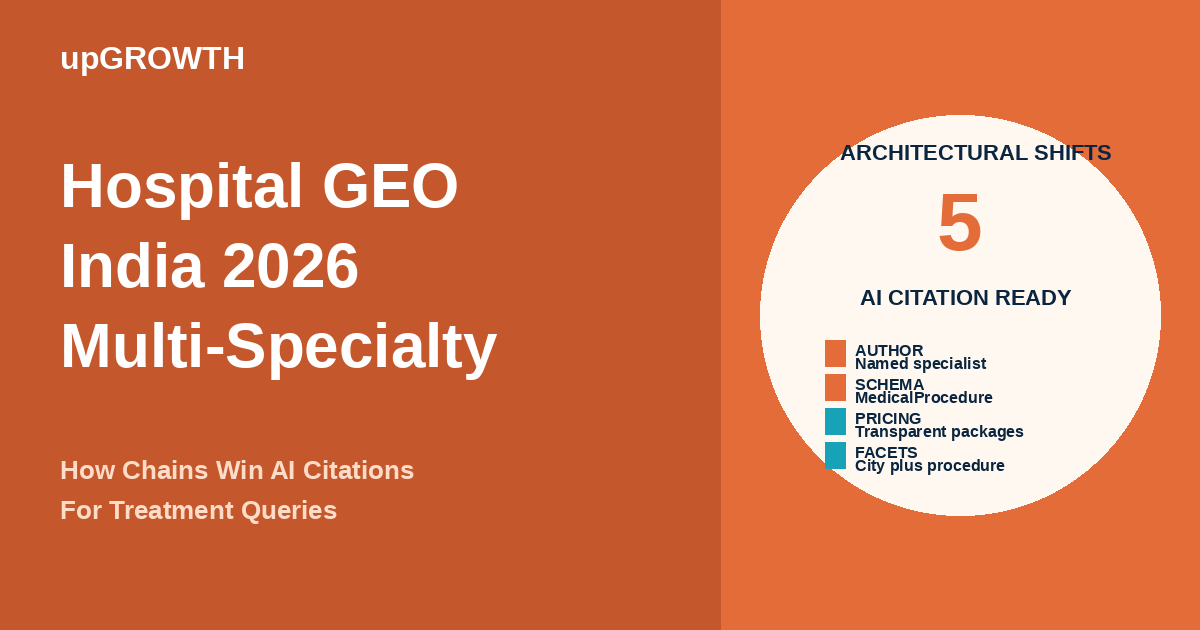
The fix is structural, not cosmetic. Hospital websites need five foundational shifts before content optimization delivers measurable citation share.
Shift 1: Named specialist authorship on every medical page. Every procedure page, treatment explanation, and symptom guide needs a named consultant as author or medical reviewer. The author needs a standalone Person schema profile page on the same domain, carrying medicalSpecialty, board certifications with verification URL where available, publication list, and years of experience. When Perplexity or ChatGPT crawls the procedure page, it follows the author schema to the profile, verifies the credentialing, and weights the content higher.
Shift 2: MedicalProcedure and MedicalCondition schema on every clinical page. Not as an SEO checkbox. As the structural backbone. MedicalProcedure schema exposes fields for preparation, followup, bodyLocation, typicalTest, procedureType, and procedureStage. MedicalCondition schema exposes fields for signOrSymptom, riskFactor, associatedAnatomy, and possibleTreatment. Filling these fields forces the content team to write clinically structured information, not marketing narrative. AI platforms extract structured fields faster than prose.
Shift 3: Price and package transparency with clear scope disclaimers. Publishing procedure pricing ranges (not exact quotes) with clear scope disclaimers (“This range covers standard package inclusions. Your specific case may require additional investigations or extended stay”) captures the cost-intent query cluster that is currently owned by aggregators. The hospitals that have done this in India over 2024-2025 (Manipal, Aster in Kerala, HealthCare Global in oncology) show material AI citation share for price queries. The hospitals that refuse to publish pricing continue losing this query cluster permanently.
Shift 4: Quarterly content refresh workflow. Every procedure and treatment page needs a quarterly review cycle with explicit dateModified updates, even if the clinical content has not changed. Update the “last clinically reviewed” date, add one new reference, expand the FAQ by one question. This is administrative content maintenance, not new content production. It signals freshness to AI platforms without requiring large editorial capacity.
Shift 5: Specialist-authored symptom triage content. The symptom-to-specialist query cluster is winnable. It requires each department to commit to publishing 6-12 “when to see a specialist” pieces annually, authored by a named consultant, covering the red-flag symptoms that should route patients to their specialty. Cardiology publishes “chest pain red flags,” oncology publishes “cancer warning signs by age group,” orthopedics publishes “joint pain that needs imaging.” This content hits the triage query cluster and establishes the hospital as the symptom-checker’s upstream authority source.
The City Plus Procedure Play Indian Hospitals Keep Missing
Indian healthcare search has a geographic dimension that US and European frameworks underweight. Medical tourism is internal before it is international. Patients from Tier 2 and Tier 3 cities travel to metros for complex procedures. The query “best hospital for liver transplant in Chennai” comes from a researcher in Madurai, Coimbatore, or Trichy. The query “knee replacement cost Hyderabad” comes from someone in Warangal or Nizamabad.
AI platforms weight geographic relevance heavily in healthcare because they know the asker likely needs a physically accessible facility. But they also weight it intelligently. When someone searches “best cardiac surgeon for bypass India,” AI platforms assume metro access and route to Delhi, Mumbai, Bengaluru, Chennai, Hyderabad answers. When someone searches “cardiac surgeon in Indore,” they route to Indore-specific or near-Indore tertiary care answers.
Hospital chains with multi-city presence are underplaying this. A single procedure page per hospital site covers “knee replacement” generically. What AI platforms reward is a procedure page that exposes LocationFacet schema, lists the specific specialists performing the procedure at each city facility, shows city-specific package pricing ranges, and names the specific operating theater capabilities. The same underlying procedure page, structured with city facets, wins AI citation share for eight city-plus-procedure queries instead of one generic procedure query.
Apollo, Manipal, and Fortis have the multi-city footprint. They do not have the multi-city structured content architecture. That is where a 10-city hospital chain with proper city-facet content outperforms a 15-city chain with generic procedure pages in AI search, despite having a smaller physical footprint.
The Operational Playbook for Hospital GEO
The rollout sequence matters. Hospitals that try to do everything simultaneously fail because the clinical review bottleneck (doctors reviewing content) is the binding constraint, and parallel workflows compete for the same scarce reviewer attention.
Phase 1: Credentialing audit and reviewer architecture (Months 1-2). Map every clinical specialty to a lead reviewer. Build Person schema profile pages for the reviewer panel. Verify external credentialing links (Medical Council of India registration, board certifications, society memberships). Establish the review cadence: how many hours per month does each specialist commit, what is the compensation, who owns the workflow. Without this layer, content production cannot scale.
Phase 2: Top 40 procedure page rebuild (Months 2-4). Identify the 40 highest-volume procedures across the hospital’s specialty mix. Rebuild each page with MedicalProcedure schema, named author, named reviewer, primary source citations, city-facet structure (for multi-city chains), and quarterly refresh commitment. This single workstream typically drives 60-70 percent of citation share gains in the first 6 months.
Phase 3: Specialist profile depth rebuild (Months 3-5, parallel with Phase 2). Upgrade the top 100-200 doctor profiles with full Person schema, condition-specific expertise tags, publication lists, society memberships, and subspecialty disclosure. This powers the “best specialist for X in city Y” query cluster and supports Phase 2 content as a credibility stack.
Phase 4: Symptom triage and treatment comparison content (Months 4-8). Launch 6-12 pieces per specialty on “when to see a specialist” and “treatment options comparison” topics. Each piece authored and reviewed by named consultants. This hits the triage query cluster and the second-opinion query cluster. Expect citation share visibility within 60-90 days of publication.
Phase 5: Price transparency rollout (Months 6-9). For hospitals willing to publish ranges, implement package pricing pages with clear scope disclaimers. This unlocks the cost-intent query cluster that aggregators currently dominate. Hospitals unwilling to publish pricing can skip this phase and accept permanent concession on that query cluster.
Phase 6: Continuous refresh and expansion (Month 9 onward). Quarterly refresh cycle across all clinical content. Topical expansion into adjacent procedures and conditions. Competitive citation monitoring and defensive content updates when competitors move up.
What Hospital GEO Actually Costs in India
The budget conversation is where most hospital CMO offices stall. The comparison point is usually the existing SEO agency retainer (INR 1.5-3 lakh per month) or the digital agency retainer (INR 3-6 lakh per month including paid media). Hospital GEO done properly costs more than either because clinical review time is the expensive input.
Specialist reviewer compensation: INR 3,000-8,000 per piece reviewed, depending on specialty (oncology and cardiology reviewers command the top of the range, general medicine sits at the bottom). For a 40-procedure rebuild plus 60 new pieces annually, reviewer costs run INR 5-9 lakh for the first year.
Content production at GEO quality: INR 8,000-15,000 per piece for research, writing, schema implementation, and coordination with reviewers. For the same volume, content production runs INR 12-20 lakh in year one.
GEO strategy and execution retainer: INR 2.5-5 lakh per month for agency-led work covering architecture, prioritization, schema implementation, monitoring, and refresh cycles. Hospital chains typically need 12-month engagements minimum to see compounding effect. Annual cost: INR 30-60 lakh.
Schema and technical implementation: INR 3-8 lakh one-time depending on CMS complexity. Most hospital sites run custom builds that require developer involvement for proper MedicalProcedure and Person schema deployment.
Total year-one investment for a single mid-size multi-specialty chain: INR 50 lakh to 1 crore. Total for a multi-city national chain: INR 1.5-3 crore annually during build phase, dropping to INR 80 lakh to 1.5 crore in steady state.
The payback calculation is not “traffic per rupee.” It is citation share in the query clusters that influence high-value admissions (cardiac surgery, oncology, transplants, joint replacement, bariatric surgery). A single additional cardiac surgery patient acquired through AI citation at INR 6-9 lakh per procedure changes the ROI math entirely. Hospitals that track this carefully see GEO retainer payback within 5-9 months.
Common Mistakes Indian Hospital Chains Keep Making
Seven patterns appear in every hospital GEO audit we run.
Mistake 1: Outsourcing medical content to generalist agencies. Agencies without medical editors produce grammatically correct, clinically shallow content that AI platforms cannot cite safely. The cost-saving is illusory. Bad content takes up page slots that then cannot be refilled without cannibalizing search signals.
Mistake 2: Department pages without specialist attribution. “Our cardiology department provides comprehensive care” pages are citation-invisible. They carry no specific expertise, no named specialist, no measurable claim. AI platforms skip them.
Mistake 3: Refusing price transparency on principle. Hospitals arguing that pricing is “case-specific and cannot be published” are technically correct and strategically wrong. Ranges with scope disclaimers work. Refusing to publish at all concedes the cost-intent query cluster to aggregators who publish made-up numbers.
Mistake 4: Star specialists without Person schema profiles. The hospital’s best surgeon, widely published, decades of experience, shows up as a PDF bio on a department page. No Person schema, no structured expertise data, no linkable credentialing. AI platforms cannot surface this specialist even when the query explicitly asks for them.
Mistake 5: Treating GEO as a one-time project. Hospital marketing directors approve a 90-day GEO rebuild and expect compounding results without ongoing refresh. Citation share decays within 90-120 days without maintenance. The retainer is the work, not the build.
Mistake 6: Ignoring city-facet architecture in multi-city chains. Eight procedure pages across eight city sites competing with each other for the same queries, instead of one procedure architecture with eight city facets working in concert.
Mistake 7: No defensive monitoring. Competitor hospitals and symptom-checker startups move up in AI citations. The hospital learns about it 6 months later when admissions data shifts. Citation monitoring at query level, checked monthly, is the early warning system most hospital digital teams do not have.
Hospital Generative Engine Optimization Implementation Costs and ROI
Expense Category
Estimated Annual Cost (INR)
Key Deliverables
Specialist Reviewer Compensation
5,000,000 – 9,000,000
Clinical review of 40 procedure rebuilds plus 60 new pieces annually by named consultants
GEO Strategy and Execution Retainer
3,000,000 – 6,000,000
Agency-led architecture, prioritization, schema monitoring, and quarterly refresh cycles
Content Production
1,200,000 – 2,000,000
Research, writing, and medical schema implementation for high-quality GEO content
Schema and Technical Implementation
300,000 – 800,000 (one-time)
Deployment of MedicalProcedure and Person schema on custom hospital website builds
Healthcare Growth
GTM Strategy Teardown
Multi-Specialty: Scaling Clinical Authority
How a geo-targeted SEO framework and high-margin surgical funnels captured the competitive urban healthcare market in India.
Hyper-Local Dominance
Geo-Centric GMB EngineEnsuring individual hospital branches dominate “best hospital near me” and Map Pack results for specific urban catchments.
Neighborhood Landing PagesHyper-localized pages that target medical needs specific to the demographics of surrounding residential zones.
Procedure Intent
High-Margin BiddingFocusing performance spend on high-value surgeries (Knee replacement, Cardiology, Oncology) rather than generic hospital searches.
Emergency Intent CaptureOptimizing for immediate “ER near me” or “24/7 hospital” searches to capture acute medical demand in real-time.
Clinical E-A-T
Doctor-Specific SEODeveloping authoritative profiles for senior consultants to leverage their personal reputation and Google’s E-A-T guidelines.
Accreditation SignalsHighlighting NABH/JCI certifications across all digital touchpoints to reinforce hospital safety and quality standards.
Nurture & Convert
WhatsApp Appointment LoopsBridging the gap between a digital inquiry and a walk-in visit through low-friction WhatsApp confirmation workflows.
Post-Discharge EngagementUsing digital nurture triggers for follow-up appointments and health checkups, increasing patient Lifetime Value (LTV).
In Multi-Specialty healthcare, trust and hyper-local proximity are the primary conversion drivers.
Seven Common Questions About Hospital GEO in India
Q: Do we need to be NABH accredited for AI platforms to cite us?
A: NABH accreditation is not a direct AI citation input, but it correlates with the signals AI platforms do weight: structured clinical governance, documented protocols, and credential verification. Non-NABH hospitals can win AI citations by investing heavily in named specialist authorship, primary source citations, and MedicalProcedure schema. NABH-accredited hospitals win more easily because their clinical documentation discipline translates more naturally into structured content.
Q: How fast can a hospital chain see AI citation share improvement?
A: For procedure-specific queries in Tier 2 cities, 60-90 days after rebuilding the relevant procedure pages with proper authorship and schema. For competitive metro queries (oncology in Mumbai, cardiac surgery in Bengaluru), 5-8 months for visible share and 12-18 months for material share. The bottleneck is clinical review capacity, not content production or technical implementation.
Q: Can we use AI to generate the underlying medical content?
A: For initial drafts where a named specialist will review, revise, and sign off, yes. For direct publication without clinical review, no. AI platforms have become measurably better at detecting unsupervised AI medical content, and Google’s quality raters flag it. The standard is not “was AI used” but “is there verifiable clinical review.” Hospitals that use AI-assisted drafts under proper specialist review are gaining efficiency without citation penalty.
Q: What happens if competing hospitals do not invest in GEO?
A: You win the query clusters they concede by default, while symptom-checker startups, health aggregators, and telehealth platforms keep competing aggressively. Competing against other hospitals is not the primary contest. Competing against non-hospital sources that currently own most treatment-intent AI citations is the contest that matters.
Q: How do we handle doctors who refuse to be named reviewers for content they did not write?
A: Medical review is a professional responsibility they already perform for patient education materials, grand rounds, and academic publications. The workflow needs to mirror what they already do: review a draft, suggest changes, approve a final. The compensation needs to be appropriate. Most refusals trace back to unclear expectations or unrealistic turnaround demands. Once reviewers see the citation data, most convert.
Q: Should we use a specialty-specific GEO agency or a generalist growth agency?
A: Neither alone. Specialty-specific medical content agencies often do not understand AI citation mechanics. Generalist growth agencies do not understand medical review workflows or YMYL liability. The working model is a growth agency that understands GEO architecture, partnered with or internally resourced with medical content editors who understand clinical accuracy. upGrowth operates this hybrid model for healthcare clients.
Q: What schema markup should hospitals implement beyond standard Article schema?
A: At minimum, MedicalOrganization or Hospital schema at the organization level, Physician schema for doctor profiles, MedicalProcedure schema for procedure pages, MedicalCondition schema for condition explanation pages, MedicalTherapy for treatment pages, and FAQPage schema for FAQ sections. MedicalWebPage schema as a wrapper for clinical content pages is increasingly weighted by AI platforms as the primary medical content signal.
Your Next Move: A Structured Hospital GEO Audit
Hospital chains audit financial performance quarterly. They rarely audit citation performance in AI search. The gap between those two audits is where the competitive disadvantage compounds. A symptom-checker startup does not take beds away in one quarter. It takes them away over 24 months through gradual reshaping of how prospective patients research treatment decisions.
upGrowth runs a Hospital GEO Audit that maps your current AI citation share across 50-100 treatment-intent queries in your primary geographies, benchmarks against the top three hospital competitors and the top three non-hospital competitors, identifies the 10-15 highest-leverage procedure page rebuilds, and delivers a 90-day action plan sequenced around clinical reviewer capacity. The audit is a paid discovery engagement that becomes the foundation for either an internal execution plan or an upGrowth-led GEO retainer.
Amol has helped catalyse business growth with his strategic & data-driven methodologies. With a decade of experience in the field of marketing, he has donned multiple hats, from channel optimization, data analytics and creative brand positioning to growth engineering and sales.

 Growth Strategy and Planning
 Inbound Growth
 Growth Hacking
 Fractional CMO
 Search Engine Optimization
 Paid and Performance Marketing
 Social Media Marketing
 Demand Generation
 AI-Driven Growth Strategy
 AI-Native Workflow Automation
 Generative Engine Optimization
 Grove — AI Growth Strategist

 AI Automation
 Framework
 Case Study
 Tools
Tools Growth Tools
 Decision Tree
 Compare
 Custom GPT's
 Guides
 Offer
Offer Webstories
 Quizzes
 Blog
Blog AI-powered Apps
 Social Media Tools
 Agency Fit Score