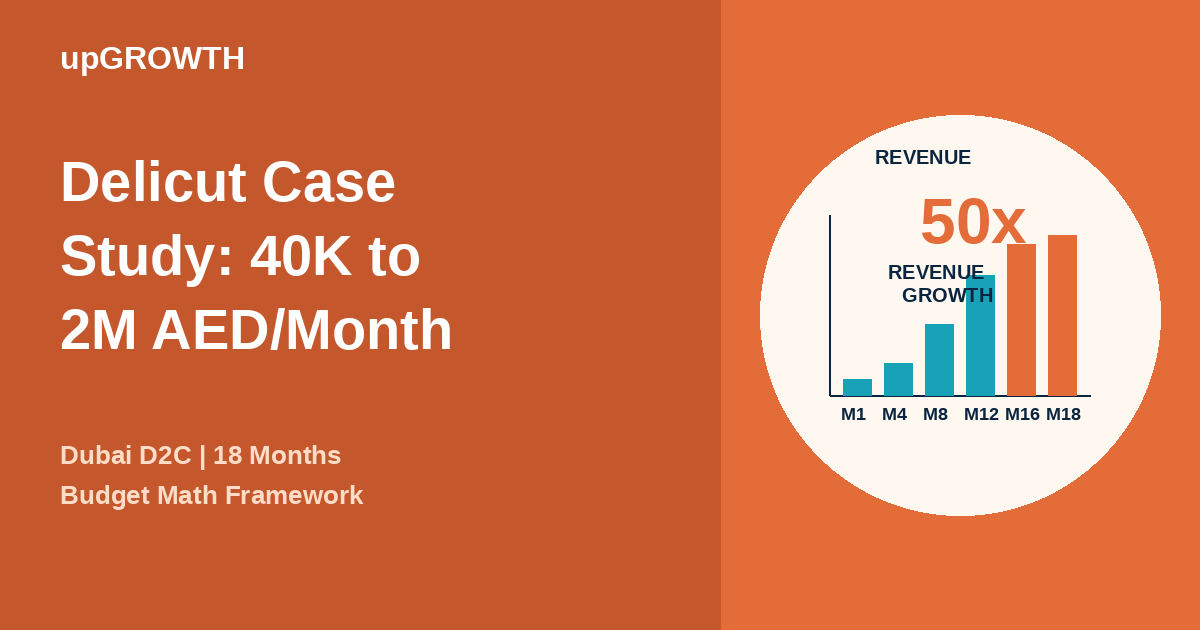
Delicut, a Dubai-based premium meat delivery brand, scaled from AED 40,000 to over AED 2,000,000 in monthly revenue working with upGrowth. The core unlock wasn’t creative or channel mix. It was budget math. Getting the ratio between ad spend, agency fee, contribution margin, and repeat revenue right. This case study breaks down exactly what we did, month by month, with the numbers that mattered.
In This Article
Share On:
Most D2C scaling stories in the GCC are edited. The founder talks about “going viral” or “cracking the algorithm” or “finding product-market fit.” None of that explains how Delicut went from 40K AED/month to 2M+ AED/month in about 18 months. What explains it is boring. Marketing budget math. Unit economics that held up at scale. Agency fee structure that aligned incentives. And a refusal to chase ROAS when profit was the real number.
The team at upGrowth Digital has run this playbook in variations across Dubai, Riyadh, and Kuwait City for food delivery, beauty, supplements, and home categories. The specifics differ. The math is the same. This case study pulls the curtain back on Delicut because the numbers are clean, the scale is real, and the lessons transfer to any D2C brand trying to move from AED 40K to AED 500K+ monthly revenue.
Here’s the shape of what we’ll cover. First, the starting position in month one and why it was actually good (most agencies would have quit on it). Second, the four budget-math shifts we made over 18 months that compounded into 50x revenue growth. Third, the ratios we held constant even as absolute numbers moved. Fourth, what broke and how we fixed it. Fifth, what this means for your own brand if you’re stuck between AED 40K and AED 200K monthly.
The Starting Position: AED 40K Per Month, And Why It Wasn’t Broken
When Delicut came to upGrowth, the numbers looked like this. Monthly revenue of about AED 40,000. Ad spend of AED 18,000 across Meta and Google. Agency fee of AED 8,000 at the previous shop. ROAS of 2.2 on a blended basis. Contribution margin of 58% (premium meat, no warehouse, direct from supplier). Repeat rate of roughly 35% over 90 days.
Most agencies look at a 2.2 ROAS and call it a failing account. That’s because most agencies only understand revenue-over-spend and not actual profit. Let’s do the real math on month one.
Revenue: 40,000. COGS and fulfillment at 42% of revenue: 16,800. Gross contribution: 23,200. Ad spend: 18,000. Agency fee: 8,000. Total marketing cost: 26,000. Contribution after marketing: negative 2,800. On the surface, this was a losing account.
But now add the repeat layer. Roughly 35% of the first-order cohort came back within 90 days, with an average of 1.8 repeat orders per repeater at similar AOV. LTV-adjusted revenue on the first-order cohort was closer to AED 62,000, which meant LTV-adjusted contribution margin was about AED 36,000 against the same AED 26,000 marketing cost. Contribution after marketing, LTV-adjusted: positive AED 10,000. A 25% contribution margin at the cohort level.
This is the most important number in the Delicut story. Not 2M. Not 50x. The 25% LTV-adjusted cohort margin in month one. That number said the unit economics were already working. The brand wasn’t broken. The previous agency had been optimizing for first-order ROAS instead of cohort profit. Once you see the cohort math clearly, scaling becomes a budget-math problem, not a creative problem.
Shift One: Re-Baselining Agency Fee Against Ad Spend
The first budget-math change wasn’t to the ad account. It was to the agency contract. At AED 40K revenue, a flat AED 8,000 agency fee was 20% of revenue. Every new dirham of spend would have to beat that baseline before contributing profit. At low volumes, the fee structure was eating the unit economics.
We restructured the engagement. For the first three months, we took a lower flat retainer with a clear ladder. Fee would step up as ad spend crossed defined thresholds. The founder got two things from this. Alignment (agency eats less when brand is small) and predictability (no surprise invoices as spend scaled).
In month one under the new structure, agency fee dropped to AED 4,500 on AED 18,000 of ad spend. The new marketing cost on AED 40K revenue was AED 22,500. Contribution after marketing, LTV-adjusted, went from positive 10,000 to positive 13,500. That extra AED 3,500 bought us room to test aggressively without burning the cash runway.
This is the budget-math lesson most D2C founders miss. Agency fee as a percentage of revenue matters more than ad spend as a percentage of revenue at small scale. A 20% agency fee on a 25% contribution-margin business leaves almost nothing for ad spend testing. A 10% agency fee leaves headroom.
Shift Two: Moving From ROAS Targets to Contribution Margin Targets
The previous agency had been reporting on a Meta ROAS target of 3.0 and a Google ROAS target of 4.0. We threw those targets out in month two.
We replaced them with a single target. LTV-adjusted contribution margin per marketing dirham. The target number was 0.35, meaning every dirham of ad spend plus agency fee had to generate AED 0.35 of cohort contribution margin after 90 days. This number respects the economics without caring which channel or campaign produced it.
The shift changed media buying behavior immediately. Before: “This campaign is at 2.1 ROAS, pause it.” After: “This campaign is at 2.1 first-order ROAS, but cohort repeat rate is 41%, so LTV-adjusted contribution is AED 0.38, keep scaling.” Three campaigns that would have been paused under the old framework became the highest scalers under the new one.
By month four, ad spend had doubled to AED 36,000. Revenue had more than tripled to AED 135,000. The ratio of ad spend to revenue had improved from 45% to 27%. That’s not because we got better at Meta ads (we didn’t, particularly). That’s because we stopped killing campaigns that were cohort-profitable but first-order unattractive.
Shift Three: Treating Repeat Revenue As a Marketing Budget Line
The third shift came in month six. By then, first-order volume was running at about 1,200 orders per month. Repeat behavior was creating a shadow revenue line that was growing faster than new-customer revenue. But none of it had a budget attached.
We carved out 15% of the total marketing budget for retention. WhatsApp broadcasts to prior buyers. A three-touch email sequence post-first-order. A loyalty voucher that triggered between day 25 and day 40 after last purchase (the peak churn window for premium meat delivery in Dubai). Paid retargeting to the 60-day lapsed audience.
Retention budget in month six was about AED 12,000 out of AED 80,000 total marketing spend. Attributable incremental repeat revenue was AED 63,000. Contribution from that incremental revenue (at 58% margin) was AED 36,500. The ROI on retention was 3.04x contribution-over-spend. Better than any acquisition channel.
By month nine, retention budget was 22% of total marketing spend. Repeat revenue was 58% of total revenue. The brand had effectively turned every first-order transaction into a compounding annuity. That’s what allowed the scale curve to steepen after month six.
Shift Four: Letting CAC Rise Because LTV Was Rising Faster
Most agencies treat rising CAC as a red flag. At scale, rising CAC is often a sign you’re doing something right. You’re exhausting easy audiences and paying more to win harder ones. The question isn’t whether CAC is rising. It’s whether LTV is rising faster.
Between month six and month twelve, Delicut’s blended CAC moved from AED 95 to AED 142. A 49% increase. Over the same period, 180-day LTV moved from AED 310 to AED 520. A 68% increase. The LTV-to-CAC ratio went from 3.3 to 3.7 despite the CAC increase. That’s scale-healthy.
The budget-math implication was that we could keep scaling spend aggressively. Every AED 1,000 of incremental spend was buying AED 3,700 of LTV against AED 1,420 of CAC. Absolute profit per new customer was still growing even as unit economics got slightly more expensive. By month twelve, monthly ad spend had crossed AED 280,000. Revenue had crossed AED 1,100,000.
The brand that would have killed itself at month two if we’d held CAC targets rigid ended up at month twelve with nearly 30x revenue growth precisely because we let CAC drift upward with LTV.
What Broke At AED 1M Monthly, And How We Fixed It
Scale exposes cracks that small numbers hide. Around month thirteen, at about AED 1.1M monthly revenue, three things broke.
Fulfillment capacity maxed out. The same-day delivery window couldn’t absorb more orders without hiring. Supplier pricing started to move as volumes grew, which ate 2-3 percentage points of contribution margin. Customer service response times stretched past the founder’s tolerance, driving a brief spike in refund requests.
The marketing fix was not to scale faster. It was to pause acquisition for six weeks while the operations side caught up. We redirected 40% of the acquisition budget into retention and into a concentrated push on AOV growth (bundle offers, premium SKU mix-ins). Revenue plateaued around AED 1.2M for two months while the operations capacity expanded.
This is the less-glamorous part of scaling. Sometimes the biggest marketing win is refusing to press harder on a pedal when the wheels can’t handle the torque. The brands that blow up at AED 1M monthly usually do so because the founder or the agency kept pushing ad spend while operations broke underneath.
After operations rebuilt, we reopened the acquisition taps. Month sixteen hit AED 1.6M. Month eighteen crossed AED 2.0M.
The Ratios We Held Constant Through Every Scale Jump
Revenue went from AED 40K to AED 2M+. Ad spend went from AED 18K to AED 480K+. Agency fee scaled with a clear ladder. But certain ratios held almost constant from month three onward, and those ratios were the real scoreboard.
Total marketing spend (ad spend plus agency fee plus retention) as a percentage of revenue stayed between 23% and 27% through the entire scale period. Below that band, we could have tested harder. Above it, profit was at risk. The band was the envelope.
LTV-adjusted contribution margin per marketing dirham stayed between AED 0.33 and AED 0.41. We never chased above that number (which would have meant under-investing in growth) and we never slipped below it (which would have meant destroying the unit economics).
Retention budget as a percentage of total marketing budget stayed between 18% and 24% from month nine onward. The brand that spent too little on retention gave back first-order profit. The brand that spent too much starved acquisition. The band was the balance.
Repeat revenue as a percentage of total revenue drifted from 35% in month one to 61% by month eighteen. That drift was the real engine. Every percentage point of repeat mix made the next AED of ad spend more profitable than the last.
Meta Ads Management Pricing Benchmarks Dubai 2026
Milestone Phase
Monthly Revenue (AED)
Ad Spend (AED)
Starting Position (Month 1)
40,000
18,000
Month 4
135,000
36,000
Month 12
1,100,000
280,000
Month 18
2,000,000
480,000
D2C Case Study
Growth Math Teardown
Delicut: Scaling from AED 40k to 2M
How a fresh-meat D2C brand decoded UAE unit economics to scale profitably through hyper-retention and creative-led growth.
Scaling Economics
The AOV BridgeMoving AOV from AED 120 to AED 280 through “Build your Box” bundling, allowing higher CAC tolerance.
45% Retention MoatAchieving a 3.8x LTV/CAC ratio by ensuring nearly half of all customers order 4+ times a year.
Visual Performance
The “Kitchen Reality” HookSwitching from studio photos to raw, kitchen-prep videos reduced Cost-Per-Click (CPC) by 40%.
Bilingual TestingLocalized Arabic hooks for the local demographic vs. high-energy English UGC for the expat market.
Cold-Chain Scale
Zonal Delivery DensityUsing ad-spend to “cluster” orders in specific Dubai communities, cutting last-mile costs by 18%.
The 60-Minute PromiseLeveraging speed as a “marketing hook” to compete with aggregators while maintaining D2C margins.
Conversion Engine
Post-Purchase UpsellsImplementing one-click upsells on the thank-you page to capture incremental margin on high-intent users.
WhatsApp Re-orderingBypassing the app/site for recurring customers via WhatsApp bots, increasing order frequency by 22%.
Delicut’s success proves that AOV and Retention are the only levers that matter when scaling high-frequency D2C in Dubai.
Q: How replicable is this for a D2C brand outside food delivery?
A: The ratios translate directly. Any D2C category with repeat potential can use the same budget-math framework. Beauty with subscription skincare. Supplements. Pet food. Home essentials. The specific LTV and repeat rates differ by category, but the structural math (agency fee ladder, contribution margin targets, retention budget carve-out, LTV-adjusted ROAS) is category-agnostic. The framework breaks down only for one-off purchase categories where repeat rates are structurally near zero.
Q: How long before you could tell this was going to scale?
A: The cohort math in month one told us the brand could scale. The execution proof came by month four, when we’d tripled revenue while improving the ad-spend-to-revenue ratio. If a brand is three months in and the ad-spend-to-revenue ratio isn’t improving as volume grows, the unit economics probably don’t support aggressive scaling and the conversation changes.
Q: What’s the minimum starting revenue for this approach to work?
A: We’ve run this framework with brands starting at AED 15K monthly. Below that, the agency fee structure doesn’t work (even a lean retainer eats too much of the unit economics). At AED 15K-40K monthly with 50%+ contribution margin and 25%+ repeat rate, the math opens up. Below AED 15K or below 40% contribution margin, the brand usually needs to sell differently before it can advertise differently.
Q: How much of this was Delicut-specific vs replicable?
A: About 70% is replicable framework. The 30% that was specific to Delicut was the premium positioning (which supported the 58% contribution margin), the Dubai delivery logistics (same-day window was a differentiator), and the founder’s willingness to pause growth when operations strained. The budget math, the agency fee structure, the retention carve-out, and the LTV-adjusted ROAS targets are all framework-level, not brand-level.
Q: What would you do differently if you started over?
A: Push retention infrastructure harder in months one through three. We built retention budget into the mix from month six. If we’d built it from month one, we’d likely have hit AED 2M a full quarter earlier. The cost of delayed retention is permanent. You can’t go back and resuscitate lapsed customers from twelve months ago.
Q: How does this compare to typical GCC food delivery scaling?
A: Most GCC food delivery brands scale through aggregator marketplaces (Talabat, Careem, Deliveroo) which means they’re competing on discounts and don’t own the customer. Delicut scaled direct-to-consumer through its own site and WhatsApp order flow, which is why retention economics worked. The LTV numbers here would look very different for an aggregator-dependent brand. The budget-math framework still applies, but the retention layer shrinks significantly.
Your Next Move: Pressure-Test Your Budget Math Before Scaling
If you’re a D2C founder in the GCC running between AED 40K and AED 500K monthly revenue, the Delicut story should raise one question. Is your budget math set up to scale 10x, or is it set up to die at AED 200K?
The answer almost always comes down to three numbers. Agency fee as a percentage of revenue. LTV-adjusted contribution margin per marketing dirham. Retention budget as a percentage of total marketing spend. Get those three wrong and scaling makes you poorer. Get them right and scaling compounds.
We run two-week GCC D2C strategy sprints for AED 12,000-22,000 depending on complexity. The sprint walks your actual account data through the Delicut framework. Cohort analysis on your last 90 days. Agency fee audit against revenue. Retention budget modeling. Scale-readiness assessment across the three ratios above. Output is a 90-day execution plan with specific budget math, not a generic pitch deck.
Watch how Delicut scaled from 40K to 2M AED with smart marketing budget allocation
For Curious Minds
upGrowth identified potential because the surface-level 2.2 ROAS was masking strong underlying unit economics. The LTV-adjusted cohort margin reveals the actual profitability of a group of customers over time, which is a far more accurate indicator of a sustainable business than a simple first-order return on ad spend.
For Delicut, the initial math looked poor: AED 40,000 revenue minus costs and AED 26,000 in marketing resulted in a loss of AED 2,800. However, with a 35% repeat rate, the LTV-adjusted revenue for that same cohort was closer to AED 62,000. This flipped the calculation to a positive contribution of AED 10,000, yielding a healthy 25% LTV-adjusted margin. This single metric proved the business model was sound; the problem was a flawed measurement of success focused on immediate returns. This deeper analysis is the key to unlocking scalable growth. Uncover the full month-by-month financial breakdown in the complete case study.
Budget math is the practice of focusing on the financial relationships between ad spend, agency fees, contribution margins, and repeat revenue to build a profitable scaling engine. For Delicut, this was more critical than creative because the core economic model was already working, just obscured by poor financial structure.
While good creative is important, no amount of it can fix a broken economic model. The upGrowth strategy prioritized getting the core ratios right first, such as restructuring the agency fee that was consuming over 30% of the gross contribution. By focusing on the 25% LTV-adjusted cohort margin as the key metric, scaling became a predictable mathematical exercise rather than a creative gamble. This approach ensures that every dollar spent on growth is invested into a system proven to generate a profit over a customer's lifetime. Discover the specific ratios they used to scale from AED 40,000 to AED 2,000,000 in the full analysis.
A high flat retainer can be dangerous for an early-stage brand, as it creates a fixed cost that eats into fragile unit economics. A performance-based or tiered model better aligns incentives, as the agency's compensation grows alongside the brand's success.
Delicut's initial AED 8,000 flat fee was 20% of its AED 40,000 revenue, making profitability nearly impossible at that scale. The shift to a lower retainer with a fee that scaled with ad spend was the first critical change upGrowth made. When choosing a structure, you should weigh these factors:
Contribution Margin: A high margin (like Delicut's 58%) can support a higher marketing cost, but the structure still matters.
Sales Velocity: At low volumes, fixed fees have a disproportionate impact.
Growth Goals: An aligned structure incentivizes the agency to pursue profitable growth, not just higher ad spend.
The right structure turns an agency from a cost center into a genuine growth partner. The complete story details the exact tiered fee structure that unlocked Delicut's rapid expansion.
Certainly, the contrast between first-order and lifetime value profitability is stark and demonstrates why many D2C brands are misjudged. On a first-order basis, Delicut's numbers were discouraging, but a closer look at repeat business revealed a completely different story.
The math for a single month's new customer cohort was:
Revenue: AED 40,000
COGS & Fulfillment (42%): - AED 16,800
Gross Contribution: AED 23,200
Total Marketing Cost (Ad Spend + Fee): - AED 26,000
Contribution After Marketing: - AED 2,800 (A loss)
However, factoring in the 35% repeat rate added approximately AED 22,000 in LTV-adjusted revenue over 90 days. This transformed the cohort's economics to a contribution after marketing of positive AED 10,000. This is how a cohort that initially lost money became a profitable asset for the business. Learn how this insight informed every subsequent budget decision in the full case study.
The core principles are entirely transferable because they are based on universal business mathematics, not category-specific tactics. A D2C beauty brand in Riyadh would apply the same framework, simply adjusting the inputs for its unique economic profile.
The process remains identical: first, you must ignore vanity metrics like ROAS and calculate your LTV-adjusted cohort margin. For a beauty brand, the repeat purchase cycle might be 60 days instead of Delicut's 90, and the contribution margin might be 70% instead of 58%. The key is to understand how much you can truly afford to spend to acquire a customer who will be profitable within that cycle. The product changes, but the financial discipline of scaling on profitable unit economics does not. This playbook provides a durable model for growth for any D2C brand, from Dubai to Riyadh. Explore how these variables interact in our D2C Marketing ROI Calculator.
The 58% contribution margin was the most powerful green flag, signaling exceptional underlying health. This high margin meant that for every dirham of revenue, a substantial amount was left over after covering the cost of goods and fulfillment, which could then be reinvested into growth.
This provided a crucial financial cushion. While the initial marketing spend of AED 26,000 led to a small first-order loss, the high margin ensured this loss was manageable. A brand with a 30% margin could not have sustained this acquisition model. Combined with the 35% repeat rate, this high margin created a powerful economic engine where the profitability of repeat orders quickly erased the initial acquisition cost. This combination of high margins and customer loyalty is the ideal foundation for scaling. The full report discusses other, more subtle indicators of a brand ready to scale.
To assess viability for scaling, you must shift your focus from revenue to cohort-level profitability with a clear, data-driven approach. This involves moving beyond simple metrics to understand your true financial engine, just as upGrowth did for Delicut.
Here is a three-step plan to get started:
Calculate True Contribution Margin: For every order, subtract all variable costs, including COGS, payment processing, and fulfillment. This is your real gross profit per order.
Track 90-Day Cohort Behavior: Isolate all new customers from a specific month. Track how many of them return to make a second or third purchase within 90 days and calculate the average repeat revenue per customer.
Determine Your LTV-Adjusted CAC: Combine the first-order contribution with the repeat-order contribution to find your cohort's true 90-day value. This tells you how much you can profitably spend to acquire a new customer.
This process will reveal if you have a scaling problem or a unit economics problem. The complete guide offers a detailed worksheet to run these calculations for your own brand.
To align incentives, you must propose a contract that makes the agency a partner in profitable growth, not just a manager of ad spend. The Delicut and upGrowth restructure offers a clear blueprint for this, moving away from a punitive fixed-fee model at low scale.
Your proposal should contain three core components:
A Modest Base Retainer: This covers the agency’s foundational operational costs and strategic oversight.
Tiered Performance-Based Fee: This should be a percentage of ad spend or revenue growth that activates and increases as you hit pre-agreed milestones. This directly ties agency compensation to successful scaling.
A Shared Success Metric: Define the primary goal as improving a key business metric like LTV-adjusted cohort margin, not a vanity metric like ROAS.
This structure ensures the agency is rewarded for achieving sustainable business outcomes, not simply for spending your budget. See a template for this type of modern D2C agency agreement in the full article.
The focus is already shifting from chasing high first-order ROAS to building businesses on a foundation of solid unit economics and cohort profitability. In competitive markets like Dubai and Riyadh, the cost of acquisition will only rise, making an LTV-focused strategy a requirement for survival, not a choice.
Delicut's story is a leading indicator of this trend. It proves that the most successful D2C brands will be those that master their numbers internally. This implies that agency-brand relationships must evolve from simple media buying services to integrated growth partnerships. Future contracts will feature shared risk and reward, with compensation tied to metrics like LTV-adjusted contribution margin, reflecting a deeper alignment of goals. Brands that fail to make this shift will struggle to scale profitably. Discover the key performance indicators that will define the next era of D2C success in our complete analysis.
The most common mistake is rejecting the account based on a surface-level metric like a 2.2 ROAS without performing deeper diligence on the business's cohort economics. Many agencies are structured to optimize for immediate, easily measured returns and will label an account a failure if it does not meet a simple ROAS threshold.
Founders can prevent this by taking control of the narrative. Instead of just showing your ad platform dashboard, you should proactively present a clear analysis of your LTV. Show a prospective agency the data on your 90-day repeat purchase rate (like Delicut's 35%), your contribution margin, and your calculated LTV-adjusted profitability per cohort. By doing this, you shift the conversation from 'Why is your ROAS low?' to 'Here is our proven, profitable customer acquisition model.' This reframing educates the agency on your real business drivers. Read about the conversation that saved the Delicut engagement in the full case study.
The AED 8,000 fixed fee created a barrier because it represented a disproportionately large fixed cost relative to the brand's revenue and gross profit. At AED 40,000 in monthly revenue, this fee consumed 20% of top-line sales and over 30% of the AED 23,200 in gross contribution, making it nearly impossible to turn a profit on new customer acquisition.
The immediate structural change implemented by upGrowth was to replace this punitive flat fee with a hybrid model. They introduced a lower flat retainer combined with a tiered fee structure that scaled alongside ad spend and revenue growth. This dramatically lowered the fixed cost burden at the start, preserving precious margin that could be reinvested into ads. This alignment of financial incentives was the critical first step that made the entire scaling journey mathematically possible. The full case study reveals the exact numbers behind this pivotal contractual change.
Delicut's high 58% contribution margin was the strategic foundation that enabled its entire growth playbook. This margin created a substantial buffer of gross profit for every order, which directly funded the patience required to wait for LTV to be realized.
From AED 40,000 in revenue, this margin generated AED 23,200 in gross contribution. This meant the business could withstand a total marketing cost of AED 26,000, resulting in a manageable first-order loss of just AED 2,800. A brand with a lower margin, for example 30%, would have only generated AED 12,000 in contribution, leading to a much larger and likely unsustainable loss. The high margin ensured that the initial investment in acquiring a customer was a calculated risk with a clear, data-backed path to profitability through repeat purchases. Learn how to calculate and defend your own brand's margin in the full guide.
Amol has helped catalyse business growth with his strategic & data-driven methodologies. With a decade of experience in the field of marketing, he has donned multiple hats, from channel optimization, data analytics and creative brand positioning to growth engineering and sales.
In This Article
Download The Free Digital Marketing Resources
[slide-anything id="15651"]
We plant one 🌲 for every new subscriber.
Want to learn how Growth Hacking can boost up your business?

 Growth Strategy and Planning
 Inbound Growth
 Growth Hacking
 Fractional CMO
 Search Engine Optimization
 Paid and Performance Marketing
 Social Media Marketing
 Demand Generation
 AI-Driven Growth Strategy
 AI-Native Workflow Automation
 Generative Engine Optimization
 Grove — AI Growth Strategist

 AI Automation
 Framework
 Case Study
 Tools
Tools Growth Tools
 Decision Tree
 Compare
 Custom GPT's
 AI Answer Gap
 Offer
Offer Webstories
 Quizzes
 Blog
Blog AI-powered Apps
 Social Media Tools
 Agency Fit Score