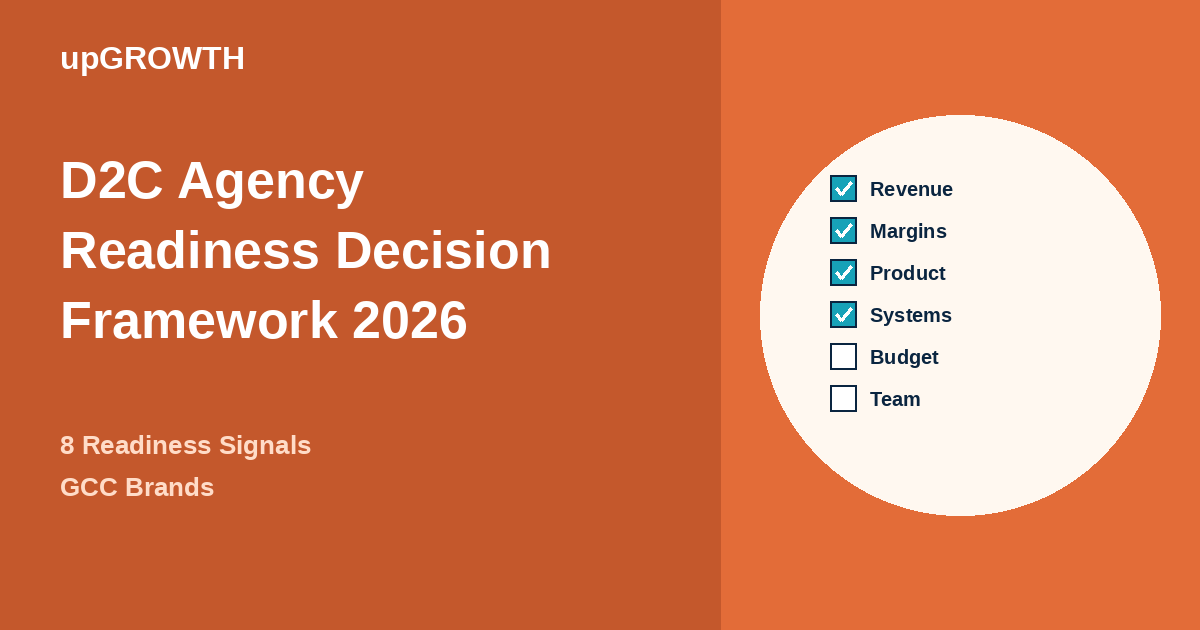
A D2C brand in the GCC is ready for full-service agency management when monthly revenue sits reliably above AED 150,000, media spend is above AED 30,000 per month, and the founder can write down 3 specific outcomes an agency would own in the next 6 months. Below those thresholds, an agency relationship either subsidises the agency’s overhead or creates scope fights by month three. Readiness is a business maturity signal, not a funding event.
In This Article
Share On:
Founders ask the wrong question about agencies. They ask “which agency should I hire?” when the real question is “is my business ready to be hired by an agency?”
Most D2C brands in Dubai, Riyadh, and Doha hire their first full-service agency 6 to 9 months too early. They sign a AED 25,000 monthly retainer when their revenue is AED 80,000 a month. The agency under-delivers because the brand does not have the product-market fit, the creative assets, or the decision-making maturity to use an agency well. The founder blames the agency. The agency blames the brand. Both are partly right.
This guide lays out a decision framework for D2C brands across the GCC to decide whether you are actually ready for full-service agency management, what the honest alternatives look like, and the 8 specific signals that tell you it is time.
The framework comes from working with over 60 D2C brands, including our case studies with Delicut in Dubai (40K to 2M AED monthly) and pattern recognition across dozens of engagements that worked and several that did not.
What Full-Service D2C Agency Management Actually Means
Before the readiness question, the definitions. “Full-service” is a term that has been diluted by marketing copy to the point of meaninglessness.
A true full-service D2C agency engagement in the GCC covers four things: paid media execution across Meta, Google, and TikTok with a real creative engine; owned channel growth including SEO, email, and SMS; analytics and attribution with server-side tracking; and strategic leadership at the account level that connects marketing to business outcomes. Anything less is a specialist engagement being sold as full-service.
A full-service retainer in the UAE starts at around AED 35,000 per month. A full-service retainer in KSA starts at around SAR 38,000 per month. Below those numbers, you are getting a pooled-resource agency model, not dedicated full-service management.
This matters for the readiness question because a brand that is not ready for full-service management can still benefit from specialist agency support. The readiness framework below is specifically about full-service, not about whether to ever hire an agency.
The 8 Signals You Are Ready for Full-Service Agency Management
Count how many of these 8 signals apply to your brand right now. A brand that checks 6 or more is ready. A brand that checks 3 or fewer should delay. In between is the danger zone where many D2C founders talk themselves into a relationship that will not work.
Signal 1: Revenue stability above AED 150,000 monthly for at least 3 consecutive months. Agencies need predictable budgets. A brand oscillating between AED 80,000 and AED 200,000 monthly cannot commit to consistent media spend, which means the agency cannot build momentum in any channel. Wait for stability before signing.
Signal 2: Gross margin above 55 percent after COGS, logistics, and payment processing. D2C economics in the GCC are brutal. If your unit economics only work at 35 percent margin, paid media at scale will not make you profitable, it will amplify losses. Brands with structural margin problems should fix pricing and cost of goods before hiring an agency.
Signal 3: A written customer acquisition cost target you can defend. Not “we want cheap customers.” A specific number like “AED 85 CAC at payback in month 2” based on your LTV math. If the founder cannot articulate this in one sentence, the agency has no target to optimise toward.
Signal 4: Monthly media spend above AED 30,000 already running. You should already be spending on paid media, even badly, before hiring a full-service agency. Brands that have never run ads do not know what they are buying. Do 3 months of basic in-house Meta ads before engaging an agency. You will learn more from those 90 days than from any agency pitch.
Signal 5: A clear product positioning that a stranger could understand in 15 seconds. Agencies cannot manufacture positioning. They can amplify it. If your positioning is still fuzzy, an agency engagement will expose that to a wider audience faster, which is expensive.
Signal 6: At least 6 months of historical data across your funnel. Website traffic patterns, repeat purchase rates, conversion rate benchmarks, AOV trends. An agency starting with no historical data is flying blind for the first quarter. If you launched 3 months ago, wait.
Signal 7: Founder availability of at least 4 hours per week for agency collaboration. This is the most underestimated readiness signal. Full-service agency relationships demand founder time in the first 90 days. If the founder is overwhelmed by operations, the agency will make decisions the founder would have made differently and nobody benefits.
Signal 8: Clear decision-maker authority on marketing spend and direction. If every agency recommendation has to go through a board, a co-founder, and an external advisor before approval, the agency will burn through goodwill in the first 60 days waiting on decisions that never come. Single-point authority on marketing decisions is a pre-requisite.
Count honestly. Most founders who do this exercise realise they are at 4 or 5 signals, not 7 or 8. That is useful information.
The Readiness Decision Tree
Here is the simplified decision tree we use with founders in discovery calls:
Do you have 6+ of the 8 signals above?
Yes: You are ready for full-service agency management. Move forward with shortlisting and interviewing agencies at the right tier for your revenue stage. Use the pricing guide in our D2C agency costs in GCC article to calibrate budget expectations.
No: Continue to the next question.
Are you above AED 100,000 monthly revenue with at least 4 of the 8 signals?
Yes: You are ready for specialist agency support, not full-service. Hire a specialist for one specific channel (usually Meta ads) for 6 months while you build the other signals. Specialist retainers run AED 12,000 to AED 20,000 monthly in the UAE and are the right entry point for this stage.
No: Continue to the next question.
Are you below AED 100,000 monthly revenue?
Yes: Agency engagement of any kind is premature. Focus on in-house growth through a freelancer or 2-person team. Reinvest any would-be agency budget into media spend, inventory, and product development. Revisit the agency question when you cross AED 150,000 monthly revenue.
This decision tree costs you nothing to run and saves many D2C founders from a 6-month mistake.
Founders who realise they are not ready often panic and hire anyway because they feel behind. Bad move. Use the pre-ready window to build the foundations that make the eventual agency relationship 3x more productive when it starts.
Build your creative asset library. Most brands cross into agency-ready revenue without having any library of high-performing creative. Spend 3 months generating 40 to 60 short-form video clips, 20 high-quality product photos, and 10 customer testimonial videos. An agency that starts with this library moves 2 quarters faster than one that starts with nothing.
Run 90 days of in-house Meta ads with a tight budget. AED 15,000 to AED 25,000 monthly is enough to learn which creative angles work, which audiences convert, and what your category CAC looks like before agencies start quoting you unrealistic targets.
Set up your analytics foundation. GA4 configured properly. Meta pixel with server-side tracking. A basic attribution model even if it is imperfect. Agencies hate starting at zero on analytics because it takes 6 weeks and produces no visible wins. Do this yourself in the pre-ready phase.
Write your positioning document. Single page. Who is the customer, what is the product, why does it exist, why now, why you. If you cannot write this page, no agency can write it for you. They can refine it. They cannot create it.
Build a customer research rhythm. Monthly conversations with 5 to 10 customers. Recorded. Transcribed. The insights become the input for agency creative briefs when the engagement begins.
Establish financial clarity. Know your CAC, LTV, payback period, contribution margin, and unit economics cold. An agency engagement amplifies whatever economics you bring to it. Bring weak economics and the agency engagement fails. Bring strong economics and the agency can scale them.
Doing these 6 things in the 6 months before agency-ready status saves founders AED 150,000 to AED 300,000 in wasted agency fees over the following year.
Common Readiness Mistakes Founders Make
The readiness question gets fumbled in predictable ways. Watch for these:
Mistake 1: Confusing “we have budget” with “we are ready.” Having closed a funding round does not make a brand agency-ready. Capital does not create product-market fit, stable margins, or positioning clarity. Plenty of well-funded D2C brands in the GCC burn through AED 500,000 on an agency retainer before admitting they were not ready.
Mistake 2: Hiring an agency to fix a sales problem. If your core issue is product or pricing, no agency will solve it. Agencies amplify what works. If what is happening in the funnel is fundamentally broken, the amplifier just makes the failure louder.
Mistake 3: Hiring an agency because a competitor did. Your competitor might be 9 months ahead of you on the readiness curve. Watching them hire Tier 3 agency X does not mean you should. Do your own readiness assessment.
Mistake 4: Treating the agency pitch as the readiness check. Agencies will pitch you into readiness because that is how they close deals. They will not tell you to wait 6 months. You have to do that assessment yourself or work with a senior advisor who has no commercial incentive in the agency hire.
Mistake 5: Assuming a fractional CMO is always the answer. A fractional CMO is only useful if you already have execution capacity to be directed. If you are pre-ready, a fractional CMO has nobody to manage and nothing to strategise about. Hire the fractional after the execution layer exists, not before.
The brands that scale best in the GCC do not go from zero agency to full-service agency in one jump. They stage the relationship across 18 to 24 months.
Stage 1 (AED 0 to AED 100,000 monthly revenue): No agency. Founder or co-founder runs paid media with help from a freelance creative. AED 5,000 to AED 12,000 monthly in freelance support is the right spend range. Focus is product-market fit, not agency scaling.
Stage 2 (AED 100,000 to AED 300,000 monthly revenue): Specialist agency for paid social (Meta plus TikTok). AED 15,000 to AED 25,000 retainer. Founder still owns strategy, creative direction, and owned channels. Agency executes paid media only.
Stage 3 (AED 300,000 to AED 1 million monthly revenue): Full-service agency engagement. AED 35,000 to AED 70,000 retainer. Agency owns paid media, creative production, landing pages, email, and attribution. Founder moves to strategic oversight and business decisions.
Stage 4 (AED 1 million+ monthly revenue): Hybrid model. In-house growth leadership (Head of Growth or VP Marketing at AED 35,000 to AED 60,000 monthly). Agency becomes a specialist partner for channels that cannot be built in-house economically (programmatic, TikTok, retention automation). Agency fee sits in the AED 50,000 to AED 100,000 range but with narrower scope.
Stage 5 (AED 3 million+ monthly revenue): Full in-house marketing team. Agency becomes a project-based creative and strategic partner, not a retained execution partner. Fees shift to project-based pricing.
Founders who try to skip stages typically pay for it within 2 quarters. Stage 2 to Stage 4 directly rarely works. Stage 1 to Stage 3 is a common trap.
When to Pause an Existing Agency Relationship
Sometimes the readiness question gets asked in reverse. You are already 6 months into an agency engagement and things are not working. Is the answer to fire them, or to pause and rebuild the foundation?
Three signals suggest you should pause rather than replace:
You still cannot articulate your CAC target, LTV, or unit economics cleanly. The agency is not the blocker here. The business clarity is missing.
Your creative library is still thin and the agency is recycling the same 4 concepts. This is usually a sign that neither side invested enough in creative production capacity.
Your founder availability dropped below 2 hours per week with the agency over the last 90 days. That signal usually precedes an agency departure by 60 days, but the actual problem is founder bandwidth, not agency competence.
In those cases, pause the retainer for 60 days. Use the pause to rebuild the foundation. Then relaunch with clearer expectations. This saves a relationship more often than firing the agency does.
If those three signals do not apply and the agency is still underperforming, that is a different conversation and probably the right moment to transition.
D2C Agency Readiness Signals and Thresholds
Readiness Signal
Benchmark Threshold
Requirement Detail
Revenue Stability
Above AED 150,000 monthly
Stability must be maintained for at least 3 consecutive months to ensure predictable budgets and media spend momentum.
Gross Margin
Above 55%
Margin after COGS, logistics, and payment processing; essential because GCC D2C economics require high margins for paid media scaling.
Monthly Media Spend
Above AED 30,000
Brands should have at least 3 months of basic in-house Meta ads experience to understand the media buying process.
Historical Data
At least 6 months of funnel data
Includes website traffic patterns, repeat purchase rates, conversion benchmarks, and AOV trends to avoid “flying blind” during scaling.
Customer Acquisition Cost (CAC) Target
Defensible written target
A specific number (e.g., AED 85 CAC at month 2 payback) based on LTV math that the agency can optimize toward.
Founder Bandwidth
At least 4 hours per week
Dedicated time for agency collaboration in the first 90 days to prevent misaligned operational decisions.
Product Positioning
15-second clarity
Clear positioning that a stranger can understand quickly; agencies amplify existing positioning rather than manufacturing it.
Decision-Maker Authority
Single-point authority
Clear authority on marketing spend and direction to avoid burning goodwill through slow approval processes.
Scale Readiness
The Agency Transition Audit
D2C Agency Readiness: When to Pull the Trigger
Most GCC brands hire an agency too early and fail, or too late and plateau. Here is the framework to determine if you are ready for full-service management.
The “Math of Scale”
AED 100k Monthly FloorHiring a top-tier Dubai agency before hitting AED 100k in revenue often leads to the agency fee eating your entire marketing margin.
The 3:1 RatioYou are ready when your ad spend is at least 3x the agency’s management fee. Anything less is a “management tax” on your growth.
Internal Infrastructure
Proven Unit EconomicsAgencies amplify existing results. If your ROAS is failing at small spend, an agency will only help you lose money faster.
Logistics StabilityCan you handle a 3x surge in orders? In Dubai, marketing scale is useless if your last-mile delivery fails the customer experience.
Content Velocity
The Creative BottleneckIf the founder is still the only person making TikToks/Reels, you aren’t ready for a media buying agency—you need a content engine.
UGC AssetsFull-service readiness requires at least 5-10 fresh “raw” video hooks monthly to feed the Meta/TikTok algorithms.
Founder Time-Value
Opportunity CostIf the founder is spending 10+ hours a week in Ads Manager instead of product development, the agency becomes a ROI-positive investment.
The “Specialist” NeedReady when you need complex attribution (Server-side tracking) or multilingual KSA expansion that requires native expertise.
Agencies are accelerators, not fixers. Ensure your foundation is solid before outsourcing your growth engine.
Common Questions D2C Founders Ask About Agency Readiness
Q: Can I use revenue as the only signal for agency readiness?
A: No. Revenue without margin, positioning, and founder bandwidth is a mirage. A brand doing AED 300,000 monthly on 30 percent margin with a confused founder is less agency-ready than a brand doing AED 150,000 monthly on 65 percent margin with clear positioning. Use all 8 signals, not just the top line.
Q: What if my product is seasonal and revenue fluctuates wildly month-to-month?
A: Use trailing 12-month revenue divided by 12 as your baseline. For seasonal D2C categories (wedding, Ramadan-driven, summer-specific), wait until you have at least 18 months of data so seasonal patterns are clear. Then structure the agency engagement with seasonal scope adjustments rather than a flat retainer.
Q: Should I hire an agency immediately after raising funding?
A: No. Wait 90 days post-funding to allow the business to stabilise into its new operating rhythm. Founders who hire agencies in the first 30 days after a raise typically over-scope the engagement and regret it by quarter two. The discipline of waiting 90 days forces clarity on where the capital should actually go.
Q: Is there a scenario where a pre-ready brand should still hire an agency?
A: One. If you are specifically entering a new geographic market (going from UAE to KSA, or Dubai to Riyadh expansion) and need local market expertise you cannot build in-house. A specialist local agency for the market entry phase (6 months) can justify the spend even below the normal readiness thresholds. The scope should be strictly market entry, not general growth.
Q: What is the one question I should ask an agency to test if they will tell me I am not ready?
A: Ask “what would make you decline to work with a brand at our stage?” A senior agency operator will have a real answer. An agency hungry for revenue will give you a vague non-answer and move the conversation back to their capabilities. The quality of that answer tells you everything about whether the agency will prioritise your outcomes over their AR.
Q: Does the readiness framework change for subscription or recurring revenue D2C models?
A: Slightly. Subscription D2C can hire full-service agencies at slightly lower monthly revenue (AED 120,000 instead of AED 150,000) because LTV economics are cleaner, payback is more predictable, and the agency can optimise against known cohort curves. But the other 7 signals still apply.
Your Next Move: A 2-Week Readiness Assessment Sprint
If you are on the fence about agency-readiness, do not spend another quarter guessing. A 2-week readiness sprint gives you a written assessment of where you sit on the 8 signals, what to fix before hiring an agency, and what your agency hire should look like when you are ready.
The deliverable is a written readiness report, a 90-minute strategy session with our senior team, and a 6-month roadmap for either the pre-agency phase or the agency hiring phase. Investment: AED 12,000 for brands below AED 200,000 monthly revenue, AED 18,000 for brands above that threshold.
If you would rather just talk through your situation: book a discovery call with upGrowth Digital here. Bhaskar Thakur, our co-founder, runs the discovery calls personally. He will tell you honestly whether you are ready or not.
For Curious Minds
A true full-service D2C agency provides integrated strategic leadership across paid media, owned channels, and analytics, not just siloed execution in one area. This distinction is vital because retainers starting at AED 35,000 per month are priced for a dedicated, multi-disciplinary team, and mistaking a specialist for a full-service partner leads to misaligned expectations and poor ROI. A genuine full-service engagement must cover four core pillars to justify its cost:
Paid Media and Creative: Execution on platforms like Meta, Google, and TikTok, supported by a real creative engine to produce assets.
Owned Channel Growth: Development of SEO, email, and SMS marketing to build long-term value beyond paid acquisition.
Analytics and Attribution: Implementation of robust measurement systems, including server-side tracking, to ensure data accuracy.
Strategic Leadership: An account lead who connects marketing activities directly to your business goals.
Paying a full-service fee for channel management means you are subsidizing agency overhead without receiving the integrated strategy that drives scalable growth. Understanding this difference is the first step in assessing your own readiness for such a partnership.
Business maturity for agency readiness is about operational stability and strategic clarity, not just having cash in the bank. It means your brand has predictable performance metrics and a clear understanding of its own economics, allowing an agency to build momentum rather than fight fires. Before engaging an agency, you must demonstrate maturity in several key areas:
Financial Stability: Your revenue is consistently above AED 150,000 monthly, and your gross margin exceeds 55%. This proves the business can support sustained media spend.
Strategic Direction: You have a written customer acquisition cost target and can articulate three specific outcomes for the agency to own.
Operational Capacity: Your creative asset pipeline and internal decision-making processes are streamlined enough to keep pace with an agency's execution speed.
An agency cannot fix fundamental flaws in your business model or strategy. Proving your maturity in these areas ensures you are hiring a partner to scale a working system, not to invent one for you, as detailed in the full readiness framework.
When your monthly revenue is below the AED 150,000 stability threshold, opting for a specialist agency is a much lower-risk decision. A full-service retainer is designed for scaling an already validated model, whereas a specialist can help you achieve that validation in a single critical area. Your evaluation should weigh the following factors: a specialist offers deep expertise in one channel, like Meta ads or email marketing, at a lower cost, which is ideal for a business still trying to stabilize revenue and prove product-market fit. In contrast, a full-service agency requires consistent budgets and a multi-channel strategy, which a business with fluctuating income cannot support, often leading to a failed engagement where both parties are frustrated. By hiring a specialist first, you can fix a specific bottleneck, achieve revenue stability, and then graduate to a more comprehensive partnership when the business is truly ready. This phased approach avoids the common pitfall of hiring a full-service agency 6 to 9 months too early, a crucial insight explored further in the guide.
The success of Delicut exemplifies how agency partnership acts as an accelerant for a business that is already fundamentally sound, not a savior for one that is not. Their rapid growth was possible because the underlying business met the readiness criteria, allowing the agency to focus purely on scaling what worked. This case study highlights the proven impact of having key signals in place: by the time Delicut engaged a full-service partner, they likely had stable unit economics, a degree of product-market fit, and the operational capacity to handle a massive increase in order volume. An agency can build powerful acquisition engines, but if the gross margin is below 55% or the logistics cannot keep up, that engine will just burn cash faster. The Delicut story is a powerful reminder that an agency relationship is a multiplier, and if you multiply a business with foundational weaknesses, you only create larger, more expensive problems. The full guide breaks down the specific signals that made their success a repeatable strategy rather than a lucky outcome.
To avoid the common mistake of a premature agency hire, you must shift your focus from ambition to empirical evidence from your business operations. A clear-eyed analysis of your own data provides a definitive answer on readiness, removing emotion from the decision. Before signing any retainer, rigorously assess these internal indicators:
Revenue and Margin Consistency: Look at your P&L for the last three consecutive months. Is your revenue reliably above AED 150,000, and is your gross margin holding steady above 55%?
Acquisition Cost and Payback: Can you calculate your current customer acquisition cost (CAC) and its payback period? An agency needs a specific target, not a vague goal like "lower CAC."
Media Spend Sustainability: Have you been able to consistently spend over AED 30,000 per month on ads without compromising profitability? An agency needs a predictable budget to work with.
If these numbers are not solid, you are not ready. Waiting until they are transforms the agency conversation from a speculative bet into a strategic investment, a theme the complete framework explains in greater detail.
Congratulations on achieving revenue stability; now, the work shifts to preparing your business to be a great client, which is essential for a successful partnership. A methodical 90-day preparation plan ensures you onboard an agency smoothly and see results faster. Follow this stepwise plan to prepare for your first full-service engagement:
Month 1: Codify Your Strategy. Document everything. Write down your target customer acquisition cost, articulate your customer LTV, and define three specific outcomes you want the agency to own in the first six months.
Month 2: Organize Your Assets. Create a centralized library of all creative assets, brand guidelines, and past campaign performance data. Also, ensure your analytics are clean, with server-side tracking implemented if possible.
Month 3: Streamline Decision-Making. Appoint a single, empowered point of contact from your team to manage the agency relationship. This prevents communication bottlenecks and slow approvals that can kill campaign momentum.
Completing this preparation ensures that when the agency starts, they can focus on execution and strategy instead of basic discovery and setup. The full guide offers more detail on how to become a client that top agencies want to work with.
Defining ownable outcomes shifts the agency relationship from a list of tasks to a partnership focused on achieving clear business goals. This clarity is your best defense against the scope creep and miscommunication that plagues many founder-agency relationships. To write effective outcomes, use the 'Objective - Metric - Timeline' framework:
Objective: State the high-level business goal. For example, 'Increase new customer acquisition profitability.'
Metric: Assign a specific, quantifiable KPI. For instance, 'Achieve a blended CAC of AED 85 at payback within 2 months.'
Timeline: Set a clear deadline. An example would be, '...within the next 6 months.'
A complete outcome would be: "Achieve a blended customer acquisition cost of AED 85 with a 2-month payback period for all new customers acquired over the next six months." Creating three such statements gives the agency unambiguous targets and provides you with a clear basis for evaluating their performance, a concept further explored in the readiness guide.
As competition in the GCC D2C space intensifies, the financial benchmarks for agency readiness will likely become even more stringent. The 55% gross margin is a baseline for profitability today, but rising ad costs and customer expectations could push that minimum higher to 60% or more. This trend implies that future D2C success will depend less on marketing execution and more on fundamental business model innovation: brands must build a durable competitive advantage through their supply chain, product uniqueness, or community-led retention. Relying solely on paid media to grow will become a losing game as acquisition costs climb. Your long-term strategy should therefore focus on improving unit economics from day one, exploring creative retention channels, and building a brand that can command premium pricing. Getting your margins and LTV right before you even consider scaling is no longer just good advice; it is becoming a prerequisite for survival, a future-focused perspective the full article expands upon.
Delaying the development of a robust, first-party data infrastructure is one of the most critical strategic errors a modern D2C brand can make. Relying on an agency's tracking setup or sticking to basic pixel implementation creates significant long-term vulnerabilities that can cripple your growth. The primary risks of this delay are twofold: first, you lose data ownership and historical context if you ever switch agencies, forcing your new partner to start from scratch. Second, with the increasing unreliability of client-side tracking due to privacy changes, your marketing decisions will be based on incomplete and inaccurate data, leading to wasted ad spend and an inability to properly measure ROI. Building this capability in-house, or with a specialist, ensures you own your data and can make informed strategic decisions regardless of which execution partners you work with. This data maturity is a core pillar of a scalable D2C business, a topic the full guide emphasizes for sustainable success.
The most common mistake founders make is believing that scaling revenue through aggressive paid media will somehow solve their poor unit economics. In reality, advertising spend acts as a multiplier; if your gross margin is only 35 percent, you are simply paying to acquire unprofitable customers faster. Fixing this requires a disciplined focus on your P&L before your marketing dashboard:
Renegotiate COGS: Go back to your suppliers to negotiate better rates based on future volume projections or explore alternative sourcing.
Optimize Logistics: Audit your shipping and fulfillment costs, as these are major margin killers in the GCC. Consolidating providers or optimizing packaging can yield significant savings.
Re-evaluate Pricing: Many founders underprice their products. Conduct a pricing analysis to see if you can increase your prices without a significant drop in conversion rate, which is often the fastest path to a healthier margin.
Only after your margin is consistently above 55% should you pour significant budget into paid acquisition. This financial discipline is the foundation of sustainable growth.
The mutual blame game in a failed agency partnership almost always stems from a lack of a clearly defined and agreed-upon operating system. To prevent this, you must establish a framework for communication, reporting, and decision-making before the work even begins. This framework should be built on three pillars of radical clarity:
A Shared Scorecard: Agree on 3-5 key metrics that define success. This scorecard, reviewed weekly, should be the single source of truth for performance, removing subjective opinions.
Defined Communication Cadence: Establish a strict schedule for meetings, reports, and ad-hoc communication. For example, one weekly tactical call, one monthly strategic review, and all other communication via a shared Slack channel.
Clear Roles and Responsibilities: Create a document that outlines exactly who owns what, from creative approval to budget decisions. This eliminates confusion and holds both sides accountable.
This structured approach replaces ambiguity with clarity, turning the relationship into a professional partnership focused on shared goals rather than a chaotic one destined for conflict.
For a brand in the 'danger zone,' the primary risk of hiring a full-service agency is entering a state of 'purgatory' where the retainer is too expensive for the value received, but you are too committed to easily exit. The agency will be constrained by your lack of readiness, leading to mediocre results and a slow drain on your cash flow. Instead of forcing a full-service relationship, you should pursue more focused, lower-risk growth strategies first: focus on mastering one or two organic channels like SEO or email marketing, which build long-term assets without heavy media spend. Alternatively, hire a freelancer or a specialist agency for a single, high-impact project, such as improving your conversion rate or setting up your analytics. This allows you to address specific weaknesses and build momentum. Once you have successfully checked off the remaining readiness signals, like stable revenue over AED 150,000, you can then engage a full-service agency from a position of strength and clarity.
Amol has helped catalyse business growth with his strategic & data-driven methodologies. With a decade of experience in the field of marketing, he has donned multiple hats, from channel optimization, data analytics and creative brand positioning to growth engineering and sales.
In This Article
Download The Free Digital Marketing Resources
[slide-anything id="15651"]
We plant one 🌲 for every new subscriber.
Want to learn how Growth Hacking can boost up your business?

 Growth Strategy and Planning
 Inbound Growth
 Growth Hacking
 Fractional CMO
 Search Engine Optimization
 Paid and Performance Marketing
 Social Media Marketing
 Demand Generation
 AI-Driven Growth Strategy
 AI-Native Workflow Automation
 Generative Engine Optimization
 Grove — AI Growth Strategist

 AI Automation
 Framework
 Case Study
 Tools
Tools Growth Tools
 Decision Tree
 Compare
 Custom GPT's
 AI Answer Gap
 Offer
Offer Webstories
 Quizzes
 Blog
Blog AI-powered Apps
 Social Media Tools
 Agency Fit Score