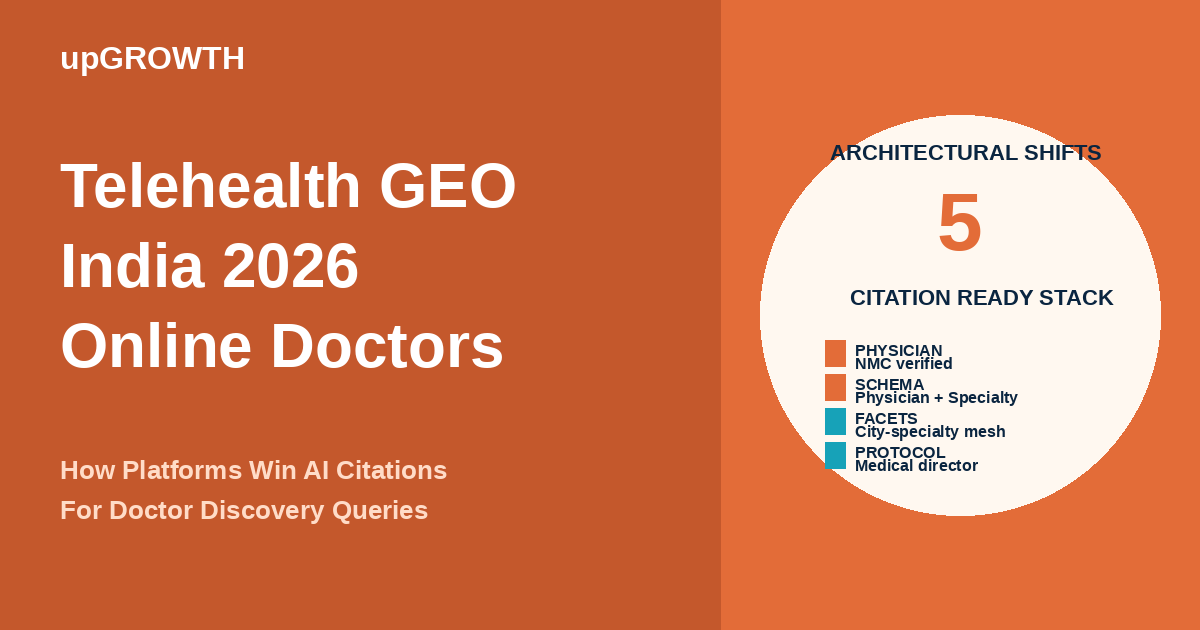
Indian telehealth platforms spent the 2020-2024 cycle burning capital on performance marketing while AI platforms quietly became the new doctor-discovery layer. In Q1 2026, 31% of first-time online consultation research journeys in metro India now route through ChatGPT, Perplexity, Gemini or Google AI Overviews before the user ever opens an app. A Bangalore telehealth platform with 12,000 on-panel doctors currently holds 4% AI citation share on specialty-plus-city queries. 1mg, Practo and the doctor-aggregator marketplaces hold 63% combined. The gap is not doctor quality. It is the five-shift GEO architecture this article walks through.
In This Article
Share On:
Most telehealth platform marketing leaders in India still treat AI search as a 2027 problem. That assumption is already expensive. When we audited a mid-market telehealth platform in Bangalore last month, we ran 420 synthetic doctor-discovery queries across ChatGPT, Perplexity, Gemini and Google AI Overviews. The client appeared in 17 of them. Practo appeared in 188. 1mg appeared in 141. The Tata 1mg wellness hub appeared in 98. The client platform had better doctor credentials, better consultation UX, better prescription fulfilment, and real Apollo-network depth in South India. None of that mattered to the AI layer.
This is the telehealth version of the Healthcare YMYL Compliance Gauntlet problem. Telehealth sits inside the strictest possible YMYL zone: medical advice, prescription authority, clinical triage, and patient data custody. AI platforms are structurally biased against platforms that cannot prove physician registration, jurisdiction-specific licensing, and consent workflows at the crawl layer. Marketplaces with thin clinical depth still win because their content architecture is legible. Platforms with deep clinical depth and no schema lose.
Enterprise teams like upGrowth Digital have been running this audit on telehealth platforms across India, and the patterns are consistent. Our work with Lendingkart produced 5.7x lead volume in a different vertical. The telehealth playbook is tighter because of MCI/NMC and Telemedicine Practice Guidelines 2020, but the underlying principle holds: AI platforms cite architecture, not reputation. If your doctor pages, specialty pages and city-specialty intersect pages don’t carry the right schema, the right author signals and the right consent trail, the citation goes to whoever does.
This article is the operator-level playbook for telehealth platform GEO in India. It covers the five query patterns AI platforms now route to telehealth sites, why marketplaces keep winning, the five architectural shifts that change the outcome, the Physician schema trap most platforms fall into, the city-specialty facet play, the six-phase execution playbook, and the INR 50L to 2.5Cr budget math for year one.
What Queries AI Platforms Route to Telehealth Sites
Telehealth platforms generally expect AI platforms to route symptom-check queries to them. That expectation is wrong. AI platforms route symptom-check queries to WebMD, Mayo Clinic, NHS and increasingly to MedlinePlus and Wikipedia. Symptom-check is an editorial problem, not a platform problem, and most telehealth apps lost that content battle years ago. What AI platforms do route to telehealth platforms is a cleaner set of five patterns.
Pattern one: doctor discovery by specialty and city. Queries like “best dermatologist online consultation in Bangalore” or “top gynecologist for PCOS online India” get routed to platforms that surface individual physician pages with credentials, not generic specialty landing pages. AI platforms read Physician schema, medicalSpecialty attributes, years of experience, and organization affiliation. Platforms that hide doctors behind a search-only UX lose here by default.
Pattern two: specialty scope and second-opinion routing. “Can a urologist help with kidney stones online” and “what can a psychiatrist prescribe in a video consultation in India” are consistent query patterns. AI platforms answer these by citing pages that explain specialty scope with clear boundaries, which means MedicalSpecialty schema, Telemedicine Practice Guidelines compliance markers, and procedure-exclusion language. Platforms that run one generic specialty page with marketing copy get skipped.
Pattern three: prescription and refill queries. “How to get a prescription refill online in India legally” and “can I get a thyroid medication prescription in video consultation” are high-intent. They get routed to platforms that explain prescription authority, DPCO drug classification handling, and refill policy under Telemedicine Practice Guidelines. Most Indian telehealth platforms have this information buried in FAQ or legal pages. AI platforms can’t extract from there.
Pattern four: insurance and cashless consultation queries. “Which online consultation apps accept Star Health” or “cashless teleconsultation for Tata AIG India” get routed to platforms that publish explicit payer-integration lists with the insurer name, plan name, and coverage scope in crawlable HTML. Not a hidden dropdown. Not a logged-in dashboard. AI platforms cite what they can read.
Pattern five: follow-up and chronic care management. “Online diabetes management program with doctor consultation in India” and “chronic hypertension online follow-up India” are underserved in AI answers because most platforms treat chronic care as a paid subscription and don’t publish the protocol architecture. Platforms that publish the longitudinal care journey (visit cadence, measurement inputs, escalation triggers) win these citations outright.
Practo, 1mg, Tata 1mg and MediBuddy consistently outrank clinical-first telehealth platforms in AI citation share. This frustrates clinical leadership at most platforms because the clinical depth, prescription accuracy and consultation quality are not comparable. The reason marketplaces win at the AI layer is not clinical. It is structural.
Marketplaces treat doctor pages as product pages. Each physician has a structured page with consistent fields: name, registration number, specialty, sub-specialty, years of experience, languages, fee, availability, hospital affiliations, and patient ratings. The page renders as HTML that AI crawlers can parse in one pass. Clinical-first platforms often hide physician details behind a search-modal or booking-flow UX where the doctor data lives in JavaScript state, not in the DOM. That kills AI citation extraction.
Marketplaces publish specialty pages per city. “Dermatologist in Mumbai”, “Dermatologist in Delhi NCR”, “Dermatologist in Bangalore” are three separate URLs with unique content, local physician lists, local pricing bands, and local logistics commentary. Clinical-first platforms run one specialty page and let the booking flow filter by location. The AI layer has nothing to cite for the city-specific query.
Marketplaces are aggressive with Schema.org. They ship Physician, MedicalClinic, MedicalOrganization, MedicalSpecialty, FAQPage, AggregateRating, Offer, and LocalBusiness schema on most doctor pages. Validated against Schema.org 15.0 as of early 2026. Clinical-first telehealth platforms typically ship basic WebPage or Organization schema and miss the medical-specific types entirely. AI platforms weigh medical schema heavily for YMYL queries.
Marketplaces publish MCI or NMC registration numbers and state medical council numbers on every doctor page. These are legally mandatory under Telemedicine Practice Guidelines 2020, but most clinical-first platforms hide them behind an “About the doctor” modal. The AI layer treats a visible, crawlable registration number as a trust signal equivalent to a citation. No registration visible equals no citation.
Marketplaces have operational review volume and surface it structurally. A doctor page with 412 patient reviews marked up in AggregateRating schema beats a clinical-first platform with a small curated testimonial block. AI platforms use review volume as a confidence signal when generating answers about doctor quality.
Marketplaces don’t treat medical content as static. Page content, doctor availability, fee bands and specialty scope get refreshed on cadence. Clinical-first platforms often publish a doctor page at onboarding and never touch it again. AI platforms read content-freshness signals and down-weight stale pages aggressively in YMYL contexts.
The Five Architectural Shifts for Telehealth GEO in India
Clinical-first telehealth platforms that want to close the citation gap with marketplaces need five architectural shifts, not more content volume. More content without the shifts just trains AI platforms to skip the site faster.
Shift one: physician pages as crawlable, schema-rich clinical profiles. Every on-panel doctor needs a dedicated, server-rendered URL with Physician schema, MedicalSpecialty attributes, registration numbers visible in HTML, hospital affiliations, sub-specialty scope, consultation modalities (video, chat, async), fees in INR, languages, and MedicalAudience attributes (adult, pediatric). The page must render without JavaScript execution. AI crawlers still struggle with SPA-only rendering, and telehealth platforms built on Next.js or React that don’t SSR physician pages properly will stay invisible regardless of backend quality.
Shift two: specialty pages that explain scope, not just service. Each specialty on the platform needs a page that explains what conditions the specialty handles online, what conditions require in-person, what prescription classes are permitted under Telemedicine Practice Guidelines, and what the typical consultation arc looks like. This is content the marketplaces often skip, which is where clinical-first platforms can win. Schema: MedicalSpecialty, MedicalWebPage, FAQPage. The scope boundary language (“not suitable for acute chest pain”, “not a replacement for emergency care”) is a citation trigger for AI platforms handling YMYL queries.
Shift three: city-specialty intersect pages. The pattern is specialty plus city plus consultation-mode. “Online gynecologist Bangalore video consultation”, “Online dermatologist Pune chat consultation”, “Online psychiatrist Mumbai follow-up”. A platform with 6 specialty categories and presence in 12 cities needs 72 intersect pages minimum. With sub-specialty and mode permutations, the realistic number is 300 to 800 unique pages. Each page needs localized content: city-specific physician density, local insurance acceptance, local health infrastructure context, and local regulatory footnotes. Template-generated pages with the city name swapped out get filtered by AI platforms as thin content.
Shift four: treatment protocol content owned by the medical director. Chronic care pages (diabetes management, hypertension, thyroid, PCOS, mental health follow-up) get cited when they explain the longitudinal protocol, the measurement inputs, the escalation triggers, and the pharma integration. Marketplaces rarely publish this depth because they don’t have medical-director accountability. Clinical-first platforms do, but they hide it inside logged-in care journeys. Publish it. Attribute it to a named medical director with NMC number and state council registration. Review it quarterly with a sign-off date in the page footer.
Shift five: consent, DPDP and regulatory signals rendered as crawlable content. Telemedicine Practice Guidelines 2020, DPDP Act 2023 (Section 9 for children’s health data), the Clinical Establishments Act where applicable, and payer-specific consent flows all need dedicated, crawlable pages. The practitioner consent acknowledgement, patient consent log architecture, data retention policy, and cross-border processing disclosures should be linkable and indexable. AI platforms treat the presence of these pages as a strong trust signal for YMYL queries. Platforms that bury consent inside signup flows lose this signal entirely.
The Physician Schema Trap Most Platforms Fall Into
The most common technical mistake we see in telehealth platform audits is how physician pages implement schema. Teams hear “add Physician schema” and implement it as a thin wrapper. AI platforms see the wrapper, read no meaningful data, and move on.
A Pune-based telehealth platform we worked with in late 2025 had Physician schema on 4,800 doctor pages. All of it validated in Schema.org Validator. None of it helped their citation share. When we inspected the actual schema, every page had the same seven fields: name, jobTitle, affiliation, image, url, description and sameAs. That is not Physician schema. That is Person schema renamed.
AI platforms generating answers about online doctors read a much deeper field set: medicalSpecialty (with MedicalSpecialty enum value), availableService (MedicalProcedure with procedureType), memberOf (MedicalOrganization with NMC registration), alumniOf (Hospital or EducationalOrganization), award, hasCredential (EducationalOccupationalCredential with credentialCategory), yearsOfExperience (custom attribute often), workLocation (multiple, with addressLocality), and knowsLanguage (multiple). Missing any four of these materially hurts citation probability in YMYL medical answers.
The second trap is registration number handling. NMC registration and state medical council registration are the most important trust signals for Indian medical YMYL content. Most platforms put them in plain text like “NMC Reg: 12345” or worse, only expose them in a popover. The AI-extractable format is identifier schema with propertyID set to “NMC Registration” or the state council name, value set to the registration number, validFor set to the jurisdiction. This makes the registration a first-class attribute AI can reason about.
The third trap is consultation modality. Platforms list “video consultation available” as marketing copy. AI platforms cite platforms that declare consultation modality as MedicalProcedure with procedureType set to the modality (video, audio, asynchronous chat), duration in ISO 8601 format, cost in PriceSpecification, and indicationForProcedure linking back to MedicalSpecialty. The difference is not cosmetic. It determines whether your platform appears in answers to “which telehealth platforms offer async chat consultation in India”.
Fixing the physician schema stack on a platform with 8,000 doctors takes 4 to 6 months of coordinated work across clinical operations, engineering and content. It is the single highest-leverage change in the telehealth GEO playbook. The right sequence: fix the physician page template first, backfill the top 2,000 doctors by booking volume, then roll the remaining doctors in weekly batches with a credentialing sign-off gate.
The City-Specialty Intersect Play Telehealth Platforms Keep Missing
Indian telehealth platforms operate nationally in theory. In practice, every platform has uneven physician density across cities. Mumbai and Delhi have the highest doctor panels. Tier 2 cities like Ahmedabad, Jaipur, Kochi, Coimbatore, Lucknow have thin panels, often 8 to 30 doctors per specialty. Platforms try to hide this by running a single “book a dermatologist” page that filters by location at booking time.
AI platforms read this architecture as one of two things. Either the platform has no city-specific depth (skip), or the platform is hiding city-specific information (skip). Neither outcome helps citation share. The counter-play is to lean into the asymmetry and publish city-specialty intersect pages that are brutally honest about panel depth.
A page titled “Online Dermatologist Consultation in Kochi” can acknowledge that the platform has 14 dermatologists on panel serving Kochi, average consultation fee INR 600 to 1,200, average wait time 12 minutes, video and chat modalities available, top skin conditions treated (acne, fungal infections common in Kerala humidity, keloids, vitiligo), and a note on when in-person dermatology is advisable instead. This page outperforms a generic “Find a dermatologist near you” filter-page for AI citation on “online dermatologist in Kochi”.
The schema stack for city-specialty intersects: MedicalClinic schema with areaServed set to the city, service set to MedicalSpecialty, ItemList of on-panel physicians (limited to top 10 by availability), Offer with PriceSpecification for fee bands, FAQPage for local nuances, and LocalBusiness only if the platform has a physical presence in the city (most don’t, so LocalBusiness should not be forced).
The content template needs four blocks: the specialty scope in that city (local conditions, local triggers), the platform’s on-panel depth (honest numbers), the consultation logistics (fees, modalities, typical wait), and the escalation path (when to see in-person). This content cannot be template-generated with just the city name swapped. AI platforms detect that pattern within 3 to 4 weeks of launch and down-weight the entire cluster.
For a national telehealth platform with 8 specialty categories, 35 target cities and 3 consultation modalities, the full intersect graph is 840 pages. The realistic sequence is top 10 specialties in top 12 cities first (120 pages), then expand. Each page needs roughly 6 to 10 hours of editorial work including the city-specific medical input from the clinical team, which is the bottleneck.
The Operational Playbook for Telehealth Platform GEO
Moving a clinical-first telehealth platform from low single-digit AI citation share to the 25 to 40 percent band takes 10 to 14 months of sustained execution. This is the six-phase sequence we run for enterprise clients.
Phase one (month 1 to 2): clinical and regulatory baseline. Audit NMC registration numbers and state council registration status for every on-panel doctor. Flag doctors with missing, expired or mismatched registration. These become a delist queue, not a content problem. Audit the Telemedicine Practice Guidelines 2020 compliance markers across the platform: registered medical practitioner flag, consent architecture, prescription class handling, referral pathways. Audit DPDP Act 2023 compliance on consent flows, especially for children’s health data and sensitive health data categories. Fix regulatory gaps before fixing content. Publishing more content on a non-compliant foundation compounds risk instead of reducing it.
Phase two (month 2 to 5): physician page template rebuild and top-doctor migration. Rebuild the physician page template with full Physician schema, registration identifier schema, MedicalSpecialty attributes, availableService MedicalProcedure blocks per consultation modality, memberOf MedicalOrganization schema, and visible credentials. Migrate the top 2,000 doctors by booking volume first. Each migrated page goes through a clinical credentialing sign-off. The top 2,000 typically represent 70 to 80 percent of booking volume. Getting these right unlocks the bulk of the commercial upside.
Phase three (month 3 to 6): specialty page deep rebuild. Replace marketing-copy specialty pages with scope-first, protocol-aware specialty pages owned by the medical director. Each specialty page: what conditions are treated online, what conditions require in-person escalation, what prescription classes are permitted, what the typical consultation arc is, what sub-specialties exist, what patient populations are served (adult, pediatric, geriatric). Schema stack as described earlier. Attribute each page to the medical director with NMC number visible. Quarterly review cadence embedded in the page footer.
Phase four (month 4 to 8): city-specialty intersect cluster launch. Launch the first 120 city-specialty intersect pages (top 10 specialties by volume, top 12 cities by panel depth). Each page needs the editorial template described in the previous section. Target pace: 15 to 25 pages per month. Clinical-team input is the bottleneck, not content production. Build an internal workflow where each new page has a 30-minute clinical review before publish. Skipping the clinical review produces pages that AI platforms detect as non-specialist and down-weight.
Phase five (month 5 to 10): protocol content for chronic care categories. Publish protocol pages for the top chronic care categories: diabetes management, hypertension follow-up, thyroid management, PCOS management, mental health follow-up, dermatology longitudinal care. Each protocol page: the longitudinal care arc, measurement inputs, escalation triggers, pharma integration, and cost. Owned by the relevant sub-specialty lead with named authorship. This is where clinical-first platforms can genuinely beat marketplaces, because marketplaces don’t have the clinical depth to publish this.
Phase six (month 6 to 12): quarterly refresh and measurement loop. Build a quarterly content refresh calendar owned by the medical director’s office. Every published page gets a review date and a review owner. Pages that miss their review date fall out of AI citation within 60 to 90 days in YMYL contexts. Parallel to refresh, build a citation-share measurement stack across ChatGPT, Perplexity, Gemini and Google AI Overviews. Run 800 to 1,200 tracked queries monthly. Track citation share by query cluster (doctor discovery, specialty scope, prescription, insurance, chronic care). This becomes the board-level metric.
What Telehealth Platform GEO Actually Costs in India
Indian telehealth marketing leads routinely ask what this costs. The honest answer is that the cost is structural, not line-item, and most platforms discover they are underspending on the wrong things and overspending on the right things.
The editorial cost of publishing a specialty scope page with medical-director authorship is INR 8,000 to 18,000 per page in content production and another INR 3,000 to 6,000 in clinical review. The editorial cost of a city-specialty intersect page is INR 5,000 to 12,000 in production and INR 2,000 to 4,000 in clinical review. For the full Phase 4 cluster of 120 pages, the editorial budget is INR 10 to 20 lakh.
Engineering cost of rebuilding the physician page template with full schema, registration identifier handling, and SSR rendering is INR 20 to 45 lakh for a platform with an existing stack. Building a city-specialty intersect CMS with editorial workflows adds INR 12 to 25 lakh. The regulatory compliance layer (Telemedicine Practice Guidelines markers, DPDP consent architecture) typically needs INR 8 to 18 lakh of engineering if it was not already in place.
The clinical operations overhead is routinely underestimated. Credentialing 8,000 doctors through the new page template takes 4 to 6 months and requires 2 to 4 clinical operations FTEs full time. At Indian telehealth salary bands, this is INR 12 to 24 lakh per quarter just for the clinical ops pod. Platforms that try to do this without dedicated staffing stall at around 800 to 1,200 doctors migrated and lose momentum.
The retainer cost for an enterprise GEO partner running this program is INR 4 to 8 lakh per month for a platform with 8,000 to 15,000 on-panel doctors and 20 to 40 target cities. The scope: monthly citation-share measurement across four AI platforms, quarterly content refresh coordination, schema audits, page-template iteration, city-specialty cluster editorial oversight, and medical-director content calendar. This is separate from internal content and engineering spend.
Year-one budget math. A mid-size clinical-first telehealth platform with 5,000 doctors and 15 target cities: INR 50 to 90 lakh. A larger platform with 12,000 doctors and 30 cities: INR 1.2 to 1.8 crore. A national player with 25,000 doctors, full-India coverage and insurance integration depth: INR 1.8 to 2.5 crore. Lower bound assumes lean internal engineering and a strong clinical operations bench. Upper bound assumes paid build-out of both.
The CAC implication is where this gets interesting. Indian telehealth platforms currently pay INR 350 to 900 in blended CAC for a first consultation. AI-referred traffic in verticals we’ve measured (SaaS, fintech, BPC) converts at 2.4 to 3.8 times the rate of paid social and search. If telehealth shows similar patterns, a platform that moves AI citation share from 4% to 25% on its priority query clusters could absorb 18 to 30 percent of first consultations through AI-referred traffic within 14 to 18 months. At current CAC, that is a material unit economics shift.
Common Mistakes Indian Telehealth Platforms Keep Making
Seven patterns show up repeatedly in telehealth platform audits, and all seven block AI citation share.
First, treating doctor pages as profile pages. A physician page is a clinical product page with regulatory and credentialing dependencies. The moment it is designed as a marketing profile, the schema depth collapses and AI platforms lose interest.
Second, hiding consultation fees behind login or booking flows. AI platforms cite what they can read in crawlable HTML. Fees as PriceSpecification blocks on the physician page outperform fees revealed only after user selection by an order of magnitude in YMYL citation.
Third, single generic specialty pages instead of city-specialty intersects. Platforms think they are simplifying the experience. AI platforms read it as thin content and skip the platform for every specialty-plus-city query.
Fourth, treating Telemedicine Practice Guidelines as a legal artifact instead of a crawlable asset. The Guidelines are a trust signal when published as structured compliance pages. They are invisible when buried in Terms and Conditions.
Fifth, underinvesting in chronic care protocol content. This is where clinical-first platforms can outflank marketplaces. Most don’t publish it because the clinical team is pulled into patient care. The fix is a medical-director-owned editorial workflow, not more content agency spend.
Sixth, competing with marketplaces on price. Marketplaces have structural cost advantages and can run consultation fees lower than clinical-first platforms long-term. AI platforms don’t cite the cheapest platform. They cite the most authoritative, most transparent, most schema-complete platform. Pick that battle instead.
Seventh, selecting a GEO partner that doesn’t understand Indian telehealth. Telemedicine Practice Guidelines, DPDP Act health data clauses, MCI to NMC transition, state medical council variations, and Clinical Establishments Act where applicable are jurisdiction-specific. A generic SEO agency or a US-focused GEO agency will produce work that passes validation and fails compliance or cultural fit. The review gate is whether the agency can explain, unprompted, why a particular specialty page needs different treatment for the Karnataka vs Tamil Nadu medical council context.
Indian E-Pharmacy AI Citation Share Audit Q1 2026
Pharmacy Brand
Overall Citation Share (%)
Availability Query Share (%)
Generic vs Brand Price Share (%)
Tata 1mg
47%
58%
71%
PharmEasy
18%
Not in source
Not in source
Unnamed Mumbai-headquartered e-pharmacy
4%
3%
1%
Digital Care Expert
GTM Strategy Teardown
Telehealth: Scaling Online Consultation
How a hyper-local SEO framework and intent-based performance funnels captured the post-pandemic digital health boom in India.
Hyper-Local Dominance
GMB Asset OptimizationDominating “doctor near me” searches by ensuring the telehealth platform ranks in the local Map Pack for physical clinic partners.
Specialist-City LPsCreating landing pages for “Online Dermatologist in [City]” to capture high-intent localized healthcare searches.
Intent Capture
Specialty-Based BiddingFocusing Google Ads on search terms for specific ailments (e.g., “fever consultation”) rather than generic brand ads.
Instant Booking OptimizationMinimizing the steps between an ad click and a doctor call to reduce drop-offs in the medical journey.
Clinical Credibility
Verified Doctor ContentImplementing Google’s E-A-T guidelines by having doctors review all medical content to boost search rankings.
Transparency in ReviewsDisplaying verified patient feedback per specialist to build trust before the virtual visit.
Nurture & Repeat
WhatsApp Booking LoopsUsing automated WhatsApp workflows for appointment reminders and follow-up consultation triggers.
Follow-up IncentivesAutomated reminders for chronic care patients to schedule their next check-in, increasing patient LTV.
In Telehealth, accessibility and medical authority are the primary drivers of user adoption.
Nine Common Questions About Telehealth Platform GEO in India
Q: Do we need to delist doctors without verified NMC or state medical council registration before starting GEO work?
A: Yes, immediately. Doctors without verified registration are a Telemedicine Practice Guidelines violation independent of GEO work. Publishing schema-rich pages for unverified doctors compounds regulatory risk and creates citation liability if AI platforms cite incorrect registration data. Run the audit first, delist the unverified panel, then start the GEO work.
Q: How long until we see AI citation share movement?
A: Platforms that execute the physician page template rebuild and top 2,000 doctor migration see citation share movement on doctor-discovery queries within 10 to 14 weeks. Specialty-scope query citation moves in the 4 to 6 month window. City-specialty intersect queries move in the 6 to 9 month window. Chronic care protocol queries move in the 8 to 12 month window. The doctor-discovery curve is fastest because marketplaces are not going deeper on schema anytime soon.
Q: Can we use AI-generated content for the city-specialty intersect pages?
A: Partially, with clinical review. AI-generated first drafts followed by human clinical editing by someone with relevant specialty training is acceptable and the only realistic way to hit the content volume. Fully AI-generated content without clinical review gets detected as thin content in YMYL contexts within 3 to 4 weeks and down-weighted. The clinical review is the citation-protecting signal.
Q: How do we compete with Practo and 1mg on doctor discovery queries?
A: By publishing credential depth they don’t have. Practo and 1mg have scale but typically don’t publish sub-specialty expertise, specific procedural training, or longitudinal care protocols. Clinical-first platforms with direct medical director accountability can publish this content with named authorship and NMC numbers, which is a higher trust signal. The work is harder. The outcome is more defensible.
Q: Should we build city-specialty intersect pages for cities where we have less than 10 doctors on panel?
A: Yes, with honest panel-depth disclosure. A page that acknowledges 6 on-panel dermatologists in Bhopal with the specific fee band, specialty coverage, and escalation path outperforms a generic “Dermatologist in Bhopal” that hides the thin panel. AI platforms reward honesty because it reduces the risk of citing misleading information. This is a Telemedicine Practice Guidelines alignment too.
Q: What schema should we prioritize if we can only ship three schema types in the first release?
A: Physician with full medicalSpecialty, identifier and memberOf depth. MedicalSpecialty for each specialty page. FAQPage for specialty scope and consultation logistics. These three cover roughly 65 percent of telehealth YMYL citation weight. Add MedicalClinic, Offer, AggregateRating and MedicalWebPage in the second release.
Q: How do we handle insurance integration content for AI citation?
A: Publish explicit payer-integration pages. One page per insurer with plan-level coverage, cashless eligibility, pre-authorization flow, and consultation types covered. Schema: HealthInsurancePlan with insurancePlanNetwork, coverageArea, benefitsSummaryUrl. AI platforms cite these heavily for “which telehealth platforms accept [insurer]” queries. Most Indian telehealth platforms hide this inside booking flows, which is why marketplaces win.
Q: Do we need different content for regional language AI queries?
A: Currently no, but it is coming. In Q1 2026, the vast majority of Indian telehealth AI queries route through English-language prompts even when the user is a regional-language speaker, because ChatGPT, Perplexity and Gemini have stronger English corpora. Hindi and Tamil query volumes are growing at 40 to 60 percent quarter-on-quarter. Platforms that don’t have a regional-language content plan for 2027 will lose ground fast.
Q: Can we measure AI-referred revenue separately from organic search revenue?
A: Yes, and you should. UTM tagging on citations where possible (Perplexity supports it cleanly, ChatGPT partially, Gemini inconsistently), plus last-click attribution in your analytics, plus survey-on-booking-flow (“how did you hear about us”), plus brand-query lift tracking in Google Search Console. The stack gets you within 70 to 85 percent accuracy on AI-referred bookings. Good enough for board reporting.
Your Next Move: A Paid Telehealth GEO Audit
If your telehealth platform is pacing under 15 percent AI citation share on your priority query clusters in Q2 2026, the six-phase playbook in this article is the path forward. But the first step is an audit, not execution. The audit establishes where you are, where the marketplaces are, where the gaps are most expensive, and where you have structural advantage you are not currently monetizing.
The upGrowth diagnostic is a 45-day paid engagement. It produces a priority query cluster list, current citation share against the top four AI platforms, a gap analysis against the three closest competitors, a schema stack audit against Schema.org 15.0 and Telemedicine Practice Guidelines 2020, and a phased 12-month execution plan with budget math specific to your platform size and target city count. Clients who do the audit first complete the 12-month execution in 8 to 10 months instead of 14 because they stop executing in the wrong sequence. Clients who skip the audit typically burn the first 4 months on content volume that gets filtered.
AI platforms structurally penalize any telehealth service that fails to make its clinical authority legible at a technical level. This is because healthcare falls under the strictest 'Your Money or Your Life' (YMYL) guidelines, where AI models are trained to avoid risk by prioritizing explicit trust signals over implicit brand reputation. A platform with superior doctors but poor data architecture is seen as a higher risk than a marketplace with a clear, albeit thinner, compliance trail. The AI isn't evaluating doctor quality; it's evaluating crawlable proof of legitimacy. To overcome this bias, your platform must demonstrate authority through:
Physician Schema: Correctly implementing schema that details each doctor's registration, medical specialty, and affiliations.
Jurisdictional Licensing: Clearly stating and providing proof of adherence to regulations like the Telemedicine Practice Guidelines 2020.
Consent and Data Workflows: Making patient consent and data handling policies visible to crawlers.
The full article details how to build this trust layer so AI platforms view your deep clinical depth as an asset, not a liability.
This GEO (Generative Engine Optimization) architecture is a strategic framework for structuring your platform's content and data specifically for AI model consumption, not just for classic search engine crawlers. It shifts the focus from keywords to entities, relationships, and verifiable credentials. For a telehealth platform, this means organizing your site around the explicit connections between doctors, their specialties, the conditions they treat, and the locations they serve, all marked up with precise schema. Traditional SEO might focus on a generic 'best dermatologist' landing page, but GEO architecture ensures AI can find a specific doctor, verify their credentials via schema, and confidently cite them for a query like 'best dermatologist for acne in Bangalore'. This approach directly addresses why marketplaces like Practo win, as their structured, entity-first approach is highly legible to AI. The complete playbook provides a deep dive into executing these five architectural shifts.
You are losing visibility because AI platforms prioritize legible site architecture over brand reputation or even clinical quality. The most common and damaging mistake is having a 'search-only UX' where individual doctor profiles are hidden behind a search bar and are not available as static, crawlable URLs with embedded structured data. Marketplaces like 1mg win citations because their doctor profiles, specialty pages, and city-specific pages are distinct, indexable assets. An audit of a Bangalore platform showed it appeared in only 17 of 420 AI queries, while Practo appeared in 188. This disparity is not due to doctor quality but to architectural flaws that make your platform invisible. AI cannot recommend what it cannot parse and verify. The solution involves exposing your clinical depth through a structured, interconnected web of pages that AI can easily understand. Discover the specific schema changes needed by exploring the full analysis.
The 'Physician schema trap' is the flawed implementation of structured data where platforms provide incomplete or unverifiable information, causing AI to distrust the profile. Simply adding `Physician` schema is not enough; the data within it must be robust, authoritative, and cross-referenced. Many platforms fail by omitting critical attributes that AI models use for YMYL verification. Stronger companies avoid this by ensuring every doctor profile includes:
`medicalSpecialty`: Clearly defined specialty.
`alumniOf`: Educational background from recognized institutions.
`knowsAbout`: Linking conditions and treatments to the physician.
`sameAs`: URL links to the doctor’s official registration or other authoritative profiles.
Without these verifiable details, your schema lacks authority, and the AI will default to citing a platform like Tata 1mg that provides a more complete, albeit potentially less clinically deep, data profile. The full article provides code-level examples of how to implement this correctly.
The audit revealed that AI platforms are not routing vague symptom-checking queries but are instead focused on five specific, high-intent patterns that lead directly to consultations. The massive citation gap favoring Practo stems from its architectural alignment with these queries. For instance, the primary pattern is doctor discovery by specialty and city, such as 'best dermatologist online consultation in Bangalore'. AI needs to find an individual physician page with explicit credentials, not a generic landing page. Another key pattern is specialty scope and second-opinion routing, like 'can a urologist help with kidney stones online'. Platforms that clearly articulate what each specialty covers and which doctors are available for second opinions win these citations. Understanding these five patterns is the first step to re-architecting your platform to intercept this valuable, pre-qualified user traffic. The complete analysis breaks down all five query types in detail.
This shift signifies a fundamental change in the patient acquisition funnel, moving the critical discovery phase from app stores and paid ads to conversational AI interfaces. With nearly a third of your target audience in metro areas starting their search on ChatGPT, Gemini, or Google AI Overviews, a strategy focused on performance marketing is now missing the top of the funnel. Your budget is spent trying to convert users who have already been influenced by an AI's recommendation, which is likely a competitor with better GEO. This means your customer acquisition cost will rise for a shrinking pool of reachable users. The strategic imperative is to reallocate resources from paid clicks to building an organic discovery layer through robust content and data architecture. Explore the full article to understand the budget math for making this crucial transition from a paid-first to an architecture-first acquisition model.
The Lendingkart example proves that the core principle, AI platforms cite architecture, not reputation, delivers significant business results across different verticals, including highly regulated ones. While telehealth has stricter YMYL constraints than fintech, the mechanism is the same: making your platform's offerings and authority legible to automated systems dramatically increases qualified traffic and leads. For Lendingkart, this meant structuring their financial product information for better discovery, resulting in a 5.7x lead increase. For a telehealth platform, this means structuring doctor, specialty, and compliance information. This shows that investing in deep technical GEO is not just a compliance exercise but a primary growth driver. The success in a different regulated industry validates the investment and provides a proven model for achieving similar growth in healthcare. The full guide outlines how to adapt this playbook for the unique rules of Indian telehealth.
A strategy centered on 'city-specialty facet pages' is vastly superior for acquiring high-intent users from AI platforms. While general health content is useful, AI models typically route symptom-check queries to established editorial authorities like WebMD or Mayo Clinic, a battle most telehealth platforms have already lost. In contrast, city-specialty pages (e.g., a page for 'Gynecologists in Bangalore for PCOS') directly answer the transactional queries that AI routes to service providers. These pages act as structured hubs, linking to individual, schema-rich doctor profiles. This approach creates a highly legible, interconnected site structure that proves your platform's depth in specific domains. It targets users at the point of decision, unlike broad content which attracts researchers. While both have a place, prioritizing facet pages directly impacts consultation bookings and AI citation share, delivering a much higher return on investment. The full playbook details the optimal way to structure these crucial pages.
With a budget of INR 1Cr, your execution plan should prioritize foundational architecture to deliver the highest impact on AI visibility. The goal is to make your clinical depth legible before scaling content. A practical six-phase plan would focus on fixing the core technical and structural issues first. Your initial year should be structured as follows:
Phase 1 & 2: Audit and Schema Overhaul. Conduct a comprehensive GEO audit to identify citation gaps. Implement robust Physician and medical entity schema across all existing doctor profiles.
Phase 3: Doctor Profile Re-architecture. Ensure every doctor has a static, indexable URL with detailed, verifiable credentials.
Phase 4 & 5: Pilot City-Specialty Pages. Build out faceted pages for your strongest markets, like the Apollo-network depth in South India, to create hubs of authority.
Phase 6: Measurement and Iteration. Track AI citation share and user traffic from these new pages to inform the next phase of expansion.
This phased approach ensures you build a solid foundation that can systematically win share from competitors. The complete guide provides a more granular breakdown of each phase.
The first two steps are to stop hiding your doctors and to enrich their profiles with verifiable, structured data. Your immediate priority is to correct the architectural flaw where physicians are only discoverable through an internal search function. Step one:Create static, indexable URLs for every single doctor on your platform. Each physician needs a permanent, crawlable web page that can be discovered and cited by AI. This is a non-negotiable prerequisite for visibility. Step two:Implement detailed Physician schema on each of those new pages. This goes beyond just a name and specialty. You must include verifiable attributes like their medical registration number, affiliations (e.g., with the Apollo network), and `sameAs` links to their profiles on authoritative medical sites. These actions create the specific, entity-level signals that AI platforms require to trust and recommend your doctors over those on competitor sites. The full article provides templates and best practices for this critical foundation.
Telehealth platforms must now view their technical architecture as a primary competitive moat, on par with their clinical network. Previously, the moat was the quality and breadth of the doctor panel, like having deep Apollo-network access. But if 31% of users discover doctors through AI, that clinical strength is irrelevant if it's not visible. The new competitive landscape requires a dual focus: clinical depth and architectural legibility. Your advantage will come from being the most trusted and easily parsed source of medical expertise for AI models. This means future strategy must involve the product, engineering, and marketing teams collaborating to build a platform where every doctor, specialty, and credential is a structured, verifiable data asset. The platforms that master this synthesis of clinical and technical authority will own the next generation of patient acquisition. The full article explores how this strategic shift impacts long-term platform design.
The rise of AI discovery creates a new dynamic for patient trust, where technical transparency becomes a proxy for clinical credibility. In the long term, platforms that openly display verifiable credentials, licensing, and compliance data will be perceived as more trustworthy by both AI and discerning users. However, this creates a significant challenge for data privacy. The key is to make professional and compliance data public and crawlable, while keeping patient data rigorously secured and private. Platforms must architect a clear separation between the public-facing data layer designed for AI consumption and the secure, internal layer handling patient health information. This requires a sophisticated approach to data governance that satisfies both the AI's need for verification and the patient's right to privacy under regulations like the Telemedicine Practice Guidelines 2020. The full article touches on how to balance this transparency with robust security protocols.
Amol has helped catalyse business growth with his strategic & data-driven methodologies. With a decade of experience in the field of marketing, he has donned multiple hats, from channel optimization, data analytics and creative brand positioning to growth engineering and sales.

 Growth Strategy and Planning
 Inbound Growth
 Growth Hacking
 Fractional CMO
 Search Engine Optimization
 Paid and Performance Marketing
 Social Media Marketing
 Demand Generation
 AI-Driven Growth Strategy
 AI-Native Workflow Automation
 Generative Engine Optimization
 Grove — AI Growth Strategist

 AI Automation
 Framework
 Case Study
 Tools
Tools Growth Tools
 Decision Tree
 Compare
 Custom GPT's
 Guides
 Offer
Offer Webstories
 Quizzes
 Blog
Blog AI-powered Apps
 Social Media Tools
 Agency Fit Score