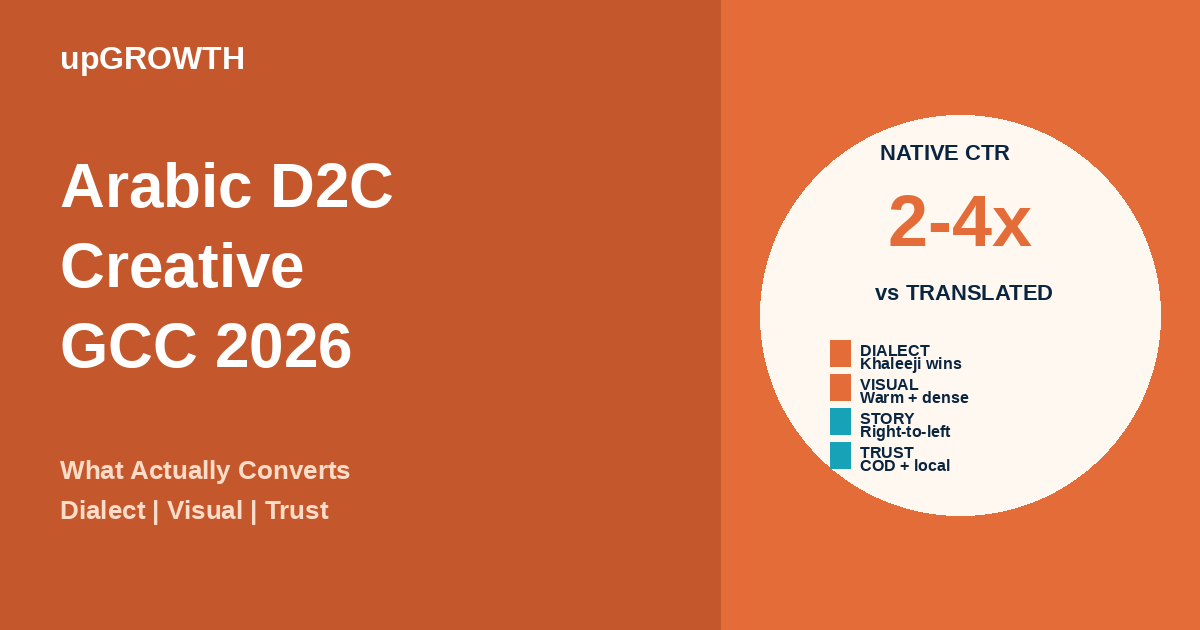
Arabic D2C creative that actually converts is not translated English creative. It is rebuilt from the ground up around dialect choice (MSA vs Khaleeji), visual cultural codes, storytelling structure, and trust signals that match how Gulf buyers decide. Brands that translate instead of transcreate see CTRs collapse by 60-80% versus native-built Arabic creative, even with identical targeting and spend. The four-element framework in this playbook is what separates creative that moves inventory from creative that burns budget in the UAE and KSA.
In This Article
Share On:
Here is the failure pattern we see every quarter. A D2C brand scales in India or the US, translates their top-performing creative into Arabic using Google Translate or a freelancer on Fiverr, launches in Dubai, and watches their CPC triple while their CTR collapses. They assume Arabic creative doesn’t work. The creative works fine. What they ran wasn’t Arabic creative. It was English creative wearing an Arabic costume.
Arabic D2C creative lives in a different semiotic world. The dialect you pick signals who you’re talking to before a single word registers. The colors you choose carry religious and regional weight. The way you structure a story must account for a reading direction that goes right to left and a cultural cadence that rewards patience over punch. Every stock image you pull from Shutterstock screams “foreign brand” to a Khaleeji viewer in 1.5 seconds. That 1.5 second judgment is the entire battle.
We’ve built creative for paid performance campaigns across Dubai, Abu Dhabi, Riyadh, and Jeddah for D2C brands in beauty, food, fashion, wellness, and home. The four-element framework below is what consistently produces winning creative in the GCC. None of it is complicated. All of it gets skipped when founders try to shortcut the work.
Why Translated English Creative Fails in GCC (And What Converts Instead)
Translation preserves words. Transcreation preserves intent. The difference shows up in three specific places.
Dialect mismatch kills trust. Modern Standard Arabic (MSA) is the formal written standard used in news and official documents. It is not what Gulf consumers speak. If your ad copy reads like a government press release, your audience treats you like one. Khaleeji Arabic is the spoken dialect of the Gulf (UAE, KSA, Qatar, Kuwait, Bahrain, Oman). It is informal, direct, and uses specific vocabulary that Egyptian or Levantine Arabic doesn’t share. Using Egyptian Arabic (the most common default because of entertainment media) to sell to Saudi buyers signals “we don’t actually understand you.”
Visual imports don’t code as local. An American model on a beach in Santorini lighting wearing a white linen dress looks great in a US Facebook ad. In KSA, that same image codes as “this is for women who don’t live like me.” Gulf women, even those who don’t wear abaya daily, recognize what local premium looks like. It is not pastel minimalism copied from Aesop. It is warmer tones, specific fabrics, architectural context, and compositional density that Western minimalism rejects.
Humor and urgency don’t translate. American D2C copy leans on self-deprecating humor, fake scarcity, and aggressive CTAs (“Buy now or miss out”). Gulf consumers read aggressive urgency as low-status. The brands that convert in GCC use slower, more dignified pacing, often with product demonstration before any call to action, and frame scarcity through exclusivity rather than countdown timers.
Fix the dialect first. Then fix the visuals. Then fix the copy rhythm. In that order.
The Four Elements That Make Arabic D2C Creative Convert
After testing thousands of ad variants across GCC markets, the winning creatives consistently hit four elements. Miss any one and performance degrades visibly.
Element 1: Dialect choice matched to geography. For UAE campaigns, Khaleeji with light MSA formality works for the premium segment and Egyptian Arabic works for the mass expat Arabic audience. For KSA, Khaleeji is mandatory, with a sub-dialect match (Najdi for Riyadh, Hejazi for Jeddah) for the top-performing creative. For Egypt-expat targeting in Dubai, Egyptian Arabic outperforms Khaleeji by 30-40% on CTR. Running one creative in one dialect across all GCC is the single most common mistake and the easiest one to fix.
Element 2: Visual codes that read as local. Three specific signals matter. Lighting: warmer tones (3000K-3500K) read as local premium, cooler Scandinavian lighting reads as foreign. Composition: Gulf audiences respond to denser, more layered compositions with ornamental framing rather than negative-space minimalism. Context: a product shot in a majlis-style interior, on Arabic coffee service, or in an oud-infused atmosphere outperforms the same product on a plain white background by 2-3x on engagement.
Element 3: Storytelling structure built for right-to-left reading. Arabic reads right to left. Your visual hierarchy must start from the right. The product should enter from the right side of the frame, the CTA button in video ads should animate from right to left, and text overlays should weight their emphasis on the right. English-trained designers default to left-start composition, which fights the viewer’s eye direction and leaks attention.
Element 4: Trust signals calibrated to Gulf buying psychology. Gulf consumers weigh trust signals differently than Western consumers. User reviews matter less than visible authority (celebrity or notable-person usage, government or religious endorsement where applicable, luxury retail placement). COD (cash on delivery) icons in the ad frame increase conversion by 15-25% in KSA. “Made in UAE” or “Made in KSA” badges carry more weight than “Made in France” for most categories, except luxury where French or Italian origin still commands a premium.
Creative Frameworks by Format (Static, Video, UGC)
Static ad framework (single image, Meta/Snap). Structure: product on the right, benefit headline in bold Khaleeji Arabic in the upper right, social proof element (arabic text review quote or celebrity association) in the lower right, and price/offer on the left side. Background: warm-toned contextual setting, not plain. Logo in the top right corner (where Arabic viewers expect brand identification). Total elements: five or fewer. Avoid the Western instinct to load the frame with multiple product shots.
Video ad framework (15-30 seconds, Meta Reels/TikTok/Snap). Hook (0-3 seconds): visual intrigue, not spoken. Arabic viewers scroll fast on spoken hooks in foreign dialects but stop on strong visuals. Product intro (3-8 seconds): product enters from the right, held by hands that match the audience (Arab hands, not Caucasian or South Asian). Demonstration (8-20 seconds): show the product working in a recognizably local context. Proof (20-25 seconds): one trust signal (celebrity usage, review quote in Arabic text, made-local badge). CTA (25-30 seconds): soft Arabic CTA (“Available now with COD” beats “Shop now”), button animates from right.
Influencer/UGC framework. The Gulf influencer economy is mature and the audience is sophisticated. Generic unboxing doesn’t move product. What works: longer-form content (60-90 seconds on Snap, 2-3 minutes on Instagram), first-person narrative of the problem and solution, showing the influencer’s actual home/life/family rather than studio content, and explicit mention of where to buy with COD if applicable. Nano and micro-influencers (10K-100K) consistently outperform mega-influencers on conversion rate for D2C in GCC, though mega-influencers still drive awareness at scale.
Common Mistakes That Tank Arabic Creative Performance
These are the mistakes we see brands make over and over in the first 90 days of GCC entry. Each one is a CTR killer.
Direct translation without transcreation. Taking English copy and running it through Google Translate or a non-native freelancer produces copy that technically parses but culturally fails. Every Arabic copy line should be written by a native Khaleeji or Egyptian speaker (depending on target) who understands D2C conversion copy, not just Arabic grammar.
Stock photography with non-local models. Shutterstock’s “Middle Eastern woman” category is largely populated by Turkish, Iranian, or North African models that Gulf audiences recognize as not-local. Either use local model shoots or use genuinely Khaleeji creators. The cost delta is real (AED 5,000-15,000 per shoot vs free stock) but the CTR delta is 2-4x in our testing.
Western humor and irony. Gulf consumers recognize and often enjoy Western humor in entertainment context, but respond poorly to it in commercial context. The “unhinged” D2C brand voice that works for Liquid Death or Poppi in the US reads as disrespectful or unprofessional when translated to GCC. Dignified, warm, slightly formal voice consistently outperforms quirky-casual.
Ignoring the Ramadan/Eid calendar. Gulf consumer behavior shifts dramatically during Ramadan (different shopping hours, different messaging tone, different category preferences) and Eid (gift-giving spikes, discount expectations). Running the same creative calendar you run in India or the US during these periods is leaving money on the table. Plan Ramadan creative refreshes 60 days in advance. Eid gift-bundle creative should launch 14 days before Eid, not 3.
Mixed-gender visuals in KSA without care. KSA has liberalized significantly since 2017 and mixed-gender lifestyle content is now acceptable in most contexts. However, the visual calibration still matters. Modest styling, appropriate physical distance between models, and family-coded contexts (rather than romantic-coded) convert better than applying UAE-liberal visual standards directly to KSA. This is not a rule about what’s permissible, it’s a rule about what feels local.
Testing Framework for Arabic Creative (What to A/B Before Scaling)
Don’t scale a single creative concept. The variants that convert in one GCC market don’t always convert in another. Here is the testing sequence we run for every D2C brand entering GCC.
Week 1-2: Dialect test. Same visual, same product, same offer. Three copy variants: pure MSA, Khaleeji, Egyptian Arabic (if targeting includes expat Arabic audience). Run at AED 100-200/day per variant. Winner: dialect with highest CTR at equivalent CPM.
Week 3-4: Visual test. Winning dialect copy. Four visual variants: local model in local context, local model in neutral context, product alone in local context, product alone in neutral context. Winner: visual with highest add-to-cart rate.
Week 5-6: Format test. Winning visual + copy. Three formats: static image, 15-second video, 30-second video. Winner: format with lowest CAC at scale.
Week 7-8: Offer test. Winning creative and format. Four offer variants: free shipping, COD highlight, bundle discount, first-purchase percentage off. Winner: offer with highest AOV-adjusted conversion.
Week 9+: Scale winner, refresh every 21 days. Creative fatigue in GCC Meta ads hits around day 18-21. Plan your creative refresh cycle in advance so you’re not scrambling when CTR drops.
Six Common Questions About Arabic D2C Creative Strategy
Q: Should I use MSA or Khaleeji for my D2C brand in GCC?
A: Khaleeji for UAE, KSA, Qatar, Kuwait, Bahrain, and Oman campaigns targeting local Gulf Arabs. Egyptian Arabic for UAE campaigns targeting expat Arab audiences (approximately 40% of UAE Arabic speakers are Egyptian expats). MSA only for formal institutional contexts. A Khaleeji-only D2C brand will outperform a MSA-only brand by 40-60% on CTR for lifestyle and fashion categories.
Q: How much does professional Arabic creative cost vs translated creative?
A: A native-written Arabic copy piece costs AED 500-1,500 per ad variant from a specialized GCC creative agency. Translation-only from a freelancer runs AED 50-150. The cost delta is 10x but the CTR delta is 2-4x in favor of native creative. Monthly creative budget for a D2C brand running serious Meta ads in GCC should include AED 8,000-20,000 for native Arabic creative production.
Q: Do I need different creative for UAE and KSA?
A: Yes. The dialect sub-variations, visual calibration for KSA’s more modest aesthetic, and different trust signal weights (COD matters more in KSA, premium positioning matters more in UAE) mean you should build separate creative sets. At minimum, rework the copy and the model/context imagery. Running identical creative in both markets leaves 20-40% performance on the table.
Q: Can I use AI-generated Arabic creative from tools like ChatGPT or Midjourney?
A: For copy, AI tools have improved significantly but still miss dialect-specific conversion nuances. Use them for first drafts, not final ad copy. Always have a native Khaleeji or Egyptian speaker review and edit. For imagery, Midjourney struggles with authentic Gulf visual codes (abaya details, majlis aesthetics, facial features) and often produces stereotypical or off-putting results. Human photography with local models still wins for performance creative in GCC.
Q: How do Ramadan and Eid change my creative calendar?
A: Ramadan requires a complete creative refresh 14 days before the month starts. Messaging shifts from aggressive sales to family, community, and iftar-oriented themes. Shopping hours shift (traffic peaks between 10 PM and 2 AM during Ramadan). Eid creative should launch 14 days before Eid al-Fitr and Eid al-Adha, focused on gifting, family, and celebration. Brands that ignore these cycles lose 30-50% of their Q1 GCC revenue potential.
Q: Should I show prices in my Arabic ads?
A: For mass-market D2C (under AED 300 AOV), yes. Price visibility with COD icon drives click-through. For premium D2C (AED 500+ AOV), lead with experience and exclusivity, show price on the landing page. Gulf luxury consumers expect to qualify the brand before encountering price, and price-first premium creative reads as mass-market positioning.
Your Next Move: Build Arabic Creative That Actually Moves Inventory
If you’re translating English creative into Arabic, you’re not running an Arabic creative strategy. You’re running a creative fire. The fix is not more translation, it’s a rebuilt creative system that starts from Gulf buying psychology, uses the right dialect for your geography, hits the four visual elements that code as local, and tests systematically before scaling.
Most founders learn this the expensive way, after burning AED 50,000-200,000 on translated creative that underperformed and blaming the market instead of the creative. The market is fine. The creative was wrong.
We build GCC-native creative systems for D2C brands entering UAE and KSA. The engagement starts with a Strategy Sprint (Rs 4L or AED 17,500) where we audit your current creative, benchmark against winning Gulf D2C creative in your category, and build the specific four-element framework your brand should run. From there, you either build in-house with our framework or we run creative production and media buying as an execution retainer.
Directly translating English creative fails because it preserves words but destroys intent, leading to a severe disconnect with Gulf audiences. This approach ignores the fact that Arabic D2C creative operates in a completely different semiotic world, where trust is built on cultural and linguistic nuance that automated tools cannot replicate. The 60-80% CTR collapse happens because the creative feels foreign and untrustworthy within the first 1.5 seconds of viewing. The core misunderstanding is treating localization as a simple language swap rather than a deep cultural adaptation process called transcreation. Successful brands understand that everything from dialect choice to visual composition must be rebuilt from the ground up to resonate. They recognize that what works in the US is often perceived as low-status or irrelevant in the UAE and KSA. To succeed, you must move beyond mere words and begin adapting the entire message. Explore the full framework to see how to rebuild your creative for this unique market.
The choice between MSA and Khaleeji Arabic directly signals your level of local understanding and fundamentally impacts trust. MSA is the formal, written language of news and official documents; using it in D2C ads makes your brand feel distant and institutional, like a government press release. Khaleeji, the spoken dialect of the Gulf, is informal and direct, creating an immediate sense of connection and authenticity. Using the wrong dialect, such as the more common Egyptian Arabic, is a clear sign that you have not invested in understanding the local culture, which immediately erodes credibility. For most D2C applications, Khaleeji is the correct choice for building rapport. For certain premium segments in the UAE, a light blend of Khaleeji with some MSA formality can convey sophistication. Getting this single element wrong can invalidate your entire creative effort before the message is even read. Discover the specific dialect strategies for each Gulf market in the complete guide.
Western visual codes often fail in the GCC because they don't align with local definitions of premium or aspirational lifestyles. An image of an American model in a minimalist linen dress on a European beach, for example, immediately codes as 'foreign' and 'not for me' to a Saudi consumer. The popular Western pastel minimalism seen from brands like Aesop is perceived as cold and empty, contrasting with the regional preference for warmth, detail, and compositional density. Successful visual strategies for the Gulf involve several key shifts. Instead of generic stock photos, use local models in culturally relevant settings. Swap cool, muted color palettes for warmer tones and richer fabrics. Acknowledge architectural context that feels familiar. The goal is to create imagery that reflects the lived reality and aspirations of Gulf women, which is a world away from the visual shorthand used in US or European ads. Learn the four essential elements of visual conversion by reading the full playbook.
To avoid the typical performance collapse, a fashion brand must adapt its creative in a specific, deliberate order. Rushing this process or getting the sequence wrong is why so many new entrants fail. The foundational step is to build a trustworthy presence before asking for a sale. Here is the proven three-step plan for effective adaptation.
Fix the dialect first: Shift all copy from MSA or translated English to the authentic Khaleeji Arabic spoken in Dubai. This is the bedrock of local connection.
Fix the visuals second: Recast and reshoot all creative using local models, locations, and styling that reflects Gulf aesthetics. This proves you understand the customer's world.
Fix the copy rhythm third: Re-script your ads to move away from aggressive, urgent calls to action. Adopt a more dignified, patient pace that demonstrates value before asking for the purchase.
This sequence ensures you establish cultural fluency before making a commercial appeal. The full article details how to execute each of these steps for maximum impact.
In the GCC advertising context, transcreation is the process of completely rebuilding a marketing message to preserve its original intent, emotion, and impact for a new culture, rather than just translating its words. Translation, which is what tools like Google Translate provide, focuses only on linguistic equivalence and misses the deep cultural codes that drive purchasing decisions. This is why it fails. For example, a humorous or urgent slogan in English might translate into grammatically correct Arabic that is culturally perceived as rude or low-status. Transcreation considers factors like dialect choice (Khaleeji vs. MSA), visual symbolism, storytelling pace, and local values around commerce. It is the difference between an ad that speaks fluent Arabic and an ad that speaks fluent 'Khaleeji consumer'. Brands that invest in this deeper process are the ones that build trust and convert inventory. Understand the full four-element framework for effective transcreation by reading more.
The failure pattern is remarkably consistent and begins long before the campaign launches. A D2C brand gains traction in a market like the US or India, identifies the GCC as its next target, and then takes a fatal shortcut: they hand their top-performing English creative to a low-cost freelancer on Fiverr or use an automated tool for translation. They launch this 'Arabic' creative in Dubai and are shocked when CPCs triple and CTRs collapse. They then conclude that paid ads in the Gulf do not work. The problem is not the channel; it is the creative. The solution is to completely abandon the translate-and-launch mindset. Instead, you must adopt a transcreation model that builds creative natively for the market. This involves a four-element framework focusing on correct dialect, culturally appropriate visuals, dignified copy rhythm, and trusted signals, ensuring the ad feels like it was made by and for the Gulf consumer. Dive deeper into this framework to reverse the pattern of failure.
The storytelling rhythm that works in the West is often counterproductive in the Gulf. American D2C copy frequently relies on self-deprecating humor, aggressive scarcity tactics like countdown timers, and punchy, direct CTAs. In the GCC, this approach is often read as low-status and untrustworthy. Successful creative in the region adopts a different cadence. It is a slower, more dignified pacing that prioritizes demonstrating value and building trust before asking for a sale. Humor is rarely used, as it can easily be misinterpreted across cultures. Urgency is framed through exclusivity and status, not through high-pressure 'buy now or miss out' language. Often, the most effective ad structures feature a patient product demonstration or a narrative that unfolds logically, respecting the audience's intelligence and giving them space to make a considered decision. This deliberate pacing aligns with a cultural preference for respectful and sophisticated commercial interactions. Explore the full guide to master the art of storytelling for this discerning audience.
As more brands enter the GCC, consumers are becoming increasingly sophisticated and discerning. The tolerance for poorly translated, generic advertising is rapidly diminishing, which means the competitive bar for creative is rising. Forward-thinking brands must shift from a tactical, translation-focused approach to a strategic, culture-first creative model. This has direct implications for both strategy and budget. Strategically, brands need to invest in deep pre-market research to understand local semiotics, not just language. This means allocating budgets for local creative teams, photographers, and copywriters in Dubai or Riyadh, rather than relying on remote freelancers. Operationally, you should plan for longer creative lead times to allow for proper transcreation and in-market testing. The future winners in this market will be those who treat the GCC as a primary region with unique demands, not as a simple add-on to their Western marketing efforts. The full analysis provides a roadmap for future-proofing your brand's creative investment.
Operating in a different 'semiotic world' means that the signs and symbols that create meaning extend far beyond words on a page. While grammatical accuracy is important, it is merely the entry ticket. True conversion is driven by mastering the non-verbal language of a culture. In the GCC, this includes several layers. The choice of Khaleeji Arabic over MSA is a semiotic signal of 'we are insiders'. The use of warm color palettes carries positive associations that cool tones lack. Even the compositional structure of an image is affected by the right-to-left reading direction of Arabic. Mastering this symbolic language is what allows a brand to build trust in the 1.5 seconds before a viewer decides if an ad is for them. Grammatically perfect Arabic in an ad featuring Western models and aesthetics still shouts 'foreign brand', breaking the connection and killing conversion potential. The full playbook explores how to decode and apply these crucial cultural symbols.
A home goods brand can use the four-element framework as a clear, sequential guide to build creative that converts in KSA. This systematic approach ensures no critical cultural details are missed. Following this order prevents wasting budget on ads that are destined to fail. The implementation would look like this:
Element 1: Dialect Choice. Exclusively use the Khaleeji Arabic dialect as spoken in Saudi Arabia. Avoid any Egyptian or Levantine influence to ensure the copy feels completely native and trustworthy.
Element 2: Visuals. Feature home interiors that reflect local architectural styles and decor preferences, not Western minimalism. Cast Saudi families or individuals who look authentic to the target audience.
Element 3: Storytelling Rhythm. Craft a narrative that focuses on family, hospitality, and quality. The pace should be elegant and measured, not rushed.
Element 4: Trust Signals. Incorporate cues that matter locally, such as certifications, positive customer testimonials from Saudi buyers, or highlighting locally sourced materials if applicable.
By building the creative around these four pillars, the brand can launch with a message that resonates deeply. Learn more about adapting each element in the full article.
The dramatic underperformance of translated creative highlights the current limitations of AI in handling high-context cultural adaptation. While AI is excellent at literal, word-for-word language tasks, it cannot yet grasp the semiotic and cultural nuances that drive trust and conversion in the GCC. The 60-80% CTR drop is a clear metric showing the value of human-led transcreation. The long-term implication is not that AI has no role, but that its role will be an assistive one. Future workflows will likely involve AI generating initial drafts or handling basic translations, which are then refined, rebuilt, and culturally validated by human experts with deep local knowledge. Brands that rely on fully automated localization for a market as nuanced as the Gulf will continue to see poor returns, reinforcing that for the foreseeable future, genuine cultural connection cannot be automated. This positions human creative strategists as essential for success in the region.
The four-element framework provides a systematic approach to building high-performing Arabic D2C creative. Missing even one of these elements can cause a significant drop in performance because they work together to create a cohesive and trustworthy message. The framework is the antidote to the common 'translate and launch' mistake. The four essential elements are: 1. Dialect Choice Matched to Geography, ensuring you speak the consumer's everyday language, like Khaleeji in the Gulf. 2. Culturally Native Visuals, which involves using local models, settings, and aesthetics that resonate with the target audience. 3. Appropriate Storytelling Rhythm, focusing on a dignified pace over aggressive urgency. 4. Region-Specific Trust Signals, which are the cues that build credibility within that specific culture. Addressing all four is critical because a campaign with the right dialect but wrong visuals will still feel disconnected, and great visuals with an untrustworthy CTA will fail to convert. Success requires a holistic execution of this entire framework.
Amol has helped catalyse business growth with his strategic & data-driven methodologies. With a decade of experience in the field of marketing, he has donned multiple hats, from channel optimization, data analytics and creative brand positioning to growth engineering and sales.

 Growth Strategy and Planning
 Inbound Growth
 Growth Hacking
 Fractional CMO
 Search Engine Optimization
 Paid and Performance Marketing
 Social Media Marketing
 Demand Generation
 AI-Driven Growth Strategy
 AI-Native Workflow Automation
 Generative Engine Optimization
 Grove — AI Growth Strategist

 AI Automation
 Framework
 Case Study
 Tools
Tools Growth Tools
 Decision Tree
 Compare
 Custom GPT's
 Guides
 Offer
Offer Webstories
 Quizzes
 Blog
Blog AI-powered Apps
 Social Media Tools
 Agency Fit Score