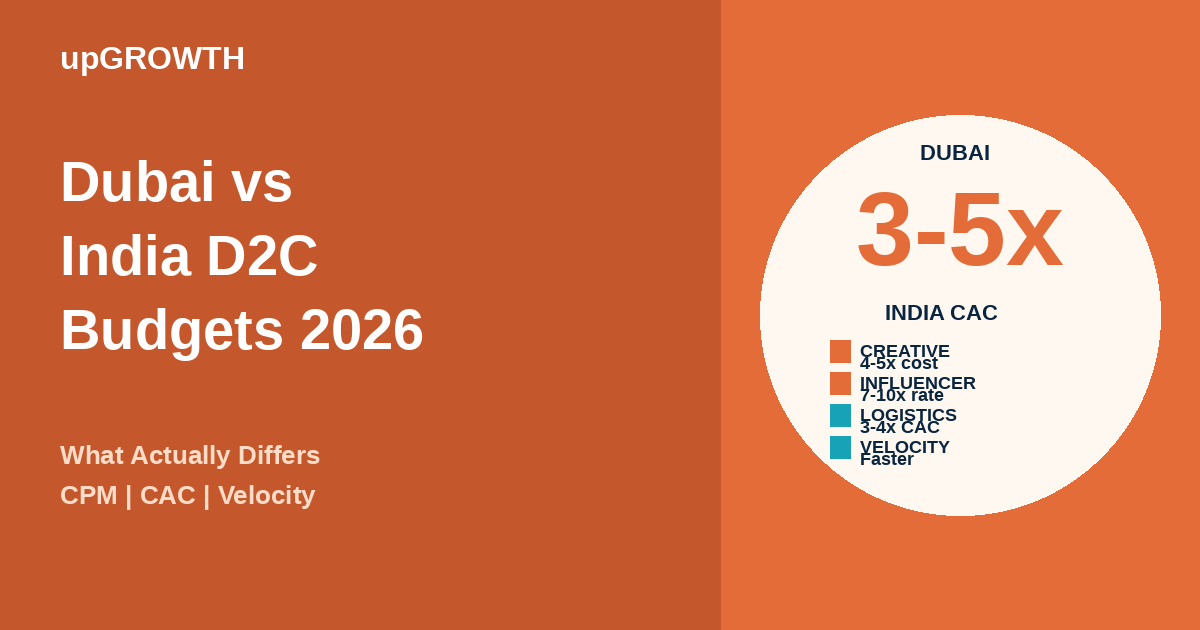
Dubai D2C marketing costs 3-5x more than India for equivalent reach, but AOV and LTV are also 3-5x higher. The real differences are not in CPM. They are in creative production, influencer rates, logistics-dependent CAC, and the shorter path from discovery to purchase. Brands that win in both markets run them as separate P&Ls, not as scaled-up versions of each other.
In This Article
Share On:
A founder messaged last week with a spreadsheet. He was selling a premium skincare line in India at INR 899 AOV, AED 89 AOV equivalent in Dubai, and wanted to know why his Dubai CAC was “three times higher than it should be.” His logic: Dubai CPMs on Meta are ~2.5x India CPMs, so CAC should be 2.5x. It was 3.8x. Something felt off.
It was not off. He was measuring the wrong thing.
Dubai and India are not two instances of the same D2C market with different exchange rates. They are structurally different markets with different creative standards, different media consumption patterns, different logistics economics, and very different purchase psychology. If you run your Dubai spend like an Indian D2C brand with currency conversion, you will bleed cash and blame the wrong variable.
At upGrowth Digital, we run paid acquisition and organic growth for D2C brands across both markets. The Delicut case study alone (AED 40K to 2M+ monthly in 18 months) forced us to build a parallel framework for GCC economics that looks nothing like the Indian playbook we started with. This piece breaks down where the real cost differences live, what it means for your budget allocation, and when the India learnings transfer versus when they actively hurt you.
Why Dubai D2C Is Not Just “Expensive India”
The mental model most Indian D2C founders start with: Dubai is India with higher CPMs and richer customers. Multiply your India numbers by 2.5x, add some Arabic translation, you’re done.
That model is wrong on four dimensions. Let me walk through each.
First, creative production economics are inverted. In India, you can produce a 15-second Meta Ad for INR 8,000-25,000 using freelancers on Fiverr, Upwork, or direct WhatsApp relationships. In Dubai, the equivalent production costs AED 1,500-4,500 (roughly INR 34,000-102,000). Not because Dubai is more expensive in absolute terms. Because Dubai audiences have higher creative quality expectations, and low-production ads get skipped in 0.8 seconds. You cannot run Indian freelancer creative in Dubai and expect similar CTR.
Second, influencer pricing scales non-linearly. A 100K-follower Indian lifestyle creator charges INR 15,000-40,000 per post. A 100K-follower Dubai creator (especially bilingual Arabic-English) charges AED 4,000-12,000 per post. That’s not 2.5x. That’s 7-10x. The supply is thinner, the audience is wealthier, and the creators know it.
Third, logistics CAC is a massive hidden variable. In India, cash-on-delivery is 55-70% of D2C orders, return rates run 25-40% for fashion/beauty, and unit logistics cost is INR 80-150 per order. In Dubai, COD is also significant (especially for first-time buyers), but return rates are lower (15-22%) because AOV is higher and buyers are more deliberate. However, unit logistics costs AED 18-32 per order (INR 410-730), and if you’re shipping pan-GCC (UAE + KSA + Kuwait + Qatar + Oman + Bahrain), cross-border logistics add another AED 12-45 per order depending on customs handling.
Fourth, and most importantly, purchase velocity is faster in Dubai. The average India D2C shopper takes 5-9 touchpoints across 12-28 days to convert at a premium price point. The Dubai shopper with the same intent takes 3-5 touchpoints across 4-10 days. This is partly because Dubai buyers have more disposable income and smaller consideration sets, and partly because UAE market size means fewer “analysis paralysis” loops. Your funnel compresses. Your retargeting windows need to be tighter. Your content strategy needs to front-load proof, not spread it across a 6-week nurture.
CPM, CPC, and CAC Benchmarks: India vs Dubai (2026)
Let me put real numbers on the table. These are aggregated from the D2C brands we actively manage plus published industry benchmarks. They’re directional, not universal.
Meta Ads (Facebook + Instagram) – Cold Traffic, D2C Beauty/Apparel/Lifestyle
Ratio: Dubai CAC runs 3.5-5x Indian CAC for equivalent product categories. But Dubai AOV runs 3-4x (AED 180-420 vs INR 900-2,100 equivalent), so unit economics can still work if your margin structure supports it.
Google is actually cheaper relative to Meta in Dubai than in India. If your category has high search intent (skincare, supplements, home goods), the Dubai search funnel is punchier.
TikTok – Emerging Channel, Higher Variance
India: Limited D2C scale due to platform ban aftermath, alternative platforms. Not directly comparable.
Dubai: TikTok CPM AED 12-28, CPC AED 0.6-1.8, CAC on conversion campaigns AED 45-130. TikTok in Dubai is currently the single highest-ROAS channel for D2C beauty and food categories if you have short-form video capability.
Budget Allocation Differences That Actually Matter
If you have AED 50,000 per month (INR 11.4L equivalent) to deploy in Dubai, here is how we typically split it for a mid-stage D2C brand. Compare this to how that same budget gets deployed in India.
Dubai allocation (AED 50K/month):
Meta Ads media spend: AED 20,000 (40%)
Google Ads media spend: AED 8,000 (16%)
TikTok media spend: AED 6,000 (12%)
Creative production (5-8 ads/month): AED 7,500 (15%)
Influencer/creator partnerships (2-3 per month): AED 5,500 (11%)
Agency management/tools: AED 3,000 (6%)
India allocation (INR 11.4L/month equivalent):
Meta Ads media spend: INR 6,20,000 (54%)
Google Ads media spend: INR 1,80,000 (16%)
Creative production (12-18 ads/month): INR 1,10,000 (10%)
Influencer partnerships (6-10 per month): INR 1,20,000 (10%)
The structural difference: Dubai skews more of your budget to creative and influencer, less to raw media spend. India skews the opposite way. If you apply Indian ratios to Dubai (76% on media, minimal creative), your ads will burn because the creative won’t hold attention. If you apply Dubai ratios to India (26% on non-media costs), you’ll be under-deployed on reach.
When Indian D2C Learnings Transfer to Dubai (And When They Don’t)
This is where founders get hurt most often. Let me be specific about what transfers and what doesn’t.
What transfers cleanly:
Email and WhatsApp marketing mechanics. WhatsApp Business API, abandoned cart flows, post-purchase sequences – these work identically. Dubai shoppers respond to WhatsApp faster than Indian shoppers actually.
Referral program structures. Give-get mechanics, tiered rewards, double-sided incentives – same frameworks, just adjusted for AOV.
Performance marketing structure. TOFU-MOFU-BOFU campaign segmentation, lookalike audiences, retargeting windows – transferable but needs Dubai-specific lookalike seeds.
What does NOT transfer:
Creative taste. Indian D2C creative trends toward dense, feature-packed, promotional visuals with multiple offers stacked. Dubai audiences respond to cleaner, aspirational, lifestyle-driven creative with single clear value propositions. Using Indian creative in Dubai tanks CTR.
Influencer strategy. India has a 1,000+ creator ecosystem in every vertical. You can run micro-influencer whisper campaigns with 50 creators. Dubai has maybe 80-120 relevant creators in any given D2C vertical. You need a concentrated strategy, not a volume play.
Discounting philosophy. Indian D2C conditioned consumers to expect 30-50% discounts. Dubai D2C consumers are more skeptical of heavy discounting – it signals low quality. The psychology is inverted.
COD and payment mix. UAE has Apple Pay and Tabby/Tamara (BNPL) as meaningful percentages of checkout. Neither is material in India D2C. If you don’t enable BNPL in UAE, you’re leaving 15-22% of conversions on the table.
Retention economics. UAE population is transient (18-24 month average expat tenure for many segments). Your repeat-purchase windows are compressed. LTV models built on Indian 36-month cohorts will overestimate Dubai LTV.
Six mistakes I’ve seen Indian D2C founders make repeatedly when they expand to Dubai. In rough order of most-to-least expensive:
1. Running Indian creative with Arabic subtitles. The creative was built for Indian consumption patterns. Arabic text does not fix it. You need ground-up creative shot for Dubai market, ideally by a creator who lives there or a production team that understands the visual language.
2. Using all-India payment stack. If your checkout doesn’t offer Apple Pay, Tabby/Tamara, and card-first flows, you’re losing conversions. UPI doesn’t exist in UAE. COD conditioning is different.
3. Scaling spend too fast. In India, you can 3x spend month-over-month and retain efficiency because creative volume supports it. In Dubai, 3x spend scaling typically breaks CPA by 40-60% because the creative wells dry up fast. Scale at 1.5-2x max per month.
4. Ignoring Ramadan, Eid, and DSF. These aren’t optional calendar events in Dubai. CPMs spike 40-80% during Ramadan evenings. Dubai Shopping Festival (late December to end of January) is your Black Friday equivalent. Not planning for these is like an Indian brand ignoring Diwali.
5. Using pure-India influencers for GCC launch. South Asian community in Dubai is ~38% of UAE population, so Indian creators do work for that segment. But if you’re only reaching that audience, you’re capped at 38% of TAM. You need Arabic-first, Khaleeji, and Western expat creators too.
6. Assuming logistics partners work the same. Delhivery, Shiprocket, Ecom Express – these don’t operate in UAE. You’ll work with Aramex, DHL, or local 3PLs like Quick Commerce Dubai. Pricing, SLAs, and tech integrations are completely different. Budget 3-4 weeks of operational runway to get this right.
D2C Marketing Benchmark Comparison: Dubai vs India (2026)
Metric
India Value
Dubai Value
Budget Allocation: Meta Ads
54%
40%
Budget Allocation: Creative Production
10%
15%
Meta Ads CAC (First-purchase)
INR 450-1,100
AED 80-220
Typical Average Order Value (AOV)
INR 900-2,100
AED 180-420
Meta Ads CPM
INR 180-340
AED 22-45
Meta Ads CPC
INR 7-18
AED 1.2-2.8
Google Shopping CPC
INR 4-12
AED 0.8-2.4
Influencer Rate (100K followers)
INR 15,000-40,000
AED 4,000-12,000
Creative Production Cost (per ad)
INR 8,000-25,000
AED 1,500-4,500
Cross-Border Economics
GTM Strategy Teardown
Dubai vs. India: The 3-5x CAC Gap
Why Dubai D2C isn’t just “expensive India” and how the inverted budget allocation model drives high-velocity growth.
Efficiency Benchmarks
CAC Ratios (3.5x – 5x)India CAC: ₹450-₹1,100 vs. Dubai CAC: AED 80-220. Higher costs are offset by 3-4x higher AOVs (AED 180-420).
Purchase VelocityDubai shoppers take 4-10 days to convert (3-5 touchpoints) vs. India’s 12-28 days (5-9 touchpoints).
Budget Allocation
The 25% Creative RuleDubai requires ~25% of budget for creative/influencers. Applying India’s media-heavy ratios (minimal creative) lead to rapid ad fatigue.
Influencer Non-LinearityDubai influencers expect cash over barter. Rates scale non-linearly, requiring deeper partnership models than Indian nano-seeding.
Logistics Variable
Unit Logistics (5x Cost)India: ₹80-150/order vs. Dubai: AED 18-32/order (₹410-730). Pan-GCC shipping adds another AED 12-45 in customs/fees.
RTO & COD AdvantageDubai returns (RTO) are significantly lower than India’s 25-40% fashion benchmarks, preserving CAC efficiency.
Distribution Strategy
Marketplace MixGCC brands often run 80%+ marketplace revenue (Noon/Amazon) vs. India’s 40-50% D2C-first preference.
Profitability ParadoxDirect D2C can be 4.5x more profitable per unit in Dubai, yet the “trust tax” keeps founders dependent on marketplaces.
Dubai isn’t just more expensive; it requires a fundamental budget pivot from raw media spend to high-fidelity creative.
Eight Common Questions About Dubai vs India D2C Budgets
Q: What minimum monthly budget do I need to meaningfully test Dubai as an Indian D2C brand?
A: AED 25,000-35,000 (INR 5.7-8L) per month for a 3-month test. Below this, you can’t generate statistically meaningful data across creative variants and audience segments. The test includes media spend, 4-6 Dubai-native creatives, and 2 creator partnerships.
Q: Can I just translate my Indian ads to English for Dubai?
A: Technically yes, practically no. The visual grammar is different. Indian D2C ads tend to be information-dense with overlay text, multiple offers, and fast cuts. Dubai ads perform better when they’re visually cleaner, aspirational, and built around a single proposition. Translation alone leaves 40-60% CTR performance on the table.
Q: How does the Dubai creator economy compare to India’s?
A: Smaller and more expensive per creator, but with higher conversion rates when matched correctly. A 50K-follower Dubai lifestyle creator often delivers better ROAS than a 500K-follower India creator because the audience is smaller, more purchase-ready, and the creator has direct relationships with a higher percentage of followers.
Q: Should I run UAE-only campaigns or pan-GCC from day one?
A: UAE-only for the first 90 days. Prove the model in your most tested market before adding KSA (different regulatory environment, Arabic-first creative needs, different logistics) and smaller markets. Trying to launch pan-GCC simultaneously triples operational complexity before you have any signal.
Q: How do I handle the VAT and customs impact on D2C unit economics?
A: UAE has 5% VAT (invoice-inclusive), which is straightforward. The bigger issue is customs if you’re shipping from India: expect 5% customs duty plus 5% VAT on CIF value, plus clearance fees of AED 100-300 per shipment. For B2C direct shipments, this makes fulfillment-from-India uneconomical above AED 150 AOV. Most serious D2C brands ship from a Dubai-based fulfillment partner (Fetchr, Bosta, Quiqup).
Q: What’s the realistic payback period for Dubai D2C CAC?
A: For beauty/personal care: 2.4-3.8 months. For apparel/fashion: 3.2-5.1 months. For supplements/wellness: 2.8-4.2 months. For food/gourmet: 1.8-2.6 months (Delicut sits in this range). These are slightly faster than Indian D2C equivalents because AOV is higher and repeat frequency is similar.
Q: Do I need a local entity to run D2C in Dubai?
A: Not necessarily. You can operate through Free Zone setups (IFZA, DMCC, Meydan Free Zone are popular for D2C) with 100% foreign ownership, no personal tax, and mainland sales access via distributors. Full mainland presence costs more but unlocks direct B2B and retail channels. For D2C pure-play, Free Zone is usually sufficient for the first 24 months.
Q: When should I consider an agency partner for Dubai D2C?
A: When your monthly media spend crosses AED 30,000 and you don’t have in-house creative + media buying capability in UAE. Below that spend level, a fractional consultant or project-based engagement is more efficient. Above it, the agency management fee pays for itself in media optimization and creative production scale.
Your Next Move: Dubai Market Entry Strategy Session
If you’re an Indian D2C brand actively planning Dubai expansion, the highest-value first step is a 90-minute market entry strategy session. We walk through your current India economics, map them against Dubai reality, and build a 12-week test plan with specific budget allocation, creative production requirements, and partner stack recommendations.
The output: a 14-page Dubai market entry plan with month-by-month budget allocation, creative brief templates, influencer shortlist (20-30 relevant creators for your category), logistics partner shortlist, and a success/failure framework. Rs 4L (AED 17,500) fixed fee, turnaround 2 weeks.
Amol has helped catalyse business growth with his strategic & data-driven methodologies. With a decade of experience in the field of marketing, he has donned multiple hats, from channel optimization, data analytics and creative brand positioning to growth engineering and sales.

 Growth Strategy and Planning
 Inbound Growth
 Growth Hacking
 Fractional CMO
 Search Engine Optimization
 Paid and Performance Marketing
 Social Media Marketing
 Demand Generation
 AI-Driven Growth Strategy
 AI-Native Workflow Automation
 Generative Engine Optimization
 Grove — AI Growth Strategist

 AI Automation
 Framework
 Case Study
 Tools
Tools Growth Tools
 Decision Tree
 Compare
 Custom GPT's
 Guides
 Offer
Offer Webstories
 Quizzes
 Blog
Blog AI-powered Apps
 Social Media Tools
 Agency Fit Score