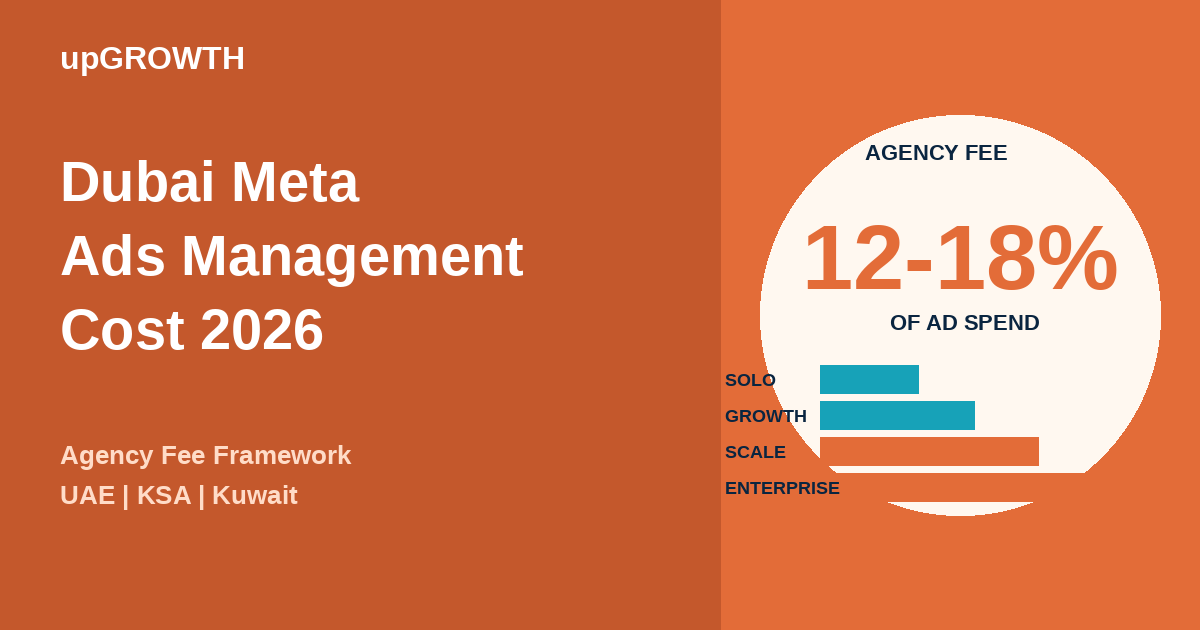
Meta Ads management cost in Dubai typically sits at 12-18% of ad spend for agencies and AED 8,000-22,000 flat for retainers, but the pricing structure matters more than the number. Flat retainers incentivise the agency to keep spend flat. Percentage retainers incentivise scale but inflate waste at higher budgets. The right model depends on your revenue bracket, creative cadence, and how much of the account the in-house team can actually run.
In This Article
Share On:
A Dubai D2C founder messaged me last month with a number that looked reasonable on paper. AED 15,000 monthly retainer to manage AED 60,000 in Meta Ads spend. 25% of spend going to the agency. The ROAS was fine. The account was profitable. But the founder had a nagging feeling that the math wasn’t quite working out, and he was right.
The agency was doing solid execution work. Fresh creatives every two weeks, audience testing, standard optimisation cadence. The problem was structural. At AED 60K in spend, 25% of spend is a heavy fee. At AED 200K in spend, 25% of spend is criminal. And the agency had no incentive to push his account past AED 100K because the fee scaled linearly with spend while the operational effort did not.
This is the math most Dubai D2C founders are running and getting wrong. Not because agencies are dishonest. Because the pricing models weren’t built for the scale you’re trying to reach. At upGrowth Digital we’ve managed Dubai and GCC Meta Ads budgets from AED 20K per month to AED 1M+ per month, and the pricing structure that works at each level is different. Let’s break it down honestly.
What Meta Ads Management Actually Costs in Dubai (2026 Benchmarks)
Here are the pricing patterns I see consistently across the Dubai and UAE D2C market in 2026:
Solo freelancers and boutique agencies (under AED 40K spend): AED 3,000-6,000 flat monthly retainer. Sometimes quoted as 10-15% of spend. Usually one person wearing three hats. Fine for early-stage accounts with simple funnels, but the creative bottleneck hits fast.
Mid-market agencies (AED 40K-150K spend): AED 8,000-15,000 flat or 12-18% of ad spend, whichever is higher. This is the most crowded segment in Dubai. You get a dedicated account manager, a creative strategist who’s half-time on your account, and a performance analyst. The fee-to-spend ratio sits around 15-20% at the lower end of this bracket.
Scale-stage agencies (AED 150K-500K spend): AED 18,000-35,000 flat or 8-12% of ad spend. At this budget range the percentage model starts to work in the founder’s favour because the operational complexity does justify the higher absolute dollars, but the percentage is lower. Expect a pod structure (AM, strategist, analyst, creative producer).
Enterprise (AED 500K+ spend): Flat retainer of AED 30,000-60,000 OR 5-8% of spend (whichever is higher). Below 5% you’re getting managed by a junior. Above 8% at this scale is getting robbed.
Those are the visible numbers. What’s not visible is the structural incentive each pricing model creates, and that’s what actually determines whether you’ll scale.
Flat Retainer vs Percentage of Ad Spend: The Structural Tradeoff
Every Dubai Meta Ads agency uses one of three models. Each has a hidden incentive that shapes how your account gets run.
Flat retainer: AED 12,000 monthly regardless of spend. Feels safe to founders. Predictable cost. But the agency’s incentive is to minimise effort, not to scale your account. A flat-retainer agency running your AED 60K account makes the same money whether you spend AED 60K or AED 30K. They’re not motivated to push creative velocity, test new audiences aggressively, or expand into new placements. The account plateaus and nobody talks about why.
Percentage of ad spend (typically 10-15%): Feels fair. You pay more when you spend more. The agency’s incentive aligns with scale. But the waste scales too. At AED 200K in spend, 12% means AED 24,000 in agency fees. That AED 24K could have hired you an in-house performance manager and paid for creative production separately. The agency has no incentive to run your account efficiently because a 10% drop in waste means a 10% drop in their revenue.
Flat or percentage, whichever is higher: The hybrid that most upper-mid-market agencies use. AED 12,000 flat OR 12% of spend, whichever is higher. This protects the agency on small accounts and gives them upside on large ones. For founders, it’s the worst of both worlds if the flat floor is aggressive. You pay the flat when spend is low, and the percentage when spend is high.
The math changes when you’re paying for creative production separately. If the retainer covers only media buying and account management (no creative production), the fee should be 40-50% lower than a full-service retainer. Dubai agencies don’t always break this out clearly.
What a Dubai Meta Ads Retainer Should Include (Line by Line)
Here’s the deliverable breakdown I’d expect at each price point. If the agency can’t match this list, renegotiate or walk.
AED 8,000-12,000/month (suitable for AED 30K-80K ad spend):
Daily spend monitoring across accounts, weekly optimisation passes, bi-weekly strategy review, monthly performance report, 4-6 ad variants tested monthly (but agency does NOT produce creative assets — you supply video and photography), audience research once per quarter, pixel and Conversions API health check monthly. Account manager at 20% allocation, analyst at 15% allocation.
AED 12,000-20,000/month (suitable for AED 80K-200K ad spend):
All the above plus 8-12 ad variants monthly, creative strategist supports 2 concept briefs monthly, you supply raw footage and agency edits, A/B testing framework with quarterly velocity targets, weekly strategy calls, monthly executive summary, full-funnel campaign architecture (prospecting / retargeting / retention), landing page testing recommendations, weekly creative refresh cadence. Account manager at 40%, creative strategist at 25%, analyst at 30%.
AED 20,000-35,000/month (suitable for AED 200K-500K ad spend):
All the above plus full creative production (UGC coordination, editing, animation), dedicated pod (AM, strategist, analyst, creative producer), weekly creative drops, cohort analysis and LTV tracking wired into ad strategy, conversion rate optimisation for landing pages, competitive ad research via ad library, media mix modelling support, bi-weekly CEO-level strategy calls. This bracket starts to earn the fee.
Anything less than this at each bracket means you’re overpaying. Anything more and the agency’s over-delivering or padding.
Agency fee is the visible line item. Creative production is the invisible one, and it eats more budget than founders realise.
At AED 60K in monthly spend, you need roughly 8-12 new ad variants tested monthly to avoid creative fatigue. If each variant needs a 15-30 second video with decent production, that’s AED 1,500-4,000 per variant depending on whether you’re using UGC creators, an in-house production team, or an agency-managed studio. 10 variants at AED 2,500 average is AED 25,000 monthly in creative production alone. That’s more than most founders budget.
What’s happening in practice: founders run the same 4 creatives for months, ad fatigue kicks in, CPMs rise, ROAS drops, and they blame the agency for “declining performance.” The agency’s been asking for fresh creative for 8 weeks. The founder’s been saying “next month” because production feels expensive.
Real Dubai D2C creative budget at AED 60-100K spend tier: AED 15,000-25,000 per month, running outside the agency retainer. At AED 200K+ spend, expect AED 30,000-60,000 monthly for creative production if you want to maintain the weekly refresh cadence that keeps CPMs under control.
This is why flat retainers that include creative production at AED 25K total for AED 150K spend accounts usually can’t deliver. The agency is either under-producing creative or losing money on the account. Neither ends well.
When to Hire an Agency vs Build In-House in Dubai
The agency-vs-in-house decision in Dubai is less about cost and more about the specific growth phase you’re in.
Agency makes sense when: You’re spending under AED 300K monthly and haven’t built the creative and analytics muscle yet. Agency access to platform betas, industry benchmarks, and cross-client pattern recognition is worth the fee at this stage. You get compounding learning without paying to build it in-house.
In-house makes sense when: You’re spending AED 300K+ monthly consistently, your product category is stable, and your ICP is well-defined. At this scale, hiring a Dubai-based performance manager (AED 18,000-28,000 monthly salary depending on seniority) plus a creative strategist (AED 15,000-22,000 monthly) plus freelance creative production (AED 30,000-50,000 monthly) typically costs AED 65,000-100,000 monthly total. That’s 22-35% cheaper than a scale-stage agency doing the same work, and you own the institutional knowledge.
Hybrid makes sense when: You’re in the messy middle (AED 150K-400K spend) where you can’t justify full in-house but you’ve outgrown boutique agency coverage. Common structure: internal performance manager owns the account, agency on a reduced retainer (AED 8,000-15,000) provides strategic oversight, creative support, and platform intelligence. This is where we see the most efficient Dubai D2C scale today.
The in-house versus agency cost comparison looks different in Dubai than it does in India or Europe. Dubai-based marketing salaries are 40-60% higher than Indian equivalents for comparable roles, which shifts the break-even point upward. An Indian founder thinking “I’ll just hire someone in-house for AED 10K” is likely getting a junior who can’t run the scale they need.
Red Flags in Dubai Meta Ads Agency Pricing
Five things to watch for when evaluating Dubai agencies:
1. Performance guarantees with no floor. “We guarantee 4x ROAS” sounds great until you ask what happens if ROAS drops to 3x. The agency restructures the pricing, argues about attribution windows, or quietly shifts the conversation to “brand building phases.” Run from any agency that guarantees a specific ROAS without conditions. Performance depends on your product, pricing, landing pages, and market dynamics, none of which the agency fully controls.
2. Commission-only structures. “We don’t charge anything, we just take 20% of the incremental revenue we generate.” Sounds founder-friendly. It’s not. The agency has no skin in keeping your account profitable because their fee is indexed to revenue, not contribution margin. They’ll push you into unprofitable scale and keep collecting the commission.
3. Bundled “digital marketing” retainers. “AED 25,000 monthly for Meta Ads, Google Ads, SEO, and social media management.” This is red flag territory. Each of those disciplines needs focused expertise. A bundle pricing structure usually means you’re getting surface-level coverage across four channels instead of depth in one. Meta Ads management alone deserves a dedicated team at any meaningful spend level.
4. No creative refresh cadence specified. If the retainer doesn’t quantify ad variants tested monthly, you’ll get whatever the agency feels like producing. And what they feel like producing drops when the account gets boring. Lock in creative velocity as a contractual deliverable.
5. Opacity on who actually runs the account. Many Dubai agencies sell the CEO or senior strategist in the pitch, then hand the account to a junior on day one. Ask for the seniority level of the person making daily optimisation decisions. Ask how many accounts they manage. If it’s more than 4 at your spend level, the attention is spread too thin.
How to Structure a Dubai Meta Ads Retainer That Scales
Here’s the structure we recommend to Dubai D2C founders at the AED 80K-300K monthly spend range:
Base fee + performance kicker. Flat retainer covers the guaranteed execution baseline. Performance kicker adds 5-10% of the agency fee when specific metrics are hit. Examples: maintain contribution margin above 18%, hit creative refresh velocity of 10 variants monthly, keep CPMs within 15% of baseline. This aligns incentives without creating the commission-only trap.
Creative budget broken out separately. Don’t bundle creative production into the management retainer. Agree on a monthly creative budget (AED 15,000-40,000 depending on spend tier) that’s transparent, billable separately, and directly tied to ad variants delivered. This prevents the “we can’t produce fresh creative because the retainer doesn’t cover it” standoff.
Quarterly fee review tied to spend bracket. Write into the contract that the fee automatically reviews when spend crosses thresholds (AED 100K, AED 250K, AED 500K). At each threshold, the percentage drops. At AED 60K spend, you might pay 15% of spend. At AED 150K, drop to 11%. At AED 300K, drop to 8%. Lock this in writing at contract signing so you’re not renegotiating from a weak position 8 months in.
Explicit scope and out-of-scope list. Most disputes come from scope ambiguity. Document what’s in: daily monitoring, weekly optimisation, monthly reporting, X creative variants tested per month, specific platforms covered. Document what’s out: creative production, landing page design, non-Meta platforms, influencer sourcing, customer service response. Anything not explicitly in-scope is billed separately or not delivered.
Meta Ads Management Pricing Benchmarks Dubai 2026
Service Tier
Ad Spend Range (AED)
Management Fee Structure
Key Deliverables
Solo Freelancers & Boutique Agencies
Under 40,000
AED 3,000 – 6,000 flat or 10 – 15% of spend
Simple funnels; usually one person wearing three hats; creative bottlenecks are common.
Mid-market Agencies
40,000 – 150,000
AED 8,000 – 15,000 flat or 12 – 18% of spend (whichever is higher)
Common Questions About Dubai Meta Ads Management Cost
Q: Is 15% of ad spend a fair Meta Ads management fee in Dubai?
A: 15% is fair at AED 40K-100K monthly spend with a mid-market agency doing full management plus creative strategy. Above AED 150K monthly spend, 15% is too high and you should be negotiating to 10-12%. Above AED 300K monthly spend, 15% is excessive and you should be at 7-10% or moving to a flat retainer structure.
Q: How much should I budget for creative production on top of the agency fee?
A: Budget 20-30% of your ad spend for creative production separately from the agency retainer. At AED 60K ad spend, that’s AED 12K-18K monthly in creative production. At AED 200K spend, AED 40K-60K monthly. Undershooting creative budget is the single most common reason Dubai D2C accounts plateau at the same creative variants running for months.
Q: Can I get away with a flat AED 5,000 retainer agency in Dubai?
A: You can at spend levels under AED 30K monthly and simple single-product funnels. At that price point expect a solo operator or junior-led team, minimal creative strategy input, and limited platform expertise. It works until it doesn’t. Most D2C brands outgrow this tier within 4-6 months of meaningful growth.
Q: Should I hire a freelance Meta Ads specialist instead of an agency in Dubai?
A: A senior freelance specialist in Dubai costs AED 8,000-15,000 monthly for one account and can deliver the same tactical output as a mid-market agency. You lose agency-level process rigour, bench depth, and cross-client learning. For AED 60-100K monthly spend accounts with stable operations, a senior freelancer is often the right call. For complex multi-market operations or founders who need strategic sparring, the agency earns its fee.
Q: What’s the difference between UAE, KSA, and Kuwait Meta Ads management pricing?
A: UAE-based agencies quote 20-40% higher than Indian or Egyptian agencies serving the same market due to local salaries and operating costs. KSA agencies price slightly higher than UAE due to smaller mature talent pool. Kuwait operates mostly through UAE-based agencies serving the market remotely. For most GCC D2C brands, a UAE-based agency or an Indian agency with dedicated GCC account management hits the best quality-to-cost ratio.
Q: Do Dubai Meta Ads agencies charge VAT?
A: UAE-registered agencies charge 5% VAT on all retainer fees. Indian agencies serving UAE clients do not charge UAE VAT but may be subject to reverse-charge mechanism depending on your setup. Factor VAT into total cost comparisons when evaluating local versus offshore options.
Your Next Move: Audit Your Meta Ads Retainer Structure
If you’re spending AED 60K or more monthly on Meta Ads in Dubai, the retainer structure is probably costing you 15-25% more than it should be at your scale. Not because the agency is overcharging, but because the pricing model was set when your spend was smaller and hasn’t been renegotiated as you’ve grown.
We run retainer audits for Dubai D2C brands as part of our execution retainer engagements. Starting at Rs 1.5L per month (approximately AED 7,000 per month) for strategic oversight engagements, going up to full performance management retainers structured with the base-plus-performance-kicker model I described above. The audit itself surfaces three to four structural fixes that typically save AED 8,000-25,000 monthly at scale-stage accounts.
A structural incentive is how an agency's pricing model inherently shapes its behavior toward your account. Focusing on this is critical because a misaligned model, like a simple flat retainer, can reward an agency for maintaining the status quo, directly opposing your goal of scaling revenue and ad spend. The fee structure dictates the partnership's true objective, which is far more impactful than a few percentage points on the fee.
Your agency's motivation is directly tied to how they get paid:
Flat Retainer: The agency's profit is highest when they exert the minimum effort. They are incentivized to keep your AED 60,000 spend account stable, not to develop the high creative velocity needed to grow to AED 200,000.
Percentage of Ad Spend: The agency is motivated to increase your budget. This can lead to recommendations for higher spending without a corresponding focus on efficiency, as their fee, such as 12% of ad spend, grows with the budget itself.
Aligned Growth: The ideal model connects agency compensation to tangible business outcomes, ensuring both parties benefit when your brand scales profitably.
Choosing the right structure is less about cost and more about engineering a partnership for growth. The full article breaks down how to identify these incentives during your selection process.
For a brand at the AED 100,000 monthly spend level, a typical Dubai agency fee falls into the mid-market bracket, costing either an AED 8,000-15,000 flat retainer or 12-18% of ad spend, often with a 'whichever is higher' clause. This fee should secure more than just basic campaign management; it represents an investment in a dedicated team and strategic oversight. The key is to ensure the services provided justify this fee-to-spend ratio of around 15%.
At this investment level, you should expect a dedicated team structure and a specific cadence of work:
A dedicated account manager as your primary point of contact.
A creative strategist who is at least half-time on your account, planning new angles and concepts.
A performance analyst responsible for data interpretation and optimization.
A consistent creative cadence, with fresh ad creatives delivered at least every two weeks to avoid ad fatigue.
Brands like those managed by upGrowth Digital at this stage require a partner that can handle increased complexity. Scrutinizing the team structure behind the fee is essential to understanding if you're paying for execution or true strategic growth.
A founder with an AED 60,000 monthly budget must evaluate pricing models based on their growth ambitions, not just current costs. A flat retainer offers cost predictability, which feels safe, but it often leads to stagnation. A percentage-of-spend model encourages scaling but can mask inefficiencies. Your choice should reflect your desired growth trajectory for the next 6-12 months.
Weigh these factors before making a decision:
Flat Retainer (e.g., AED 12,000): The primary risk is complacency. The agency has no financial motivation to push your spend from AED 60,000 to AED 100,000, as their workload increases while their fee does not. This model is best for brands that need stable, expert execution but are not in an aggressive growth phase.
Percentage of Ad Spend (e.g., 15%): This aligns the agency's revenue with your ad spend, motivating them to find ways to scale. The risk is that an agency might push for higher budgets without adequate focus on return, as their fee of AED 9,000 at a 15% rate grows with spend, not necessarily with profit.
Your decision hinges on whether you need a manager or a growth partner. The article provides a framework for deciding which model aligns with your specific revenue and scaling goals.
The 25% fee on an AED 60,000 spend, amounting to an AED 15,000 retainer, creates a severe scaling barrier due to misaligned incentives and unsustainable unit economics. While the agency performs competently at the current level, the model discourages them from pushing for growth because the effort required to scale spend does not increase linearly with their fee. This structure makes the agency a costly executor, not a strategic growth partner.
The scaling problem manifests in several ways:
Incentive to Coast: The agency has little motivation to double the spend to AED 120,000. This would require significant new creative testing and audience expansion, yet their fee would double to an unjustifiably high AED 30,000 for non-linear effort.
Profitability Ceiling: A 25% management fee is a major burden on your return on ad spend (ROAS). It artificially inflates your customer acquisition cost, making it harder to profitably scale to new audiences that naturally have lower conversion rates.
Lack of Strategic Push: The agency is content with maintaining a 'fine' ROAS. They are not incentivized to have tough conversations about pushing past comfortable performance plateaus.
This real-world case shows why the underlying math of your agency agreement is more predictive of success than their day-to-day execution, a concept we explore with more examples.
When your Meta Ads spend crosses the AED 150,000 monthly threshold, you graduate to a scale-stage agency model where the pricing structure and team should look fundamentally different. The fee percentage drops significantly to the 8-12% of ad spend range, or a flat retainer of AED 18,000-35,000. This shift reflects that operational complexity does not scale linearly with budget, making higher percentages unsustainable and inefficient.
Your expectations for service and team structure should elevate accordingly:
Pod Structure: Instead of a single account manager, you should expect a dedicated 'pod' of specialists. This typically includes an Account Manager, a dedicated Strategist, a Data Analyst, and a Creative Producer working collaboratively on your account.
Strategic Depth: The conversation moves from basic campaign optimization to higher-level growth strategy, including market expansion, complex funnel development, and advanced attribution modeling.
Proactive Creative Engine: The agency should operate as a proactive creative engine, constantly testing new concepts and formats to unlock new audience segments, rather than just refreshing existing ads.
As detailed by firms like upGrowth Digital, this transition is crucial for sustained growth. Failing to upgrade your agency partner in line with your spend is a common reason why promising D2C brands plateau.
To successfully scale spend from AED 40,000 to AED 150,000, you must proactively manage the evolution of your agency's pricing model. A structure that works for a small budget will create a ceiling on growth, so a phased approach is necessary. The goal is to transition from a cost-focused model to a performance-aligned partnership.
Here is a stepwise plan to guide this transition:
Initial Phase (at AED 40k): Start with a small agency on a flat monthly retainer (e.g., AED 6,000). Your primary goal here is validating product-market fit and establishing baseline performance metrics, not massive scale.
Growth Phase (Approaching AED 80k): Once performance is stable, renegotiate the terms. Move to a hybrid model with a lower flat base (e.g., AED 8,000) plus a small performance kicker tied to a key metric like ROAS or contribution margin. This introduces a shared-risk, shared-reward system.
Scaling Phase (at AED 150k+): At this level, the model should be a pure percentage of spend, but at a lower rate, such as 8-12% of ad spend. This ensures the absolute fee remains reasonable while keeping the agency fully incentivized to manage and grow a larger, more complex account.
This deliberate, phased approach ensures your agency's incentives are always aligned with your immediate business objectives. The full post details how to structure these agreements for maximum clarity and impact.
The trend of misaligned agency incentives poses a significant threat to the long-term profitability of the GCC's D2C ecosystem. If founders continue selecting partners based on simplistic fee structures, it will lead to widespread capital inefficiency, premature growth plateaus, and a higher rate of failure for promising brands. This is a systemic risk that makes the market less competitive over time.
To safeguard future growth, founders should implement these strategic shifts now:
Prioritize Incentive Alignment Over Cost: Shift the evaluation criteria from 'who is cheapest' to 'which pricing model best aligns with my 3-year growth plan'. This means favoring hybrid or performance-based contracts.
Demand Financial Transparency: Insist on seeing how agency fees impact your true customer acquisition cost and lifetime value calculations. An agency charging 5-8% of spend on a large budget should be able to model this clearly.
Build In-house Strategic Capacity: Even when outsourcing execution, retain strategic oversight internally. Your team must be equipped to challenge agency recommendations and understand the 'why' behind the strategy.
This proactive stance, championed by consultancies like upGrowth Digital, moves the founder from a passive client to an active partner in growth. The complete article explains how to build this capacity effectively.
The most costly mistake founders make with a flat retainer model is assuming the agency's goal is to grow the account. In reality, the agency's primary financial incentive is to maximize their profit by minimizing the hours spent on your account, which leads to stagnation. They are motivated to keep things stable and quiet, not to aggressively test and scale.
To solve this, you must build growth incentives directly into the agreement. Stronger companies avoid this trap by structuring contracts that reward performance, not just presence:
Implement a Tiered Retainer: Structure the flat fee to increase at specific ad spend or revenue milestones. For example, an AED 12,000 retainer at AED 60k spend could automatically increase to AED 16,000 if the account successfully scales to AED 120k spend for two consecutive months.
Add a Performance Bonus: Keep the base retainer but add a bonus for exceeding a target metric, like a 10% bonus on fees for achieving a ROAS above a certain threshold.
Set Clear Escalation Clauses: The contract should outline specific expectations for creative velocity and testing frequency, with clear consequences if these are not met.
By transforming a simple flat fee into a dynamic, performance-based agreement, you change the entire dynamic of the partnership. The full article provides more examples of how to build these clauses effectively.
A percentage-of-spend model inflates waste at scale because the agency is rewarded for spending more, not necessarily for spending smarter. As budgets increase, the easiest way for an agency to grow their fee is to simply increase top-line spend, often by expanding into less efficient audiences or placements. This directly links their revenue to your expense line, not your profit line.
To counteract this, you must hold your agency accountable with metrics that measure efficiency, not just volume:
Contribution Margin: Go beyond ROAS and track the actual profit generated after ad spend, agency fees (e.g., their 12% of ad spend), and cost of goods sold are deducted.
Marginal ROAS (mROAS): Measure the return on each *additional* dollar spent. This reveals if scaling the budget is actually generating a profitable return or just increasing revenue at a loss.
New Customer Acquisition Cost (CPA): Isolate the cost to acquire a brand-new customer. If this number is rising sharply as spend increases, the agency is likely sacrificing efficiency for scale.
Tracking these indicators forces a more sophisticated conversation about profitable growth. The full piece explores how to build a dashboard around these vital signs for your D2C business.
The shift from a boutique to a scale-stage agency represents a move from tactical execution to strategic partnership. While a smaller agency focuses on keeping the campaigns running efficiently, a true scale-stage partner becomes an integral part of your growth engine. You are no longer paying for an operator; you are investing in a specialized growth team.
Key differences in service and strategic value you should demand include:
From Operator to Strategist: The agency should move beyond daily optimizations to lead conversations on market expansion, budget allocation across the full funnel, and new channel testing.
Advanced Analytics and Reporting: Reporting should evolve from basic Meta Ads metrics to business-level insights, including contribution margin analysis and lifetime value projections. An agency managing AED 250k should have a dedicated analyst on your account.
Integrated Creative Strategy: Instead of just refreshing ads, the agency should have a creative producer developing a strategic testing roadmap based on data-driven hypotheses, ensuring creative is a growth lever, not a bottleneck. Their fee, at 8-12% of ad spend, justifies this higher level of service.
This evolution is critical for breaking through growth plateaus. The full analysis details what this next level of partnership looks like in practice.
The non-linear scaling of effort is the central conflict in percentage-of-spend models at high budgets. The work required to manage an AED 1M account is not ten times the work of managing an AED 100k account, yet the fee is ten times higher. This creates a massive incentive for the agency to push for higher spend, because their profit margin on each incremental dollar of your budget becomes enormous. Their fee scales with your costs, while their own costs remain relatively flat.
This structural conflict of interest manifests in several ways:
Diminishing Returns on Fees: At AED 1M spend, a 5-8% of spend fee is AED 50k-80k. It's difficult for an agency to provide commensurate value for that fee, leading to overpayment for services. This is why upGrowth Digital and others use lower percentages at scale.
Resistance to Efficiency: The agency is disincentivized from finding efficiencies that might lower the required ad spend, as this would directly reduce their own revenue.
Focus on Volume Over Profit: Recommendations may favor broad, high-volume campaigns over more complex, profitable niche strategies because the former is an easier path to higher spend.
Understanding this dynamic is key to negotiating a fair agreement at scale. The article provides clear benchmarks to ensure you are not overpaying when you reach enterprise-level budgets.
A 'whichever is higher' clause, combining a flat fee and a percentage, creates asymmetrical risk that heavily favors the agency, especially for a seasonal business. This structure is designed to protect the agency's revenue floor while allowing them to capture all the upside during peak spending months. For the client, it often results in paying a premium rate year-round. It provides the agency with stability at the client's expense.
Here is how the risks break down for each party:
For the Client (Your Brand): In low-spend months, you pay a minimum flat fee (e.g., AED 8,000) that may represent a very high percentage of your actual spend (e.g., 40% of AED 20k). In high-spend months, you pay the higher percentage (e.g., 15% of AED 150k), so you never benefit from economies of scale. You essentially get the worst of both models.
For the Agency: The risk is minimal. Their baseline revenue is guaranteed by the flat fee during your off-season, covering their overhead. During your peak season, their revenue scales up with your budget, ensuring they capitalize on your success without sharing in the low-season risk.
For seasonal brands, a more balanced approach is a lower base retainer paired with a performance bonus. The complete guide offers alternative models better suited for businesses with fluctuating budgets.
Amol has helped catalyse business growth with his strategic & data-driven methodologies. With a decade of experience in the field of marketing, he has donned multiple hats, from channel optimization, data analytics and creative brand positioning to growth engineering and sales.
In This Article
Download The Free Digital Marketing Resources
[slide-anything id="15651"]
We plant one 🌲 for every new subscriber.
Want to learn how Growth Hacking can boost up your business?

 Growth Strategy and Planning
 Inbound Growth
 Growth Hacking
 Fractional CMO
 Search Engine Optimization
 Paid and Performance Marketing
 Social Media Marketing
 Demand Generation
 AI-Driven Growth Strategy
 AI-Native Workflow Automation
 Generative Engine Optimization
 Grove — AI Growth Strategist

 AI Automation
 Framework
 Case Study
 Tools
Tools Growth Tools
 Decision Tree
 Compare
 Custom GPT's
 AI Answer Gap
 Offer
Offer Webstories
 Quizzes
 Blog
Blog AI-powered Apps
 Social Media Tools
 Agency Fit Score