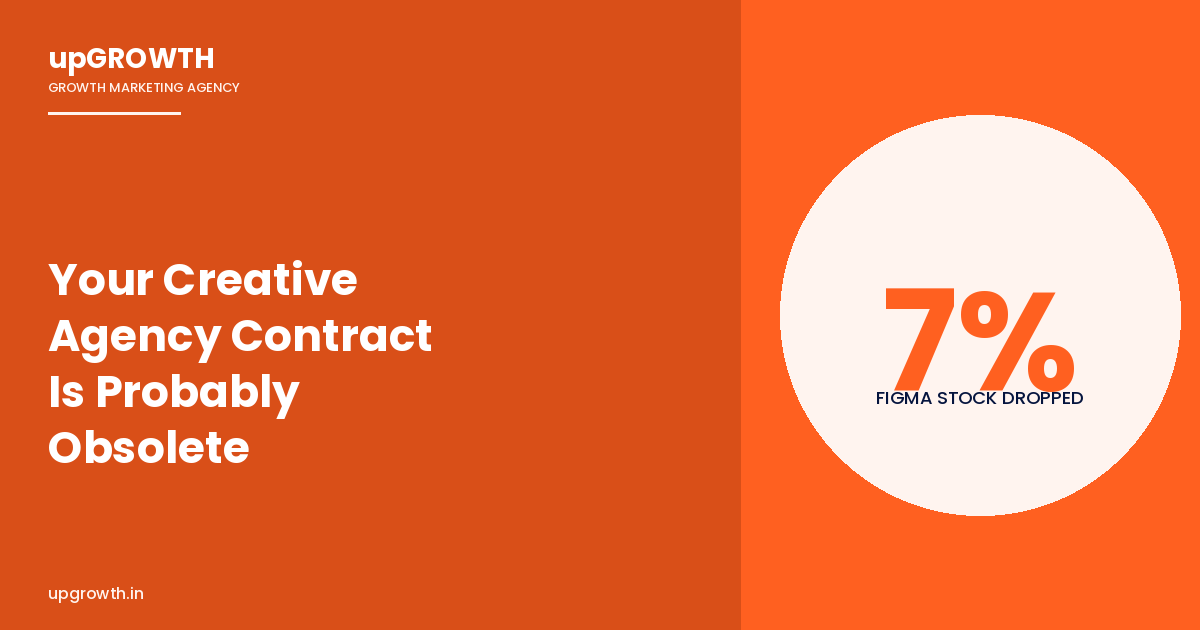
Anthropic shipped Claude Design on April 17, 2026. Figma’s stock dropped nearly 7% the same day. The marginal cost of producing marketing creative, copy, and prototypes just collapsed again, the way Claude Code collapsed development cost in 2025. If your agency retainer was priced before this shift, you’re paying for work that AI now delivers in a fraction of the time. This article walks through why most mid-market marketing agency contracts are now structurally obsolete, the three specific signs to look for in your own, and a 4-minute diagnostic you can run before your next renewal conversation.
In This Article
Share On:
On April 17, 2026, Anthropic launched Claude Design. By the end of that trading day, Figma’s market capitalization had dropped by several hundred million dollars. The company’s senior designer at Brilliant reported that pages requiring over 20 prompts to recreate in competing tools needed only 2 prompts in Claude Design. Datadog’s product team compressed what had been a week-long design cycle into a single conversation. This was not a minor product launch. This was a step change in how fast marketing creative can move from idea to shipped.
If you signed your current marketing agency retainer more than six months ago, there’s a high probability the scope and pricing are now misaligned with what the work actually costs to produce. Not because your agency is lazy or overcharging, but because the underlying production cost of content, creative, reporting, and prototyping dropped faster than contracts get renegotiated. This is the uncomfortable part that nobody at your agency will volunteer.
At upGrowth Digital, we run a 32-person AI-augmented agency serving 150+ clients across SaaS, fintech, D2C, and healthcare. We’ve rebuilt our own workflow three times in the last 18 months. When we helped Lendingkart scale 4x in paid spend while reducing cost per lead by 30%, we didn’t add headcount to match the spend. We changed the ratio of humans to AI in the production pipeline. That’s the shift your agency is either making or avoiding, and the answer matters for every rupee you’re paying them.
What follows is a working framework for evaluating whether your current agency contract still makes economic sense, what the alternative looks like, and how to have the conversation without torching a relationship that may still be salvageable.
What Claude Design and Claude Code Actually Changed
Claude Code has been available since 2024 and rewrote how engineering teams think about shipping features. Product managers who used to wait three sprints for a working prototype now get one in an afternoon. That changed the economics of software development. Claude Design is the same pattern applied to visual work: prototypes, slides, one-pagers, marketing creative, design systems.
The launch matters for agencies specifically because three categories of work that used to be billable now cost a tenth of what they did. First, internal design exploration. A senior designer used to produce three directions for a landing page and then refine one over several days. Claude Design produces twelve directions in an hour, and the designer becomes a curator instead of a creator. Second, prototype-to-production handoff. The handoff bundle into Claude Code closes the loop from visual concept to shipped code with almost no human translation layer. Third, slide decks and one-pagers. Work that used to take an AE or marketer four hours now takes 20 minutes with a solid brief.
If your agency is still billing the old way for these deliverables, you’re subsidizing their inefficiency. That’s not an insult to them. It’s a contract problem. Most retainers were signed in 2024 or 2025 when the production cost was different. The fair move is renegotiation, not resentment.
Three Signs Your Agency Contract Is Now Structurally Obsolete
Here are the three patterns we see most often when we audit inbound prospects’ existing agency relationships. If two or more of these show up in yours, your contract is probably obsolete regardless of how good the team is.
Sign 1: Deliverables-based pricing with vague activity scope
The contract says “10 blog articles per month, 20 social posts, 4 creative concepts.” The agency bills a flat retainer. There’s no line tying any of that activity to a business outcome. This was the dominant model in 2023 and it survived because production was expensive and scope was a reasonable proxy for effort. Now that production is cheap, activity-based scope means you’re paying for outputs that AI produces in minutes. You’re funding the agency’s margin, not their value.
The test: ask your agency what percentage of their content production uses AI in any capacity. If they say “we don’t, we’re human-only,” either their pricing should have dropped or their differentiation should be explicit (regulated verticals, highly technical content, brand voice that needs human craft). If they say “yes, heavily,” the pricing should reflect that leverage. If they say “a little,” press for specifics. Vagueness here is usually a signal.
Sign 2: Turnaround times of two weeks or more on standard work
A social post should not take two weeks. A blog article should not take three weeks. A landing page variant should not take ten days. These turnaround norms were baked into agency operating models when production was genuinely slow. They are now a symptom of process debt, not complexity. The Datadog team compressed a week-long design cycle into one conversation. Your agency should be moving at that pace on standard work, not on exceptional work.
If your current turnaround is in weeks for work that should take days, you’re paying the cost of their inefficient process. The agencies who have rebuilt their workflow run at 48 to 72 hours for 80 percent of deliverables. Anything beyond that needs a specific reason.
Sign 3: Reporting that measures activity, not outcomes
The monthly report shows impressions, reach, engagement, posts published, articles written, ads launched. It does not show pipeline generated, CAC trend, LTV impact, or revenue attributed. This is not because agencies don’t know how to measure outcomes. It’s because activity metrics are safer to report when the underlying work is commodity production. Outcome measurement forces accountability that the old model didn’t support.
When we work with clients at upGrowth, we split every engagement into Tier 1 KPIs (what we own: ad spend, uptime, reporting) and Tier 2 KPIs (what we contribute to: conversions, revenue, lead quality). We don’t promise revenue outcomes because too many variables are outside our control. But we name which ones we influence, and we tie a chunk of our compensation to those. If your current agency won’t do that, it’s worth asking why.
What an AI-Native Agency Contract Should Look Like in 2026
The new contract isn’t about cutting fees. It’s about restructuring what the fees buy. Here’s what the modern version of a marketing agency retainer should include.
Faster turnaround norms. Standard work in 48 to 72 hours. Exceptional work in one week with a written reason. Daily iteration capability on paid channels. The agency should be able to ship creative variants the same day as a performance meeting, not three days later.
Outcome-linked compensation. A portion of fees (10 to 25 percent is typical) tied to measurable outcomes. For performance marketing, that’s ROAS or CPL targets. For SEO and content, it’s organic revenue or qualified pipeline. For brand, it’s share of voice or direct traffic growth. If the agency refuses any outcome link, they’re either protecting their margin or protecting themselves from accountability, and neither serves you.
Explicit AI leverage in the scope. The contract should name which tools and workflows use AI, which don’t, and why. This is not a trust issue. It’s a pricing transparency issue. If 60 percent of your content production uses AI-first drafts with human refinement, the contract should reflect that economics.
Smaller scope, higher ownership. Instead of paying for 10 articles and 20 social posts, you’re paying for a named growth motion. “Scale organic demand capture for enterprise SaaS” or “drive D2C CAC under ₹500 while maintaining ROAS above 3.” The agency figures out the mix. Output volumes become variable, outcomes become fixed.
Strategy and judgment as the core value. The billable hours shift from production to judgment. What to make, when to ship it, what to cut, which channel to double down on. Production is commoditized; strategy and operator judgment are not. The contract should reflect that the agency’s senior people spend their time on strategy, not on approving AI-generated blog posts.
How to Renegotiate Without Burning the Relationship
If you’ve had a good run with your current agency, starting a renegotiation conversation feels risky. It shouldn’t. Good agencies welcome these conversations because they’ve been wanting to restructure too but didn’t know how you’d react. Here’s how to run the conversation.
Open with the market context, not with your grievance. Something like: “The Claude Design launch and the broader AI shift has changed the cost structure of marketing production. I want to make sure our contract reflects the new reality and that we’re both getting value. Can we spend 45 minutes walking through this?” That’s a co-owner framing, not an adversarial one.
Bring three specific questions to the meeting. First, what percentage of your production workflow now uses AI leverage, and how has that changed over the last 12 months? Second, what would a compensation model that ties 15 percent of our fee to one outcome metric look like? Third, if we reduced the scope by 30 percent and redeployed those hours toward strategy and measurement, what would that look like operationally? Good agencies will answer all three. Defensive ones will deflect, which tells you what you need to know.
Give them 30 days to come back with a restructured proposal. If they come back with a thoughtful response that addresses real changes, extend the relationship. If they come back with token adjustments and the same fee, start evaluating alternatives. The marginal cost of switching agencies is lower than the compounding cost of staying with a misaligned one.
We built a diagnostic tool that scores your company against four agency archetypes: traditional full-service, specialist boutique, AI-native operator agency, and in-house team plus AI stack. Ten questions, no login, no email required to get your score. The result tells you which model fits your company’s speed needs, budget, AI maturity, and accountability preferences.
The scoring logic is based on hiring patterns we’ve observed across 150+ companies we’ve advised or worked with. Mid-market SaaS and fintech companies most often score highest against the AI-native operator archetype because of iteration speed and outcome orientation. D2C brands in scaling mode score across archetypes depending on budget. Enterprise companies with heavy compliance needs often score highest against the in-house plus AI model.
The diagnostic is most useful when you run it twice. Once for where you are (with your current agency’s operating mode) and once for where you need to be (based on your growth goals). The gap between the two scores is usually where the renegotiation conversation lives.
Take the Agency Fit Score diagnostic here. It takes 4 minutes. You’ll get your best-fit archetype, your score against all four, and the specific next move to make this quarter.
Six Common Questions About Agency Contracts in the AI Era
Q: Should I fire my current agency if they score poorly on AI adoption?
A: Not yet. The first move is a renegotiation conversation, not a termination. Good agencies who haven’t yet restructured often will, once a client names the misalignment. Give them 30 to 60 days to come back with a restructured proposal. If they come back with surface-level changes and no real restructuring, then start evaluating alternatives. Switching costs are real but lower than the compounding cost of a misaligned contract.
Q: What percentage of my agency retainer should be tied to outcomes?
A: Somewhere between 10 and 25 percent is where most modern contracts land. Below 10 percent and there’s no meaningful accountability. Above 25 percent and the agency starts over-optimizing for the outcome metric at the expense of long-term work. For performance marketing engagements, outcome-linked percentages can go higher (up to 40 percent) because the attribution is clean. For brand and content work, keep it in the 10 to 20 percent range.
Q: How can I tell if my agency is actually using AI or just claiming to?
A: Ask three specific questions. First, show me a live workflow where AI produces the first draft and a human refines it. Second, what’s your typical turnaround for a new landing page variant from brief to ready for QA? Third, which specific tools are in your production stack today that weren’t six months ago? Agencies actually using AI answer these quickly with specifics. Agencies pretending answer with abstractions about “AI-enabled workflows.”
Q: Is it worth paying a premium for a specialist agency over a full-service one in 2026?
A: Yes, for specific scenarios. If you need deep craft in one discipline (technical SEO for a large site, performance creative for a D2C brand, enterprise ABM) a specialist is worth 30 to 50 percent more than a generalist because the quality gap is real. For broad scope, full-service still makes sense if you value a single accountable partner. The archetype that tends to lose economic viability is “full-service generalist without AI adoption,” because they compete with both specialists and AI-native operators and lose on both axes.
Q: What’s a realistic monthly marketing agency retainer range in India in 2026?
A: Specialist boutique engagements start around ₹2 lakh per month and scale to ₹5 lakh. AI-native operator agencies price between ₹3 lakh and ₹8 lakh per month plus performance-tied upside. Full-service retainers for mid-market companies land between ₹5 lakh and ₹15 lakh per month. Enterprise engagements with strategy sprints can exceed ₹20 lakh per month. Companies spending less than ₹2 lakh are better served by freelancers or highly focused specialist boutiques than by full-service retainers.
Q: How often should I review my agency contract?
A: Every six months minimum in 2026, compared to annually in the pre-AI era. The underlying production cost structure is changing fast enough that a 12-month review cycle misses at least two significant shifts. Put a calendar invite with your agency’s senior lead every six months labeled “contract structure review” rather than “performance review.” The framing changes what the conversation produces.
Your Next Move: Audit Your Current Contract This Week
The cost of staying in a misaligned contract compounds monthly. Every month you pay for production work that AI now does cheaper, you’re transferring margin to your agency that should be either in your pocket or reinvested into better strategic work. This isn’t an indictment of your agency. It’s a market reality that’s changing faster than contracts adapt.
Here’s what to do in the next seven days. Run the Agency Fit Score diagnostic for your company as it is today. Compare the result to what your current agency actually delivers. If there’s a gap of 20 percentage points or more between your best-fit archetype and your current operating mode, schedule a renegotiation conversation with your agency. Bring the three questions from the “How to Renegotiate” section. Give them 30 days to respond with a restructured proposal.
If you want a second opinion on your current contract before the renegotiation, we run a 30-minute contract audit for qualifying mid-market companies. No sales pitch, no deck, just a walk-through of what’s structurally misaligned and what a fair restructure looks like. Book your agency contract audit here.
For Curious Minds
A 'structurally obsolete' contract means its pricing and scope are based on outdated production costs that have been radically lowered by AI. This is a critical issue because you are paying for labor and time that are no longer required, directly impacting your marketing ROI.
The launch of Claude Design fundamentally collapsed the cost of three core agency deliverables:
Internal Design Exploration: A task that once took a senior designer days to produce a few creative directions can now be done in under an hour, yielding a dozen options.
Prototype-to-Production Handoff: The integration with Claude Code nearly eliminates the human translation layer, turning visual concepts into shipped code with unprecedented speed.
Marketing Collateral: Standard assets like slide decks and one-pagers, which previously took hours, can now be generated in minutes.
If your retainer, likely signed in 2024 or 2025, still bills for these activities the old way, you are subsidizing agency inefficiency. The goal isn't to blame your agency but to initiate a fair renegotiation based on today's new economic reality. Understanding this misalignment is the first step toward correcting it, which the full article can help you diagnose.
AI-augmented agencies deliver superior results by fundamentally changing the ratio of human strategy to machine execution, not by scaling human labor. When upGrowth Digital helped Lendingkart scale paid spend by 4x, they achieved a 30% cost per lead reduction by re-engineering their internal production pipeline with AI at its core.
This new operating model creates efficiency gains that are passed on as better performance. For example, an AI-augmented team uses generative tools to create hundreds of ad creative variations for testing in the time a traditional team creates a few. This high-velocity experimentation allows them to find winning creative faster, directly lowering acquisition costs. They also automate performance reporting and data analysis, freeing up human experts to focus on high-level strategy and interpreting insights rather than manual data pulling. It is a shift from delivering hours to delivering outcomes, and this different approach is key to unlocking growth. To see if your agency is making this shift, you need to look closely at their workflow.
To prepare for your agency review, you should conduct a focused, data-driven audit of your current contract's value. This shifts the conversation from subjective feelings to objective analysis of efficiency and output in the age of AI.
Here is a simple, three-step plan:
Audit Recent Deliverables: Review the last three months of work, especially design explorations, prototypes, and marketing collateral. Compare the hours billed or retainer cost allocated to these tasks against the new industry benchmarks where such work is nearly instantaneous with tools like Claude Design.
Inquire About Their AI Workflow: Ask your agency directly how they have integrated generative AI into their creative and development processes. Specific questions about their workflow for turning a brief into a coded landing page can reveal whether they are curators of AI output or still rely on manual, time-intensive methods.
Propose a New Scope of Work: Draft a revised SOW focused on strategic outcomes and testing velocity rather than billable hours for production. This reframes the relationship around shared business goals, such as reducing CPL by a certain percentage or increasing creative testing volume.
Taking these steps will help you have a productive conversation about modernizing your partnership. The full article provides a more detailed diagnostic to guide this evaluation.
This dramatic compression of production time will force a permanent shift away from traditional hourly billing and retainer models toward value-based pricing. When the 'work' of producing a design or prototype becomes nearly free, its value is no longer tied to the time it takes but to the strategic insight behind it and the business outcome it generates.
In the near future, you should expect to see new models emerge. Agencies will increasingly offer contracts based on performance metrics, revenue sharing, or fixed fees for achieving specific business milestones. Client expectations will also evolve, with a greater emphasis placed on an agency's strategic capabilities, market insights, and speed of iteration. The role of the agency designer or developer transforms into that of a strategic curator and prompter, guiding AI to achieve a vision. The value is in the vision, not the manual labor of creation. This is a fundamental change in the agency-client dynamic that savvy marketers should prepare for.
The most common mistake is assuming an agency is maliciously overcharging when they are often just slow to adapt their own business model. The solution is to approach the conversation as a forward-looking partner seeking to modernize the relationship for mutual benefit.
Look for these red flags in your current engagement:
Slow Turnaround on Creative Concepts: If it still takes several days or a week to get initial design directions for a landing page or ad, their workflow is likely not AI-augmented.
High Costs for Simple Collateral: Significant charges for creating slide decks, one-pagers, or social media graphics are a clear sign of an outdated production model.
Lack of Proactive Process Discussion: If your agency isn't bringing up how they are using tools like Claude Design to get you more for your money, they are either not using them or not passing the efficiency gains along.
Address this by framing the conversation around opportunity, not cost. Ask, "How can we use these new tools to double our creative output and testing speed within our current budget?" This positions you as a partner in innovation and efficiency, not just a client scrutinizing a bill.
The difference in process and timeline for creating a landing page is stark, highlighting the core value of an AI-augmented agency. Choosing the right partner depends on whether you value speed and data-driven iteration over a more traditional, deliberative process.
A traditional agency might take 2-3 weeks: a designer spends several days on 2-3 mockups, followed by rounds of feedback, refinement, and then a lengthy handoff to a developer. An AI-augmented agency like upGrowth Digital can compress this to 2-3 days. A strategist uses Claude Design to generate a dozen visual directions in an hour, curates the best options with you, and then uses a Claude Code handoff to generate a functional prototype almost immediately. This allows you to spend more time on strategy and testing rather than waiting on production. When choosing, weigh an agency's ability to demonstrate this integrated, high-speed workflow over one that simply lists AI tools on a capabilities deck.
This immediate market reaction signals a fundamental disruption, not just an incremental product improvement. Figma's stock drop reflects a direct threat to its core value proposition, as Claude Design absorbed a significant portion of its workflow, moving from pure design tool to an end-to-end concept-to-code platform.
This financial data is validated by on-the-ground user reports. The senior designer at Brilliant needing only 2 prompts to achieve what previously took over 20 shows a 10x reduction in complexity and effort. This combination of a high-level market shock and specific, team-level productivity leaps proves that the underlying economics of digital creative work have been permanently altered. Your strategic planning must now account for this new reality, where the cost and time to execute ideas have collapsed. Evaluating how your partners are adapting to this shift is no longer optional, as detailed in the rest of the analysis.
The primary opportunity cost is a loss of competitive speed and market agility, which is far more damaging than just overpaying on a retainer. While your competitors are testing ten new campaign ideas in a week, you are stuck waiting for your agency to produce one, putting you at a significant disadvantage.
Failing to adapt means you are missing out on:
Massive Testing Volume: An AI-augmented partner can generate and test exponentially more creative, copy, and landing page variations, allowing you to find what resonates with customers much faster.
Accelerated Prototyping: Product and marketing teams can get functional prototypes in an afternoon, as seen with Claude Code, enabling rapid validation of new features or offers.
Strategic Focus: When your agency's humans are freed from manual production, they can devote more time to high-value strategic work, market analysis, and optimizing campaign performance.
The true cost is being outmaneuvered by more nimble competitors. The financial waste from an obsolete contract is just the symptom of this deeper strategic problem.
The economic rationale of pre-2026 retainers is broken because they price labor for tasks that are now automated. The value was based on time and skill, both of which have been superseded by AI for certain production tasks, making the old pricing model invalid.
The three transformed work categories are:
Internal Design Exploration: Traditionally a bottleneck where a senior designer would spend days creating a few options. Claude Design now produces more diverse options in minutes, changing the designer's role from creator to curator.
Prototype-to-Production Handoff: This was a manual, error-prone step requiring translation between design and code. The integration with Claude Code makes this a nearly seamless, automated process.
Slide Decks and One-Pagers: This standard marketing collateral used to consume hours of marketer or designer time. It is now a 20-minute task with a well-written brief.
Because these tasks formed a substantial part of billable hours in many retainers, continuing to pay for them at 2024 rates means you are paying a premium for work that now costs a fraction to produce.
A modern, AI-centric workflow for a D2C brand is built for high-velocity creative testing and optimization. It moves away from producing a few 'perfect' ads to generating hundreds of variations to find what actually drives performance in the market.
The workflow involves using a tool like Claude Design to generate a massive volume of creative assets based on a core brief, testing different images, headlines, and calls-to-action simultaneously. The agency's role becomes managing this testing engine, analyzing performance data in real-time, and feeding insights back into the AI to refine the next batch of creatives. Success is no longer measured by the number of deliverables but by direct business outcomes. Your new KPIs should be: cost per viable creative asset, time to insight (how fast you learn what works), and the direct impact on campaign ROAS and customer acquisition cost. Explore the full article to learn how to structure a contract around these modern metrics.
Resistance to adopting these AI tools is often rooted in an agency's legacy business model, which is built on selling hours. Adopting tools like Claude Design that dramatically reduce production time directly threatens their primary source of revenue if they cannot pivot to a new pricing structure.
This resistance stems from a few key factors: the perceived difficulty of retraining staff, the investment required in new workflows, and a fear of devaluing their creative talent. However, this avoidance ultimately harms their clients by making them less competitive. A client of a slow-moving agency receives fewer creative assets, slower campaign launches, and less data-driven iteration than a competitor working with an AI-augmented firm. This means their marketing becomes less effective over time, not because the strategy is bad, but because the execution is too slow for the modern market. This is why evaluating an agency's operational model has become as important as evaluating their creative portfolio.
The Datadog example provides powerful, real-world evidence of the economic shift because it quantifies the collapse in time, which is the primary driver of cost in agency work. Compressing a week-long cycle, which likely involved multiple designers, product managers, and feedback rounds, into a single conversation represents a productivity gain of over 95%.
When a multi-day process involving several highly paid professionals becomes a short, interactive session, the marginal cost of producing that next prototype or design variation approaches zero. This is the definition of a collapsed cost structure. It proves that the value is no longer in the labor of production but in the quality of the initial idea and the strategic curation of the AI's output. For any company paying an agency retainer that prices design work by the hour or day, the Datadog case is a clear signal that the underlying financial assumptions of that contract are now invalid, a topic explored further in the complete analysis.
Amol has helped catalyse business growth with his strategic & data-driven methodologies. With a decade of experience in the field of marketing, he has donned multiple hats, from channel optimization, data analytics and creative brand positioning to growth engineering and sales.

 Growth Strategy and Planning
 Inbound Growth
 Growth Hacking
 Fractional CMO
 Search Engine Optimization
 Paid and Performance Marketing
 Social Media Marketing
 Demand Generation
 AI-Driven Growth Strategy
 AI-Native Workflow Automation
 Generative Engine Optimization
 Grove — AI Growth Strategist

 AI Automation
 Framework
 Case Study
 Tools
Tools Growth Tools
 Decision Tree
 Compare
 Custom GPT's
 AI Answer Gap
 Offer
Offer Webstories
 Quizzes
 Blog
Blog AI-powered Apps
 Social Media Tools
 Agency Fit Score