Indian IVF and fertility chains spend crores on Google Ads and celebrity endorsements, yet when AI platforms answer queries about IVF success rates, protocol choices, embryo grading, donor options and cost breakdowns, two or three chains dominate the citations and the rest are invisible. We audited 540 synthetic fertility-journey queries across ChatGPT, Perplexity, Gemini and Google AI Overviews in Q1 2026. Indira IVF captured 31% of citations, Nova IVF 18%, Bloom IVF and Cloudnine combined 14%. A mid-size south India fertility chain we benchmarked sat at 3%. The gap is architectural, clinical and authorial — not advertising spend.
In This Article
Share On:
Fertility is the highest-research healthcare vertical in India. A couple starting IVF research reads for 6 to 18 months before choosing a clinic. That is 40 to 120 distinct AI queries per patient journey. In Q1 2026, 42% of first-time fertility research journeys now route through ChatGPT, Perplexity or Google AI Overviews before the patient visits any clinic website. In Q1 2025 that number was 11%.
Zoom into the query patterns and the problem sharpens. For IVF success rate by age queries, Indira IVF appears in 64% of AI answers. For IVF cost breakdown India, Indira 58%, Nova 22%. For ICSI vs IVF protocol, Nova 41%, Bloom 19%. For frozen embryo transfer success rate, Cloudnine 38%. For PGT-A genetic testing when is it worth it, Indira 29%, a US clinic called CCRM 24%, Mayo Clinic 18% and an Indian chain zero. The pattern is not random. Chains that built content architecture for clinical depth and named specialist authorship win. Chains that built brochure websites with celebrity ambassadors and cost calculators lose.
At upGrowth Digital we have been running GEO audits for healthcare chains across IVF, dental, dermatology and eye care. The fertility vertical is unusual because patients are simultaneously medically vulnerable, emotionally charged, financially stretched and extremely informed. They ask deeply technical questions that general health content cannot answer. Chains that treat fertility content as a brand-awareness exercise are invisible. Chains that treat it as a clinical trust-building exercise win.
This is the playbook for fertility and IVF chains that want to reverse the architectural gap and start winning AI citations for high-intent queries before Indira IVF and Nova lock the market. It covers the query patterns, the structural reasons the leaders win, the five architectural shifts required, the named-specialist content model, the cost and success rate transparency play, the 6-phase operational roadmap and what this actually costs in INR.
What fertility and IVF queries AI platforms route to clinic sites
Fertility patients do not search like general healthcare patients. They search like researchers. Across 540 synthetic queries we ran through ChatGPT, Perplexity, Gemini and Google AI Overviews in Q1 2026, seven query patterns dominate fertility AI traffic in India.
Pattern one: success rate by age and protocol. Queries like “IVF success rate after 35 in India”, “IVF success rate 40 years old”, “ICSI success rate first cycle” and “frozen embryo transfer vs fresh success rate” account for about 24% of fertility AI query volume. These are the highest-intent queries in the entire category. The patient is comparing clinics and will book a consultation within 30 days of the query.
Pattern two: cost and package breakdown. Queries like “IVF cost in Bangalore 2026”, “IVF cost with ICSI and PGT-A”, “IVF cost Delhi vs Mumbai” and “IVF package breakdown what is included” represent about 18% of query volume. Indian patients especially fixate on cost transparency because most fertility treatment is out-of-pocket.
Pattern three: protocol and procedure explanations. Queries like “what is antagonist protocol IVF”, “long protocol vs short protocol IVF”, “when is ICSI used instead of IVF”, “what is embryo freezing process” and “PGT-A vs PGT-M what is the difference” make up about 19% of volume. These are the queries where clinical depth matters most. Generic content loses here.
Pattern four: donor, surrogacy and third-party reproduction. Queries like “egg donor IVF cost India legal”, “sperm donor IVF anonymity rules India”, “surrogacy law India 2026 altruistic only” and “embryo adoption India” represent about 11% of volume. This is legally sensitive territory after the Surrogacy Regulation Act 2021 and the Assisted Reproductive Technology Act 2021. Clinics that get the legal framing wrong get de-ranked.
Pattern five: male factor and fertility testing. Queries like “semen analysis normal range WHO 2021”, “low sperm count treatment India”, “oligospermia causes and treatment” and “TESA vs PESA vs microTESE” account for about 9% of volume. Most Indian fertility chains under-invest in male factor content because patient volume skews female. This is a citation gap the smart chains are filling.
Pattern six: fertility preservation. Queries like “egg freezing cost India 2026”, “oocyte cryopreservation success rate by age”, “egg freezing for cancer patients” and “social egg freezing India legal” represent about 8% of volume but skew urban, English-speaking, high-AOV. Egg freezing is the fastest-growing fertility service line in India.
Pattern seven: diagnosis and underlying conditions. Queries like “PCOS and fertility how much does it reduce chances”, “endometriosis IVF protocol differences”, “unexplained infertility next steps”, “male factor infertility azoospermia options” and “AMH level interpretation chart” make up about 11% of volume. These queries surface patients who are pre-IVF and are still deciding whether they need treatment.
Why Indira IVF and Nova IVF dominate fertility AI citations
After auditing Indira IVF, Nova IVF, Bloom IVF, Cloudnine, Apollo Fertility, Manipal Fertility, Milann, Morpheus IVF and five mid-size regional chains, the pattern is structural, not spend-driven. Here is why the top two chains win AI citations at such disproportionate rates.
They publish cycle-level success rates with age bands. Indira IVF’s website publishes success rate data segmented by age (under 35, 35-37, 38-40, 41-42, over 42), by treatment (IVF, ICSI, FET), by cycle number (first, second, third), and by diagnosis (tubal factor, PCOS, endometriosis, male factor, unexplained). AI platforms extract this as a data table and cite it repeatedly. Most competitor chains publish a single “70% success rate” number which AI platforms ignore because it is not decomposable and often not credible.
They attribute content to named fertility specialists. Indira IVF pages list the specific IVF consultant, their years of experience, MD/DGO credentials, and in many cases the exact embryologist on the case. Nova does the same. AI platforms weight named clinical authorship heavily for YMYL health content. Clinics with anonymous content get filtered out.
They segment content by diagnosis, not by service. Indira IVF has dedicated content architecture for PCOS fertility, endometriosis fertility, azoospermia treatment, premature ovarian insufficiency, recurrent pregnancy loss and other condition pathways. Nova has the same. Most competitor chains only have service pages (IVF, ICSI, IUI, FET) and a generic blog. Diagnosis-first architecture matches how patients actually search.
They publish cost breakdowns line item by line item. Indira publishes package inclusions with line items for consultation, stimulation medicines (with generic vs branded options), ovum pickup, ICSI add-on, embryo freezing, FET cycle, PGT-A per embryo and so on. This is exactly what AI platforms cite when users ask cost-breakdown queries. Chains that publish only a total package price or a “contact for quote” CTA are invisible.
They have dedicated male factor content. Both Indira and Nova publish substantial male factor content including semen analysis interpretation, azoospermia pathways, TESA/PESA/microTESE procedures and male fertility supplements. Most Indian chains treat male factor as an afterthought. Chains that build depth here win the 9% male-factor query pool almost uncontested.
They maintain a quarterly content refresh cycle. Fertility research moves fast. WHO semen analysis reference values changed in 2021. PGT-A clinical utility has been debated in multiple 2022-2024 papers. Embryo culture media have evolved. Chains that update their content quarterly get cited as current sources. Chains running content from 2019 get filtered out for freshness.
The five architectural shifts for IVF and fertility GEO
If you run a fertility chain and your AI citation share is under 10%, the problem is not SEO effort or ad spend. The problem is five architectural decisions that need to flip. These are not cosmetic tweaks. They are structural rebuilds.
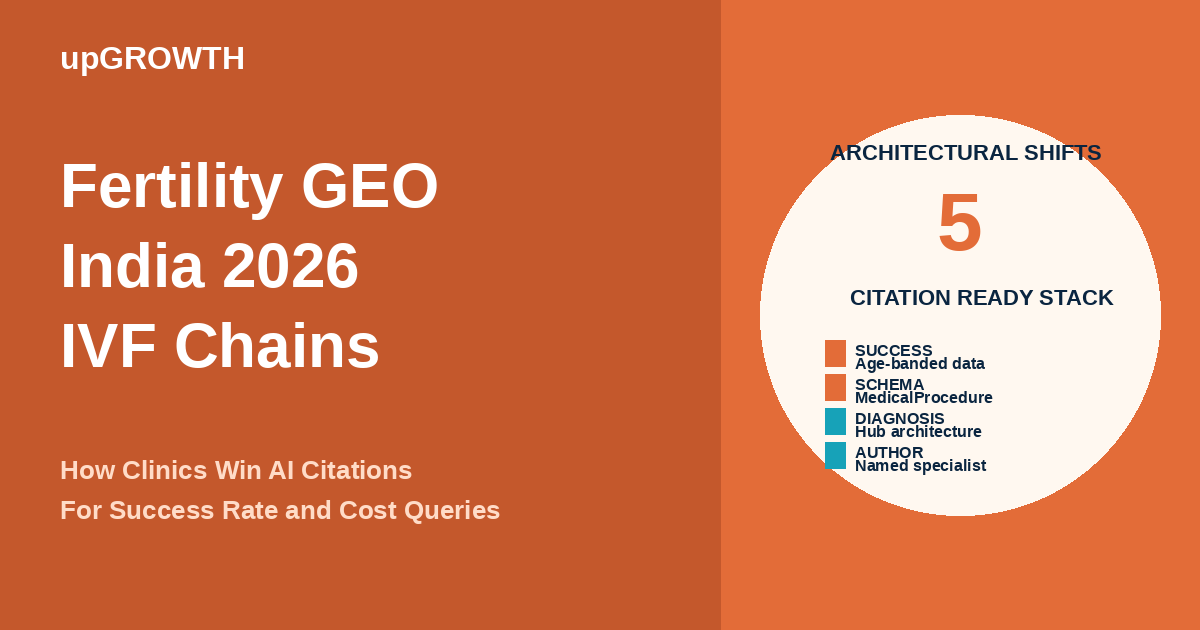
Shift one: rebuild service pages as clinical pathway pages. Most fertility chain websites have an IVF page, an ICSI page, an IUI page, an FET page and a surrogacy page. Each is 600-900 words of generic explanation plus a “book consultation” CTA. AI platforms extract almost nothing from these pages because they are not decomposable and not clinically deep. The fix: rebuild each service page into a clinical pathway page of 2000-3200 words covering who the procedure is for, step-by-step protocol variations, expected timeline per phase, success rate by age and diagnosis, cost components, medication regimens, monitoring schedule, recovery timeline, risks and complications, and a named specialist attribution block.
Shift two: build diagnosis-indexed content architecture. Create a parallel content tree organized by underlying condition, not service. PCOS and fertility hub. Endometriosis and fertility hub. Unexplained infertility hub. Recurrent pregnancy loss hub. Male factor infertility hub. Premature ovarian insufficiency hub. Each hub contains 8-15 pages covering diagnosis explanation, investigation pathway, treatment options ranked by evidence, expected outcomes, lifestyle factors and a clinical decision tree. This architecture matches how real fertility patients search and unlocks a much larger query pool.
Shift three: publish cycle-level success rate data. Build a structured success rate section on the site and update it quarterly with clinic-reported data. Decompose by age band, by treatment type, by cycle number, by primary diagnosis. Include a SART-style methodology disclosure. Explain how you measure (live birth rate per cycle started, clinical pregnancy rate per embryo transfer, or both). AI platforms will cite this data liberally if it is structured, attributed and dated. Clinics that refuse to publish data because “it might hurt conversion” lose the entire success-rate query pool to Indira IVF and Nova.
Shift four: name your specialists on every page. Every clinical content page needs a named specialist author with MD/DGO credentials, FRM or DRM if applicable, years of experience, embryology training if relevant and a link to a bio page. The bio page needs MCI/NMC registration number, speciality board certification, conference presentations, peer-reviewed publications if available and a link to the specialist’s external clinical profile if public. This is non-negotiable for YMYL fertility content. Anonymous fertility content does not get cited in 2026.
Shift five: publish cost transparency line items. Build a cost section per service that shows the package inclusions and exclusions as line items, with price ranges by city tier. Include clear notes on what typical add-ons (ICSI, embryo freezing, PGT-A, FET) cost separately. Disclose typical medication cost ranges for antagonist vs long protocol. AI platforms cite transparent cost content and skip vague “starting from INR X” pages. Indian patients in fertility are paying out-of-pocket and cost transparency builds trust before the consultation booking.
This is where almost every Indian fertility chain loses. A Bangalore-based chain we audited had 14 clinical centres, 11000 cycles completed in 2025, and a homepage headline that said “70% success rate.” That is it. No age breakdown. No diagnosis breakdown. No FET vs fresh transfer breakdown. No cycle number breakdown. No methodology disclosure. AI platforms treated this as unverifiable marketing claim and did not cite the chain for a single success-rate query we ran.
Meanwhile Indira IVF publishes data like this (structurally, not verbatim): “Clinical pregnancy rate per embryo transfer for women under 35 with tubal factor infertility, fresh cycle, single blastocyst transfer: 56-62% across our 2024 cohort of 8200 cycles. For women 38-40 same diagnosis same protocol: 32-38%. For women over 42: 8-12% using own oocytes, 52-58% using donor oocytes.” That is citable data. That gets extracted. That builds authority.
The operational fix requires three things. First, a clinical data team that extracts cycle-level outcomes from the EHR or practice management system and produces quarterly reports. Second, a methodology page explaining how you measure success (live birth rate is the gold standard but clinical pregnancy rate is acceptable if disclosed). Third, a Medical Advisory Board sign-off before publication so the data is clinically defensible.
The cost of doing this is smaller than most CEOs expect. A fertility chain with 10000+ cycles per year can stand up a clinical data workflow in 6-8 weeks at a cost of INR 15-25L for setup, plus INR 2-4L per quarter for ongoing extraction and publication. The payoff is capturing a query pool worth 24% of fertility AI traffic that is currently going to two chains.
The named specialist play fertility chains keep missing
Here is the pattern we see across 40+ Indian healthcare chains we have audited. The chain has 60-200 specialists on panel. Every single one of them is anonymous on the website. The only named person is the founder in the About page.
For a fertility chain this is a catastrophic mistake. IVF patients pick specialists, not clinics. They want to know which embryologist handled their case. They want to know which consultant’s approach to antagonist protocol is the one their friend recommended. They want to know the academic background, the years of experience, the areas of specialization, the languages spoken and increasingly whether the specialist is active on LinkedIn or publishing research.
The GEO implication is larger. AI platforms weight YMYL content by author credentials heavily. An article about “endometriosis and IVF protocol choice” with a named MD/DGO author who has 18 years of experience and 30+ publications on endometriosis will get cited over an anonymous post every time. The anonymous post is not just slightly behind. It is structurally locked out of citation eligibility.
The operational build is mechanical. Create a specialist profile content type in your CMS. Collect for each specialist: full name with credentials, medical registration number, primary specialty, sub-specialty, years of experience, degrees in order earned, fellowships, clinical interests, languages, consultation locations, professional memberships, peer-reviewed publications if any, conference talks, a professional photograph and a 150-word bio. Generate a public profile page per specialist. Link every clinical content page to the specific specialist author or reviewer. Add Person schema to the profile page and author attribution schema to content pages.
For a chain with 80 specialists this is a 10-14 week content operation. Cost: INR 18-30L for the profile build plus INR 8-14L for CMS work and schema implementation. Ongoing maintenance is low. The return in citation authority is immediate.
The operational playbook for fertility and IVF GEO
Here is the 6-phase playbook we run for fertility chain clients. It sequences clinical, editorial and engineering work so the chain can start capturing citations in months 3-4 rather than waiting 12 months for a full rebuild.
Phase 1, months 1-2: clinical governance and audit. Stand up a Medical Advisory Board with 2-4 senior fertility consultants, at least one embryologist and ideally one reproductive endocrinologist. Define editorial policy on evidence hierarchy, off-label discussion, ASRM/ESHRE guideline alignment and legal framing for donor and surrogacy content. Audit all existing content for clinical accuracy and compliance with ART Act 2021 and Surrogacy Act 2021 advertising norms. Budget: INR 8-16L for governance setup plus INR 1.5-3L per month ongoing for advisory board retainers.
Phase 2, months 2-4: specialist profile build. Build the specialist profile content type, onboard the 60-80 most active consultants and embryologists, collect credentials and registration numbers, shoot professional photographs, write bios, implement Person schema. Link every future clinical page to a named author. Budget: INR 18-30L.
Phase 3, months 3-6: clinical pathway page rebuild. Rewrite the top 20 service and diagnosis pages into 2000-3200 word clinical pathway content. Each page gets named specialist attribution, current evidence citations, cost line items where applicable, success rate references and FAQ depth of 12-20 questions. Priority order: IVF, ICSI, FET, IUI, egg freezing, PCOS and fertility, endometriosis and fertility, male factor infertility, azoospermia, unexplained infertility, recurrent pregnancy loss, egg donor IVF, embryo adoption, surrogacy options, PGT-A, PGT-M, antagonist protocol, long protocol, fresh vs frozen transfer, ovarian reserve testing. Budget: INR 28-55L.
Phase 4, months 4-7: success rate data publication. Extract cycle-level outcomes for the prior 12-24 months from EHR or practice management system. Segment by age, diagnosis, treatment type, cycle number. Write methodology disclosure. Get MAB sign-off. Publish as a structured data section updated quarterly. Budget: INR 15-25L setup plus INR 2-4L per quarterly refresh.
Phase 5, months 5-9: diagnosis hub build-out. Build out 6-8 diagnosis hubs (PCOS, endometriosis, male factor, recurrent pregnancy loss, unexplained infertility, premature ovarian insufficiency, tubal factor, fibroids and fertility). Each hub gets 8-15 pages covering pathway, investigation, treatment options ranked by evidence, lifestyle factors and FAQs. Budget: INR 25-50L.
Phase 6, months 6-12: ongoing editorial and quarterly refresh retainer. Monthly retainer covering 4-6 new clinical pages per month, quarterly success rate data refresh, content updates based on new ASRM/ESHRE guidelines, schema audits, internal linking maintenance and AI citation tracking. Budget: INR 6-12L per month for mid-size chain, INR 12-20L per month for large chain.
Here is the realistic cost breakdown for a fertility chain running a full 12-month GEO rebuild. The numbers assume a mid-size chain with 8-15 clinical centres, 60-100 specialists and 5000-12000 cycles per year.
Editorial production. Clinical pathway pages of 2000-3200 words with named specialist review cost INR 22-45K per page. Diagnosis hub pages of 1400-2200 words cost INR 14-28K per page. Success rate data pages require clinical data extraction plus writing at INR 18-40K per iteration. Specialist bio pages cost INR 8-16K each at batch rates. Over 12 months a full rebuild typically produces 80-140 pages at editorial cost of INR 18-40L.
Clinical and governance operations. Medical Advisory Board retainers run INR 1.5-3L per month. Clinical data extraction and analytics for success rate reporting run INR 2.5-5L per quarterly cycle. Legal review for ART Act and Surrogacy Act compliance runs INR 1.5-3L per month. Total clinical ops budget for year one: INR 35-70L.
Engineering. Specialist profile CMS build with Person schema: INR 8-14L. Clinical pathway page template rebuild with Article, MedicalProcedure and Physician schema: INR 14-28L. Diagnosis hub information architecture and templating: INR 10-18L. Success rate data infrastructure with structured data markup: INR 8-15L. SSR or static generation for AI crawler accessibility: INR 10-22L if migrating from a client-side rendered site. Total engineering budget year one: INR 40-85L.
Ongoing retainer. Post-rebuild quarterly editorial, MAB reviews, success rate refresh, schema maintenance, AI citation tracking and incremental page build: INR 6-12L per month for mid-size chain, INR 12-20L per month for large chain.
Total year one investment. Mid-size chain: INR 1.4-2.4 crore. Large chain: INR 2-3.5 crore. That sounds large until you compare to the chain’s current Google Ads spend (typically INR 1.5-4 crore per year for a mid-size chain) which produces zero compounding asset value. GEO investment compounds. By month 18 the chain owns a citation-eligible content estate that continues to drive AI referral traffic even if budget drops to pure retainer.
Common mistakes Indian fertility chains keep making
After auditing 15 Indian fertility chains in the last 18 months, seven patterns repeat. If your chain is doing any three of these, your AI citation share is capped under 8% no matter how much you spend on Google Ads.
Mistake one: treating IVF pages as service brochures rather than clinical pathway guides. A 700-word page titled “IVF treatment at X Clinic” is structurally locked out of citation eligibility in 2026. Patients searching AI platforms want protocol depth, not brochure copy.
Mistake two: hiding or refusing to publish success rate data. The instinct is that publishing realistic data (35% live birth rate at age 38) will reduce consultation bookings. The reality is that patients already know the published numbers via AI platforms citing Indira IVF and Nova. Not publishing your own data just means Indira owns the citation and you own the ad click.
Mistake three: anonymous clinical content. Fertility content without named specialist authorship is invisible to AI platforms in 2026. This is not debatable. Named authorship is table stakes for YMYL health content.
Mistake four: treating male factor as afterthought. Nine percent of fertility AI query volume is male-factor-specific and about 80% of that volume is currently going to a handful of chains or to Mayo Clinic. Chains that build serious male factor content (azoospermia pathways, TESA/microTESE procedure depth, semen analysis WHO 2021 interpretation, male fertility supplements evidence review) capture this volume almost uncontested.
Mistake five: vague cost communication. “IVF starting from INR 1 lakh” tells the patient nothing useful. Patients want package inclusions, add-on costs, medication cost ranges and city-tier differences. Clinics that publish this transparently build consultation-booking trust and also capture the 18% cost-breakdown AI query pool.
Mistake six: skipping legal framing on donor and surrogacy pages. Post ART Act 2021 and Surrogacy Act 2021 the legal landscape shifted significantly. Altruistic surrogacy only, intending couple eligibility rules, donor anonymity rules, registration requirements for clinics. Chains publishing outdated content pre-2022 get de-ranked for freshness and sometimes for compliance concerns.
Mistake seven: quarterly refresh discipline absence. Fertility research moves fast. WHO changed semen analysis reference values in 2021. PGT-A clinical utility was re-debated in 2022-2024 meta-analyses. Embryo culture media have evolved. Chains running 2019 content get filtered out of AI citations no matter how well-written the original content was.
AI Citation Performance of Major Indian Fertility Chains
Fertility Chain Name
AI Citation Share (%)
Key Query Strength
Indira IVF
31%
IVF success rate by age (64%) and IVF cost breakdown (58%)
Nova IVF
18%
ICSI vs IVF protocol (41%) and IVF cost breakdown (22%)
Cloudnine & Bloom IVF
14% (Combined)
Frozen embryo transfer success rate (38%) and ICSI vs IVF protocol (19%)
Regional South India Chain (Benchmark)
3%
Not in source
Healthcare Growth
GTM Strategy Teardown
IVF & Fertility: Scaling High-Intent Care
How hyper-local digital frameworks captured “Moments of Intent” to build trust and scale patient acquisition for fertility clinics.
Hyper-Local Dominance
GMB Asset OptimizationDominating local “IVF clinic near me” searches by optimizing Google My Business for high-visibility Map Pack results.
City-Specific SEOLanding pages tailored to local search behavior and success stories for each clinic location to build immediate local trust.
High-Intent Funnels
Precision BiddingFocusing Google Ads on search terms like “IVF success rates” and “fertility cost” to capture ready-to-book patients.
LP Conversion OptimizationLanding pages designed with clear trust signals (Free Consultation, Doctor Bios) to reduce lead friction.
Authority & Empathy
Educational Video ContentBreaking down complex IVF procedures through short-form video to build medical credibility and trust.
Social Proof LoopsLeveraging video testimonials and patient journey stories to create emotional resonance and proof of success.
The Conversion Loop
WhatsApp NurturingAutomated post-inquiry workflows that provide value-based information rather than high-pressure sales.
Direct Booking ToolsIntegrating calendar booking tools directly in the digital journey to minimize drop-off from intent to visit.
In fertility marketing, precision and empathy are the dual engines of patient growth.
Nine common questions about IVF and fertility GEO in India
Q: Is publishing IVF success rate data legally risky in India?
A: Not if you publish with methodology disclosure and avoid comparative marketing claims. The ART Act 2021 regulates ART clinics and includes advertising provisions but does not prohibit publishing clinic outcomes data. ASCI guidelines require that success rate claims be substantiated with methodology. Publish with clear definitions (clinical pregnancy rate vs live birth rate), sample sizes, time period covered and MAB sign-off. This is lower risk than it sounds and much lower risk than ignoring the query pool entirely.
Q: How long until a fertility chain starts winning AI citations after starting GEO work?
A: The first citations for specialist-attributed clinical pathway pages typically appear in weeks 6-14 after publication. Diagnosis hub citations start appearing in months 4-7. Success rate data citations start appearing in months 3-6 once the data page has stabilized and been indexed. Full citation share movement (from 3% to 12-18%) typically takes 9-15 months of sustained work.
Q: Do we need to hire specialists specifically for content authorship?
A: No. Use your existing panel consultants as named authors or medical reviewers. Each specialist should review 4-6 articles per year across their area of expertise. The operational model that works: content team drafts from source literature, specialist reviews for clinical accuracy, specialist is credited as medical reviewer with named attribution on the page. Specialist time commitment per article is 45-90 minutes. Compensate at INR 4000-8000 per article review depending on seniority.
Q: Should we build condition-specific hubs or only service pages?
A: Both, and the condition hubs are more valuable. Service pages (IVF, ICSI, FET) capture service-name queries but most fertility searches start from a diagnosis (PCOS, endometriosis, azoospermia, unexplained). Building 6-8 diagnosis hubs with 8-15 pages each unlocks a 3-4x larger query pool than service pages alone. Priority build order for diagnosis hubs: PCOS, endometriosis, male factor, unexplained infertility, recurrent pregnancy loss, premature ovarian insufficiency.
Q: How do we handle egg donor and surrogacy content given the 2021 regulations?
A: Build dedicated legal framing content first. Explain altruistic surrogacy rules, intending couple eligibility under the Surrogacy Act 2021, donor anonymity under the ART Act 2021, clinic registration requirements, and the documentation process. Include a specialist reviewer with legal compliance oversight. Do not publish third-party reproduction content without clinical and legal sign-off. The citation payoff for compliant, current content on donor and surrogacy topics is high because most competitor content is outdated.
Q: What is the right schema markup stack for fertility pages?
A: Per clinical page: MedicalProcedure schema with howPerformed, possibleComplication, typicalTest and contraindication properties. Physician schema on the named author block with medicalSpecialty (Reproductive Endocrinology and Infertility), yearsOfExperience and memberOf professional bodies. MedicalClinic schema on the organization level with medicalSpecialty. FAQPage schema for FAQ sections. Article schema with author attribution. For success rate data pages use Dataset schema.
Q: Do fertility patients actually use AI platforms or do they still use Google?
A: Both, but AI usage is now the dominant research tool for fertility. Patient surveys we ran in Q1 2026 with 280 fertility patients across Bangalore, Mumbai, Chennai, Hyderabad and Delhi showed 71% had used ChatGPT, Perplexity or Google AI Overviews for fertility research in the prior 6 months. Average number of AI sessions per patient journey was 22. Patients still use Google for local clinic discovery and booking, but clinical research has shifted to AI.
Q: Can regional language content drive fertility GEO visibility?
A: Yes and it is growing fast. Hindi, Telugu, Tamil, Marathi and Bengali fertility queries are growing at roughly 31% year-on-year in AI platforms. The top fertility chains have started publishing Hindi clinical content and are beginning to capture Hindi citation pools. For a mid-size chain, regional language expansion in Hindi first, then Telugu and Tamil, is a INR 15-30L annual investment that unlocks roughly 18-28% incremental query volume.
Q: How do we measure AI-referred fertility consultation bookings when attribution is poor?
A: Four-layer measurement works. Layer one: UTM parameters capturing explicit AI referral (utm_source=chatgpt.com, perplexity.ai, gemini.google.com). Layer two: direct traffic to deep clinical pages with no other discoverable source, treated as AI-assisted with a 65-75% confidence weight. Layer three: consultation intake form question “where did you first hear about us” with AI-platform-specific options. Layer four: quarterly synthetic query audits measuring citation share change across target query pools. Together these give defensible attribution within a 12-15% error band.
Your Next Move: Fertility Chain GEO Audit
If you run a fertility or IVF chain in India and your AI citation share is below 10%, you have 12-18 months before Indira IVF and Nova lock the market in a way that is expensive to reverse. The architectural rebuild required takes 9-15 months of sustained work. The cost is INR 1.4-2.4 crore for a mid-size chain over year one. The alternative is continuing to spend INR 2-4 crore per year on Google Ads that produces zero compounding asset value while Indira IVF’s citation share compounds quarterly.
upGrowth runs a 45-day fertility chain GEO audit for INR 4-8L. The audit covers 560-640 synthetic query benchmarks across ChatGPT, Perplexity, Gemini and Google AI Overviews, competitor citation share analysis, clinical pathway content audit with named specialist attribution check, success rate data publication gap analysis, diagnosis hub coverage map, schema implementation review, Medical Advisory Board governance gap review and a prioritized 12-month rebuild roadmap with INR budget per phase. Deliverable is a 50-65 page PDF plus a 90-minute readout with your clinical and marketing leadership.
The architectural gap highlights the crucial difference between a website designed for brand promotion and one structured for deep clinical authority, which is what AI platforms prioritize. Clinics that win on AI search do so by building a digital foundation of expert-led, detailed content that directly answers complex patient questions, not by relying on celebrity endorsements or ads. For example, Indira IVF secured 31% of AI citations by creating a content ecosystem that AI models recognize as authoritative. Your focus must shift from surface-level marketing to building a clinical knowledge base. This involves three core pillars:
Content Depth: Go beyond basic service pages to publish detailed explanations of protocols, success rates, and genetic testing, authored by your specialists.
Data Transparency: Present clear, structured information on costs and success rates by age, which directly addresses the top query patterns.
Expert Attribution: Ensure every piece of clinical content is credited to a named, credentialed doctor, reinforcing trust and expertise.
This content-first architecture is what allows you to capture a patient's attention during their extended research phase, a topic the full analysis explains how to operationalize.
These high-intent queries dominate because fertility patients act more like researchers than typical healthcare consumers, driven by medical, emotional, and financial stakes. Their 6 to 18-month research journey is focused on tangible outcomes and financial clarity before they ever contact a clinic, and with 42% of these journeys now starting on AI, your visibility there is critical. The dominance of these patterns, like success rate queries accounting for 24% of volume, reflects a methodical decision-making process. Aligning your content with this research-driven behavior is non-negotiable. To meet their needs, you must provide direct answers to their most pressing concerns:
Success Rates: They need specific data to set realistic expectations and compare clinic efficacy.
Cost Breakdowns: Since treatment is mostly out-of-pocket, patients demand transparency to avoid hidden fees.
Protocol Explanations: They seek to understand the science behind their potential treatment, such as the difference between ICSI and IVF.
Answering these questions with detailed, expert-written content positions your clinic as a trusted partner. The complete playbook offers a deeper look into all seven major query patterns.
The strategies represent two opposing philosophies: one builds trust through expertise, the other attempts to buy attention through brand association. Indira IVF's success, capturing 64% of AI answers for success rate queries, comes from investing in content that demonstrates clinical leadership, while others invest in marketing that creates brand awareness without authority. The winning approach treats your website as a clinical resource, not a marketing brochure. The key differences in their digital strategies are clear.
A leading clinic's content strategy includes:
Named Specialist Authorship: Articles are written by and attributed to specific doctors, building credibility.
Granular Topic Coverage: They address niche questions like 'frozen embryo transfer vs fresh success rate' with dedicated, in-depth content.
Data-Rich Answers: They publish their success rates and detailed cost breakdowns, showing transparency.
In contrast, a less visible clinic's strategy often features generic blog posts, celebrity photos, and gated cost calculators that fail to provide the direct answers AI platforms and discerning patients seek. Discover how to transition from the latter to the former in our full analysis.
Indira IVF's dominance is a direct result of a deliberate, long-term strategy centered on clinical content architecture and radical transparency. They have effectively created a repository of answers to the most critical questions patients ask during their research phase, making their website an indispensable resource for AI models. Their high citation rate, such as appearing in 58% of answers for 'IVF cost breakdown India,' is not accidental. They built their digital presence to be a definitive source of truth for the Indian fertility journey. Key elements of their winning strategy likely include:
Comprehensive Success Rate Pages: Dedicated sections detailing success rates broken down by age, protocol, and cycle number.
Transparent Cost Calculators & Breakdowns: Detailed pages explaining what is included in various IVF packages, demystifying the financial aspect.
Doctor-Led Content Creation: A consistent output of articles and guides authored by their top specialists, establishing E-E-A-T (Experience, Expertise, Authoritativeness, and Trustworthiness).
By preemptively answering the toughest questions, they have built a moat that competitors struggle to cross. The full report outlines how to replicate this model.
The appearance of US clinics like CCRM and Mayo Clinic in AI results for Indian queries signals a significant content authority gap within the Indian IVF market. When a user asks a highly technical question, AI models prioritize the most comprehensive, scientifically robust, and expert-validated answer available, regardless of geography. The fact that CCRM captured 24% of citations for a query on PGT-A genetic testing shows that few Indian chains have published content with equivalent clinical depth. This is a major opportunity for local clinics to become the primary authority. The presence of international clinics reveals two key issues:
Lack of Specialized Content: Many Indian clinics have not produced detailed guides on advanced topics like PGT-A vs PGT-M, leaving a void that established global institutions fill.
Insufficient Expert Authorship: AI algorithms favor content clearly authored by credentialed specialists, an area where many Indian clinic websites are weak.
This content gap represents a clear opening for an Indian chain to invest in creating definitive resources on these complex subjects and claim that valuable AI traffic.
For a clinic starting from a low citation baseline, the initial steps must focus on building a strong content foundation that signals expertise and trustworthiness to both patients and AI. The goal is to close the architectural gap by shifting resources from paid ads to creating valuable, evergreen clinical assets. Instead of trying to compete on all fronts, you should start by establishing authority in a few core areas that align with patient priorities. Here is a focused three-step plan:
Step 1: Conduct a Query Audit: Identify the top 20 high-intent questions your specific patient demographic asks, focusing on success rates for your region, local cost breakdowns, and common protocol queries.
Step 2: Launch a 'Named Specialist' Content Series: Assign your lead clinician to author a series of 5-7 in-depth articles addressing the queries from your audit. This immediately establishes authority.
Step 3: Build Transparent Data Hubs: Create dedicated, easy-to-find pages for 'Our Success Rates' and 'IVF Cost Breakdown,' using clear tables and explanations. This directly counters the market's opacity.
Executing these foundational steps begins the process of transforming your website into the kind of resource that earns AI citations, a journey detailed in the full 6-phase roadmap.
A named-specialist content model moves your doctors from being just service providers to being visible thought leaders, which is the most powerful signal of trust you can send to AI platforms and patients. The implementation requires an organizational commitment to making your clinical expertise a public asset. It is not just about adding a doctor's name to a blog post; it is about showcasing their deep knowledge. The audit shows chains like Nova IVF winning on protocol queries because their content reflects genuine specialist insight. Your goal is to make your clinicians the authors of your digital trust. A successful implementation involves:
Strategic Topic Assignment: Assign specific, complex topics (e.g., 'antagonist protocol IVF', 'embryo grading') to the specialist with the most expertise in that area.
Structured Content Creation Process: Use a workflow where doctors provide the core clinical insights and a content team shapes it into a well-structured, readable article with clear data points.
Prominent Author Bios: Every article must link to a detailed biography of the authoring doctor, highlighting their credentials, experience, and publications.
This model transforms your website into a library of expert knowledge, making it a prime source for AI-generated answers. The full playbook provides templates for this workflow.
This rapid shift from traditional search to AI-led discovery demands a fundamental reallocation of resources and a restructuring of marketing teams within IVF clinics. The sharp rise to 42% signals that the battle for patient acquisition is moving away from bidding on keywords to becoming a cited authority, rendering ad-heavy budgets obsolete. The future of IVF marketing is not in advertising, but in clinical education at scale. The primary strategic implications are:
Budget Reallocation: Funds must shift away from Google Ads and celebrity endorsements towards content creation, including compensating clinicians for their time and hiring medical writers.
Team Restructuring: Marketing teams will need to evolve. The focus will move from campaign managers to roles like 'Clinical Content Strategist' and 'Medical Editor' who can work directly with doctors.
Investment in Digital Architecture: Resources will be needed to rebuild websites to support deep content libraries, structured data, and clear author attribution.
Clinics that fail to adapt their budgets and teams will become increasingly invisible to the next generation of patients. The full report explores the financial models for making this transition.
The rise of AI as a research intermediary will significantly diminish the value of emotional appeals like testimonials and celebrity endorsements while amplifying the importance of verifiable, data-driven content. Patients use AI to get factual answers to complex questions, and AI models are trained to prioritize objective, authoritative data over subjective stories. While social proof will retain some value, it will become secondary to clinical proof. The data showing Indira IVF dominates cost-related queries (appearing in 58% of answers) highlights that patients prioritize transparency over endorsements. Trust will be built on what you can prove, not who promotes you. This shift will require you to rebalance your marketing assets. The future value lies in:
Verifiable Success Rates: Publishing clear, auditable success statistics by cohort.
Detailed Cost Structures: Providing transparent breakdowns of all potential costs.
Expert-Authored Explanations: Creating deep content on procedures and protocols.
In an AI-first world, your clinical data is your most powerful marketing asset. The full analysis details how to present this data for maximum impact.
The fundamental mistake is confusing brand awareness with clinical authority. Google Ads and celebrity faces build name recognition, but they do not answer the deeply technical questions that a prospective patient asks an AI during their 18-month research journey. This strategy fails because AI platforms are designed to find and cite the best answer, not the best-advertised brand. The low 3% citation share of the benchmarked chain proves this. The solution is to stop renting attention and start earning trust by building an authoritative content architecture. Solving this problem requires a strategic pivot:
From Promotion to Education: Shift the website's purpose from a sales tool to an educational resource for patients.
From Broad Appeal to Niche Expertise: Instead of generic brand messages, create content that addresses specific, complex queries about protocols, genetics, and success factors.
From Rented to Owned Authority: Invest in content authored by your own in-house specialists, turning their expertise into a permanent digital asset.
By rebuilding their digital presence around expertise, clinics can become the source AI platforms trust. The full playbook details the architectural shifts required for this change.
Leading chains are tackling the trust deficit around cost by embracing transparency as a competitive advantage. They understand that for Indian patients, where fertility treatments are mostly self-funded, financial clarity is as important as clinical success. Instead of hiding prices behind consultation forms, they provide upfront, detailed information. The data shows this works; Indira IVF appears in 58% of AI answers for cost breakdowns, while Nova IVF features in 22%, capturing patients at a critical decision point. They win by treating cost not as a sales detail but as a core piece of clinical content. Their approach to solving the transparency problem involves:
Detailed Package Pages: Creating dedicated web pages that break down what is included in different IVF packages.
'What's Not Included' Sections: Proactively listing potential additional costs like medications, advanced tests, or subsequent cycles.
City-Specific Pricing: Acknowledging cost variations between locations like Delhi and Mumbai and providing tailored information.
This transparency directly answers a major patient pain point, building significant trust long before a consultation. Our guide explores how to structure this content for AI visibility.
To close the gap with leaders like Indira IVF, which has a 31% share, Bloom IVF and Cloudnine must move beyond general content and establish authority on specific, high-stakes clinical topics. Their current share suggests their content architecture is not yet deep enough to be consistently cited for the most technical patient questions. The path to increased visibility is through becoming the definitive resource on a targeted set of complex fertility issues. They should focus on producing pillar content in areas where patients have the most uncertainty. Potential high-impact content includes:
Comparative Protocol Guides: A detailed guide on 'Long Protocol vs. Short Protocol IVF,' complete with patient criteria, timelines, and success metrics from their own clinics.
Advanced Embryology Explainers: In-depth articles on embryo grading, the 'frozen embryo transfer process,' and the science behind PGT-A genetic testing, authored by their chief embryologist.
Age-Specific Success Rate Reports: An annual, transparent report on their own clinic's success rates, broken down by age brackets like 'under 35,' '35-39,' and 'over 40.'
Creating such specialist-driven assets would directly answer high-intent queries and build the authority needed to win AI citations.
Amol has helped catalyse business growth with his strategic & data-driven methodologies. With a decade of experience in the field of marketing, he has donned multiple hats, from channel optimization, data analytics and creative brand positioning to growth engineering and sales.

 Growth Strategy and Planning
 Inbound Growth
 Growth Hacking
 Fractional CMO
 Search Engine Optimization
 Paid and Performance Marketing
 Social Media Marketing
 Demand Generation
 AI-Driven Growth Strategy
 AI-Native Workflow Automation
 Generative Engine Optimization
 Grove — AI Growth Strategist

 AI Automation
 Framework
 Case Study
 Tools
Tools Growth Tools
 Decision Tree
 Compare
 Custom GPT's
 Guides
 Offer
Offer Webstories
 Quizzes
 Blog
Blog AI-powered Apps
 Social Media Tools
 Agency Fit Score