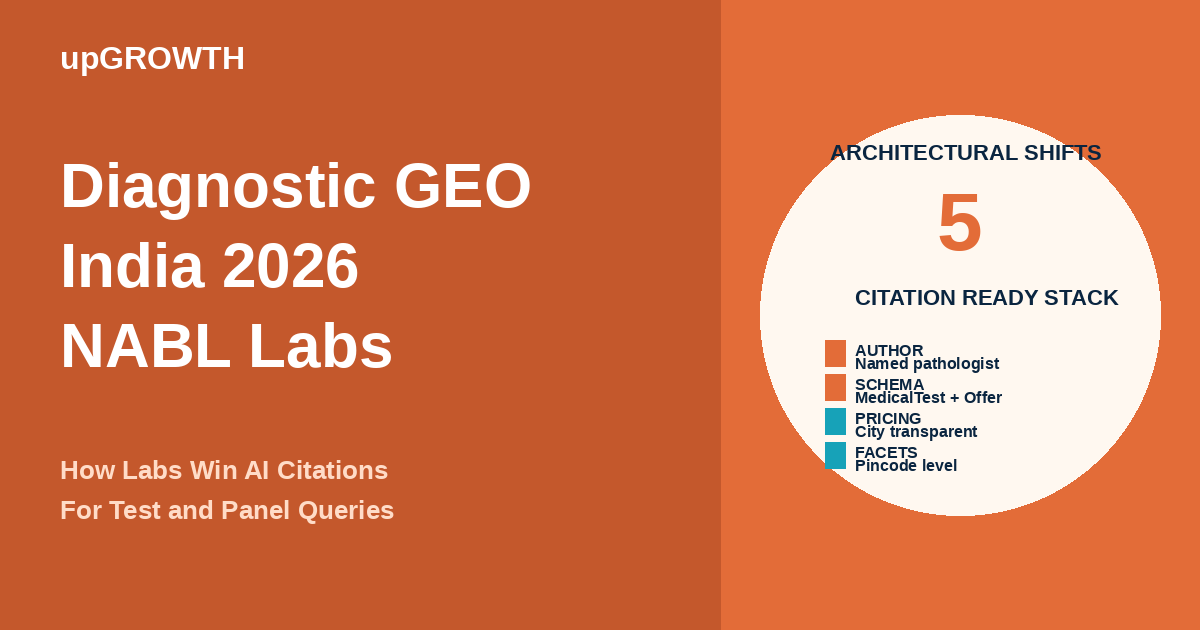
Indian diagnostic chains with NABL accreditation, 3000+ collection centres and 40-year brand equity keep losing AI citations to 1mg Labs, PharmEasy and Tata 1mg for test and panel queries. The gap is not credibility. It is content architecture. AI platforms cite sources that publish named-pathologist authorship, Test schema with CPT-style IDs, transparent MRP with home-collection disclosure, NABL scope in machine-readable format and quarterly-refreshed test explainers. This guide breaks down the 5 structural shifts, city-facet playbook and INR 40L-2Cr year-one budget for diagnostic chain GEO.
In This Article
Share On:
A Mumbai-headquartered diagnostic chain with 180 collection centres across Maharashtra pulled its Q1 2026 AI citation report in March. For 64 high-volume test queries (thyroid panel, lipid profile, vitamin D, CBC, HbA1c, LFT, KFT, hormone panels, PCOS workup, diabetes screening), their citation share across ChatGPT, Perplexity, Google AI Overviews and Gemini was 7%. Not 7% of traffic. 7% of citations. For the same queries, 1mg Labs held 41%, PharmEasy Diagnostics 22%, Tata 1mg 14%. A 48-year-old lab with NABL accreditation, 14 pathologists on payroll and 4 consultant microbiologists was losing to an e-pharmacy aggregator that started doing diagnostics in 2021.
This is the pattern across Indian diagnostics in 2026. Dr. Lal PathLabs, Metropolis Healthcare, SRL Diagnostics, Thyrocare, Agilus (Hindustan Unilever), Vijaya Diagnostics, Neuberg all have the clinical credibility. Most still have the volume. But when a user asks ChatGPT “what is the difference between T3 T4 and TSH test” or “how much does a full body checkup cost in Bangalore” or “which fasting is needed for lipid profile”, the cited sources are aggregators and marketplace platforms, not the chains that run the labs.
AI platforms now influence 24-28% of self-ordered test research journeys in metro India based on our Q1 2026 client data across three NABL-accredited chains. That share grows 3-4 points per quarter. For diagnostics specifically, the AI-influenced portion is higher than hospital GEO because tests are lower-consideration purchases. People do less research before booking a thyroid panel than before choosing a surgeon. That makes the first AI answer disproportionately powerful.
We have been running GEO engagements for diagnostic chains since 2024. Here is what works, what does not, and what the architecture looks like when a 40-year-old lab brand starts winning citations it used to lose. For the horizontal compliance frame, read the Healthcare YMYL Compliance Gauntlet guide. This piece covers the diagnostic-specific structural shifts.
What Queries AI Platforms Actually Route to Diagnostic Chain Sites
Start with the traffic pattern, not the content plan. Across six diagnostic chain clients, AI-sourced sessions cluster around five query types:
Test explanation queries. “What is HbA1c”, “difference between T3 T4 TSH”, “what does high ESR mean”, “lipid profile components”. These are informational but conversion-adjacent. A user asking what HbA1c measures often books the test 2-14 days later. 1mg Labs and PharmEasy own this category because they publish test explainers with named medical reviewers, clear panel breakdowns and CPT-style IDs. Diagnostic chains often publish 200-word pages that say “HbA1c is a test for diabetes. Book now.” That content gets skipped entirely.
Panel composition queries. “What is included in a full body checkup”, “master health checkup vs executive checkup”, “diabetes panel components”, “PCOS panel tests list”. Buyers compare packages across chains. AI platforms pull the answer from whichever source lists the components clearly in structured format. Marketplaces do this. Chains often hide the full panel behind a booking form.
Price queries with city qualifier. “Thyroid test price in Pune”, “vitamin D test cost Delhi”, “full body checkup price Hyderabad”, “HbA1c test price Chennai”. This is where diagnostic chains lose the most winnable ground. They have the prices. They collect home samples in those cities. They just do not publish a machine-readable price per city with home-collection fee broken out. PharmEasy and 1mg Labs do. AI platforms cite whoever has the cleanest structured answer.
Preparation and fasting queries. “Fasting hours for lipid profile”, “can I drink water before HbA1c”, “how to prepare for thyroid test”, “what not to eat before liver function test”. These are trust queries. Users want a specialist answer before they book. Pathologist-authored preparation guides rank and get cited. Generic SEO pages written by the marketing team do not.
Result interpretation queries. “What does high TSH mean”, “low vitamin D levels symptoms”, “ESR 40 normal or high”, “high bilirubin causes”. These queries look informational but carry strong commercial intent. Someone reading about high TSH often books a follow-up test, consults an endocrinologist or re-tests. Chains that publish specialist-authored interpretation content capture the citation and the second-visit revenue.
If your content plan does not map one-to-one against these five patterns for your top 50 tests and panels, you will not win diagnostic GEO. Generic test pages that treat all queries identically get beaten by marketplaces that segment correctly.
Why Marketplaces Keep Beating 40-Year-Old Diagnostic Chains in AI Search
You already know what the marketplaces have that you do not. The question is why you still have not copied it. Here is what we see inside client audits:
Named pathologist authorship. 1mg Labs pages carry a named pathologist byline with MD Pathology credentials, MCI registration number and a review timestamp. Diagnostic chain pages often say “Written by the medical team” or carry no author at all. AI platforms weight named clinical authorship heavily for medical content. You employ 14 pathologists and still do not publish under their names. That is the single largest self-inflicted wound in Indian diagnostic GEO.
Test schema with structured test IDs. PharmEasy Diagnostics uses MedicalTest schema consistently with structured test IDs, panel composition marked up as ItemList, and price marked up as Offer schema per city. Most diagnostic chain sites have generic Product schema or nothing at all. Schema is not decorative. AI platforms extract structured facts from schema-marked pages first before falling back to text scraping.
MRP transparency with home-collection disclosure. Marketplace pages display MRP, discounted price, home-collection fee, city-specific variation and report turnaround time in a standard format. Diagnostic chain pages often display “Call for price” or show one price without disclosing that home collection adds INR 150 in some cities and is free in others. The asymmetry of information pushes AI platforms toward the source that discloses, not the one that hides.
NABL scope in crawlable format. Every NABL-accredited lab has a scope document listing which tests are under accreditation. Chains keep it as a PDF buried in the About Us section. Marketplaces do not have NABL but still cite the chain’s NABL status in their listings. Publishing the scope as a structured, crawlable page per lab location turns accreditation into a citation asset. Right now it is an invisible trophy.
Quarterly refresh with dateModified. Reference ranges update when labs switch equipment or update methodologies. Collection hours change. Panel compositions change. Marketplaces refresh their test pages quarterly with fresh dateModified timestamps. Diagnostic chains publish once in 2019 and call it done. AI platforms penalize stale content in YMYL categories, and diagnostics is YMYL.
Home collection coverage maps. A user in Thane searching “home collection for thyroid test near me” wants to know if your phlebotomist actually comes to their pincode. Marketplaces publish pincode-level service maps. Chains often publish a city-level promise that is untrue for half the postal codes in that city. When the AI-retrieved answer tells the user you cover their area and you do not show up, you lose the patient and the trust.
These are not capability gaps. You can fix every one of these in 90-120 days. The gap exists because diagnostic chain marketing teams spent 20 years optimizing for keyword rank and treating content as a cost centre. AI platforms cite content architecture, not budget.
The Five Architectural Shifts That Win Diagnostic GEO
Based on what has actually moved citation share across our diagnostic chain engagements, here is the minimum viable architecture. None of these are optional.
Shift 1: Named pathologist authorship on every test page. Each test page carries a named author (MD Pathology), MCI registration number, review date and a brief credential line. For high-volume tests, add a second reviewer (senior pathologist or chief of lab). Person schema is marked up with medicalSpecialty set to the correct pathology subspecialty. If 14 pathologists feels like too many bylines to manage, start with 5 senior ones covering the top 100 tests. Rotate review ownership quarterly.
Shift 2: MedicalTest and Offer schema on every test and panel page. Test pages use MedicalTest schema with subject of test, normal range, sample type, preparation requirements and panel composition as ItemList. Price is marked up with Offer schema per city including home-collection fee as a separate priceSpecification. Panel pages reference each included test by MedicalTest @id. AI platforms reading structured data can answer “what is included in full body checkup” and “how much does a lipid profile cost in Pune with home collection” directly from your schema.
Shift 3: City-facet pages for every test in every serviced city. A chain operating in 35 cities with 200 tests needs 7,000 city-facet pages. This sounds overwhelming until you realize it is a templated generation problem. Each page carries the same test explainer content with a city-specific price, city-specific home-collection fee, city-specific turnaround time and pincode-level coverage map. The schema stack (MedicalTest + Offer + LocalBusiness) makes this scale. Marketplaces already do this. Chains keep thinking “we’ll do the top five cities and see”. The top five cities miss 60% of the AI traffic opportunity.
Shift 4: Interpretation content authored by specialists who can be cited. For each high-volume test, publish a paired interpretation guide written by a relevant specialist (endocrinologist for thyroid, cardiologist for lipid, hepatologist for liver function). The interpretation guide answers the result queries AI platforms route to you now and to marketplaces if you do not show up. This is the highest-leverage content category for converting test bookers into repeat patients and consultation leads. Most chains skip it because it requires specialist coordination. That is exactly why it is defensible.
Shift 5: Quarterly refresh workflow owned by the medical director. Every test page gets reviewed on a quarterly cadence. Reference ranges checked. Panel compositions verified. Prices updated. Home-collection coverage expanded. dateModified refreshed. This workflow does not live in marketing. It lives in the medical director’s office with SLA-bound inputs from marketing and operations. If the workflow does not have a clinical owner, the content will drift into inaccuracy within two quarters and AI platforms will deprioritize you.
Diagnostic chains that implement these five shifts see first citation wins on Tier 2/3 queries in 45-75 days and metro panel queries in 4-7 months. Skip any one shift and the whole stack underperforms. Marketplaces combine all five. That is the benchmark.
The Pathologist Authorship Trap Most Diagnostic Chains Fall Into
Six months into most diagnostic GEO engagements, the named-pathologist shift hits a specific failure mode. Marketing commissions 200 test pages, each “reviewed by Dr. X MD Pathology”. Dr. X is a real pathologist at one of the chain’s metro labs. She never saw 180 of those pages. Marketing put her name and credentials on pages that a junior content writer drafted. Six months later an AI platform surfaces one of those pages, a user asks Dr. X about it on LinkedIn, and Dr. X denies authorship publicly.
This is not hypothetical. It happened to a Delhi-NCR chain in 2025. The AI platforms picked up the contradiction and downranked the entire domain’s medical content for two quarters. The chain had to disclose every authorship claim, re-review every page with a signed clinician attestation and add a transparent review process page. The recovery took 11 months.
The fix is a structured reviewer workflow with real sign-off. Every test page gets a draft from a medical content writer. The named pathologist reviews the draft, makes changes, approves in writing (email or internal ticketing system with timestamp). That approval creates a document trail. If the authorship is ever challenged, the chain can produce the review. This adds 30-45 minutes of pathologist time per page and roughly INR 2,500-5,000 in reviewer compensation. For 200 pages that is INR 5-10L. For a chain spending INR 50L on a year of GEO, that is 10-20% of budget. It is the most important 10-20% of the budget.
Chains that try to skip this step to save money consistently underperform. Authorship theatre gets caught. AI platforms now cross-reference author claims against public profiles, LinkedIn, MCI databases and publication histories. A pathologist bylined on 200 cardiology-adjacent interpretation pages triggers quality signals that weigh against you.
The Pincode-Facet Play Diagnostic Chains Keep Missing
City-facet pages win citation share for city-level queries. Pincode-facet pages win citation share for a much more valuable query: the home-collection booking intent query.
A Bangalore user in 560100 searching “home collection lipid profile near me” wants three things: is the lab available in their pincode, what is the cost, how soon can the phlebotomist reach them. The chain with a pincode-facet page that answers all three directly in schema wins the citation and the booking. Most chains answer none of the three at the pincode level.
Here is the pincode-facet architecture that has worked across three client rollouts. Each pincode gets a LocalBusiness or MedicalOrganization schema instance tied to the nearest collection centre or hub lab. Home-collection availability is a yes/no machine-readable field with a service area polygon in GeoCoordinates. Top 40 tests for that pincode get price, turnaround and sample-type overlaid from the test schema. The page loads a pincode-specific FAQ (what is the collection window, can I get evening slots, what is the weekend availability). That FAQ is pincode-specific. Not city-specific. Not chain-wide. Pincode.
For a chain covering 800 pincodes, that is 800 pages. Generated from templates. Maintained in a single database that feeds the page generator. The operational cost is minimal once the infrastructure is built. The SEO and GEO return is disproportionate because marketplaces rarely go to pincode-level facets for their own diagnostic pages. Geography is where diagnostic chains can out-local marketplaces if they build the right data layer.
For multi-city chains with home collection in 30+ cities, the pincode-facet play is the single highest-leverage investment outside of the five core architectural shifts. It converts operational capability into citation and conversion share.
Translating the architecture into execution for a multi-lab chain with NABL accreditation looks like this in practice.
Phase 1, month 1-2: Accreditation and capability audit. Pull the NABL scope document for every lab location. Cross-check against the test catalogue on the website. Every test that appears on the website must be within accreditation scope at the delivering lab. This is a compliance requirement and an AI credibility requirement. Document every pathologist on payroll with MCI registration numbers, subspecialty credentials, publication history. Build the authorship matrix showing which pathologist can credibly author or review which test category.
Phase 2, month 2-4: Top 50 test page rebuild. Start with the 50 tests that drive 80% of revenue. For each: pathologist-authored explainer, panel composition marked up as ItemList, preparation and fasting guide, MedicalTest schema, city-level Offer schema, named-specialist interpretation content. Each page goes through draft -> pathologist review -> approval -> publish -> index ping. Target velocity is 3-5 pages per week to maintain review quality.
Phase 3, month 3-5: Panel and checkup rebuild. Master health checkup, executive checkup, diabetes panel, thyroid panel, pre-employment panel, PCOS panel, senior citizen panel. Each panel page lists component tests with links to the individual test pages, total price per city, add-on tests with delta pricing, report turnaround time. Panels drive higher AOV and higher margin. Get them right before scaling volume.
Phase 4, month 4-7: City and pincode facet rollout. Templated generation for city-facet pages across all serviced cities. Pincode-facet pages for the top 200 pincodes by current booking volume. Each facet carries city or pincode-specific price, home-collection availability, turnaround and coverage. This is an engineering-heavy phase. Expect 40-60% of the phase effort to be on the data layer and page generator rather than content.
Phase 5, month 5-9: Interpretation content build. Specialist-authored result interpretation guides for the top 30 tests. Endocrinologist for thyroid and HbA1c. Cardiologist for lipid. Hepatologist for LFT. Nephrologist for KFT. Hematologist for CBC variations. Each interpretation guide gets schema markup as MedicalWebPage, cross-links to the test booking page, includes a “when to consult a specialist” callout that drives consultation lead gen.
Phase 6, month 6-12: Quarterly refresh workflow activation. By month 6 the content library is large enough to need systematic refresh. Medical director owns the quarterly review calendar. Marketing supports with drafts and schema updates. Operations feeds in price changes, coverage expansions, turnaround updates. Every page gets dateModified updated on refresh cycles. The refresh workflow is permanent. Without it, the content rots and citation share declines quarter on quarter.
The whole programme from audit to mature refresh takes 9-12 months. First meaningful citation wins show up at month 3-4. Material revenue impact from AI-sourced bookings typically shows up at month 7-9. Payback on a well-executed diagnostic GEO programme runs 12-16 months on average across our client base.
What Diagnostic Chain GEO Actually Costs in India
The budget question always comes up early, so let us answer it with real numbers based on what we have billed and what has worked.
Pathologist reviewer compensation runs INR 2,500 to INR 5,000 per test page reviewed. For interpretation content written by external specialists, compensation is INR 5,000 to INR 10,000 per piece because the content is longer and the expertise deeper. A chain building 200 test pages plus 30 interpretation guides spends INR 8-15L on clinical reviewer and author compensation year one.
Content production (drafts, editing, schema implementation, QC) runs INR 6,000 to INR 12,000 per page for test pages and INR 12,000 to INR 20,000 for interpretation guides. Same 200 test pages plus 30 interpretation guides: INR 15-30L year one.
Engineering work for schema, pincode-facet data layer and page generator is INR 15-35L one-time depending on existing CMS flexibility. Chains on WordPress or a modern headless CMS land at the lower end. Chains on legacy PHP systems with custom databases land at the higher end. Some chains need to rebuild their CMS entirely before GEO can work. That rebuild is a separate INR 40-100L project.
Retainer fees for a GEO agency running the programme are INR 3-6L per month depending on scope. A national chain running 35 cities with pincode facets and an active reviewer workflow sits at the top of that range. A regional chain in 5-8 cities sits at the lower end. Retainer covers content strategy, schema design, reviewer workflow management, analytics, citation monitoring and quarterly refresh orchestration.
Total year-one spend for a mid-size regional chain (5-10 cities, 150 tests): INR 40L to INR 90L. Total year-one spend for a national chain (30+ cities, 300+ tests, pincode facets): INR 1.2Cr to INR 2Cr. By year two costs drop 40-50% because the build-out is done and spend shifts to refresh, expansion and interpretation depth.
Revenue impact varies by starting point. For a chain with weak AI citation share (under 5% for core test queries), a well-run programme typically takes citation share to 20-30% within 12 months. At current AI-influenced traffic levels, that translates to 15-25% incremental organic booking revenue on covered query categories. For a chain doing INR 500Cr revenue with 30% of bookings touched by digital, the math works fast. For smaller chains the ROI calculus needs tighter targeting of tests and cities.
Common Mistakes Indian Diagnostic Chains Keep Making
Patterns we have seen repeated across audits of 14 diagnostic chains in the last 18 months.
First, treating tests as products rather than medical content. Test pages written by e-commerce content teams read like shampoo product pages. AI platforms route medical queries to medical content. Shampoo content gets filtered out.
Second, hiding price behind a booking form. The assumption is that obscuring price protects margins and forces a call. What it actually does is push the user to a competitor page that displays price, lets them compare, and AI platforms cite the competitor. You lose the user at the research stage, not at the booking stage.
Third, ignoring pincode-level truth. Marketing commits to “home collection across Bangalore” when operations can only cover 40% of the pincodes. AI platforms retrieve and surface the promise. The user books. The phlebotomist cannot reach them. They leave a one-star review that trains the next AI answer against you.
Fourth, treating NABL as a static badge. Accreditation scope changes. Labs add tests, drop tests, change methodologies. Chains rarely reflect this on the public website. AI platforms that index NABL data and chain claims flag mismatches and downweight the source.
Fifth, underinvesting in interpretation content. Chains focus on test booking pages and neglect result interpretation. Interpretation queries have higher commercial intent than booking queries because they come from users who have already tested, received results and are about to engage a specialist. That specialist consultation is a revenue category most chains leave on the table.
Sixth, trying to compete on price with marketplaces. Chains cannot and should not race to the bottom. They compete on clinical authority, NABL-backed accuracy, pathologist credentials, repeat-patient continuity of care. GEO strategy should reinforce those differentiators, not try to out-cheap 1mg Labs. Chains that try end up with margin compression and no citation improvement.
Seventh, outsourcing GEO to agencies that do not understand NABL, MCI, ASCI code for diagnostics and DPDP for sensitive health data. Agencies write content that looks fine and triggers compliance risk. Diagnostic GEO needs agencies with healthcare domain depth, clinical reviewer networks and working knowledge of the regulatory stack.
Seven Common Questions About Diagnostic Chain GEO in India
Q: Do we need NABL accreditation to win diagnostic GEO?
A: NABL is not a GEO requirement but it is a massive citation asset. AI platforms weight NABL, ISO 15189 and CAP accreditation heavily because they indicate clinical rigor. If you have NABL, publish the scope document as crawlable content per lab location. If you do not have NABL, consider whether you should before investing heavily in GEO. Non-accredited diagnostic content competing against NABL-accredited chains has a permanent credibility handicap.
Q: How soon do we see citation improvement?
A: Tier 2/3 city queries and long-tail test explainer queries start moving at 45-75 days. Metro-level panel queries (full body checkup in Mumbai, master checkup in Bangalore) take 5-8 months because competition is heavier. National brand-level category queries can take 9-12 months. Budget the programme for 12 months minimum before expecting full-scale impact.
Q: Can we use AI-generated content for test pages?
A: You can draft with AI. You cannot publish without pathologist review and approval for medical content. Diagnostics is YMYL. Publishing unreviewed AI content exposes you to ASCI complaints, DPDP risk if AI invents claims, and AI platform deprioritization. Use AI to accelerate drafting. Use clinical reviewers to own publication. That combination is the only sustainable approach.
Q: Should we compete with 1mg Labs and PharmEasy directly?
A: Compete on what they cannot replicate. Named in-house pathologists, NABL accreditation, multi-lab clinical depth, specialist interpretation, continuity of care across repeat bookings. Do not try to match their price transparency by undercutting. Match the transparency format and let your clinical depth carry the differentiation.
Q: Do we need a pincode-facet architecture from day one?
A: Not from day one. Start with the top 10 cities at city-facet granularity. Add pincode facets for the top 200 pincodes by booking volume in months 4-7. Pincode facets add complexity and should follow the core test and panel page rebuild, not precede it.
Q: How do we pick the right GEO agency for a diagnostic chain?
A: Ask for three things. First, case studies with NABL-accredited labs or large hospital groups. Healthcare is not interchangeable with other B2C verticals. Second, their clinical reviewer network. Do they have working relationships with pathologists and medical specialists, or will you need to build the roster yourself. Third, their schema implementation capability. Many agencies talk GEO but cannot actually implement MedicalTest, MedicalOrganization and Offer schema correctly.
Q: What schema types matter most for diagnostic GEO?
A: MedicalTest for every test. ItemList for panel composition. Offer for price with priceSpecification for home collection. MedicalOrganization or LocalBusiness per lab location. Person for pathologists and specialist reviewers with medicalSpecialty. MedicalWebPage for interpretation content. FAQPage for preparation and interpretation FAQs. Get these six right and you have 80% of the schema stack that matters.
Your Next Move: The Diagnostic Chain GEO Audit
If you run marketing, digital or medical operations at a diagnostic chain with 50+ collection centres and under 15% AI citation share on your top 30 test queries, you have a solvable problem with a clear path. The architecture is known. The compliance stack is known. The content workflow is known. What is missing is the execution system.
We run a 45-day paid discovery for diagnostic chains that produces three deliverables. A citation-share audit of your top 50 tests and 10 panels across ChatGPT, Perplexity, Google AI Overviews and Gemini benchmarked against 1mg Labs, PharmEasy, Tata 1mg and your two closest chain competitors. A gap analysis against the 5-shift architecture showing which shifts you are missing and the incremental citation lift from fixing each. And a phased 12-month roadmap with budget bands, reviewer workforce requirements, schema implementation plan and city-facet rollout sequencing.
The paid discovery fee goes toward the first quarter retainer if you engage us for the full programme. If you do not engage us, the audit document is yours and can guide whoever does run the programme.
Content architecture has surpassed brand equity in importance because AI platforms prioritize machine-readable, structured data over historical reputation. While a 40-year-old brand has clinical credibility, AI models cannot easily parse this; instead, they reward content that is explicitly structured for interpretation. For example, a Mumbai-based chain saw its citation share fall to just 7% against aggregators like 1mg Labs, who excel at this.
Your path to regaining visibility involves five key structural shifts: implementing named-pathologist authorship for medical authority, using Test schema with CPT-style IDs for clarity, displaying transparent pricing with home collection details, publishing your NABL scope in a machine-readable format, and maintaining quarterly-refreshed test explainers. These elements make your content verifiable and citable for an algorithm. The complete guide details how to integrate these elements into your existing digital presence.
A high-quality test explainer for AI is a comprehensive, structured resource, not a brief summary. Legacy chains fail because their short descriptions lack the depth and structural signals AI needs for verification and citation. AI platforms now influence 24-28% of test research journeys, and they favor sources like PharmEasy Diagnostics that provide detailed, authoritative content.
An effective explainer must include:
Named Medical Reviewer: Assigns clear authorship and credibility.
Structured Breakdowns: Lists all components of a panel (e.g., lipid profile) with their significance.
Technical Identifiers: Uses CPT-style IDs that align with medical coding standards.
Clear Context: Explains what a test measures, normal ranges, and what high or low results might indicate.
This detailed, transparent approach is why aggregators consistently win informational queries. Adopting this format is the first step toward reclaiming your authority, a process further outlined in our analysis.
The primary difference is the explicit and structured presentation of data. Aggregators like Tata 1mg win citations because their pages are built for algorithmic consumption, while established labs often bury critical information. A user asking for a price in Hyderabad gets a direct answer from an aggregator because the information is transparent and localized.
Key architectural advantages for aggregators include:
City-Faceted Pricing: They display clear, location-specific MRPs on the page, not in a PDF or behind a form.
Structured Panel Composition: Every test included in the 'full body checkup' is listed in a machine-readable format.
Disclosure of Terms: Home collection availability and associated charges are stated upfront.
In contrast, many legacy labs fail to present this data clearly, making it impossible for AI to extract and cite. For labs like Metropolis Healthcare, adopting a city-facet playbook with transparent pricing is essential to competing for these high-intent queries, as the full guide explains.
Aggregators dominate informational queries by prioritizing a sophisticated content architecture designed for AI, not by showcasing their clinical history. They understood early that AI platforms value structured, citable data over brand legacy. While a 48-year-old lab has immense human-facing credibility, its digital assets often lack the signals AI models look for, explaining why their citation share can be as low as 7%.
1mg Labs and PharmEasy built their authority by systematically publishing content that features:
Detailed explainers with clear authorship by medical professionals.
Structured data markup (Schema) that defines what each test is.
Clear comparisons presented in tables or lists that are easy for AI to parse.
Their success proves that in the AI era, digital authority is built, not inherited. For legacy labs, the path forward requires a strategic overhaul of their digital content framework, a central theme of our complete analysis.
The impact is a direct loss of market share in the fastest-growing discovery channel. While specific revenue loss data for Dr. Lal PathLabs or SRL Diagnostics is internal, the pattern is clear: their low citation share on high-volume queries like 'lipid profile components' or 'HbA1c test price' means they are invisible to nearly a third of their potential market. This segment, influenced by AI, is growing 3-4 points per quarter.
Losing these AI-led opportunities translates to a tangible decline in new patient acquisition from digital channels. The user journey for a low-consideration purchase like a blood test is short, making the first AI-powered answer highly influential. When an aggregator is cited, they capture the lead and the booking. This ceding of digital shelf space is not a branding issue but a technical failure that has compounding negative effects on growth. Our report shows how to reverse this trend by focusing on structural content improvements.
Hiding panel components behind a booking form is a critical error because it makes the information inaccessible to AI crawlers. Generative AI platforms need to parse and verify information directly from a webpage to cite it as a source; if the content is gated, it effectively does not exist for them. This is a primary reason why aggregators, who list all tests publicly, win these valuable panel composition queries.
The immediate fix is to radically embrace transparency. Your website must be re-architected to:
Display the full list of tests included in every panel on the main package page.
Use structured data (e.g., HTML lists or tables) to present this information clearly.
Ensure the page is indexable and not blocked by logins or forms.
This simple change directly addresses the AI's need for accessible data and can quickly improve your citation share for panel-related queries. Our full playbook covers how to implement this across hundreds of test pages.
The most damaging mistake is publishing unstructured, narrative-style test information. NABL-accredited labs provide world-class clinical services but often present the information online as a simple paragraph, which AI models struggle to interpret and trust. This is why a Mumbai chain with 14 pathologists on staff still lost citations to aggregators.
The solution is to translate clinical expertise into a machine-readable language. Implementing Test schema is the most effective way to do this. This specific structured data vocabulary allows you to label key information explicitly:
`@type`: 'PathologyTest'
`code`: A CPT-style identifier for the test.
`usedToDiagnose`: Linking the test to conditions like diabetes.
`normalRange`: Defining the expected values.
This removes ambiguity and allows AI platforms like Google AI Overviews and Perplexity to treat your content as a factual, database-like source, dramatically increasing citation probability. The guide provides implementation details for this technical shift.
A diagnostic chain can make significant gains in AI citations within a year by focusing on foundational content architecture rather than expensive ad campaigns. The INR 40L to 2Cr budget should be allocated to a strategic overhaul that prioritizes structure and authority. This approach is what allows newer players to outmaneuver established brands with decades of brand equity.
Your year-one implementation plan should be:
Q1: Technical & Content Audit. Identify the top 100 highest-volume tests and panels. Audit existing pages for structural gaps and create a content refresh calendar.
Q2: Implement Structural Fixes. Deploy Test schema, add named medical reviewers to all test pages, and publish your NABL scope in a machine-readable format.
Q3: Launch City-Facet Pages. Create dedicated pages for top cities with transparent, localized pricing and panel compositions.
Q4: Refresh & Amplify. Begin the quarterly refresh cycle for test explainers and monitor AI citation share, adjusting strategy based on performance.
This structured, methodical approach ensures your investment builds a long-term competitive asset. The complete guide breaks down the budget allocation for each of these phases.
A 'city-facet playbook' allows an established chain to leverage its physical presence to win local AI-driven queries. Instead of a single generic test page, you create a dedicated, optimized page for each key test in each major city you serve. This counters the one-size-fits-all approach of some aggregators and meets the user's highly specific intent.
For a company like Thyrocare, implementation involves:
Creating Templated City Pages: Develop a scalable template for pages like '/tests/thyroid-profile/pune'.
Displaying Localized Pricing: Each page must clearly state the test price and home collection fee for that specific city.
Mapping Collection Centres: Embed a map or list of nearby collection centres on each city page.
Using Local Schema: Implement `LocalBusiness` schema to reinforce your physical connection to the location.
This hyper-local strategy directly targets the high-conversion price queries that chains are currently losing. The full article provides templates and best practices for rolling this out across a large network.
The most significant long-term risk is brand irrelevance in the primary channel for patient discovery. By ignoring generative engine optimization (GEO), established diagnostic brands are effectively becoming invisible to a rapidly growing segment of the market. This creates a dangerous dependency on traditional channels like doctor referrals, which are also being digitally influenced.
The strategic risks compound over time:
Market Share Erosion: Competitors who master GEO will steadily capture the 24-28% (and growing) of patients who start their journey with AI.
Loss of Direct-to-Consumer Channel: Failure to connect with self-researching patients means losing control over the D2C relationship, ceding it to aggregators like 1mg Labs.
Diminished Brand Authority: When AI platforms consistently cite competitors, it creates a perception that those competitors are the true authorities, regardless of clinical history.
This is not just a marketing problem; it is a core business continuity risk. The guide explores how to build a defensive moat using GEO principles.
This trend will fundamentally redefine brand trust, shifting it from legacy and physical presence to digital authority and convenience. For low-consideration services like a standard blood test, consumers prioritize a fast, reliable answer. When AI consistently cites a digital-first platform like Tata 1mg, that platform becomes the de facto authority in the consumer's mind, eroding the loyalty built by labs like Metropolis Healthcare over decades.
This shift is driven by two factors:
The Power of the First Answer: AI provides a single, synthesized answer, making it disproportionately influential. The cited source gains immense credibility.
Convenience as the New Loyalty: After getting an answer, the user can often book the test on the same aggregator platform, creating a frictionless journey that traditional labs struggle to match.
The long-term implication is that trust will be earned algorithmically before it is earned clinically. Adapting your digital strategy to become that trusted, citable source is no longer optional, a point our guide examines in detail.
This dramatic underperformance stems from a failure to translate offline authority into online, machine-readable credibility. The 7% citation share is a direct result of a content architecture that ignores how AI platforms evaluate and rank information. While the lab has 180 centres and deep clinical expertise, its website does not communicate this in a structured way.
The key failures are:
Lack of Named Authorship: Content is published anonymously, lacking the expert attribution AI's E-E-A-T guidelines require.
Opaque Pricing and Panels: Hiding costs and test components makes the information unusable for direct answers.
Unstructured Clinical Data: Test explainers are written as simple prose without schema markup, making them difficult for AI to parse.
Aggregators like PharmEasy Diagnostics, despite being newer, built their digital presence specifically to avoid these mistakes. Rectifying these foundational errors is the only way for legacy labs to reclaim their rightful authority, as detailed in our GEO guide.
Amol has helped catalyse business growth with his strategic & data-driven methodologies. With a decade of experience in the field of marketing, he has donned multiple hats, from channel optimization, data analytics and creative brand positioning to growth engineering and sales.

 Growth Strategy and Planning
 Inbound Growth
 Growth Hacking
 Fractional CMO
 Search Engine Optimization
 Paid and Performance Marketing
 Social Media Marketing
 Demand Generation
 AI-Driven Growth Strategy
 AI-Native Workflow Automation
 Generative Engine Optimization
 Grove — AI Growth Strategist

 AI Automation
 Framework
 Case Study
 Tools
Tools Growth Tools
 Decision Tree
 Compare
 Custom GPT's
 Guides
 Offer
Offer Webstories
 Quizzes
 Blog
Blog AI-powered Apps
 Social Media Tools
 Agency Fit Score