B2B SaaS SEO in India is not American SaaS SEO translated into rupee budgets. It is a different acquisition game with longer sales cycles, smaller search volumes, lower trust in cold outbound, and rising GEO pressure that makes 2018-era keyword strategies look dangerous. This playbook shows you what actually works from Rs 10Cr to Rs 100Cr ARR: the topic architecture, the link economics, the technical non-negotiables, and the AEO overlay that protects your pipeline from AI search cannibalisation.
In This Article
Share On:
Most SaaS founders ask the wrong SEO question. They ask “how do we rank for [category keyword]?” when they should be asking “how do we become the source AI systems cite when a buyer asks the question that precedes our category keyword?”
That is the whole shift. And it shows up everywhere. In 2023, an Indian B2B SaaS at Rs 25Cr ARR could get away with a thin content library, a few comparison pages, and some backlink spam. Organic leads still came in because Google still rewarded published text with meaningful traffic. In 2026, Google AI Overviews resolves roughly 40-60 percent of informational queries before the user ever clicks a blue link. ChatGPT, Perplexity, and Gemini absorb the rest. If you are not the cited source, you are not the option.
This is the playbook I would write for a founder at Rs 10Cr ARR trying to cross Rs 100Cr. It is built on what we have seen work with SaaS clients at upGrowth Digital and what has broken in the companies we have audited. The framework is specific to Indian B2B SaaS because the economics do not transfer from the US playbook. CAC ratios are different. Buyer psychology is different. And the cost of bad SEO is lower in India but the cost of bad strategy is higher.
Fi.Money became the top authority for smart deposit queries in Google’s AI Overviews by doing this well. Vance secured dominance in AI Overviews for IMPS and UTR payment tracking queries using the same discipline. The compound effect of AEO-aligned SEO in 2026 is that one well-executed piece becomes a citation magnet across five AI platforms simultaneously. The compound effect of bad SEO in 2026 is that you disappear from three of them.
Why Indian B2B SaaS SEO Does Not Follow the US Playbook
American SaaS SEO assumes high search volumes, mature buyer language, and expensive labour that forces companies to invest in defensible content moats. Indian SaaS SEO has none of those assumptions intact.
Search volumes for Indian B2B SaaS queries are 5-15x smaller than US equivalents. “SaaS onboarding software” generates roughly 8,900 US monthly searches and 720 India monthly searches. That means the long tail matters more. You cannot rank three hero keywords and call it a programme. You need 200 precision-targeted pages that each capture 20-80 monthly searches and convert disproportionately.
Indian buyers also start their research earlier in the funnel. A Series A founder googling “how to hire a sales team” is two quarters away from buying sales enablement software. A US founder doing the same query is often 30 days away. This changes which topics you target and how you structure the funnel. The awareness layer matters more in India because the consideration layer is slower.
Link economics look different too. Indian SaaS gets fewer editorial links from international publications, so domain authority builds through industry partnerships, Indian media (YourStory, Inc42, Entrackr, The Ken), and community citations rather than US tech press. A US SaaS at Rs 50Cr ARR equivalent might have 3,000 referring domains. An Indian SaaS at the same ARR often has 400. The ceiling is real, but so is the discount in competitive friction.
Rank Math, YoastSEO, and other WordPress SEO plugins dominate the Indian market at a level rarely seen in the US. Rank Math alone is installed on 2M+ Indian sites. This matters because your technical playbook needs to account for what your dev team is actually using, not what Silicon Valley thinks is best practice.
SEO Strategy by ARR Band: What Actually Changes at Each Stage
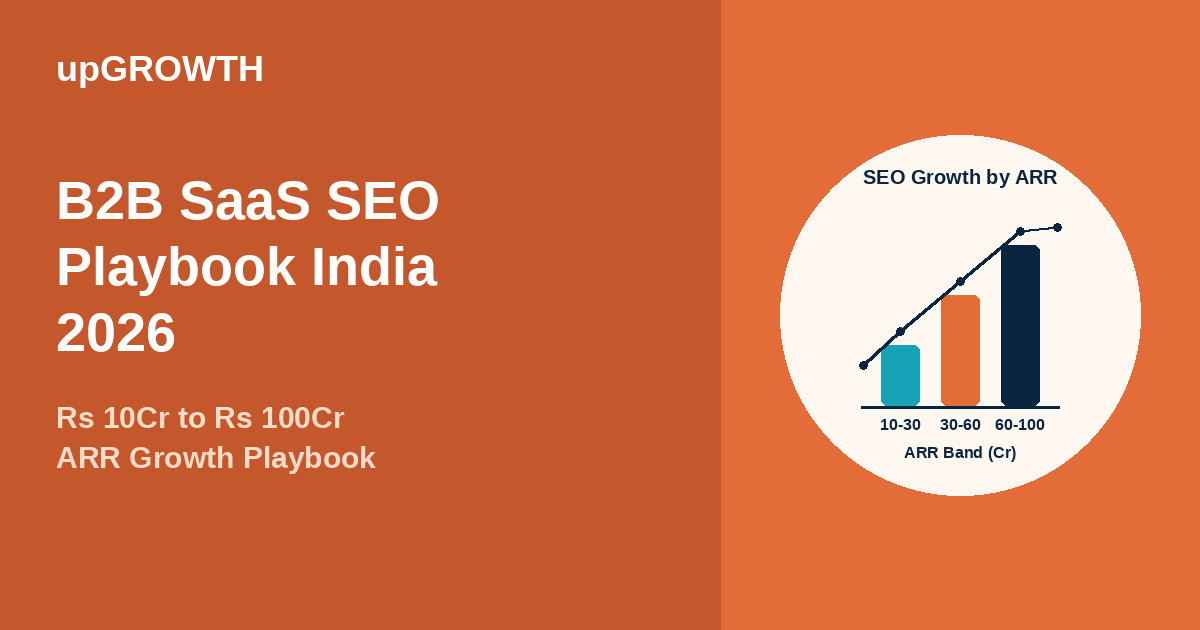
Your SEO programme at Rs 10Cr ARR looks nothing like your SEO programme at Rs 60Cr ARR. The budget changes, the team changes, the content architecture changes, and the measurement framework changes. Founders who try to run the same playbook across all three bands waste 6-12 months of runway.
At Rs 10-30Cr ARR, your SEO programme is about category definition. You have 15-40 pages of content, most of them unfocused. You are not ranking for your category yet because your category page does not exist or it reads like a product datasheet. The right move here is to kill 60 percent of existing content that is not converting, build 8-12 pillar pages mapped to the exact queries your first 50 customers searched before buying, and establish one non-negotiable monthly publishing cadence (2-3 long-form pieces minimum). Spend envelope: Rs 3-6L per month. Hire a freelance senior SEO strategist and one writer. Agency work here is expensive relative to output because you are still figuring out positioning.
At Rs 30-60Cr ARR, SEO shifts to compounding. You have the category page. You have 50-100 content pieces. Now you build topic clusters that interlink aggressively. You start doing original research (customer surveys, product usage data, industry benchmarks) because that is what earns the citations that matter. You add a GEO layer because AI Overviews are now cannibalising 30 percent of your top-of-funnel traffic. Spend envelope: Rs 6-15L per month. Either an experienced in-house SEO lead or a specialised agency running both SEO and GEO in parallel. You want 4-6 long-form pieces per month plus a content refresh cadence on your top 40 URLs.
At Rs 60-100Cr ARR, SEO becomes a moat. You have 150-400 pages, most of them earning links and traffic. You invest in tools (Ahrefs, Semrush, Clearscope, AirOps for AI monitoring). You build a 4-6 person content team or partner with a specialist agency running 60-80 content pieces per year. Your SEO programme now feeds product-led growth, sales enablement, and investor narrative simultaneously. Spend envelope: Rs 15-35L per month. The unit economics work because one ranked page can deliver 300-800 qualified leads per year at 20-40x the cost of the equivalent paid campaign.
What breaks founders is trying to run the Rs 60-100Cr playbook at Rs 15Cr ARR because a competitor is doing it. You will burn cash on content that does not rank because you have not earned the authority yet. Rank first, then scale.
Topic Architecture: The 4-Layer Model That Actually Ranks
Most Indian SaaS SEO programmes fail at topic architecture. They publish disconnected content that reads like a Wikipedia index rather than a coherent expertise argument. Google does not reward breadth. It rewards depth plus interlinking. Here is the architecture that works.
Layer 1: Category Pillar. This is the single most important page on your site after the homepage. It answers the highest-intent category query for your software. If you sell expense management software, your category pillar is at /expense-management-software/ and it is a 3,500-5,500 word definitive guide. Not a landing page. A real, evidence-rich resource that includes a comparison framework, a pricing breakdown, a buyer checklist, and honest trade-offs. You publish this once and update it quarterly.
Layer 2: Topic Clusters. For each major sub-topic inside your category, you build a cluster of 6-12 pages that interlink. For expense management, you might have clusters on “reimbursement workflows,” “GST compliance for expense management,” “expense fraud detection,” and “enterprise expense automation.” Each cluster has one pillar page and 5-11 supporting pages. Every supporting page links back to the cluster pillar and to 2-3 sibling pages.
Layer 3: Comparison and Alternative Pages. For every major competitor and adjacent category, you build a comparison page. These are high-intent, bottom-of-funnel pages that convert at 5-15x the rate of informational content. “Concur vs Happay,” “Zoho Expense vs Fyle,” “alternatives to Expensify in India.” These pages need honest data, real feature comparisons, and ideally a use-case-based recommendation rather than a generic “we’re the best” conclusion. Honesty here wins trust and trust wins pipeline.
Layer 4: Use Case and Buyer Persona Pages. For every industry vertical and buyer persona you serve, you build a dedicated page. “Expense management for manufacturing companies,” “expense automation for CFOs,” “travel expense software for logistics.” These pages capture buyer-intent traffic and also signal relevance to Google’s topic understanding. They should be 1,200-2,000 words, include a case study or testimonial, and link aggressively back to your category pillar.
The discipline is in the interlinking. Every new page you publish must link to at least 4 existing pages on your site, and you must update at least 2 existing pages to link to the new one. This is how topical authority compounds. Without it, you have 200 orphan pages and a bad traffic chart.
Keyword Research for Indian B2B SaaS: Beyond Volume and Difficulty
If you are still running keyword research based on Ahrefs monthly search volume in India, you are missing 60 percent of the opportunity. Indian B2B search is long-tail, conversational, and increasingly voice-driven. Here is the research framework we use.
Start with buyer interviews, not keyword tools. Before any keyword research, talk to 10-15 of your last customers and ask them three questions: “What did you search for in the first week you realised you had this problem?” “What did you search for in the week you shortlisted vendors?” “What search result made you trust a vendor enough to book a demo?” These interviews reveal queries that never show up in keyword tools because volume is 10-30 monthly searches but buying intent is near 100 percent.
Then layer keyword tools for volume-backed expansion. Use Ahrefs or Semrush for India-specific search volume. Filter for queries with at least 40 monthly searches OR at least 3 question-based variations OR appearance in Google “People Also Ask” for your category. Most SaaS founders over-index on volume. For Indian B2B, a 60-search query with buyer intent beats a 600-search query with pure informational intent.
Build the AEO prompt map in parallel. For every keyword cluster, identify the ChatGPT and Perplexity prompt that would route a buyer to your answer. “Best expense management software India” is the keyword. “What expense management tool should a 200-person manufacturing company in India use?” is the AEO prompt. Your content needs to answer both simultaneously. The title, H2s, and answer-ready sentences should map to the AEO prompt. The URL, meta description, and anchor text should map to the keyword. This dual-targeting is what produces GEO citations.
Flag the YMYL topics. If you sell to fintech, healthcare, or legal-regulated verticals, your keyword list will include YMYL (Your Money Your Life) topics that Google scrutinises harder for E-E-A-T. These topics need higher authority thresholds, named expert authors, and citation-heavy content. Do not treat them like generic SaaS SEO or you will see rankings stall at page 2 indefinitely.
Validate against zero-click dominance. For every target query, search it today in Google, ChatGPT, and Perplexity. If Google shows a featured snippet plus AI Overview, organic CTR is under 15 percent even in position 1. The smart play there is to optimise for AI Overview citation, not for blue-link ranking. Different content structure, different language, different success metric.
Technical SEO Non-Negotiables for 2026 (The List Nobody Maintains)
Most SaaS sites fail technical SEO audits in ways that are easy to fix but never prioritised because “growth” looks more exciting. Here is what we check first on every audit, and what you should run monthly.
Core Web Vitals on mobile. If your mobile LCP is above 2.5 seconds or your INP is above 200 milliseconds, you are losing rankings. Most WordPress-based SaaS sites in India fail mobile LCP because of bloated theme scripts and unoptimised hero images. Fix: compress images to WebP under 120KB, defer non-critical JS, lazy-load below-fold images, and kill theme builders you are not actively using.
Indexation hygiene. Run a Google Search Console coverage report monthly. Pages marked “Indexed, though blocked by robots.txt,” “Duplicate without user-selected canonical,” or “Crawled, currently not indexed” are telling you something is broken. Often it is a misconfigured sitemap, a canonical tag pointing to the wrong URL, or parameter URLs being indexed from your demo booking flow.
Schema markup for AEO. Every content piece needs Article schema with author, datePublished, and dateModified. Every FAQ section needs FAQPage schema. Every product page needs Product schema. Without schema, AI systems have a harder time extracting your content cleanly, which directly reduces citation share. Rank Math makes this straightforward. Use it.
AI bot crawlability. Check your robots.txt. Make sure OAI-SearchBot (ChatGPT), PerplexityBot, ClaudeBot, Google-Extended (Gemini), and CCBot (Common Crawl, which feeds many LLMs) are explicitly allowed. If you blocked these “to protect content from AI scraping” in 2024, unblock them now. Your content cannot be cited if AI cannot crawl it.
Internal linking density. Every page should have at least 5 internal links (both inbound and outbound). Pages with fewer than 3 inbound internal links rank poorly regardless of content quality. Use Screaming Frog or Ahrefs Site Audit monthly to find orphan pages and fix them.
URL structure discipline. Use short, keyword-rich URLs. Never let WordPress auto-generate slugs with dates, category paths, or the full post title as a slug. /expense-management-software/ beats /blog/2024/10/everything-you-need-to-know-about-expense-management-software-in-india/. Every time.
HTTPS, redirects, and canonicalization. One version of your site. One canonical URL per page. All HTTP redirects to HTTPS. www and non-www pick one and 301 the other. We have seen SaaS sites lose 30 percent of their organic traffic to unresolved canonicalisation issues nobody noticed for 18 months.
GEO Overlay: How to Layer AI Search Visibility on Traditional SEO
GEO (Generative Engine Optimization) is not a replacement for SEO. It is an overlay. The SEO fundamentals still matter. What changes is that ranking on Google page 1 no longer guarantees traffic. You also need to be the source AI Overviews cites, the answer ChatGPT synthesises, and the link Perplexity chooses to display.
The core difference: SEO optimises for a click. GEO optimises for a citation. A citation in AI Overview or ChatGPT does not always drive a click, but it builds brand presence and trust signals that compound over 3-6 months into pipeline. Brand search volume, direct traffic, and LinkedIn mentions all lift when your content becomes AI-citable.
Four things we do on every SaaS GEO engagement:
One. Audit AI citation share monthly. Run your top 50 buyer queries through ChatGPT, Perplexity, Google AI Overviews, and Gemini. Record which brands get cited and whether you appear. Track citation share over time. This metric is as important as keyword rankings in 2026 and most agencies still do not track it. Without baseline data, you are guessing whether your GEO investment is working.
Two. Write for extraction, not for engagement. AI systems extract self-contained sentences. If your most important insight requires reading three paragraphs to understand, AI will not cite it. Rewrite your key insights as 1-2 sentence standalone statements with specific numbers, named entities, and dated context. “As of Q1 2026, the average Indian B2B SaaS at Rs 30Cr ARR spends 14-18 percent of revenue on marketing” is extractable. “Marketing spend varies significantly depending on stage and ARR” is not.
Three. Embed proprietary data anchors. AI systems preferentially cite content that contains original research, proprietary benchmarks, or named case studies with specific numbers. Generic “thought leadership” content without data anchors rarely gets cited. Every pillar piece should include at least one original data point you cannot find elsewhere. Customer survey results, product usage data, or direct quotes from named practitioners all work.
Four. Build entity consistency across platforms. AI systems build a knowledge graph about your brand from Wikipedia, Crunchbase, LinkedIn, your website, and third-party mentions. Inconsistent company descriptions, conflicting team counts, or different positioning statements across platforms damage citation trust. Do a quarterly entity audit and fix inconsistencies. This is the most overlooked 2026 discipline in SaaS marketing.
Fi.Money, Vance, and mPower Financing all moved into AI Overview dominance by doing these four things with discipline. None of them are secret. They just require sustained execution, which is where most SaaS teams fall short.
Content Production System: How to Ship 4-8 Pieces a Month Without Losing Quality
SEO volume matters. But volume without quality destroys rankings because Google’s Helpful Content signals penalise AI-generated or shallow content aggressively now. The production system that works for Indian SaaS at 4-8 monthly pieces looks like this.
Brief every piece before writing. The brief is where you win or lose. Include: target keyword, AEO prompt, search intent, buyer stage, three extractable sentences the piece must contain, three case studies or data points to reference, internal links to 4+ existing pages, and success metric. Briefs take 45-90 minutes. They save 8-15 hours of rewrite work downstream.
Write first drafts from expert interviews, not from AI. The highest-performing SaaS content in 2026 sources insights from founders, operators, and customers. Use AI to speed up research and structuring, but the core insights must come from human expertise. Schedule a 30-minute recorded interview with a subject matter expert, transcribe it, and use the transcript as the raw material for the piece. This is what creates content AI systems want to cite.
Edit for extraction, not for flow. Standard editing fixes grammar and rhythm. AEO editing also checks: Does each H2 answer a natural-language question? Does the first sentence of each section contain the answer? Are there at least 3-5 standalone extractable statements per piece? Is there a named author with credentials? Are there 4+ internal links? If any of these are missing, the piece is not ready.
Publish, then invest in distribution. SEO does not stop at publish. For every piece, push it to: LinkedIn (short-form extraction, 3-4 posts per piece), founder email list, 2-3 relevant community forums, partners for backlinks, and re-engaged traffic via email. The first 4 weeks after publish are when you earn the engagement signals and backlinks that tell Google the piece matters. Ignore this step and you ship excellent content that never ranks.
Refresh quarterly. Content decays. Statistics become outdated. New competitors launch. Every quarter, update your top 20 traffic-driving pages with fresh data, new internal links, and improved headlines. Google rewards this aggressively. A 6-month-old page updated with Q2 2026 data will outrank an identical unrefreshed page.
Link Building for Indian B2B SaaS: What Actually Moves Domain Authority
Indian SaaS link building is not American link building. Guest posts on Forbes are not realistic at Rs 20Cr ARR. Paid links damage your domain long-term. HARO has collapsed in quality. Here is what works for Indian B2B SaaS in 2026.
Industry publications (YourStory, Inc42, Entrackr, The Ken). Pitch founder narratives, case studies, and industry commentary to Indian tech publications. These links carry topical authority for Indian B2B SaaS specifically and signal relevance to Indian search results. Expect 12-20 placements per year with disciplined pitching.
Customer case studies with backlinks. Every customer case study should include a section published on both your site and the customer’s site with a backlink. This earns you a relevant, contextual link from a business site in your niche. High authority. Almost never spammed.
Original research and data reports. Publish one major data report per year with proprietary survey data or product usage benchmarks. Indian SaaS publications, international analysts, and peer companies cite data reports actively. One good data report can generate 40-80 backlinks over 12 months.
Co-created content with complementary SaaS. Partner with a non-competing SaaS serving the same buyer. Co-author a pillar piece, co-host a webinar, and cross-publish with backlinks. This is high-quality link-building at near-zero cost. We have seen this produce 8-15 links per partnership in B2B SaaS verticals.
Podcasts, interviews, and speaker placements. Your founder and CGO should be on 2-4 podcasts per quarter. Most podcast show notes include links back to speaker websites. Low-effort, high-consistency backlinking.
Tool and calculator linking. If you have a useful free tool (ROI calculator, benchmark tool, assessment quiz), pitch it to relevant industry blogs and resource pages. Tools are linkable assets that earn editorial mentions because they add genuine value to the publisher’s audience.
What does not work anymore: generic guest posting on low-authority blogs, link exchanges, paid link networks, and PBNs. Google’s SpamBrain has made these tactics either worthless or actively harmful. The cost of a bad link-building programme is usually 6-12 months of rankings loss while you disavow and recover.
Measurement Framework: What to Track, What to Ignore
SaaS SEO measurement in 2026 requires more than organic traffic and keyword rankings. Here is the metric stack we build for every client, organised by what matters at each ARR band.
Input metrics (Rs 10-30Cr). Content velocity (pieces published per month), brief completion rate, publish-to-index time, average internal links per piece, backlinks earned per piece. These tell you if your SEO machine is running. Traffic and leads are lagging indicators at this stage because you do not have enough content for rankings to matter yet.
Ranking and visibility metrics (Rs 30-60Cr). Position tracking for your top 200 target keywords, featured snippet share, top 10 share, share of voice vs top 3 competitors, branded vs non-branded traffic ratio. Add AI citation share (how often your brand appears in ChatGPT, Perplexity, and AI Overviews for your top 50 buyer queries). This metric becomes critical at this stage because GEO is now cannibalising top-of-funnel clicks.
Pipeline metrics (Rs 60-100Cr). Qualified leads per month from organic, CAC on organic leads vs paid, SEO-influenced pipeline (deals touched by organic content in the buying journey), SEO-attributed revenue, ROAS equivalent for content spend. At this stage, SEO needs to defend its budget with pipeline impact, not traffic reports.
The metric most SaaS teams get wrong: they measure traffic when they should measure qualified pipeline. Traffic is vanity without conversion rate. A page generating 2,000 monthly visits with 0.1 percent lead conversion is worth less than a page generating 180 monthly visits with 4 percent lead conversion. Always measure what happens after the click.
Google Search Console, Ahrefs or Semrush, GA4 with proper event tracking, and a monthly AI citation audit tool (like AirOps or manual ChatGPT/Perplexity queries) are the minimum measurement stack. Skip any of these and you are flying blind in one direction.
Five Mistakes That Kill SaaS SEO Programmes in India
We have audited 150+ SaaS companies and the same five mistakes appear repeatedly. Avoid these and you will be ahead of 80 percent of your competitors.
One. Publishing without a category pillar. You cannot rank your category if your category page does not exist or reads like a feature list. Build the pillar first, then cluster content around it. Most SaaS sites publish 60 blog posts before they build the one page that earns them authority.
Two. Chasing high-volume informational keywords at the wrong stage. A Rs 15Cr ARR SaaS trying to rank for “what is SaaS” is wasting budget. You lack the domain authority and the buyer is not qualified. Focus on low-volume, high-intent queries that actually convert at your stage. Scale up to harder keywords as authority compounds.
Three. Ignoring comparison and alternative pages. These are the highest-converting SEO pages you will ever build. If you do not have pages for “[your product] vs [top 3 competitors]” and “alternatives to [category leader],” you are leaving 30-50 percent of bottom-of-funnel traffic on the table.
Four. Writing thin content that reads like AI. Google’s Helpful Content signals, combined with the 2024 spam update, have made thin AI-assisted content actively harmful. If your content is 60 percent generic advice, 30 percent repetition, and 10 percent sales pitch, it is hurting your domain. Write expert content or do not write.
Five. No GEO overlay at Rs 30Cr+ ARR. You cannot run 2022 SEO in 2026 and expect the same results. If you are not measuring AI citation share, building AEO-aligned content structure, and optimising for extraction, you are watching your top-of-funnel traffic erode quarter over quarter without understanding why.
Every one of these mistakes is fixable. But fixing them takes 6-12 months of disciplined execution because SEO is a lagging indicator. The sooner you start, the sooner the compound effect kicks in.
Six Common Questions About SaaS SEO in India
Q: How long does it take for a SaaS SEO programme to produce qualified leads?
A: Realistic timeline for Indian B2B SaaS is 6-9 months to first qualified leads from organic, 12-18 months to meaningful pipeline contribution (20+ percent of sourced pipeline), and 24-36 months for SEO to become a defensible acquisition moat. Programmes that promise leads in 90 days either skip the fundamentals or rely on paid link-building that hurts you later. We have seen consistent pipeline impact start around month 8 in 80 percent of our engagements.
Q: What is the minimum SEO budget for Indian B2B SaaS to make organic a real acquisition channel?
A: Below Rs 3L per month, your SEO programme is a hobby project. It cannot sustain the content velocity, technical maintenance, link-building, and measurement required to compound. The realistic minimum for a Rs 10-30Cr ARR SaaS is Rs 3-6L per month for a 9-12 month commitment. At Rs 30-60Cr, Rs 6-15L per month. At Rs 60-100Cr, Rs 15-35L per month. If you cannot commit to at least 9 months of consistent spend, do not start.
Q: Should I hire an in-house SEO lead or work with an agency?
A: Below Rs 30Cr ARR, agency is usually better because in-house SEO at this stage is a single person trying to do strategy, writing, link-building, and technical work simultaneously. Agencies give you a team. Above Rs 60Cr ARR, in-house plus specialist agency support often wins because the in-house lead can align SEO with product and sales priorities the agency cannot see. The worst option is hiring one mid-level in-house SEO and expecting them to do everything. That fails 80 percent of the time.
Q: How do I know if my current SEO agency is doing good work?
A: Ask for the last 90 days of: content briefs, published pieces, backlinks earned (with referring domains), technical audit findings fixed, ranking improvements for target keywords, AI citation share report, and qualified leads attributed to organic. If they cannot produce this in 48 hours, they are not running a real programme. Good agencies have this data ready because they measure their own work.
Q: What does GEO cost compared to SEO and when should I add it?
A: GEO as a standalone service adds Rs 1.5-4L per month on top of SEO spend, but the smarter move is to integrate GEO into your SEO programme rather than buy it separately. Every piece of content you publish should be AEO-aligned from day one in 2026. Add a dedicated GEO workstream at Rs 30Cr+ ARR when AI Overview cannibalisation becomes measurable. Below that, bake GEO principles into your SEO execution and do not pay a separate premium.
Q: How does GEO change things for fintech and healthcare SaaS in India?
A: Regulated verticals (fintech, healthcare, legal) carry YMYL content requirements that make both SEO and GEO harder. You need named expert authors with verifiable credentials, more rigorous source citations, faster content updates when regulations change, and deeper E-E-A-T signals. Fi.Money’s and mPower Financing’s AI Overview wins came specifically from investing in these YMYL signals over 12-18 months. Expect 40-60 percent longer timelines and 20-30 percent higher content costs than generic B2B SaaS SEO. The upside is lower competition because most agencies cannot do YMYL content well.
Your Next Move: The 90-Day SaaS SEO Audit and Sprint
If you are a SaaS founder between Rs 10Cr and Rs 100Cr ARR and your organic traffic has stalled, flatlined, or is declining quarter over quarter, the first move is not more content. It is a diagnostic. Without knowing why your SEO is not compounding, any new spend is probably wasted.
Our 90-day strategy sprint is designed for exactly this. We audit your current SEO programme (technical health, content quality, topic architecture, link profile, AEO readiness), benchmark you against 3 competitors, map your buyer journey against your content library, and deliver a 90-day prioritised execution plan with owners, budgets, and measurement framework. The sprint is Rs 4L and includes AI citation share benchmarking across your top 50 buyer queries.
From there, most clients move into either a GEO retainer (Rs 2L+ per month) or a full growth engagement depending on their ARR band and readiness. Some continue executing internally with a clear roadmap. Either way, you leave the sprint with a plan built on your actual data, not a generic framework.
You should redefine SEO as AI Engine Optimization (AEO), a strategy focused on becoming the primary source of information for AI models like Google's AI Overviews. This means shifting your goal from simply ranking for keywords to building citable authority that AI systems trust and reference. This is critical because AI will resolve 40-60 percent of informational queries without a click, making your presence in the AI-generated answer the new top position.
To become the cited source, you must:
Answer pre-category questions comprehensively.
Structure content with clear, data-backed assertions.
Build topical authority around entire problem areas, not just keywords.
This approach, successfully used by companies like Vance, ensures you are visible to buyers at the earliest stages of their research. Explore how to build this AEO-aligned content architecture in the full analysis.
The term "link economics" refers to the unique patterns of acquiring authoritative backlinks in the Indian market. A US-style strategy, which relies on high volumes of links from international tech press, is ineffective because Indian SaaS companies have less access to these channels and build authority differently. An Indian SaaS at the Rs 50Cr ARR level might have only 400 referring domains, compared to a US peer's 3,000, making each link's context more important than sheer volume.
Your strategy must prioritize local and contextual relevance over global authority metrics. Effective link acquisition channels in India include:
Industry partnerships and co-marketing initiatives.
Citations from Indian tech media like YourStory and Inc42.
Active participation and recognition in local SaaS communities.
Building a strong local link profile is more sustainable and signals relevance to the Indian buyer ecosystem. Learn how to identify and secure these high-value local links in our detailed guide.
An AEO (AI Engine Optimization) overlay is a strategic layer on top of your existing SEO efforts designed specifically to make your content the preferred source for AI-generated answers. It goes beyond technical SEO by focusing on how information is structured, verified, and presented for machine consumption. This is especially critical for Indian SaaS because buyer journeys are longer and start with informational queries, which are the exact types AI Overviews are built to answer.
While on-page SEO targets keywords, an AEO overlay focuses on becoming the definitive answer for the questions behind those keywords. With AI set to absorb 40-60 percent of informational query traffic, companies like Fi.Money thrive by ensuring their content is easily citable. An AEO overlay involves creating deep, authoritative content hubs that AI systems recognize as the gold standard, protecting your pipeline from disappearing. This playbook details how to build that protective AEO layer.
The massive difference in search volume completely invalidates the US model of targeting a few high-volume "hero" keywords. Since Indian B2B search volumes are 5-15x smaller, a successful strategy must focus on capturing a large number of long-tail, high-intent queries rather than competing for a small number of broad terms. This requires a shift from a keyword-centric to a topic-centric content model.
Your keyword strategy must adapt in three key ways:
Go for Breadth: Aim to build 200 precision-targeted pages, each capturing 20-80 monthly searches, instead of three pages targeting thousands.
Target Early Funnel Queries: Indian buyers start research earlier, so content must address problems they have long before they are solution-aware.
Prioritize Conversion Rate: With lower traffic per page, the focus must be on creating content that converts its small audience at a disproportionately high rate.
Failing to make this adjustment means your SEO program, like many audited by upGrowth Digital, will fail to generate a meaningful pipeline. Uncover the full methodology for building a high-converting, long-tail strategy in our report.
The dominance of specific plugins like Rank Math standardizes the technical SEO environment for a majority of Indian companies, creating both constraints and opportunities. Your technical playbook must be pragmatic, working within the capabilities and common configurations of these tools rather than prescribing solutions that are incompatible with your team's existing stack. This contrasts with the US market, where a wider variety of platforms and tools necessitates a more flexible, custom approach.
This market reality means your technical SEO audit should focus heavily on optimizing the settings within these popular plugins to gain a competitive edge. Since so many sites use the default settings, a company that masters the advanced features of Rank Math or YoastSEO can achieve superior technical health. The key is not to fight the stack but to master it for a tangible advantage. The complete guide provides a checklist for optimizing these specific environments.
Companies like Fi.Money and Vance achieved dominance in AI Overviews by creating content that directly and authoritatively answers specific user questions, making it easy for AI to cite them. Their success was not accidental but a result of a disciplined AEO-aligned approach that focused on becoming the canonical source for niche financial queries like "smart deposit" or "UTR payment tracking."
To replicate their strategy, you should:
Identify High-Value Niche Queries: Find questions your audience asks that have a clear, factual answer you can provide.
Create Definitive Answer Pages: Build pages that are structured for citability, using clear headings, concise definitions, and data-backed statements.
Establish Topical Authority: Surround these answer pages with supporting content that demonstrates deep expertise in the subject area.
By becoming the most trusted source for a cluster of related queries, you ensure your brand is the one featured when AI answers a user's question. This playbook explains how to identify and own these citation-worthy topics.
Given the lower ceiling for referring domains, Indian SaaS companies must pursue a more targeted and relationship-driven link acquisition strategy. Instead of mass outreach, the focus should be on building a defensible moat through high-quality, contextually relevant local citations. The goal is to maximize the authority passed from each of the 400 domains rather than chasing a higher, unrealistic number.
Effective non-traditional channels include:
Strategic Partnerships: Co-authoring research or webinars with non-competing companies in your ecosystem.
Indian Media Features: Securing coverage in publications like The Ken or Entrackr that are highly respected within the local market.
Community Engagement: Becoming an active, valuable contributor in industry forums and communities, leading to organic citations.
These channels build trust and authority with the Indian buyer in a way that generic international links cannot. The full article breaks down how to execute each of these plays.
This stark 12x difference in search volume for a core category keyword proves that a top-down, head-term-focused SEO strategy is destined to fail in India. Relying on a keyword like "SaaS onboarding software" to drive your pipeline is not viable when it only generates 720 searches nationally. Instead, you must adopt a bottom-up approach, aggregating traffic from hundreds of low-volume, high-intent long-tail keywords.
This data point highlights the need to:
Deconstruct the Buyer's Journey: Map out all the niche problems and questions a user has before they even know they need onboarding software.
Build a Content Library, Not Just Pages: Create a comprehensive resource of 200+ articles that each target a specific, low-volume query.
Focus on Cumulative Impact: Understand that your organic pipeline will be the sum of many small streams of traffic, not one or two large ones.
This is the core strategic pivot required to succeed, a principle that successful firms like upGrowth Digital's clients understand well. Explore how to build this kind of scalable content engine in the complete guide.
For a founder at Rs 10Cr ARR, the shift to an AEO-focused model must be disciplined and phased to manage resources effectively. The core idea is to stop chasing high-volume keywords and start owning the entire conversation around the problems your product solves, especially for buyers who are not yet solution-aware. This builds a long-term, defensible pipeline.
A practical three-step plan includes:
Conduct "Pre-Category" Research: Spend a month interviewing customers to identify the questions they asked two quarters before they started looking for a solution like yours.
Build Foundational Topic Clusters: For the next six months, exclusively create deep, authoritative content hubs that answer these early-funnel questions.
Structure for Citability: Ensure every article includes clear definitions, bolded key terms, and data points that make it easy for Google's AI Overviews to reference your content, similar to the strategy used by Vance.
This phased approach builds authority and pipeline simultaneously. The full playbook provides a detailed project plan for this transition.
Your content architecture must be built around a hub-and-spoke model that mirrors the elongated Indian buyer journey. The central "hub" should be a pillar page addressing a major problem your audience faces, while the "spokes" are detailed articles that answer the specific, early-funnel questions they Google. This structure allows you to capture user intent at the awareness stage and systematically guide them toward consideration.
To effectively execute this:
Map the Full Journey: Identify the awareness-stage queries (e.g., "how to hire a sales team") that precede consideration-stage queries ("best sales enablement software").
Create Problem-First Content: Your content should focus on solving the user's immediate problem, with only a subtle mention of your product.
Use Internal Linking Strategically: Guide readers from an awareness-level blog post to a more solution-oriented consideration-level guide.
This methodical approach builds trust over the longer sales cycle and establishes your brand, much like Fi.Money, as the go-to expert. The detailed playbook shows exactly how to design these content journeys.
The primary strategic risk is total pipeline invisibility and unpredictability. Continuing with an outdated SEO playbook means you are optimizing for a user behavior, clicking blue links, that is rapidly declining for informational queries. When 40-60 percent of your target audience gets their answer directly from the search results page, your pipeline from organic search could be cut in half without warning.
This creates a severe business vulnerability because your entire top-of-funnel strategy becomes dependent on a shrinking pool of traffic. The compound effect of this is that while you disappear, competitors like Vance who master AEO will become the cited source across multiple AI platforms, solidifying their authority and capturing market share. Your pipeline predictability will collapse because you are no longer part of the conversation. The full article explores the cascading financial impact of this strategic misstep.
Asking how to rank for one keyword is the wrong question because it assumes a search environment that no longer exists. AI-powered search engines prioritize and feature sources that provide comprehensive answers to user intent, not just pages matching a string of text. The more effective and strategic question is: "How do we become the source AI systems cite when a buyer asks the question that precedes our category keyword?"
This shift in perspective forces you to build a deep, authoritative content moat instead of just ranking a few landing pages. To do this, you must:
Think in Questions, Not Keywords: Identify the underlying problems your buyers are trying to solve.
Answer Exhaustively: Create the single best resource on the internet for that question.
Optimize for Citability: Structure your content so AI can easily extract and feature your answer.
As proven by Fi.Money, this is how you build a defensible channel in a world where AI will answer 40-60% of queries. The complete playbook details this fundamental shift in thinking.
Amol has helped catalyse business growth with his strategic & data-driven methodologies. With a decade of experience in the field of marketing, he has donned multiple hats, from channel optimization, data analytics and creative brand positioning to growth engineering and sales.
In This Article
Download The Free Digital Marketing Resources
[slide-anything id="15651"]
We plant one 🌲 for every new subscriber.
Want to learn how Growth Hacking can boost up your business?

 Growth Strategy and Planning
 Inbound Growth
 Growth Hacking
 Fractional CMO
 Search Engine Optimization
 Paid and Performance Marketing
 Social Media Marketing
 Demand Generation
 AI-Driven Growth Strategy
 AI-Native Workflow Automation
 Generative Engine Optimization
 Grove — AI Growth Strategist

 AI Automation
 Framework
 Case Study
 Tools
Tools Growth Tools
 Decision Tree
 Compare
 Custom GPT's
 AI Answer Gap
 Offer
Offer Webstories
 Quizzes
 Blog
Blog AI-powered Apps
 Social Media Tools
 Agency Fit Score