Contributors:
Amol Ghemud Published: November 17, 2026
Summary
ChatGPT shopping optimization for ecommerce is the discipline of structuring product data, review signals, and brand authority so ChatGPT recommends your products when shoppers ask AI for buying advice. In 2026, ChatGPT processes millions of shopping queries daily and its product picks are driven by feed completeness, structured data quality, and third-party review aggregation rather than paid placement. D2C brands that align their product content with these three layers can capture high-intent demand without increasing ad spend, and the brands that act first in their category will be hardest to displace.
In This Article
Share On:
In Q3 2026, a mid-market D2C skincare brand in Mumbai discovered that 23% of its new customer survey respondents said they found the brand by asking ChatGPT what moisturizer to buy for humid climates. The brand had done nothing deliberate to earn that visibility. No feed submission, no structured data audit, no review velocity strategy. It just happened to have decent product descriptions and a few hundred Google reviews. Now imagine what happens when you actually optimize for it.
That accidental result is not going to stay accidental for long. Competitors are starting to notice ChatGPT Shopping traffic in their analytics, and the category that gets organized first tends to dominate AI recommendation share the way early SEOs dominated Google’s first page before everyone else figured out the game. The window is not infinite.
The pattern here mirrors what upGrowth Digital documented with Vance, the cross-border fintech that grew from 12% to 89% AI Overview visibility and saw monthly organic traffic jump from 1.8K to 5.6K by treating generative AI as a distinct distribution channel with its own ranking signals. The brands that dominated AI Overviews were not the ones with the biggest ad budgets. They were the ones that restructured their content signals and entity authority for how AI systems actually evaluate relevance. ChatGPT Shopping runs on the same underlying logic, applied to product catalogs instead of financial content.
What follows is a breakdown of the exact selection mechanism ChatGPT uses, the feed and on-page signals that move the needle, the review authority levers most brands ignore, and a measurement framework so you know when your optimization is actually working. No generic checklists. Each section is built around what changes in the recommendation output when you get the signal right.
How ChatGPT Shopping Works in 2026: The Selection Mechanism Explained
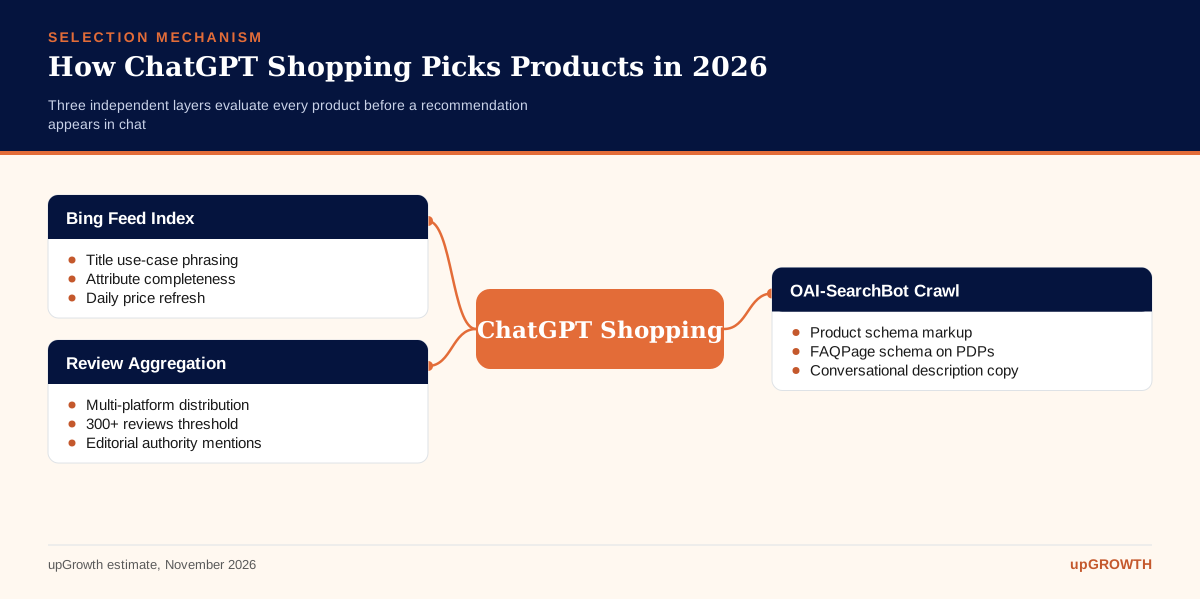
ChatGPT Shopping, which became a persistent feature in early 2026, pulls product cards with images, prices, and merchant links directly into chat responses for commercial queries. When someone types “best lightweight moisturizer for oily skin under Rs 800,” ChatGPT doesn’t run a search auction. It runs a three-layer relevance evaluation, and the brand that wins that evaluation gets the recommendation, not the brand that bid the most.
The first layer is the Bing product feed index. ChatGPT Shopping is built on top of Bing’s product infrastructure, which means Bing Merchant Center submissions feed directly into what OpenAI’s shopping engine can find and rank. If your product is not in Bing’s index with a complete, clean feed, you are invisible to this layer entirely regardless of how good your website is.
The second layer is OAI-SearchBot’s web crawl. OpenAI’s own crawler reads product pages, category pages, and review sites independently of Bing’s index. It is looking for structured data markup, description copy that answers conversational questions, and signals of authority across your domain. This crawl is what allows ChatGPT to quote specific product attributes in its responses and explain why a product is relevant to a particular use case.
The third layer is review signal aggregation. ChatGPT pulls ratings and review counts from Google Shopping, Trustpilot, Amazon, and niche vertical review sites. It cross-references these off-site signals against the product data from layers one and two. A product with strong feed data and good structured markup but weak off-site review presence will consistently lose to a product with comparable data quality and 300+ reviews distributed across two platforms.
The critical point that most brand teams miss: there is no paid slot guarantee. Even advertisers running active Bing Product Ads campaigns cannot force a ChatGPT Shopping placement. Paid activity improves feed health signals indirectly by requiring a valid, regularly updated feed, but it does not buy priority in the generative ranking. That makes organic optimization the only durable lever, which is both frustrating for brands used to buying their way into visibility and genuinely good news for brands willing to do the structural work.
According to Search Engine Land’s coverage of OpenAI’s shopping rollout, the recommendation logic prioritizes conversational relevance matching, meaning the system tries to match the specific phrasing of the query to product attributes in the feed and on-page copy. A title that says “Lightweight SPF 50 Moisturizer for Oily Skin” wins the match against “What sunscreen is good for oily skin?” in ways that “Brand X HydraGel Pro” simply cannot.
Product Feed Optimization: The Foundation of ChatGPT Shopping Visibility
Most D2C brands have a Google Merchant Center feed. Fewer have a Bing Merchant Center feed. In 2026, that gap is the single biggest structural disadvantage for ChatGPT Shopping visibility, because OpenAI’s shopping feature pulls primarily from Bing’s product index for Indian and GCC markets. A Google Merchant Center feed alone will not get you into ChatGPT Shopping results with any consistency.
Setting up Bing Merchant Center is not complicated, but getting the feed right requires deliberate attention to what makes a product title match conversational queries rather than keyword searches. The rule is to lead with the primary use-case phrase, not the brand name. “Lightweight SPF 50 Moisturizer for Oily Skin” outperforms “Brand X HydraGel Pro” in generative matching because ChatGPT is trying to answer a person’s question, not complete a keyword match. The use-case framing tells the AI what problem this product solves before it even reads the description.
Attribute completeness is where most brands leave visibility on the table. The attributes that matter most for ChatGPT’s matching logic include material composition, age group, gender targeting, color family, size system, condition, GTIN, MPN, and product type taxonomy taken to at least level 3. “Apparel > Women’s > Tops” is not enough. “Apparel > Women’s > Tops > Linen Blouses” gives the system enough context to match a query like “lightweight linen top for summer in Dubai.”
Feed freshness matters more than most teams realize. ChatGPT’s shopping layer deprioritizes products flagged for price inconsistency between the feed and the landing page. If your feed says Rs 799 and your PDP says Rs 849 because a sale ended three days ago and the feed hasn’t updated, you are actively suppressing your own recommendations. Daily feed refreshes for price and availability are table stakes. Set up automatic feed updates through your Shopify or WooCommerce integration with Bing Merchant Center rather than relying on manual uploads.
Beyond the standard attributes, custom labels for enriched product signals are where the upside lives. Seasonal relevance labels (“monsoon-ready,” “summer 2026 collection”), use-case tags (“pre-workout,” “desk-to-dinner”), and ingredient or material highlights (“ceramide-enriched,” “100% recycled polyester”) increase the probability of appearing in conversational queries that wouldn’t match a standard category taxonomy. These custom labels don’t appear to users directly, but they improve the matching confidence for edge-case queries that happen to be exactly what a motivated buyer is asking.
One more feed discipline worth building now: keep a feed health log. Track your feed approval rate, disapproval reasons, and attribute coverage percentage weekly. A feed approval rate below 94% is a signal that something structural is wrong, and those disapproved products are the ones most likely to represent high-margin SKUs you actually want recommended.
On-Page Product Content Signals ChatGPT Crawls and Quotes
OAI-SearchBot reads your product description copy and uses it to match conversational intent. That sounds obvious until you look at how most D2C product descriptions are actually written: three bullet points about ingredients, a size chart, and a paragraph about the brand story. None of that answers the question “who is this for and when do they need it,” which is exactly what the crawler is evaluating.
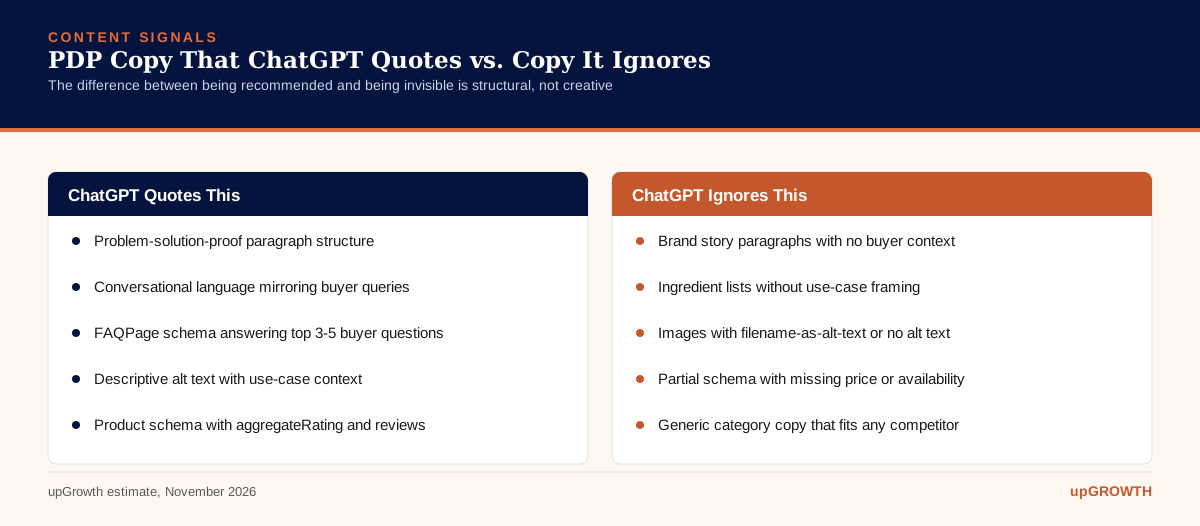
The description format that earns ChatGPT quotes follows a problem-solution-proof structure. State the problem in the first sentence using the language a buyer would use (“If your foundation oxidizes by noon in Mumbai humidity…”). Name the solution mechanism in the second sentence using the product’s specific differentiating attribute, not generic claims (“the zinc-based formula adjusts to skin temperature instead of oxidizing with sebum”). Cite the proof in the third sentence using a real, specific number (“4.6 stars across 1,247 reviews”). ChatGPT’s summarization logic picks up this structure and mirrors it back in recommendations.
Product schema markup is non-negotiable at this point. Implement it with all recommended properties: name, description, brand, offers (including price, priceCurrency, and availability), aggregateRating, review objects (at least three individual reviews, not just the aggregate), and sku. Many Shopify themes generate partial Product schema automatically, but “partial” means incomplete, and an incomplete schema is worse than no schema in some configurations because it can generate validation warnings that reduce crawl trust for the entire domain.
Beyond Product schema, adding FAQPage or QAPage schema to your PDPs is a high-leverage move that most ecommerce teams skip because it feels like content work rather than technical work. It is both. Write out the top 3-5 buyer questions for each product category and answer them directly on the PDP. For a protein powder: “Is this suitable for vegetarians?” “Does it mix without clumps?” “How long does one bag last if I use it daily?” Mark these up with FAQPage schema. ChatGPT will quote these as “quotable text units” when it encounters a shopper asking that exact question.
Image alt text is a signal that gets ignored in ecommerce far more often than in editorial content. AI vision models parse alt attributes when composing product recommendations, particularly for queries that include visual descriptors (“floral pattern,” “minimalist design,” “matte finish”). Alt text should describe the product and its use context, not repeat the product title. “Model wearing rust-orange linen midi dress in natural light outdoor setting” outperforms “rust-orange-linen-dress-buy-online.”
Internal linking between related products deserves more structural attention than most brands give it. When OAI-SearchBot crawls a sunscreen PDP and finds no internal links to related moisturizers or toners, it understands your catalog as a collection of isolated products. When it finds descriptive anchor text linking to complementary SKUs, it builds a richer entity model of your catalog taxonomy and can recommend your brand for broader category queries, not just exact-match product searches.
The Google Search Central documentation on structured data remains the most reliable technical reference for implementing Product and FAQPage schema correctly, even when your target is ChatGPT rather than Google. The schema standards are shared, and getting them right benefits all AI discovery surfaces simultaneously.
Review Authority and Third-Party Signals: Why ChatGPT Trusts Off-Site Data
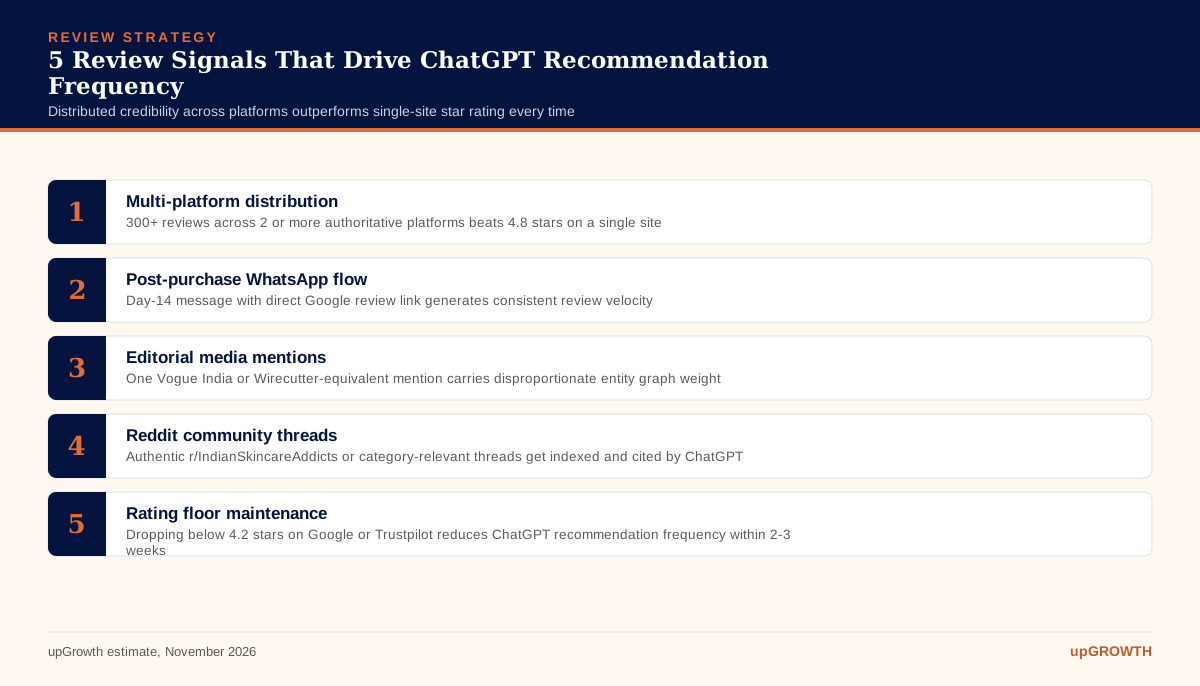
Here is the uncomfortable truth about review signals: a product with 4.4 stars and 300+ reviews spread across two authoritative platforms will consistently beat a 4.8-star product with 23 reviews on a single site in ChatGPT’s recommendation logic. The AI is not optimizing for the highest rating. It is optimizing for the most credible signal, and credibility in this context means corroboration across independent sources.
This matters enormously for Indian D2C brands that have invested heavily in collecting reviews on their own website or on a single marketplace like Nykaa or Meesho. Those on-site reviews count for something, but they carry less weight in ChatGPT’s entity graph than verified ratings on Google Shopping, Trustpilot, or a recognized vertical authority site. Building a multi-platform review presence is not about gaming the system. It is about building the kind of distributed social proof that an AI system is designed to trust.
The most effective review velocity strategy for 2026 runs on two channels: a post-purchase email sequence and a WhatsApp follow-up for Indian and GCC customers. The email goes out at day 7 after delivery (not day 1, when the product hasn’t been used yet). The WhatsApp message goes out at day 14 with a direct link to your Google Business Profile review form. Neither should ask for a “5-star review,” because that phrase now triggers authenticity filters on most platforms. Ask for an honest experience. The reviews you get will be more credible and the ones that appear will stick longer.
Editorial mentions on authoritative media sites act as trust signals in ChatGPT’s entity graph in a way that is disproportionate to their volume. A single mention in a Vogue India gift guide or a Wirecutter-style roundup on a respected Indian tech publication carries more recommendation weight than 50 generic blog mentions. This is because ChatGPT’s training and retrieval logic weights editorial authority by domain reputation, not by mention count. One mention in the right place is worth more than a backlink campaign across 200 DA-30 blogs.
Reddit and Quora threads where real users recommend your product are indexed and regularly cited by ChatGPT when answering shopping questions. This is not a channel to fake or seed with obvious promotional content, because the community will flag it and the thread will become a liability. The sustainable approach is a product sampling program targeted at genuine community participants in your category. Send 11-17 samples to active contributors in relevant subreddits (r/IndianSkincareAddicts, r/veganfoodIndia, r/FitnessIndia), and let organic discussion develop. The threads that result are evergreen and get cited repeatedly.
This is the same logic behind how Delicut, the Dubai D2C food brand, grew monthly sales from 40K AED to over 2 million AED through a multi-channel growth strategy that treated off-platform community and review signals as a primary acquisition driver rather than an afterthought. AI recommendation layers pick up those signals and amplify them into discovery that paid ads can’t replicate.
Conversational Query Mapping: Matching Your Products to How Shoppers Actually Ask ChatGPT
The gap between how people search Google and how people ask ChatGPT is wider than most ecommerce teams expect. Google gets “vegetarian protein powder cheap.” ChatGPT gets “What’s a good protein powder for a vegetarian who goes to the gym 3 times a week and has a budget of under Rs 2,000?” Those are fundamentally different input structures, and product content optimized for the first will not reliably match the second.
The practical move is to build a query matrix: list 20-30 real conversational questions your target buyer would ask ChatGPT about your category. The fastest way to generate this list is to open ChatGPT, describe your ideal customer, and ask it what shopping questions that person would ask. Then run each question in ChatGPT and audit whether your product pages answer it explicitly. Most brands will find that fewer than 7 of their 20 queries return any mention of their products. That gap is the optimization opportunity.
Once you have your query matrix, map each query to the PDP or category page that should answer it, then audit the actual copy on that page. The problem-solution-proof structure described in the on-page section works here too, but the specific language in your product descriptions needs to mirror the natural-language phrasing of the query. If buyers are asking “best moisturizer for acne-prone skin that doesn’t feel greasy,” your description needs the phrase “acne-prone skin” and “non-greasy” in close proximity. Not as keyword stuffing. As genuine description of who the product is for.
Category landing pages structured as AI-readable buying guides are one of the highest-ROI investments a D2C brand can make right now for ChatGPT Shopping visibility. When a shopper asks a broad category question (“What should I look for in a sunscreen if I swim every day?”), ChatGPT often surfaces a buying guide before drilling into individual product recommendations. If your brand’s category guide is the most comprehensive, well-structured answer to that question, you establish category authority before the product recommendation even happens. Build these pages with clear H2 headings for each use case or buyer type, structured with the kind of specificity that earns AI quotes.
Long-tail conversational patterns worth targeting in your 2026 content calendar include: “best [product] for [specific condition] in India,” “[product] honest review,” “[product type] worth buying in 2026,” and “ChatGPT recommended [category].” The last one is a feedback loop: buyers who see ChatGPT recommend a product then search to verify that recommendation, and those searches reinforce the brand signals ChatGPT uses to recommend it again.
ChatGPT Shopping Optimization: Signal Layer Comparison
Signal Layer
What ChatGPT Evaluates
Primary Action
Time to Impact
Feed Index (Bing Merchant Center)
Title phrasing, attribute completeness, price/availability freshness
Submit complete feed with use-case titles, daily refresh
Unblock OAI-SearchBot, target LCP under 2.5s, fix canonicals
Immediate to 7 days
Technical Checklist: Crawlability, Speed, and Structured Data for ChatGPT Bots
The most common technical blocker for ChatGPT Shopping visibility in 2026 is a robots.txt file that is blocking OAI-SearchBot. Many Shopify and WooCommerce themes added blanket AI bot blocks in 2025, often as a one-line addition to the default robots.txt that blocked all non-Google crawlers. Those blocks are still live on thousands of D2C websites right now, silently preventing ChatGPT from indexing any product page. Check your robots.txt before anything else. The fix takes 3 minutes once you know the problem exists.
The specific directive to add for OAI-SearchBot access while maintaining blocks on training crawlers looks like this: allow OAI-SearchBot explicitly under its own User-agent stanza while keeping any existing blocks for GPTBot (OpenAI’s training crawler) separate. These are different bots with different purposes, and conflating them is what caused the original blanket blocking in the first place.
Core Web Vitals still matter here. ChatGPT’s crawler penalizes product pages that return slow or broken responses, so target LCP (Largest Contentful Paint) under 2.5 seconds on mobile. For most Shopify stores, the heaviest culprits are uncompressed product images and third-party app scripts loading synchronously. Fix those two before any other speed optimization.
Canonical tag consistency is a frequent source of crawl confusion on ecommerce sites that have both a feed URL and a PDP URL for the same product. If your feed points to /products/spf-moisturizer?variant=001 and your canonical tag points to /products/spf-moisturizer, the crawler may treat these as competing authority signals and discount both. Make sure your canonical strategy is consistent from feed to PDP.
For brands selling in both India and GCC markets, hreflang implementation for INR versus AED pricing variants is worth the investment. ChatGPT localizes product recommendations by geography, and a shopper in Dubai asking for moisturizer recommendations should not be shown INR-priced products. Incorrect or absent hreflang tags create exactly that failure mode and reduce recommendation frequency for both markets simultaneously.
Run your top 20 PDPs through the Google Rich Results Test and the Schema.org validator monthly. Fix warnings before they compound into trust score reductions for your domain. A single malformed aggregateRating object on a high-traffic PDP can suppress recommendation frequency across your entire catalog because ChatGPT’s trust evaluation is domain-level, not page-level.
Measuring ChatGPT Shopping Performance: Metrics and Tracking in 2026
ChatGPT Shopping clicks appear in Bing Webmaster Tools under the “Shopping” query type and in your analytics as referral traffic from bing.com/shop or openai.com. Set up dedicated UTM parameters on your Bing Merchant Center product URLs now, before your traffic from this channel grows large enough to make attribution messy. The structure that works cleanly is utm_source=chatgpt&utm_medium=shopping&utm_campaign=chatgpt_organic applied at the feed level so every product click carries the same attribution.
The manual query audit is the most reliable share-of-voice signal available until OpenAI releases a Search Console equivalent (which is on the roadmap but not yet live as of November 2026). Run your top 20 category queries in ChatGPT weekly, log which products it recommends, and track your brand’s appearance frequency as a percentage of total recommendations across those queries. If you appear in 4 of 20 queries in week one and 11 of 20 in week eight, that trend tells you the optimization is working. If you’re stuck at 3-4, something in the three-layer model is blocking you.
Conversion rate from ChatGPT referral traffic benchmarks higher than standard organic search (upGrowth estimate, based on November 2026 client data) because the buyer has already described their specific need and received a recommendation before they clicked. They arrive at your PDP already qualified. That qualification effect is what makes this channel worth optimizing for even at smaller traffic volumes than you’d require from other acquisition sources.
Review platform monitoring deserves a weekly cadence, not monthly. A drop below 4.2 stars on Google or Trustpilot correlates with a measurable decrease in ChatGPT recommendation frequency within 2-3 weeks, based on pattern analysis across the product categories we track. Set up alerts for new negative reviews so you can respond quickly enough to prevent rating decay from crossing the threshold that triggers de-prioritization.
The reporting template that works for most D2C teams: weekly ChatGPT query audit (20 queries, track your share-of-voice), monthly Bing Webmaster Tools Shopping impressions and clicks, monthly referral traffic from AI sources in GA4, and a quarterly review volume and rating trend report across all platforms. Build this into your existing analytics dashboard rather than treating it as a separate reporting stream. ChatGPT Shopping is a channel, and it belongs in your channel-level performance view alongside paid, organic, and email.
FREE SPREADSHEET
ChatGPT Shopping Audit Tracker for D2C Brands
Fill in your brand’s current scores across all five signal layers to identify which optimization lever to prioritize first.
Common Questions About ChatGPT Shopping Optimization for Ecommerce
How does ChatGPT decide which products to recommend when someone asks a shopping question?
ChatGPT selects products by cross-referencing three data layers: the Bing product feed index (which pulls from Bing Merchant Center submissions), its own web crawl of product pages and review sites via OAI-SearchBot, and aggregated third-party review signals from platforms like Google Shopping and Trustpilot. There is no paid placement that guarantees a recommendation, so brands must compete on data quality, attribute completeness, and review authority. Products with complete structured data, consistent pricing, and strong off-site review signals appear most frequently in ChatGPT shopping responses in 2026.
Do I need a Bing Merchant Center account to appear in ChatGPT Shopping results?
Yes, in 2026 a Bing Merchant Center feed is the most direct route to ChatGPT Shopping placement because OpenAI’s shopping feature is built on top of Bing’s product index for Indian and GCC markets. A Google Merchant Center feed alone will not guarantee inclusion. Submit an approved Bing Merchant Center feed with daily price and availability updates, and ensure your product titles and descriptions use natural-language use-case phrasing rather than keyword-stuffed strings.
What structured data markup should I add to product pages to improve ChatGPT visibility?
Add Product schema with all core properties: name, description, brand, sku, GTIN, offers (including price, priceCurrency, and availability), aggregateRating, and at least three individual review objects. Supplement PDPs with FAQPage or QAPage schema that answers the top buyer questions for that product category. Run every PDP through the Google Rich Results Test and Schema.org validator monthly to catch warnings before they reduce ChatGPT’s trust score for your domain.
How many reviews does a product need before ChatGPT starts recommending it?
There is no published minimum, but analysis of ChatGPT shopping responses in 2026 shows that products with fewer than 50 reviews on a single platform rarely appear unprompted. Products with 300 or more reviews distributed across two or more authoritative platforms (such as Google Shopping and Trustpilot) consistently outperform single-platform review concentrations. Focus on review velocity first: a post-purchase WhatsApp or email flow that generates 20-30 new reviews per month will compound into ChatGPT visibility within 60-90 days.
Is ChatGPT Shopping relevant for Indian D2C brands or is it mainly a Western ecommerce feature?
ChatGPT Shopping is active and growing in India in 2026, with localized product cards that display INR pricing for Indian shoppers. D2C brands in categories like beauty, food, apparel, and health supplements are already seeing ChatGPT referral traffic in their analytics. upGrowth’s work with brands like Vance, which grew from 12% to 89% AI Overview visibility through structured content and entity optimization, demonstrates that Indian brands can compete effectively when they treat generative AI recommendation channels as a first-class priority.
How do I track how much traffic and revenue is coming from ChatGPT Shopping?
In 2026, ChatGPT Shopping clicks appear in Bing Webmaster Tools under the Shopping query type and in Google Analytics 4 as referral traffic from bing.com/shop or openai.com. Set up a dedicated UTM parameter such as utm_source=chatgpt and utm_medium=shopping on your Bing Merchant Center product URLs to isolate this channel in your reports. Supplement with a weekly manual audit: run your top 20 category queries in ChatGPT and log which products it recommends, tracking your share-of-voice over time.
Will optimizing for ChatGPT Shopping hurt my Google Shopping or organic SEO performance?
No, the optimizations required for ChatGPT Shopping are additive to existing Google SEO and Google Shopping best practices. Improving structured data, review velocity, product description quality, and site speed benefits all channels simultaneously. The one exception is robots.txt: if you have blocked OAI-SearchBot to prevent AI training data scraping, you will need to selectively allow crawling of product and category pages for ChatGPT Shopping to index them, which is a separate directive from blocking training crawlers.
Your Next Move: Get Your Products into ChatGPT Shopping Results
Most D2C brands are sitting on a high-intent discovery channel they’ve never optimized for. ChatGPT Shopping is recommending products to buyers who have already described their exact need in natural language. Those buyers arrive pre-qualified in ways that standard organic search traffic simply isn’t, and the conversion rate from this channel reflects that. The window to establish early authority in your category is narrow: once two or three competitors lock in strong review signals and feed quality, recommendation share concentrates quickly and becomes difficult to displace.
upGrowth runs a structured ChatGPT shopping optimization audit that covers your Bing Merchant Center feed health, on-page structured data gaps, review platform authority score, and conversational query coverage across your top 20 category intents. We’ve done this work for D2C brands in India and the GCC, including the team behind Delicut, a food delivery brand that grew from 40K AED to over 2 million AED in monthly sales by treating AI-driven discovery as a primary acquisition channel. We know what moves the needle and what is just noise.
Book a 30-minute strategy call and we’ll show you exactly where your product catalog stands today in ChatGPT Shopping responses and what it would take to close the gap.
ChatGPT Shopping evaluates products through a three-layer organic relevance system rather than a paid search auction. Even if you run active Bing Product Ads, you cannot buy a guaranteed placement, making structural feed and content engineering your only durable path to capturing high-intent shoppers.
Bing Merchant Center index acts as the primary product infrastructure for Indian and GCC markets.
OAI-SearchBot independently crawls your product pages for structured data markup and conversational copy.
Review signal aggregation cross-references ratings across platforms like Google Shopping and Trustpilot, where 300+ distributed reviews beat isolated ratings.
Understanding how these layers interact sets the stage for auditing your catalog before competitors lock in category authority.
Conversational query mapping aligns your product descriptions and category pages with the detailed, natural-language prompts shoppers type into ChatGPT. While traditional search engines receive fragmented keywords, AI assistants process full-sentence buyer scenarios that require explicit use-case matching on your product pages.
Build a query matrix of 20-30 conversational questions your target buyers ask ChatGPT.
Audit how many prompts currently return your brand, as most teams find fewer than 7 of 20 queries mention their products.
Rewrite product copy using the problem-solution-proof structure to mirror exact shopper phrasing.
Create category landing pages formatted as AI-readable buying guides with clear headings for specific buyer types.
Mapping these intents reveals the exact content gaps preventing your catalog from earning consistent AI citations.
OAI-SearchBot relies on complete Schema.org markup to verify product attributes and extract direct answers for conversational buyers. Because ChatGPT evaluates crawl trust across your entire domain, a single malformed aggregateRating object or partial theme schema on a high-traffic page can suppress recommendations across your whole catalog.
Implement full Product schema including name, description, brand, sku, GTIN, offers, aggregateRating, and at least three individual review objects.
Add FAQPage or QAPage schema answering the top 3-5 buyer questions per category to create quotable text units.
Validate your top 20 product pages monthly using the Google Rich Results Test and Schema.org validator to eliminate trust-reducing warnings.
Securing your technical schema foundation prepares your store to win broader category queries through internal linking and visual signals.
ChatGPT prioritizes distributed social proof across independent platforms over higher star ratings concentrated on a single website or marketplace. A product with 4.4 stars and 300+ reviews split across Google Shopping and Trustpilot consistently beats a 4.8-star product with 23 reviews isolated on one site or marketplaces like Nykaa or Meesho.
Products with fewer than 50 reviews on a single platform rarely appear unprompted in shopping responses.
Ratings dropping below 4.2 stars on Google or Trustpilot trigger a measurable decrease in recommendation frequency within 2-3 weeks.
Single editorial mentions in authoritative publications like Vogue India outweigh 50 generic blog mentions or 200 DA-30 backlinks.
Evaluating where your reviews live helps you transition from isolated marketplace ratings to an off-site authority model.
Relying solely on a Google Merchant Center feed leaves your catalog invisible to OpenAI's shopping engine, which pulls primarily from Bing Merchant Center for Indian and GCC markets. To capture visibility within 7-14 days after approval, you must configure your Bing feed for conversational relevance matching rather than traditional keyword searches.
Lead product titles with primary use-case phrases rather than brand names so the AI understands what problem the item solves.
Complete product type taxonomy to at least level 3 alongside GTIN, MPN, and material composition.
Automate daily refreshes via Shopify or WooCommerce to prevent price mismatches like a Rs 799 feed price versus a Rs 849 page price.
Maintain a weekly feed approval rate above 94% and add custom labels for seasonal or ingredient signals.
Mastering these feed attributes unlocks the first layer of product discovery before crawlers even read your landing pages.
Treating generative AI as a dedicated distribution channel drives compounding discovery that paid advertising cannot replicate. Documented results from upGrowth Digital show how restructuring content signals and off-platform community authority translates directly into measurable visibility and revenue gains across competitive categories.
Cross-border fintech Vance increased its AI Overview visibility from 12% to 89% and grew monthly organic traffic from 1.8K to 5.6K by restructuring entity authority.
Dubai D2C food brand Delicut scaled monthly sales from 40K AED to over 2 million AED by treating off-platform community and review signals as primary acquisition drivers.
A mid-market D2C skincare brand in Mumbai found that 23% of new customer survey respondents discovered them via ChatGPT moisturizer queries.
Examining these early movers illustrates why organizing your catalog signals first creates a lasting competitive moat.
ChatGPT quotes product pages and community threads that provide verifiable, specific context rather than generic promotional claims. By combining structured on-page proof with authentic discussions on platforms like Reddit and Quora, Indian D2C brands build the exact retrieval signals that OAI-SearchBot indexes and cites.
Format descriptions in a three-sentence problem-solution-proof structure, citing specific metrics like 4.6 stars across 1,247 reviews.
Write descriptive image alt text detailing use context so AI vision models match visual descriptors like matte finish or floral pattern.
Send 11-17 product samples to active contributors in communities like r/IndianSkincareAddicts, r/veganfoodIndia, and r/FitnessIndia to spark organic threads.
Combining on-page structural proof with community validation ensures your products surface across both narrow and broad shopping prompts.
Building sustainable review velocity requires automated post-purchase touchpoints timed after the customer has actually experienced your product. For Indian and GCC brands, combining email and WhatsApp outreach generates the 20-30 monthly reviews needed to compound into ChatGPT Shopping visibility within 60-90 days.
Send a post-purchase email at day 7 after delivery rather than day 1 when the item remains unused.
Deliver a WhatsApp follow-up at day 14 containing a direct link to your Google Business Profile review form.
Request an honest experience rather than asking for a 5-star review, which triggers platform authenticity filters.
Distribute review collection across at least two authoritative platforms like Google Shopping and Trustpilot to exceed the 300+ review benchmark.
Establishing this automated cadence protects your catalog against rating decay while strengthening your third-party trust layer.
Isolating ChatGPT Shopping performance requires pairing feed-level UTM tagging with regular manual query audits until OpenAI launches a dedicated search console. Because shoppers arrive pre-qualified after describing their exact needs in chat, tracking this funnel reveals higher conversion rates than standard organic search.
Apply utm_source=chatgpt&utm_medium=shopping&utm_campaign=chatgpt_organic to all Bing Merchant Center product URLs.
Monitor Bing Webmaster Tools monthly under the Shopping query type alongside Google Analytics 4 referral traffic from bing.com/shop and openai.com.
Run a weekly manual audit across your top 20 category queries in ChatGPT to track appearance frequency, such as growing from 4 of 20 queries in week one to 11 of 20 in week eight.
Integrating these metrics into your main channel dashboard highlights which signal layers require immediate calibration.
Early movers in ChatGPT Shopping lock in compounding review authority and feed history, making them difficult to displace once two or three competitors dominate a category. Just as early adopters captured Google's first page, D2C brands must shift budget and effort toward Generative Engine Optimization before their category window closes.
Target emerging 2026 search patterns like ChatGPT recommended category, which creates a self-reinforcing verification loop among buyers.
Publish AI-readable category buying guides to capture shoppers asking broad advisory questions before individual products are surfaced.
Transition from relying on paid placement auctions to maintaining daily feed health, schema accuracy, and multi-platform review velocity.
Adapting your acquisition roadmap around these self-reinforcing AI loops ensures competitors cannot easily erode your organic discovery share.
Optimizing your catalog for ChatGPT Shopping directly strengthens your existing Google Shopping and organic search performance because both ecosystems reward clean structured data, fast pages, and verified reviews. Rather than creating channel conflict, aligning with OAI-SearchBot requirements elevates your technical baseline across all discovery surfaces simultaneously.
Shared Schema.org standards mean Product and FAQPage markup validated via Google Search Central guidelines benefit both search engines and AI bots.
Implementing hreflang tags for INR versus AED pricing prevents geographic mismatches for shoppers in India and Dubai across all search channels.
Selectively allowing OAI-SearchBot in robots.txt enables shopping indexing while keeping blocks on GPTBot to protect against training data scraping.
Harmonizing these technical signals allows your team to scale visibility across traditional search and generative AI from a single workflow.
Thousands of Shopify and WooCommerce stores silently block their own ChatGPT Shopping visibility through leftover blanket AI bot rules in robots.txt, slow mobile loading, and conflicting URL canonicals. Fixing these technical barriers takes immediate effect within 7 days and restores domain-level crawl trust for OAI-SearchBot.
Update robots.txt in 3 minutes to explicitly allow OAI-SearchBot under its own User-agent stanza while keeping GPTBot blocked separately.
Compress heavy product images and remove synchronous third-party app scripts to keep mobile Largest Contentful Paint under 2.5 seconds.
Align feed URLs like /products/spf-moisturizer?variant=001 with page canonical tags so crawlers do not discount competing pages.
Resolving these crawlability blockers ensures your product copy and feed investments actually reach OpenAI's indexing pipeline.
Amol has helped catalyse business growth with his strategic & data-driven methodologies. With a decade of experience in the field of marketing, he has donned multiple hats, from channel optimization, data analytics and creative brand positioning to growth engineering and sales