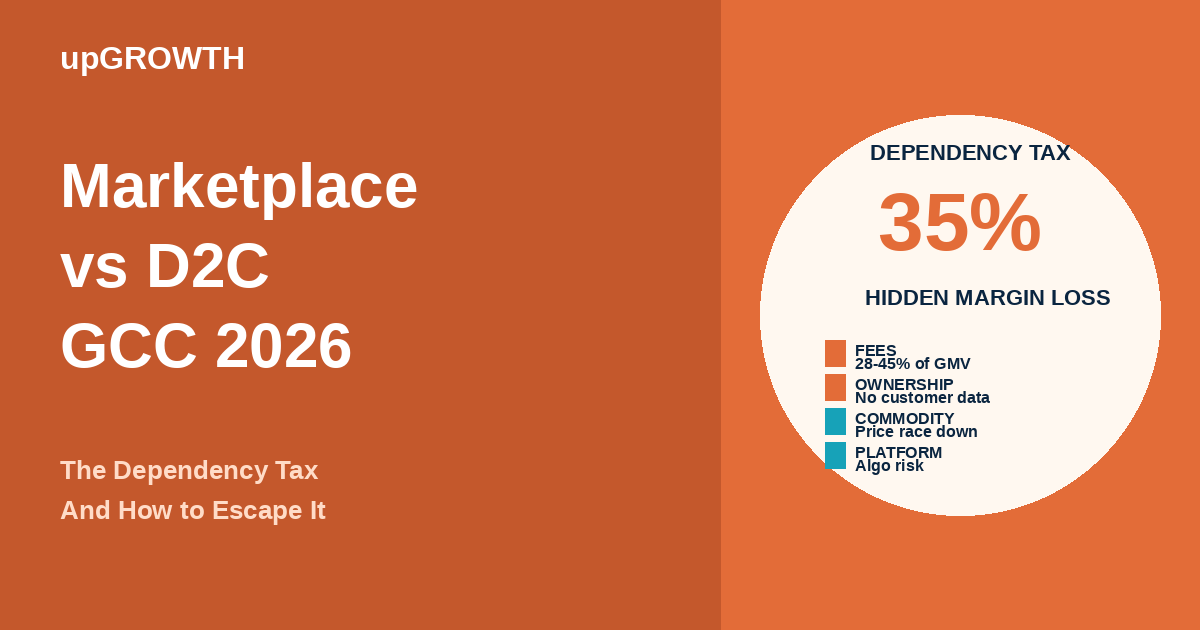
Marketplaces in GCC (Noon, Amazon.ae, Amazon.sa, Talabat, Deliveroo) look like free distribution. They are not. Every AED of marketplace revenue carries a tax that compounds over time: margin compression, customer ownership loss, commoditization risk, and platform dependency that turns into existential exposure when the algorithm shifts. The winning brands in GCC are not the ones that abandoned marketplaces. They are the ones that used marketplace volume to fund D2C infrastructure, then shifted the mix deliberately. This is how to run that playbook.
In This Article
Share On:
A founder in Dubai ran the numbers last quarter. 82% of his revenue came from Noon and Amazon.ae combined. His margin after platform fees, advertising cost, and fulfillment was 4%. His D2C website was pulling 18% margin on the same SKUs but only 12% of total volume. He asked a reasonable question: if D2C is 4.5x more profitable per unit, why is he still 82% marketplace?
The answer is not “because marketplaces are easier.” The answer is that nobody showed him what the actual cost of marketplace dependency looks like when you model it over 24 months, factor in platform fee increases, competitive pressure from private label, and the erosion of pricing power when customers never see your brand name. When he did that model with us, the marketplace revenue stopped looking like revenue. It started looking like a loan at 35% interest that he had been renewing quarterly without realizing it. If you want the same analysis on your business, upGrowth Digital runs this as a diagnostic before any retainer engagement.
This playbook makes a case most marketplaces do not want you to hear. Not that marketplaces are bad. That marketplace revenue without a deliberate D2C migration path is a slow bankruptcy you cannot see on the P&L until it is too late to fix. Here is the dependency tax, how it compounds, and the 4-phase escape plan for GCC D2C brands that want to own their future.
What the Dependency Tax Actually Costs
The dependency tax is not the commission you see on the invoice. That is the visible layer. Noon takes 15-20% for most categories. Amazon.ae runs 8-15% depending on vertical. Talabat takes 25-35% on food delivery. If you stopped there, marketplaces look like a reasonable customer acquisition channel.
The real tax shows up in four layers that compound on each other.
Layer one is direct fees. Commission plus fulfillment plus advertising cost inside the platform (sponsored product ads, headline banners). For most GCC sellers, this totals 28-45% of gross revenue depending on category. Beauty and personal care runs high. Commodity grocery runs lower but has tighter margins to start.
Layer two is customer ownership. You do not get the customer’s email. You do not get their phone number in a usable format. You cannot retarget them. You cannot build a repeat-purchase flow. Every transaction is a fresh acquisition cost because you cannot nurture what you do not own. A customer who buys from you on Amazon.ae three times is still three separate new-customer transactions from your economic perspective. This is not a bug of the platform. It is the core of its business model.
Layer three is margin compression through commoditization. Marketplaces are search engines. Search engines reward lowest price within acceptable quality thresholds. The moment a competitor appears with a cheaper version, your ranking drops, your conversion drops, and you either cut price or watch volume collapse. Private label from the marketplace itself (Amazon Basics, Noon brand) compounds this pressure because the platform has data on what sells and zero incentive to protect your margin.
Layer four is platform risk. Algorithm changes, category fee restructuring, account suspensions for technical violations, counterfeit listings piggybacking on your SKUs, and buy-box losses to resellers. Every D2C brand that runs 60%+ marketplace has stories of revenue dropping 40% in a week because of a platform decision they had no input on.
Model it out: a brand at 70% marketplace revenue with 35% platform tax and 18% D2C margin has a blended margin of roughly 12%. The same brand at 40% marketplace and 60% D2C has a blended margin of roughly 21%. Same revenue. Almost double the profit. The escape is not about whether to use marketplaces. It is about what percentage of your business lives there.
Why GCC Brands Over-Index on Marketplaces More Than Any Other Region
GCC D2C brands run marketplace mix that would look insane in India or Southeast Asia. A Dubai beauty brand at 85% Noon is normal. A Riyadh supplement brand at 90% Amazon.sa is typical. The same brands operating out of Mumbai would be at 40-50% marketplace maximum. The gap is not random. It is structural.
Three forces push GCC brands deeper into marketplace dependency than other regions.
First, trust infrastructure. GCC consumers have lower baseline trust in independent D2C websites than Indian or American consumers do. The reasons are historical: cash-on-delivery fraud, fake product concerns, limited recourse for bad experiences, and a general preference for transacting through known intermediaries. Marketplaces solve trust by proxy. Noon pays if the product is fake. Amazon.ae handles returns. The consumer does not have to evaluate your brand. They have to evaluate the marketplace they already trust.
Second, logistics complexity. Running D2C fulfillment in GCC means integrating with Aramex, SMSA, or Naqel, handling COD reconciliation, managing return logistics across borders (UAE to KSA returns are a common failure mode), and solving last-mile in markets with inconsistent addressing systems. Fulfillment-by-Noon and FBA solve this with one contract. The operational simplicity is real and has a dollar value most founders underestimate at launch.
Third, paid media expense. Meta and Google CPMs in UAE are among the highest in the world. Acquiring a new D2C customer in Dubai routinely costs 3-5x what the same acquisition costs in India. When acquisition is expensive, the marketplace’s “we bring traffic to the listing” value proposition becomes proportionally more attractive. A brand that can cover marketplace fees but cannot cover Meta CPA will rationally choose the marketplace.
These forces are real. They are not excuses. But they explain why the escape from marketplace dependency in GCC requires a different playbook than the escape in other regions. You cannot just “build a better Shopify site and run Meta ads.” The infrastructure, trust, and media math that makes D2C work in India do not transfer cleanly. The GCC escape plan has to solve trust, logistics, and acquisition cost at the same time.
The goal is not zero marketplace. The goal is to shift from 70-90% marketplace to 40-50% marketplace over 18-24 months, while growing total revenue. This is how.
Phase one, months 1-3, is infrastructure. Before any migration push, you need a D2C site that converts. In GCC that means Arabic + English toggle that actually works (not Google Translate garbage), Mada + Tabby + Tamara + Apple Pay at checkout, COD option with a trust-signaling copy block, clear returns policy in Arabic, WhatsApp customer support integration, and local phone numbers for support. Skip any of these and your D2C conversion will be 1.5-2% when it should be 3.5-4.5%. This phase does not move the needle on revenue. It removes the leaks that will sabotage every acquisition effort that follows.
Phase two, months 3-6, is harvesting marketplace demand back to D2C. This is the highest-leverage move most brands miss. You have customers buying from you on Amazon.ae right now. You cannot email them. But you can put an insert in every shipped package offering a discount code for their next purchase on your D2C site, a loyalty program they can only join off-platform, and a QR code linking to an Arabic-language brand story page. The conversion rate on these inserts is typically 3-8% of shipped units, which sounds small but compounds into a meaningful D2C customer base within two quarters. Marketplaces do not love this. They also cannot stop it.
Phase three, months 6-12, is deliberate acquisition mix rebalancing. Now you run paid media directly to D2C but with a specific structure: Meta top-of-funnel that drives to D2C, Google branded search to D2C, influencer campaigns to D2C, and marketplace ads only for category search terms where D2C cannot compete on intent. You will see marketplace revenue stay flat or decline slightly. You will see D2C revenue grow 40-80% quarter over quarter if the phase one infrastructure is solid. Total revenue goes up. Marketplace percentage comes down. Both at the same time.
Phase four, months 12-24, is margin expansion through D2C-exclusive products. Launch SKUs that exist only on your D2C site. Premium variants, bundles, subscription offerings, personalization. This does three things: gives repeat customers a reason to come back to your site instead of reordering on Noon, gives marketplace ads something to reference (“exclusive bundle at brand.com”), and protects margin because D2C-exclusive SKUs cannot be commoditized through marketplace price competition. This is the phase where the escape becomes irreversible.
You will know the migration is working when four specific metrics move in the right direction. None of these are revenue growth, because revenue grows or flattens based on dozens of variables unrelated to channel mix.
First, D2C new customer acquisition cost declines quarter over quarter. This sounds counterintuitive. Acquisition costs should rise as you scale paid media. The reason it should decline in this playbook is that marketplace-insert-driven D2C signups have near-zero CAC, and they make up a growing percentage of new customers. If CAC is rising, phase two (the insert play) is not working and needs attention.
Second, repeat purchase rate on D2C is higher than on marketplace. This should be obvious but brands rarely measure it. Customers who buy from you on D2C should show 2-3x higher LTV than marketplace customers because you can actually communicate with them. If your D2C repeat rate is similar to marketplace, your retention marketing is broken.
Third, direct + branded search traffic grows as a percentage of total D2C traffic. This is the moat. When customers type your brand name into Google instead of “vitamin C serum” into Noon, you have won. This metric takes 12-18 months to move meaningfully but predicts long-term defensibility better than any other indicator.
Fourth, marketplace revenue concentration on your top 3 SKUs decreases. If your marketplace revenue is concentrated in a few SKUs, you are one algorithm change away from collapse. A healthy marketplace business has revenue distributed across many SKUs, because that reflects a brand that consumers seek out rather than a few products that happened to rank well.
The Counterargument and When It Is Valid
There is a legitimate counterargument to this entire playbook: marketplace margin is bad but marketplace volume is predictable, and D2C is a harder, slower business that fails more often than it succeeds.
This counterargument is valid in specific cases. If you have one SKU, no brand equity, limited capital, and your goal is to get to cash-flow positive in 12 months, pure marketplace may be the right call. If your category has a very short consideration window (impulse purchases, low-ticket commodities) where brand loyalty matters less than search ranking, marketplace is probably the right channel weight. If your founder team has no marketing expertise and no budget to hire any, D2C will struggle regardless of how good the playbook is.
The brands this playbook is wrong for are narrow. Single-SKU, zero-capital, commodity, impulse-purchase, no-marketing-team brands. For everyone else, staying 80%+ marketplace past month 12 is a strategic failure disguised as an operational simplicity.
What to Do in the Next 90 Days
If you are reading this and your marketplace mix is above 65% for a brand that has been in market for more than a year, run the following in order. Week 1, pull your actual blended margin numbers on marketplace vs D2C. Not the numbers you think they are. The actual P&L cut. Week 2, audit your D2C site against the phase one infrastructure checklist and identify the 3 biggest gaps. Week 3-4, ship the 3 infrastructure fixes. Week 5-8, design and print the marketplace insert program and ship it to all fulfillment locations. Week 9-12, measure the insert-driven D2C signups and decide if phase three paid media acceleration is justified.
This is the single highest-ROI 90-day program most GCC D2C founders can run. It costs almost nothing in cash (infrastructure fixes and insert printing). It surfaces the real margin picture. It starts compounding the D2C base from the volume you already have. And it does all of this without betting the company on a big paid-media push that may or may not pay back.
GCC Marketplace vs D2C Comparison and Migration Plan
Platform or Channel
Net Margin Percentage
Customer Ownership Level
Platform Risk Level
Direct-to-Consumer (D2C) Website
18-28%
Full (Own customer data, emails, and LTV)
Low (Brand-owned assets, direct relationship)
Marketplaces (Noon, Amazon.ae, Talabat)
6-12%
Low (No email/phone access, gated data)
High (Algorithm shifts, fee hikes, account suspensions)
E-commerce Architect
GTM Strategy Teardown
GCC: Breaking the Marketplace Tax
A framework for global brands in the Middle East to transition from platform dependency to high-margin direct-to-consumer ecosystems.
Identifying the “Tax”
Commission LeakageCalculating the impact of 15-30% platform fees vs. the potential for 1st-party customer lifetime value (LTV).
Data Blindness ExitReclaiming customer emails and behavior data previously locked inside Marketplace “black boxes.”
Regional Differentiation
Exclusive GCC BundlesCreating high-AOV bundles available only on the D2C site to incentivize migration from platforms.
Concierge ExperiencePersonalized Arabic support and VIP loyalty programs that standard marketplaces can’t replicate.
Intent Capture
Brand-First SearchUsing Google Search Ads to protect brand terms and drive traffic to owned landing pages.
Social Shopping LoopsLeveraging TikTok and Snapchat (top GCC channels) for direct-to-checkout influencer campaigns.
Loyalty & Logistics
WhatsApp Re-targetingBuilding high-conversion automated flows on WhatsApp to drive repeat D2C purchases.
Regional 3PL ControlImplementing localized fulfillment to match platform delivery speeds without the platform fees.
In the GCC, owning the user data is the ultimate strategic advantage against marketplace dominance.
Six Common Questions About Marketplace vs D2C in GCC
Q: Should we exit Noon and Amazon completely?
A: No. The goal is to shift the mix, not exit. Marketplaces serve a real function for discovery and trust, particularly with first-time customers. The right target is 40-50% marketplace, not zero. Brands that exit marketplaces entirely usually see revenue drop 30-50% and never recover because they underestimated how much of their volume was marketplace-search-driven rather than brand-driven.
Q: What is the realistic margin difference between marketplace and D2C in GCC?
A: For most D2C categories in GCC, blended net margin after all costs runs 6-12% on marketplace and 18-28% on D2C. The gap is wider than most founders assume because they forget to include sponsored product ads, return handling costs, and the cost of the FBA/FBN buffer inventory you have to keep stocked. Run the numbers on your own P&L before accepting any generic benchmark.
Q: How long does the marketplace-to-D2C migration actually take?
A: Realistically 18-24 months to go from 80% marketplace to 50% marketplace while growing or maintaining total revenue. Brands that try to do it in 6 months usually crash revenue. Brands that take longer than 24 months usually let the discipline slip and stay dependent. The steady 18-24 month cadence is what separates successful migrations from failed attempts.
Q: Do marketplace inserts violate Noon or Amazon policies?
A: Both platforms prohibit inserts that directly solicit off-platform transactions or discourage future marketplace purchases. They allow inserts that promote your brand, invite customers to join a loyalty program, or link to educational content. The line is subtle but important. Design inserts that build brand relationship without explicitly saying “buy from our website next time” and you stay within policy. Get this wrong and accounts can be suspended.
Q: What is the one metric that predicts D2C success in GCC?
A: Repeat purchase rate within 90 days of first D2C transaction. If this is above 28%, your D2C economics will compound. If it is below 18%, you have a retention problem that paid media cannot fix. Most GCC D2C brands that fail have repeat rates in the 10-15% range, which means they are running a paid acquisition business with no retention loop. Fix retention before scaling acquisition.
Q: Is marketplace advertising worth the cost?
A: For category search terms, yes. For brand terms, usually no. Sponsored product ads on category terms (like “vitamin C serum” in Noon) can drive discovery that D2C paid media struggles to match on unit economics. Sponsored ads on your own brand terms are mostly defensive spending against competitors trying to hijack your brand searches. The defensive spending is often necessary but should be measured as brand protection cost, not customer acquisition cost.
Q: Should GCC D2C brands prioritize Noon or Amazon.ae?
A: Depends on category. Beauty, fashion, and fast-moving consumer goods generally perform better on Noon because of its regional focus and Arabic-first interface. Electronics, home, and commodity categories generally perform better on Amazon.ae because of Prime trust and logistics infrastructure. Most brands should be on both but concentrate inventory and advertising spend on the platform where their specific category converts better.
Your Next Move: Run the Marketplace Dependency Audit Before You Plan Next Year
If your marketplace mix is above 65% and you are entering the next planning cycle without a deliberate migration plan, you are planning to repeat the dependency tax for another 12 months. The audit itself is straightforward: pull blended margin by channel, map the phase one infrastructure gaps, design the insert program, and build the 18-month migration target with quarterly checkpoints. The output is a one-page migration plan with the three decisions that need to be made now to avoid the plan dying in execution.
We run this audit as a paid discovery engagement before any retainer. The deliverable is the migration plan, the 90-day action list, and the three-year blended-margin projection showing what happens if you do this versus what happens if you do not. The audit output often makes the retainer decision obvious in either direction. Book the audit here.
For Curious Minds
The dependency tax is the cumulative cost of relying on marketplaces, going far beyond the listed commission. It represents a slow erosion of your brand's financial health through four compounding layers that are not visible on a standard P&L statement. While a platform like Noon might charge a 15-20% fee, the real tax includes your total direct costs (fees, fulfillment, ads) often reaching 28-45% of revenue, plus the strategic costs of forfeiting customer relationships.
This hidden tax is composed of:
Direct Fees: The combined expense of commissions, fulfillment programs, and mandatory in-platform advertising.
Customer Ownership Loss: You cannot get customer emails or phone numbers, making every sale a costly new acquisition instead of a nurtured repeat purchase.
Margin Compression: Intense price competition and the rise of private labels force you to constantly lower prices.
Platform Risk: Your revenue is vulnerable to sudden algorithm changes, fee hikes, or account suspensions.
Understanding these layers is the first step to shifting your strategy from short-term volume to long-term enterprise value, a playbook detailed further in the full analysis.
Selling on marketplaces like Talabat means you are effectively renting their customers instead of building your own. You lose the ability to create a direct relationship because the platform intentionally gates access to crucial data like customer emails and phone numbers. This prevents you from implementing retention marketing strategies like email flows, loyalty programs, or personalized retargeting campaigns.
Consequently, a customer who buys from you on Amazon.ae three separate times is not a loyal, repeat customer from an economic standpoint. For your business, those are three distinct 'new' customer transactions, each incurring an acquisition cost without contributing to a growing database of engaged buyers. This structure makes it impossible to build customer lifetime value (LTV), which is a key driver of sustainable, profitable growth for D2C brands. To escape this cycle, you must build a channel where you own the data and can nurture the journey beyond the first sale.
A true comparison requires looking past top-line revenue and analyzing unit economics and long-term asset creation. While marketplaces like Amazon.ae offer immense volume, the example of the Dubai founder shows D2C can be 4.5x more profitable per unit. You must weigh the immediate cash flow from marketplaces against the higher-margin, brand-building potential of a D2C site.
Key evaluation factors include:
Per-Unit Margin: Calculate your net margin after all platform fees, ad spend, and fulfillment costs (e.g., 4% on marketplace vs. 18% on D2C).
Customer Lifetime Value (LTV): This is near zero on marketplaces but is a key growth lever for D2C.
Data Ownership: The ability to collect and use customer data for retargeting and personalization.
Brand Equity: D2C allows you to control the customer experience and build a memorable brand, reducing commoditization.
Analyzing these factors helps you shift from a purely sales-driven mindset to one focused on building a defensible business asset, a core theme explored throughout the complete guide.
The Dubai founder's experience provides a stark, data-driven illustration of the marketplace dependency trap. His 82% revenue concentration on platforms like Noon and Amazon.ae generated a meager 4% margin, revealing that high volume does not equal high profit. This scenario shows how direct fees, advertising costs, and fulfillment charges accumulate to consume nearly all the profit from each sale.
In contrast, his D2C channel, despite contributing only 12% of revenue, operated at an 18% margin. This powerful metric demonstrates that owning the customer journey directly creates exponentially more value per transaction. The founder's initial focus on marketplace revenue was masking a slow financial bleed; modeling this over 24 months showed the business was on an unsustainable path. This case proves that a blended strategy, where D2C is the primary engine for profit, is essential for survival and growth in the competitive GCC market.
The rise of private labels like Amazon Basics and Noon branded products is a critical threat that accelerates brand commoditization. These marketplaces use their vast sales data to identify top-selling products and then launch their own lower-priced versions, placing them in premium search spots. This creates a direct and formidable competitor that you cannot outrank or out-market on their own platform.
This forces you into a no-win situation: either you lower your price to compete, destroying your margins, or you maintain your price and lose sales volume and visibility. Over time, customers are trained to see the product category, not your specific brand, as the primary purchasing driver. This is the essence of commoditization through platform leverage. The only effective defense is to build a brand and a direct sales channel off-platform where you control the narrative and are not directly competing with the sales channel itself.
For a brand heavily reliant on Amazon.sa, the first step is to treat marketplace revenue as seed funding for your D2C escape plan. Instead of reinvesting profits into more marketplace ads, you must deliberately allocate that capital to building your own infrastructure. This requires a mental shift from seeing marketplace sales as the end goal to seeing them as a temporary, strategic means to an end.
A foundational plan involves these initial actions:
Model the True Cost: Run a 24-month forecast modeling the full dependency tax, as the Dubai founder did, to create urgency and secure buy-in.
Build the D2C Foundation: Launch a high-converting Shopify or similar e-commerce store with excellent UX, even if traffic is low initially.
Insert D2C Calls-to-Action: Use package inserts, warranty registrations, and social media to drive marketplace customers to your own site for future purchases.
This initial phase is about building the infrastructure for independence before you begin actively shifting volume away from platforms like Talabat, a process detailed in the complete 4-phase plan.
The trend of increasing platform risk implies that a D2C-optional strategy is no longer viable for long-term survival in the GCC. Brands that remain over 60% dependent on marketplaces like Amazon.ae or Noon are essentially building their business on rented land where the landlord can change the rules overnight. A single algorithm shift or an account suspension for a minor violation can cut revenue by 40% or more in a week, creating an existential threat.
Over the next 24 months, this risk will likely intensify as platforms automate more compliance and ranking decisions. Brands without a D2C channel will lack a stable revenue baseline to weather these shocks. They will be forced into a purely reactive position, unable to plan long-term. The key implication is that D2C is not just a growth channel; it is evolving into a necessary insurance policy against platform volatility, and those without it risk becoming obsolete.
The most common error is viewing high marketplace sales volume as a sign of success, when it often masks a deeply unhealthy business model. Brands become addicted to the top-line revenue from platforms like Noon without calculating the true, blended margin after all costs. They mistake this revenue for profit and reinvest it back into the same low-margin channel, deepening their dependency.
Reframing this revenue as a loan at a 35% interest rate, as the article suggests, is a powerful mental model. It correctly frames the situation: you are getting cash flow now, but at the steep price of your future margins, customer relationships, and brand equity. This perspective forces you to ask a different question: not 'How can I sell more on marketplaces?' but rather 'How can I use this expensive capital to build an asset that I own?' This shift is critical for allocating resources toward a sustainable D2C future, a path you can explore more deeply.
For restaurants and food brands on aggregators like Deliveroo and Talabat, platform risk is acute due to commissions of 25-35% and total dependency on their discovery algorithms. Developing a D2C ordering system is the most effective solution to reclaim control and profitability. It directly counteracts the core problems of the aggregator model by creating an alternative, owned sales channel.
Here is how D2C solves the key issues:
Margin Control: You eliminate the massive commission fee, dramatically improving per-order profitability.
Customer Ownership: You capture customer data to run promotions, launch loyalty programs, and encourage repeat orders directly.
Risk Mitigation: Your business is no longer entirely vulnerable if an aggregator changes its commission structure or algorithm.
While aggregators provide initial customer acquisition, a D2C system allows you to convert that borrowed audience into a permanent asset. The full article provides a roadmap for using aggregator volume to fund this critical transition.
The four layers of the dependency tax do not just add up; they multiply each other's negative effects, severely damaging a brand's long-term valuation. It starts with direct fees from a platform like Amazon.ae, which can total 28-45%, immediately reducing cash flow. This lack of cash makes it harder to invest in your own D2C channel, deepening your reliance on the marketplace.
Next, the loss of customer ownership means you cannot build a predictable, recurring revenue base, which is highly valued by investors. Margin compression from competitors further reduces profit, and the constant platform risk introduces a high level of volatility that makes future earnings uncertain. An investor sees a business with low margins, no customer list, a weak brand, and unpredictable revenue. This combination leads to a significantly lower valuation compared to a D2C-first brand with the same top-line revenue, showing how failing to manage dependency erodes enterprise value.
The economic benefit of owning customer relationships is proven by a simple but powerful D2C metric: the ratio of customer lifetime value (LTV) to customer acquisition cost (CAC). Unlike on Amazon.ae, where your LTV is effectively 1x your first purchase value, successful D2C brands achieve LTV:CAC ratios of 3:1 or higher. This means for every dollar spent acquiring a customer, they generate three or more dollars in profit over that customer's lifespan.
This is achieved by using owned data for:
Email & SMS Marketing: Driving repeat purchases at a near-zero acquisition cost.
Personalized Offers: Increasing order frequency and average order value.
Loyalty Programs: Building a defensible moat against competitors.
This data-driven approach turns marketing from a perpetual expense into a compounding investment in a revenue-generating asset. Exploring how to build this asset is a central focus of the complete playbook.
A beauty brand facing high fees on Noon can use the platform as a powerful market research tool to de-risk its D2C launch. Instead of just focusing on the volume, you should analyze your marketplace sales data to understand exactly what resonates with the GCC customer before investing heavily in your own channel. This is a form of capital-efficient market validation.
Strategically, you can use the data to:
Identify Hero SKUs: Pinpoint your top-performing products to feature prominently on your D2C site and in launch campaigns.
Refine Audience Targeting: Analyze which product types are selling to infer demographic and psychographic details for your D2C ad targeting.
Test Price Points: Use marketplace sales velocity at different price points to establish an optimal pricing strategy for your own site.
This approach turns the high fees you pay to Noon into an investment in product and market intelligence, ensuring your D2C launch is built on a foundation of proven demand. To see how this fits into a broader migration plan, explore the full analysis.
Amol has helped catalyse business growth with his strategic & data-driven methodologies. With a decade of experience in the field of marketing, he has donned multiple hats, from channel optimization, data analytics and creative brand positioning to growth engineering and sales.

 Growth Strategy and Planning
 Inbound Growth
 Growth Hacking
 Fractional CMO
 Search Engine Optimization
 Paid and Performance Marketing
 Social Media Marketing
 Demand Generation
 AI-Driven Growth Strategy
 AI-Native Workflow Automation
 Generative Engine Optimization
 Grove — AI Growth Strategist

 AI Automation
 Framework
 Case Study
 Tools
Tools Growth Tools
 Decision Tree
 Compare
 Custom GPT's
 AI Answer Gap
 Offer
Offer Webstories
 Quizzes
 Blog
Blog AI-powered Apps
 Social Media Tools
 Agency Fit Score