Contributors:
Amol Ghemud Published: November 12, 2026
Summary
Generative engine optimization for local businesses is now the difference between being the first recommendation an AI gives a nearby shopper and being invisible. As of 2026, over 60% of near me queries on AI-native surfaces return a synthesized answer rather than a traditional SERP, meaning local businesses must optimize for citation by language models, not just for ranking on a results page. This guide breaks down the five pillars that determine whether an AI engine recommends your business: entity and NAP consistency, review corroboration, local schema markup, question-mapped content, and GEO-aware authority signals.
In This Article
Share On:
A bakery in Bandra, Mumbai, ranks number one on Google Maps, holds a 4.8-star rating, and still gets zero mentions when a potential customer opens ChatGPT and types “best artisan bakery near Bandra for a birthday cake.” Not because the bakery is bad. Because it has no structured entity data, no question-mapped content, and three conflicting phone numbers scattered across the web. The AI engine runs a trust check, finds ambiguity, and recommends the competitor two streets over whose website answered that exact question in a 73-word paragraph.
This is not a ranking problem. It is a trust-verification problem. And the distinction matters enormously for how you fix it. AI engines like ChatGPT, Gemini, and Perplexity are not crawling your site the way Googlebot does, assessing backlink authority and keyword density. They are asking a quieter question: “Do enough independent, consistent sources confirm that this business is what it claims to be, located where it claims to be, offering what it claims to offer?” If the answer is uncertain, your business does not make the recommendation. Someone else’s does.
The revenue implications are real. Delicut, a Dubai-based meal-prep brand that upGrowth scaled from 40K AED to over 2 million AED per month in monthly sales, is a useful reference point. A significant part of that growth came from building content that directly answered the questions GCC residents were typing into AI engines about healthy meal delivery near them. When your business becomes the most citable answer to a local intent question, 2 million AED per month is not an outlier. It is what AI-visible local positioning is worth in real revenue terms.
What follows is the exact sequence of signals an AI engine checks before it names your business in a near me answer, and what to do at each stage. Think of it as your business’s AI trust audit, run in advance so you pass it before a customer’s query does.
Why Near Me Searches Now Live Inside AI Engines, Not Just Google Maps
The shift happened faster than most local businesses noticed. In 2026, ChatGPT, Gemini, and Perplexity handle a substantial and growing share of local intent queries, and they do not return a list of ten blue links or a map pack. They synthesize a single recommended answer. Search Engine Land reported in early 2026 that AI-assisted local search now influences purchase decisions for a majority of urban mobile users across major markets, with that proportion accelerating quarter over quarter. For local businesses, this means the audience that once scrolled through your Google Maps listing is increasingly reading one AI-generated paragraph and acting on it.
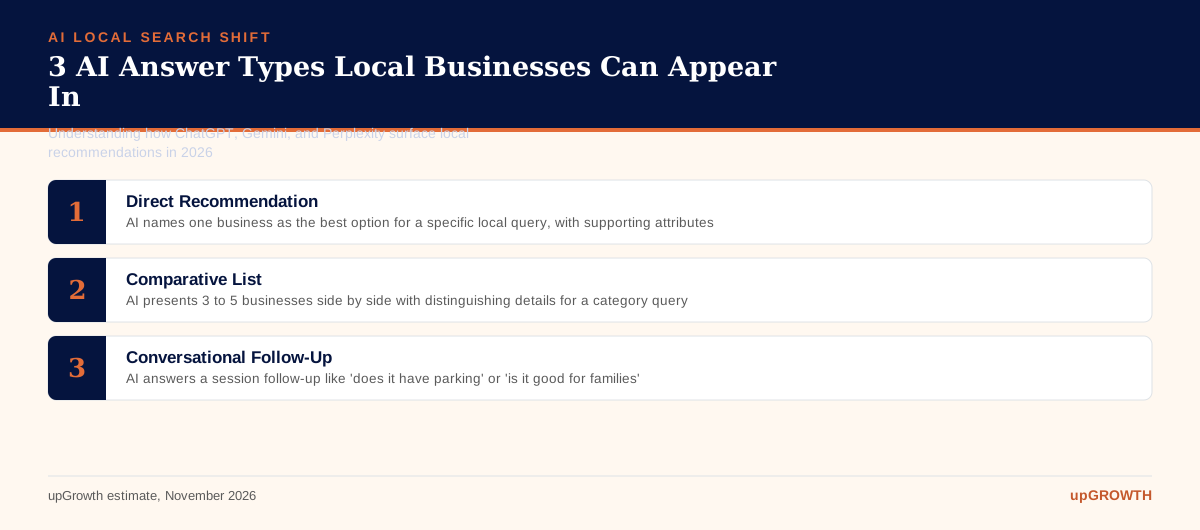
There are three distinct AI answer types a local business can appear in, and understanding the difference matters for how you structure your content. The first is a direct recommendation: “The best Thai restaurant near Koramangala right now is X, known for its pad see ew and late kitchen hours.” The second is a comparative list: “Here are three options for artisan coffee near Connaught Place, with different price points and vibes.” The third is a conversational follow-up within a session: a user asks “does it have parking?” or “is it good for a first date?” after receiving an initial recommendation. Each type requires a slightly different signal to trigger, but all three share one prerequisite: the AI engine must have enough consistent, corroborated information about your business to surface it at all.
The stakes of non-appearance are steeper than they look. When a user gets an AI-generated answer, the session typically ends there. They do not open a second tab, check Google Maps, or scroll further. A business not cited in an AI answer is functionally non-existent for that query session, even if it ranks organically at position one. That is not hyperbole. That is the mechanical reality of how conversational AI search works in 2026.
Show me a local business that has done nothing with its digital presence since 2023, and I will show you a business that is invisible to roughly a third of its potential customer base right now.
Entity and NAP Consistency: The Foundation AI Engines Check First
Before an AI engine will recommend your business, it needs to be confident your business is a coherent, real-world entity. In technical terms, your business entity is the cluster of structured facts that AI models use to decide whether you are trustworthy enough to cite: your name, address, phone number, category, hours, URL, and the relationships between all of those data points across the web. When those facts conflict, even slightly, the AI engine registers ambiguity and defaults to a competitor whose facts are cleaner.
NAP consistency is the most common failure point. A business that lists its phone number as “+91-98201-XXXXX” on its website, “9820XXXXXXX” on Justdial, and “+91 98201XXXXX” on Sulekha has three technically different phone strings. A human reads all three and understands they are the same number. A language model’s entity resolution process sees three signals that do not match and lowers its confidence score for that entity. The same problem appears with address abbreviations: “MG Road” versus “Mahatma Gandhi Road,” “2nd floor” versus “#200,” “Bangalore” versus “Bengaluru.” Each mismatch is a small trust deduction. Enough of them and your business falls below the citation threshold.
The fix is methodical. Run an audit using a tool like Moz Local or BrightLocal to surface every listing your business appears in across Google Business Profile, Justdial, Sulekha, Yelp, Apple Maps, Bing Places, and Facebook. Build a canonical NAP string, one exact version of your name, address, and phone that you will use everywhere, and push it uniformly across every listing. This is not glamorous work. It is also the highest-leverage 48 hours you will spend on generative engine optimization for local businesses this year.
Beyond consistency, there is the concept of entity salience. AI engines weight businesses that are mentioned consistently across a large number of trusted third-party sources. Coverage depth matters as much as consistency. A business mentioned on 47 credible local directories and 12 editorial sources has higher entity salience than one that appears on 3 directories with perfect consistency. Both dimensions, accuracy and breadth, contribute to whether an AI engine trusts your entity enough to recommend it.
Reviews as Corroboration Signals: What AI Engines Actually Extract
AI engines do not count stars. They read sentences. This distinction is what most local businesses miss entirely when they think about reviews as a GEO signal.
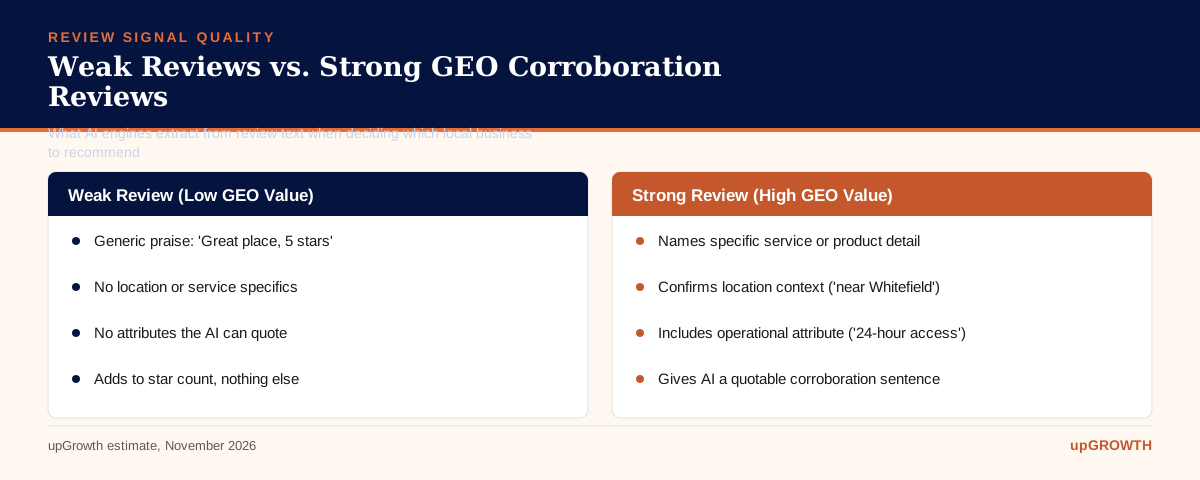
When a language model processes your Google reviews before deciding whether to recommend you for “best gym near Whitefield with 24-hour access,” it is scanning review text for specific claims that corroborate or contradict your self-described attributes. A review that says “great gym, 5 stars” gives the AI almost nothing to work with. A review that says “the only gym near Whitefield I found that actually has 24-hour card access and doesn’t smell like a locker room” gives the AI a quotable, specific corroboration for two distinct attributes: location and operating hours. The second review is worth fifty of the first.
The tactical implication is direct: coach customers to include specific, keyword-rich phrases in their reviews that match the questions AI users are likely to ask. This does not mean asking customers to fake experiences. It means prompting them with specificity. Instead of “please leave us a review,” try “if you found it easy to book a same-day appointment, mentioning that in your review helps other customers find us.” The resulting review text becomes a corroboration signal the AI engine can cite.
Review velocity and recency matter more than most business owners realise. AI models trained on crawled data weight recent reviews more heavily than older ones. A business with 200 reviews accumulated before 2024 and nothing new in the past 12 months is losing corroboration strength month by month. The signal decays. A consistent programme of 7 to 11 new reviews per month, all text-rich and specific, keeps corroboration strength fresh and competitive.
Review responses are an underused GEO signal. When a business owner responds to a review with specific, factual information, “yes, we’re open until 11 PM on Fridays, and we do have covered parking on the basement level,” that response text is additional structured signal that AI engines extract. The owner becomes a secondary narrator of the business’s attributes, adding machine-readable confirmation that the review’s claims are accurate.
One additional nuance for businesses targeting the GCC market: Google Maps reviews in Arabic carry additional weight for Arabic-language AI queries. Delicut’s growth across Dubai neighbourhoods was supported in part by building review signals that served both English and Arabic AI queries, increasing entity salience across both language surfaces. For any business in Dubai, Abu Dhabi, or Riyadh, bilingual review depth is not optional. It is table stakes.
Local Schema Markup: Telling AI Engines Exactly What You Are
If NAP consistency is the foundation and reviews are the corroboration layer, local schema markup is the translation layer. It converts your business attributes into a structured vocabulary that AI engines can read without having to infer anything. And inference is where recommendations go wrong.
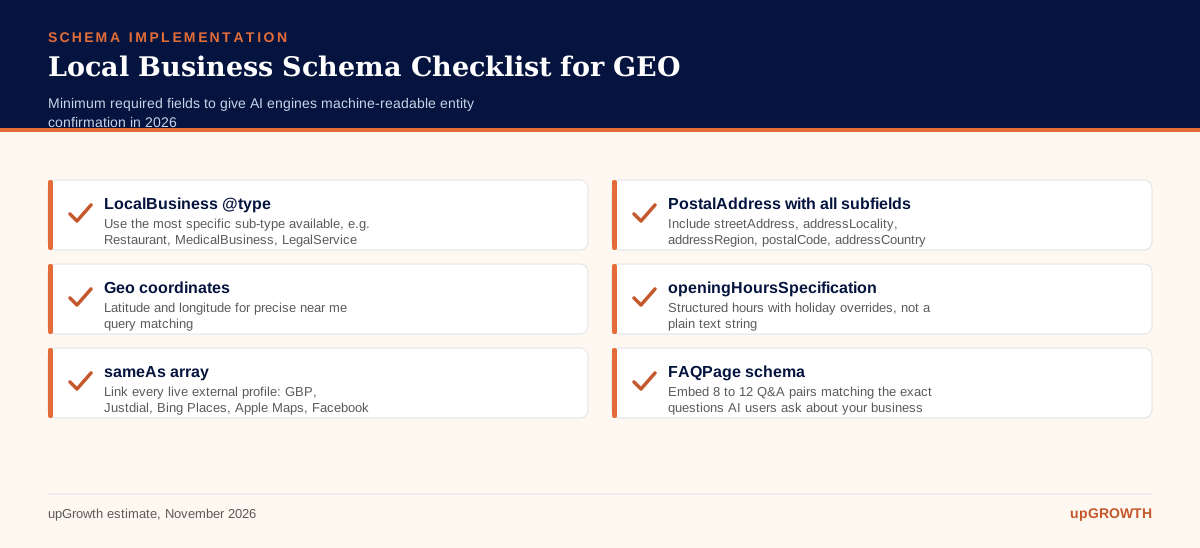
LocalBusiness schema (defined at Google Search Central and schema.org) and its sub-types, Restaurant, MedicalBusiness, AutomotiveBusiness, LegalService, and dozens of others, give AI engines machine-readable confirmation of entity attributes. The minimum viable schema set for a local business includes: @type (your specific business category), name, address as a PostalAddress object with streetAddress, addressLocality, addressRegion, postalCode, and addressCountry fields, telephone, openingHoursSpecification, geo with latitude and longitude coordinates, sameAs linking to all your external profiles, and priceRange. Each field removes one more inference the AI has to make. Fewer inferences means higher confidence. Higher confidence means more recommendations.
Local Business Schema: Minimum Viable vs. Full GEO Stack
Schema Element
Minimum Viable
Full GEO Stack
What It Gives the AI
LocalBusiness @type
Generic LocalBusiness
Specific sub-type (e.g. Restaurant)
Category confirmation without inference
PostalAddress
Street and city
All subfields + geo coordinates
Exact location match for near me queries
openingHoursSpecification
Basic hours string
Structured spec with holiday overrides
Answers “are they open now/on X day”
sameAs
GBP URL only
All major directory and social profiles
Entity salience and cross-platform corroboration
FAQPage schema
Not present
Q&A pairs matching AI user queries
Citable source for conversational follow-up answers
AggregateRating
Not present
ratingValue, reviewCount, bestRating
Machine-readable review quality signal
FAQPage schema deserves its own emphasis. It is the bridge between your local schema and your GEO content strategy. By embedding the specific questions AI users ask, with authoritative answers, directly into your page’s structured data, you give AI engines a citable source for conversational near me answers. “Does this restaurant take reservations?” “Is there parking?” “Are they halal-certified?” Each question answered in FAQPage schema is a conversational follow-up your business can win without anyone having to click anything. The AggregateRating schema layer adds machine-readable review quality signals on top, letting the AI engine consume your review standing directly rather than inferring it from unstructured text.
Question-Mapped Content: Writing Pages That AI Engines Answer With
The core GEO content principle is simple to state and surprisingly hard to execute: AI engines answer questions by citing the page that most directly and authoritatively answers that exact question. Not the page with the most backlinks. Not the page that uses the keyword the most times. The page that answers the question best, in a form the AI can extract and quote. For local businesses, this means you need pages that are structured as direct answers to the specific questions nearby customers ask.
Start with a question taxonomy. The questions local customers ask AI engines about nearby businesses cluster into five types: operational (“Is Sharma Sweets open on Diwali?”), logistical (“Does Blue Tokai Indiranagar have parking?”), qualitative (“What’s the best dish at Meghana Foods?”), transactional (“How much does a haircut cost at Truefitt and Hill in Delhi?”), and contextual (“Is this café good for a work meeting?”). Each type requires a different answer structure, but all of them share one requirement: the answer must be specific, factual, and self-contained in 50 to 100 words. Vague answers do not get cited. Specific ones do.
The obvious approach here is to build a single FAQ page and call it done. Here is what happens when you do that. The FAQ page covers 8 generic questions, none of them tied to actual search query data, and the answers are three sentences each of marketing language. The AI engine scans it, finds nothing extractable, and moves on. The problem shows up at month 2 when you notice zero improvement in AI citation frequency despite having “done the FAQ thing.” What actually works is the opposite: map your questions to real customer queries from your GBP Q&A section, your review text, and your customer service inbox. Then write each answer as a standalone paragraph that could be dropped into an AI response verbatim and still make sense. That is the standard you are writing to.
Beyond the FAQ page, build hyper-local landing pages. A generic “Thai food delivery in Bangalore” page is competing with every Thai restaurant in a city of 13 million people. A “Thai food delivery in Indiranagar, Bangalore” page answers the precise geographic query an AI user types. For a business serving multiple neighbourhoods, one page per neighbourhood, each with specific local context, is a GEO content architecture that most local competitors have not built. That gap is your opportunity.
The Delicut playbook is instructive here. upGrowth Digital built neighbourhood-level content pages for Delicut targeting specific Dubai districts, structured to answer the exact questions GCC residents were asking AI engines about healthy meal delivery near them. Those pages fed AI engine answers for “healthy meal prep near [district]” queries and contributed directly to Delicut growing from 40K AED to over 2 million AED per month in monthly sales. The content was not clever. It was specific, factual, and built around real questions. That is the template.
GEO-Aware Authority Signals: Off-Page Factors That Drive AI Recommendations
Everything covered so far, entity consistency, review signals, schema, question-mapped content, happens on or directly around your owned properties. But AI engines also consider the breadth and quality of third-party mentions when deciding which local business to recommend. This is the off-page layer of GEO for local businesses, and it is where the gap between good local businesses and AI-recommended local businesses most often lives.
Third-party mentions that carry GEO authority include local news coverage, food and lifestyle blog features, podcast mentions, and hyperlocal community forums. A restaurant featured in a Zomato blog post about the best new openings in Koramangala has a qualitatively different signal than the same restaurant appearing only on its own website. AI engines trained on web data have seen the Zomato post. They have attributed it. It contributed to the restaurant’s entity salience. Your owned content can tell the AI what you are. Third-party editorial content corroborates it.
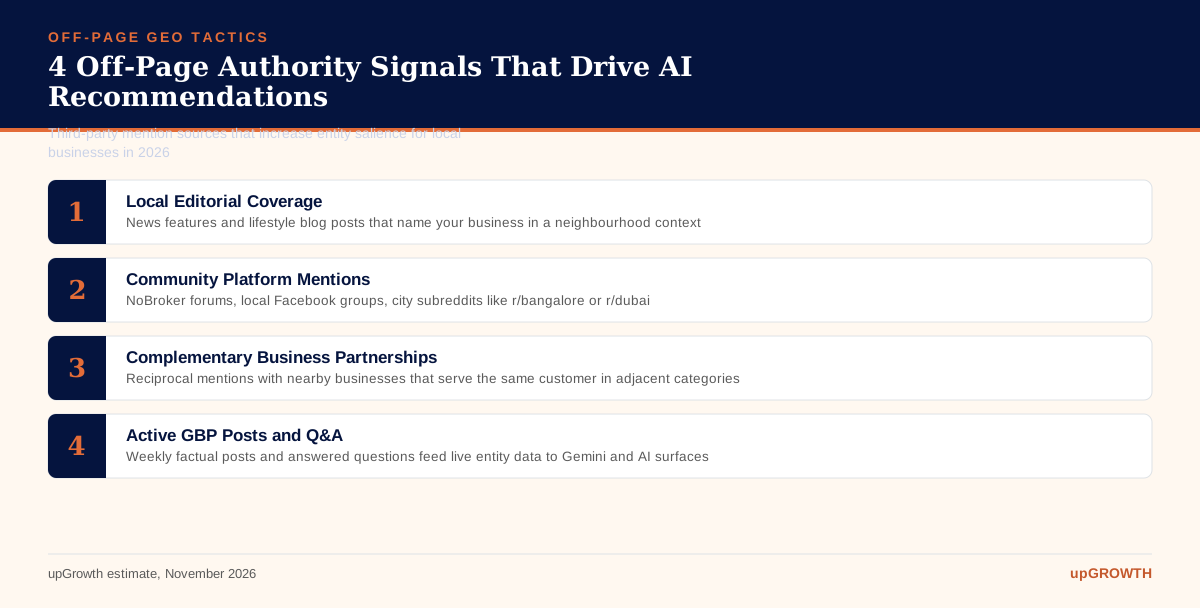
The tactical off-page GEO checklist for a local business in 2026 looks like this. Submit to local directories with editorial standards, not just any free listing aggregator. Pitch local journalists with a neighbourhood-specific story angle, something tied to a local trend or community event rather than a generic “new business opens” press release. Earn mentions on community platforms: NoBroker forums, local Facebook groups, Reddit city subreddits like r/bangalore or r/dubai. Build reciprocal mention partnerships with complementary local businesses, the gym that mentions the nearby protein shake bar, the hair salon that mentions the coffee shop next door. Each mention is a corroboration vote. Collect enough of them and your entity salience crosses the threshold where AI engines recommend you by default.
Citation velocity matters as a signal in its own right. A sudden cluster of 11 to 17 new mentions over a three-week PR push sends a positive authority signal to AI engines monitoring entity growth. Zero new mentions for six months sends a decay signal. This is not a one-time task. It is a programme.
Your Google Business Profile is a live GEO data feed, not a set-and-forget listing. AI engines pull GBP posts, Q&A answers, and product and service listings as supplementary entity data. An inactive GBP, one with no posts in three months, unanswered customer questions, and photos from 2023, is a missed authority signal. Post weekly GBP updates that mirror your question-mapped content strategy: short, factual, specific posts that answer likely customer questions. “We’re open until 11 PM on weekends, including the holiday on November 15th. Covered parking available on Level B2.” That post is a GEO signal, a customer communication, and a schema supplement, all in one paragraph. Search Engine Land’s 2026 coverage on AI local search consistently identifies GBP activity as one of the stronger real-time signals feeding Google’s Gemini-powered local recommendations.
Common Questions About Generative Engine Optimization for Local Businesses
What is generative engine optimization for local businesses?
Generative engine optimization (GEO) for local businesses is the practice of structuring your business data, website content, and off-page mentions so that AI engines like ChatGPT, Gemini, and Perplexity recommend your business when nearby users ask local intent questions. Unlike traditional SEO, which targets a ranked list of links, GEO targets the single synthesized answer an AI returns. For local businesses in 2026, this means ensuring entity consistency, review corroboration, local schema markup, and question-mapped content all work together to make your business the most citable option for near me queries.
How do I get my local business recommended in AI near me answers?
To get recommended in AI near me answers, start with four fundamentals: (1) make your NAP — name, address, phone — identical across every directory and listing platform, (2) build a critical mass of recent, text-rich reviews that include the specific phrases customers search for, (3) add LocalBusiness and FAQPage schema to your website so AI engines can read your attributes in structured form, and (4) publish short, factual question-and-answer content pages that directly address the questions your nearby customers type into AI tools. Consistency across all four signals is what moves a business from invisible to recommended.
Does Google Business Profile help with AI search recommendations?
Yes, Google Business Profile (GBP) is an active data source that AI engines — including Google’s own Gemini — use when constructing local recommendations. Your GBP attributes, Q&A section, weekly posts, photos, and service listings all feed into the entity profile an AI engine builds for your business. A neglected GBP with outdated hours, no posts in six months, and unanswered customer questions sends a low-authority signal. Treat your GBP as a living GEO content channel, not a one-time setup task.
What schema markup should a local business use for GEO?
At minimum, a local business should implement LocalBusiness schema (or its relevant sub-type, such as Restaurant or MedicalBusiness) with name, PostalAddress, telephone, openingHoursSpecification, geo coordinates, sameAs links to all external profiles, and AggregateRating. Add FAQPage schema to any page that answers common customer questions. This combination gives AI engines machine-readable confirmation of who you are, where you are, what you offer, and what customers say about you — all in a single structured data layer. Use the upGrowth local business schema generator at /tools/local-business-schema-generator/ to build valid JSON-LD without manual coding.
How long does it take to see results from GEO for a local business?
Most local businesses see meaningful improvement in AI citation frequency within 60 to 90 days of implementing entity consistency, schema markup, and question-mapped content, assuming review velocity is maintained throughout. The fastest wins typically come from fixing NAP mismatches and adding LocalBusiness schema, which give AI engines immediate structured confirmation of your entity. Longer-term authority signals — third-party mentions, editorial coverage, review depth — compound over three to six months. upGrowth’s work with Delicut demonstrated that a structured GEO content and entity programme can drive substantial revenue growth within two to three months of consistent execution.
Is GEO different from local SEO, and do I need both?
GEO and local SEO share foundational elements — NAP consistency, reviews, and schema — but they optimize for different outputs. Local SEO optimizes for position in a ranked list (the Google Map Pack or organic results). GEO optimizes for citation in a synthesized AI answer, which is a single recommended response with no rank position to compete for. In 2026, you need both: local SEO still drives traffic from users who scroll through results, while GEO captures the growing share of users who accept the first AI-generated recommendation without scrolling at all. The good news is that strong GEO practice reinforces local SEO, since both reward entity clarity and authoritative content.
Can a small business with no budget do GEO?
Yes, the highest-impact GEO actions for a small local business are low or zero cost: standardize your NAP across free listings (Google Business Profile, Bing Places, Apple Maps, Justdial), respond to every review with specific factual detail, add LocalBusiness JSON-LD to your website (use a free schema generator), and publish a simple FAQ page that answers the ten questions your customers ask most often. These four steps alone put a small business ahead of the majority of local competitors who have done none of them. Paid GEO support — such as a full entity audit, neighbourhood content pages, or PR-led citation building — accelerates results but is not a prerequisite for getting started.
Your Next Move: Get Your Local Business Recommended by AI Engines
If a potential customer opens ChatGPT or Gemini right now and asks for the best version of what you offer near your location, does your business come up? For most local businesses in 2026, the honest answer is no. Not because they are bad at what they do. Because their entity data is inconsistent, their schema is missing, and their website has no content structured for AI citation. That is a solvable problem, and it does not require starting from scratch.
upGrowth’s GEO practice works with local businesses to run a full entity audit, standardize NAP across every live listing, build LocalBusiness and FAQPage schema, map your top 20 customer questions to on-site content, and set up a review velocity programme that keeps your corroboration signals fresh month over month. The same approach contributed to Delicut growing from 40K AED to over 2 million AED per month in monthly sales by making the brand the go-to AI recommendation for healthy meal delivery across Dubai neighbourhoods. That kind of positioning does not happen by accident. It is built, signal by signal, using exactly the framework laid out in this article.
The businesses that act on this in the next 60 to 90 days will be the ones AI engines recommend by default for the rest of 2026. The businesses that wait will spend those same months watching a competitor’s name appear in every AI answer their customers see.
In generative engine optimization, your business entity is the cluster of structured facts that language models use to verify if your brand is trustworthy enough to cite in a synthesized response. Platforms like ChatGPT, Gemini, and Perplexity bypass traditional keyword density to run a quiet trust-verification audit across independent sources.
Core Entity Attributes: Language models cross-reference your name, address, phone number, category, hours, and URL across the web.
Entity Resolution: Even minor formatting mismatches between platforms lower the model's confidence score, causing you to fail the citation threshold.
Entity Salience: Appearing consistently across 47 credible local directories and 12 editorial sources builds far greater authority than existing on just 3 directories.
Mastering both data accuracy and coverage breadth ensures your business passes the initial algorithmic check required to earn default local recommendations.
When urban mobile users ask platforms like ChatGPT or Gemini for nearby recommendations, the engines synthesize responses into three specific formats rather than returning ten blue links. Structuring your digital footprint for conversational query alignment ensures your brand captures the exact moment a customer decides to buy.
Direct Recommendation: Singling out one top business, such as naming the best Thai restaurant near Koramangala for late kitchen hours.
Comparative List: Grouping three options, such as artisan coffee shops near Connaught Place, categorized by distinct price points and vibes.
Conversational Follow-up: Answering secondary session questions about parking availability or first-date suitability after the initial prompt.
Because users rarely open a second tab or check Google Maps after receiving these answers, tailoring your content to feed all three formats is essential for survival.
A question taxonomy framework organizes the exact queries local customers type into AI engines into five distinct behavioral categories. Because models cite pages that provide the most direct, extractable answers, businesses like Meghana Foods or Blue Tokai Indiranagar must address these specific clusters using self-contained paragraphs of 50 to 100 words.
Operational and Logistical: Answering holiday hours for Sharma Sweets on Diwali or confirming parking availability at Blue Tokai Indiranagar.
Qualitative and Transactional: Highlighting the best dish at Meghana Foods or stating exact haircut prices at Truefitt and Hill in Delhi.
Contextual Suitability: Confirming whether a local venue is quiet enough for a professional work meeting.
Mapping real customer inquiries to these five categories transforms your website from a static brochure into a primary source for automated local citations.
While a minimum viable schema setup provides basic identity markers, deploying a full GEO schema stack removes the guesswork that causes language models to skip your business. Defined through Google Search Central and schema.org, this translation layer converts your attributes into machine-readable code that prevents recommendation failures.
Category and Location Precision: Upgrading from a generic LocalBusiness tag to a specific sub-type like Restaurant, while adding geo-coordinates to basic street fields.
Operational and Social Proof: Replacing basic hours strings with structured holiday overrides, and linking all directory profiles via sameAs properties rather than just a Google Business Profile URL.
Conversational Readiness: Embedding FAQPage and AggregateRating properties to feed follow-up answers and review quality signals directly to the model.
Eliminating inference hurdles through complete structured data directly elevates your citation confidence score across every major search platform.
Weighing traditional local SEO against generative engine optimization requires understanding that both disciplines share foundational elements like NAP consistency, schema, and reviews, but target entirely different user behaviors. While local SEO fights for position in a ranked list on Google Maps, GEO pursues a single synthesized citation on platforms like Perplexity.
Output Mechanics: Traditional SEO captures users who still scroll through map packs, whereas GEO captures users who accept the first AI answer without opening a second tab.
Zero-Budget Synergies: Standardizing listings on Bing Places, Apple Maps, and Justdial, alongside adding JSON-LD via the upGrowth generator, serves both channels simultaneously.
Timeline Expectations: Fixing NAP mismatches yields citation gains in 60 to 90 days, while off-page PR compounds over three to six months.
Executing a unified strategy ensures you retain traditional map pack traffic while capturing the rapidly expanding audience of conversational searchers.
The rapid expansion of Delicut, a Dubai-based meal-prep brand scaled by upGrowth from 40K AED to over 2 million AED in monthly sales, proves the revenue power of hyper-local AI positioning. Rather than relying on generic marketing, the strategy focused on making the brand the most citable answer for GCC residents searching for healthy meal delivery.
District-Specific Architecture:upGrowth Digital built neighbourhood-level landing pages targeting specific Dubai districts to answer localized meal-prep queries.
Factual Query Alignment: Content was structured around the exact questions residents typed into AI engines, avoiding clever fluff in favor of extractable facts.
Bilingual Corroboration: Building Google Maps review depth in both English and Arabic increased entity salience across dual-language search surfaces in Dubai.
Replicating this neighbourhood-by-neighbourhood blueprint allows multi-district brands to dominate local intent queries and drive measurable revenue growth.
Ranking number one on Google Maps with a 4.8-star rating no longer guarantees visibility when a customer opens ChatGPT to find an artisan bakery near Bandra for a birthday cake. Language models do not evaluate backlink authority like Googlebot; instead, they execute a cross-web trust check that penalizes data ambiguity.
Missing Entity Structure: The top-rated Bandra bakery lacked structured entity data and had three conflicting phone numbers scattered across the web.
Algorithmic Ambiguity: Facing unverified contact strings, the AI engine lowered its confidence score and bypassed the market leader entirely.
Extractable Competitor Content: A rival bakery two streets over won the recommendation simply by answering that exact birthday cake query in a factual 73-word website paragraph.
Eliminating data conflicts and publishing concise, question-mapped answers ensures your hard-earned local reputation translates into conversational search citations.
Language models read sentences rather than counting stars, meaning your on-page reviews and off-page mentions must provide explicit attribute corroboration to trigger recommendations. Whether evaluating a gym near Whitefield or a restaurant in Koramangala, AI engines scan external text to verify your self-described business claims.
Attribute-Rich Reviews: A review stating a Whitefield gym has 24-hour card access and a clean environment is worth fifty generic 5-star ratings because it confirms location and hours.
Owner Response Signals: Replying to reviews to confirm Friday hours until 11 PM and basement parking adds secondary machine-readable confirmation.
Third-Party Editorial Authority: Earning a feature in a Zomato blog post about top openings in Koramangala provides independent web attribution that elevates entity salience.
Combining customer review coaching with targeted local PR creates a self-reinforcing web of proof that compels AI models to recommend your business by default.
Resolving Name, Address, and Phone mismatches is the highest-leverage 48-hour project you can execute to repair your entity resolution score. While human readers recognize that differently formatted phone strings belong to the same company, language models view variations across Indian and global directories as trust-destroying conflicts.
Comprehensive Directory Audit: Deploy Moz Local or BrightLocal to surface every live listing across Google Business Profile, Justdial, Sulekha, Yelp, Apple Maps, Bing Places, and Facebook.
Canonical String Creation: Establish one exact format for your phone number and address, eliminating conflicts like MG Road versus Mahatma Gandhi Road or Bangalore versus Bengaluru.
Uniform Deployment: Push your single canonical NAP string uniformly across every discovered directory and expand coverage toward 47 credible directories.
Completing this methodical data cleanup removes the primary friction point preventing language models from verifying your real-world location.
Building off-page authority requires treating external platforms and your Google Business Profile as active, real-time data feeds that nourish models like Gemini. A structured citation velocity programme paired with weekly profile updates bridges the gap between being a good local business and being the default AI recommendation.
Targeted PR and Community Velocity: Generate 11 to 17 new mentions over a three-week push by pitching neighbourhood stories to local journalists and engaging on NoBroker forums, Facebook groups, and Reddit communities like r/bangalore or r/dubai.
Reciprocal Local Partnerships: Cross-promote with nearby complementary venues, such as a gym mentioning a neighbouring protein shake bar.
Live GBP Feeds: Publish weekly posts detailing holiday hours on November 15th and Level B2 parking, while actively answering Q&A queries.
Sustaining this rhythm prevents authority decay and supplies conversational engines with the fresh corroboration signals they demand.
With Search Engine Land reporting in early 2026 that AI-assisted local search influences purchase decisions for a majority of urban mobile users, static digital profiles now face rapid obsolescence. Because language models weight recent data heavily, businesses that have not updated their presence since 2023 are already invisible to roughly a third of their market, requiring a shift toward continuous signal velocity.
Combating Review Decay: A profile with 200 reviews from before 2024 and zero in the past 12 months loses corroboration strength monthly; you must generate 7 to 11 new text-rich reviews every month.
Preventing Citation Stagnation: Allowing six months to pass with zero new third-party mentions sends a decay signal, necessitating periodic PR pushes of 11 to 17 mentions.
Ongoing GBP Maintenance: Replace outdated 2023 photos and unanswered questions with weekly factual updates.
Acting within the next 60 to 90 days secures default recommendation status before competitors lock down your local category.
For companies operating across the GCC market, treating bilingual digital signals as an afterthought will severely restrict future customer acquisition as multilingual AI queries accelerate. Language models matching users in Dubai, Abu Dhabi, and Riyadh rely on language-specific entity salience, meaning English-only profiles fail to trigger recommendations when locals prompt engines in Arabic.
Language-Matched Weighting:Google Maps reviews written in Arabic carry dedicated algorithmic weight when AI engines synthesize answers for Arabic-language local intent queries.
Dual-Surface Corroboration: The growth of Delicut across Dubai districts relied directly on cultivating review signals in both English and Arabic to capture the entire addressable market.
Regional Table Stakes: As conversational search adoption compounds across Middle Eastern urban centers, bilingual depth transitions from a competitive advantage to a baseline survival requirement.
Embedding dual-language review generation into your daily operations ensures your brand captures every neighbourhood query regardless of how residents phrase their prompts.
Amol has helped catalyse business growth with his strategic & data-driven methodologies. With a decade of experience in the field of marketing, he has donned multiple hats, from channel optimization, data analytics and creative brand positioning to growth engineering and sales.