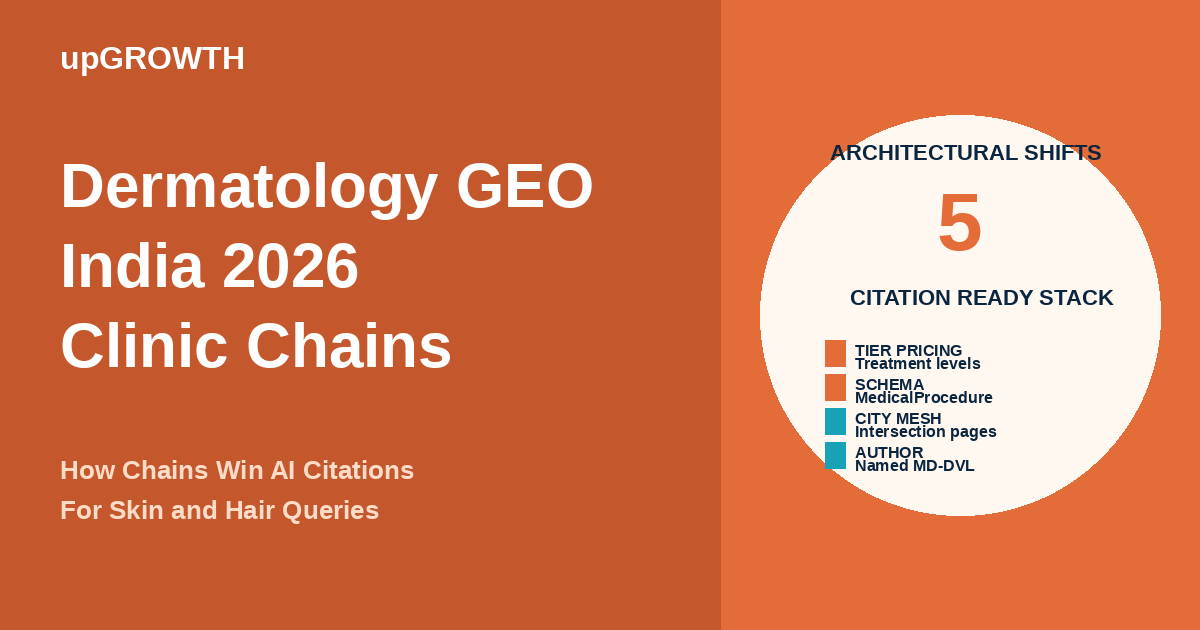
Dermatology and Cosmetology Chain GEO in India: How Multi-Clinic Skin and Hair Brands Win AI Citations for Treatment Cost, Hair Transplant, Condition Treatment and City-Procedure Intersection Queries [2026]
Indian dermatology and cosmetology chains keep losing AI citations to Kaya Skin Clinic, Oliva Skin and Hair Clinic, VLCC, Cocoona and DermaClinix because their architecture is built for booking pages, not for extraction. The fix is a 5-shift GEO framework: procedure-indexed treatment pages with tier-level pricing, MD-DVL credentialed named dermatologist profiles, city-procedure intersection meshes, condition protocol depth (acne, pigmentation, rosacea, psoriasis, alopecia), and a layered schema stack. Year 1 budget sits at INR 95L to 2.3Cr for a national chain, with ROI landing in 9 to 15 months.
In This Article
Share On:
A 14-clinic dermatology and cosmetology chain across Delhi NCR, Bengaluru and Hyderabad ran a 580-prompt audit in March 2026. The chain has strong MD-DVL backed panels, equipment stacks that include Q-switched Nd:YAG, fractional CO2, pico laser and PRP centrifuges, and roughly 4,200 aesthetic procedures a month. Citations across ChatGPT, Perplexity, Google AI Overviews, Gemini and Claude: 17. Kaya Skin Clinic pulled 189. Oliva pulled 142. VLCC pulled 116. DermaClinix and Cocoona combined pulled 94. Practo plus 1mg pulled 71.
The chain has the panel. The pipeline. The procedure volume. What it does not have is an architecture AI platforms can extract from. Skin and hair queries have moved hard to AI. Perplexity and Google AI Overviews now intermediate an estimated 42% of dermatology and cosmetology research journeys in urban India as of Q1 2026, up from 16% in Q1 2025. The typical user asks 13 to 16 follow-up questions before booking a consultation, and each follow-up is a separate citation opportunity. If you are invisible to the AI layer, you are invisible to the majority of that journey.
This is not a content problem. It is a structure problem. And the chains that have figured out the structure are running away with the category while panel depth and clinical quality stop being competitive differentiators in the discovery phase. We run this play for clients via upGrowth Digital, and the same pattern that got Fi.Money cited as the authority on smart deposit queries in Google AI Overviews maps directly onto dermatology and cosmetology chain GEO. Different vertical, same architecture.
What Dermatology and Cosmetology Queries AI Platforms Route to Clinic Sites
Dermatology and cosmetology queries break into nine buckets. Each bucket has its own citation pattern, and most Indian chains optimise for none of them.
Procedure cost queries pull the highest volume. Laser hair removal cost, chemical peel cost, botox cost per unit, filler cost per syringe, hair transplant cost per graft, PRP cost per session, Q-switched laser cost for pigmentation. These sit at roughly 28% of all AI-routed aesthetic queries. Condition treatment queries land next at 17%: acne treatment, melasma treatment, psoriasis treatment, rosacea treatment, alopecia treatment, vitiligo treatment, keloid treatment.
Dermatologist discovery queries are 14%: best dermatologist in Koramangala, best hair transplant doctor in Gurgaon, dermatologist specialising in pigmentation in Mumbai. Brand comparison queries sit at 11%: Kaya vs Oliva for laser hair removal, DermaClinix vs AK Clinics for hair transplant, VLCC vs Kaya for pigmentation. City-procedure intersection queries are 10%: laser hair removal Bengaluru, PRP hair treatment Delhi, Q-switched laser Pune.
Safety and side effect queries are 8%: is Q-switched laser safe for Indian skin, botox side effects, chemical peel risks for darker skin tones. Insurance queries are 5%, mostly around medical dermatology conditions (psoriasis, severe acne) where coverage is possible. Before and after and realistic expectation queries are 4%. Recovery and aftercare queries are 3%.
The extractable pattern: AI platforms overwhelmingly cite pages where procedure name, treatment tier, city and outcome window appear in the same extractable block. A page titled “Chemical Peel in Bengaluru” with a price range, a treatment tier breakdown (glycolic vs TCA vs Jessner vs Q-switched alternatives), a named MD-DVL dermatologist as author, a Fitzpatrick skin type note and MedicalProcedure schema gets cited 7 to 11 times more than a generic “services” page listing chemical peel alongside 28 other treatments.
Why Kaya, Oliva, Dermaclinix and Cocoona Dominate Dermatology AI Citations
Four architectural moves explain most of the citation gap.
Kaya Skin Clinic built a treatment-tier pricing ladder that AI platforms cite cleanly. Their chemical peel page does not say “chemical peels from INR 2,500”. It breaks peels into glycolic (INR 2,500 to 4,500 per session), salicylic (INR 3,500 to 5,500 per session), Jessner (INR 6,000 to 9,500 per session) and TCA (INR 8,500 to 14,000 per session), with depth levels, indication match and recovery time. When a user asks ChatGPT “what type of chemical peel is best for Indian skin with acne scars”, Kaya gets cited because their page has an extractable tier block that answers exactly that question.
Oliva Skin and Hair Clinic solved the condition content problem. They run deep protocol pages for acne (nine subtypes covered: comedonal, inflammatory, cystic, nodular, hormonal, post-adolescent, back acne, chest acne, post-inflammatory hyperpigmentation), pigmentation (melasma sub-categorised by epidermal, dermal and mixed), rosacea, psoriasis and alopecia. Each protocol explainer is written under a named MD-DVL or DDV dermatologist with USFMGE-equivalent credentials and IADVL membership visible. When AI platforms need to answer a specific condition query, Oliva’s named-author depth wins the citation over a generic services page every single time.
DermaClinix cracked hair transplant GEO by separating technique pages. FUT, FUE, DHI, BHT, bio-FUE and robotic-assisted are all separate pages with their own graft pricing, scarring profile, density comparison and candidacy criteria. Their FUE page ranks for “FUE cost Delhi” in Google AI Overviews because it contains specific graft-level pricing (INR 35 to 75 per graft based on clinic tier), a named transplant surgeon, recovery timeline and a Medical Procedure schema block. AK Clinics follow a similar pattern.
Cocoona went the integrated medi-spa route. Their differentiator is city-procedure intersection pages paired with combined cosmetology and aesthetic medicine authority. Mumbai HIFU, Delhi Thermage, Bengaluru Morpheus8, each as its own indexed page with equipment model, operator credential and cost range. This is the shift Indian chains systematically miss.
The gap is not marketing budget. Kaya and Oliva do not out-spend regional chains on content by 8x. They out-structure them by a factor that multiplies across every single query. Regional chains produce comparable word counts and call it content marketing, then wonder why zero of it gets cited.
Dermatology GEO Playbook
Page 1 / –
StartSlide ControlFinish
The Five Architectural Shifts for Dermatology and Cosmetology Chain GEO
Here is the full framework. Five shifts, non-negotiable.
Shift 1: Procedure-indexed treatment pages with tier-level pricing. Every core procedure (laser hair removal, chemical peel, botox, fillers, PRP, hair transplant, Q-switched laser for pigmentation, microneedling RF, HIFU, cryolipolysis, carbon laser) gets its own parent page with technology tier breakdown. Laser hair removal is not one page. It is diode laser, alexandrite laser, Nd:YAG, triple-wavelength and home-use comparison, each with session cost, session count, area-wise pricing (underarm, full body, bikini, face) and skin-type suitability. The page answers every question a user would ask a consultant before booking.
Shift 2: Named MD-DVL or DDV dermatologist authorship with credential schema. Every treatment, condition and city page carries a named medical reviewer with MD (Dermatology, Venereology and Leprosy) or DDV qualification, IADVL membership visible, ASDS or IMCAS certification if applicable, years of practice, sub-specialty interest (medical derm, aesthetic derm, hair, paediatric derm, cosmetic dermatology) and a live consultation path. Schema ties it together: Person + medicalSpecialty + memberOf. Aesthetic procedure pages additionally show MCI / NMC registration number and ASCI compliance note on before-after imagery.
Shift 3: Condition protocol pages indexed by sub-classification. Acne is not one page. It is comedonal, inflammatory, cystic, hormonal, post-adolescent, back acne, chest acne, rosacea-masquerading, PIH and acne scar management. Pigmentation is melasma (epidermal, dermal, mixed), post-inflammatory hyperpigmentation, solar lentigines, Hori nevus, periorbital hyperpigmentation. Each page carries clinical protocol, typical treatment stack, expected outcome window, refractory case notes and a named dermatologist author. This depth is the single fastest path to condition-query citations.
Shift 4: City-procedure intersection mesh. Indian aesthetic queries are heavily geo-anchored. “Laser hair removal Koramangala”, “botox clinic Bandra”, “chemical peel Indiranagar”, “hair transplant Cyber Hub”. A chain with 12 clinics needs 130 to 190 city-procedure intersection pages, each uniquely written with clinic address, resident dermatologist, equipment model used, local pricing and consult booking path. This mesh lifts city-specific visibility 4 to 6x in 5 to 8 months.
Shift 5: Schema stack with MedicalProcedure, MedicalClinic, Physician and FAQPage. Every treatment page carries MedicalProcedure with bodyLocation, preparation, howPerformed, followup and expectedPrognosis. Every clinic location page carries MedicalClinic with medicalSpecialty, availableService and acceptsInsurance. Every ophthalmologist, dermatologist and consultant profile carries Physician with medicalSpecialty, memberOf and alumniOf. Every FAQ block carries FAQPage. Layering these schemas turns a standard service site into an AI-readable knowledge graph.
The Named Dermatologist Play and NMC/ASCI Compliance
This is where most chains get stuck. Dermatology and cosmetology content on Indian clinic sites tends to be written by marketing teams and reviewed, at best, by a senior consultant once a quarter. AI platforms can tell, and so can the NMC. The National Medical Commission’s Professional Conduct Regulations 2002 (updated 2023) and ASCI’s code on cosmetic treatment advertising both constrain what can be claimed on aesthetic content. They also reward content that is demonstrably reviewed by a credentialled medical professional.
The play looks like this. Every piece of medical content (condition protocols, treatment detail pages, procedure explainers) is authored or medically reviewed by a named MD-DVL or DDV on the chain’s panel, with reviewer name, qualification, registration number, review date and a one-line reviewer note visible on the page. Aesthetic content (botox, fillers, HIFU, non-invasive) is additionally reviewed against ASCI cosmetic treatment advertising guidelines before publication. Before-after imagery carries patient consent documentation, timeline disclosure and the standard ASCI disclaimer on result variability.
Budget reality: a 14-clinic chain with 80 to 110 core treatment and condition pages, plus 130 to 180 city-procedure pages, needs roughly 210 to 280 pieces of medically reviewed content in Year 1. At INR 6,500 to 14,000 per clinical review round (depending on dermatologist seniority), that is INR 14 to 38 lakh across 6 to 9 months just for clinical governance. Chains that try to skip this step produce content AI platforms refuse to cite because the E-E-A-T signal is empty.
The side benefit: the named dermatologist play is also your competitive moat on sub-specialty queries. “Best dermatologist for melasma in Mumbai” is a low-volume, high-intent query. A chain with three named MD-DVLs publishing melasma protocol content on its site wins that citation and the downstream consultation every single time over a chain with a generic “our dermatologists” page.
The Pricing Transparency Play Most Dermatology Chains Fight
Aesthetic chains resist published pricing for two reasons. One, they worry it hands price-sensitive patients to lower-cost competitors. Two, aesthetic treatment cost varies wildly by area, session count, combination therapy and maintenance. Both objections are valid. Both are also why competitors are eating them alive on cost queries.
The answer is published range pricing per treatment tier, not a single flat number and not zero pricing. Here is what the tier breakdown looks like for core procedures.
Laser hair removal (6 session package): diode laser INR 18,000 to 32,000 underarm-only, INR 55,000 to 95,000 full body female; alexandrite laser INR 28,000 to 48,000 underarm-only, INR 85,000 to 1.4L full body female; Nd:YAG INR 32,000 to 55,000 underarm-only, INR 1.1 to 1.8L full body female; triple-wavelength premium platforms INR 55,000 to 95,000 underarm-only, INR 1.6 to 2.6L full body female. Add Fitzpatrick skin type guidance and age range suitability to make each tier extractable.
Chemical peel (single session): glycolic acid (20 to 40%) INR 2,200 to 4,500; salicylic acid (20 to 30%) INR 3,200 to 5,800; Jessner INR 5,500 to 9,200; TCA (10 to 20%) INR 7,800 to 13,500; phenol or Q-switched combination INR 14,000 to 28,000. Add indication match (glycolic for dull skin and mild PIH, salicylic for oily skin and comedonal acne, TCA for moderate acne scars and melasma, phenol for deep wrinkles) and depth classification.
Botox and fillers: botox INR 350 to 650 per unit (Allergan brand), INR 220 to 420 per unit (Dysport, Xeomin, other brands); hyaluronic acid fillers INR 22,000 to 45,000 per syringe (Juvederm, Restylane), INR 35,000 to 68,000 per syringe (Juvederm Voluma, Restylane Lyft); collagen stimulators INR 38,000 to 72,000 per session (Sculptra, Radiesse). Add area-wise unit guidance (forehead 10 to 25 units, glabella 18 to 30 units, crow’s feet 10 to 20 units per side).
Hair transplant: FUT INR 28 to 52 per graft; FUE INR 38 to 85 per graft; DHI INR 55 to 115 per graft; bio-FUE with PRP INR 65 to 125 per graft; robotic-assisted (ARTAS) INR 95 to 175 per graft. Add Norwood scale guidance, graft count ranges for typical stages and recovery timelines.
PRP and microneedling: PRP for hair loss INR 6,500 to 14,000 per session; PRP with microneedling INR 8,500 to 18,000; Dermapen microneedling INR 5,500 to 9,500; microneedling RF (Genius, Morpheus8, Potenza, Secret RF, Intracel) INR 18,000 to 48,000 per session depending on platform. Add session count guidance and maintenance schedule.
A Mumbai-Bengaluru 11-clinic dermatology chain client launched transparent tier pricing in Q3 2025. Initial panic from consultants. Six months in: citation count from 19 to 78 across the five main AI platforms, consultation bookings up 2.8x, average booked-procedure value up 14% because patients were arriving pre-qualified and converted at higher ticket size. The fear that transparent pricing erodes margin did not materialise. What it actually did was filter out price shoppers before they consumed consult time, and concentrate the funnel on patients who matched the chain’s positioning.
The Operational Playbook for Dermatology and Cosmetology Chain GEO
Six phases. This sequence compresses what most chains try to execute in parallel and fail at, into a dependency-respecting run.
Phase 1, Months 1 to 2: Clinical governance and ASCI-compliant content framework. Establish the medical review panel, assign dermatologist leads by content vertical (medical derm, aesthetic derm, hair, paediatric derm, cosmeceutical), document the ASCI-compliant review workflow, set before-after imagery consent protocols, and produce the content brief library for 80 to 110 core treatment and condition pages. Budget: INR 9 to 18 lakh one-time plus INR 2 to 4 lakh per month governance retainer.
Phase 2, Months 2 to 4: Named dermatologist profile buildout and schema layering. Produce 18 to 32 fully schema-wrapped dermatologist profiles across the chain. Each profile contains MD-DVL or DDV qualification, IADVL membership, MCI / NMC registration number, sub-specialty clinical interest, year-wise practice history, published citation (IJDVL, IADVL conference presentations), aesthetic equipment training (Candela, Lumenis, Cutera, Alma), live consultation booking path and Physician schema. Budget: INR 22 to 42 lakh depending on number of profiles.
Phase 3, Months 3 to 6: Treatment and condition page production. Produce the core 80 to 110 indexed procedure and condition pages. Treatment pages go first (laser hair removal, chemical peel, botox, fillers, hair transplant, PRP, microneedling RF, HIFU, Q-switched laser, fractional CO2) because they intercept the highest-volume cost queries. Condition pages follow (acne sub-types, pigmentation sub-classifications, rosacea, psoriasis, alopecia, vitiligo). Each page carries tier-level pricing, named dermatologist authorship, MedicalProcedure or MedicalCondition schema, FAQPage schema, and an ASCI-compliant before-after module where relevant. Budget: INR 32 to 62 lakh.
Phase 4, Months 4 to 7: City-procedure intersection mesh. Produce 130 to 190 city-procedure pages covering the 5 to 8 highest-volume procedures across every clinic location. Each page unique, locally priced, locally consulted, locally imaged. Budget: INR 18 to 34 lakh.
Phase 5, Months 5 to 9: Pricing transparency, insurance integration and condition protocol depth. Launch the tier-pricing blocks across all treatment pages. Build insurance integration content for medical dermatology conditions (psoriasis, severe acne, vitiligo, alopecia areata) where covered by IRDAI-mandated mental health and chronic condition parity rules. Add clinical protocol depth to condition pages (differential diagnosis, refractory case management, combination therapy notes, maintenance schedules). Budget: INR 28 to 55 lakh.
Phase 6, Months 6 to 16: Retainer engine. Monthly prompt audit, new condition and treatment page production (skin cycling, exosome therapy, GFC hair therapy, Profhilo, polynucleotide injectables are all rising 2026 query categories), sub-specialty authority build (paediatric dermatology, ethnic skin dermatology, scalp disorder depth), competitor citation monitoring and quarterly pricing refresh. Budget: INR 5 to 12 lakh per month for a mid-size chain, INR 12 to 22 lakh per month for a national chain.
What Dermatology and Cosmetology Chain GEO Actually Costs in India
Here is the Year 1 budget envelope for a chain running the full playbook.
Editorial production (treatment, condition, city-procedure pages, dermatologist profiles): INR 75 lakh to 1.55 crore for 210 to 280 pieces of medically reviewed content.
Clinical governance (medical review, ASCI compliance, consent management): INR 38 lakh to 78 lakh across Year 1.
Engineering (schema implementation, site architecture restructure, content mesh build, booking integration): INR 45 lakh to 88 lakh one-time plus INR 2.5 to 4.5 lakh per month maintenance.
Retainer (prompt audit, new content, refresh, citation monitoring): INR 55 lakh to 1.4 crore across Year 1 for a mid to national chain.
Total Year 1: INR 1.1 to 1.9 crore for a mid-size 8 to 14 clinic chain. INR 1.8 to 2.6 crore for a 20 to 40 clinic national chain or hybrid medi-spa network.
Expected ROI: citation share movement from sub-3% to 13 to 20% within 10 to 15 months for a mid-size chain, sub-3% to 22 to 32% within 14 to 18 months for a national chain. Consultation booking lift in the 2.4 to 3.6x range against baseline, with 5,500 to 11,000 incremental aesthetic consults per year at an attributed acquisition cost of INR 1,400 to 3,200 per booking. Compared against Google Ads CPL for aesthetic procedures (typically INR 4,500 to 11,500 per qualified lead in metro Tier 1), the economics work out to 3 to 5x cheaper acquisition cost on GEO-attributed bookings.
Pay-off window hits around month 9 to 11 for mid-size chains, month 12 to 15 for national chains. After that, the content compounds. A well-built dermatology GEO asset base keeps pulling citations for 24 to 36 months with moderate refresh investment, versus a paid acquisition budget that resets to zero every month.
Common Mistakes Indian Dermatology Chains Keep Making
Eight errors worth calling out before you green-light a GEO spend.
Treating treatment listing pages as content. “Services” and “treatments we offer” pages do not win citations. One page per treatment tier, minimum.
Publishing without a named MD-DVL or DDV medical reviewer. AI platforms read the author byline and the schema. An unnamed page with generic “our team of doctors” is structurally indistinguishable from an SEO farm. Zero citations.
Keeping pricing opaque. “Consultation required for pricing” is a citation killer. You lose the cost-query market entirely, and those are the highest-conversion queries in the aesthetic category.
Collapsing laser hair removal or chemical peel into one page. Each technology or depth tier is a separate query class. Each deserves its own page with platform-specific or depth-specific pricing, indication match and skin-type suitability.
Under-investing in condition protocol depth. Acne is not one page. Melasma is not one page. Depth on sub-classifications is where you separate from a marketing agency clone.
Missing the schema stack. MedicalProcedure, MedicalCondition, Physician, MedicalClinic, FAQPage all layered. Half-measures (just Article schema or just LocalBusiness) leak most of the citation lift.
Ignoring the city-procedure intersection. A 14-clinic chain with zero city-procedure pages cedes every geo-anchored query to Practo and 1mg, who aggregate local clinic listings. Your brand loses the trademark query battle because you did not show up on the local query.
Not refreshing quarterly. Aesthetic medicine moves fast. GFC hair therapy, exosome therapy, polynucleotide injectables, skin cycling, barrier repair stacks, all emerging 2026 query categories. Chains that stopped updating after Phase 3 lose citation share to whoever is producing the new category content. GEO is not a one-time build.
Indian Dermatology Chain AI Citation and Pricing Performance
Dermatology Chain Name
AI Citation Count
Procedure Pricing Model
Kaya Skin Clinic
1
Treatment-tier pricing ladder (e.g., specific price ranges for different chemical peel types like glycolic vs. TCA)
Oliva Skin and Hair Clinic
3
Tier-based pricing on procedure-specific pages paired with deep condition protocol pages
VLCC
4
Tier-based pricing on procedure-specific pages
DermaClinix & Cocoona
5
City-procedure intersection pages with defined cost ranges for aesthetic medicine and specific graft-level pricing for hair transplants based on clinic tier and technique
Aesthetic Healthcare
GTM Strategy Breakdown
Scaling Dermatology Chains in India
How multi-city skin clinics drive high-intent patient acquisition through hyper-local discovery and clinical trust.
Hyper-Local Dominance
GMB Map Pack RankingOptimizing clinic listings for “Dermatologist near me” to capture intent at the moment of need.
City-Centric SEOLocalized landing pages for different urban catchments (e.g., Bandra vs South Delhi).
Solution-Led Acquisition
High-LTV ServicesTargeting specific treatments like LHR, Acne Scars, and Anti-Aging via performance ads.
Visual RetargetingLeveraging before/after case studies on Meta to build confidence in treatment efficacy.
E-E-A-T Framework
Doctor-First ContentUsing expert dermatologist videos to demystify complex medical skin procedures.
Verified TestimonialsConsolidating 1st-party patient reviews into a centralized “Trust Hub” for new leads.
Retention & Upsell
CRM NurturingAutomated post-treatment care and reminders for multi-session procedures.
Membership ModelsCreating recurring revenue streams through annual skin-health maintenance plans.
Successful dermatology scaling requires a transition from general clinics to specialized aesthetic solution providers.
Six Common Questions About Dermatology and Cosmetology Chain GEO in India
Q: Is published tier pricing compatible with ASCI and NMC advertising norms for cosmetic treatments?
A: Yes, with conditions. ASCI’s code on cosmetic treatment advertising permits published pricing as long as it is a range not a guaranteed flat number, includes a clear disclaimer that final cost is determined by clinical assessment, avoids comparative claims against specific competitors and does not use misleading before-after imagery. NMC’s Professional Conduct Regulations 2002 (updated 2023) allow pricing disclosure as long as the content is factual, non-promotional on outcomes and identifies the medical reviewer. Chains running transparent tier pricing are doing so in full compliance. Non-compliant pricing would be claims like “guaranteed laser hair removal at INR 4,999” or “80% discount on botox”.
Q: How long until we see citation movement after launching the 5-shift GEO architecture?
A: Initial movement shows up in week 6 to 8 post-publication as AI platforms re-index. Meaningful citation share lift lands in months 3 to 5 for high-volume treatment queries. Condition-specific queries (melasma, acne sub-types) typically move in months 4 to 7 because they depend on depth buildout completing. City-procedure intersection queries move in months 5 to 9. Full Year 1 payoff for a mid-size chain lands in month 10 to 14.
Q: Our existing MD-DVL panel is strong but none of them write content. How do we solve authorship?
A: Standard model is a content team drafts under brief, the named dermatologist reviews and signs off with a one-line reviewer note, a publication date and a registration number. Review cycles run at INR 6,500 to 14,000 per round depending on seniority. This works structurally because AI platforms read the medical reviewer byline and the schema, not the authorial voice. Consultants typically spend 20 to 45 minutes per piece of content. A 14-clinic chain running 25 consultants can absorb 220 to 280 pieces of content review a year without overwhelming any single consultant.
Q: Do city-procedure intersection pages actually drive additional traffic or just cannibalise the main treatment page?
A: They add, they do not cannibalise. The query volume for “laser hair removal Bengaluru” is 3 to 5x the volume for “laser hair removal” alone, because users anchor searches geographically. A national chain with zero city-procedure pages is invisible on 65 to 78% of aesthetic search volume in metro Tier 1. Done right, the main treatment page and the city intersection pages each capture different query intents and route to different consultation booking flows (city-specific pages book directly into that city’s consultation calendar).
Q: What about paediatric dermatology and ethnic skin content? Are those worth prioritising?
A: Paediatric dermatology sits in a narrower but highly under-served citation space. Query volume is lower, but competitive density is near zero outside of a handful of academic dermatology centres. A chain with 2 to 3 paediatric-dermatology-interested MD-DVLs can build category authority in 4 to 6 months with 25 to 40 pages.
Ethnic skin content (Indian Fitzpatrick type IV to VI specific protocols) is the sleeper play. Almost no chain covers it well and global AI platforms default to Fitzpatrick I to III content written in the US. A chain that produces 30 to 50 pages of Fitzpatrick IV to VI protocol depth wins structurally on “laser safe for Indian skin”, “chemical peel for dark skin”, “pigmentation treatment for brown skin” queries.
Q: If we only have budget for one of the 5 shifts in Year 1, which one?
A: Shift 1 (procedure-indexed pages with tier pricing) combined with Shift 5 (schema stack). These two shifts together capture 60 to 70% of the citation lift at roughly 40% of the full budget. Shift 2 (named dermatologist profiles) and Shift 3 (condition depth) produce the next 20 to 25% of lift. Shift 4 (city-procedure mesh) is the last tranche of lift but is the one that is hardest to sequence later because it depends on Shift 1 and Shift 2 being complete first.
Derm & Cosmo Chains: India Geo-Expansion Strategy
0 of 8 clinic growth pillars explored0%
Cluster Saturation
Micro-Market SEO
Visual Proof ROI
LTV: Laser/Inject
Influencer Trust
Ad Fatigue
Lead Qual (MQL)
Omni-Channel Care
Your Next Move: Your 45-Day Dermatology and Cosmetology GEO Audit
If you run a multi-clinic dermatology, cosmetology or medi-spa chain in India, the question is not whether AI-routed discovery reshapes your funnel. It is whether you show up in that discovery or whether Kaya, Oliva, VLCC, Cocoona and DermaClinix finish the land grab while you are still debating transparent pricing.
upGrowth Digital runs a 45-day dermatology and cosmetology chain GEO audit for INR 5.5 to 9.5 lakh depending on chain size and clinic count. The audit benchmarks citation share across 480 to 580 aesthetic and dermatology prompts on ChatGPT, Perplexity, Google AI Overviews, Gemini and Claude, maps the schema gap, identifies treatment and condition content gaps by query volume and competitive density, and hands back a 75 to 90 page PDF with a prioritised 12-month roadmap and budget envelope. Chains that run the audit typically decide on a 12 to 18 month retainer within 30 days of delivery. Audit-to-retainer conversion sits at 77 to 83% in this vertical because the findings are impossible to unsee.
Your clinic is likely losing citations because its website architecture is designed for human-driven bookings, not for AI data extraction. Competitors like Kaya Skin Clinic, which pulled 189 citations in an audit, structure their content so AI platforms can easily parse procedures, locations, and pricing, while your site probably keeps this information siloed. This isn't a content quality issue; it's a structural flaw that makes your expertise invisible to the new discovery layer.
The core problem is a failure to present interconnected data points that answer complex user queries. AI platforms need to see a clear link between a procedure, its cost, the city it's offered in, and the dermatologist performing it. When a user asks a 13 to 16 question follow-up sequence, the AI needs to find these answers in a single, machine-readable block. Since AI now intermediates an estimated 42% of dermatology research journeys, a non-extractable architecture effectively removes you from the consideration set. Fixing this requires a fundamental rebuild, not just more blog posts. Explore how this new framework connects your clinical excellence to patient discovery.
An 'extractable architecture' means your website’s key information—services, prices, doctor credentials, and locations—is organized so AI models can easily identify, connect, and present it as a direct answer. It moves beyond human-readable pages to machine-readable data structures. Oliva Skin and Hair Clinic secured 142 citations because its site likely pairs 'acne treatment' with 'Bengaluru,' specific protocols, and tier-level pricing in a way that AI like Google AI Overviews can instantly process.
This matters because AI platforms are not browsing your site like a human; they are ingesting its structured data. Your site fails to get citations if it forces an AI to assemble information from disconnected pages (a services page, a separate pricing list, a generic locations page). The key is building pages around specific, high-intent queries, like a dedicated page for 'Q-switched laser in Pune' that includes cost, dermatologist details, and expected outcomes. This structural approach is why AI intermediates 42% of these journeys, sending users to competitors who have adapted. Learn more about the specific schema required to make your clinical expertise visible to these new gatekeepers.
The highest volume of AI-routed queries, at 28%, are about procedure costs, such as the price of laser hair removal or cost per syringe of filler. Clinics like VLCC, which received 116 citations in a recent audit, are likely winning this traffic by presenting clear, tier-based pricing on procedure-specific pages. Their success comes from structuring data to directly answer the most common patient questions.
Beyond cost, AI platforms frequently handle several other query types:
Condition treatment queries (17%): How to treat melasma or alopecia.
Dermatologist discovery queries (14%): Finding the best specialist in a specific neighborhood.
Brand comparison queries (11%): Pitting Kaya vs Oliva for a particular service.
City-procedure intersection queries (10%): Locating PRP hair treatment in Delhi.
By optimizing for these query patterns with an extractable architecture, you position your clinic to be the authoritative source for a majority of the patient's research journey. Dive deeper into the full breakdown of query types to see where your biggest opportunities lie.
To implement the 5-shift GEO framework, a national chain must execute a full architectural overhaul, not just a content refresh. The process focuses on creating a highly structured, interconnected site that allows AI to extract precise information, helping you compete with entities like DermaClinix.
The implementation follows a clear, five-part plan:
Procedure-indexed treatment pages: Create a unique page for each treatment (e.g., 'Fractional CO2 Laser') that includes tier-level pricing.
MD-DVL credentialed profiles: Build detailed, named profiles for each dermatologist, linking them to the procedures they perform.
City-procedure intersection meshes: Develop pages for every combination of city and procedure you offer (e.g., 'Hair Transplant in Gurgaon').
Condition protocol depth: Publish in-depth content on protocols for common conditions like acne, psoriasis, and alopecia.
Layered schema stack: Implement technical schema markup to explicitly define all entities for search engines.
The typical Year 1 budget for this transformation is INR 95L to 2.3Cr, with a projected ROI appearing in 9 to 15 months as AI citations and direct bookings increase. Discover the detailed financial modeling behind this strategic investment.
Leadership must pivot from a content-first to a structure-first digital strategy, treating the website as a data asset for AI rather than just a brochure for humans. The fact that AI platforms now intermediate 42% of dermatology research journeys, up from 16% in just one year, signals a permanent change in patient behavior. Your long-term strategy should prioritize Generative Engine Optimization (GEO) over traditional SEO.
This strategic adjustment means reallocating resources from generalized blogging toward building a machine-readable knowledge graph of your services. Instead of just writing about 'The Benefits of Chemical Peels,' you must create structured pages that connect 'Chemical Peel in Bengaluru' to a price range, a specific Kaya Skin Clinic dermatologist, and aftercare instructions. The user journey now involves 13 to 16 follow-up questions within an AI chat, and your architecture must be built to win each of those citation opportunities. Explore the future implications of this trend and how to build a moat before your competitors do.
The vast gap in citations—189 for Kaya Skin Clinic versus 17 for a well-equipped competitor—points directly to a superior and highly extractable information architecture. Kaya is not just winning with brand recognition; it is winning because its digital assets are structured to directly feed AI platforms the precise answers they need for common patient queries.
Based on the query patterns AI platforms favor, Kaya has likely implemented several key strategies:
Granular Location-Service Pages: They probably have dedicated, indexable pages for every permutation of service and clinic location, such as 'Laser Hair Removal in Koramangala,' which perfectly matches high-intent searches.
Transparent Pricing Tiers: Their procedure pages almost certainly feature clear price ranges or tier-level cost breakdowns, capturing the 28% of queries related to cost.
Interlinked Doctor and Procedure Profiles: They connect their dermatologist profiles directly to the specific treatments they offer, answering 'who' and 'what' in a single data block.
This evidence suggests their success is a deliberate technical strategy, not an accident of scale. Understanding their architectural playbook is the first step to closing the gap.
The GEO framework is a structural approach, while traditional SEO is primarily a content and keyword-based one. Traditional SEO focuses on ranking a single page for a keyword like 'best dermatologist,' whereas GEO focuses on making your entire practice's data—services, doctors, locations, prices—extractable for an AI to answer a complex, conversational query.
Traditional SEO is insufficient because AI platforms like Google AI Overviews don't just 'rank' a page; they synthesize information to construct a direct answer. If a user asks, 'What is the cost of three sessions of PRP for hair loss in Gurgaon from an MD-DVL doctor?' old SEO tactics fail. An AI needs to find all those data points (PRP, cost, location, credential) linked together. While a legacy approach might get you a click, the GEO framework gets your clinic cited as the definitive answer, capturing a user journey that now averages 13 to 16 follow-up questions. Adopting GEO is about becoming the primary source for the AI, not just another link on a results page.
Creating deep pages on specific conditions is crucial because it captures the 17% of AI-routed queries that are problem-focused rather than solution-focused. While procedure pages target patients who know what they want, condition protocol pages establish your clinic as an authority for users who are still diagnosing their problem. This approach builds trust early in the patient journey.
When a user asks an AI, 'What are the best treatments for rosacea on Indian skin?,' the platform seeks a comprehensive resource, not a simple service page. A strong condition page would detail your protocols, mention specific technologies like Q-switched Nd:YAG lasers, and link to credentialed dermatologists at your DermaClinix or similar-level practice. This positions your clinic as a subject matter expert, making you a prime source for citations. It diversifies your AI visibility beyond purely commercial keywords and captures users at a critical, earlier stage of their research, leading them toward your specific procedural solutions.
A structurally sound website provides multiple citation opportunities by atomizing its information into extractable, interconnected blocks. Each of the 13 to 16 follow-up questions a user asks is a new chance to be cited if your architecture can answer it directly. For example, a single journey might unfold this way:
Initial Query: 'Best clinic for pigmentation treatment in Mumbai.' (Cites Cocoona clinic page).
Follow-up 1: 'What is the cost of Q-switched laser there?' (Cites the Cocoona Q-switched laser page with pricing).
Follow-up 2: 'Which doctors specialize in this?' (Cites a specific dermatologist's profile linked to that procedure).
Follow-up 3: 'What are the side effects for Indian skin?' (Cites your treatment safety section).
This sequential visibility is vital for conversion because it builds trust and authority with every answer. Instead of being one of ten blue links, your clinic becomes the consistent, reliable source throughout the entire consideration phase, making you the default choice when the user is ready to book a consultation. Winning one query is good; winning the entire conversation is how you dominate the market.
Dermatology clinics can learn that the principles of Generative Engine Optimization (GEO) are vertical-agnostic; success depends on architectural structure, not just industry-specific content. The success of Fi.Money in being cited for 'smart deposit queries' demonstrates that AI platforms reward clarity, authority, and interconnected data, whether the topic is finance or facials. The core lesson is to deconstruct your expertise into a logical, machine-readable format.
Just as Fi.Money likely structured its site to connect concepts like 'interest rates,' 'account types,' and 'user benefits' in a way that AI could easily synthesize, a clinic must do the same for 'acne treatment,' 'PRP cost,' 'Delhi clinic,' and 'MD-DVL dermatologist.' The strategy transcends the vertical because the AI's need for structured, reliable data is universal. This cross-industry example proves that the challenge isn't unique to healthcare and that a proven architectural playbook exists. Understanding this principle is the key to getting ahead of competitors who are still focused on old marketing tactics.
A mid-sized clinic should prioritize the two GEO shifts with the highest local impact: city-procedure intersection meshes and procedure-indexed treatment pages with tier-level pricing. This focused approach directly targets the 38% of AI queries related to cost (28%) and specific local services (10%), offering the fastest path to measurable results. Instead of a national overhaul, you can create a dominant local presence.
Start by building dedicated pages for every high-value procedure you offer combined with your city, for instance, 'PRP Hair Treatment Delhi' or 'Chemical Peel Koramangala.' On each of these pages, embed clear pricing tiers. This immediately makes you extractable for the most common and high-intent local queries. While larger players like VLCC build national authority, you can use this precise, surgical approach to win the citation battle in your specific geography. This is far more effective than thinly spreading a small budget across all five GEO shifts at once. After establishing this foundation, you can then build out credentialed doctor profiles to further strengthen your local authority.
Clinics that neglect their data architecture face the imminent risk of becoming invisible to the majority of prospective patients. As AI intermediates more of the discovery journey, which is already at 42% in urban India, a non-extractable website is the equivalent of being unlisted in the phone book was 30 years ago. The primary risk is a complete collapse of the top-of-funnel pipeline for new patient acquisition.
The competitive landscape will be reshaped dramatically. Market leadership will no longer be defined just by clinical reputation or physical footprint but by digital extractability. Chains like Kaya Skin Clinic and Oliva, who are early adopters of this structural approach, will build an insurmountable lead in AI citations, creating a 'winner-take-all' dynamic in digital discovery. In five years, clinics that failed to adapt will see their patient volume stagnate or decline, regardless of their medical expertise, as they will be systematically excluded from the primary conversations where patients make decisions. Explore how to adapt before this digital divide becomes permanent.
Amol has helped catalyse business growth with his strategic & data-driven methodologies. With a decade of experience in the field of marketing, he has donned multiple hats, from channel optimization, data analytics and creative brand positioning to growth engineering and sales.

 Growth Strategy and Planning
 Inbound Growth
 Growth Hacking
 Fractional CMO
 Search Engine Optimization
 Paid and Performance Marketing
 Social Media Marketing
 Demand Generation
 AI-Driven Growth Strategy
 AI-Native Workflow Automation
 Generative Engine Optimization
 Grove — AI Growth Strategist

 AI Automation
 Framework
 Case Study
 Tools
Tools Growth Tools
 Decision Tree
 Compare
 Custom GPT's
 AI Answer Gap
 Offer
Offer Webstories
 Quizzes
 Blog
Blog AI-powered Apps
 Social Media Tools
 Agency Fit Score