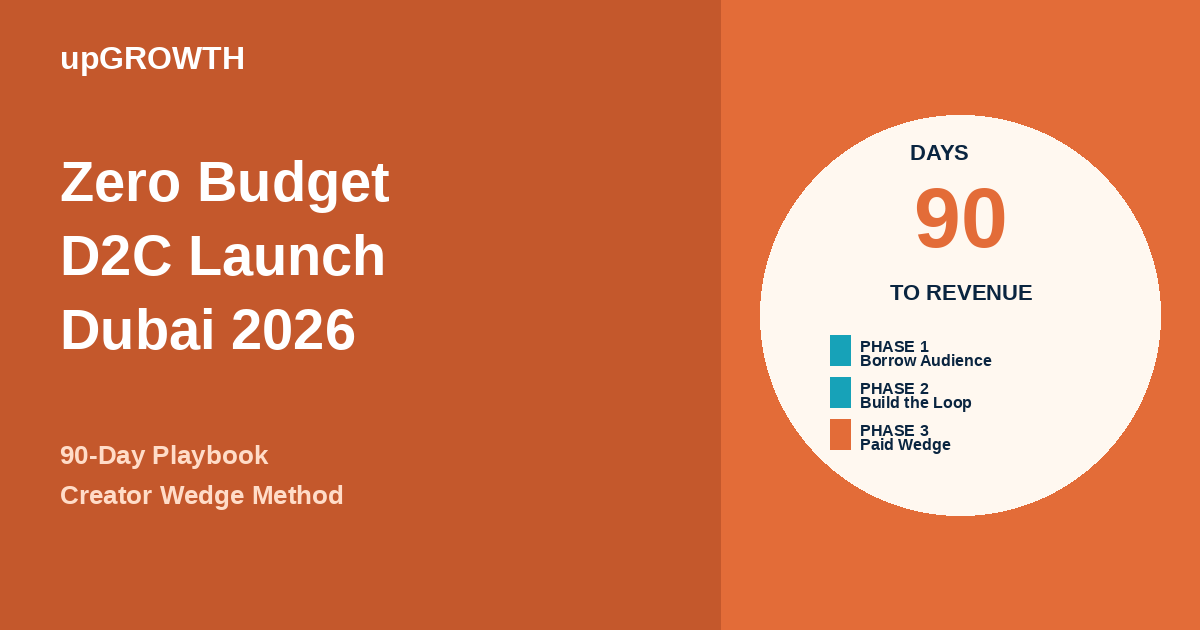
Launching a D2C brand in Dubai with zero paid media budget is possible if you treat the first 90 days as distribution arbitrage, not brand building. The play is borrowed audiences, founder-led organic, micro-creator barter, and one obsessively narrow product wedge. We have launched four GCC D2C brands this way. The ones that made it past month six all did the same five things in the same order.
In This Article
Share On:
Most Dubai D2C founders I meet treat zero-budget launches as a survival mode. They post on Instagram, hope friends share, and quietly burn through six months of savings before deciding marketing does not work. The actual problem is not the budget. It is the absence of a distribution thesis.
The brands that crack this in Dubai share one trait. They pick one channel, one audience, and one offer for the first 90 days. They do not split attention. They do not run “brand awareness.” They build a single distribution loop that produces orders, then they reinvest those orders into paid acquisition by month four.
This playbook documents the exact 90-day sequence we have used with two food D2C brands, one wellness brand, and one accessories brand in the UAE between 2023 and 2025. Three of the four cleared AED 50K in monthly revenue by day 90 with under AED 3,000 in total marketing spend across the three months. The one that did not had a product-market fit issue we should have caught in week two. We will cover that too.
If you want to validate the unit economics before you start, run your numbers through our D2C marketing ROI calculator for GCC markets. Without 60% gross margin minimum, this playbook will not save you. With it, the next 90 days are an execution problem, not a budget problem.
Why Zero Budget Launches Fail in Dubai (And Why Most Founders Misdiagnose It)
The standard zero-budget playbook from US D2C content does not work in Dubai. The reason is structural. Organic Instagram reach in the UAE is lower than US benchmarks because the platform skews more transactional. WhatsApp drives more commerce than email. Influencer barter is harder because UAE creators expect cash, not product. Word of mouth is slower because the expat population turns over.
What this means: founders who copy “free marketing” content from US blogs end up posting Reels three times a week, getting 200 views, and concluding they are bad at content. They are not. They are using the wrong distribution mechanic for the wrong market.
The Dubai zero-budget play is not “be good at organic content.” It is “borrow distribution from people who already have it.” That changes everything about what you do in week one.
The 90-Day D2C Launch Playbook: Overview
Here is the structural map. Each phase has one core job. Do not move to the next phase until the current job is done.
Days 1-30: Audience borrowing. Find 10-15 micro-creators (5K-30K followers) in your niche who already have your customer. Trade product for content. Goal: first 30 orders, 100 emails, baseline content library.
Days 31-60: Distribution loop. Build a referral mechanic that turns first customers into acquisition channels. Launch a WhatsApp broadcast list. Start a creator affiliate program with 3-5 of your best week-one collaborators. Goal: 100 cumulative orders, 30% repeat rate from cohort one.
Days 61-90: Paid wedge. Take the top-performing organic content from days 1-60 and put AED 30-50/day behind it on Meta. Not a campaign. A boosted post. Optimise for purchases, not engagement. Goal: AED 50K monthly revenue run rate, validated CAC under AED 80, ready to bring on a performance retainer.
This is the entire framework. Five tactics, three phases, one outcome. Now the execution detail.
This is the highest-leverage activity in the entire 90 days. If you do this wrong, the rest of the playbook collapses. If you do this right, you exit day 30 with 30+ orders and a content library you can repurpose for six months.
The mechanic is simple. You identify 15 UAE-based micro-creators (5K-30K followers) whose audience matches your customer. You send them your product for free. They post about it. You get orders, content, and credibility.
The execution is harder than it sounds because most founders pick the wrong creators. The right creator profile in Dubai 2026 looks like this:
Engagement rate above 4% on their last 12 posts. Comments that include questions and tags, not just emojis. Audience visibly UAE-based (check geo on a few followers). Content style that matches your brand aesthetic. Posts about lifestyle topics adjacent to your category, not the category itself. Posts at least 3-4 times a week so they will not forget about you.
The wrong profile: 50K-100K followers but 1% engagement, audience scattered across MENA without UAE concentration, sponsored content every other post, only posts when they get paid.
Send them a personal DM. Not a copy-paste pitch. Reference a specific recent post. Tell them you are a new UAE D2C brand. Offer them three units of your product, no strings attached. Ask if they would be open to a collaboration if they like it. Then shut up.
Out of 15 outreach DMs, expect 6-8 to engage, 4-5 to accept the product, and 2-3 to actually post. Two posts from credible micro-creators will produce more orders than three months of posting on your own brand handle.
The Product Wedge Rule (And Why You Should Sell One SKU First)
Every Dubai D2C brand I have advised in their first 90 days has wanted to launch with three to seven SKUs. Every single one regretted it.
The reason: when creators talk about your brand, they need a single hero product to anchor the story. When customers land on your site, they need a single best-seller to remove decision friction. When you write copy, you need a single value proposition. Three SKUs means three confused stories.
Pick one SKU as your wedge. The one that has the highest gross margin, the most photogenic appearance, and the simplest “why this product matters” story. Lead with that for 90 days. Add the rest of your line in months four and five once you have orders coming in.
This is what Delicut did with their cold cuts wedge. This is what every successful D2C brand in our portfolio has done. Founders resist it because they are emotionally attached to their full range. The market does not care about your range. The market cares about one product they can recommend.
Phase 2: Build the Distribution Loop (Days 31-60)
By day 30, you should have 30+ orders, 100+ email captures, and a small group of customers who genuinely like your product. This phase converts those customers into acquisition channels. Three mechanics, executed in parallel.
Mechanic 1: WhatsApp broadcast list. Send a personal message to every customer asking if they want to join your VIP WhatsApp list for early drops, member-only discounts, and behind-the-scenes content. Expect 60-70% acceptance. This list becomes your highest-converting channel for the next two years. WhatsApp open rates in UAE run 90%+ versus 20% for email.
Mechanic 2: Referral mechanic. Add a “give AED 50, get AED 50” referral on every order confirmation page and post-purchase email. Tools like Yotpo, Smile, or even a manual coupon system work. Track which customers refer the most and reach out to them personally. They become your unpaid sales team.
Mechanic 3: Creator affiliate conversion. Take the 3-5 best-performing creators from phase 1. Convert their barter relationship into a 15% revenue share. Give them a unique discount code. They become incentivised to post about you organically because every post earns them money. This is materially cheaper than running paid creator deals and produces more authentic content.
The output of phase 2 is not just orders. It is a flywheel. Every new customer enters a loop that produces 1.3-1.6 future customers without paid acquisition. Once this loop is running, paid media works because it accelerates a system that already produces compound returns. Without the loop, paid media just buys you flat-volume orders that disappear when you stop spending.
By day 60, you should have 100+ orders, a working referral loop, and a content library of 15-30 creator-generated assets. This is when paid media earns its place.
Do not hire an agency yet. Do not run a campaign. Do not optimise for reach or engagement. Here is the exact play:
Identify the top 3 organic posts from your creator collaborations and your own brand handle. Highest engagement, most comments, most saves. These are pre-validated creatives.
Boost each post on Meta with AED 30-50/day. Set the objective to Sales. Set the audience to a 1% lookalike of your existing customers (you should have 100+ purchase events by now, which is the minimum threshold for a usable lookalike). Set the placement to Feed and Reels only. No Stories, no Audience Network.
Run for 7 days. Kill anything with cost per purchase above AED 100. Scale anything below AED 80 by 20% per week.
By day 90, expect AED 50K monthly revenue run rate, blended CAC of AED 60-90, and a clear sense of which creatives, audiences, and offers convert. This is when you bring on a Meta Ads agency or a performance retainer. Now the agency has data to work with, and you are paying for execution, not discovery.
What to Skip in the First 90 Days (Even If You Are Tempted)
Founders waste the most time on activities that feel like marketing but produce no measurable revenue in the first 90 days. Skip all of these:
SEO and content marketing. Worth doing eventually. Will not produce orders in 90 days. Defer to month four.
PR and press releases. UAE press is pay-to-play. Even when you get coverage, conversion to orders is near zero in the first 90 days because the audience does not know your brand exists yet.
Influencer events and brand activations. Cost AED 15K+ for one evening. Produce two Instagram stories from attendees and zero direct orders. Save this for month nine when you have a brand worth activating.
A retail pilot. Distribution channels split your focus. Master one channel (your website) before adding others. Carrefour, Spinneys, and other retail conversations are valid in month six, not month one.
Brand redesign. Your logo is not the bottleneck. Your distribution thesis is. If your packaging is functional and your site loads on mobile, that is enough for the first 90 days.
Building a community. Communities require members. You do not have members yet. You have prospects. Build the customer base first, then the community emerges from it.
When This Playbook Does Not Work (And What to Do Instead)
This playbook assumes three things about your business. If any of them are missing, change strategy before day one.
You need 60%+ gross margin. Below this, paid media in month three will not be unit-positive at any reasonable CAC, and your loop will collapse. Either reformulate your product, raise prices, or cut COGS before launching.
You need a category where micro-creators talk about products like yours. If you are launching a B2B SaaS tool or a niche industrial product, the creator wedge does not work. You need a different distribution mechanic. Talk to us before you waste time on creator outreach.
You need product-market fit signals from week two onwards. If creators are receiving your product and not posting, that is a signal. If customers are buying once and not coming back, that is a bigger signal. The playbook assumes the product is good enough to spread organically. If it is not, no amount of distribution tactics will fix it.
The brand that did not make it past month six in our portfolio failed on this third point. The product was decent but not remarkable. Creators received it, posted polite content, and moved on. Customers bought once and did not reorder. We diagnosed the issue at week six and recommended a product reformulation. The founder chose to keep pushing distribution. Six months later, the brand was dead. The lesson: distribution amplifies whatever is true about your product. If the product is mediocre, distribution makes the failure faster, not slower.
Common Questions About Zero Budget D2C Launch in Dubai
Q: Can I really launch a D2C brand in Dubai with zero budget?
A: Zero paid media budget, yes. You will still spend on inventory, packaging, a basic website (Shopify at AED 100/month), product samples for creators, and shipping. Plan for AED 15,000-25,000 in operational costs across the first 90 days. The “zero budget” refers to paid acquisition, not total cost.
Q: How many creators should I reach out to in week one?
A: 15-20 personalised DMs in week one. Expect 4-5 to accept your barter offer and 2-3 to actually post. Quality of fit matters more than volume. Twenty thoughtful outreach DMs beat 200 copy-paste pitches every time.
Q: What if I do not have a product yet?
A: Make 50-100 units before you start outreach. Creators expect to receive product within 5-7 days of agreeing. If you cannot ship quickly, they lose interest. If you do not have inventory yet, focus the next 4-6 weeks on production and use that time to build your creator target list.
Q: When should I start running paid ads?
A: Day 60 at the earliest. You need 100+ purchase events to build a usable Meta lookalike audience and 15-30 organic creative assets to test. Running ads before this is buying flat-volume orders without a system to amplify them.
Q: How is this different from launching in India?
A: Dubai has higher AOV (AED 200-400 vs INR 800-1,500), lower organic reach, higher creator costs even for barter, faster word of mouth in narrow communities, and stronger WhatsApp commerce. The playbook adapts but the principles transfer. The biggest difference: Dubai customers expect premium presentation from day one. Indian D2C launches can get away with scrappier branding. UAE customers will not buy from a brand that looks unfinished.
Q: When do I bring on an agency?
A: Day 90 at the earliest, after you have validated the loop and have data for the agency to work with. Bringing on a performance agency in month one means paying for discovery and education, which is expensive and slow. Bringing them on in month four means paying for scale, which is what agencies do best.
Your Next Move: A 90-Day Launch Strategy Sprint
If you are pre-launch or in your first 60 days and want to compress the learning curve, our 90-day D2C launch sprint costs Rs 4L (AED 17,500) and gives you a documented distribution thesis, a creator target list of 50+ vetted UAE micro-creators in your niche, a product wedge analysis, a referral mechanic build, and a paid creative roadmap for month three.
Most founders who run this sprint cut their first 90 days from “six months of trying things and burning capital” to a focused 90-day execution plan with weekly checkpoints. The sprint pays for itself the first time you decline a AED 25,000 influencer activation that would have produced zero orders.
Watch how to launch a D2C brand in Dubai in 90 days without spending on ads
For Curious Minds
Distribution arbitrage is the foundation of a successful zero-budget launch because it prioritizes immediate sales over slow-burn brand awareness. Instead of building an audience from nothing, you find and borrow existing, relevant audiences to generate initial revenue and data points. This approach values immediate traction, providing the cash flow and proof points needed to survive and later fund paid growth. The key difference lies in the objective and measurement:
Focus: Arbitrage targets immediate orders by tapping into established creator audiences, while brand building focuses on long-term recall and affinity.
Timeline: This method delivers results within the first 30-60 days, essential for a brand with no budget, unlike branding which can take months to show ROI.
Metrics: Success is measured by orders, emails collected, and a validated CAC under AED 80, not by vanity metrics like views or followers.
This method ensures you build a business on a foundation of real sales, not just hopeful content creation. Discover the complete 90-day sequence for executing this strategy in the full playbook.
Copying US D2C playbooks in Dubai is a recipe for failure due to fundamental market differences that impact organic growth. The local environment requires a strategy built on borrowed distribution rather than owned content creation from day one. Relying on US-centric advice leads to wasted effort on platforms and tactics that do not resonate with the UAE consumer base. Key structural differences include:
Platform Dynamics: Organic Instagram reach is lower in the UAE, while WhatsApp drives significantly more commerce than email, requiring a different communication strategy.
Creator Economy: The influencer landscape is more transactional, with many creators expecting cash payments, making product-only barter collaborations harder to secure.
Audience Fluidity: A high expat turnover rate means that traditional word-of-mouth marketing spreads more slowly and has a shorter lifespan.
This playbook is engineered specifically to navigate these challenges for new D2C brands. See how to turn these market realities into an advantage by reading the full guide.
A founder must see a 'distribution loop' as a sales engine and 'brand awareness' as a luxury for a later stage. The loop is a system where each customer helps generate the next one, creating a self-sustaining growth mechanic. Prioritizing this loop is the only way to generate predictable revenue without a marketing budget, directly fueling the path to your first AED 50K month. The evaluation is simple:
Objective: A distribution loop aims for a 30% repeat rate and new orders from referrals, while a brand awareness campaign aims for views and followers with no direct sales link.
Output: The loop produces cash flow, customer data, and user-generated content, which are tangible assets. Awareness produces vanity metrics that cannot be reinvested.
Mechanism: Loops are built with referral programs and creator affiliates, while awareness relies on broad, untracked social media posting.
Focusing on the loop validates your business model with actual sales before you ever spend on ads. Learn how to construct this vital engine in our detailed 90-day plan.
The brands that succeeded shared a disciplined focus on a single distribution channel rather than scattering their efforts. Their rapid growth stemmed from executing a precise 90-day sequence without deviation, turning early momentum into a predictable revenue engine. This model shows a large budget is not a prerequisite for traction if the underlying strategy targets a minimum 60% gross margin. The core tactics they all mastered included:
Creator Barter Wedge: They systematically identified 10-15 micro-creators with 5K-30K followers and traded products for authentic content, generating the first 30+ orders.
Audience Ownership: They immediately moved new customers to a WhatsApp broadcast list, creating a direct and high-engagement communication channel.
Early Paid Validation: In the final 30 days, they used top-performing organic content for small, purchase-optimized boosted posts on Meta to validate acquisition costs.
This structured approach provided the validation needed before committing to larger marketing retainers. Learn how to apply this same disciplined framework to your launch by reading our detailed guide.
The initial 90-day focus on borrowed audiences is designed to build a solid business foundation before paid scaling, not just to survive. By generating early revenue and customer feedback without ad spend, you de-risk the entire venture and validate your unit economics. This approach, which mirrors the capital-efficient scaling seen with brands like Delicut, creates the necessary assets to make paid acquisition profitable from the start. The foundation is built upon three pillars:
Financial Proof: Achieving an AED 50K monthly run rate provides the cash flow to fund initial ad tests without requiring external capital.
Content Library: The creator barter phase generates a repository of authentic, high-performing organic content ready to be used in paid campaigns.
Data Validation: You enter month four already knowing your best customers, top-performing offers, and a baseline customer acquisition cost, removing guesswork from your ad strategy.
This groundwork transforms paid media from a gamble into a calculated next step for growth. Explore the full playbook to see how this foundation is methodically built.
This strategy solves the core problem by shifting the focus from creating content to accessing customers directly. Founders who believe they have a content problem spend months posting to an empty room, whereas the real issue is a lack of an audience. 'Borrowing distribution' shortcuts this process by placing your product in front of an engaged, pre-built audience from day one. This avoids the capital burn associated with slow, organic audience building. The solution works by:
Providing Immediate Reach: Instead of hoping the algorithm shows your content, you partner with 10-15 micro-creators who guarantee eyeballs from your target demographic.
Generating Social Proof: Content from third-party creators acts as powerful social proof, which is more persuasive than brand-created content for a new company.
Validating Product-Market Fit: Real customer feedback and sales data from these initial placements quickly confirm if your product is desirable before you spend more.
This method generates orders and insights simultaneously, making every action in the first 30 days count. Discover how to identify and engage the right creators in our complete guide.
For an accessories brand, the first 30 days are about surgically executing the creator barter wedge. The goal is not just exposure but to acquire customers and content assets simultaneously with zero media spend. Following this sequence is critical for building the momentum needed for the next phase and hitting your target of 30 initial orders. Your step-by-step plan is:
Identify Creators: Find 10-15 Dubai-based micro-creators (5K-30K followers) whose style aligns perfectly with your brand aesthetic. Look for high engagement rates, not just follower counts.
Craft Your Pitch: Reach out with a personalized offer, trading a generous product package for specific deliverables like one Instagram Reel and three stories.
Track Everything: Create a simple spreadsheet to monitor outreach, agreements, content received, and unique discount codes for each creator to track sales.
Repurpose Content: As content comes in, immediately repurpose it for your own social media feeds, website, and future ads, building your asset library.
This methodical approach turns product seeding into a predictable acquisition channel. The full playbook provides templates and more detail on managing this process effectively.
While revenue is the primary goal, several other KPIs are crucial for proving your business model is ready for paid scaling. These metrics tell you if your brand has long-term potential and if your unit economics can sustain profitable growth once you start paying for customers. Obsessively tracking them in the first 90 days prevents you from scaling a leaky bucket. You must monitor:
Gross Margin: This is non-negotiable. If your gross margin is not at a 60% minimum, the economics of paid acquisition will not work, no matter how good your marketing is.
Repeat Purchase Rate: Aim for a 30% repeat rate from your first customer cohort. This proves product satisfaction and indicates a healthy customer lifetime value.
Customer Acquisition Cost (CAC): Even with organic methods, you have costs. Calculate your CAC from creator gifting and boosted posts. It must be well below your average order value and validated at under AED 80.
These numbers provide the truth about your business's health. The full article explains how to set up tracking for these essential KPIs from day one.
This playbook circumvents the challenge of cash-first creators by targeting a different segment of the influencer ecosystem. The strategy's success hinges on the insight that micro-creators are often more motivated by authentic partnerships and high-quality products than macro-influencers are. They are in an audience-building phase themselves and value collaboration. This focus makes product barter viable by:
Aligning Incentives: Micro-creators are building their portfolio and are more open to receiving excellent products they genuinely love and can showcase to their niche audience.
Increasing Authenticity: Their followers are typically more engaged and trust their recommendations more than those from mega-influencers, leading to better conversion rates from gifted collaborations.
Reducing Costs: Approaching this tier avoids the high cash fees demanded by larger creators, making it the only feasible option for a zero-budget launch while still achieving the goal of 30+ initial orders.
By choosing the right partners, you transform an obstacle into a strategic advantage. Our guide details exactly how to find and pitch these high-value micro-creators.
A 'paid wedge' is a small, surgical investment to test paid acquisition, not a full-blown campaign. It involves taking your top-performing organic content from the first 60 days and putting a minimal daily budget (AED 30-50) behind it on Meta. This method serves as a bridge from organic traction to predictable, paid growth by using validated content to test the waters. It is more effective for a new Dubai brand because:
It Uses Proven Creative: You are not guessing which ad will work. You are amplifying content that has already demonstrated resonance with an audience.
It Minimizes Financial Risk: Instead of risking thousands on a large campaign, you are spending just enough to gather crucial data on your CAC and conversion rates.
It Provides Clear Signals: The goal is not massive sales but to validate if you can acquire customers profitably, providing a clear green light for bringing on a performance retainer.
This approach is about buying data, not just customers, to make an informed decision about scaling. Learn the specific ad setup for this tactic in our comprehensive playbook.
For a food D2C brand, days 31-60 are about converting initial buyers into a growth engine. The 'distribution loop' is built by creating systems that encourage and reward repeat purchases and referrals, which is essential for achieving a healthy 30% repeat rate. Using tools native to the UAE market, like WhatsApp, is central to this phase. The key actions are:
Launch a WhatsApp Broadcast List: Move all new customers from day 1-30 onto a broadcast list for exclusive offers, new product announcements, and personalized communication. This channel has higher open rates than email in the UAE.
Start a Simple Referral Program: Offer customers a compelling incentive (e.g., 20% off their next order) for each new customer they refer. This directly turns existing customers into an acquisition channel.
Activate Creator Affiliates: Select your 3-5 best-performing creators from the first phase and offer them a commission on sales driven through a unique code, aligning their incentives with yours for the long term.
This turns one-time buyers into a compounding asset for your brand. The full article offers more specific tactics for maximizing customer lifetime value.
As this playbook becomes more common, the space for simple product-for-post barters will likely become more competitive. The effectiveness may decrease as more brands approach the same pool of micro-creators. To stay ahead, founders must evolve from transactional relationships to building true, long-term partnerships with their best early collaborators. This creates a defensible moat that competitors cannot easily replicate. To build these deeper relationships, you should:
Establish Affiliate Programs Early: Transition your top 3-5 creators from one-off barters to a commission-based affiliate program, giving them a real stake in your growth.
Involve Them in Product Development: Ask for their feedback on new products before launch. This makes them feel like valued partners, not just marketing channels.
Provide Exclusive Access: Offer them first looks at new collections or invite them to brand events, creating a sense of an inner circle.
Building a community with your creators, not just using them as a channel, will be the key to sustained success. Explore our complete guide for more on future-proofing your creator strategy.
Amol has helped catalyse business growth with his strategic & data-driven methodologies. With a decade of experience in the field of marketing, he has donned multiple hats, from channel optimization, data analytics and creative brand positioning to growth engineering and sales.

 Growth Strategy and Planning
 Inbound Growth
 Growth Hacking
 Fractional CMO
 Search Engine Optimization
 Paid and Performance Marketing
 Social Media Marketing
 Demand Generation
 AI-Driven Growth Strategy
 AI-Native Workflow Automation
 Generative Engine Optimization
 Grove — AI Growth Strategist

 AI Automation
 Framework
 Case Study
 Tools
Tools Growth Tools
 Decision Tree
 Compare
 Custom GPT's
 AI Answer Gap
 Offer
Offer Webstories
 Quizzes
 Blog
Blog AI-powered Apps
 Social Media Tools
 Agency Fit Score