Contributors:
Amol Ghemud Published: November 25, 2026
Summary
Generative engine optimization certification courses are multiplying fast in 2026, but most of the market is still unstructured, making it hard to separate credible programmes from filler content. No major accreditation body has issued a standalone GEO credential yet, which means practitioners need a rigorous vetting framework rather than a simple list of approved courses. upGrowth’s work with Vance, which moved AI Overview visibility from 12% to 89%, demonstrates that methodology-driven GEO execution produces measurable, compounding results, and the same methodology is what a credible course should teach.
In This Article
Share On:
In early 2026, a fintech brand’s CMO asked her SEO lead a question that would have sounded absurd two years ago: “Which of our pages does ChatGPT actually cite?” Nobody in the room knew the answer. That knowledge gap is now a business risk, not a curiosity.
The commercial stakes clarify fast once you map the user journey. A CFO researching expense management software asks Perplexity a question. Perplexity cites three vendors. Two of them win a shortlist spot before a human ever types a URL. The third, whose SEO rankings were perfectly fine, is invisible to that CFO entirely. Traditional search rankings and AI citations are increasingly different lists, and the brands winning in both have teams who understand why.
That is why upGrowth Digital‘s GEO programme, which helped Vance grow its Google AI Overview visibility from 12% to 89% and monthly organic traffic from 1.8K to 5.6K, did not happen through guesswork. It happened through a structured methodology covering entity architecture, citation-worthy content, and schema implementation. The teams doing this work consistently are not waiting for a perfect curriculum to arrive from a university. They are building the skill set now, from components that exist now.
What follows is the honest state of generative engine optimization certification courses in 2026: which verified programmes actually exist, what a rigorous vetting checklist looks like for the dozens of unverified ones, and what core skills any credible GEO course must cover. If you are deciding whether to train your team, enrol yourself, or outsource to specialists, this is the map you need before spending money or time on the wrong programme.
Why GEO Certifications Are Being Created Right Now in 2026
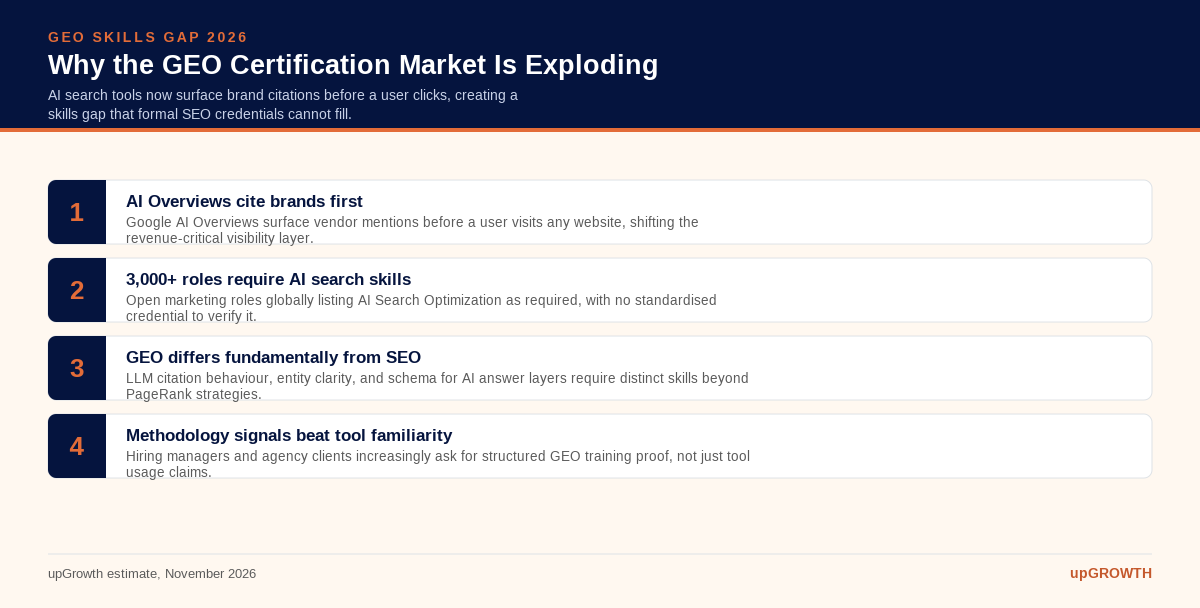
The simplest explanation: AI Overviews, ChatGPT, Perplexity, and Gemini now surface brand mentions before a user ever clicks, which means visibility in those answer layers is a revenue variable, not a vanity metric. When that becomes a board-level priority, someone always asks “who on our team knows how to do this?” and right now the honest answer at most companies is “nobody, formally.”
The skills gap is measurable. An upGrowth estimate based on LinkedIn activity in Q3 2026 suggests “AI Search Optimization” appears as a required or preferred skill in well over 3,000 open marketing roles globally, with almost no standardised credential to satisfy it. Hiring managers are listing the requirement, then struggling to verify whether a candidate actually has the skill or just attended a webinar that used the phrase.
This is where certification matters as a signal. A credential does not prove competence on its own. What it signals is methodological grounding: the holder has been exposed to a structured framework, not just a collection of blog posts. For agency clients evaluating whether to trust a GEO pitch, that signal is worth something. For internal hiring managers who cannot personally assess GEO competence, it is worth even more.
The distinction between GEO and SEO also needs to be drawn sharply here, because a lot of the confusion in the certification market comes from treating them as the same discipline with different branding. Traditional SEO targets PageRank, link authority, and click-through from blue-link results. GEO targets large language model citation behaviour, structured data interpretation, entity recognition, and authority within AI-generated answer layers. The ranking signals are different. The content architecture is different. The measurement framework is different. A course that teaches GEO well cannot simply be an SEO course with the word “generative” appended to the title.
The Honest State of GEO Certification in 2026: What Exists and What Does Not
Here is the uncomfortable truth that most content on this topic avoids: as of late 2026, no major accreditation body has issued a standalone, industry-recognised generative engine optimization certification. Not Google. Not HubSpot. Not Coursera under its own brand. The phrase “GEO certification” is currently a marketing term, not a credential category with regulated standards. That does not mean useful courses do not exist. It means you need to be precise about what you are actually buying.
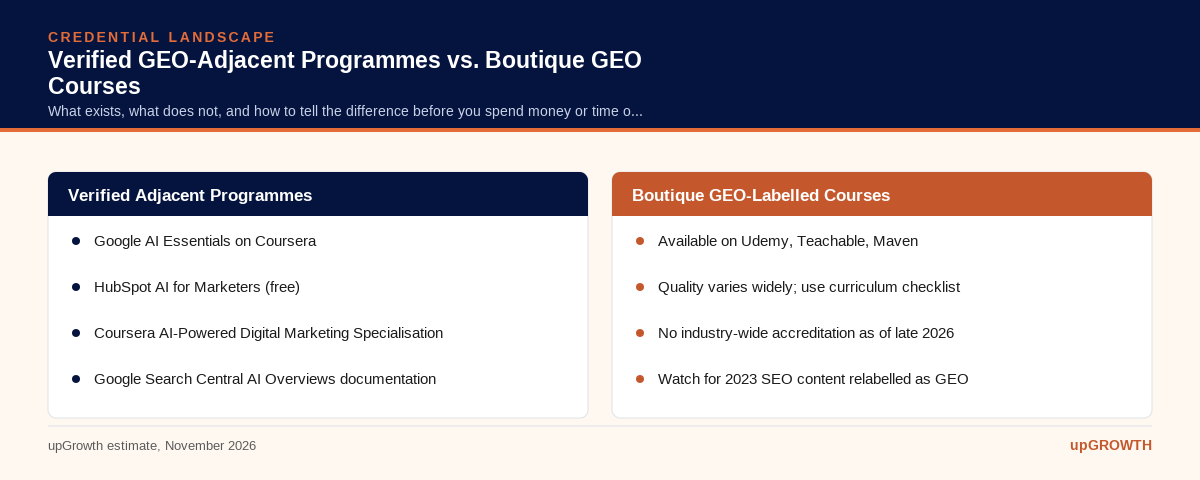
The verified, publicly accessible programmes that cover relevant GEO components are three.
Google AI Essentials, available through Coursera as part of Google Career Certificates, covers foundational AI literacy, prompt design, and responsible AI use. It does not use the term GEO, but its modules on AI-assisted content creation and search behaviour form a credible baseline. Free to audit; certificate requires subscription.
HubSpot’s AI for Marketers certification covers AI content tools, automation, and marketing applications. Again, not labelled as GEO, but the modules on content structuring for AI tools and prompt-layer marketing are directly relevant. It is free and the certificate is verifiable through HubSpot’s credential portal.
Coursera’s AI-Powered Digital Marketing Specialisation, developed in collaboration with DeepLearning.AI and partner universities, runs deepest on the technical side. It includes modules on AI search behaviour, content optimisation for AI tools, and digital campaign measurement. This is the closest thing to a structured GEO adjacent curriculum from an accredited source currently available.
Beyond these three, boutique GEO-labelled courses exist on Udemy, Teachable, and Maven. Some are genuinely good. Some are 2023-era SEO material with a new title. The vetting framework in the next section tells you exactly how to tell the difference before you pay.
The honest framing: treat this landscape as evolving. By Q1 2027, it is reasonable to expect that at least one major platform will have launched a GEO-specific track with verifiable credentials. Until then, the vetting framework below is your best tool.
Show me a GEO course that promises “rank #1 in ChatGPT” with no mention of how LLMs select citations, and I will show you a course that was written before the instructor ran a single prompt test. The red flags are specific and learnable.
Start with the curriculum checklist. A course that earns the GEO label in 2026 must cover all of the following, not just some of them: AI Overview inclusion criteria and how Google selects content for surfacing; E-E-A-T signal building in the context of LLM training data; structured data and schema for LLMs (not just legacy rich snippet purposes); entity disambiguation and knowledge graph clarity; citation-worthy content architecture; and prompt-layer keyword research that maps user intent to AI response phrasing, not just search bar queries. If a course skips two or more of these, it is incomplete for GEO purposes regardless of what the sales page claims.
Instructor credibility has three verifiable markers. First, published case studies with before/after AI Overview metrics. Screenshots, traffic data, appearance rates. Not testimonials. Second, verifiable client work or contributions to recognised publications. Search Engine Land, Search Engine Journal, and academic preprints on AI search are the reference points here. Third, evidence that the instructor understands hallucination risk and factual accuracy obligations in GEO content. Any instructor who does not discuss this is teaching a partial version of the discipline.
Practical output is non-negotiable. A good GEO course produces at least one auditable deliverable: a completed GEO content audit, an entity schema implementation, or a citation-gap analysis on a real domain. If the course ends with a multiple-choice quiz and a PDF certificate, it is testing recall, not competence.
The free-versus-paid question resolves simply. Several high-quality free modules exist inside Google Search Central documentation on AI Overviews, and these are updated continuously by Google’s own team. Paid courses justify their cost only when they offer one or more of three things: structured cohort feedback from a practitioner instructor, a verified completion credential that can be shared on LinkedIn, or a proprietary methodology that the free resources do not cover. If a paid course offers none of these, the free resources are the better investment of time.
One final red flag worth naming: courses built entirely on 2023-era SEO material relabelled as GEO. You will recognise them by the absence of anything on Share of Model tracking, AI-sourced click attribution, or the structural differences between how Google AI Overviews and ChatGPT select citations. These are not interchangeable systems, and a course that treats them as such is out of date before it starts.
Core Skills a GEO Certification Course Must Teach in 2026
The original GEO research from Princeton, available as a preprint on arXiv, identified citation frequency in LLM responses as the primary GEO metric. That paper launched the discipline’s academic framing, and the skills a credible course must teach flow directly from understanding why LLMs cite what they cite.
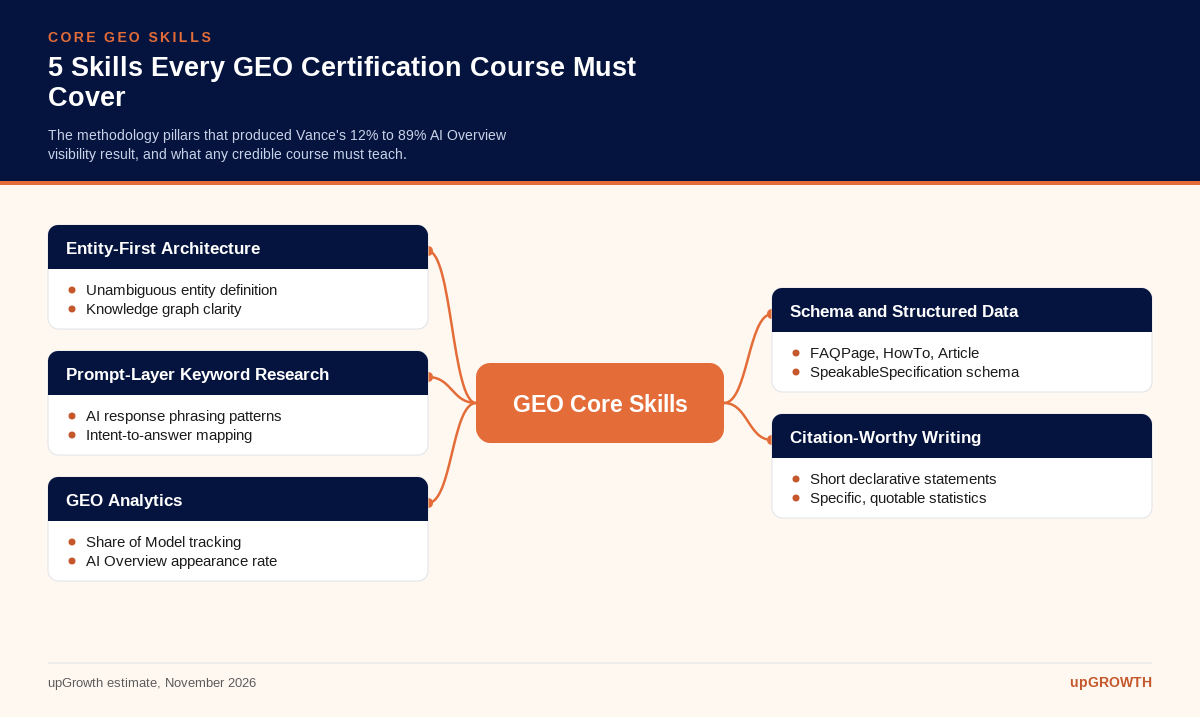
Entity-first content architecture is the foundation. LLMs build knowledge graphs internally, and they cite sources whose entities are unambiguous. A page about “payment tracking” that also discusses “remittance” and “IMPS” and “UTR numbers” as clearly defined, interlinked entities will be cited more reliably than a page about “how to track your money transfer” that uses casual language throughout. This is why Vance’s AI Overview visibility grew the way it did: entity clarity was central to the content restructuring.
Structured data and schema form the second pillar. HowTo, FAQPage, Article, and the increasingly relevant SpeakableSpecification schema types all improve the probability that an AI system will select a piece of content for inclusion in a generated answer. A course that does not teach schema implementation hands-on is leaving the most technical and highest-impact lever untouched.
Prompt-layer keyword research is where GEO diverges most sharply from traditional SEO. The goal is not to find what users type into a search bar. It is to map the phrasing patterns that AI engines use when generating responses to a category of questions. Those phrasing patterns become the content architecture. This is a different research methodology and requires different tools.
Citation-worthy writing is the content execution layer. Short declarative statements. Cited statistics. Answer-layer formatting that makes content easy for an LLM to quote verbatim. The sentence “IMPS transfers are typically processed within 30 seconds” is more citable than “IMPS transfers happen very quickly.” Specificity is not just a stylistic preference in GEO. It is a citation signal.
GEO analytics closes the loop. Tracking AI Overview appearance rate, Share of Model (a metric gaining real traction in 2026 as agencies build internal dashboards for it), and referral traffic from AI-sourced clicks using tools like BrightEdge, the Semrush AI Toolkit, and manual prompt testing across ChatGPT, Gemini, and Perplexity is the measurement framework. A course that teaches strategy without teaching measurement is teaching half the job.
upGrowth’s GEO practice uses these same pillars in client engagements. The Vance result, 12% to 89% AI Overview visibility and a 7x increase in ranking power, is the outcome of applying all five consistently, not just one or two in isolation.
Free Generative Engine Optimization Resources Worth Your Time Right Now
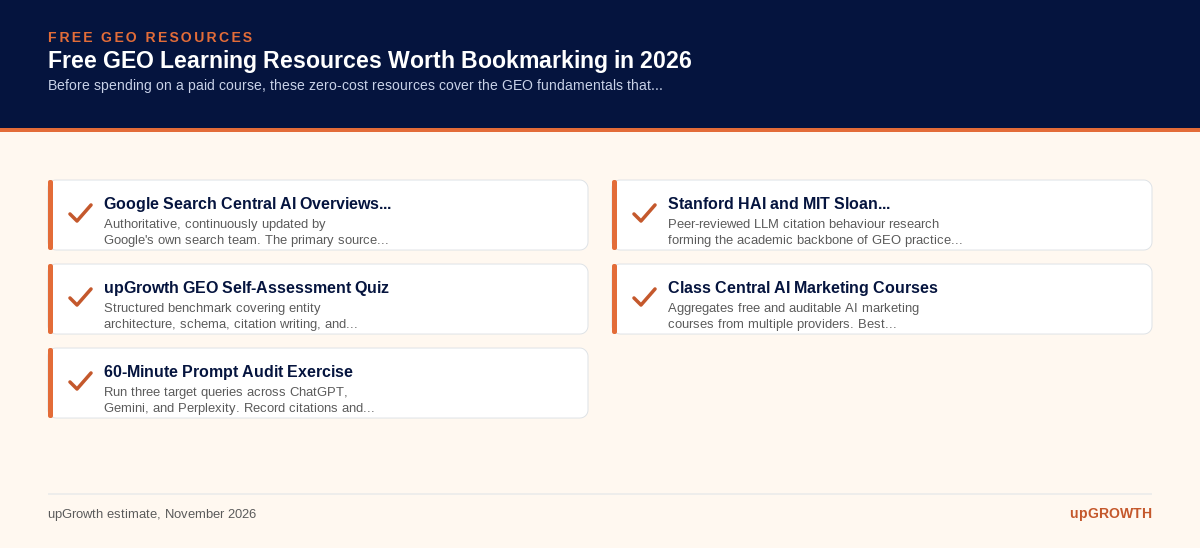
The best free GEO education available in 2026 is not a course. It is a 60-minute experiment. Pick three queries relevant to your brand or category. Run each one in ChatGPT, Gemini, and Perplexity. Record exactly which domains are cited in each response. Then open those pages and ask: what do they have structurally that your pages do not? That zero-cost audit teaches more about citation behaviour than most paid intro modules.
Beyond that exercise, four free resources are worth bookmarking. Google Search Central’s blog and documentation on AI Overviews is the primary source. It is continuously updated by Google’s own search team and is authoritative in a way no third-party course can replicate. When Google changes how AI Overviews select content, this is where the signal appears first.
Stanford HAI and MIT Sloan Management Review publish peer-reviewed articles on LLM behaviour and content citation patterns. These form the academic backbone of GEO practice and are freely accessible. They are dense, but reading two or three gives a practitioner a framework for understanding why citation decisions happen, not just what to do about them.
Class Central aggregates free and auditable AI marketing courses from multiple providers. It is the fastest way to find courses you can audit without paying for a certificate, which is the right starting point before committing to a paid programme.
Who Should Prioritise a GEO Certification Course in 2026
Not everyone needs a GEO certification in 2026. But certain roles are actively handicapped without one, and the gap is widening faster than it was twelve months ago.
SEO specialists whose clients are asking why traffic is flat despite good rankings are the most urgent case. AI Overviews are absorbing clicks that previously went to position-one organic results. The SEO-only skill set does not explain this or fix it. An SEO specialist who can also map a client’s AI Overview appearance rate and run a citation-gap analysis is a fundamentally different commercial proposition than one who cannot.
Content strategists at SaaS and fintech brands face the same urgency. These are early-adopter verticals for AI search behaviour, as upGrowth’s work with Vance in fintech and Qikink in e-commerce confirms. The users in these categories are already using AI tools in their research journeys, which means brands that are not being cited are losing consideration at the very top of the funnel.
Agency account managers who need to pitch GEO as a service line will find that a verifiable credential adds commercial credibility to that conversation. A client who is evaluating whether to invest in GEO will respond differently to “we have a certified GEO practitioner on this account” than to “we have been reading about this.” The credential does not close the deal, but it removes a friction point.
In-house brand teams at D2C and EdTech companies scaling into the GCC market should also prioritise GEO upskilling. AI search adoption in that region is accelerating alongside English-language digital media consumption, and the competitive window for establishing AI citation authority there is still open in ways it is narrowing elsewhere.
Marketing leaders who want to benchmark their team’s capability before hiring or outsourcing can use the certification vetting framework from the previous section as the basis of an internal skills audit. Run the curriculum checklist as a quiz. The gaps it reveals tell you exactly what to look for in a hire or what to scope in an external engagement.
Building a GEO Skill Set Without Waiting for the Perfect Certification
A documented AI Overview inclusion win with before/after screenshots and published methodology beats a certificate from an unverified boutique course in almost every hiring or client conversation in 2026. Proof of work is the credential the market actually trusts right now, because the market knows the certification category is immature.
The most practical path is a credential stack built from adjacent verified certifications while the GEO-specific market matures. Google AI Essentials plus HubSpot AI for Marketers plus an SEO analytics certification from an established provider creates a verifiable foundation that any hiring manager can check. It is not a GEO certification, but it signals the methodological grounding that a GEO practitioner needs, and it is honest about what it is.
Contributing to open-source GEO research builds public authority faster than any certificate. The team behind the original GEO paper from Princeton is publishing updated benchmarks. Citing and extending that work in published articles or LinkedIn posts creates the kind of original, cited content that itself improves GEO visibility. The loop is satisfying: doing GEO research makes you more cited, which proves your GEO competence, which makes clients trust you more.
Practitioner communities are the fastest-moving knowledge sources in this space. LinkedIn’s AI Search Marketers group and Slack communities focused on AI search have become genuinely useful in 2026 in a way that formal courses often are not. The practitioners sharing real citation data, real schema implementation results, and real before/after screenshots in those communities are ahead of most course curricula.
One concrete exercise that closes multiple gaps at once: offer to audit one brand’s AI Overview visibility pro bono and publish the full methodology publicly. This produces a case study, which is portfolio evidence. It produces original data, which gets cited by others. And the process of doing it forces you to master every skill in the GEO curriculum without paying for a course that might not cover them all.
Free to low (audit free, certificate requires Coursera subscription)
Self-built credential stack
Google AI Essentials + HubSpot AI + SEO analytics cert + published case study
Strong when combined with practical portfolio evidence
Partially verifiable; portfolio evidence is primary signal
Low to moderate (time investment is higher than cost)
Boutique GEO-labelled courses
Udemy, Teachable, Maven offerings labelled “GEO” or “AI SEO”
Varies widely: use curriculum checklist to vet before buying
Platform completion certificate only; not widely recognised
Rs 999 to Rs 18,000 depending on platform and instructor
Free resources only
Google Search Central docs, Stanford HAI, upGrowth GEO quiz, Class Central audit
Strong on fundamentals; weaker on structured methodology and cohort feedback
No formal credential
Rs 0
Agency-led GEO training
Workshops or embedded training from GEO-specialist agencies
Strongest on methodology; directly tied to measurable client outcomes
Depends on agency; often delivered as part of a service engagement
Moderate to high; value depends on case study track record
Common Questions About Generative Engine Optimization Certification Courses
Is there an official generative engine optimization certification in 2026?
As of late 2026, no major accreditation body has issued a standalone, industry-recognised generative engine optimization certification. What exists are adjacent AI and digital marketing certifications from Google, HubSpot, and Coursera that cover relevant modules. Boutique GEO-labelled courses are available on platforms like Udemy and Maven, but these vary widely in quality and should be vetted against a curriculum checklist before enrolment.
What should a good GEO certification course cover?
A credible generative engine optimization course should cover AI Overview inclusion criteria, entity-first content architecture, structured data and schema for LLMs, citation-worthy writing techniques, prompt-layer keyword research, and GEO-specific analytics including Share of Model tracking. Courses that focus only on traditional SEO tactics relabelled as GEO are unlikely to produce real AI search visibility gains.
Are there free generative engine optimization courses online?
Yes. Google’s AI Essentials on Coursera, Google Search Central’s AI Overviews documentation, and Stanford HAI publications are all free and cover foundational GEO concepts. upGrowth also offers a free GEO quiz at upgrowth.in/generative-engine-optimization-ai-search-quizzes/ that functions as a structured self-assessment benchmark. Class Central aggregates auditable AI marketing courses from multiple providers at no cost.
How long does it take to learn generative engine optimization?
A practitioner with an existing SEO or content strategy background can grasp GEO fundamentals in four to six weeks of structured study combined with hands-on experimentation. Building measurable AI Overview visibility, however, typically takes two to four months of consistent implementation, as upGrowth’s client work demonstrates. The discipline is evolving rapidly, so continuous learning is essential beyond any single course.
Which roles benefit most from a GEO certification or course?
SEO specialists, content strategists, digital marketing managers, and agency account executives benefit most from GEO training in 2026. SaaS and fintech professionals are particularly well-positioned to apply GEO skills immediately, given that AI search tools are heavily used in those research journeys. Marketing leaders at brands expanding into the GCC market should also prioritise GEO upskilling, as AI search adoption in that region is accelerating.
How is generative engine optimization different from SEO, and do I need both skills?
Traditional SEO targets PageRank and click-through from blue-link results. GEO targets large language model citation behaviour, structured data interpretation, and authority within AI-generated answer layers. In 2026, both skill sets are necessary: SEO drives organic traffic, while GEO ensures your brand is cited before a user even clicks. Professionals who hold both skill sets command significantly higher market value as hiring demand for AI search skills surges.
Can I build a GEO portfolio without a formal certification?
Yes, and in many cases a documented portfolio is more credible than a certificate from an unverified boutique course. Document an AI Overview inclusion win with before/after data, publish the methodology publicly, and combine adjacent verified certifications such as Google AI Essentials and HubSpot AI for Marketers into a credential stack. upGrowth’s own GEO practice is built on case study evidence, including growing Vance’s AI Overview visibility from 12% to 89%, which is the kind of proof-of-work that matters most to clients and employers.
What to Ask Next About Generative Engine Optimization Certification Courses
Readers who get this far usually ask one of these next.
How do I know my current GEO skill level?This quiz helps you assess your generative engine optimization maturity so you know exactly where to focus your learning next. GEO maturity level quiz →
What does generative engine optimization actually involve in practice?This page explains what GEO is and how to implement it, giving you a practical foundation to apply what any course teaches. what GEO is and how →
How is answer engine optimization different from GEO?This page clarifies answer engine optimization as a concept, helping you map it against GEO skills you are building. answer engine optimization explained →
Your Next Move: Get a GEO Audit From the Team That Moved a Brand From 12% to 89% AI Overview Visibility
Courses can teach you the theory. Seeing the methodology applied to your own domain in a live audit is what converts understanding into measurable AI search presence. upGrowth’s GEO team has helped fintech brands like Vance dominate AI Overviews and helped Qikink build citation authority in a competitive e-commerce category. We can run a GEO visibility audit on your domain, identify which queries your brand should be cited for but is not, and map a 90-day execution plan that your team can own internally or we can run for you.
If you are evaluating whether to invest in GEO training for your team or hand the execution to specialists, that conversation starts with understanding where your current AI search presence actually stands. Book a 30-minute strategy call and we will bring your AI Overview appearance data to the first meeting.
For Curious Minds
Generative Engine Optimization targets large language model citation behaviour and answer-layer authority rather than traditional blue-link clicks. While standard SEO focuses on PageRank and link authority, GEO restructures your digital footprint so systems like Perplexity and Google AI Overviews cite your brand before a user ever clicks a URL.
Entity-first content architecture builds unambiguous knowledge graphs that models trust.
Prompt-layer keyword research maps user intent directly to AI response phrasing patterns.
Citation-worthy writing uses short declarative statements and specific statistics.
upGrowth Digital applied this exact distinction to help Vance grow its AI Overview visibility from 12% to 89%. Mastering these mechanics ensures your brand wins top-of-funnel shortlists in an era where zero-click search dominates.
In late 2026, the term GEO certification operates as an unregulated marketing label rather than a formal credential backed by Google, HubSpot, or Coursera. Because no standardised accreditation exists yet, a certificate alone cannot prove technical competence, even though AI Search Optimization appears in over 3,000 open marketing roles globally based on Q3 2026 LinkedIn estimates by upGrowth.
It signals exposure to a structured methodological framework over scattered reading.
It gives agency account managers commercial credibility when pitching new service lines.
It helps internal hiring managers filter candidates who understand answer-layer signals.
Treating this evolving market with precision protects your training budget until official platform tracks launch by Q1 2027.
Share of Model is a foundational 2026 analytics metric that measures how frequently large language models cite your domain across specific category prompts. Because traditional rank trackers cannot see inside generative answer layers, pairing Share of Model tracking with platforms like BrightEdge and the Semrush AI Toolkit closes the attribution loop between AI mentions and revenue.
Track your exact AI Overview appearance rate across high-intent commercial queries.
Measure referral traffic originating from AI-sourced clicks across ChatGPT and Gemini.
Run manual prompt tests to benchmark your citation frequency against category competitors.
upGrowth used this complete analytics loop to move Vance from 1.8K to 5.6K in monthly organic traffic, proving that what gets measured in AI search gets compounded.
Verified adjacent programmes from Google, HubSpot, and Coursera provide recognised credentials and foundational literacy at zero to low cost, whereas boutique courses on Udemy, Teachable, and Maven cost between Rs 999 and Rs 18,000 with unverified quality. Choosing the right educational path requires weighing curriculum depth against credential verifiability.
Google AI Essentials covers prompt design and search behaviour basics for free on audit.
HubSpot AI for Marketers offers free, verifiable training on prompt-layer content structuring.
Coursera and DeepLearning.AI deliver the deepest technical modules on AI search measurement.
Evaluating boutique options against these accredited baselines prevents you from paying for repackaged 2023 SEO tactics.
Free resources like Google Search Central documentation and Stanford HAI papers deliver authoritative theory for Rs 0, while paid courses or agency workshops only justify their cost when they provide verifiable execution support. Before spending training budget, compare free self-study against the three markers that make paid programmes worthwhile.
Access to structured cohort feedback directly from a practicing GEO instructor.
A verified completion credential that hiring managers can validate on LinkedIn.
A proprietary execution methodology tied to measurable outcomes, such as upGrowth growing Vance from 12% to 89% AI Overview visibility.
Benchmarking your baseline with the free upGrowth GEO quiz helps you decide whether self-study or hands-on specialist training fits your current skill gaps.
upGrowth Digital elevated Vance from 12% to 89% visibility in Google AI Overviews and achieved a 7x increase in ranking power by applying a disciplined, five-pillar technical methodology rather than isolated content tweaks. This client engagement, which also grew monthly organic traffic from 1.8K to 5.6K, illustrates the exact competencies any valid course must impart.
Entity-first content architecture that defines interlinked concepts like IMPS and UTR numbers clearly.
Hands-on implementation of HowTo, FAQPage, Article, and SpeakableSpecification schema.
Citation-worthy writing built on specific, quotable metrics such as 30-second processing times.
Inspecting how these five pillars compound in live fintech environments gives you a proven blueprint for your own domain.
The foundational Princeton preprint on arXiv established citation frequency in LLM responses as the primary performance metric for generative search, proving that models favour specific structural patterns over traditional keyword density. Peer-reviewed publications from MIT Sloan Management Review and Stanford HAI build upon this academic backbone to explain why generative engines cite specific domains.
Models rely on internal knowledge graphs and select pages with unambiguous entity disambiguation.
Declarative sentences containing cited statistics serve as direct triggers for verbatim quoting.
Consistent methodology across entity architecture and schema drove Vance from 12% to 89% visibility in upGrowth client work.
Studying these academic preprints gives your team an enduring strategic advantage over practitioners relying on surface-level tips.
B2B buyers and consumers in fintech, SaaS, and e-commerce increasingly rely on ChatGPT and Perplexity to build vendor shortlists before ever visiting a search engine results page. upGrowth Digital engagements across Vance in fintech and Qikink in e-commerce prove that securing early citation authority captures high-intent consideration at the very top of the funnel.
Vance expanded its Google AI Overview presence from 12% to 89% through structured entity clarity.
Qikink established durable citation authority inside a highly competitive e-commerce category.
Performance-driven execution also helped Lendingkart scale conversions from 56K to 87K via Google Ads.
Examining how fast-moving verticals adapt to answer engines reveals where your own industry's buyer journey is heading next.
You can learn more about real-world citation behaviour in 60 minutes of structured prompt testing across ChatGPT, Gemini, and Perplexity than from most introductory paid modules. Pairing this zero-cost diagnostic experiment with the free self-assessment benchmark at upGrowth exposes your exact domain and skill gaps.
Select three high-intent commercial queries directly relevant to your brand category.
Run each query across ChatGPT, Gemini, and Perplexity, recording every cited domain.
Inspect the winning pages to identify structural elements, schema types, and entity definitions your pages lack.
Applying this same auditing rigor is how upGrowth helped Vance jump from 12% to 89% AI Overview visibility, giving you an immediate starting point for internal execution.
Because hiring managers for over 3,000 open marketing roles know the certification market is still maturing, a documented proof-of-work portfolio paired with verified adjacent credentials carries the highest commercial weight. You can build an auditable GEO skill profile in four to six weeks of study and two to four months of implementation.
Complete Google AI Essentials, HubSpot AI for Marketers, and an established SEO analytics certification.
Audit a brand's AI Overview visibility pro bono and implement entity schema and citation restructuring.
Publish the full methodology with before-and-after metrics, mirroring how upGrowth documented Vance growing from 12% to 89% visibility, and share findings in LinkedIn's AI Search Marketers group.
Executing this self-built loop turns your public research into cited authority that attracts clients directly.
Waiting until Q1 2027 for major platforms to launch regulated GEO tracks leaves your brand invisible during a critical window of buyer migration toward answer engines. With upGrowth estimating over 3,000 open roles demanding AI Search Optimization in Q3 2026, marketing leaders must replace passive credential filtering with active competency benchmarking.
Use the six-part curriculum checklist as an internal skills audit across your current team.
Test candidates using the free upGrowth GEO quiz to verify their grasp of schema and entity architecture.
Require portfolio evidence showing real appearance rate gains, similar to Vance reaching 89% visibility from 12%.
Adopting this verification standard ensures you hire or outsource to practitioners who drive measurable revenue rather than webinar attendees.
AI search adoption across the GCC market is accelerating alongside English-language digital media consumption, creating an open competitive window to establish first-mover citation authority before category leaders lock in model preference. D2C and EdTech teams that master GEO mechanics now can secure top-of-funnel visibility at a fraction of future customer acquisition costs.
Train content teams on entity disambiguation so regional queries map cleanly to your brand.
Deploy SpeakableSpecification and FAQPage schema to capture multi-modal answer layers.
Follow the upGrowth execution model that drove a 7x ranking power increase and 89% AI Overview visibility for Vance.
Moving before regional competitors formalise their AI search capabilities turns early educational investment into compounding market share.
Amol has helped catalyse business growth with his strategic & data-driven methodologies. With a decade of experience in the field of marketing, he has donned multiple hats, from channel optimization, data analytics and creative brand positioning to growth engineering and sales.
Your buyers ask AI before they search. Run AI Answer Gap and see whether ChatGPT, Perplexity, Gemini and Google AI Overviews name your brand for the questions that matter in your category.