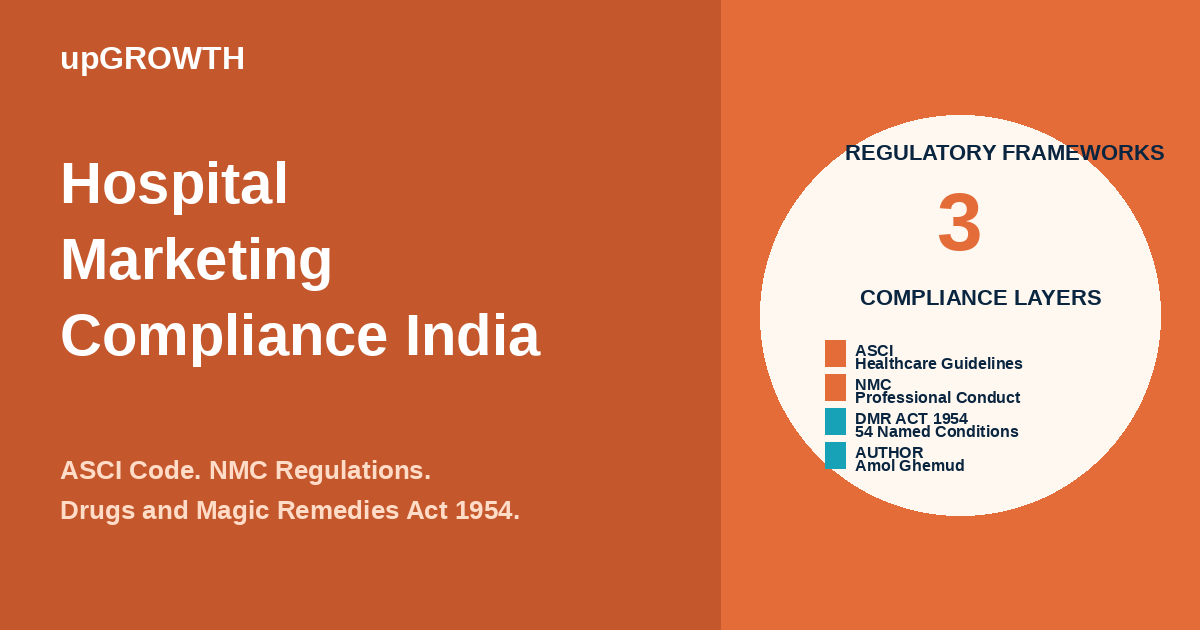
Indian hospital marketing compliance sits at the intersection of three regulators: the Advertising Standards Council of India (ASCI), the National Medical Commission (NMC), and the Drugs and Magic Remedies (Objectionable Advertisements) Act 1954. Hospital chain CMOs who run superlative claims, individual doctor promotion creatives, or outcome promises without documentary evidence are not marketing aggressively. They are building their own regulatory case file. This guide walks through the three compliance signs, the safe formulations that replace them, and the compliance layer architecture senior healthcare marketing agencies use to protect hospital brands.
In This Article
Share On:
Disclaimer: This article is general educational guidance for hospital marketing leaders in India. It is not legal advice. Specific creative reviews, ASCI complaint responses, and regulatory filings require qualified legal counsel and, where relevant, consultation with the hospital’s medical superintendent. Regulations referenced here are current as of April 2026. Hospitals should verify the latest amendments to the ASCI Code, NMC regulations, and the Drugs and Magic Remedies Act 1954 before finalising campaigns.
A hospital chain marketing head showed me her agency’s latest campaign draft last month. The copy read “India’s best cardiac outcomes, 99.2 percent success rate, trusted by 5 lakh patients.” Every single phrase in that sentence violates ASCI healthcare guidelines. Her agency had run 14 campaigns like that over 18 months. The chain had no idea it was sitting on a regulatory landmine that could wipe out a year of brand building in a single ASCI Consumer Complaints Council hearing.
Hospital chains across Mumbai, Delhi, Bengaluru, Chennai, Hyderabad, Pune and Kolkata are running Meta Ads, Google Ads, billboards and landing pages today with language that violates the ASCI Code for Self-Regulation, the NMC Professional Conduct Regulations 2002, the National Medical Commission Registered Medical Practitioner Regulations 2023, and the Drugs and Magic Remedies (Objectionable Advertisements) Act 1954. Most of the violations come from marketing agencies that treat healthcare like an e-commerce category, without understanding that the regulatory posture in Indian healthcare advertising is closer to pharma than to D2C.
At upGrowth Digital, we audit healthcare marketing assets for hospital chains before any GEO campaign work starts. In almost every audit we have run for multi-specialty chains in the past 24 months, at least 40 percent of the live creative has one or more compliance risk flags. That is a structural gap in how Indian hospital marketing is staffed, briefed and approved.
The Three Regulatory Bodies Governing Hospital Marketing in India
Hospital marketing in India is not governed by a single regulator. It sits under a triangle of overlapping authorities, each with its own scope, enforcement mechanism and penalty structure. A hospital CMO who understands only ASCI, or only NMC, or only the Drugs and Magic Remedies Act 1954, has a two-thirds blind spot. The compliance gaps tend to open exactly where two regulators overlap, like doctor promotion under both NMC and ASCI, or cure claims under both ASCI and the Drugs and Magic Remedies Act 1954.
Regulator one: Advertising Standards Council of India (ASCI). ASCI is a self-regulatory organisation that administers the ASCI Code for Self-Regulation of Advertising Content in India. While ASCI is not a statutory body, its rulings are treated as de facto enforcement because the Ministry of Information and Broadcasting, the Consumer Protection Authority, and most large digital platforms rely on ASCI’s Consumer Complaints Council decisions. For healthcare specifically, ASCI issued the Healthcare Guidelines in 2023 and updated them with additional provisions in 2024, covering superlative claims, comparative advertising, efficacy representations and treatment promise language.
Regulator two: National Medical Commission (NMC). NMC regulates the conduct of registered medical practitioners in India under the National Medical Commission Act 2019. The relevant advertising provisions sit in the NMC Professional Conduct Regulations 2002 (inherited from the old Medical Council of India and still operative on key clauses) and the National Medical Commission Registered Medical Practitioner Regulations 2023. These regulations restrict how individual doctors can be featured in advertisements, what they can claim about their own practice, and what constitutes prohibited solicitation of patients.
Regulator three: Drugs and Magic Remedies (Objectionable Advertisements) Act 1954. This central law, administered through the Ministry of Health and Family Welfare with enforcement support from state drug control authorities, prohibits advertising that claims to diagnose, cure, mitigate, treat or prevent a schedule of 54 named diseases and conditions. The Act is older than most hospital chains operating today, yet it remains the hammer ASCI and consumer courts use to strike down cure claims, reversal programs and miracle recovery creatives in healthcare advertising.
How they interact. A single creative, like a billboard for a cardiac hospital, can attract scrutiny from all three regulators simultaneously. ASCI evaluates the “best” language. NMC evaluates the cardiologist’s face shot and direct CTA. The Drugs and Magic Remedies Act 1954 evaluates any outcome claim touching its schedule of 54 conditions. Agencies that run creative through only one filter leave the other two exposed.
ASCI Code for Self-Regulation and ASCI Healthcare Guidelines 2023 to 2024: What Hospital Chains Must Know
The ASCI Code for Self-Regulation is the primary reference document for Indian hospital advertising. On top of this base Code, ASCI issued Healthcare Guidelines in 2023 and a further updated set in 2024, specifically addressing hospital chains, diagnostic centres, telemedicine platforms and aesthetic clinics.
Every superlative claim in hospital advertising needs documentary evidence or recognised third-party validation under ASCI Code Chapter 1.1, read alongside the ASCI Healthcare Guidelines 2023. Words like “best,” “number one,” “leading,” “top rated,” “most advanced,” “most trusted” and “India’s first” require a verifiable source, and a Justdial or Google Maps rating count is not a verifiable source for hospital marketing purposes.
The ASCI Healthcare Guidelines 2023 added specific rules around comparative advertising. A hospital cannot compare itself to a named competitor on outcomes without peer-reviewed data or audited clinical data, and cannot use language like “better than leading hospitals” without defining the comparison set. The ASCI Healthcare Guidelines 2024 update tightened this further by explicitly prohibiting aesthetic and elective procedure advertising that shows before-after imagery without qualifying disclosures about results variability, medical supervision and contraindications.
For hospital chain CMOs, the practical implication is this. If your agency has not been briefed on ASCI Healthcare Guidelines 2023 and 2024, your creative pipeline is almost certainly generating non-compliant assets. The ASCI Consumer Complaints Council does not accept ignorance as a defence. Rulings enter the public ASCI database that any competitor, journalist or disgruntled patient can reference for years. Once a hospital brand has two or three upheld ASCI complaints on its record, subsequent campaigns attract heightened scrutiny and the brand loses the ability to run legitimate comparative campaigns later.
Hospital Compliance Blueprint
Page 1 / –
StartSlide ControlFinish
Sign One: Superlatives Without Documentary Evidence (Best, Number One, Leading, Most Trusted)
The first and most common compliance failure in Indian hospital marketing is the superlative claim without documentary evidence. Under the ASCI Code for Self-Regulation Chapter 1.1 and the ASCI Healthcare Guidelines 2023, claims like “best cardiac hospital in Pune,” “number one oncology centre in South India,” “leading fertility chain,” or “most trusted hospital in Gujarat” require a verifiable, cited third-party certification or published ranking from a recognised body.
Non-compliant example. “India’s best cardiac outcomes. 99.2 percent success rate. Trusted by 5 lakh patients.” “India’s best” is a superlative without documentary evidence. “99.2 percent success rate” is an outcome claim without peer-reviewed or audited source data. “Trusted by 5 lakh patients” is a volume claim that implies endorsement without defining what “trusted” measures.
Safe formulation example. “Accredited by NABH. Over 12,000 angioplasties performed at our cardiac centres across Maharashtra since 2015. Average door-to-balloon time of 47 minutes, as reported in our 2024 clinical audit published on our hospital’s clinical outcomes portal.” This sentence has three verifiable claims, each with an attributable source. NABH accreditation is a National Accreditation Board for Hospitals and Healthcare Providers certification that is verifiable on the QCI website. The volume figure is a count from the hospital’s own surgical records. The door-to-balloon time references a dated, published clinical audit. ASCI cannot sustain a complaint against this formulation, because the evidentiary backbone is intact.
The rule of thumb for CMOs is this. Before any creative goes live, ask your agency to produce the evidence document for every superlative, quantitative or comparative claim. If the evidence document does not exist, the claim needs to come out. Hospital chains often push back because competitors run similar claims. That is not a defence under the ASCI Code. The Consumer Complaints Council evaluates each complaint on its own merit against the Code, not against industry practice. A competitor getting away with non-compliant claims today is a pending complaint that has not been filed yet.
Sign Two: Individual Doctor Promotion Under NMC Professional Conduct Regulations 2002 and 2023
The second compliance failure is individual doctor promotion that crosses into solicitation. The NMC Professional Conduct Regulations 2002, carried forward and supplemented by the National Medical Commission Registered Medical Practitioner Regulations 2023, prohibit registered medical practitioners from soliciting patients directly or indirectly through advertisements. This includes paid creatives that feature the doctor’s face, name and qualifications alongside a direct response call to action like “Book your consultation” or “Call now for appointment.”
The distinction that matters is between informing and soliciting. Informing the public that a hospital has a cardiology department with NMC-registered specialists is permitted. Running a Meta Ads creative with Dr Sharma’s face, full credentials, a cardiac hospital logo, and a “Book now” button is individual doctor solicitation, which the NMC regulations prohibit.
Non-compliant example. A billboard showing Dr Ramesh Gupta, MBBS MD DM Cardiology, with his face, the hospital name, a phone number, and the headline “Trusted cardiac care, book your consultation today.” This creative puts the individual doctor in the foreground as a direct response asset, which the NMC Professional Conduct Regulations 2002 and the NMC Registered Medical Practitioner Regulations 2023 treat as prohibited solicitation.
Safe formulation example. A billboard showing the hospital’s cardiology department branding, without any individual doctor face shot, with the headline “Our cardiology department. NMC-registered specialists. 22 years average experience. NABH-accredited cardiac care.” The doctors are referenced as a team with a credential profile, not as individuals with face shots and direct CTAs. The hospital is the advertiser. The department is the service. The individual doctor is not turned into a direct response creative.
The 2023 NMC regulations extended this reasoning into the digital space explicitly. Doctor-led YouTube channels, Instagram reels, and paid LinkedIn posts that feature the doctor making treatment claims or inviting direct consultation booking attract the same solicitation scrutiny as traditional billboards. Hospital chains that push individual doctors into content marketing without a governance framework are creating regulatory exposure for both the hospital and the doctor’s individual medical registration.
The safer content strategy is to use doctors as educators within a hospital-branded content property, with no direct booking CTA attached to the doctor’s personal presence. The moment a direct booking CTA attaches to the doctor’s face, the creative crosses the solicitation line. The governance rule is simple. The hospital brand can make direct response asks. The department brand can make direct response asks. The individual doctor cannot be turned into a direct response asset in any paid or organic creative.
Sign Three: Outcome Claims, Cure Promises and the Drugs and Magic Remedies Objectionable Advertisements Act 1954
The third compliance failure is the outcome claim, cure promise or specific recovery timeline. The Drugs and Magic Remedies (Objectionable Advertisements) Act 1954, despite being over seven decades old, remains the primary statutory hammer against cure claims in Indian hospital advertising. The Act prohibits advertising that claims to diagnose, cure, mitigate, treat or prevent a schedule of 54 named diseases and conditions, including cancer, diabetes, epilepsy, glaucoma, hypertension, leucoderma, obesity, sexual impotence, tuberculosis, mental illness, heart disease, kidney disease, and several other categories.
Any creative in Indian hospital marketing that uses words like “cure,” “reversal,” “permanent solution,” “guaranteed recovery,” or “eliminate completely” for any of the 54 named conditions under the Drugs and Magic Remedies Act 1954 is a prima facie violation. The Act does not require proof of patient harm. The violation is in the advertising claim itself, not in whether the treatment actually worked for any specific patient.
Non-compliant examples. “Diabetes reversal program, guaranteed results in 90 days.” “Cancer-free in six months with our proprietary protocol.” “Permanent cure for hypertension through our integrated medicine approach.” “Guaranteed fertility success.” Each of these creatives touches one or more of the 54 named conditions with a cure, reversal or guarantee claim, and each is a direct violation of the Drugs and Magic Remedies Act 1954.
Safe formulation examples. “Our integrated diabetes care program focuses on glycaemic control, lifestyle modification and medication optimisation under the supervision of MD-qualified endocrinologists. Outcomes vary by patient profile and adherence.” “Our oncology department offers evidence-based cancer treatment protocols including surgical, medical and radiation oncology, delivered by a multidisciplinary tumour board. Treatment plans and outcomes are individual to each patient’s diagnosis and stage.” These formulations describe the service and the clinical approach without promising cures, reversals or specific recovery timelines.
Beyond the Drugs and Magic Remedies Act 1954, the ASCI Healthcare Guidelines 2023 and 2024 require that any comparative efficacy claim, success rate percentage or recovery timeline must be supported by peer-reviewed published data or the hospital’s own audited outcome report. Stock photography, testimonial creatives, and “typical results may vary” disclaimers do not meet this evidentiary bar under the current ASCI Healthcare Guidelines.
If a hospital chain wants to publish outcome data, the defensible path is to commission a clinical audit, publish it on the hospital’s clinical outcomes page with a date and methodology section, and reference it by citation in marketing creatives. Agencies that run “60 percent success rate” or “98 percent patient satisfaction” creatives without citing peer-reviewed literature or audited clinical data are not taking creative liberties. They are building the hospital’s ASCI case file for them.
What Senior Healthcare Marketing Agencies Do Differently: The Compliance Layer Architecture
Senior healthcare marketing agencies that serve hospital chains in India do not treat compliance as a finishing polish. They treat it as an architectural layer that sits between the creative team and the hospital brand, catching violations before they go live rather than after they draw complaints.
The compliance layer architecture has five components, each of which closes a specific category of risk.
Component one: the pre-creative briefing filter. Every brief passes through a compliance filter before it hits the creative team. If the brief asks for “aggressive campaign to beat Apollo on Meta Ads” or “guarantee success positioning for fertility funnel,” the filter rewrites the brief into a defensible format before any creative work begins. This is the cheapest point to catch a compliance problem.
Component two: the live claims register. The agency maintains a living document that records every factual, quantitative or comparative claim the hospital has made across all current creatives, the source document that supports each claim, the date the source was verified, and the creative assets where the claim appears. When a new claim is proposed, the register either returns the existing evidence document or flags that a new evidence document needs to be commissioned before the claim can be used.
Component three: the three-filter creative review. Every creative asset, before it goes to the hospital for final sign-off, runs through three parallel filters. Filter one checks against the ASCI Code for Self-Regulation and ASCI Healthcare Guidelines 2023 and 2024. Filter two checks against the NMC Professional Conduct Regulations 2002 and the NMC Registered Medical Practitioner Regulations 2023. Filter three checks against the Drugs and Magic Remedies (Objectionable Advertisements) Act 1954 and its schedule of 54 named conditions. An asset that fails any filter goes back to the creative team with a specific regulation reference, not a vague “make it softer” note.
Component four: the proactive ASCI engagement path. When the hospital has a novel claim format, a first-of-its-kind procedure announcement, or a comparative study to publish, senior agencies write to ASCI proactively for pre-clearance rather than waiting for a complaint. This inverts the usual dynamic. Instead of ASCI being a regulator the hospital hopes to avoid, ASCI becomes a pre-publication advisor, and the hospital carries a paper trail of good-faith engagement that insulates the brand if a complaint later lands.
Component five: the complaint response playbook. When an ASCI notice does land, senior agencies have a 7-day response playbook ready, with a template response structure, pre-identified legal counsel for healthcare advertising disputes, and an evidence pull process that surfaces the claims register entry for the cited creative within hours, not weeks. Hospitals that scramble for four weeks when an ASCI notice lands usually end up with an upheld complaint, because they miss the response window.
At upGrowth, we stopped taking healthcare briefs where the hospital wanted us to “just run aggressive Meta ads like the others.” A Punjab kidney transplant hospital brief that asked for “Punjab’s best kidney transplant hospital, 99 percent success” campaign did not become a client last quarter. The annual retainer was real money. The compliance exposure was larger.
Building a Living Claims Register for Your Hospital Marketing Stack
The single highest-leverage artefact a hospital chain can build to protect its marketing from regulatory risk is a living claims register. Most hospital marketing teams do not have one. Most agencies do not maintain one on their behalf. The absence of a claims register is the reason most hospitals cannot respond to ASCI notices within the 7-day window.
A living claims register is a single document, maintained centrally, that records every factual claim the hospital makes across its marketing footprint. The register has eight fields per claim. The claim text. The creative asset identifier and channel. The date the claim went live. The regulatory framework it operates under, meaning ASCI Code, ASCI Healthcare Guidelines 2023 or 2024, NMC regulations, or the Drugs and Magic Remedies Act 1954. The evidence document supporting the claim. The date the evidence was last verified. The internal owner. The expiry date after which the claim needs re-verification.
Building the register for the first time is usually a two to four week exercise for a mid-sized hospital chain with 200 to 400 live creatives. The exercise always surfaces claims that no one on the current team can source, which is itself the most valuable output of the audit.
Once the register exists, it feeds three downstream workflows. Pre-publication review gets faster because the claims library is pre-verified. ASCI complaint response gets faster because the evidence document is one click away. Campaign scaling gets faster because proven, evidenced claims can be recombined into new creatives without restarting the verification cycle.
The Compliance Pre-Flight Checklist for Every Hospital Marketing Asset
Before any hospital marketing asset goes live in India, it should pass a pre-flight checklist that covers the three regulatory frameworks in sequence. Hospital chain CMOs can hand this checklist to agencies, internal creative teams, and performance marketing partners as a minimum bar.
ASCI Code and Healthcare Guidelines check. Has every superlative been removed or replaced with a cited third-party certification? Has every quantitative claim been matched to a peer-reviewed source or internal audit document, with the date of the source visible? Has every comparative claim been evaluated against the ASCI Healthcare Guidelines 2023 and 2024 rules on defined comparison sets? Has every before-after image been evaluated for the 2024 disclosure requirements on results variability and medical supervision?
NMC Professional Conduct check. Does the creative turn any individual doctor into a direct response asset with face, credentials and CTA? Does the creative feature doctor testimonials about specific treatment outcomes? Does the creative use any doctor’s personal social channel to solicit consultation bookings? If the answer to any of these is yes, the creative needs to be reformulated as department-level or hospital-level branding rather than individual doctor promotion.
Drugs and Magic Remedies Act 1954 check. Does the creative use the words cure, reversal, permanent, guaranteed or eliminate in connection with any of the 54 named conditions? Does the creative imply a specific recovery timeline for a named condition without a qualifying peer-reviewed source? Does the creative promise diagnostic certainty, treatment success or prevention outcomes without a medical context? Any yes here is a non-starter.
Evidence document trail. For every claim in the final creative, is there a verifiable evidence document in the living claims register? If the answer is no for any claim, either the evidence needs to be commissioned before the creative goes live, or the claim needs to come out of the creative.
Disclaimer and attribution layer. Does the creative carry the required disclaimers where applicable, including the results variability disclaimer for before-after imagery, the medical supervision disclaimer for outcome references, and the clinical audit citation for any internal outcome data?
A creative that passes all five sections of this pre-flight checklist is publication-ready under current Indian healthcare advertising regulations as of 2026. A creative that fails any one section needs to go back for reformulation before publication.
Indian Hospital Marketing Regulatory Frameworks and Compliance Requirements
Regulatory Body
Governing Regulations
Prohibited Actions and Claims
Advertising Standards Council of India (ASCI)
ASCI Code for Self-Regulation, ASCI Healthcare Guidelines 2023 and 2024
Superlative claims without documentary evidence (e.g., “best”, “number one”), comparative advertising without peer-reviewed data, and before-after imagery without specific variability disclosures.
National Medical Commission (NMC)
NMC Professional Conduct Regulations 2002, NMC Registered Medical Practitioner Regulations 2023
Individual doctor solicitation involving face shots and credentials paired with direct response calls-to-action (e.g., “Book now”), and doctor-led promotional reels or posts that invite direct bookings.
Ministry of Health and Family Welfare / State Drug Control
Drugs and Magic Remedies (Objectionable Advertisements) Act 1954
Claims to diagnose, cure, mitigate, treat, or prevent a schedule of 54 named diseases (e.g., cancer, diabetes, heart disease); use of terms like “guaranteed results”, “reversal”, or “permanent cure”.
Healthcare Regulation
ASCI & NMC Compliance Guide
Hospital Marketing: The Ethics of Growth
A strategic framework for Indian healthcare providers to scale patient acquisition while staying 100% compliant with new regulations.
NMC Prohibitions
No Guarantees of CureHospitals cannot promise 100% success rates or “guaranteed results” in any surgery or treatment.
Soliciting RestrictionsDirectly inviting patients through incentive-based “referral fees” or aggressive canvassing is strictly prohibited.
ASCI Honesty Code
Superlative SubstantiationClaims like “Best Hospital” or “India’s No. 1” must be backed by current, independent third-party data.
Endorsement ClarityPatient testimonials must be genuine and represent typical results, not exceptional “miracle” cases.
Compliant Education
Awareness over SellingShift focus from “Buy our package” to “Understand these symptoms.” Educational content is safer and builds trust.
Doctor Led ContentExpert videos on procedure details and post-op care are compliant and improve patient journey.
Risk Mitigation
The 10% Disclaimer RuleMandatory health warnings and disclaimers must be legible (at least 10% of the ad area).
NMC ID DisplayAll doctor profiles and marketing materials must clearly display the State/National Medical Council registration number.
Marketing in healthcare is about Information, not Persuasion. Ethical growth is the only sustainable strategy.
Common Questions About Hospital Marketing Compliance in India
Q: Is ASCI a statutory body that can legally penalise my hospital?
A: ASCI is a self-regulatory organisation, not a statutory body. It does not impose direct monetary penalties. However, its Consumer Complaints Council rulings are treated as de facto enforcement because the Ministry of Information and Broadcasting, the Consumer Protection Authority under the Consumer Protection Act 2019, and major digital ad platforms use ASCI rulings as a reference for takedowns, regulatory action and complaint patterns. An upheld ASCI complaint also becomes a public record that competitors, journalists and legal counsel can reference for years.
Q: Can my hospital advertise a doctor’s name and qualifications at all?
A: Yes, within limits. The NMC Professional Conduct Regulations 2002 and the National Medical Commission Registered Medical Practitioner Regulations 2023 permit hospitals to inform the public about a doctor’s availability, specialisation and qualifications in a factual manner. What is prohibited is turning the individual doctor into a direct response asset with their face, credentials and a booking CTA in a paid creative. Department-level branding referencing “NMC-registered cardiologists with 22 years average experience” is generally defensible. Billboard creatives with Dr Sharma’s face and “Book your consultation” are not.
Q: What are the 54 named conditions under the Drugs and Magic Remedies Act 1954?
A: The Schedule to the Drugs and Magic Remedies (Objectionable Advertisements) Act 1954 lists 54 diseases and conditions for which advertising cure, treatment, mitigation or prevention claims is prohibited. The list includes cancer, diabetes mellitus, epilepsy, glaucoma, hypertension, leucoderma, obesity, sexual impotence, tuberculosis, mental illness, heart disease, kidney disease, appendicitis, cataract, deafness, female disorders, gall stones, goitre, and several others. Hospital chain CMOs should treat any creative that touches this list with heightened scrutiny, and should maintain an internal copy of the current Schedule as a reference document.
Q: How do I run an internal compliance audit on my last 12 months of hospital marketing assets?
A: Pull every live and recent creative across Meta Ads, Google Ads, YouTube, landing pages, billboards, print and radio. Search for the trigger words best, number one, leading, most trusted, guaranteed, cure, reversal and success rate. Flag every creative that contains any of these words. For each flagged creative, check whether an evidence document exists for the specific claim. Creatives with trigger words and no evidence document are your ASCI risk register. This audit typically takes two to four weeks for a mid-sized hospital chain and surfaces 30 to 50 percent of live creatives as needing review or reformulation.
Q: Can I use patient testimonials in hospital marketing?
A: Patient testimonials are a heightened-risk category. The ASCI Healthcare Guidelines require that testimonial creatives carry results variability disclosures, medical supervision context and, for any quantitative outcome claim within the testimonial, evidentiary backing. Testimonials that imply treatment outcomes for any of the 54 conditions under the Drugs and Magic Remedies Act 1954 are particularly exposed. The defensible formulation is usually qualitative testimonial focused on care experience, with no specific outcome claim, accompanied by the appropriate disclosures.
Q: What happens when an ASCI complaint is filed against my hospital?
A: ASCI notifies the advertiser, typically the hospital, of the complaint and requests a response within a specified window, usually 7 to 10 working days. The Consumer Complaints Council then reviews the creative, the complaint, and the advertiser’s response. A ruling is issued, which can be upheld, not upheld, or require modification. Upheld complaints enter the public ASCI database. Hospitals without a pre-built claims register typically cannot meet the response window, which often leads to adverse rulings by default.
Q: Does the Drugs and Magic Remedies Act 1954 apply to digital advertising and social media?
A: Yes. The Drugs and Magic Remedies (Objectionable Advertisements) Act 1954 applies to advertising in any medium, including digital platforms, social media creatives, YouTube videos, Instagram reels, paid LinkedIn posts and influencer content commissioned by the hospital. The medium does not change the regulatory exposure. A YouTube creative claiming “diabetes reversal in 90 days” carries the same Drugs and Magic Remedies Act 1954 exposure as a print advertisement with the same claim.
Indian Hospital Marketing: ASCI & NMC Compliance Guide
0 of 8 compliance pillars explored0%
NMC Restrictions
No “Guaranteed”
Comparative Ads
Surrogate Ads
Patient Privacy
Influencer Disclosure
Scientific Proof
Fee Transparency
Your Next Move: Run a Compliance Audit on Your Last 12 Months of Hospital Marketing Assets
If you are a hospital chain CMO, a marketing head at a multi-specialty hospital, or a single-specialty clinic group owner, the next move is not a new campaign. It is a compliance audit on the campaigns that are already live.
Pull every creative from your Meta Ads, Google Ads, YouTube, landing pages, billboards and print inventory for the last 12 months. Search for the trigger words best, number one, leading, most trusted, guaranteed, cure, reversal, success rate, 99 percent and permanent. Every creative containing any of these words goes into a flagged list. For each flagged creative, document whether an evidence source exists and whether it meets the ASCI Healthcare Guidelines 2023 and 2024 standard.
The output of this audit is your ASCI risk register. It tells you how much regulatory exposure your hospital brand is carrying right now, which claims need evidence commissioned, and which creatives need to be taken down or reformulated. Hospitals that run this audit before an ASCI complaint lands move from reactive to proactive posture.
At upGrowth, we run compliance audits for hospital chains as a paid discovery engagement before any healthcare GEO retainer begins. The output includes the full claims register, the ASCI risk flag list, the NMC doctor-solicitation flag list, and the Drugs and Magic Remedies Act 1954 exposure list.
A hospital CMO must grasp the interplay between regulators because compliance gaps often appear where their scopes intersect. Focusing only on ASCI leaves you exposed to the National Medical Commission (NMC) on doctor promotions and the Drugs and Magic Remedies Act on cure claims. This fragmented view creates a false sense of security while accumulating risk. A successful strategy requires an integrated compliance framework that addresses all three authorities simultaneously.
Advertising Standards Council of India (ASCI): Governs advertising content and claims through its self-regulatory code, which is widely enforced.
National Medical Commission (NMC): Regulates professional conduct for doctors, including their participation in advertising.
Drugs and Magic Remedies Act, 1954: Prohibits advertisements for cures of specific diseases and conditions.
Failing to navigate this triangle can lead to fines and reputational damage. The full guide explains how these bodies interact and where the most dangerous overlaps occur.
ASCI functions as the de facto authority on advertising content, and its rulings are enforced by government bodies and major platforms. While not a statutory body itself, its Consumer Complaints Council decisions are respected by the Ministry of Information and Broadcasting and the Consumer Protection Authority, making its code binding in practice. For hospitals, this means violating the ASCI code is equivalent to inviting direct regulatory action. The guidelines updated in 2024 are particularly strict on superlative claims, efficacy representations, and promises of treatment success, as seen in the "99.2 percent success rate" example. Adherence to ASCI's code is not optional; it is the first line of defense in maintaining brand reputation and avoiding legal challenges. Discover how to align your creative strategy with ASCI's specific healthcare provisions by reading further.
The Drugs and Magic Remedies Act 1954 serves as a foundational pillar of healthcare advertising ethics by prohibiting any promotion that claims to cure or treat a specific list of diseases and conditions. This law directly impacts hospital marketing by making promises of a definitive "cure" for ailments like cancer, diabetes, or heart disease illegal in advertisements. For digital campaigns, this means your landing page copy, ad creatives, and video testimonials must be carefully worded to avoid any language that suggests a guaranteed outcome or magical remedy. Violations can lead to severe legal penalties, far beyond what ASCI might impose. As audits from firms like upGrowth Digital show, many agencies overlook this act, exposing their hospital clients to significant legal risk. Learn the exact list of prohibited conditions and how to craft compliant messaging in our detailed analysis.
A compliant message focuses on the institution's capabilities, while a high-risk one makes unsubstantiated promises. A safe approach highlights the hospital's advanced technology, the cardiac team's collective experience, and patient care protocols. In contrast, an aggressive campaign might use phrases like "India's best cardiac outcomes" or feature a single doctor with superlative titles, directly violating ASCI and NMC rules. The key is shifting from individualistic, outcome-based claims to institutional, process-oriented communication. For example, instead of a "99.2 percent success rate," talk about your JCI accreditation or the volume of successful procedures performed by the department. This builds trust without creating the kind of regulatory landmine that could wipe out a year of brand-building. The full article provides specific, compliant copy formulations for sensitive specialities.
This claim is a major violation because it is a superlative promise of a treatment outcome, which is heavily scrutinized by ASCI. According to the ASCI Code, any such claim must be substantiated with irrefutable, independent, and verifiable evidence from a recognized source. To be compliant, a hospital would need to provide:
Robust, peer-reviewed clinical trial data that is specific to its patient population and protocols.
An independent third-party audit from a reputable authority confirming the statistical validity of the 99.2 percent figure across a significant sample size.
Clear context and disclaimers explaining the conditions under which this success rate was achieved, without guaranteeing it for future patients.
Because obtaining such proof is nearly impossible for a general marketing claim, making these specific statistical promises is almost always non-compliant. The full guide details the evidence standards required for any data-driven claims.
The high rate of non-compliant creative is driven by common mistakes that treat healthcare like a consumer product. Based on audits conducted by firms like upGrowth Digital, some of the most frequent violations on digital platforms include:
Superlative and Best-in-Class Claims: Using phrases like "Best Cancer Hospital in Delhi" or "Most Advanced Knee Replacement" without independent, verifiable data.
Individual Doctor Promotion: Running ads that feature a single doctor's name or photograph, which violates NMC regulations against soliciting patients.
Unsubstantiated Outcome Promises: Advertising copy that implies or guarantees a cure, such as "Get rid of your back pain forever."
Misleading Patient Testimonials: Using testimonials that claim specific medical results, which can be interpreted as a promise of a cure.
These errors stem from agencies applying standard e-commerce growth tactics to a highly regulated industry. Our guide explores how to identify and fix these common yet costly mistakes.
The audits reveal a critical disconnect between marketing teams, their agencies, and the hospital's medical and legal leadership. The primary structural gap is that marketing briefs often lack specific compliance constraints, and approval workflows do not include a mandatory check by a compliance-aware stakeholder. Agencies are briefed to drive admissions and are measured on metrics like lead generation, not on regulatory adherence. This leads to them using aggressive, e-commerce style tactics. The finding that 40 percent of creative is flagged for risk indicates that approvals are happening in a silo, without input from those who understand the NMC code or the Drugs and Magic Remedies Act. The full article outlines how to re-architect this workflow to close the gap.
To build a protective compliance layer, you must act decisively to review the past and control the future. A CMO should start with a three-step plan to immediately reduce regulatory exposure and establish a sustainable, compliant marketing function. This proactive process moves compliance from an afterthought to a core part of campaign planning.
Conduct a Comprehensive Asset Audit: Engage a specialist firm like upGrowth Digital or a legal expert to review all live and planned marketing assets against ASCI, NMC, and the Drugs and Magic Remedies Act guidelines.
Develop a "Red Flag" Word List: Create a clear document for your marketing team and agencies listing prohibited words and phrases, such as "best," "guaranteed," "cure," and specific success percentages.
Implement a Multi-Stage Approval Workflow: Mandate that all creative must be signed off not just by marketing, but also by a designated medical superintendent or legal counsel before going live.
This structured approach is the most effective way to address the risks identified.
Compliant copy builds trust by focusing on verifiable facts and institutional strengths rather than making empty promises. The strategy is to shift from claiming superiority to demonstrating credibility. Instead of saying "best," show why you are a trusted choice. Your team can achieve this by highlighting tangible, defensible assets and experiences.
Focus on Accreditations and Technology: Mention certifications like NABH or JCI, and describe the advanced medical equipment you use.
Quantify Experience Collectively: Instead of a success percentage, state "Our team of cardiologists has collectively performed over 10,000 successful procedures."
Emphasize Patient Care Processes: Talk about your patient safety protocols, your nurse-to-patient ratio, or your comprehensive post-operative care programs.
This evidence-based approach reassures patients without violating ASCI or NMC rules. Explore more examples of safe and effective copy formulations in the complete analysis.
The consistent updates to ASCI's healthcare guidelines signal a clear trend toward stricter scrutiny and enforcement. This reflects a growing intolerance for misleading or unsubstantiated medical claims in the public domain. Hospital CMOs should anticipate that this trend will continue, with regulators likely using technology to more effectively monitor digital advertising and enforce penalties. To prepare, you must embed a culture of compliance within your marketing function now, rather than waiting for a complaint to force your hand. This means investing in ongoing training for your team and agency partners, establishing a formal compliance review process for all creatives, and shifting your strategic focus from aggressive claims to transparent, evidence-based communication. The future of hospital marketing will belong to those who build their brand on a foundation of trust and regulatory integrity.
The core problem with an e-commerce mindset is its focus on high-velocity, conversion-driven tactics that ignore the ethical and regulatory guardrails unique to healthcare. This approach prioritizes clicks and leads over patient safety and informed consent, leading directly to violations like superlative claims and misleading promises. To correct this, a CMO must reframe the agency's key performance indicators (KPIs) to include compliance and brand safety alongside lead generation. You can achieve this by mandating agency-wide training on the ASCI Code and NMC regulations, making compliance a non-negotiable clause in your contract, and involving the agency in discussions with medical and legal teams to give them a deeper appreciation of the clinical and ethical context. This transforms the relationship from a simple vendor-client dynamic to a true partnership.
Focusing only on ASCI creates a dangerous blind spot because an ad can be ASCI-compliant but still violate NMC rules if it improperly promotes an individual doctor. The NMC's Professional Conduct Regulations strictly prohibit registered medical practitioners from soliciting patients or advertising their individual services. An ad featuring a doctor's name and photo with a call-to-action can be seen as solicitation, even if the copy avoids superlative claims. The integrated solution is to adopt an institution-first marketing policy. Instead of highlighting individual "star doctors," promote the collective expertise of a department or the hospital's multidisciplinary team. This respects NMC guidelines while still showcasing your medical talent, turning a major compliance risk into a brand-building opportunity.
Amol has helped catalyse business growth with his strategic & data-driven methodologies. With a decade of experience in the field of marketing, he has donned multiple hats, from channel optimization, data analytics and creative brand positioning to growth engineering and sales.
In This Article
Download The Free Digital Marketing Resources
[slide-anything id="15651"]
We plant one 🌲 for every new subscriber.
Want to learn how Growth Hacking can boost up your business?

 Growth Strategy and Planning
 Inbound Growth
 Growth Hacking
 Fractional CMO
 Search Engine Optimization
 Paid and Performance Marketing
 Social Media Marketing
 Demand Generation
 AI-Driven Growth Strategy
 AI-Native Workflow Automation
 Generative Engine Optimization
 Grove — AI Growth Strategist

 AI Automation
 Framework
 Case Study
 Tools
Tools Growth Tools
 Decision Tree
 Compare
 Custom GPT's
 AI Answer Gap
 Offer
Offer Webstories
 Quizzes
 Blog
Blog AI-powered Apps
 Social Media Tools
 Agency Fit Score