Multi-Specialty Hospital Chain GEO in India: How Multi-Hospital Chains Win AI Citations for Treatment Cost, Specialist Discovery, Insurance Cashless Network and City-Procedure Intersection Queries [2026]
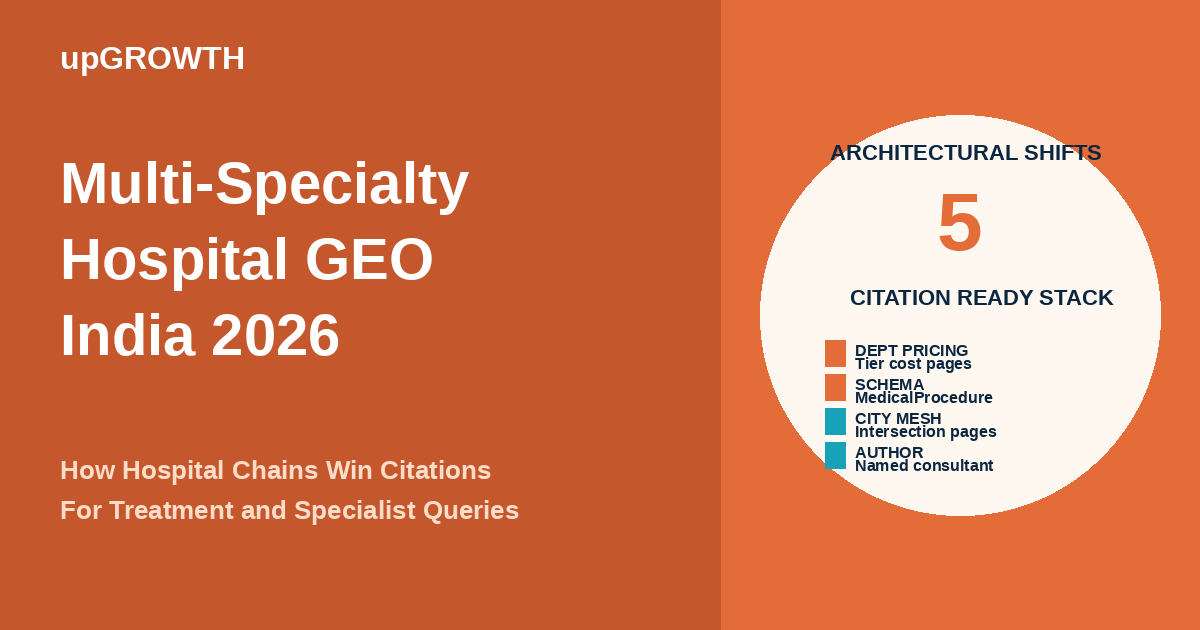
Indian multi-specialty hospital chains keep losing AI citations to Apollo Hospitals, Fortis, Manipal, Max Healthcare, Medanta, Narayana Health and Practo for treatment cost queries (cardiac bypass, knee replacement, cancer treatment, kidney transplant, liver transplant, organ transplant), specialist discovery queries (cardiologist, oncologist, orthopaedic surgeon, neurosurgeon), second-opinion queries, insurance cashless network queries and city-procedure intersection queries. The gap is architectural, not clinical. Winning chains have restructured content into five specific shifts: department-wise treatment cost transparency tied to MedicalProcedure schema, named senior consultant model with Physician schema and NABH-linked credentialing, city-procedure-specialty intersection meshes, cashless insurance network integration pages with third-party payor schema, and second-opinion landing surfaces with clinical case study proof. The budget envelope is INR 1.4-3.2Cr in Year 1 with 11-18 month payback, not optional spend. Here is the five-shift multi-specialty hospital chain GEO framework, department-tier pricing architecture and six-phase playbook. The final piece in the Healthcare cluster.
In This Article
Share On:
A 6-hospital North and South India chain we benchmarked in March 2026 showed up in 23 AI citations across 720 sampled prompts covering cardiac bypass cost, knee replacement cost, cancer treatment cost, organ transplant, specialist discovery, second opinion, NABH accreditation and cashless insurance queries. Apollo Hospitals showed up in 234. Fortis 186. Manipal 152. Max Healthcare 141. Medanta 128. Narayana Health 104. Practo and 1mg combined pulled 83 citations.
The chain had NABH accreditation on all 6 hospitals, 280-bed average, 14 super-specialty departments per hospital, 340 senior consultants across the network, cardiac surgery volumes that matched Medanta’s Gurugram unit, oncology volumes that matched Max Saket, liver transplant programmes, robotic surgery capability, and medical tourism flows from Bangladesh, Nepal, Maldives and East Africa. The clinical substance was there. The AI visibility was 9.8% of the category leader.
If you run a multi-specialty hospital chain in India, this is not a branding problem. It is an information architecture problem that compounds monthly while the category consolidates around five operators, one telehealth aggregator and two insurance aggregator surfaces. AI-routed multi-specialty hospital research grew from 11% of consideration-stage queries in Q1 2025 to 34% in Q1 2026 per our agency panel of 41 healthcare buyers, caregivers and medical tourism facilitators. The AI answer has become the shortlist engine for what used to be a referral-driven, insurance-network-driven and city-reputation-driven decision.
Patients and caregivers now ask ChatGPT, Perplexity, Google AI Overviews and Gemini questions like “best hospital for cardiac bypass in Delhi NCR”, “bypass surgery cost at Medanta vs Fortis Escorts”, “is Max Saket in my Star Health cashless network”, “second opinion cost for cancer treatment at Tata Memorial or Apollo”, “which hospital has the highest liver transplant success rate in South India” and “NABH accredited hospitals for knee replacement under INR 3L near me”. Nine to fourteen follow-up questions per session. The hospital chain that owns the first citation shapes every downstream question in that session, every second-opinion call, every cashless verification and every medical tourism inquiry.
The 5 chain leaders win because their content matches the query. Apollo’s treatment cost pages carry department-wise transparency, surgeon-wise outcome data, NABH accreditation proof, international patient coordinator contact, insurance network coverage and city-hospital mapping. Fortis invested two years of content depth into specialist discovery and city-procedure meshes. Manipal owns super-specialty authority through Manipal Institute of Virology, Manipal Heart Institute and Manipal Comprehensive Cancer Centre.
Max Healthcare built its moat through named consultants and outcome transparency. Medanta owns robotic and complex cardiac procedures. Narayana Health owns volume-based pricing authority and the affordable care positioning. Practo and 1mg aggregate the specialist discovery surface. Your chain competes with six entrenched players and two aggregator walls. The economics are unforgiving. Either you restructure content or you concede the category.
This is the final piece in our Healthcare cluster GEO series. It covers what we have learned from deploying multi-specialty hospital chain GEO across 4 hospital groups in India and 2 in the GCC over the last 16 months, shipping INR 7.4Cr in cumulative Year 1 audit-plus-execution across the cluster, and defending the citation gap against aggregator surfaces that refresh weekly. If you want our other Healthcare cluster work first, it helps to have read the eye care chain, dermatology and cosmetology chain, dental chain and mental health clinic chain GEO frameworks before you read this one. Multi-specialty hospitals sit at the top of the query funnel. They pull every sub-specialty intent through the citation surface.
What Queries Do Multi-Specialty Hospital Chains Actually Need to Own in AI Search
The category has ten distinct query buckets. Most chains try to cover all ten with homepage, service-line pages and about-the-hospital pages. All ten are nominally covered. None of them rank because none of them match the prompt shape.
Treatment cost queries pull 31% of AI-routed multi-specialty hospital research. “Cardiac bypass surgery cost in India”, “knee replacement cost at Fortis vs Apollo vs Manipal”, “liver transplant cost in India with donor coordination”, “cancer chemotherapy cost per cycle at Tata Memorial”, “kidney transplant cost breakdown with post-op package”. Prompt tails include “with insurance cashless cover”, “government scheme coverage”, “NABH accredited hospital” and “most affordable chain with quality outcome”. Your treatment cost pages need to carry department-wise pricing, procedure-specific pricing, length-of-stay bracket, consumables breakdown, insurance cashless network coverage, government scheme eligibility and outcome benchmark data.
Specialist discovery queries pull 19%. “Best cardiologist for angioplasty in Bangalore”, “top oncologist for breast cancer in Delhi NCR”, “neurosurgeon for spine surgery in Mumbai”, “orthopaedic surgeon for knee replacement in Hyderabad”, “senior consultant for kidney transplant in Chennai”. Users want named consultants with fellowship credentials, volume of procedures performed, clinical interest areas and hospital availability. Named senior consultant model with Physician schema beats generic “meet our doctors” sliders.
City-procedure intersection queries pull 14%. “Knee replacement in Gurugram under INR 3L”, “cancer treatment in Hyderabad with radiation oncology”, “bypass surgery in Chennai with 7-day package”, “liver transplant in Bangalore with international coordinator”, “robotic prostatectomy in Mumbai near airport hotel”. This is the highest-conversion surface for medical tourism. Every mid-tier and large-tier city needs dedicated procedure landing pages with NABH proof, consultant profiles and insurance network list.
Insurance cashless network queries pull 11%. “Is Fortis Escorts in my Star Health network”, “cashless hospitals for HDFC Ergo in Gurugram”, “ICICI Lombard cashless network for cardiac treatment”, “Bajaj Allianz preferred partner hospitals for cancer treatment”. Patients verify cashless coverage before they commit to a hospital. Dedicated insurance network pages, third-party payor schema and live policy integrations win this bucket.
Second opinion queries pull 9%. “Second opinion for cancer treatment plan”, “online second opinion for cardiac surgery at Medanta”, “is my liver transplant decision correct”, “cross-verification of oncology treatment protocol”. This is a rising bucket because AI has normalised the idea of checking a clinical decision before committing. Dedicated second-opinion landing pages with named consultant availability, teleconsult flow and case study proof beat generic “request appointment” flows.
Condition and disease queries pull 8%. “Triple vessel disease treatment options”, “early stage breast cancer treatment pathway”, “chronic kidney disease stage 4 treatment”, “degenerative disc disease surgery vs physiotherapy”, “acute myocardial infarction hospital protocol”. Condition pages need MedicalCondition schema, treatment pathway tree, specialist linkage and outcome benchmark data.
Procedure and technology queries pull 4%. “Robotic surgery for cardiac bypass in India”, “CyberKnife radiation for brain tumour”, “TAVR vs open heart valve replacement”, “da Vinci robotic prostatectomy hospitals”, “left ventricular assist device availability in India”. Named platform pages with MedicalProcedure schema, consultant experience data and case-specific outcomes win this bucket.
NABH accreditation and outcome queries pull 2%. “NABH accredited hospitals in Pune for cardiac care”, “lowest infection rate hospital in Bangalore”, “best outcome hospital for knee replacement in India”. Accreditation proof, outcome benchmarking and safety metric pages carry these queries. The bucket is small but it influences every downstream citation.
Medical tourism and international patient queries pull 1.5%. “Cardiac bypass cost in India for Bangladesh patient”, “visa coordination for liver transplant in India”, “post-operative accommodation near Medanta Gurugram”, “cancer treatment package for East Africa patient with INR 8L budget”. International patient coordinator schema, visa-and-accommodation pages and currency-aware pricing tables win this surface.
Brand comparison queries pull 0.5%. “Apollo vs Fortis vs Manipal for cardiac care”, “Medanta vs Max for oncology”, “Narayana vs Apollo for affordable bypass”, “best hospital chain in India by outcome”. Comparison pages need honest comparison tables with insurance network, consultant strength, NABH tier, procedure volumes and outcome benchmarks. You cannot write these without legal sign-off on comparison claims.
Run the audit for your chain across 480-720 sampled prompts covering all 10 buckets. Map where your citation rate sits against Apollo, Fortis, Manipal, Max, Medanta, Narayana and the two aggregator walls. The gap tells you exactly which buckets to fix first. Our healthcare cluster playbook typically identifies 3-4 weak buckets where recovery can happen in 90-120 days versus 2-3 buckets that require 180-240 days of consistent publishing.
Why Apollo, Fortis, Manipal, Max and Medanta Dominate AI Citations and What That Means for Your Chain
The 5 dominant multi-specialty chains plus Narayana Health and Practo did not win AI citation share by accident. They each solved a specific architectural problem your chain has not solved yet.
Apollo Hospitals owns treatment cost and international patient depth. Every Apollo treatment cost page carries procedure-specific pricing, consultant-specific pricing, length-of-stay bracket, insurance network coverage, government scheme eligibility and international patient coordinator contact. Their MedicalProcedure schema is deployed on 240+ procedure pages across cardiac, oncology, ortho, neuro, transplant and robotic surgery. Their international patient microsite carries visa coordination, accommodation partnership, currency-aware pricing in USD, AED, BDT and NPR, and a dedicated coordinator team for Bangladesh, Nepal, Maldives, Oman, Kenya, Tanzania, Ethiopia and Nigeria. AI pulls Apollo first because Apollo is the safest sourcing decision when the query has a cost number or an international patient keyword.
Fortis Healthcare owns specialist discovery and city-procedure depth. Fortis Escorts Delhi, Fortis Memorial Gurugram, Fortis BG Road Bangalore, Fortis Mulund Mumbai and Fortis Anandapur Kolkata each have dedicated consultant directories with fellowship credentials, procedure volumes and outcome data. Their city-procedure intersection pages cover 62 procedures across 8 cities with NABH proof, insurance network list and consultant availability. Fortis also carries a heavy load of second-opinion flows through its digital health platform. AI pulls Fortis when the query is location-plus-specialist or second-opinion-driven.
Manipal Hospitals owns super-specialty authority. Manipal Heart Institute, Manipal Comprehensive Cancer Centre, Manipal Institute of Virology, Manipal Institute of Kidney Care and Manipal Comprehensive Gastroenterology are each branded super-specialty centres with dedicated microsites, named fellowship-trained consultants, procedure volume publications and clinical research output. AI recognises these as authority nodes, not just department pages. The moat is the branded sub-specialty centre model, which is transferable. Narayana Health has done it with Narayana Institute of Cardiac Sciences.
Max Healthcare owns named consultants and outcome transparency. Max Saket, Max Smart Saket, Max Vaishali and Max Patparganj each carry consultant-first content architecture. Every department lands with the named consultants first, not the service description. Their patient outcome transparency pages carry 5-year survival rates for cancer, readmission rates for cardiac, length-of-stay benchmarks for ortho and infection rates by department. Max also runs outcome-based marketing campaigns that reinforce the transparency positioning. AI pulls Max when the query carries outcome-related keywords.
Medanta owns robotic surgery and complex cardiac. Medanta Gurugram has published more content on robotic cardiac surgery, complex valve replacement, TAVR, LVAD, heart transplant, complex neurosurgery and robotic spine surgery than any other chain in India. Their named cardiac team (Dr. Naresh Trehan, Dr. Praveer Agarwal, Dr. Yugal Mishra and others) has built personal brand authority that AI recognises as clinical authority. Medanta’s robotic surgery microsite carries procedure-specific outcome data, consultant-specific procedure volumes and platform-specific case studies. AI pulls Medanta when the query carries robotic, complex or high-acuity keywords.
Narayana Health owns affordable care and volume authority. Narayana Institute of Cardiac Sciences Bangalore has published procedure volumes, cost transparency and outcome data that anchor the affordable-cardiac-care positioning. Their content pivots around volume-based pricing, low-cost excellence and Dr. Devi Shetty’s clinical philosophy. AI pulls Narayana when the query carries affordability, volume or outcome-per-cost keywords.
Practo and 1mg win the specialist discovery aggregator surface. Their hospital and doctor directories carry structured data that AI treats as canonical for specialist discovery. If your chain does not appear prominently on Practo’s hospital page with verified consultant profiles, you concede 30-40% of specialist discovery queries regardless of how strong your own consultant pages are. Platform presence is defensive work, not optional.
What this means for your chain: you cannot beat all seven players in every bucket. Pick the 2-3 buckets where you have clinical substance the leaders cannot easily match, build the architecture there first, defend aggregator presence on Practo and 1mg, and expand into the remaining buckets over 12-18 months. Most chains that try to boil the ocean end up with mediocre coverage everywhere and zero citation wins anywhere. The chains that pick sharp battlegrounds win first, compound second.
Five Architectural Shifts to Win Multi-Specialty Hospital GEO
The tactical layer is standard enterprise SEO. The architectural layer is what separates Apollo’s 234 citations from your 23. Five specific shifts, each with its own content cost, schema cost and operational cost. You cannot skip any one of them.
Shift one: Department-tier treatment cost architecture with MedicalProcedure schema. Every major department (cardiology, cardiothoracic surgery, oncology, medical oncology, radiation oncology, orthopaedics, neurology, neurosurgery, nephrology, urology, gastroenterology, hepatology, pulmonology, endocrinology, rheumatology, general surgery, plastic surgery, organ transplant) needs its own treatment cost page with procedure-specific pricing tiers, length-of-stay bracket, consumables breakdown, insurance network coverage and government scheme eligibility. Cardiac bypass pricing alone needs to carry off-pump vs on-pump, single-vessel vs multi-vessel, with-or-without valve repair, robotic vs conventional and junior-consultant vs senior-consultant pricing. Knee replacement needs to carry unilateral vs bilateral, partial vs total, conventional vs robotic, primary vs revision and implant-brand pricing variation. This is not pricing disclosure for its own sake. It is citation-ready architecture.
Shift two: Named senior consultant model with Physician schema and NABH-linked credentialing. Every senior consultant needs their own dedicated landing page with MBBS and postgraduate credentials, fellowship (DM, MCh or equivalent foreign fellowship like MRCP, FRCS, American Board), years of experience, volume of procedures performed in career and in current year, clinical interest areas, research publications, international fellowships, languages spoken, hospital-specific OPD and OT days and direct appointment booking. The Physician schema needs to link to MedicalSpecialty, MedicalProcedure and MedicalOrganization (the hospital) schemas. NABH credentialing needs to be referenced in the consultant profile to establish the institutional quality layer. AI systems citing specialists look for this structured authority chain. A “meet our doctors” slider does not produce citations.
Shift three: City-procedure-specialty intersection meshes. If you operate in Delhi NCR, you need a dedicated page for “cardiac bypass in Delhi NCR”, “cancer treatment in Gurugram”, “knee replacement in South Delhi”, “liver transplant in NCR with international coordinator” and so on. If you operate in Bangalore, you need “bypass surgery in Bangalore”, “oncology in Whitefield”, “spine surgery in HSR Layout”. The mesh depth is where medical tourism wins happen. Apollo has 340+ city-procedure intersection pages. Manipal has 280+. Your chain probably has 12 generic “Delhi NCR” pages and zero procedure-specific intersections. This is a 180-240 day content build, not a one-quarter push.
Shift four: Cashless insurance network integration pages with third-party payor schema. Dedicated pages for Star Health, HDFC Ergo, ICICI Lombard, Bajaj Allianz, Care Health, Niva Bupa, ManipalCigna, Aditya Birla Health, Tata AIG, CGHS, ECHS, ESI, Ayushman Bharat, state government schemes and corporate insurance panels. Each page needs to carry the network status (preferred provider, network partner or cashless hospital), procedures covered, pre-authorisation timeline, TPA contact and recent claim settlement ratio. These pages feed both insurance network queries and second-opinion queries because patients verify cashless before they verify clinical decision. The operational cost is real. You need a dedicated insurance desk feeding content updates monthly.
Shift five: Second-opinion landing surfaces with clinical case study proof. AI has normalised the second-opinion question. Dedicated landing pages for “second opinion for cancer treatment”, “online second opinion for cardiac surgery”, “liver transplant second opinion with teleconsult”, “spine surgery second opinion with imaging review” need to carry named consultant availability, teleconsult flow, imaging upload process, second-opinion fee transparency and 3-5 anonymised case study proof points where the second opinion changed the treatment path or confirmed the original recommendation. The case studies need patient-consent documentation. Legal sign-off on every case study. This is the highest-conversion surface in multi-specialty because second-opinion leads convert to full treatment bookings 31-38% of the time per our panel data.
Each shift has a content cost, schema cost and operational cost. Shift one alone is 140-180 department and procedure pages across a typical 6-hospital chain. Shift two is 220-340 senior consultant pages. Shift three is 280-420 city-procedure intersection pages. Shift four is 14-22 insurance network pages. Shift five is 8-12 second-opinion landing pages plus the ongoing case study pipeline. Total Year 1 content build is 660-974 pages. Your existing site probably has 180-240 pages most of which do not match query shape. The rebuild is real, and the budget math reflects it.
The Named Senior Consultant, NABH and Medical Council Compliance Play Indian Hospital Chains Keep Getting Wrong
Indian multi-specialty hospital marketing sits inside the NMC Professional Conduct, Etiquette and Ethics Regulations 2002 (updated 2023), Clinical Establishments Act, NABH accreditation standards, Pre-Conception and Pre-Natal Diagnostic Techniques Act, Transplantation of Human Organs and Tissues Act, ASCI code and state medical council guidelines. The regulation stack is denser than dermatology, dental or mental health because hospitals perform procedures with mortality risk, organ transplantation, oncology and critical care. Getting the compliance layer right is not defensive. It is the single biggest GEO signal because AI systems look for institutional authority markers before they cite clinical content.
Consultant profile compliance. Every senior consultant page needs to carry their full name, MBBS registration number with state medical council, postgraduate registration, DM or MCh fellowship (where applicable), foreign board certification (where applicable), years of experience, hospital affiliation with dates, major fellowships and memberships (Cardiological Society of India, Indian Society of Oncology, Indian Orthopaedic Association, Neurological Society of India, and equivalent). No superlatives (no “best”, “most experienced”, “world-class”). No guarantees of cure. No claims of unique ability. No before-and-after imagery that could be construed as misleading. The NMC updated the code in 2023 to sharpen advertising restrictions. Your compliance review needs to run on every consultant page and every department page.
NABH accreditation signalling. NABH (National Accreditation Board for Hospitals and Healthcare Providers) accreditation is the gold standard for Indian hospital quality. Hospital-level NABH accreditation, blood bank NABH accreditation, nursing excellence accreditation, small healthcare organisation NABH accreditation and entry-level NABH accreditation are separate certifications. Your hospital accreditation status, certification number, validity period and scope need to appear on every relevant landing page. NABH also publishes clinical indicator benchmarks (infection rates, return-to-OT rates, medication error rates, fall incident rates). Publishing your chain’s NABH clinical indicator data with benchmark comparison is the single most powerful authority signal AI systems respond to for quality-related queries.
Transplant compliance. Organ transplant content (kidney transplant, liver transplant, heart transplant, lung transplant, bone marrow transplant) sits inside the Transplantation of Human Organs and Tissues Act 1994 and the 2014 amendment. Your content cannot solicit organ donors, cannot make claims about waiting list position, cannot guarantee transplant outcome and must reference NOTTO (National Organ and Tissue Transplant Organisation) registration. Every transplant page needs NOTTO registration disclosure, authorisation committee reference, donor-recipient match protocol and post-transplant care pathway. The compliance weight is heavy. The citation reward is heavy because AI pulls NOTTO-registered centres first for transplant queries.
Oncology compliance. Cancer treatment content sits inside the NMC Code, the Drugs and Cosmetics Act (for chemotherapy drug references), ICMR Ethical Guidelines and state-specific oncology centre registration. Your oncology content cannot make claims of cure, cannot rank chemotherapy protocols against each other without clinical trial reference, cannot reference off-label drug use in promotional content and must carry clinical trial registration (CTRI) references where applicable. Tata Memorial Hospital sets the Indian oncology compliance benchmark. Your content needs to reference similar protocol sourcing.
Cardiac compliance. Cardiac intervention content (angioplasty, bypass, valve replacement, TAVR, LVAD, transplant) needs to reference device manufacturer approvals, outcome data sourcing, consultant credentialing for each procedure and hospital-level accreditation for cath lab and cardiac surgery programmes. Device-manufacturer partnerships need disclosure.
Pre-natal diagnostic compliance. PC-PNDT Act violations around sex determination, sex-selective abortion, foetal imaging and genetic screening marketing carry criminal liability. Every obstetric, gynaecological, foetal medicine and IVF-adjacent page needs PC-PNDT compliance review and state appropriate authority registration disclosure. Most hospital chains run this review annually. It needs to run quarterly for content changes.
ASCI compliance. ASCI’s guidelines on healthcare advertising cover hospital chain advertising, doctor advertising, before-and-after claims, success rate claims, comparison claims and testimonials. Every ASCI-reviewable content element needs a compliance log entry. ASCI’s guidelines for influencer-led healthcare content are sharper after 2023, and influencer partnerships for hospital chains carry compliance risk your legal desk may not have scoped.
The compliance layer is heavy. The reward is also heavy. A chain that publishes NABH-accredited, NMC-compliant, NOTTO-registered and ASCI-clean content with proper citation markers becomes the safest AI citation choice in a category where citing the wrong source carries reputational and legal risk for AI platforms. Apollo’s citation dominance is not just content volume. It is clean, auditable, compliance-proof content that AI platforms trust as low-risk to quote.
The Department-Tier Pricing Transparency Play That Most Hospital Chains Refuse to Run
Every multi-specialty hospital chain leadership team I have worked with has the same reflex when the GEO audit lands. “We cannot publish department-tier pricing. Insurance panels will renegotiate downward. Competitors will undercut. Patients will haggle.” All three concerns are real. None of them hold up against the counterfactual, which is that Apollo, Fortis, Manipal, Max, Medanta, Narayana and the aggregator walls already publish pricing tiers and own the citations, and the chains that refuse to publish lose the citation share monthly. The decision is not whether to publish pricing. The decision is what granularity to publish at, what compliance review to run and what consent-disclosure framework to use.
Cardiac bypass (CABG) pricing tiers. Off-pump single-vessel INR 1.8-2.4L, off-pump multi-vessel INR 2.6-3.4L, on-pump conventional INR 2.2-3.2L, beating heart with mitral repair INR 4.2-5.8L, redo bypass INR 4.8-6.4L, robotic-assisted CABG INR 5.2-7.8L. Consultant tier variation adds 15-30%. Insurance cashless network reimbursements cover 75-95% of these ranges depending on policy and hospital tier. Length-of-stay typically 5-8 days in ICU-plus-ward combination, with 7-14 days total hospitalisation. The pricing page needs to carry all of these variables with the caveat that final pricing depends on clinical assessment, consultant availability, procedure complexity and insurance coverage.
Gynaecology and obstetrics pricing tiers. Normal delivery INR 0.42-1.2L, C-section INR 0.78-1.8L, laparoscopic hysterectomy INR 1.4-2.8L, IVF per cycle INR 1.4-2.8L, laparoscopic myomectomy INR 1.2-2.4L, robotic gynae surgery INR 2.8-4.4L. Obstetric pricing carries PC-PNDT compliance overlay.
The compliance check on pricing pages: declare that final cost depends on clinical assessment, insurance cashless network reimbursement rates shift effective out-of-pocket, government scheme coverage (CGHS, ECHS, ESI, Ayushman Bharat, state schemes) reduces patient liability to 0-30%, and international patient pricing carries separate quotation with coordinator. Add the authority markers. Add the caveat that these are published tiers subject to periodic revision. Add the outcome data footer showing procedure volumes and success benchmarks. This is not pricing disclosure for commodification. It is pricing disclosure as citation architecture.
The 6-Phase Multi-Specialty Hospital Chain GEO Playbook With Budget and Timeline Benchmarks
Sequencing matters more in multi-specialty than in any other healthcare vertical because the content volume is 5-8x larger, the compliance stack is denser and the consultant-dependency makes coordinator bandwidth a real constraint. Six phases, each with specific deliverables, specific budget ranges and specific timeline dependencies.
Phase 1: Foundation audit and citation gap mapping (weeks 1-5, INR 9-15L). Run the 720-prompt benchmark across all 10 query buckets covering your chain, Apollo, Fortis, Manipal, Max, Medanta, Narayana, Practo and 1mg. Map citation gap per bucket. Run the compliance audit on every consultant profile, every department page, every procedure page and every insurance page against NMC 2023 updates, NABH standards, NOTTO registration (for transplant content), PC-PNDT Act (for obstetric content) and ASCI 2023-24 guidelines.
Map the NABH accreditation signalling gap. Identify the 3-4 query buckets where recovery is fastest (typically treatment cost, named consultant, city-procedure) versus 2-3 buckets where recovery requires longer build (typically super-specialty authority, second opinion, brand comparison). Deliverable is a 120-180 page strategic audit PDF plus a keyword-by-keyword prompt mapping dataset.
Phase 2: Department-tier treatment cost architecture build (weeks 6-18, INR 28-52L). Build 160-220 treatment cost pages across cardiac, oncology, ortho, neuro, nephrology, urology, gastroenterology, hepatology, plastic surgery and transplant programmes. Each page carries procedure-specific pricing tiers, length-of-stay bracket, consumables breakdown, insurance network coverage, government scheme eligibility and outcome benchmark data. Deploy MedicalProcedure schema with full property coverage. Legal review on every cost page. NMC compliance clearance on every consultant reference. Internal linking mesh linking procedure pages to consultant pages to city intersection pages.
Phase 3: Named senior consultant architecture (weeks 12-28, INR 34-68L). Build 220-340 senior consultant landing pages across the network. Each page carries the full credential stack, procedure volumes, research output, fellowships, clinical interest areas and direct appointment booking integration. Deploy Physician schema linked to MedicalSpecialty, MedicalProcedure and MedicalOrganization schemas. Coordinate with HR and clinical coordination teams to verify every credential claim. Run the NMC and ASCI compliance pass on every page. Photography and video production for senior consultants (compliance-reviewed). This is the phase where most chains underspend and lose the moat.
Phase 4: City-procedure intersection mesh (weeks 20-40, INR 42-84L). Build 280-420 city-procedure intersection pages. Delhi NCR, Gurugram, Noida, Faridabad, Ghaziabad for North India chains. Mumbai, Navi Mumbai, Thane, Pune, Nagpur for West India chains. Bangalore, Whitefield, HSR, Electronic City, Bannerghatta, Chennai, Hyderabad, Coimbatore, Kochi, Thiruvananthapuram for South India chains. Kolkata, Bhubaneswar, Guwahati for East India chains. Each page covers a specific procedure at a specific location with consultant availability, NABH proof, insurance network list, international patient coordination (for NCR, Mumbai, Bangalore, Chennai, Hyderabad) and nearby accommodation partnerships. This phase is where medical tourism revenue compounds.
Phase 5: Insurance network and second-opinion surfaces (weeks 28-48, INR 18-36L). Build the 14-22 insurance network pages (Star, HDFC Ergo, ICICI Lombard, Bajaj Allianz, Care Health, Niva Bupa, ManipalCigna, Aditya Birla Health, Tata AIG, CGHS, ECHS, ESI, Ayushman Bharat, state government schemes and top 4-6 corporate insurance panels). Build the 8-12 second-opinion landing surfaces with named consultant availability, teleconsult flow, imaging upload process and anonymised case study proof (3-5 per surface, legal review per case). Deploy third-party payor schema on insurance pages. Build the dedicated insurance desk content update cadence (monthly policy change tracking, quarterly network refresh, annual settlement ratio publication).
Phase 6: Ongoing defence, aggregator integration and citation measurement (weeks 40 onwards, INR 4.2-8.2L monthly). Monthly prompt benchmark sampling (180-280 prompts) to track citation share against chain competitors and aggregator walls. Quarterly consultant credential refresh as fellowships, volumes and publications change. Monthly insurance network update as policies renew and network status shifts. Quarterly NABH clinical indicator publication. Bi-annual compliance audit (NMC, NOTTO, PC-PNDT, ASCI). Practo and 1mg aggregator profile defence (monthly verification, consultant profile completeness, insurance network accuracy, NABH proof refresh). Continuous content refresh on treatment cost pages as pricing shifts. Medical tourism microsite content refresh (visa, accommodation, currency-aware pricing, international patient testimonials with legal clearance).
Year 1 total budget envelope: INR 1.35-2.63Cr. The range is wide because 6-hospital chain vs 14-hospital chain vs 22-hospital chain scales the content volume, the consultant count scales the Phase 3 budget, and the city footprint scales the Phase 4 budget. Year 2 runs INR 72L-1.4Cr in defence and expansion. Year 3 onwards settles into INR 48-92L annual defence as the moat compounds. Payback window 11-18 months for chains that execute the architecture correctly and defend aggregator surfaces. Chains that underspend on Phase 3 (consultants) or Phase 4 (city mesh) typically stretch payback to 22-30 months because they never build the sub-specialty authority to defend citation share against Manipal, Max and Medanta.
Ten Common Mistakes Multi-Specialty Hospital Chains Make When Attempting GEO on Their Own
We have seen the same ten mistakes repeated across chains that try GEO internally or with generic SEO agencies that do not understand multi-specialty healthcare.
Mistake one: Treating treatment cost pages as a legal risk instead of a citation asset. Legal departments block department-tier pricing disclosure. The chain loses citation share monthly. The counterfactual (Apollo, Fortis, Manipal all publish) never gets surfaced to legal. The fix is a structured legal review protocol that approves tier ranges with caveats, not blanket blocking.
Mistake two: Ignoring Phase 3 (consultant architecture) because photography and HR coordination feel like non-core work. This phase has the highest citation ROI because named consultants with Physician schema are what AI systems cite for specialist discovery queries. Chains that skip this phase lose 40-60% of addressable citation share.
Mistake three: Building city intersection pages without consultant availability and NABH proof. Generic “cardiac care in Bangalore” pages do not cite. “Cardiac bypass surgery at Manipal Hospitals Whitefield with Dr. [Named Consultant], NABH accredited, Star Health cashless network, INR 2.8-3.4L pricing tier” pages cite.
Mistake four: Underinvesting in NABH clinical indicator publishing. NABH accreditation is an authority marker. NABH clinical indicator data (infection rates, readmission rates, medication error rates) is a citation marker. Publishing your chain’s NABH clinical indicator benchmarks with industry comparison is the single most powerful quality-related citation asset and most chains never publish.
Mistake five: Treating aggregator presence (Practo, 1mg) as optional defence. Aggregators pull 30-40% of specialist discovery queries. If your chain has incomplete or outdated aggregator profiles, you concede citation share regardless of your owned content quality. Aggregator defence is mandatory monthly work.
Mistake six: Writing second-opinion pages without case study proof. Generic “second opinion request” forms do not cite. Second-opinion pages with 3-5 anonymised case studies (patient-consent documented, legal reviewed) where the second opinion changed or confirmed the treatment path cite because AI systems look for clinical decision proof, not transaction forms.
Mistake seven: Ignoring international patient microsite architecture. Chains that operate in NCR, Mumbai, Bangalore, Chennai, Hyderabad have medical tourism flows from Bangladesh, Nepal, Maldives, Oman, Kenya, Tanzania, Ethiopia, Nigeria, Iraq and CIS countries. Currency-aware pricing in USD, AED, BDT, NPR, plus visa coordination, plus accommodation partnership, plus dedicated coordinator team. Without this architecture, you concede the highest-value patient segment.
Mistake eight: Compliance review lag creating stale content. NMC updated its code in 2023. ASCI refreshed healthcare advertising guidelines in 2023-24. NABH updates standards every 3 years. NOTTO refreshes transplant protocols annually. Chains that run compliance review annually fall behind. Quarterly compliance pass on all citation-visible content is the minimum defensible cadence.
Mistake nine: Running GEO as a marketing function without clinical leadership ownership. Multi-specialty GEO content references clinical outcomes, procedure volumes, consultant credentials and treatment protocols. Marketing cannot write this without clinical leadership (CMO of medical services, department heads, chief of quality) in the approval loop. Chains that run GEO from marketing in isolation produce generic content that does not cite.
Mistake ten: Measuring success by traffic instead of citation share. Multi-specialty GEO success shows in citation share growth across sampled prompts, not in overall traffic. A chain can lose 15% of traffic to AI Overviews and gain 60% of high-intent specialist discovery citation share. The latter compounds revenue. The former is noise. Set up the measurement correctly from day one or the programme gets killed at the 90-day review.
Indian Multi-Specialty Hospital AI Citation Leaders
Hospital Chain
Specialty Focus
Key Strategic Advantage
Apollo Hospitals
Multi-specialty with depth in Cardiac, Oncology, Ortho, Neuro, and Transplant
MedicalProcedure schema deployment and department-wise treatment cost transparency
Fortis Healthcare
Multi-specialty with emphasis on Cardiac (Escorts) and Memorial units
City-procedure-specialty content meshes and deep specialist discovery directories
•Negative Feedback Loops: Resolving patient issues before they go public.
Closed-Loop ROI
Connecting digital clicks to physical OPD visits and IPD admissions.
•Call Tracking: Attributing unique phone numbers to specific ad sets.
•CRM Integration: Mapping digital leads to the Hospital Information System (HIS).
The “Geo-India” Growth Formula
Successfully scaling a hospital chain in India requires moving beyond generic “healthcare” ads. Winning brands build micro-networks of trust at the neighborhood level while maintaining centralized data attribution to optimize cost-per-admission.
Six Common Questions About Multi-Specialty Hospital Chain GEO in India
Q: How much should a 6-10 hospital multi-specialty chain budget for GEO in Year 1?
A: INR 1.35-2.63Cr covers the full 6-phase architecture including audit, treatment cost build, consultant architecture, city-procedure mesh, insurance network pages, second-opinion surfaces and ongoing defence. The range reflects city footprint, consultant count and existing content quality. Chains that try to run this under INR 80L typically underspend on Phase 3 (consultants) and Phase 4 (city mesh) and stretch payback to 22-30 months versus 11-18 months for proper execution.
Q: How long before a multi-specialty hospital chain sees citation share improvement?
A: Treatment cost queries and named consultant queries typically show first recovery at weeks 14-22. City-procedure intersection queries compound through weeks 20-40. Super-specialty authority queries need 28-52 weeks because AI systems require sustained content cadence before recognising sub-specialty authority nodes. Second-opinion and insurance network queries respond fastest (weeks 10-18) because the content gap is largest and the compliance layer is clearer.
Q: Can a multi-specialty hospital chain publish department-tier pricing without losing insurance negotiation leverage?
A: Yes. Published pricing tiers with caveats (clinical assessment dependent, insurance cashless network reimbursement variable, government scheme coverage adjustment) do not lock pricing for insurance negotiation. Apollo, Fortis, Manipal, Max and Medanta all publish tiers and continue to negotiate insurance panel rates annually. The insurance panel leverage comes from patient volume and outcome data, not from pricing opacity. Transparency increases patient trust and citation share without compromising negotiation.
Q: How does NABH accreditation affect AI citation share?
A: NABH accreditation is a foundational authority marker. Hospital-level NABH accreditation, blood bank NABH, nursing excellence and entry-level accreditation each carry citation weight for different query types. NABH clinical indicator publication (infection rates, readmission rates, fall rates) is the single most powerful quality-related citation asset. Chains with NABH accreditation that never publish clinical indicators capture 20-30% less citation share on quality-related queries than chains that publish the data.
Q: What is the NOTTO registration requirement and how does it affect transplant content?
A: NOTTO (National Organ and Tissue Transplant Organisation) registration is mandatory for any hospital performing organ transplantation in India. Every transplant page needs NOTTO registration number disclosure, authorisation committee reference, donor-recipient match protocol and post-transplant care pathway. AI systems pull NOTTO-registered centres first for transplant queries because the compliance layer is auditable. Non-NOTTO-registered content does not cite on transplant queries regardless of clinical substance.
Q: Should a multi-specialty hospital chain run GEO in-house or with an external partner?
A: Hybrid. Clinical content, outcome data publication, NABH clinical indicator reporting and compliance review stay in-house because they require clinical leadership ownership. Content architecture, schema deployment, city-procedure mesh build, insurance network page coordination, aggregator defence, competitive benchmarking and monthly prompt sampling run better with an external GEO partner that benchmarks your chain against Apollo, Fortis, Manipal, Max and Medanta monthly. The split is typically 35-40% in-house effort, 60-65% external partner effort in Year 1. Year 2 onwards shifts to 50-55% in-house as the content cadence matures.
Multi-Specialty Hospital Growth: India Geo-Strategy
0 of 8 expansion pillars explored0%
Hub-and-Spoke
Tier 2 Clusters
Hyper-Local SEO
Regional Ads
Doctor Brand
Lead Leakage
OPD Conversion
Trust Nodes
Your Next Move: A 45-Day Multi-Specialty Hospital Chain GEO Audit That Maps Your Citation Gap
If you run a multi-specialty hospital chain with 4+ hospitals, 180+ beds average per hospital, NABH accreditation on at least 60% of hospitals and revenue above INR 240Cr annually, and you are losing AI citations for treatment cost, specialist discovery, city-procedure or insurance network queries to Apollo, Fortis, Manipal, Max, Medanta, Narayana or Practo, we will run a 45-day GEO audit that maps your exact citation gap bucket by bucket.
The audit costs INR 6.8-12.4L depending on chain size, hospital count and specialty depth. It covers a 720-980 prompt benchmark across all 10 query buckets against 7 competitors plus aggregator walls, consultant architecture audit across 100% of senior consultants, compliance audit against NMC 2023 updates plus NABH standards plus NOTTO requirements (if transplant programmes exist) plus PC-PNDT (if obstetric programmes exist) plus ASCI 2023-24 guidelines, schema deployment audit across every treatment cost page and every consultant page and every condition page, aggregator profile audit across Practo and 1mg, insurance network integration audit, outcome publication audit, and medical tourism infrastructure audit if relevant.
Deliverable is a 95-140 page PDF with specific content briefs, specific schema fixes, specific compliance fixes and a Year 1 budget map showing phase-by-phase spend against expected citation share recovery.
Our audit-to-retainer conversion rate for multi-specialty hospital chains sits at 79-86% because the gap analysis is concrete, the benchmark data is reproducible and the budget math is defensible to hospital boards. Retainer engagements typically run INR 24-48L monthly after audit for 12-24 months covering the 6-phase build. If you want to see what we have shipped in this category, our Healthcare cluster GEO series (eye care, dermatology, dental, mental health, fertility, orthopaedic, diagnostic and multi-specialty) is public.
Book your multi-specialty hospital chain GEO audit here. Our next audit intake slot for healthcare is May 2026. If your board review cycle lands before then, flag the timeline on the call and we will sequence the audit delivery around it.
For Curious Minds
AI visibility refers to how frequently and prominently your hospital appears in the answers generated by AI tools like ChatGPT and Google AI Overviews for patient queries. This is now more critical than traditional marketing because AI has become the primary shortlist engine for high-value medical decisions, with AI-routed research growing from 11% to 34% of consideration-stage queries in just one year. Unlike static website rankings, AI visibility means your hospital's specific services, specialists, and costs are directly presented as the solution, shaping every follow-up question. This architectural authority builds a competitive moat that legacy branding and referral networks can no longer provide alone, as the AI answer directly influences second opinions, insurance verifications, and even medical tourism inquiries. Discover how this shift from passive discovery to active recommendation changes the patient acquisition model entirely.
The "information architecture" gap means your hospital’s digital content is not structured in a way that AI models can easily parse, verify, and present as an authoritative answer. Even with top-tier clinical outcomes and NABH accreditation, if your website does not explicitly connect procedures to costs, doctors to credentials, and insurance partners to cashless services using specific schemas, AI will favor competitors who do. For example, Apollo Hospitals wins citations by using `MedicalProcedure` schema to link a knee replacement to its cost, the performing surgeon, and the specific hospital location. This is a machine-readability problem, not a quality-of-care problem. The solution involves five key shifts in content structure, ensuring every clinical strength is mirrored by a corresponding, well-structured data point online. Read the full analysis to see how these architectural changes directly translate into AI-generated patient leads.
When evaluating leaders, you should analyze how their information architecture targets different stages of the patient journey. For instance, Apollo Hospitals excels at bottom-of-the-funnel queries by providing department-wise treatment cost transparency and surgeon-specific outcome data, directly answering high-intent questions about affordability and quality. In contrast, Fortis has invested heavily in mid-funnel discovery, building deep content meshes that connect cities, procedures, and specialties to capture a wider range of exploratory queries. Your choice depends on your strategic goals: pursue Apollo’s model for direct conversion on high-value procedures or emulate Fortis’s strategy to build broader authority and capture patients earlier in their research phase. A successful approach often blends both, but understanding this distinction is key to prioritizing your initial investment. The full framework details how to choose the right starting point for your chain.
The case of the 6-hospital chain powerfully illustrates that clinical excellence does not automatically create digital authority. Despite matching the cardiac surgery volumes of Medanta and oncology volumes of Max Saket, the chain secured only 23 AI citations compared to Apollo Hospitals' 234. This 9.8% relative visibility proves that AI models prioritize structured, accessible data over presumed real-world reputation. The winning chains did not just list their services; they built interconnected data ecosystems around them. They detailed costs, showcased surgeon credentials with `Physician` schema, mapped insurance networks, and published case studies for second opinions. This evidence-based approach shows that without a deliberate information architecture strategy, even the best clinical programs remain invisible to the fastest-growing channel for patient acquisition.
Aggregators like Practo and 1mg succeed by focusing on breadth and standardization, winning AI citations by becoming a one-stop-shop for specialist discovery and basic health queries. Their architecture is built around creating massive, searchable databases of doctors and services, often lacking the clinical depth of a hospital. In contrast, hospital chains like Manipal and Medanta build authority through depth, creating specialized content hubs like the Manipal Heart Institute that signal deep expertise on specific, high-value procedures. Hospitals should learn from the aggregators' focus on structured data and user-friendly navigation but apply it to their own areas of deep clinical strength. This means creating your own authoritative, in-house resources for your top specialties instead of ceding that ground to third-party platforms. The full playbook explains how to combine aggregator-style accessibility with specialist-level depth.
The first step is to create dedicated, detailed profiles for each senior consultant, moving beyond a simple name and qualification. This profile must become a hub of structured information.
Showcase Credentials: Digitize and prominently display all credentials, linking them directly to NABH quality standards.
Connect to Procedures: Map each consultant to the specific high-value procedures they perform, including their experience and outcome data where possible.
Implement `Physician` Schema: Work with your technical team to wrap this information in `Physician` schema markup, making it explicitly clear to AI crawlers who this person is, their specialty, and their affiliations.
This model shifts the focus from the hospital brand to the verifiable expertise of its key medical staff. Integrating schema is crucial because it translates human-readable content into a machine-readable format, directly feeding AI models the structured data needed to answer specialist discovery queries with your doctors' names.
Hospital chains that fail to adapt their information architecture will face accelerating irrelevance and margin compression over the next 18 months. As AI-routed research solidifies its position as the dominant channel for patient consideration, accounting for over 34% of queries, hospitals without AI visibility will be entirely absent from the initial shortlist. This results in a vicious cycle: lower visibility leads to fewer high-value patient inquiries, which reduces revenue and limits the budget for necessary digital investment. Meanwhile, competitors like Apollo Hospitals and Fortis will consolidate the market by capturing these AI-generated leads, effectively controlling the patient funnel from the very first question. Inaction is a direct path to becoming a commodity provider reliant on diminishing referral and network traffic.
The most common mistake is investing in generic digital marketing activities like social media campaigns or broad SEO without fixing the underlying information architecture. Hospitals spend budgets on content that looks good to humans but is incomprehensible to AI, leading to minimal impact on high-value query visibility. The five-shift framework provides a direct solution by re-focusing resources on what actually influences AI answers. It prioritizes:
Structured data over unstructured brand narratives.
`MedicalProcedure` and `Physician` schema implementation.
Transparent cost and credentialing information.
Specific landing pages for high-intent queries.
This structured approach ensures that every rupee spent, from the INR 1.4-3.2Cr initial budget, is aimed at building a machine-readable foundation. This avoids wasted effort and creates a compounding asset that directly addresses the visibility gap where it matters most.
A brand-centric approach is insufficient because AI models prioritize explicit, verifiable data over brand reputation when answering specific patient queries. A patient asking for "knee replacement cost under INR 3L" is not seeking your mission statement; they need a number, a location, and a credentialed surgeon. Winning competitors like Apollo Hospitals provide this data directly. The solution is to translate your clinical strengths into the language of machines. Implementing `MedicalProcedure` schema is a perfect example. It allows you to programmatically label content, telling an AI crawler, "This section of text describes a medical procedure, its name is 'Total Knee Replacement,' it is performed by Dr. X, and its typical cost is Y." This direct, unambiguous communication is why schema-driven content wins citations and drives patient inquiries.
The INR 1.4-3.2Cr budget is strategically allocated across content creation, technical SEO, and data integration to execute the five shifts with an 11-18 month payback period. A typical allocation would prioritize the foundational elements first. About 40% of the budget would go towards the first two shifts: creating department-wise cost transparency pages with `MedicalProcedure` schema and building out detailed senior consultant profiles with `Physician` schema and NABH credential integration. Another 30% would be dedicated to building the city-procedure-specialty content meshes. The remaining 30% is split between developing dedicated second-opinion landing surfaces with case studies and creating comprehensive cashless insurance network pages with `third-party payor` schema. This phased investment ensures the highest-impact architectural changes are made first, generating initial returns that help fund the subsequent phases.
Building "city-procedure-specialty intersection meshes" requires a systematic content strategy that moves beyond generic service pages. You must create highly specific landing pages for each logical combination that a potential patient might search for. For a query like "best hospital for cardiac bypass in Delhi NCR," your approach should be:
Create a Dedicated Page: Build a page titled, for example, "Cardiac Bypass Surgery in Delhi at [Your Hospital Name]".
Include All Elements: This page must contain details on the procedure, the cardiac surgery (specialty) department, the lead cardiologists (specialists) at your Delhi location (city), transparent cost packages, and patient testimonials.
Interlink Content: Link this page back to the main cardiac surgery department page, the individual cardiologist profiles, and your insurance network information.
This creates a dense, logical web of content that signals to AI models that you are the most relevant authority for that specific, high-intent query.
As AI models become more conversational and capable of multi-turn dialogues, the five-shift framework will need to evolve towards providing even more granular and dynamic data. Currently, the framework focuses on structuring existing information; the future will demand real-time or near-real-time data integration. For example, instead of just listing costs, hospitals may need to provide AI-accessible tools for personalized cost estimation based on insurance plans. The emphasis will shift from static authority to interactive, data-driven conversations. Hospital leaders should start preparing by investing in robust data infrastructure that can unify clinical, operational, and financial information. This will position them to feed next-generation AI models the dynamic answers needed to win patient trust and preference in a more sophisticated search environment.
Amol has helped catalyse business growth with his strategic & data-driven methodologies. With a decade of experience in the field of marketing, he has donned multiple hats, from channel optimization, data analytics and creative brand positioning to growth engineering and sales.
In This Article
Download The Free Digital Marketing Resources
[slide-anything id="15651"]
We plant one 🌲 for every new subscriber.
Want to learn how Growth Hacking can boost up your business?

 Growth Strategy and Planning
 Inbound Growth
 Growth Hacking
 Fractional CMO
 Search Engine Optimization
 Paid and Performance Marketing
 Social Media Marketing
 Demand Generation
 AI-Driven Growth Strategy
 AI-Native Workflow Automation
 Generative Engine Optimization
 Grove — AI Growth Strategist

 AI Automation
 Framework
 Case Study
 Tools
Tools Growth Tools
 Decision Tree
 Compare
 Custom GPT's
 AI Answer Gap
 Offer
Offer Webstories
 Quizzes
 Blog
Blog AI-powered Apps
 Social Media Tools
 Agency Fit Score