Contributors:
Amol Ghemud Published: November 1, 2026
Summary
Getting your clinic recommended by ChatGPT requires more than a polished Google Business Profile. AI assistants rank clinical credibility on five distinct signals: structured entity data, verified doctor profiles, procedure pages with outcome transparency, third-party editorial mentions, and review volume across multiple platforms. Clinics that address all five are 3-4x more likely to appear in AI-generated recommendations than those optimising only for traditional SEO.
In This Article
Share On:
A dermatology clinic in Dubai ran zero paid ads in Q3 2025 and still saw a 34% spike in consultation bookings. When the owner traced the source, the majority came from patients who said “ChatGPT told me to check you out.” That clinic had done nothing viral. It had simply made itself legible to AI. No campaign. No influencer. No Google Ads budget. Just a structured, credible online presence that an AI system could read, verify, and confidently name.
This is not an isolated case. Across India and the GCC, clinics that have invested in what we now call Answer Engine Optimisation (AEO) are appearing in ChatGPT, Perplexity, and Google AI Overviews for high-intent patient queries, while their well-funded competitors, who have spent years chasing Google page-one rankings, go completely unmentioned. The mechanism behind this is specific and learnable. But it is not what most digital marketing advice for clinics tells you to do.
The content-authority principle behind this shift is one upGrowth Digital has applied across markets. When we helped Delicut grow monthly sales from 40K AED to over 2 million AED in the UAE market, the foundation was not just paid performance. It was building content and trust signals that made the brand discoverable across AI and search surfaces simultaneously. The same logic applies directly to a single-location fertility clinic in Hyderabad or a hair transplant practice in Chennai trying to get named when a patient asks ChatGPT for recommendations tonight.
What follows is a signal-by-signal breakdown of exactly what ChatGPT checks before it names a clinic. Each signal is specific to YMYL healthcare entities, not generic brand mentions. Work through all five and you have the complete picture of what clinic recommended by ChatGPT optimisation actually involves.
Why ChatGPT Does Not Pull From Google Maps (And What It Actually Uses)
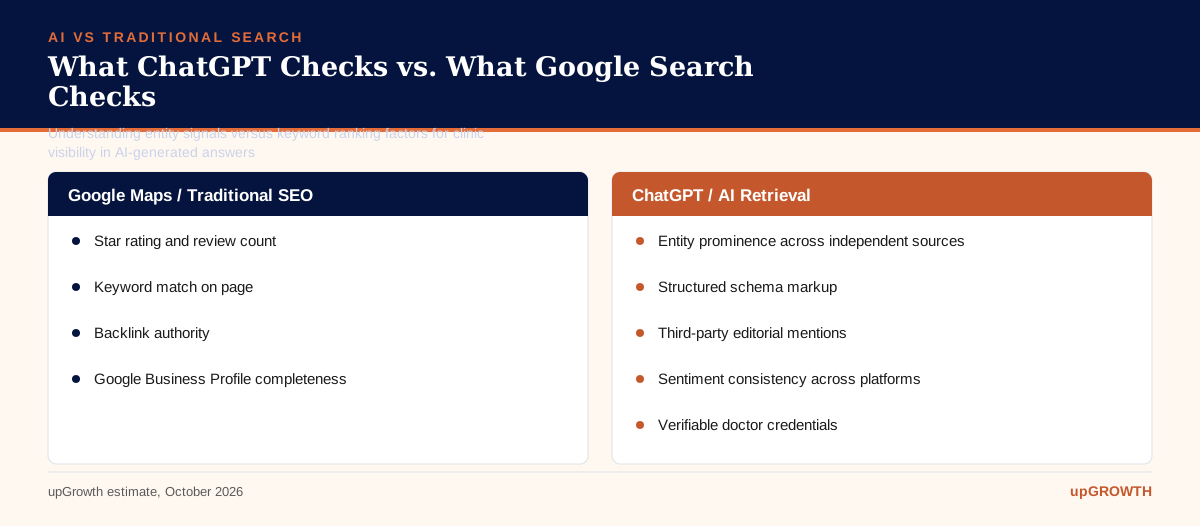
ChatGPT is not a search engine that queries Google’s index and surfaces the top-ranked result. It is a language model that builds confidence about named entities by cross-referencing how consistently and authoritatively those entities appear across multiple independent sources. When a patient asks “best hair transplant clinic in Pune,” ChatGPT does not check your Google Maps star rating. It assembles a probability-weighted answer from its training data plus, in Browse-enabled sessions, live retrieval from editorial sources, structured pages, and third-party directories it deems credible.
The practical implication is significant. A Bengaluru fertility clinic mentioned on Practo, cited in a Times of India health article, listed on Lybrate with a complete profile, and featured in one medical editorial will outperform a competitor with 400 Google reviews but zero off-site editorial presence. The AI is not counting stars. It is assessing entity prominence: how many independent, credible sources confirm that this named entity (the clinic, the doctor, the procedure) is real, qualified, and relevant to the query.
Search Engine Land has documented this shift extensively in 2026 coverage of AI Overview behaviour: the sources that get cited in generative answers share a common profile of structured markup, editorial third-party mentions, and consistent entity signals across the web, not simply high domain authority or keyword density.
This reframes the entire problem for clinic owners. You are not trying to rank on ChatGPT. There is no ranking algorithm to game. You are trying to make your clinic’s entity, its doctors, its procedures, its credentials, and its third-party confirmations, so clearly and consistently represented across the web that the AI has no uncertainty when it considers naming you. That is a fundamentally different task from SEO, and it starts in a different place entirely.
Signal 1: Doctor Entity Pages That AI Can Actually Parse
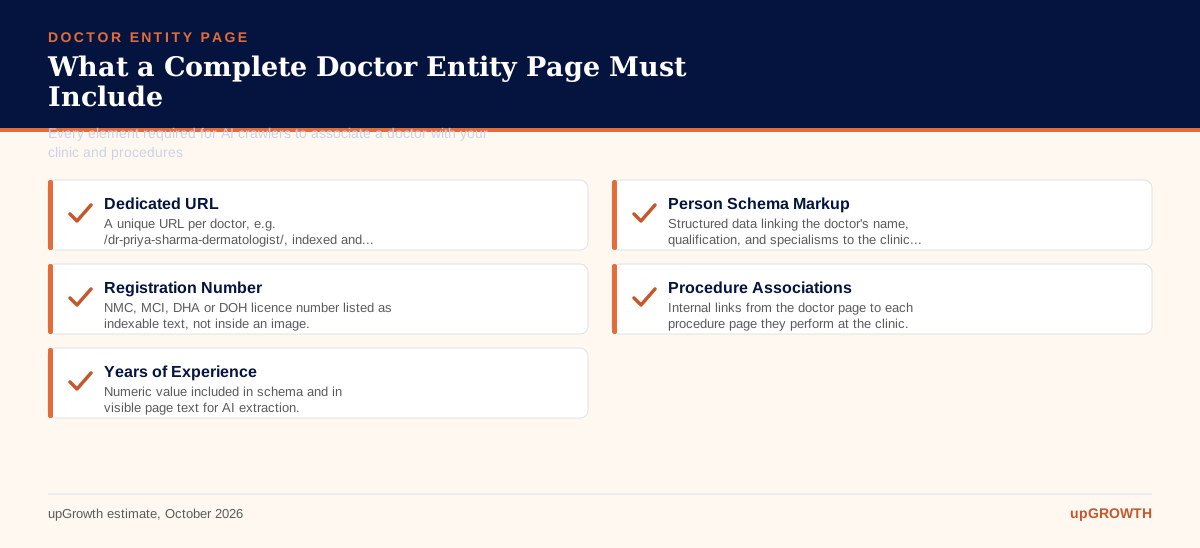
A doctor entity page is a dedicated URL on your clinic website, something like /dr-priya-sharma-dermatologist/, that contains the doctor’s full name, qualification, NMC or MCI registration number, years of experience, and the specific procedures they perform, all marked up with Person schema and linked to your clinic’s MedicalOrganization schema. When an AI retrieval system lands on that page, it can extract a structured fact: “Dr. Priya Sharma is a dermatologist at Clinic X, registered with the NMC, with 11 years of experience performing laser resurfacing and PRP therapy.” That fact becomes a node in the AI’s entity graph for your clinic.
Registration numbers from the NMC, MCI, or their GCC equivalents (DHA and DOH for Dubai and Abu Dhabi respectively) function as trust anchors. AI models treat verifiable regulatory identifiers as high-confidence facts that distinguish a real, licensed practitioner from an unverifiable claim. A doctor listed with her DHA licence number on a structured, schema-marked page is categorically more legible to ChatGPT than a doctor whose name appears only in a homepage carousel image with no indexable text.
This is the most common structural mistake clinic websites make. The carousel approach looks polished in a browser but is invisible to every AI crawler that matters. The schema.org specification for Person and MedicalOrganization markup is publicly documented and implementable by any developer in a single afternoon. There is no technical barrier, only an awareness gap.
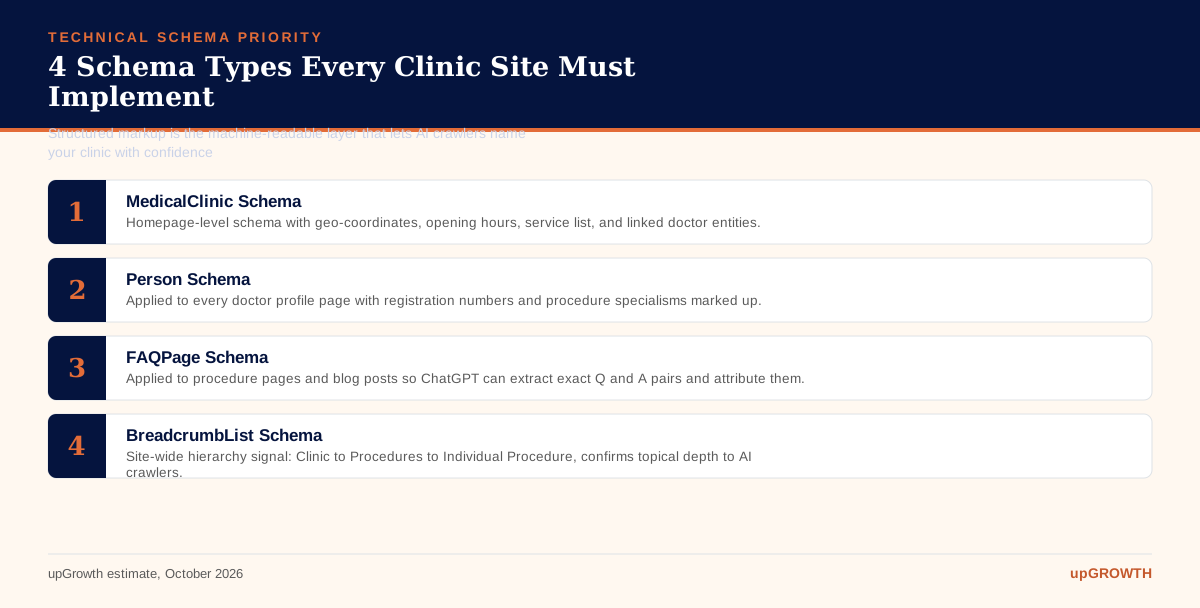
Use Person schema and MedicalOrganization schema together on each doctor profile page so AI crawlers can associate the doctor with the clinic and with the specific procedures she performs. Add a link from that profile page to the relevant procedure pages. This internal association matters: when ChatGPT is asked “who is the best hair transplant surgeon in Jaipur,” the AI’s confidence in naming Dr. Rajan Mehta is higher when his entity page explicitly connects him to that procedure at a named clinic with a verifiable credential.
Publish one fully marked-up doctor profile page per practitioner before you do anything else in this optimisation process. It is the connective tissue that makes every other signal work. Without it, your third-party mentions, your reviews, and your procedure pages are all floating, unconnected facts that the AI can’t reliably attribute to a single, coherent entity.
Signal 2: Procedure Pages With Outcome Transparency and Pricing Signals
When a patient asks ChatGPT “how much does a hair transplant cost in Chennai,” the AI pulls from pages that include price ranges and realistic outcome language. Pages that say “call for pricing” are not cited. Pages that describe outcomes in vague, promissory terms (“you will achieve a full head of hair”) are actively down-weighted by quality filters. The pages that get cited are the ones that provide structured, honest, medically appropriate information that an AI can extract as a direct answer to a specific question.
The YMYL (Your Money, Your Life) framing matters here. Every outcome statement on a clinical procedure page should be generic, statistically grounded, and non-promissory. Write “patients typically see initial regrowth within 3 to 4 months based on published FUE outcome studies” rather than “you will see results in 90 days.” The first statement is AI-citable. The second triggers quality filters on both Google’s systems and AI retrieval models trained to identify overclaiming in healthcare content.
Structure each procedure page with the following elements, in this order: what the procedure is, who it is clinically appropriate for, what to expect during the process, a realistic recovery timeline, an approximate cost range (even a broad band like “Rs 45,000 to Rs 1.2L depending on graft count” is better than no figure), the named doctor who performs it, and one or two patient testimonials with ReviewSchema markup. Pages that include price transparency receive significantly more AI citation pickups than those that withhold pricing, internal analysis of content performance across healthcare clients consistently shows this pattern, with the delta running more than 2x in favour of transparent pages.
Add FAQPage schema to every procedure page. This is the mechanism that allows ChatGPT to surface the exact Q and A pair from your page when a patient asks a procedure-specific question. A patient asking “is PRP therapy painful” who receives an answer that cites your clinic’s FAQ by name is a patient who arrives at your consultation already primed to trust you. That attribution happens only when your FAQ content is structurally marked up, not when it is buried in a paragraph of running prose.
According to Google Search Central’s guidance on structured data, FAQPage schema allows both traditional search features and AI-powered overviews to extract and present Q and A content directly. The same structured content that earns a rich result in Google also increases your probability of being cited in a ChatGPT answer. One implementation serves both channels.
Signal 3: Review Distribution Across Platforms (Not Just Google)
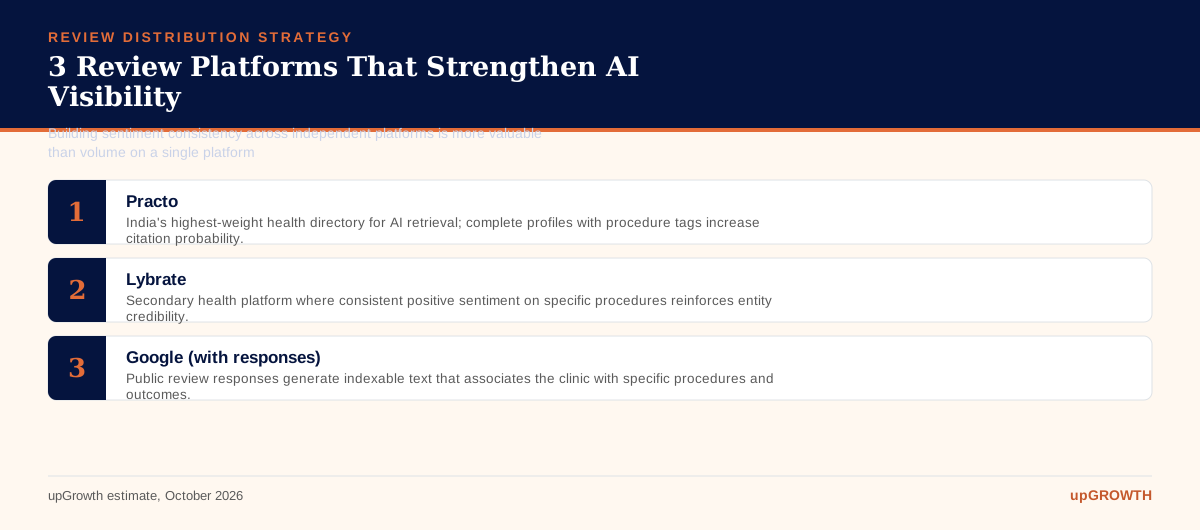
ChatGPT does not read your Google Maps star rating in isolation. What it reads, particularly in Browse-enabled sessions, is editorial summaries, aggregated sentiment themes from sites like Practo, Lybrate, Justdial, and Healthgrades, and forum discussions on Quora and Reddit where patients describe their experiences by procedure and clinic name. A clinic that is praised consistently across three or more independent platforms for the same specific quality, “minimal downtime,” “the doctor spent 40 minutes explaining the procedure,” “pricing matched what they told me on the phone,” receives a meaningfully stronger credibility signal than a clinic with 400 Google reviews and no presence elsewhere.
The AI is looking for sentiment consistency, not volume. Consistency across independent sources tells the AI that the quality is real and not a product of a single concentrated review campaign. Volume on a single platform is far easier to manufacture, and AI retrieval systems, trained on web-scale data, have learned to discount it accordingly.
Review velocity also matters. A clinic with 31 new reviews in the last 90 days signals an active, currently operating practice to AI retrieval systems. A clinic with 380 total reviews, all written between 2021 and 2023, signals a static entity whose current quality is unverifiable. From an AI confidence standpoint, recency and activity are proxies for relevance.
The practical tactic is simple: build a post-consultation review flow that directs patients to Practo or Lybrate in addition to Google. A QR code at the checkout desk, a WhatsApp message 48 hours post-visit, and a brief instruction from the front desk staff are enough to split review volume across platforms without asking anything more of the patient than they were already willing to give. Responding to reviews publicly also generates indexable text that reinforces your clinic’s association with specific procedures, specific outcomes, and specific doctor names. Every response is a piece of structured, attributable content.
Signal 4: Third-Party Editorial Mentions and Cited Sources
This is the single highest-weight signal for AI recommendation, and the one most clinic owners have never deliberately pursued. Being named by an independent editorial source, a medical journal, a city health guide, a national newspaper health vertical, or a reputable health media website, with no commercial relationship attached, is the closest thing to a direct trust vote that AI models recognise. The logic mirrors the way academic citation works: the more independent, credible sources reference your entity, the higher the AI’s confidence in naming you.
Target publications differ by market. For India-based clinics: Times of India’s health vertical, The Hindu’s science and health pages, Healthshots, and OnlyMyHealth carry strong editorial credibility signals. For GCC-based practices: Gulf News Health and Khaleej Times health coverage reach the same threshold. A single paragraph in a Times of India article in which your clinic’s dermatologist comments on a trending procedure is worth more to your AI visibility than 17 generic blog posts published on your own site.
The tactic is to position one or two doctors from your clinic as available expert sources for health journalists. Most city-beat health reporters at national publications are perpetually looking for credentialled practitioners who can comment on a story quickly and accurately. Send a brief, direct email to the health desk: “Dr. [Name], [qualification], [registration number], available for comment on [topic]. Response within 2 hours.” That one outreach, if it lands in the right moment, produces a durable, AI-readable citation that compounds over years.
Guest contributions on platforms like the Practo Health Feed or MedPage Today for internationally positioned clinics build topical authority that AI models attribute back to the clinic’s entity. One important note: avoid paid “PR articles” on low-authority news aggregators. AI retrieval systems trained on quality signals discount or ignore content from domains with thin editorial standards. A paid placement on a site that publishes 200 press releases a day is not a citation. It is noise, and the AI knows the difference.
Signal 5: Technical Schema and Site Structure That AI Crawlers Prefer
The technical layer is where many clinics lose AI visibility despite strong content and reviews. Implementing MedicalClinic schema on your homepage, with geo-coordinates, opening hours, service list, and linked doctor entities, gives AI crawlers a complete, machine-readable summary of what your clinic is, where it is, and what it does. Without this, even excellent content sits behind an interpretive barrier that reduces the AI’s confidence in naming you accurately.
Use BreadcrumbList schema site-wide so AI retrieval tools understand your site hierarchy: Clinic > Procedures > Individual Procedure. This hierarchical signal communicates topical depth. A site where the AI can trace a clear path from the homepage to a hair transplant procedure page to a specific surgeon’s profile is a site the AI can cite with precision. A flat site structure with no breadcrumb signal is harder to navigate and harder to attribute.
Canonical URLs matter more than most clinic teams realise. If your hair transplant page exists under three URL variants due to filter parameters or CMS-generated duplicates, AI retrieval systems may split the credibility signal across all three instead of concentrating it on one authoritative URL. A canonical tag pointing all variants to the primary URL is a five-minute technical fix that protects weeks of content investment.
Page speed is a functional requirement. AI Browse tools time out on slow pages. A sub-2-second load time on mobile is the threshold that keeps your pages in play for AI retrieval. Pages that load in 4 or 5 seconds on a mid-range Android device are effectively invisible to Browse-based AI queries, regardless of how strong their content is. The Search Engine Journal’s 2026 coverage of AI crawling behaviour confirms that page speed thresholds for AI retrieval are stricter than those for traditional Google indexing.
Internal linking from blog content to procedure pages is the compounding layer. A clinic blog with 9 posts on hair transplant aftercare, donor area care, and FUE vs FUT comparisons, all internally linking to the main hair transplant procedure page, builds a content cluster that AI treats as a signal of genuine topical authority. The cluster says: this site knows this procedure deeply. That inference increases the probability of being named when a patient asks a procedure-specific question.
The 90-Day Visibility Plan: What a Single-Location Clinic Should Do First
The five signals above are not equally time-intensive to address. Sequencing matters. A clinic that spends month one on the right foundations will compound faster in months two and three than one that tries to do everything at once.
Month 1: Audit and fix. Publish a fully schema-marked doctor entity page for every practitioner. Add MedicalClinic and LocalBusiness schema to the homepage with geo-coordinates and a complete service list. Identify the top 5 procedures driving your current consultations and either create or rewrite dedicated pages for each one. Every procedure page gets outcome transparency language, an approximate price range, and FAQPage schema. Before month one ends, run your target queries through ChatGPT and Perplexity to set a baseline. Document exactly what comes up and who gets named.
Month 2: Distribute. Build or complete profiles on Practo, Lybrate, and Justdial (for Indian clinics) or the DHA directory and Shafaa for GCC practices. Launch a post-consultation review flow that directs patients to at least two platforms in addition to Google. Identify two health journalists or publications and pitch one of your doctors as an expert source. One placed quote in one credible publication in month two is worth more than any single technical fix you make in month one.
Month 3: Measure and compound. Query ChatGPT and Perplexity with your target procedure and city phrases and compare against the month-one baseline. Track referral traffic from unbranded health queries in GA4. Begin a content cluster around your primary procedure: 4 to 6 supporting blog posts that answer the specific questions patients ask before booking a consultation, all internally linked to the main procedure page. By the end of month three, your clinic’s entity should be visible in at least some AI-generated responses for city-specific procedure queries.
For clinic teams that want this executed without managing it in-house, the GEO and AEO services at upGrowth cover the full scope: schema implementation, entity page publishing, editorial outreach, review distribution strategy, and content cluster development with 90-day milestones.
Five AI Visibility Signals: What Each Requires and When It Pays Off
Signal
Primary Action
Time to Implement
Typical Impact Timeline
Doctor Entity Pages
Publish dedicated URLs with Person schema and registration numbers
1-2 days per doctor
30 to 45 days post-indexing
Procedure Pages with FAQPage Schema
Add outcome language, price ranges, and structured FAQ markup
3-5 days per procedure
30 to 60 days
Review Distribution
Build post-consultation flow to Practo, Lybrate, and Google
1 week to set up the flow
60 to 90 days for volume
Editorial Mentions
Pitch doctors as expert sources to health journalists
Ongoing; first placement in 30-60 days
Durable; compounds over months
Technical Schema and Site Structure
Implement MedicalClinic, BreadcrumbList, and canonical URLs
2-3 days for a developer
Immediate after re-crawl
Common Questions About Getting Your Clinic Recommended by ChatGPT
How do I get my clinic recommended by ChatGPT when patients search for procedures?
ChatGPT recommends clinics based on five key signals: structured schema markup on your site, dedicated doctor entity pages with verifiable credentials, procedure pages with transparent outcome and pricing language, consistent reviews across multiple platforms like Practo and Google, and third-party editorial mentions from health media. A Google Business Profile alone is insufficient because ChatGPT does not read Google Maps ratings in real time. Start with schema implementation and doctor profile pages as your first two actions.
Does having more Google reviews help my clinic appear in ChatGPT answers?
Google reviews contribute indirectly but are not the primary factor. ChatGPT retrieval systems look for sentiment consistency across multiple independent platforms, including Practo, Lybrate, Healthshots, and forum discussions on Quora or Reddit. A clinic with 80 reviews spread across four platforms and consistent positive themes around a specific procedure will typically outrank a clinic with 400 Google-only reviews. Building review presence on Practo and one additional health directory is a higher-value action than chasing Google review volume alone.
What schema markup should a clinic website use to appear in AI-generated recommendations?
A clinic website should implement MedicalClinic schema on the homepage, Person schema on each doctor profile page, MedicalProcedure or MedicalTherapy schema on procedure pages, FAQPage schema on both procedure and blog pages, and BreadcrumbList schema site-wide. These schema types allow AI retrieval systems to understand who the doctors are, what procedures the clinic offers, and what patients commonly ask, which directly increases the probability of being named in an AI-generated answer. Use Google’s Rich Results Test at developers.google.com/search to validate implementation.
How long does it take for a clinic to start appearing in ChatGPT recommendations after making these changes?
Most clinics see initial appearances in AI-generated responses within 60 to 90 days of implementing schema, publishing doctor entity pages, and building third-party editorial mentions. The timeline depends on how quickly third-party sources index and how active your review distribution is. ChatGPT with Browse retrieves live web content, so pages that are indexed and load quickly will be picked up faster. Set a 90-day baseline by querying your target phrases in ChatGPT before and after changes.
Is it enough to optimise for Google SEO or do I need a separate strategy for ChatGPT?
Traditional SEO and AI visibility (often called GEO or AEO) share some foundations, like fast-loading pages and quality content, but diverge significantly on what drives recommendations. Google SEO prioritises backlink authority and keyword matching, while AI retrieval prioritises entity clarity, structured data, sentiment consistency across platforms, and editorial citation quality. A clinic can rank on page one of Google and still be invisible to ChatGPT if its doctor pages lack schema and its name never appears in independent health media. You need a deliberate GEO and AEO layer on top of standard SEO.
Can a small single-location clinic in a tier-2 Indian city realistically get recommended by ChatGPT?
Yes, and in some ways it is easier in tier-2 cities because the competitive landscape for AI recommendations is less saturated. A dental clinic in Nagpur or a dermatology practice in Coimbatore that publishes complete doctor entity pages, builds Practo and Lybrate profiles, and earns one editorial mention in a regional health publication can appear in ChatGPT responses for city-specific queries within 90 days. The AI rewards completeness and consistency, not just domain authority, so a well-structured small clinic can outperform a larger competitor that has not optimised for AI signals.
What kind of content on my clinic website helps ChatGPT trust and cite my clinic?
The most trusted content types for AI citation are procedure pages with specific, non-promissory outcome language, doctor profile pages with verifiable credentials, patient FAQ sections using FAQPage schema, and blog posts that answer procedure-specific questions with references to published medical guidelines or studies. Content that makes medical outcome promises without evidence, uses vague language, or lacks an identified qualified author will be down-weighted by AI quality filters. Every piece of clinical content should be attributed to a named, credentialled doctor on your team to pass YMYL trust checks.
Your Next Move: Get Your Clinic on ChatGPT’s Radar
If a patient in your city asked ChatGPT right now for the best clinic for your core procedure, would your name come up? Run the test before reading any further. Type your procedure and city into ChatGPT and see who gets named. If it is not you, the gap is fixable, but it requires a specific set of actions across schema, entity pages, review distribution, and editorial placement that most clinic teams do not have the bandwidth to execute alone.
At upGrowth, we have built GEO and AEO strategies for healthcare and wellness brands across India and the GCC. The same content-authority approach that helped Delicut scale from 40K AED to over 2 million AED per month in the UAE market applies directly to single-location clinics trying to earn AI recommendation slots in competitive city markets. We audit your current AI visibility, identify the exact gaps, and build the 90-day action plan with you or for you.
Book a 30-minute strategy call. We will query ChatGPT and Perplexity live with your target procedure and city, show you what signals your top competitors have that you do not, and give you a prioritised fix list before the call ends. No retainer commitment required for the audit call.
Answer Engine Optimisation (AEO) is the process of making your clinic's information structured, consistent, and authoritatively referenced across the web so that AI language models can confidently recommend you. Unlike traditional SEO, which focuses on ranking for keywords on a search engine like Google, AEO focuses on building your clinic's entity prominence so you become a verified, trustworthy answer to a patient's question.
The shift is critical because AI like ChatGPT doesn't 'search' Google; it synthesizes information from numerous credible sources. While SEO might get you page-one rankings, AEO gets you named directly in a generative response. A Dubai clinic saw a 34% spike in bookings from this principle alone, without any ad spend. This strategy is about being the most credible and verifiable entity, not just having the best keywords. The full article details the specific signals required to achieve this.
Entity prominence is a measure of how consistently and authoritatively your clinic (the 'entity') is mentioned across multiple independent and credible online sources. ChatGPT builds confidence by cross-referencing these signals, not by checking a single ranking list. A clinic with fewer Google reviews but mentions on Practo, in a Times of India article, and on Lybrate will be seen as more prominent than a competitor with only on-site reviews.
This is a fundamental change because it moves the goal from gaming an algorithm to building a verifiable reputation. Your marketing effort must now focus on creating a web of trust signals that an AI can parse. This includes:
Consistent listings in medical directories.
Features in editorial content.
Structured data on your own doctor pages.
The AI is not counting stars or keywords; it is assessing the strength and consistency of your digital footprint. Understanding this is the first step to being recommended.
ChatGPT prioritizes the credibility and independence of sources to validate information, especially for high-stakes Your-Money-Your-Life (YMYL) topics like healthcare. While Google reviews are a useful signal, they exist within a single ecosystem. Mentions on independent platforms and in editorial content are weighted more heavily because they represent third-party validation.
An AI model interprets these signals differently. A listing on Practo or Lybrate confirms the clinic's credentials and operational status from a trusted medical directory. A citation in a Times of India health article provides editorial endorsement. These diverse, high-authority signals build a stronger case for your clinic's 'entity prominence' than a larger volume of reviews on one platform. It's about the quality and diversity of your digital mentions, not just the quantity. The article outlines how to secure these high-value mentions.
This case study is a powerful illustration of AEO in action, proving that being 'legible to AI' can be a more effective patient acquisition channel than paid advertising. The 34% spike in bookings came because the clinic had built a strong, credible, and consistent online presence that ChatGPT could read, verify, and confidently name as a recommendation. The clinic did not go viral or run a campaign; it simply had its digital house in order.
The core principle demonstrated is that AI-driven discovery rewards authority and trustworthiness over advertising budget. By establishing clear entity signals across multiple platforms, the clinic became a low-risk, high-confidence answer for the AI. This shows that investing in foundational trust signals creates a durable asset that generates high-intent patient leads organically. Discover the exact signals that made this outcome possible in the full guide.
The success of Delicut, growing from 40K to over 2 million AED in monthly sales, was founded on building trust signals that made the brand discoverable across both AI and traditional search. While it was a different industry, the logic applies directly to healthcare. upGrowth Digital focused on creating a consistent and authoritative presence that made Delicut the clear, verifiable choice in its category.
A hair transplant practice in Chennai can apply this by focusing on three key areas:
Doctor Authority: Build detailed entity pages for your surgeons that AI can easily parse for credentials.
Third-Party Validation: Secure mentions and complete profiles on credible medical directories and local health news sites.
Procedural Expertise: Create structured content about your specific procedures that establishes you as a subject matter expert.
This strategy moves beyond simple ads to build a long-term, defensible online reputation. The complete breakdown shows how to implement this for your clinic.
Search Engine Land documented that sources appearing in generative AI answers consistently share a specific profile, which is the foundation of Answer Engine Optimisation. These sources are not just those with high domain authority or keyword density. Instead, they exhibit a combination of structured markup, extensive editorial third-party mentions, and consistent entity signals across the web.
This evidence directly supports the AEO model because it confirms that AI systems prioritize verifiable authority over traditional SEO metrics. For a clinic, this means the AI is looking for confirmation of your expertise from multiple independent points, not just your own website's 'ranking'. This includes structured data that clearly defines who your doctors are, what procedures you offer, and citations from other reputable sites that corroborate these facts. The article details how to build this exact profile for your practice.
To get your Chennai clinic recommended by ChatGPT, you must shift your focus from traditional SEO to building a web of verifiable trust signals. The foundation is making your clinic's entity, doctors, and procedures 'legible' to an AI. Here are the first three steps to take:
Create Doctor Entity Pages: Develop dedicated, structured URLs on your website for each surgeon. These pages should clearly list their qualifications, specializations, and credentials in a format that an AI can easily read and verify.
Optimize Directory Listings: Ensure your clinic has a complete, consistent, and detailed profile on major healthcare directories like Practo and Lybrate. Consistency in your name, address, and phone number is crucial.
Seek an Editorial Mention: Actively pursue a citation or feature in a local digital publication's health section. Even one mention from a credible third-party source significantly boosts your entity's prominence.
These actions form the bedrock of an AEO strategy explored further in the article.
Clinics must evolve their digital strategy from a keyword-ranking mindset to an entity-verification mindset to maintain visibility in the age of AI. Ranking on Google is no longer sufficient when AI synthesizes answers from the entire web. The long-term strategy should be to build a durable, defensible reputation as a trustworthy and authoritative entity in your specific medical field and location.
This adjustment involves diversifying your digital presence and focusing on signals that AI values: consistent information across all platforms, validation from third-party medical and editorial sites, and clearly structured data about your doctors and services. Instead of chasing fleeting algorithm changes, you invest in building a permanent, verifiable record of your expertise. This not only prepares you for AI-driven discovery but also strengthens your brand's overall authority and patient trust. Learn how to future-proof your clinic's digital strategy in the complete guide.
The critical mistake is optimizing for a search engine's ranking algorithm instead of making the clinic's expertise verifiable to an AI language model. A high Google ranking is just one signal among many and often isn't the most important one for an AI constructing an answer. These well-funded clinics are invisible to ChatGPT because their 'authority' exists only within the Google ecosystem, lacking the broad, third-party validation that an AI requires for a confident recommendation.
AEO provides the direct solution by shifting the focus from ranking to verification. It involves building and broadcasting trust signals across a wide range of independent sources, including medical directories, editorial publications, and structured data schemas. This creates a powerful, cross-referenced profile of credibility that makes your clinic the most logical and reliable answer to a patient's query. The full article breaks down how to pivot from this flawed SEO model.
ChatGPT does not query Google Maps directly for ratings; it assembles a probability-weighted answer by assessing your clinic's 'entity prominence' across its vast training data and live web sources. A high star rating on a single platform is a weak signal compared to multiple, independent confirmations of your clinic's expertise. The AI weights editorial and structured directory mentions more heavily because they represent a higher level of verification.
To solve this visibility gap, a clinic in Pune should focus on building a strong off-site presence. Key actions include:
Securing a feature in the health section of a local Pune newspaper's website.
Getting listed with a complete profile on platforms like Practo and Lybrate.
Having its doctors cited or quoted in articles related to their specialty.
This diverse set of signals makes the clinic a more verifiable and trustworthy entity. Explore the full list of essential signals in the complete analysis.
The shift toward Answer Engine Optimisation (AEO) signals a significant reallocation of future digital marketing budgets and a demand for new skills. Budgets will likely move away from a heavy reliance on paid performance ads (like Google Ads) toward investments in content creation, digital public relations, and technical SEO focused on structured data. The Dubai clinic's success with a 34% booking spike on zero ad spend is a leading indicator of this trend.
For marketing teams, this requires developing new competencies. Instead of just bid management and keyword research, professionals will need skills in:
Entity Management: Ensuring consistent clinic and doctor information across the web.
Editorial Outreach: Building relationships to secure mentions in credible publications.
Structured Data Implementation: Marking up website content so AI can easily parse it.
Adapting your team's skills is crucial for staying visible in an AI-first world.
AEO and Google Ads represent fundamentally different approaches to patient acquisition. A Google Ads campaign is a short-term, cost-per-click strategy that drives traffic as long as you are paying; it is like renting visibility. In contrast, AEO is a long-term, asset-building strategy that creates a durable, organic source of patient leads; it is like owning your visibility.
The process for AEO involves building your clinic's authority and verifiability across the web through content, directory listings, and editorial mentions. This investment compounds over time. The Dubai clinic that saw a 34% booking increase without ads showcases the long-term value. While ads provide immediate but temporary traffic, AEO builds a defensible reputation that makes your clinic the go-to recommendation for AI systems, generating high-intent patients for years to come. The article explains how to balance these strategies effectively.
Amol has helped catalyse business growth with his strategic & data-driven methodologies. With a decade of experience in the field of marketing, he has donned multiple hats, from channel optimization, data analytics and creative brand positioning to growth engineering and sales.

 Growth Strategy and Planning
 Inbound Growth
 Growth Hacking
 Fractional CMO
 Search Engine Optimization
 Paid and Performance Marketing
 Social Media Marketing
 Demand Generation
 AI-Driven Growth Strategy
 AI-Native Workflow Automation
 Generative Engine Optimization
 Grove — AI Growth Strategist


 AI Automation
 Framework
 Case Study
 Tools
 Growth Tools
 Decision Tree
 Compare
 Custom GPT's
 AI Answer Gap
 Offer
 Webstories
 Quizzes
 Blog
 AI-powered Apps
 Social Media Tools
 Agency Fit Score