Contributors:
Amol Ghemud Published: November 18, 2026
Summary
Ads in Google AI Overviews mark a structural change in how paid search reaches buyers: Google now injects Shopping and Search ads directly inside AI-generated answer panels, not just below them. As of 2026, AI Overviews appear on over 50% of commercial queries in India, meaning advertisers who ignore this placement risk losing visibility at the moment of highest intent. This article explains the formats, eligibility criteria, bid logic, and measurement approach Indian advertisers need to act on today.
In This Article
Share On:
In May 2024, Google confirmed ads inside AI Overviews. By mid-2026, those placements are live across India on mobile and desktop for a wide range of commercial queries. And most Indian advertisers have not yet updated a single campaign setting to account for them.
That is not a criticism. It is just the math of how fast Google moves versus how fast most marketing teams audit their accounts. The problem is that “I’ll get to it next quarter” is now a real revenue decision, because the brands occupying those in-panel slots are capturing intent before the user even scrolls to the first blue link.
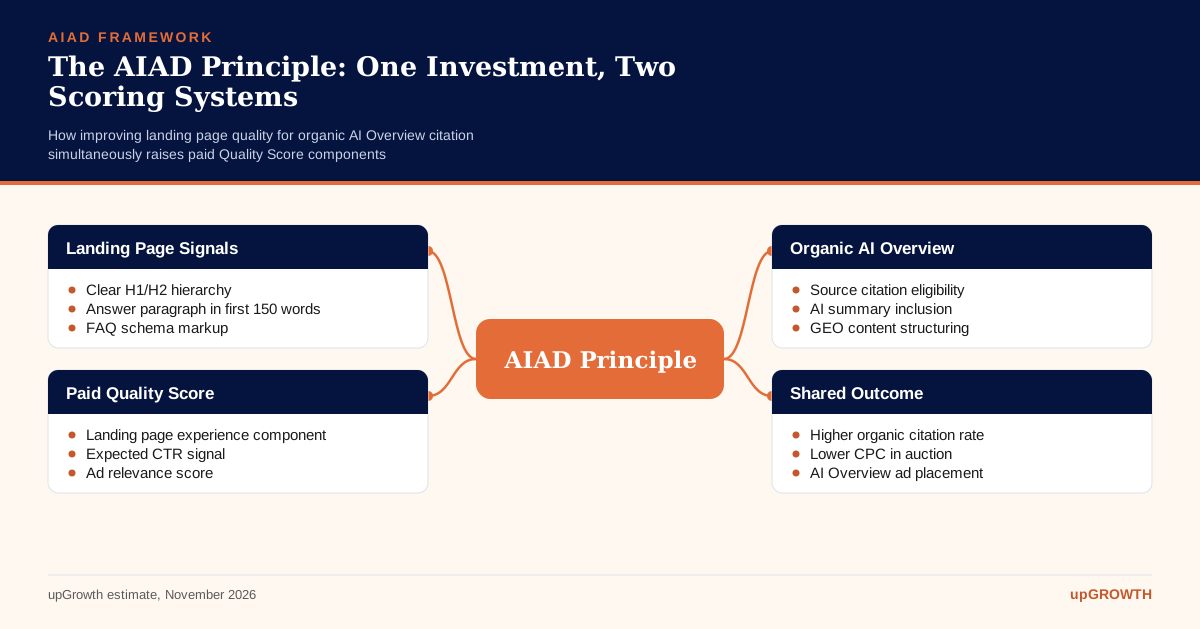
Here is what makes this shift genuinely different from every previous SERP change: the signals that determine whether your ad appears inside an AI Overview are the same signals that determine whether your content gets cited organically inside one. When Vance grew their Google AI Overview visibility from 12% to 89% through GEO-first content structuring, the structural improvements to their landing pages (clear answer paragraphs, direct H1/H2 hierarchy, FAQ schema) also raised their Quality Score components for paid placements. Organic and paid AI Overview strategy are not separate workstreams in 2026. They are the same workstream with two measurement outputs. upGrowth Digital calls this the AIAD principle: AI Ads and AI Discovery share the same eligibility layer, and optimising one lifts the other.
What follows is a practical breakdown of how ads in Google AI Overviews actually work, which campaign types qualify, how the auction logic runs, and what your team needs to do in the next 30 days to be in the running.
What Are Ads in Google AI Overviews and How Do They Work?
Google AI Overviews are AI-generated answer panels that appear above traditional blue-link results for informational and commercial queries. Ads inside them appear as clearly labelled “Sponsored” units embedded within or directly beneath the AI-generated text block. They are not a separate product you opt into. Eligible campaigns using Search, Shopping, or Performance Max can appear there automatically when Google determines it benefits the user experience for that specific query.
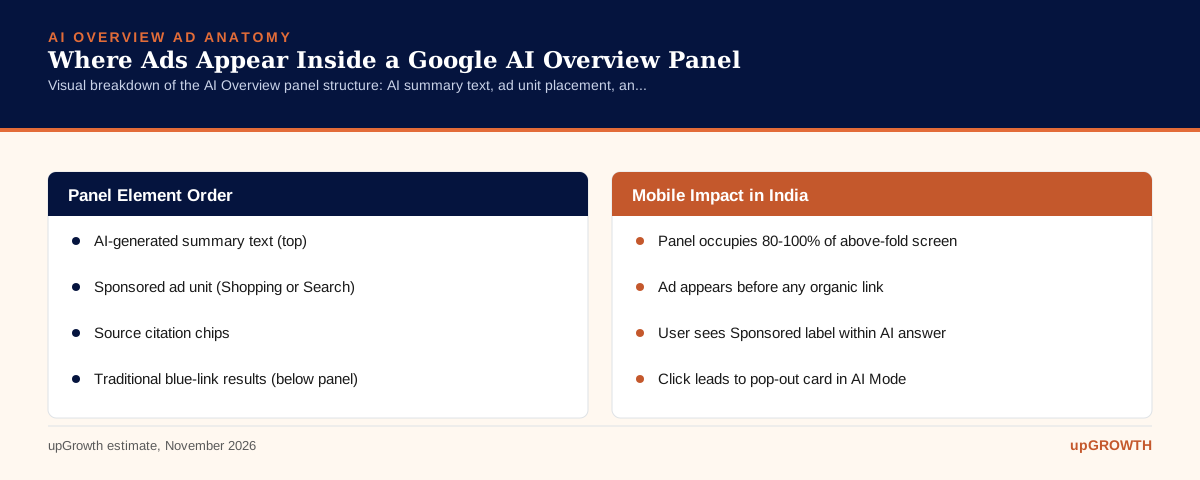
The visual structure matters because it determines where user attention lands. The AI summary text sits at the top of the panel. Source citation chips appear below the text as clickable references. The ad unit slots in between the summary and the citations, or immediately below them, depending on query type and device. On mobile in India, the AI Overview panel frequently occupies 80% to 100% of above-the-fold screen space. An ad inside that panel is not competing with six other SERP results. It is the first commercial signal the user encounters, period.
Google serves ads inside AI Overviews when the query has commercial intent and the advertiser’s campaign, keyword match, and landing page relevance meet the threshold set by its auction system. The trigger is not the keyword in isolation. It is the combination of query intent, the AI Overview instance Google has generated for that query, and whether a qualifying ad is competitive enough to be served without degrading the user experience of the AI answer itself.
Show me a landing page that takes 7 seconds to load on a mobile connection in Mumbai, and I’ll show you a campaign that will never see an AI Overview impression regardless of bid.
According to Search Engine Land, Google began scaling AI Overview ad placements globally through early 2026, with Shopping ads leading adoption and text ads following for service and finance categories. The placement is explicitly designed to serve ads when they “are helpful to the specific search” rather than as a default revenue mechanism, which is precisely why Quality Score components carry more weight than raw bid in determining eligibility.
AI Mode Ads: How Google’s Conversational Search Changes Ad Placement
AI Mode is Google’s fully conversational search interface and it is distinct from AI Overviews in one critical way: it replaces the traditional SERP entirely with a multi-turn chat-style experience. Ads in AI Mode appear as contextual units tied to the conversation thread rather than a single query. A user who asks “what personal loan has the lowest processing fee for salaried employees in Pune” and then follows up with “which of those have instant approval” can generate multiple impression opportunities for a relevant fintech advertiser across both turns, without triggering a new search.
As of November 2026, AI Mode is available in India via Google Search Labs opt-in and is being progressively rolled out to general users. Advertisers cannot yet specifically target AI Mode as a named placement. Campaigns eligible for AI Overview ads are also eligible for AI Mode ad slots, so the same campaign hygiene that gets you into the former gets you into the latter.
The practical difference for query structure is significant. AI Mode queries skew longer and far more specific than traditional searches. “Best SaaS project management tool under Rs 500 per user per month with Slack integration” is a realistic AI Mode query. That specificity favours Performance Max and broad-match Search campaigns with Smart Bidding because those structures give Google the semantic flexibility to enter auctions for query variants your keyword list would never explicitly cover.
AI Mode is also not SGE rebranded. SGE was an experimental overlay. AI Mode is a persistent interface choice a user makes, and it fundamentally changes how they navigate from ad to landing page. Instead of a standard SERP click, users access a pop-out card that previews content without leaving the conversation. That interaction pattern has real implications for bounce rate measurement and attribution that most Indian advertisers have not yet accounted for in their reporting.
The honest concession here: conversion rate data from AI Mode placements is thin. It is early. Any agency claiming precise AI Mode ROAS benchmarks for Indian markets in November 2026 is working with a very small sample. What we know directionally is that session depth is higher and exit intent is lower compared to standard SERP clicks, which suggests conversion quality is better even if volume is currently modest.
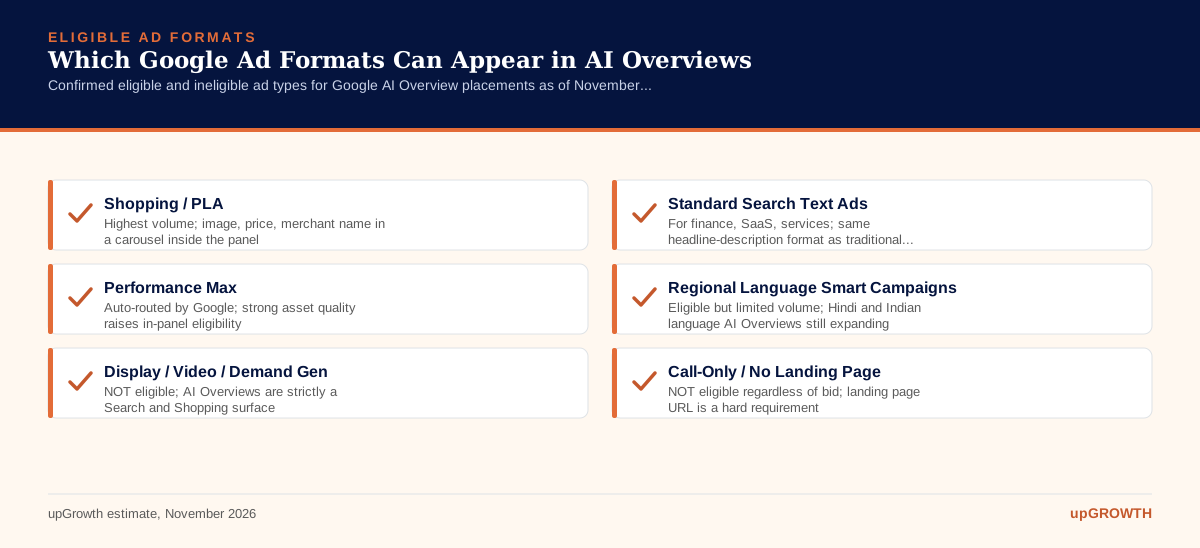
Google Shopping ads (Product Listing Ads) were the first format confirmed for AI Overview placement and remain the most commonly served inside the panel for product queries. They appear as a carousel of product cards with image, price, and merchant name. For Indian D2C brands and e-commerce advertisers, this is currently the highest-volume opportunity inside AI Overviews.
Standard Search text ads appear inside AI Overviews for service, finance, and lead-generation queries where there is no physical product to display. They follow the same headline-description structure as traditional Search ads. Fintech brands, SaaS companies, and B2B service providers in India are most likely to see this format serve inside their relevant AI Overview panels.
Performance Max campaigns are automatically eligible. Google’s internal routing determines placement, and PMax campaigns with strong asset quality and high landing page relevance scores are more likely to win AI Overview placement. The implication: weak PMax creative does not just hurt YouTube and Display performance. It weakens your AI Overview eligibility too.
What does not qualify, as of November 2026:
Display, Video (YouTube), and Demand Gen campaigns are not placed inside AI Overview panels. This is strictly a Search and Shopping surface.
Call-only ads and ads without a landing page URL do not qualify.
Smart campaigns in Hindi and regional Indian languages are eligible in principle, but volume is lower because AI Overviews for non-English queries in India are still expanding.
The regional language point is worth flagging separately. If your campaigns run in Tamil, Telugu, Marathi, or Hindi, you are not locked out of AI Overview placements permanently. You are just early. Google’s AI Overview coverage for Indian regional language queries was expanding through mid-2026 according to Search Engine Journal, and campaign teams that build out language-specific asset quality now will have a structural advantage when volume catches up.
Ad Format Eligibility for Google AI Overview Placements (November 2026)
Ad Format
Eligible for AI Overviews?
Best For
Shopping / PLA
Yes (highest volume)
D2C, e-commerce, product queries
Standard Search (text)
Yes
Fintech, SaaS, services, lead gen
Performance Max
Yes (auto-routed)
All verticals with strong asset quality
Display / Video / Demand Gen
No
Not applicable for AI Overview surface
Call-only / No landing page
No
Ineligible regardless of bid
Smart campaigns (regional language)
Yes, but limited volume
Hindi, Tamil, Telugu queries (expanding)
How Bidding, Auction, and Placement Logic Work Inside AI Overviews
There is no separate bid modifier for AI Overview placement. The same Max CPC, Target CPA, Target ROAS, or Maximize Conversions strategy governing your standard Search campaign determines eligibility and position inside the AI Overview panel. Google has not created a premium auction layer for this placement. It has extended the existing auction into a new surface, which is both good news (no new budget line required) and a trap (if your Quality Score is mediocre, more money solves nothing).
Ad Rank inside the AI Overview panel is calculated the same way as traditional Search Ad Rank: bid multiplied by Quality Score, adjusted for auction-time signals including expected clickthrough rate, ad relevance, and landing page experience. The Google Ads Help documentation has not broken this out as a separate calculation for in-panel placements, and there is no indication it will. The panel is just a narrower stage running the same play.
The narrower stage is the key phrase. Google does not guarantee a fixed number of ad slots inside any AI Overview. It can range from zero to three depending on query, device, and commercial intent score of the specific AI Overview instance. Because the in-panel space is tighter than a full SERP, campaigns scoring Quality Score 5 or below on relevant keywords are effectively invisible to this placement even if they win Position 3 on a traditional SERP. The effective competition threshold is higher in the panel than below it.
Here is the AIAD principle in practice: improving landing page experience to win organic AI Overview citation directly raises your landing page experience Quality Score component. The same page that earns a source citation chip gets a better Quality Score signal in the paid auction. You are not choosing between organic AI Overview strategy and paid AI Overview strategy. You are building one asset that scores in both systems simultaneously.
For Indian advertisers watching cost per acquisition carefully, this is the highest-leverage insight in the entire article: AI Overview ad eligibility rewards Quality Score improvement, not bid increases. Quality Score improvements are free. They require content and UX work, not rupees in the auction. A campaign that moves from Quality Score 5 to Quality Score 8 on its top 20 keywords is not just 60% more competitive in the AI Overview panel. It is paying less per click everywhere.
Measurement: How to Track Ads in Google AI Overviews in Google Ads
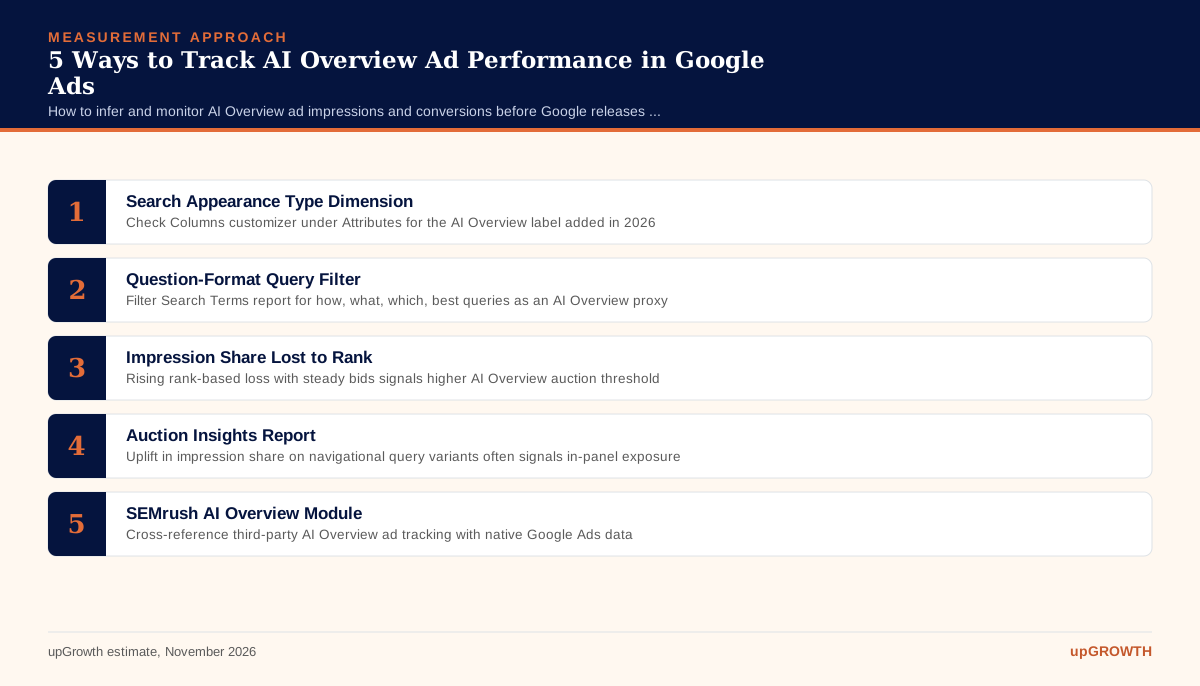
Google Ads does not currently offer a dedicated AI Overview placement report as a default column in the standard UI. Impression share, click data, and conversion data for in-panel ads flow into the same campaign and ad group rows as standard Search and Shopping data. That means right now, you cannot see “AI Overview impressions: 4,312” in a single clean view. You have to infer and triangulate.
Google introduced a “Search appearance type” dimension in Google Ads reporting in 2026, which includes an “AI Overview” label. Check whether this dimension is available in your account by opening the Columns customizer and looking under the Attributes section. Not all accounts have it yet, and rollout has been uneven across Indian accounts based on account age and campaign type mix.
The Search Terms report is your next-best signal. A sudden uplift in impression share on navigational or question-based query variants (queries starting with “how”, “what”, “which”, “best”) often signals AI Overview placement is contributing impressions. These query structures are the ones most likely to trigger AI Overview generation on the results page. Building a custom filter in your Search Terms report to isolate question-format queries takes about 11 minutes and gives you a persistent proxy metric you can track week over week.
For Shopping campaigns specifically, monitor the “Impression share lost to rank” metric alongside average position shifts. If you see rank-based impression share loss increasing while bids hold steady, it is a reasonable inference that AI Overview competition is raising the effective Ad Rank threshold for in-panel placement.
Third-party tools including SEMrush and Optmyzr added AI Overview ad tracking modules in 2026. Cross-referencing these with native Google Ads data builds a more complete picture, though no third-party tool yet claims real-time in-panel impression data for Indian accounts. The data is directional, not definitive.
Conversion attribution works the same way as standard Search: clicks from inside AI Overview ads attribute to the same conversion window and model as traditional Search clicks. There is no separate attribution path, which simplifies reporting but also means you cannot currently isolate AI Overview ad ROAS from standard Search ROAS in a single campaign. That is a measurement limitation worth raising with your media team, because it creates a risk of under-valuing AI Overview conversions if they skew toward longer-consideration queries.
Ads in Google AI Overviews vs. ChatGPT Ads: Key Differences for Indian Advertisers
ChatGPT ads (OpenAI’s sponsored content program, announced in 2025 and expanded through 2026) operate on a fundamentally different infrastructure. They are contextual placements inside ChatGPT’s conversational responses, sold through a separate buy, not through Google Ads. If you are considering a budget split between the two, the starting question is not “which is better.” It is “which one has the infrastructure I can actually measure and act on.”
Google AI Overview ads inherit the entire Quality Score, conversion tracking, audience signal, Smart Bidding, and billing infrastructure Indian advertisers already have in place. There is no new account to open, no new pixel to deploy, no new creative format to learn. ChatGPT ads require a separate account, distinct creative set, and reporting integration with limited third-party attribution support in India as of late 2026.
The intent signal difference is real and consequential. Google AI Overviews trigger on explicit search queries with declared commercial intent. The user typed something. ChatGPT interactions are more exploratory and research-oriented. A user asking ChatGPT about personal loan options in India is earlier in the funnel than a user Googling “apply for personal loan with low interest rate Pune.” Different funnel stage means different KPIs, different creative approach, and a different expectation of what “conversion” looks like within the first 30 days of a campaign.
Budget allocation for Indian advertisers with limited digital budgets: the highest-ROI move in 2026 is optimising existing Google Search and Shopping campaigns for AI Overview eligibility before allocating separate budget to ChatGPT ads. The compounding return from AIAD (better landing pages raising both organic citation probability and paid Quality Score) is measurable within a single billing cycle. ChatGPT ads are worth watching, worth testing at a small scale if budget allows, and worth revisiting when attribution matures. They are not yet a primary channel for most Indian performance advertisers.
Action Plan: How Indian Advertisers Should Prepare for AI Overview Ad Placements in 2026
The question is not whether to care about ads in Google AI Overviews. The placements are live, the inventory is real, and the brands in those slots right now are not necessarily the biggest spenders. They are the ones with the strongest Quality Scores and the clearest landing page content. Here is what to actually do, in order of leverage.
Step 1: Audit Quality Score components for your top 20 keywords. Pull the keyword-level Quality Score breakdown and prioritise landing page experience improvements for any keyword scoring 5 or below. This is the single highest-leverage action for AI Overview eligibility and it costs nothing in the auction.
Step 2: Align landing page content with AI-readable structure. Use clear H1/H2 hierarchy, include a direct answer paragraph in the first 150 words, and add FAQ schema markup. These are the same structural signals that drive organic AI Overview citation and they also improve landing page experience scores in Quality Score calculation. One investment, two scoring systems. That is the AIAD principle in practice.
Step 3: Expand to broad match with Smart Bidding. AI Overview ad placements are more likely to trigger on longer, conversational query variants. Broad match keywords paired with Target CPA or Target ROAS give Google the semantic flexibility to enter these auctions without you manually building out every long-tail variant.
Step 4: Review Performance Max asset quality. Ensure all PMax campaigns have high-quality image assets, strong headline and description diversity, and URL expansion enabled with page feeds pointing to the most relevant landing pages. Weak PMax creative hurts AI Overview eligibility, not just YouTube and Display performance.
Step 5: Set up custom columns in Google Ads to monitor question-based query variants (queries starting with “how”, “what”, “best”, “which”) as a proxy for AI Overview impression share until Google releases a dedicated segment. This takes under 15 minutes and gives you a week-over-week trend line.
Step 6: Fintech and SaaS advertisers specifically need to ensure landing pages comply with Google’s financial products advertising policies and display trust signals (RBI registration numbers, SSL certificate indicators, privacy policy links) above the fold. AI Overview ad eligibility in regulated categories carries stricter landing page standards, and a policy flag removes you from the auction entirely regardless of Quality Score.
According to recent Google Search Central documentation, structured content with clear answer formatting is a consistent signal for AI-generated surface inclusion. The overlap between that guidance and Quality Score landing page requirements is not coincidental. It is the same underlying system asking the same question: does this page give the user what they came for, clearly and quickly?
Yes. Google uses AI across its entire ads stack: AI determines Ad Rank in every auction, Smart Bidding strategies use machine learning to set bids in real time, Performance Max campaigns use AI to allocate budget across channels, and as of 2026, AI also decides which ads appear inside AI Overview panels on the Search results page. For advertisers, this means campaign structure, asset quality, and landing page relevance matter more than manual bid management because those are the inputs AI optimises against.
What are the types of Google Ads that can appear in AI Overviews?
As of November 2026, two ad types are confirmed for placement inside Google AI Overviews: Shopping ads (product listing ads showing image, price, and merchant) and standard Search text ads. Performance Max campaigns can also serve inside AI Overviews when Google determines the ad is relevant to the AI-generated answer. Display, Video, and Demand Gen ads are not placed inside AI Overview panels. Indian advertisers running Smart Shopping or standard Shopping campaigns in English are most likely to see in-panel placements today.
How does Google’s AI search work?
Google’s AI search, which powers AI Overviews and AI Mode, uses a large language model integrated with Google’s index to generate a synthesised answer directly on the search results page instead of only returning a list of links. The model selects and attributes information from web pages it deems authoritative for the query, displaying source citations as chips beneath the AI summary. AI Mode extends this to a fully conversational interface where users can ask follow-up questions within the same session. Paid ads are injected into these AI-generated surfaces through the standard Google Ads auction when queries carry commercial intent.
Do ads in Google AI Overviews cost more than regular Search ads?
No, there is no separate price or premium bid required to appear inside Google AI Overviews. Ads in AI Overviews are served through the same auction as standard Search ads, using the same Quality Score, Ad Rank, and bidding strategies advertisers already have in place. However, because AI Overview panels have fewer ad slots than a traditional SERP, the effective competition for a visible in-panel placement is higher. The practical implication is that improving Quality Score, specifically landing page relevance and expected clickthrough rate, is more cost-effective than raising bids.
How do I know if my ads are appearing in Google AI Overviews?
Google Ads introduced a ‘Search appearance type’ dimension in 2026 that includes an AI Overview label; check the Columns customizer under Attributes in your reporting view. Additionally, you can use the Search Terms report to identify question-based and conversational query variants driving impressions, which often signal AI Overview placement. Third-party tools such as SEMrush and Optmyzr added AI Overview ad tracking modules in 2026 that can supplement native Google Ads data. As of now, there is no single dedicated AI Overview placement dashboard, so cross-referencing multiple data sources is recommended.
What is the difference between Google AI Overview ads and ChatGPT ads?
Google AI Overview ads run through the existing Google Ads platform, using the same Quality Score, Smart Bidding, and conversion tracking infrastructure advertisers already use in India. ChatGPT ads are a separate product from OpenAI, requiring a distinct account and creative set, with limited third-party attribution support in India as of late 2026. Google AI Overview ads trigger on explicit search queries with declared commercial intent; ChatGPT ad interactions tend to be more exploratory and research-stage. For most Indian advertisers with limited budgets, optimising existing Google campaigns for AI Overview eligibility delivers faster, more measurable returns than launching a separate ChatGPT ads programme.
Which search engines are not AI-powered?
As of 2026, virtually all major search engines including Google, Bing, and Baidu have integrated AI-generated answer layers into their core results pages. DuckDuckGo and Brave Search offer AI summarisation features but allow users to disable them, making them closer to non-AI default experiences. Mojeek, the independent UK-based crawler, does not use an AI-generated answer layer on its main results. For advertisers, the practical reality is that the dominant platforms Indian users search on, primarily Google, are now AI-first, and campaign strategies must reflect this shift.
Your Next Move: Audit Your Campaigns for AI Overview Ad Eligibility
AI Overview ad placements are live in India right now. The brands winning those slots are not necessarily the ones spending the most. They are the ones with the strongest Quality Scores, the clearest landing page content, and the right campaign structure to let Google’s auction do its job. If you haven’t reviewed your top 20 keywords for landing page experience and Ad Rank components in the last 90 days, you’re almost certainly leaving AI Overview inventory on the table.
upGrowth’s paid media team works with SaaS, fintech, and D2C brands across India and the GCC to build campaigns that perform across both traditional SERP positions and emerging AI surfaces. We helped Vance grow their Google AI Overview visibility from 12% to 89% through GEO-first content structuring, and we apply the same framework to paid campaign eligibility. The technical signals that make a landing page AI Overview-worthy are the same ones that raise Quality Score, so the investment works across both channels simultaneously.
Book a 30-minute audit call and we’ll show you exactly which campaigns are closest to AI Overview eligibility, what it would take to get them there, and what the incremental impression value looks like for your category in India.
Amol has helped catalyse business growth with his strategic & data-driven methodologies. With a decade of experience in the field of marketing, he has donned multiple hats, from channel optimization, data analytics and creative brand positioning to growth engineering and sales