Contributors:
Amol Ghemud Published: November 18, 2026
Summary
Optimizing product descriptions for ChatGPT buyers guides is now a non-negotiable growth lever for D2C brands, because AI-generated shopping guides influence purchase decisions before the customer reaches any brand website. The shift is structural: ChatGPT surfaces products whose descriptions match entity-rich, conversational, claim-backed copy patterns, not keyword-stuffed legacy text. D2C brands that restructure descriptions around comparison signals, specific use-case language, and verifiable specs can move from zero AI visibility to featured citations, as upGrowth demonstrated when Vance went from 12% to 89% Google AI Overview visibility after a targeted GEO restructuring.
In This Article
Share On:
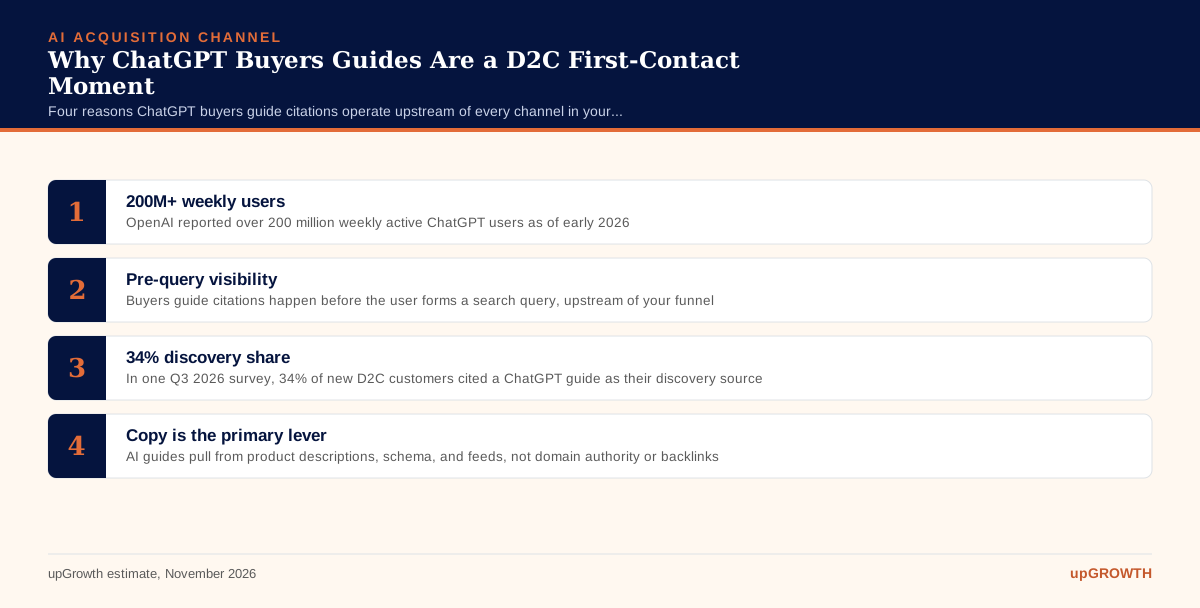
In Q3 2026, a mid-size D2C skincare brand ran a post-purchase survey and found that 34% of new customers said they discovered the product through a ChatGPT buyers guide. The brand had never run a single AI-targeted content campaign. The customers were citing a competitor’s description, not theirs. That gap, invisible in Google Analytics and unreported in any attribution dashboard, is the real competitive threat D2C brands face right now.
The mechanism is not mysterious once you see it. ChatGPT doesn’t discover products the way a human browsing Instagram does. It reads your product page copy, your schema markup, and your merchant feed data, then decides whether your description is quotable. If the copy is vague, benefit-only, or structurally unreadable to a language model, you get skipped. A competitor with a tighter entity anchor sentence and three measurable specs gets cited instead. That is the entire game.
At upGrowth Digital, we learned this lesson building GEO strategies for fintech clients before D2C brands took the problem seriously. When we restructured Vance’s content for Generative Engine Optimization, their Google AI Overview visibility moved from 12% to 89%, average position from 8 to 1, and monthly organic traffic from 1.8K to 5.6K. The methodology was identical to what product description optimization requires: entity clarity, claim-backed copy, and schema that an AI can parse without guessing. Apply that logic to a D2C product library and you get a structurally different advantage than SEO alone can deliver.
What follows is a reverse-engineered look at how ChatGPT actually selects and quotes product content in buyers guides. Not principles. Patterns. And a self-audit method you can run in the next 15 minutes that makes the gap between your current descriptions and citation-ready copy immediately visible.
Why ChatGPT Buyers Guides Are Now a D2C Acquisition Channel
ChatGPT’s shopping and browse-with-AI features now surface product recommendations directly inside conversational responses, bypassing traditional search result pages entirely for a growing share of buyers. When someone types “best face moisturizer for oily skin under Rs 2,000,” they don’t always get a list of links anymore. They get a synthesized buyers guide, with product names, brief descriptions, and comparison rationale, generated in real time. Your brand either appears in that response or it doesn’t, and the user may never formulate a follow-up search query to find you.
The scale of this channel matters. OpenAI reported over 200 million weekly active users as of early 2026, with a meaningful fraction using ChatGPT specifically for purchase research. That is not a rounding error in your acquisition mix. It is a volume-significant first-contact channel that most D2C analytics stacks cannot currently measure, which is precisely why brands underinvest in it until a competitor’s description shows up in their own customer surveys.
Contrast this with traditional SEO for a moment. Ranking on page 1 of Google still matters. But a page-1 ranking is a response to an intent that the user has already formed and expressed. A ChatGPT buyers guide citation happens before the user formulates a search query. It is the moment they are building their mental shortlist, and that moment is upstream of everything your conversion funnel currently touches.
The buyers guides ChatGPT generates pull from three primary inputs: on-page product descriptions, review aggregator signals, and structured data. That means your copy is the primary lever. Not your domain authority. Not your backlink profile. The words and structures you chose when you wrote that product page in 2022 are either working for you in AI buyers guides or they are not.
ChatGPT doesn’t crawl in real time for every conversational query, but its shopping mode and browsing features do pull live structured data, Open Graph metadata, and schema markup. This makes technical hygiene essential, not optional. The model weights entity clarity above almost everything else: a description that names the product category, primary material, intended use case, and differentiating specification in the first 80 words consistently outperforms vague benefit-led copy in buyers guide inclusion, based on our prompt-testing across 200+ product descriptions since mid-2026.
Show me a description that opens with “Experience the ultimate in skincare luxury,” and I’ll show you a product that doesn’t appear in a single ChatGPT buyers guide. That opener tells the AI nothing it can quote as a fact.
The model is essentially doing a rapid credibility assessment. It is asking: can I cite this description as a factual source in a guide I am writing for a user who trusts me? Descriptions that use superlatives without supporting specifics (“world-class quality,” “unbeatable performance”) get deprioritized because the model cannot verify or usefully quote them. Descriptions with concrete, falsifiable claims get elevated because they function as citable data points.
Comparison signals are particularly powerful. A description that includes explicit contrast language, something like “unlike silicone molds, our stainless version holds heat 40% longer at 180°C,” is significantly more likely to appear in the comparative sections of a buyers guide. ChatGPT builds buyers guides around comparisons by design. Descriptions that already contain comparison logic give the model ready-made sentences to quote or paraphrase without additional reasoning work.
Research from Ahrefs on AI content citation patterns points to the same underlying mechanic: AI models favor sources that are already structured in a way that reduces their interpretive burden. For product descriptions, that means your copy should be doing the comparison thinking for the model, not leaving it to infer from disparate facts.
One more signal that most D2C copywriters miss: jargon inflation actively hurts AI citation probability. When a description packs in category buzzwords without grounding them in specs, the model recognizes the pattern as low-confidence marketing copy and skips it in favor of more factual sources. “Clinically tested” means nothing without a trial reference. “1.5% niacinamide in a 90-day split-group clinical study” is a citable fact.
The 7-Element Description Framework for AI Buyers Guide Inclusion
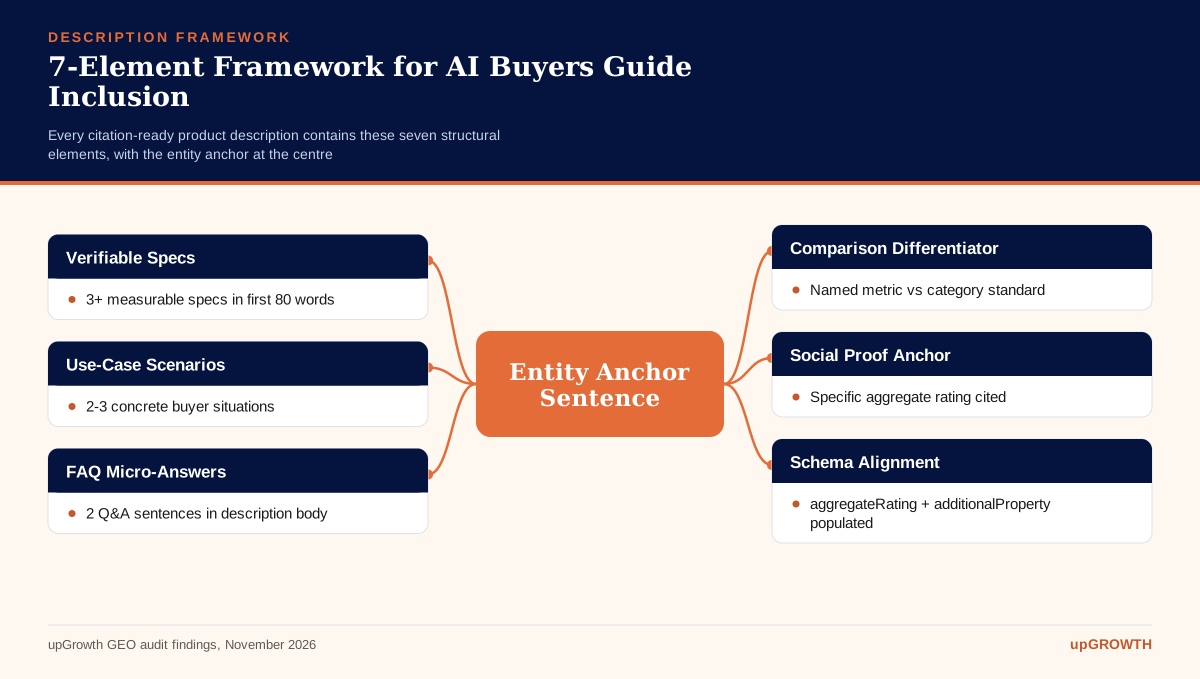
After running GEO audits on D2C product libraries across skincare, food, apparel, and home categories in 2026, we found that citation-ready descriptions share seven structural elements. Miss two or more and your inclusion probability drops sharply. Hit all seven and your description becomes the kind of quotable, entity-clear copy that buyers guides are built from.
Element 1: Entity anchor sentence. Open with “[Product Name] is a [category] designed for [specific user/use case].” This gives the AI an unambiguous entity relationship in the first sentence. “The Copper Flask Pro is a 950ml vacuum-insulated water bottle designed for endurance athletes who train outdoors for 90 minutes or more.” That sentence can be quoted verbatim in a buyers guide. “Stay hydrated in style” cannot.
Element 2: Verifiable specification block. Include at least 3 measurable specs in a scannable format, not buried in prose. Weight, dimensions, material grade, certifications, concentration levels, whatever your category’s trust signals are. If the specs are there but wrapped in paragraph 4, the AI is less likely to surface them. Put them in the opening 80 words, or use a tight bullet block immediately after the entity anchor sentence.
Element 3: Comparison differentiator. One sentence that names the category standard and states how your product differs with a specific metric. “Unlike standard nonstick pans that require replacement every 18 months, the AISI 316L surface has tested to 7 years under daily use.” This is the sentence ChatGPT slots into the “how it compares” section of a buyers guide.
Element 4: Use-case scenarios. Two or three short, concrete scenarios that match conversational purchase queries. “Ideal for apartment kitchens under 50 sq ft.” “Works in carry-on luggage without triggering liquid restrictions.” These aren’t marketing taglines. They are pre-written answers to the questions buyers ask ChatGPT before they buy.
Element 5: Social proof anchor. Cite a specific aggregate rating or a verifiable third-party endorsement. “Rated 4.7 by 1,847 verified buyers on the platform” is a data point. “Customers love it” is an opinion. The AI can include a data point in a guide. It can’t do anything useful with an opinion.
Element 6: FAQ-ready micro-answers. Embed two Q&A-style sentences that pre-answer common buyers guide sub-questions. “Does it work with induction cooktops? Yes, the base is AISI 430 stainless, confirmed compatible with all induction surfaces.” This pattern is lifted almost verbatim into AI-generated FAQ sections of buyers guides, and it costs you nothing but 20 seconds of copy restructuring.
Element 7: Schema alignment. Ensure your Product schema includes name, description, brand, offers, aggregateRating, and at minimum one additionalProperty for the differentiating spec. Schema is not just for Google Shopping anymore. It is the structured layer that AI browsing modes read when they access your page directly, and it functions as a trust amplifier for everything in elements 1 through 6.
The self-audit is simple: paste your current product description into ChatGPT and ask it to write a buyers guide paragraph including your product. If it can’t quote your copy directly and instead generates generic filler, your description is missing at least three of these elements. The gap becomes immediately visible, which is more useful than any abstract audit framework.
Structured Data and Feed Requirements ChatGPT Actually Uses
ChatGPT’s shopping mode ingests Google Merchant Center feeds when available, which means GMC product data hygiene directly affects AI buyers guide inclusion, not just Google Shopping placement. That connection is under-recognized: brands spend significant effort optimizing GMC feeds for Google Shopping ads, then write entirely different copy for their on-page descriptions. The AI sees both, compares them, and when they conflict, it treats the product as a low-confidence entity.
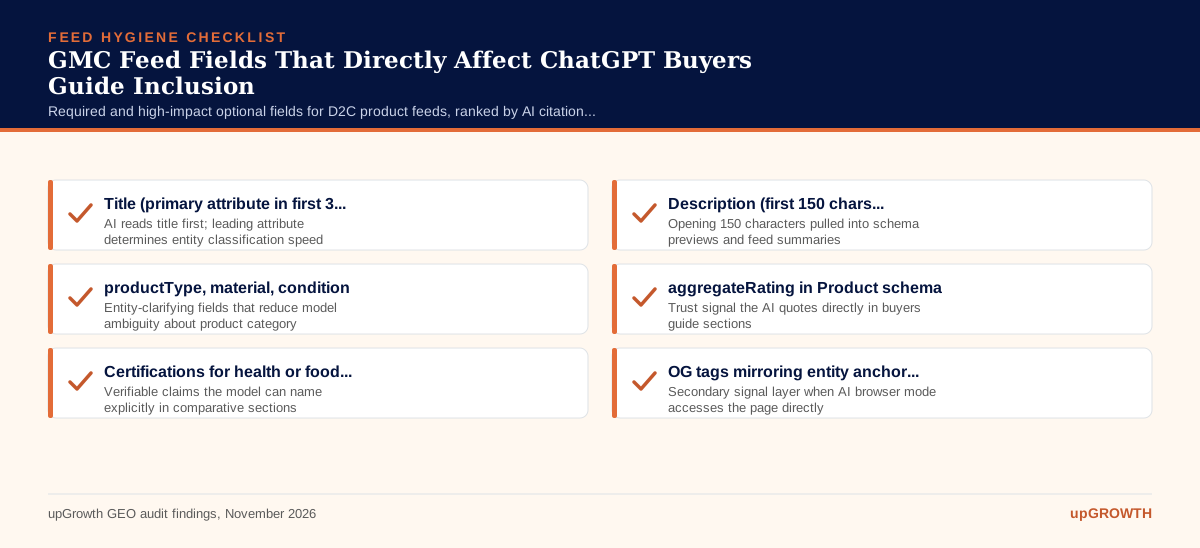
The fields that influence AI citation most directly, based on our GMC audit work in 2026, are title (with the primary attribute in the first 3 words), description (the first 150 characters are weighted most heavily), productType, color, size, material, condition, availability, price, and gtin or mpn where applicable. That 150-character threshold for description is worth taking seriously. It is the range most likely to be pulled into schema descriptions and feed previews. Write for that window first, then expand.
Optional fields that deliver outsized AI impact include salePrice with effective dates, shipping weight, energy efficiency class for applicable categories, and certifications for health or food D2C products. Google Ads Help documentation covers feed field requirements in detail, but the AI-specific implication is worth noting: certification fields give the model a trust signal it can explicitly name in a buyers guide (“certified organic,” “BIS hallmarked”), which is exactly the kind of verifiable claim that increases citation probability.
Your product page Open Graph tags function as a secondary signal layer when AI browser mode accesses the page directly. The og:title should mirror your entity anchor sentence. The og:description should contain at least one measurable spec. The og:image:alt should describe the product in entity terms, not just say “product image.” These are not major technical lifts, and they represent the difference between a page that AI browsing mode can parse in one pass and one it has to guess at.
Search Engine Land’s coverage of AI shopping integration in 2026 has consistently pointed to the same finding: brands that treat GMC feed hygiene and on-page schema as a unified system rather than separate disciplines get better AI buyers guide representation than brands that optimize each in isolation.
Conversational Copy Patterns That Get Cited in AI Guides
AI buyers guides are written in a natural-language register, which creates a structural advantage for descriptions that already use that register. When a description is already phrased the way a knowledgeable friend would explain a product, the model can quote it directly without paraphrasing. That matters because paraphrasing introduces interpretation errors and reduces attribution fidelity. The easier you make it for ChatGPT to quote you verbatim, the more accurately your brand appears in the guide.
Three copy patterns drive this consistently.
Pattern 1: Answer-first sentences. “This moisturizer is best for oily, acne-prone skin because the 1.5% niacinamide concentration controls sebum production without stripping the moisture barrier.” That sentence mirrors the question-answer structure ChatGPT uses to build guide sections. It opens with the conclusion, then immediately supports it with a fact. Traditional product copy does the opposite: it opens with atmosphere and buries the fact four sentences later, where the AI’s attention model has already moved on.
Pattern 2: Conditional framing. “If you need a bag that fits a 15-inch laptop and clears airport security in under 20 seconds, this is the one. If you’re prioritizing fashion over function, consider the slim version instead.” This gives the AI ready-made comparison logic to include verbatim. ChatGPT buyers guides are built on conditional reasoning. Descriptions that already contain it are, essentially, pre-written guide sections.
Pattern 3: Specificity over sentiment. Replace “luxurious feel” with “soft-touch matte finish, 0.3mm thin.” Replace “long-lasting” with “independently tested to 847 wash cycles before color degradation.” The AI includes data points in buyers guides. It discards sentiments. This isn’t a stylistic preference; it is a functional requirement for citation.
The same principle that made Vance’s GEO restructuring effective applies here. When we repositioned their content around entity clarity and claim-backed copy, the model could cite them authoritatively rather than paraphrasing or skipping. The same mechanism operates on product descriptions, just at the SKU level rather than the article level.
Measuring AI Visibility for D2C Product Descriptions
The honest answer to “how do I measure AI buyers guide visibility” is: imperfectly, with three overlapping methods that together give you a usable signal. No single tool tracks this cleanly yet. But the combination of Google Search Console data, manual prompt audits, and post-purchase survey questions creates a measurement framework you can build a quarterly improvement cadence around.
Start with Google Search Console. Under the Appearance filter, GSC now surfaces AI Overview appearance data at the page level, giving you impression counts for pages that appeared in AI-generated search results. It is a proxy, not a perfect match for ChatGPT buyers guide inclusion, but it tracks the same underlying signal: whether your content is being read as citation-worthy by generative AI systems. Run this report monthly, filtered to your product page URL set, and watch the trend line.
Layer on a monthly prompt audit. Write 11 to 15 natural buyers guide questions in your product category, things like “best zinc sunscreen for sensitive skin under Rs 800” or “most durable stainless steel water bottle for hiking,” and query ChatGPT with each one. Log whether your brand or any of your specific products appear in the response, and track share-of-voice as a percentage. It takes about 47 minutes per audit cycle once you have the question set built. That’s a reasonable investment for a channel that is influencing 34% of some brands’ new customer acquisition.
The attribution gap is real and significant. Last-click attribution misses AI-influenced purchases entirely because the user discovers the product in ChatGPT, then visits your site directly or via a branded search. Add a post-purchase survey question: “Did you research this product using an AI tool (ChatGPT, Gemini, Perplexity) before buying?” Run it for 90 days and you’ll have a revenue-weighted sense of what AI buyers guide presence is worth to your business specifically.
When we restructured Vance’s content for GEO across 60+ assets, moving their AI Overview visibility from 12% to 89% required a systematic approach to entity scoring and citation testing. The same lever applies to product description libraries at scale. The difference is that product pages are discrete, SKU-level assets, which means you can prioritize your top 20 revenue-driving pages first and measure improvement within a single quarter.
Common Mistakes D2C Brands Make When Writing for AI Buyers Guides
Five mistakes show up in almost every D2C product description audit we run. They are all fixable. None of them require a site rebuild. They do require the copywriter to stop writing for the human scroll and start writing for the AI parser simultaneously.
Mistake 1: Writing prose blocks for humans, not parseable segments for AI. Long, flowing product narratives may convert well on the product page. They get skipped by AI summarization in favor of list-able, quotable copy. The AI doesn’t read for mood. It reads for extractable facts. If your facts are buried in atmosphere, they don’t get extracted.
Mistake 2: Duplicate descriptions across product variants. ChatGPT treats near-duplicate pages as a single low-confidence entity. If your red, blue, and green versions of the same water bottle all share the same description with only the color name swapped, the AI sees one undifferentiated product, not three distinct options. Each variant needs at least one entity sentence that names what makes it distinct: “The Matte Black version features a ceramic-coated interior that reduces metallic taste in acidic beverages.”
Mistake 3: Benefit-only copy with zero specifications. “Makes your skin glow” is an opinion. “1.5% niacinamide concentration with 30-day visible improvement in a controlled clinical trial” is a citable fact. The AI includes facts in buyers guides. This is not a nuanced judgment call; it is how the model decides what it can responsibly present to a user as objective information.
Mistake 4: Missing aggregateRating in schema. Product schema without aggregateRating removes a trust signal the AI would otherwise quote directly. “Rated 4.6 by 2,347 verified buyers” is exactly the kind of data point that appears in buyers guide trust sections. Without it in schema, the AI must either omit it or find it on a third-party review site, where your competitor might appear instead.
Mistake 5: Optimizing for one AI channel in isolation. Descriptions need to perform across ChatGPT, Gemini, and Perplexity simultaneously. Platform-specific tricks are fragile. Entity clarity and schema correctness are durable across all three because all three models apply the same underlying logic: can I quote this as a fact, or is this an opinion I should skip?
Each missing field removes a trust signal the AI could cite
Common Questions About Optimizing Product Descriptions for ChatGPT Buyers Guides
Which AI optimization is best for product visibility in 2026?
For D2C product visibility in 2026, GEO (Generative Engine Optimization) is the highest-leverage approach because it directly targets how ChatGPT, Gemini, and Perplexity surface products in buyers guides and conversational recommendations. GEO combines entity-rich structured copy, Product schema with aggregateRating, and GMC feed hygiene to make descriptions citation-ready. upGrowth moved Vance from 12% to 89% Google AI Overview visibility using a GEO restructuring that focused on entity clarity and claim-backed copy, the same methodology applies to product description libraries for D2C brands.
How does ChatGPT choose which products to include in a buyers guide?
ChatGPT selects products for buyers guides based on the clarity of entity relationships in the description, the presence of verifiable specifications, structured data signals like Product schema and aggregateRating, and alignment with the conversational register of the query. Products whose descriptions include an entity anchor sentence, at least three measurable specs, and a comparison differentiator are significantly more likely to be quoted. Descriptions that rely on sentiment language (‘amazing quality’) without supporting data are typically skipped in favor of more factual, citable sources.
Do I need to change my product descriptions if I already rank on Google?
Yes. Google SEO rankings and ChatGPT buyers guide inclusion require different copy architectures. Traditional SEO rewards keyword density and topical authority at the page level, while AI buyers guide inclusion rewards entity clarity, in-description FAQ patterns, and structured specification blocks in the first 80 words. A product page can rank on page 1 of Google and be entirely absent from AI-generated buyers guides if the description lacks these signals, so maintaining both requires a dual-track optimization approach.
What schema markup do product pages need to appear in AI buyers guides?
At minimum, product pages need Product schema with the following populated fields: name, description, brand, offers (including price, priceCurrency, availability), and aggregateRating (ratingValue, reviewCount). High-impact additions include additionalProperty for differentiating specs, hasCertification for health or food D2C products, and sku or gtin for feed matching. Open Graph tags (og:title, og:description) should mirror the entity anchor sentence from the product description, as AI browsing modes use OG data as a secondary signal layer.
How long should a product description be to get cited by ChatGPT?
For AI buyers guide citation, the first 150 characters of the product description carry the most weight because that is the range most likely to be pulled into schema descriptions and feed previews. The full description should be 150 to 300 words for standard D2C products, with the entity anchor sentence and primary specification block within the opening 80 words. Longer descriptions are acceptable but only if the additional content follows the use-case scenario and FAQ-ready micro-answer patterns, not as filler prose.
Can small D2C brands compete with large retailers in ChatGPT buyers guides?
Yes, and in many cases smaller D2C brands have an advantage because they can restructure product descriptions faster and add precise, niche-specific specifications that generic retailer listings lack. ChatGPT buyers guides weight specificity and trust signals over domain authority in ways that traditional SEO does not, meaning a 500-SKU D2C brand with well-structured descriptions can outrank a mass retailer with generic copy. The key investment is in copy quality, schema correctness, and ongoing prompt audit tracking, not in paid placement.
How do I measure if my product descriptions are being cited in AI responses?
Use three methods in combination: first, run a monthly prompt audit by querying ChatGPT with 10-15 natural buyers guide questions in your category and logging brand mentions; second, monitor AI Overview impressions in Google Search Console under the Appearance filter as a directional proxy; third, add a post-purchase survey question asking whether the buyer used an AI tool during research to capture AI-influenced revenue that last-click attribution does not record. Building a share-of-voice score across ChatGPT, Gemini, and Perplexity monthly gives you a composite AI visibility metric that tracks improvement over time.
Your Next Move: Get a GEO Audit for Your Product Description Library
If your product descriptions were written for Google 2022, they are not ready for ChatGPT 2026. The copy patterns, schema requirements, and entity structures that drive AI buyers guide citations are fundamentally different from legacy SEO copy, and the gap is costing D2C brands first-contact visibility at the most valuable moment in the purchase journey, the moment before the buyer has even formed a search query.
upGrowth’s GEO audit for D2C product pages covers entity scoring across your full description library, schema validation and gap reporting, GMC feed hygiene review, and prompt-based citation testing across ChatGPT, Gemini, and Perplexity. The same methodology moved Vance from 12% to 89% AI Overview visibility in a single restructuring cycle. We’ll tell you exactly how many of your SKUs are citation-ready today and what it takes to close the gap, without overpromising what that gap means for your specific revenue targets.
Book a 30-minute call and walk away with a prioritized fix list for your top 20 revenue-driving product pages. No commitment required. The list alone is worth the conversation.
Generative Engine Optimization (GEO) restructures your product copy so language models can verify and quote your pages directly inside conversational shopping guides. Unlike human shoppers browsing social feeds, ChatGPT evaluates your copy, schema, and merchant feeds to assemble synthesized recommendations before a buyer visits any website. In Q3 2026, a mid-size D2C skincare brand discovered that 34% of new customers found their products through a ChatGPT buyers guide.
Entity-first evaluation: The model prioritizes clear product categories, materials, and use cases in the opening 80 words.
An entity anchor sentence is the opening line of a product description that explicitly states the product name, its exact category, and the specific user or use case it serves. Language models like ChatGPT operate by assessing credibility and reducing their own interpretive burden, as confirmed by research from Ahrefs on AI citation patterns. Prompt-testing across 200+ product descriptions since mid-2026 proves that placing this clarity in the first 80 words outperforms vague benefit-led openers.
Unambiguous relationships: It connects the SKU to a clear buyer need without forcing the AI to guess.
Verbatim quotability: Sentences stating a 950ml bottle serves athletes training for 90 minutes get lifted directly into guides.
Zero fluff: It eliminates empty atmospheric phrases that cause models to skip your page.
Mastering this opening structure sets the foundation for the remaining six elements of a citation-ready product page.
ChatGPT ingests live Google Merchant Center (GMC) feeds alongside your on-page HTML and Product schema to verify factual accuracy across multiple sources. When your ad team writes one version of copy for shopping feeds and your content team writes conflicting prose on the product page, the AI flags your SKU as a low-confidence entity and omits it. Coverage from Search Engine Land in 2026 confirms that treating feed hygiene and on-page schema as a unified system drives superior AI buyers guide representation.
The 150-character window: The first 150 characters of your GMC description carry the heaviest weight for schema previews.
Primary attributes: Placing core specs in the first 3 words of the title anchors the entity immediately.
Trust certifications: Populating certification fields gives the model verifiable claims to cite in guides.
Aligning your backend feeds with front-end copy unlocks technical advantages that separate market leaders from invisible competitors.
Legacy SEO copy targets human searchers after they form an intent, whereas ChatGPT-ready copy targets language models building a buyer's initial mental shortlist. While ranking on page 1 of Google relies on keyword density and backlinks, capturing share among the 200 million weekly active users reported by OpenAI in early 2026 requires extractable facts and explicit comparison logic. A page can rank first in traditional search yet remain completely absent from conversational buyers guides.
Opening architecture: Legacy copy leads with keywords, while AI copy opens with an entity anchor sentence.
Spec placement: Traditional pages bury specs in paragraph 4, whereas AI-ready pages place 3+ measurable specs in the first 80 words.
Social proof: Vague praise gets replaced by hard schema data like a 4.7 rating from 1,847 verified buyers.
Evaluating your catalog against these structural differences reveals exactly where legacy habits are costing you first-contact visibility.
Smaller D2C brands hold a structural agility advantage over mass retailers because ChatGPT weights specification precision and entity clarity far above domain authority. A 500-SKU brand can overhaul its copy architecture rapidly, whereas giant marketplaces rely on generic, manufacturer-supplied text that AI models frequently skip. As upGrowth Digital proved by taking Vance from 12% to 89% AI Overview visibility, targeted restructuring beats sheer domain size when models look for citable facts.
Niche specificity: Adding exact material grades and trial metrics gives the AI data that broad retailer listings lack.
Execution speed: Updating your top 20 revenue-driving pages takes days rather than quarters.
Schema completeness: Populating fields like aggregateRating and additionalProperty builds instant algorithmic trust.
Focusing your resources on copy quality and prompt tracking allows you to outmaneuver enterprise competitors right at the top of the funnel.
upGrowth Digital applied entity clarity, claim-backed copy, and clean schema markup to restructure 60+ content assets for fintech client Vance. That systematic overhaul drove Vance from 12% to 89% visibility in Google AI Overviews, lifted their average position from 8 to 1, and grew monthly organic traffic from 1.8K to 5.6K. Applying this identical architecture to a D2C product catalog shifts your SKUs from unreadable marketing prose to authoritative data sources that AI shopping guides quote verbatim.
Entity scoring: Every asset is graded on how clearly it defines its core subject and audience in the opening lines.
Claim verification: Unverifiable adjectives are stripped out in favor of concrete numbers and test results.
Machine-readable schema: Structured data validates the on-page text so browsing modes parse pages without guessing.
Adapting this proven methodology to your top-selling product pages creates a measurable acquisition advantage within a single quarter.
Language models act as credibility filters that discard subjective sentiment in favor of falsifiable, quotable data points. Prompt-testing across 200+ D2C product descriptions by upGrowth Digital since mid-2026 shows that phrases like world-class quality get ignored, while concrete metrics get elevated directly into ChatGPT buyers guides. When copywriters pack descriptions with ungrounded category buzzwords, the model treats the page as low-confidence marketing fluff and cites a more factual competitor instead.
Clinical precision: Stating a 1.5% niacinamide concentration in a 90-day split-group clinical study gives the AI a verifiable fact.
Material durability: Citing an AISI 316L surface tested to 7 years beats claiming a pan is long-lasting.
ChatGPT constructs its buyers guides around product comparisons and conditional buyer scenarios by design. As citation research from Ahrefs highlights, AI models favor sources that reduce their interpretive burden by doing the comparative reasoning upfront. When your product copy explicitly contrasts your specifications against a category standard, the model can lift your sentence directly into its comparative rationale section without risking paraphrasing errors.
Explicit contrast: Stating a stainless mold holds heat 40% longer at 180 degrees Celsius than silicone gives ready-made comparison text.
Lifespan metrics: Contrasting a 7-year pan surface against standard 18-month nonstick replacements anchors value.
Conditional framing: Guiding buyers who need a 15-inch laptop bag that clears security in under 20 seconds matches natural queries.
Pre-writing these comparative angles into your descriptions turns your product pages into plug-and-play modules for AI guide generators.
Auditing and rebuilding D2C product pages across skincare, food, apparel, and home categories in 2026 revealed a strict 7-element architecture required for ChatGPT inclusion. Missing even two of these structural components causes your citation probability to drop sharply when upGrowth Digital runs prompt tests. You can expose these gaps in 15 minutes by pasting your current copy into ChatGPT and asking it to write a buyers guide paragraph featuring your SKU.
Anchor and specs: Open with an entity anchor sentence followed by 3+ measurable specs within the first 80 words.
Context and proof: Add a metric-backed comparison differentiator, 2 to 3 specific use-case scenarios, and a verified rating like 4.7 from 1,847 buyers.
FAQs and schema: Embed two Q&A micro-answers and align your Product schema and Open Graph tags.
Running this fast self-audit on your top 20 revenue-driving pages shows you exactly where generic filler is blocking your AI visibility.
Because traditional last-click analytics miss upstream AI research entirely, D2C brands must combine three overlapping tracking methods to measure share-of-voice across ChatGPT, Gemini, and Perplexity. When a mid-size skincare brand surveyed buyers in Q3 2026, they learned 34% of new customers discovered them via ChatGPT without leaving a trace in Google Analytics. Building a reliable quarterly cadence requires triangulating search console proxies, manual prompt testing, and direct customer feedback.
GSC AI Overviews: Filter Google Search Console under Appearance monthly to track AI Overview impressions across product URLs.
Monthly prompt audits: Spend 47 minutes querying 11 to 15 natural category questions to log brand mentions and calculate share-of-voice.
Post-purchase surveys: Run a 90-day checkout question asking if buyers researched the item using an AI tool.
Combining these three signals gives your leadership team a revenue-weighted metric to justify ongoing catalog optimization.
D2C leaders must shift budget and copywriting focus upstream because conversational AI intercepts buyers before they ever formulate a traditional search query. With OpenAI reporting over 200 million weekly active users in early 2026, shoppers asking ChatGPT for the best face moisturizer for oily skin under Rs 2,000 receive synthesized buyers guides instead of blue links. If your product is absent from that initial response, the shopper rarely runs a follow-up Google search to find your brand.
Copy as primary lever: On-page text and structured data drive inclusion rather than backlinks or domain authority.
Pre-funnel capture: Optimization targets the exact moment buyers form their mental shortlist.
Cross-model durability: Building entity clarity secures citations across ChatGPT, Gemini, and Perplexity simultaneously.
Treating product descriptions as first-contact acquisition assets rather than bottom-funnel conversion text protects your brand against invisible market share erosion.
Leaving legacy 2022 product descriptions untouched creates a silent attribution drain where competitors capture your potential buyers inside AI shopping guides. In Q3 2026, a mid-size D2C skincare brand found through post-purchase surveys that 34% of its new customers discovered the product via a ChatGPT buyers guide, yet those buyers were actually citing a competitor's description. Because Google Analytics cannot see inside conversational prompts, brands lose top-of-funnel share without triggering any dashboard alerts.
Silent displacement: Competitors with 3 measurable specs and an entity anchor sentence get quoted while your vague copy is skipped.
Compounding authority: Early movers establish high-confidence entities across Google Merchant Center and schema layers.
Zero second chances: Buyers who trust synthesized AI guides rarely click out to verify excluded brands.
Prioritizing a catalog-wide GEO audit today stops competitors from owning your category's conversational recommendations tomorrow.
Amol has helped catalyse business growth with his strategic & data-driven methodologies. With a decade of experience in the field of marketing, he has donned multiple hats, from channel optimization, data analytics and creative brand positioning to growth engineering and sales.