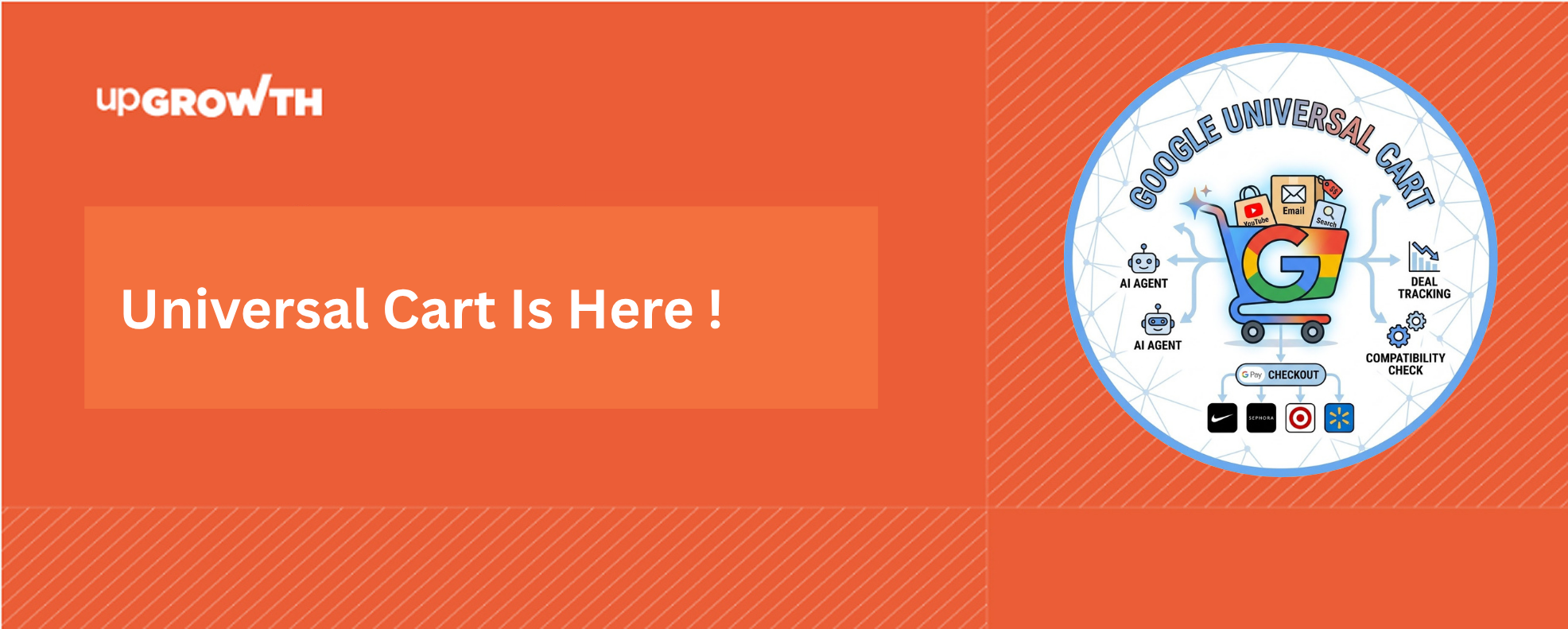
Google’s Universal Cart is turning AI search into a direct checkout experience, changing how Indian D2C brands get discovered and purchased online. This guide explains how AI-driven product feeds, schema, reviews, and GEO/AEO strategies now determine whether your brand gets recommended or ignored inside Google AI Mode.
Google just turned every search result page into a checkout. Here’s what that means for your product discovery, your brand visibility, and your D2C revenue.
The D2C Question No One Is Asking (But Everyone Should Be)
When someone searches “best protein powder for women under 30” on Google today, they do not see a list of links to your product page. They see a Google-generated AI response with a recommended product, a price, a rating, and an “Add to cart” button — all without leaving Google.
That is Universal Cart. And it went live in India as part of Google I/O 2026.
If you run a D2C brand in India — beauty, food, personal care, apparel, supplements, home goods — this is the most significant change to product discovery since Amazon entered the market. The question is not whether it affects you. The question is whether your products are inside that checkout experience or invisible to it.
What Is Google Universal Cart and How Does It Work?
Universal Cart is one of the headline announcements from Google I/O 2026. It allows users to browse products from multiple brands and retailers, add them to a single Google-managed cart, and complete the purchase without ever visiting a brand’s website. The transaction is handled inside Google’s ecosystem — payment, order confirmation, and fulfilment coordination all happen within Google.
This is not Google Shopping with a new interface. It is a fundamentally different model of purchase intent. Users no longer need to click through to your website to buy your product. They can research, compare, and purchase entirely within a Google AI response.
What this means for D2C brands: your product listing, pricing, structured data, and inventory integration with Google are now more important than your product page design. If your products are not correctly structured and fed into Google’s product ecosystem, you will not appear in Universal Cart — and a competitor who has done the groundwork will take the sale.
Why This Hits Indian D2C Brands Harder Than Anyone Else
Indian D2C has been built on a very specific discovery model: a consumer finds your brand through a Google search, lands on your website, gets impressed by your storytelling and product photography, and converts. Your website was your competitive advantage — the moat between you and the mass-market noise of marketplaces like Amazon and Flipkart.
Universal Cart changes that equation fundamentally. The product discovery stage now happens entirely inside Google’s AI interface. Your website is bypassed. The consumer never reads your brand story, sees your loyalty programme, or experiences the UX journey you have spent years perfecting.
For categories where Indian D2C has built genuine premium positioning — clean beauty, functional nutrition, sustainable apparel, artisanal food — this is a particular threat. Brand differentiation that lived in your website experience is now irrelevant to the first-touch discovery moment.
What this means: the brands that win in the Universal Cart era are not necessarily the ones with the best product pages. They are the ones whose product data, pricing signals, review volume, and schema markup make them the most legible to Google’s AI purchasing layer. Brand-building has not become less important — but where it needs to happen has shifted significantly.
The Three Layers of the Universal Cart Problem for D2C Brands
The Universal Cart challenge for D2C brands is not a single problem. It is three overlapping problems that require three distinct responses.
Layer 1: Product Feed Visibility
Universal Cart pulls product data from Google Merchant Center. If your product feed is incomplete, inconsistently priced, or missing structured attributes (size, colour, material, SKU), Google’s AI simply cannot include you. This is not a penalty — it is just the system working as designed. You are not being excluded; you are being invisible.
Most Indian D2C brands that have an SEO strategy have not invested comparably in Google Merchant Center hygiene. Feed management has been treated as an e-commerce operations task, not a marketing priority. That needs to change immediately.
Layer 2: AI Citation and Brand Authority
Universal Cart does not just pull product data. It pulls brand signals. Google’s AI synthesises reviews, expert mentions, editorial coverage, and entity data to determine which products to recommend when presenting a purchase option. This is AEO applied to commerce.
A brand that has 500 five-star reviews and strong schema markup on its own site but zero editorial mentions in third-party media, zero brand search volume growth, and no structured FAQ or product comparison content will be systematically under-recommended. The AI needs multiple corroborating signals before it will recommend your product to a user.
For many Indian D2C brands that built their growth entirely through Meta and Google performance ads, this is unfamiliar terrain. Brand authority has been treated as a nice-to-have. In the Universal Cart era, it is a prerequisite.
Layer 3: Price and Conversion Competitiveness
Universal Cart displays products side by side from multiple brands. A user searching for a moisturiser in a specific price range will see your product next to five competitors, all with prices, ratings, and delivery times visible in a single view.
This creates intense pricing pressure in categories where Indian D2C brands have historically competed on experience and story. If your product is priced at a premium and your reviews are thinner than a competitor, the AI will not do the storytelling work your website used to do. The user sees price, rating, and availability. Your origin story and founder journey are invisible at this layer.
The response here is not to cut prices. It is to ensure the structured signals that justify your premium positioning are audible to the AI: ingredient certifications, third-party test results, expert recommendations, and review depth. These need to be in your schema markup and your product feed attributes.
What Universal Cart Changes Specifically for Indian D2C Categories
The impact of Universal Cart is not uniform across all D2C categories. Here is an honest assessment for the sectors where the stakes are highest.
Beauty and Personal Care
This is the highest-risk category. Beauty is one of Google’s primary Universal Cart test beds because purchase intent is clear, products are standardised enough for comparison, and review volume is high. Indian clean beauty and natural skincare brands — many of which built their moat on ingredient transparency — are at serious risk if their ingredient data is not structured into Google Merchant Center attributes.
The opportunity: beauty is also a category where AI personalisation through Personal Intelligence is significant. A user who has previously bought natural skincare and whose search history shows ingredient sensitivity queries will be shown personalised product recommendations. Brands that have entity authority around specific ingredients (niacinamide, bakuchiol, ashwagandha) will be preferentially cited.
Nutrition and Supplements
The risk here is Google’s Generative UI replacing the content that supplements brands use to educate and convert. Queries like “best protein for vegetarians in India” or “collagen supplements for joint pain” now get a direct Google AI answer with a product recommendation embedded. If your brand is not in that answer, the user does not visit your blog, your comparison page, or your landing page.
The required response is a dual strategy: AEO-structured content that earns your brand citation authority in AI answers, paired with a clean product feed that ensures you appear in Universal Cart when the intent converts from research to purchase.
Apparel and Sustainable Fashion
Universal Cart is most disruptive in commodity apparel but creates surprising opportunity for differentiated Indian fashion brands. The challenge: Google’s AI will compare your ethnic wear or sustainable collection against mass-market alternatives purely on price and review signals if you have not structured your unique value proposition into machine-readable format.
The opportunity: Search Agents. Google’s new autonomous AI agents can research and shortlist products across hours on behalf of a user. A user who says “find me sustainable Indian-made kurtas for a wedding under 5,000 rupees” will trigger an agent that searches, evaluates, and returns a shortlist. Brands with rich product descriptions, sustainability certifications, origin data, and structured fabric attributes are far more likely to make that shortlist.
The Universal Cart Action Stack: What Indian D2C Brands Need to Do Now
The response to Universal Cart is not a single initiative. It is a stack of coordinated changes across your product data, SEO, content, and brand strategy. Here is the priority sequence.
Audit and Rebuild Your Google Merchant Center Feed
Every product needs complete structured attributes: title optimised for search intent, accurate category taxonomy, GTIN or MPN identifiers, size/colour/material variants, current inventory status, and high-resolution images. Treat your Merchant Center feed like your primary SEO asset, not a back-office function. Feed completeness and freshness directly impact Universal Cart eligibility.
2. Implement Product Schema on Every PDP
Your product detail pages need structured data that aligns with Google’s Product schema: name, description, brand, SKU, offers (price, currency, availability), aggregate rating, and review count. If you are in regulated categories like supplements, adding certifications and claims through schema gives Google additional signals to confidently cite your product.
Many Indian D2C brands have basic schema in place through their Shopify themes. But “basic” is no longer sufficient. The detail in your schema — specifically the breadth of attributes and the accuracy of your aggregate review data — is now a competitive differentiator for AI citation.
Build Brand Entity Authority Through AEO-Structured Content
Create content that answers the exact questions your target customer asks during the research phase. Not blog content for organic traffic — structured answer content that AI systems can extract, cite, and use in their responses. For a beauty brand, this means definitive ingredient guides. For a supplements brand, this means third-party validated efficacy content. For an apparel brand, this means authoritative fabric and sustainability guides.
This is the AEO layer of your Universal Cart strategy. When a user asks Google AI which brand makes the best ashwagandha supplement in India, the AI answers based on its training data and real-time signals. The brands that have produced clear, authoritative, structured content on that topic are the brands that get cited. That citation then flows directly into product recommendations in Universal Cart.
4. Invest in Review Depth and Third-Party Validation
Google’s AI does not just read your own website reviews. It synthesises reviews from Google Shopping, third-party comparison sites, editorial recommendations, and social proof signals. A D2C brand that has 2,000 reviews on its own website but weak presence on Google Shopping or specialist review platforms will have a structurally weaker citation profile than a competitor with 500 distributed reviews.
The review acquisition strategy for Indian D2C brands needs to shift from “collect reviews on our site” to “build a distributed authority profile” — verified purchases on Google, editorial mentions in Healthshots, Femina, YourStory, The Better India, and specialist category publications. Each external citation is a signal to Google’s AI that your brand is worth recommending.
Build for Owned Channels in Parallel
Universal Cart reduces your control over the first-purchase experience. The strategic response is to double down on owned channels that capture customers post-acquisition and build relationships that are independent of Google’s ecosystem: email, WhatsApp, loyalty programmes, and subscription models.
If a customer’s first purchase with your brand comes through Universal Cart — bypassing your website entirely — the brand relationship starts at fulfilment. Your packaging insert, your post-purchase email sequence, and your WhatsApp re-engagement flow become the first real brand experience. Brands that have invested in these owned channels will retain customers that Universal Cart delivers. Brands that have not will find themselves in a permanently transactional relationship with Google, paying for every sale.
The upGrowth View: Universal Cart Is a Distribution Channel, Not Just a Threat
Most of the conversation around Universal Cart in the Indian D2C ecosystem is framed as a threat. We think that framing is incomplete.
For brands that do the structural work — clean feeds, strong schema, distributed brand authority, AEO-ready content — Universal Cart is a low-friction acquisition channel. A user who discovers your product inside a Google AI purchase interface has already been pre-qualified by the AI. They are not browsing; they are buying. The conversion intent is higher than most traffic sources. The question is whether you have done the work to be in front of them at that moment.
The brands that lose in the Universal Cart era are the ones waiting to see how it plays out. The window to establish AI citation authority before your competitors do is open right now. Google’s AI systems are actively building their knowledge base about which Indian D2C brands are trustworthy, expert, and worth recommending. What you publish, structure, and signal over the next six months will shape where your brand sits in those responses for the next three years.
At upGrowth, we have been working with Indian D2C brands on exactly this transition — from performance-first growth models to AI-era brand authority strategies that earn Universal Cart visibility. We have seen what works, what does not, and where the first-mover advantage sits in each category.
Google Universal Cart is a new AI-powered shopping experience introduced after Google I/O 2026 that allows users to discover, compare, and buy products directly inside Google Search without visiting a brand’s website.
2. How does Universal Cart affect Indian D2C brands?
Universal Cart reduces the importance of traditional product page journeys and shifts product discovery into Google’s AI interface. Indian D2C brands now need strong product feeds, schema markup, reviews, and AI citation authority to stay visible.
3. Why are some D2C products invisible in Google AI search?
Products become invisible when brands have incomplete Google Merchant Center feeds, weak Product schema, poor review signals, or limited brand authority across the web. Google AI cannot recommend products it cannot confidently understand or validate.
4. What schema is important for Universal Cart visibility?
Product schema, FAQPage schema, Review schema, and Organisation schema are critical for Universal Cart visibility. These help Google AI understand product attributes, pricing, ratings, availability, and brand trust signals.
5. Does Google Universal Cart replace e-commerce websites?
No, but it changes their role. Discovery and checkout increasingly happen inside Google AI Mode, while brand websites become more important for retention, loyalty, subscriptions, and post-purchase customer relationships.
6. How can Indian D2C brands improve AI search visibility
Indian D2C brands can improve AI visibility by optimising Google Merchant Center feeds, implementing detailed Product schema, publishing AEO-structured content, building review authority, and strengthening brand entity signals across Google’s ecosystem.
Disclaimer:As of May 2026, several features and updates referenced in this blog from Google I/O 2026 are yet to be rolled out in India, and their availability, functionality, and access timelines remain subject to Google’s region-wise release schedule.
For Curious Minds
Google Universal Cart is a new feature that integrates a complete shopping cart and checkout process directly into AI-generated search results, allowing users to buy from multiple brands without ever visiting their websites. This fundamentally changes the D2C journey by moving the point of purchase from your product page to Google’s interface, making your product data more critical than your site's user experience. The transaction, from adding to cart to payment, is handled entirely within Google's ecosystem. This means the traditional funnel of driving traffic to a well-crafted website for conversion is bypassed. Instead, your success depends on how well your product information is structured for Google’s AI. Winning brands will be those whose product feeds, pricing, and reviews are most legible to the new system, not those with the most compelling brand story on their own domain. Explore the full guide to understand how this redefines brand visibility.
This model hits Indian D2C brands harder because they have traditionally relied on their websites to build a competitive moat through storytelling, premium branding, and a curated user experience. Universal Cart effectively neutralizes this advantage by making the first discovery and purchase touchpoint a standardized, Google-controlled interface. Your brand's differentiation, which lived in your website experience, is now less relevant at the moment of discovery. While marketplaces were about price and logistics, D2C was about brand connection. Now, that connection point is gone, and the competition shifts to factors that Google's AI can easily compare, such as:
Richness of structured product data in Google Merchant Center.
Competitive pricing signals and real-time inventory accuracy.
Volume and quality of customer reviews aggregated by Google.
This levels the playing field in a way that favors data-optimized brands over story-driven ones. Uncover the strategies needed to reclaim your brand's edge in this new environment.
A traditional website-first strategy focuses on creating an immersive brand experience to convert visitors, while a Universal Cart-first strategy prioritizes making product data legible to Google's AI for direct conversion within search results. The former assumes you can win the click, while the latter assumes the click may never happen. The new model requires a shift from persuading users on your site to persuading Google’s algorithm that your product is the best answer. A comparative look shows a clear trade-off. Website UX builds long-term brand affinity and captures valuable first-party data. A data-first approach, however, wins the immediate sale in an AI-driven environment by focusing on technical optimization of product feeds, schema markup, and review aggregation. The most effective long-term strategy will likely blend both, using data excellence to capture initial sales and finding new ways to build a brand relationship post-purchase. Discover how to balance these two critical approaches.
The evidence lies in the mechanism of Universal Cart itself, which makes purchase decisions based on machine-readable data points rather than brand narrative. An AI-generated response recommending a product will prioritize items with complete, accurate, and well-structured data. For example, imagine a user searches for a vegan protein powder. A brand with a compelling story on its website but an incomplete Google Merchant Center feed (e.g., missing dietary certifications or inconsistent pricing) will be invisible to the AI. A competitor with a less-known brand but a perfectly optimized feed that includes attributes like “vegan-certified,” “gluten-free,” and high review counts will be featured in the checkout-enabled AI response and win the sale instantly. This demonstrates that in the new discovery phase, legibility to the algorithm is more impactful than brand appeal to a human visitor. The full article breaks down the data attributes that matter most.
Universal Cart challenges premium positioning by abstracting a product away from its branded context, presenting it alongside competitors in a uniform, data-driven format where price and ratings are prominent. The trust and quality signals conveyed by your website's design, photography, and mission statement are lost at this critical discovery stage. To communicate premium quality now, brands must translate their value proposition into structured data that Google’s AI can understand and surface. Instead of relying on a beautiful “About Us” page, brands must focus on new signals like:
Certifications: Marking up attributes like “organic,” “fair trade,” or “sustainably sourced” in the product feed.
High-Resolution Imagery: Ensuring all required image types are high-quality and correctly formatted in the feed.
Positive Review Volume: Actively managing and encouraging detailed customer reviews on Google's platform.
These data points become the new shorthand for quality. Learn more about re-anchoring your premium brand identity in our detailed framework.
To ensure your personal care products appear in Universal Cart, you must address the three critical layers of visibility that Google's AI evaluates. Your immediate action plan should be structured around mastering these data inputs, moving beyond simple product listings to a more robust data strategy. This is not a one-time task but a continuous process of optimization to remain competitive in AI-driven search results. Here is a clear, stepwise plan to begin:
Layer 1 - Perfect Your Product Feed: Conduct a full audit of your Google Merchant Center feed. Ensure every product has complete attributes, including high-quality images, accurate sizing, color variants, and specific details like “paraben-free” or “for sensitive skin.”
Layer 2 - Align Pricing Signals: Guarantee price consistency between your website, your product feed, and any promotional ads. Use schema markup on your product pages to clearly signal the price and currency to Google.
Layer 3 - Aggregate and Amplify Reviews: Implement a strategy to actively collect Google reviews for your products. Higher review volumes and ratings are a primary trust signal for the AI.
Executing this plan is your first line of defense. Our full guide provides advanced techniques for each of these critical steps.
The most significant mistake is assuming that a strong brand and a great website are enough to remain competitive. Continuing to focus all resources on driving traffic to your domain while neglecting the underlying product data infrastructure will render your brand invisible within Universal Cart. The winning pivot is to treat your product data with the same care and creativity as your brand marketing. Instead of fighting the change, you must adapt by reallocating resources to build a best-in-class data operation. The solution involves a strategic shift from being just a great storyteller to also being a great data provider to Google. This means investing in tools for feed management, actively monitoring pricing consistency, and systemizing the collection of product reviews. Brands that successfully make this pivot will capture sales directly within search, turning a potential threat into a powerful new revenue channel. See how leading brands are already making this shift.
The long-term implication of Universal Cart is the unbundling of product purchase from brand experience, forcing a fundamental rethink of what a “brand” is. If the first interaction is a transaction on Google, brand-building must shift from pre-purchase persuasion to post-purchase engagement. Your marketing efforts must evolve from acquisition-focused storytelling to creating an exceptional ownership experience that inspires loyalty. This means your focus should shift to:
Packaging and Unboxing: The physical product's arrival is the new first impression.
Post-Purchase Communication: Email and SMS flows become critical for telling your brand story and encouraging repeat buys.
Community Building: Creating loyalty programs and communities outside the initial point of sale.
In this future, the brand is no longer just the website; it is the sum of all post-transaction touchpoints. Dive deeper into the future of D2C brand-building in our complete analysis.
The primary challenge is the potential loss of valuable first-party customer data that is typically collected during on-site checkout, such as email addresses for marketing or browsing behavior for retargeting. When Google manages the transaction, it acts as an intermediary, potentially limiting the data passed back to your brand. This obstructs your ability to build a direct, long-term relationship from the first purchase. However, this challenge also creates an opportunity to innovate in post-purchase engagement. Brands must now excel at capturing customer information through other means, such as product registration QR codes on packaging, incentives for signing up for a newsletter included in the shipping box, or exclusive content access for verified purchasers. The opportunity is to build a more loyal, engaged audience by delivering exceptional value after the sale is already complete. Find out how to design an effective post-purchase data capture strategy.
Successful brands treat their Google Merchant Center feed not as a static catalog but as a dynamic, strategic asset, helping them avoid the errors that make competitors invisible. They prevent inconsistent pricing by using automated systems to sync prices across their e-commerce platform, ads, and the Merchant Center feed in real time. This ensures the price Google’s AI sees is always the same as the price on the product page, eliminating a common reason for disapproval. To combat incomplete feeds, they go beyond the minimum required attributes. Instead of just listing size and color, they add rich details like material, style, certifications, and special features directly into the feed. This is often managed through dedicated product feed optimization platforms that enrich data automatically. By maintaining pristine, detailed, and consistent data, they become a trusted and reliable source for Google's AI, securing top placement in Universal Cart. Learn the technical details of feed optimization in our guide.
A 'clean beauty' brand could easily lose a sale despite its superior product and brand ethos if its digital shelf presence is not optimized for Google's AI. Imagine a consumer searches for a “paraben-free vitamin C serum.” This D2C brand's website might beautifully explain its commitment to clean ingredients, but if the attribute “paraben-free” is not explicitly structured in its Google Merchant Center product feed, the AI may not recognize it as a top match. A competitor, even one with weaker branding, who has meticulously tagged their product with all relevant attributes (“paraben-free,” “vegan,” “for sensitive skin”) and has a higher volume of recent Google reviews will be surfaced directly in the Universal Cart checkout. The consumer adds the competitor’s product to their cart and buys it in seconds, never even knowing the 'clean beauty' brand existed. This illustrates that the battle has moved from the brand's website to the data feed itself. Explore more examples to see how this plays out across different industries.
In the context of Universal Cart, Google's AI will unequivocally prioritize complete, structured product data and social proof over a brand's narrative. An AI is not designed to interpret the nuance of an artisanal sourcing story; it is designed to match a user's query to a product's explicit attributes with the highest degree of confidence. Therefore, the brand with robust, machine-readable data will always have the advantage in this environment. The AI will evaluate factors like:
Structured Data: Does the feed contain specific nutritional information, allergen warnings, and certifications like 'Organic'?
Review Velocity: How many positive reviews has the product received recently on Google's platforms?
Data Consistency: Is the price, stock status, and product information consistent across all digital touchpoints?
The competitor who excels in these areas will be presented as the best option, making the sale before the user ever has a chance to read the other brand's story. Read the full content to see how to translate your brand story into a data strategy.
Amol has helped catalyse business growth with his strategic & data-driven methodologies. With a decade of experience in the field of marketing, he has donned multiple hats, from channel optimization, data analytics and creative brand positioning to growth engineering and sales.
In This Article
Download The Free Digital Marketing Resources
[slide-anything id="15651"]
We plant one 🌲 for every new subscriber.
Want to learn how Growth Hacking can boost up your business?

 Growth Strategy and Planning
 Inbound Growth
 Growth Hacking
 Fractional CMO
 Search Engine Optimization
 Paid and Performance Marketing
 Social Media Marketing
 Demand Generation
 AI-Driven Growth Strategy
 AI-Native Workflow Automation
 Generative Engine Optimization
 Grove — AI Growth Strategist

 AI Automation
 Framework
 Case Study
 Tools
Tools Growth Tools
 Decision Tree
 Compare
 Custom GPT's
 AI Answer Gap
 Offer
Offer Webstories
 Quizzes
 Blog
Blog AI-powered Apps
 Social Media Tools
 Agency Fit Score