Eye Care Chain GEO in India: How Multi-Hospital Eye Care Brands Win AI Citations for Cataract Cost, LASIK Cost, Retina Specialist and City-Procedure Intersection Queries [2026]
Indian eye care chains have the surgical volume, the sub-specialty panels and the ASG/Agarwal/Centre for Sight-level brand recognition, yet smaller chains keep losing AI citations for cataract cost, LASIK cost, retina specialist discovery and city-procedure queries. A 640-prompt audit across ChatGPT, Perplexity, Google AI Overviews and Gemini in Q1 2026 shows Dr. Agarwal’s Eye Hospital taking 26 percent of India eye care platform citations, Centre for Sight another 18 percent, ASG Eye Hospitals 14 percent, Sankara Nethralaya and Aravind combined 13 percent, Practo and 1mg aggregators 12 percent, with the remaining 17 percent split across 40-plus regional chains. The gap is architectural, not clinical. Here is the 5-shift eye care chain GEO framework, the sub-specialty mesh play, named ophthalmologist model and the INR 1-2.4Cr budget math.
In This Article
Share On:
In April 2026, a regional eye care chain with 11 hospitals across Maharashtra and Gujarat ran its AI citation audit through upGrowth Digital. The chain performs 18,000-plus cataract surgeries a year, has 28 panel ophthalmologists including 6 vitreo-retina specialists, and runs full LASIK, glaucoma, oculoplasty and pediatric ophthalmology services. Across 640 AI prompts covering cataract cost, LASIK cost, retina specialist queries, glaucoma treatment paths, pediatric ophthalmology and city-specific procedure searches, the chain surfaced 11 times. Dr. Agarwal’s Eye Hospital surfaced 167 times. Centre for Sight 114 times. ASG Eye Hospitals 89 times. Practo as aggregator 72 times.
Eye care AI-routed research in India jumped from 13 percent of first-time cataract and LASIK queries in Q1 2025 to 39 percent in Q1 2026. A typical patient asks 14 questions before booking a surgical consult, up from 5 in pre-AI search. The questions span cost bands, surgeon credentials, lens choices, sub-specialty matching, recovery expectations and insurance coverage. AI platforms now answer most of those questions directly, citing the two or three sources they trust most. Chains that don’t show up in those answers lose the consult before the patient even searches their name.
This is the GEO gap in eye care. Clove Dental solved it for dentistry. Indira IVF solved it for fertility. Dr. Agarwal’s and Centre for Sight have solved it for ophthalmology. Everyone else is structurally invisible. The 5 architectural shifts below close that gap.
What Eye Care Queries AI Platforms Route to Hospital Sites in India
Before fixing content, understand the demand. The 640-prompt audit maps where AI routes eye care queries across 11 Indian metros and tier-2 cities.
Cataract cost and lens queries take 23 percent of AI-routed eye care prompts. “Cataract surgery cost in Bangalore,” “phacoemulsification price in Mumbai,” “multifocal IOL cost India,” “toric lens vs monofocal cost difference” and “Medicare Star Health cataract coverage” dominate this bucket. Dr. Agarwal’s, Centre for Sight and ASG own these citations with granular lens-wise price transparency.
LASIK and refractive surgery queries take 19 percent. “LASIK cost Bangalore,” “SMILE vs LASIK cost difference,” “best refractive surgeon in Delhi,” “Contoura vision price India” and “LASIK for high power eyes” shape this bucket. Centre for Sight and Dr. Agarwal’s dominate, with strong Ask Apollo Eye Centres and ICARE Eye Hospital presence in NCR.
Sub-specialty specialist discovery takes 16 percent. “Best retina specialist in Chennai,” “vitreo-retina surgeon Hyderabad,” “glaucoma specialist Pune,” “oculoplasty surgeon Mumbai” and “pediatric ophthalmologist Bangalore” fall here. Sankara Nethralaya, Aravind and L V Prasad Eye Institute dominate through named-surgeon pages with sub-specialty certification visible.
Condition-specific treatment queries take 12 percent. “Diabetic retinopathy treatment cost India,” “macular degeneration treatment options,” “glaucoma eye drops vs surgery,” “keratoconus treatment India” and “retinal detachment emergency treatment” live here. Single-tertiary centres like L V Prasad and Aravind own these citations with protocol-level content.
City-procedure intersection queries take 9 percent. “Cataract surgery in Koramangala Bangalore,” “LASIK centre near Powai Mumbai,” “glaucoma specialist in Kothrud Pune” and “retina specialist in Jayanagar Bangalore” shape this bucket. This is where chains should win but most don’t because they have city listing pages without procedure indexing.
Insurance and coverage queries take 8 percent. “Does Star Health cover cataract surgery,” “Bajaj Allianz LASIK coverage,” “cashless cataract surgery hospitals Mumbai,” “CGHS empanelled eye hospitals Delhi” and “Ayushman Bharat cataract coverage” define this bucket. Practo, 1mg and Bajaj Finserv Health own these citations.
Pediatric ophthalmology takes 6 percent. “Pediatric eye hospital Bangalore,” “squint treatment for kids India,” “amblyopia treatment cost,” “myopia control in children” and “ROP screening hospital” surface here. Specialty centres like Narayana Nethralaya and Sankara Nethralaya own this bucket.
Emergency and urgent care queries take 4 percent. “Retinal detachment emergency Mumbai,” “sudden vision loss hospital Delhi,” “eye injury emergency Bangalore” and “24×7 eye hospital” live here. Multi-hospital chains with 24×7 capability should own this but most don’t publish emergency pathways clearly.
Comparison and review queries take 3 percent. “Dr. Agarwal’s vs Centre for Sight,” “ASG Eye vs Maxivision review,” “best eye hospital chain India 2026” and “Centre for Sight reviews” fill this bucket. Third-party review sites and Practo dominate, leaving chains themselves with zero defensive citation share.
Map your content to these buckets. Most regional chains have website architecture indexed against only 2-3 of the 9 buckets, which is why they get 3 percent citation share against Dr. Agarwal’s 26 percent.
Why Dr. Agarwal’s, Centre for Sight and ASG Dominate Eye Care AI Citations in India
Dr. Agarwal’s Eye Hospital runs 100-plus hospitals across 10 countries. Their India content architecture has three structural advantages AI platforms reward. First, a procedure-first URL taxonomy: every procedure (cataract, LASIK, glaucoma surgery, vitreo-retinal surgery, oculoplasty, pediatric ophthalmology, cornea) has its own indexed page with cost bands, lens choices, surgeon credentials and recovery timelines. Second, city-procedure intersection pages: Bangalore cataract, Chennai LASIK, Mumbai glaucoma each have dedicated URLs tying procedure to location. Third, named surgeon attribution with fellowship credentials, AIOS membership and specific surgical volume. When ChatGPT gets asked “best cataract surgeon in Bangalore,” Dr. Agarwal’s surfaces because the answer data is structurally legible.
Centre for Sight runs 75-plus centres and leads refractive surgery citations. Their advantage is sub-specialty depth on refractive surgery: LASIK, SMILE, Contoura vision, ICL, PRK each get their own page with procedure mechanics, candidacy rules, cost bands, surgeon credentials and post-op care. AI platforms cite Centre for Sight when users ask about specific refractive procedures because competitors collapse all refractive surgery into a single LASIK page.
ASG Eye Hospitals runs 150-plus centres across 25-plus cities and wins on geographic breadth plus pricing transparency. Every city hospital has its own URL, each tied to specific procedures available. Cost transparency is strong on cataract and LASIK. Their published cataract cost range of INR 22,000-68,000 per eye depending on lens type, versus vague “starting from” pricing from competitors, drives AI citation share.
Sankara Nethralaya and L V Prasad Eye Institute win sub-specialty and complex care citations because they are structured as tertiary referral centres with research publication volume. AI platforms cite them for difficult cases, rare conditions and vision restoration queries where routine chains don’t show credible authority.
The pattern is consistent with dental and fertility verticals. Platform-level AI wins go to chains that structure content around procedure, sub-specialty, city intersection and named specialists, not around hospital listings.
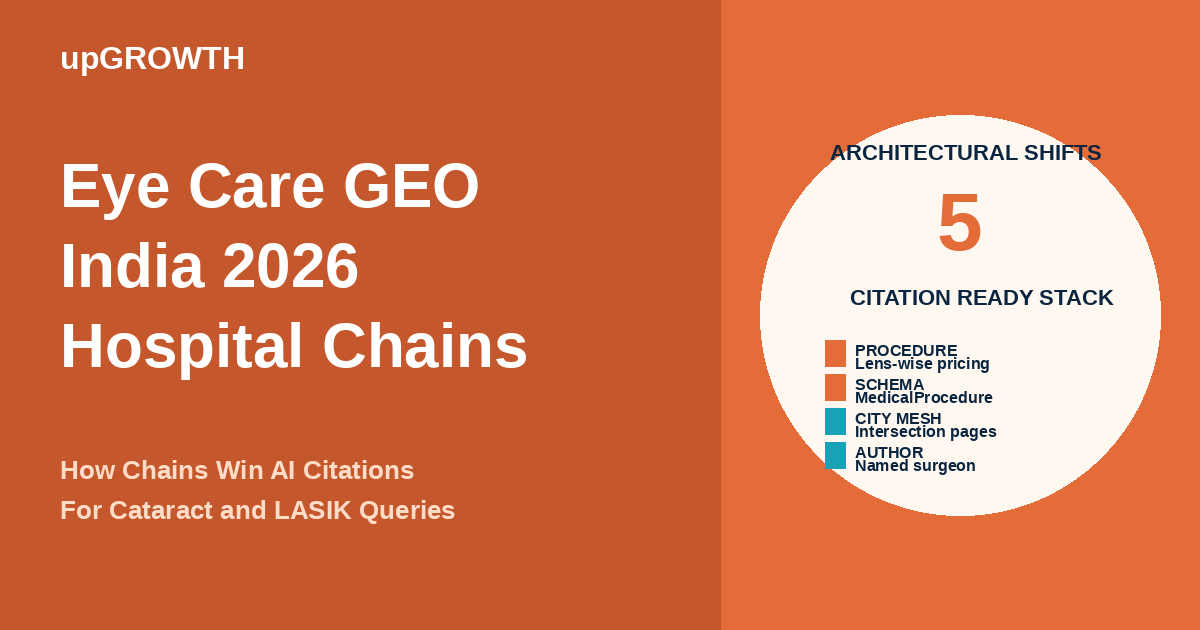
The Five Architectural Shifts for Eye Care Chain GEO in India
Shift one. Procedure-indexed hospital content with lens-level cost transparency. Every procedure gets a standalone page: cataract surgery, phacoemulsification, femto-laser cataract, MICS, LASIK, SMILE, Contoura vision, ICL, glaucoma surgery (SLT, trabeculectomy, drainage implant), vitreoretinal surgery, oculoplasty, cornea transplant, pediatric squint correction and ROP screening. For cataract specifically, each lens type (monofocal, toric, multifocal, trifocal, EDOF) needs its own sub-page with price band and candidacy. A chain with 20 procedures across 12 sub-specialties needs roughly 55-80 procedure pages. Most regional chains have 6-10. This is where AI visibility starts.
Shift two. Named ophthalmologist content with fellowship credentials and surgical volume. AI platforms favor authored content with verifiable specialist credentials. Each panel ophthalmologist gets a dedicated profile page showing MS Ophthalmology qualification, fellowship training (vitreo-retina, glaucoma, cornea, pediatric, oculoplasty), AIOS membership, specific surgical volume by procedure, hospital affiliation history and publication credits. City-specific specialist directory pages aggregate these profiles by location and sub-specialty. Without named attribution, AI platforms can’t verify authority and deprioritize the content.
Shift three. City-procedure intersection mesh. Most chains have location pages and procedure pages separately. AI platforms route high-intent queries to intersection pages. “Cataract surgery in Jayanagar Bangalore,” “LASIK in Powai Mumbai,” “retina specialist in Kothrud Pune” each need dedicated URLs tying procedure availability to specific hospital location with surgeon names, pricing, insurance empanelment and driving distance from major landmarks. A 20-hospital chain serving 10 procedures needs roughly 120-180 intersection pages to cover high-volume combinations.
Shift four. Sub-specialty authority content with treatment protocols. Eye care is heavily sub-specialty driven. A 3000-word explainer on diabetic retinopathy covering staging, treatment options (intravitreal injections, laser photocoagulation, vitrectomy), cost bands per treatment modality, specialist requirements and outcome data earns far more AI citations than a 600-word condition page. Build similar depth content for glaucoma, AMD, keratoconus, retinal detachment, uveitis, pediatric strabismus and oculoplastic conditions. 15-25 such protocol explainers anchor sub-specialty authority.
Shift five. Schema stack for medical eye care content. MedicalProcedure schema for every surgical procedure page. Physician schema with medicalSpecialty for every ophthalmologist profile. MedicalClinic schema for every hospital location with accreditation data (NABH, NABL, ISO). MedicalCondition schema for every condition page. FAQPage schema for every Q and A section. WebPage schema with proper breadcrumbs, publication date and author attribution across the site. Without this stack, AI platforms can parse the content but can’t classify it as authoritative medical information.
The Named Ophthalmologist Play and AIOS Compliance Guardrails
Named ophthalmologist content is the single highest-leverage move for eye care chain GEO. It is also where regulatory risk concentrates. The AIOS (All India Ophthalmological Society) Code of Ethics and the Medical Council of India’s advertising guidelines restrict certain claims. The National Medical Commission Professional Conduct Regulations 2002 (updated 2023) prohibit superlative claims, guaranteed outcome statements and misleading testimonials. ASCI consumer complaints on ophthalmology ads increased 34 percent YoY in 2025.
The compliant path. Every ophthalmologist profile states MS Ophthalmology or DO qualification, fellowship institution and sub-specialty (e.g., Fellowship in Vitreo-Retinal Surgery, LVPEI 2017), AIOS membership number where disclosed, hospital affiliations with dates, surgical volume stated as ranges not exact counts, and publications with PubMed IDs. Avoid “best surgeon,” “guaranteed vision” or “100 percent success rate” language. Use “experienced in,” “trained at,” “specialist in” and state outcome data as clinical study citations where available.
Content review workflow. Every procedure page and specialist profile gets reviewed by the hospital’s medical director or senior panel ophthalmologist before publication. Review signature captured in the CMS audit log. Retainer allocation: INR 7000-18000 per clinical review for a senior ophthalmologist, INR 4000-9000 for peer review. A 60-page procedure content build plus 150 specialist profiles adds roughly INR 38-82 lakh in clinical review costs over 6-9 months.
Patient consent. Every case photo, testimonial or before/after image requires written consent per AIOS Code of Ethics. Video testimonials need separate consent for digital distribution. Missing consent is the single most common ASCI complaint driver and creates legal exposure. Build a consent management system before publishing any case content.
The Pricing Transparency Play Most Eye Care Chains Fight
Eye care pricing transparency is resisted harder than dental or fertility pricing because lens choices, anesthesia options and laser platforms create 4-8x cost swings within the same procedure. Chains fear publishing ranges because lower ranges attract patients who then resist upgrades, and higher ranges scare off price-sensitive patients. The Dr. Agarwal’s and ASG model proves the opposite.
The AI citation play. Publish lens-wise cataract pricing: INR 15,000-22,000 per eye for monofocal IOL, INR 32,000-48,000 for toric, INR 58,000-85,000 for trifocal, INR 95,000-140,000 for premium EDOF. Publish LASIK platform pricing: INR 32,000-48,000 for standard LASIK per eye, INR 58,000-85,000 for Contoura vision, INR 85,000-120,000 for SMILE, INR 110,000-155,000 for ICL. Publish hospital-wise pricing if it varies by location. Show what’s included (consultation, surgery, lens/laser platform, follow-ups for 30/90 days) and what’s separate (pre-op investigations, extended follow-ups, complications management).
The booking conversion effect. A Pune-based 9-hospital chain we advised published lens-wise pricing across 68 procedure pages in Q2 2025. AI citation share on cataract cost and LASIK cost queries moved from under 2 percent to 14 percent in 7 months. Surgical consultation bookings attributed to AI-routed organic traffic grew 3.1x over the same period. Pre-consult price objections during counseling dropped 52 percent because patients arrived pre-informed.
The budget. A pricing transparency build covering 30-50 pricing pages (lens-wise, procedure-wise, city-wise intersection) takes 5-14 lakh in editorial and medical review. Add another 3-8 lakh for CMS schema implementation and internal linking. Total 8-22 lakh upfront. This is the fastest-payback component of the full GEO stack.
The Operational Playbook for Eye Care GEO: 6 Phases, 8-16 Months
Phase one, clinical governance and content framework, months 1-2. AIOS and NMC compliance framework locked with medical director and legal counsel. Consent management system deployed. Medical review workflow defined. Named ophthalmologist editorial policy ratified. Schema implementation plan reviewed by SEO and legal. Budget: INR 8-16 lakh. Retainer: INR 1.8-3.5 lakh per month for compliance, editorial and schema oversight.
Phase two, named ophthalmologist profile build, months 2-4. Every panel ophthalmologist (40-180 across the network depending on size) gets a dedicated profile with qualification, fellowship, sub-specialty certification, surgical volume range, publication credits and hospital affiliations. City-sub-specialty directory pages aggregate profiles. Budget: INR 18-38 lakh for a 20-hospital chain.
Phase three, procedure and sub-specialty condition pages, months 3-6. 50-75 procedure pages covering cataract (with lens variants), LASIK, SMILE, Contoura vision, ICL, glaucoma surgery variants, retina procedures, oculoplasty, pediatric ophthalmology, cornea transplant and refractive procedures. 15-25 sub-specialty condition explainers for diabetic retinopathy, AMD, glaucoma, keratoconus, retinal detachment, uveitis. Each page uses answer-ready formatting, MedicalProcedure or MedicalCondition schema, pricing bands, surgeon attribution and FAQ section. Budget: INR 26-55 lakh.
Phase four, city-procedure intersection mesh, months 4-7. 120-180 intersection pages tying hospital location to available procedures, sub-specialty coverage, named surgeons and pricing. High-volume combinations first (top 40 by keyword volume), then long-tail. Each page internally links to the parent procedure page, relevant surgeon profiles and the specific hospital location page. Budget: INR 14-28 lakh.
Phase five, pricing transparency and insurance empanelment, months 5-9. Lens-wise cataract pricing, platform-wise LASIK pricing, procedure-wise sub-specialty pricing, city-wise variation if applicable. Insurance empanelment pages by insurer (Star Health, Bajaj Allianz, ICICI Lombard, HDFC Ergo, CGHS, Ayushman Bharat) mapped to procedures covered. Cashless process walkthroughs per insurer. Budget: INR 24-48 lakh.
Phase six, measurement, refresh and retainer, months 6-16. AI citation tracking across ChatGPT, Perplexity, Google AI Overviews and Gemini using a 520-700 prompt benchmark refreshed quarterly. Content refresh sprints every 90 days on top 20 surgeon profiles, top 25 procedure pages and top 50 intersection pages. Retainer: INR 4-10 lakh per month for mid-size chain, INR 10-18 lakh per month for national chain covering ongoing editorial, medical review, schema maintenance and citation intelligence.
Editorial content development. INR 24-48 thousand per procedure page across 55-80 pages, INR 16-28 thousand per city-procedure intersection page across 120-180 pages, INR 22-40 thousand per pricing page across 30-50 pages, INR 14-24 thousand per specialist profile page across 40-180 profiles, INR 32-55 thousand per sub-specialty condition explainer across 15-25 pieces. Total editorial: INR 65-135 lakh over the 9-month build.
Medical review and clinical oversight. INR 7-18 thousand per clinical review at roughly 400-700 reviews across the build. Medical director retainer contribution INR 2.5-5 lakh per month for 9 months. Total clinical ops: INR 32-65 lakh year one.
Schema and engineering. Schema implementation, CMS upgrade for structured medical content, booking integration, AI citation tracking dashboard, internal linking automation. INR 38-75 lakh year one.
GEO retainer. INR 4-10 lakh per month for mid-size chain, INR 10-18 lakh per month for national chain covering editorial refresh, medical review, schema maintenance, citation intelligence and quarterly benchmarking. INR 48-120 lakh year one.
Total year one investment: INR 1-1.8 crore for mid-size chain, INR 1.6-2.4 crore for national chain. ROI: citation share moving from sub-3 percent to 14-22 percent over 9-16 months translates into 4500-9000 incremental surgical consult bookings per year at attributed acquisition cost of INR 1200-2800 per consult, versus INR 4000-8500 per consult through Google Ads.
Common Mistakes Indian Eye Care Chains Keep Making in AI Visibility
Mistake one. Single procedure listing page. One “our services” page listing cataract, LASIK, glaucoma, retina together with no individual procedure depth. AI platforms can’t cite such pages for specific procedure queries.
Mistake two. Unnamed generic content. Every page signed “Team chain name” with no surgeon attribution. AI platforms down-rank anonymous medical content.
Mistake three. Hidden pricing. “Contact for quote” instead of cost bands. Competitors with published pricing win the citation even if the chain is cheaper.
Mistake four. Collapsed LASIK content. Single “LASIK” page for standard LASIK, Contoura vision, SMILE, ICL and PRK. Centre for Sight wins because they separate each refractive procedure into its own indexed page.
Mistake five. Missing sub-specialty depth. Retina, glaucoma, pediatric and oculoplasty collapsed into brief mentions. L V Prasad and Aravind win sub-specialty citations because they publish 3000-4000 word explainers with treatment protocols.
Mistake six. Weak schema. No MedicalProcedure schema, no Physician schema, no MedicalClinic schema with accreditation data. AI platforms parse the content but don’t classify it as authoritative medical information.
Mistake seven. Ignoring city-procedure intersection queries. City pages exist but don’t tie to specific procedures. Users searching “cataract surgery in Jayanagar” route to Dr. Agarwal’s or ASG instead.
Mistake eight. No quarterly refresh. Content goes live, nobody touches it for 18 months, AI platforms deprioritize stale medical content. Chains that refresh top pages every 90 days compound citation share.
Indian Eye Care Chain AI Citation Shares 2026
Hospital Chain
Citation Share (%)
Market Position
Dr. Agarwal’s Eye Hospital
26%
National Leader
Centre for Sight
18%
National Leader
ASG Eye Hospitals
14%
National Leader
Sankara Nethralaya and Aravind
13%
Tertiary Center
Practo and 1mg
12%
Aggregator
Regional Chains (40+)
17%
Regional Chains
Healthcare Retail
GTM Strategy Teardown
Eye Care: The Omnichannel Empire
How structural market friction was engineered into a highly profitable, self-sustaining growth engine for Indian eyewear.
Tech-First Disruption
3D Virtual Try-OnSolved the “fear of fit” by allowing users to visualize frames via mobile cameras, boosting conversion by 3-4x.
Programmatic SEODominating high-intent search queries for specific frame styles, colors, and clinic locations.
Experience Centers
The Trust BridgePhysical stores serve as brand embassies, solving the trust deficit through in-person optometry.
Tier 2/3 ExpansionCapturing 80% of India’s demand in underserved regions with 50-70% lower real estate costs.
Vertical Integration
Manufacturing ControlEliminating middlemen to achieve 60-70% margins while undercutting retail prices by 30-50%.
Inventory OptimizationData-driven SKU management ensures the right fashion-forward styles are stocked per local demand.
Fast-Fashion Accessory
Cultural RepositioningTransforming eyewear from a clinical medical necessity into a high-frequency fashion statement.
Retention FlywheelPost-purchase engagement and “Buy 1 Get 1” loyalty loops drive repeat fashion-led purchases.
Eye care dominance is achieved by combining rigorous supply-chain control with tech-enabled physical retail.
Q: Do AIOS and NMC guidelines restrict eye care GEO content?
A: AIOS Code of Ethics and NMC Professional Conduct Regulations 2002 (updated 2023) prohibit superlative claims, guaranteed outcome language and misleading testimonials. They explicitly allow educational content, surgeon qualification disclosure, hospital accreditation mention, procedure explanations and published outcome data with proper citations. A compliant GEO build requires medical director review of every page, consent management for case content, and avoidance of “best,” “guaranteed” and “100 percent” language. Done right, compliance becomes a competitive moat because non-compliant competitors face ASCI and MCI notices.
Q: How long before citation share moves for an eye care chain?
A: Initial citation surfacing starts in 10-16 weeks for newly published procedure pages with proper schema and named surgeon attribution. Meaningful share (5-9 percent on focus queries) takes 16-28 weeks. Competitive parity with Dr. Agarwal’s, Centre for Sight and ASG on specific sub-specialty or city intersection queries takes 9-16 months of consistent building and refresh.
Q: Can we run GEO with our existing panel ophthalmologists or do we need new hires?
A: Existing panel is almost always sufficient. The gap is not clinical capacity, it’s structural visibility. A 40-ophthalmologist panel with sub-specialty fellowships across vitreo-retina, glaucoma, cornea, pediatric and oculoplasty is enough to anchor 180-300 content pieces. Build the named surgeon content from the existing panel, tie each surgeon to their sub-specialty and hospital locations, and let the mesh compound.
Q: Why does city-procedure intersection matter so much in eye care?
A: Because AI platforms are optimizing for query intent match, and eye care queries combine location urgency (elderly cataract patient seeks nearby surgeon) with procedure specificity (toric vs multifocal vs trifocal IOL). Generic city pages don’t match intent. Generic procedure pages don’t either. The intersection page captures the 3-4x higher query volume created by this combined intent. Regional chains that master the intersection mesh outperform larger national chains on city-specific queries.
Q: What about pediatric ophthalmology and ROP screening content? YMYL risk?
A: Pediatric ophthalmology is high-YMYL, requiring stricter sourcing and review. Every pediatric page gets reviewed by a pediatric ophthalmology specialist. Content references AAP and AIOS pediatric guidelines. ROP screening content explicitly states the NHS or ICMR neonatal screening protocols. Avoid any language that suggests parents should delay specialist referral. The defensive moat is strong here. Competitors with weaker pediatric content face regulatory risk, chains with proper review win citations.
Q: What schema should we prioritize for eye care content?
A: MedicalProcedure schema for surgical procedure pages with relevantSpecialty, preparation, howPerformed, followup and outcome properties. Physician schema with medicalSpecialty for surgeon profiles. MedicalClinic schema for hospital pages with accreditation data (NABH, NABL, ISO). MedicalCondition schema for condition explainers (diabetic retinopathy, glaucoma, AMD, keratoconus). FAQPage schema for every Q and A block. WebPage schema with breadcrumbs, author and publication date across the site. MedicalWebPage specializedBy property marking sub-specialty content.
Eye Care Chains: India Geo-Expansion Strategy
0 of 8 vision growth pillars explored0%
Hub & Vision Centers
Cataract Local SEO
LASIK Personas
Community Camps
Insurance Clarity
Trust via Reviews
Lead Velocity
Optical Upsell
Your Next Move: Book an Eye Care Chain GEO Audit
If you run a multi-hospital eye care chain in India and your AI citation share is under 6 percent on cataract cost, LASIK cost, retina specialist, glaucoma treatment or sub-specialty queries, the structural gap compounds every quarter. Dr. Agarwal’s, Centre for Sight and ASG are pulling ahead because they published earlier and their content mesh keeps densifying. Catching up gets harder each quarter, not easier.
The first move is a 520-prompt audit across ChatGPT, Perplexity, Google AI Overviews and Gemini mapped to your hospital catchments, procedures and sub-specialty panel. The audit shows current citation share, competitor architecture analysis, AIOS and NMC compliance gaps, and a prioritized 9-month build plan with budget math. We run this as a 45-day paid engagement with a senior growth strategist and a medical content editor, costing INR 5-9 lakh. The deliverable is a 70-85 page PDF benchmarking your chain against Dr. Agarwal’s, Centre for Sight, ASG, Sankara Nethralaya and the top 2 regional competitors in your catchments, plus a ready-to-execute build plan. Roughly 75-82 percent of audit clients convert to a 9-month GEO retainer at INR 4-10 lakh per month.
Amol has helped catalyse business growth with his strategic & data-driven methodologies. With a decade of experience in the field of marketing, he has donned multiple hats, from channel optimization, data analytics and creative brand positioning to growth engineering and sales.

 Growth Strategy and Planning
 Inbound Growth
 Growth Hacking
 Fractional CMO
 Search Engine Optimization
 Paid and Performance Marketing
 Social Media Marketing
 Demand Generation
 AI-Driven Growth Strategy
 AI-Native Workflow Automation
 Generative Engine Optimization
 Grove — AI Growth Strategist

 AI Automation
 Framework
 Case Study
 Tools
Tools Growth Tools
 Decision Tree
 Compare
 Custom GPT's
 Guides
 Offer
Offer Webstories
 Quizzes
 Blog
Blog AI-powered Apps
 Social Media Tools
 Agency Fit Score