Contributors:
Amol Ghemud Published: August 14, 2018
Summary
Share On:
In This Article
Search engine optimization isn’t just about keywords anymore. With every new change in Google’s algorithm, SEO becomes less of a single process or skill and more of a comprehensive strategy which needs to be implemented using SEO techniques. Successful SEO techniques need to be firmly embedded into an enterprise’s entire communications approach from the beginning.
Identifying the audience and choosing how to address them, are now crucially integrated into the never-ending quest for search engine visibility. That means the SEO expert needs to take a holistic view of the process and all its moving parts.
And that, more than anything else, can lead to SEO problems.
The SEO challenges of the past – questions about keyword density, meta tags, and so much more – are increasingly giving way to the most complex issues a company faces as it brands and positions. Good SEO demands tech savvy, clear communication, and project management skills. Let’s look at some of today’s top SEO problems.
SEO problems faced by marketers
1. Finding Some Quick Fixes
Business owners should understand the working of search engines and the importance of organic search. It doesn’t have a quick fix. Although there are some quick fixes, the results aren’t that long lasting. Creative SEO techniques do not rely on quick fixes.
2. Thinking About Tough Competition
Often, website owners think that their competition is doing something big, then why couldn’t they do. Many websites follow shady link building, duplicate content, exact match domain, and many similar practices, which make them successful temporarily. It becomes quite disheartening for those using white hat SEO techniques, but failing to claim what they truly deserve.
3. The Hourly Rate Riddle of SEO Consultants
If you are an SEO consultant, you often have noticed that your client doesn’t object in the start, but midway, the objection on hourly rate comes. Despite liking the proposal, the hourly rate discussion becomes disturbing for the SEO consultants. The reason is simple; they don’t have that level of SEO understanding as you have, so their response is obvious.
4. Demanding SEO Results for Poor Products
SEO techniques help a lot in making a business successful, but it is not a solution to everything. If a website carries poor products or inefficient services, or worst customer care, then SEO can’t deliver the desired results.
5. SEO Kept Separate from Web Development
Many SEO clients opt for designing first and developing a website prior to implementing SEO techniques. In such a case, the website is expected to perform poorly. Such a site takes more expensive changes to fix the problems later on.
The best approach is to acquire the services of an SEO consultant from the planning phase of web designing and development.
Do you want to optimize your website, drive more traffic and deliver higher conversions? This is a checklist that we follow, and can get your site to rank consistently on top of search engines.
Download this ultimate SEO Checklist which includes On-Page SEO as well as Off-Page SEO techniques that will help you rank well on the search engines.
Understanding SEO techniques
SEO is short for search engine optimization. Search engine optimization is a methodology of strategies, techniques and tactics used to increase the amount of visitors to a website by obtaining a high-ranking placement in the search results page of a search engine (SERP) — including Google, Bing, Yahoo and other search engines.
SEO helps to ensure that a site is accessible to a search engine and improves the chances that the site will be found by the search engine.
SEO is typically a set of “white hat” best practices that webmasters and Web content producers follow to help them achieve a better ranking in search engine results. There is also something called as black hat SEO techniques.
What Is Black Hat SEO?
Black hat SEO refers to a set of practices that are used to increase a site or page’s rank in search engines through means that violate the search engines’ terms of service.
Black Hat SEO is most commonly defined as a disapproved practice that nevertheless could increase a page’s ranking in a search engine result page (SERP). These practices are against the search engine’s terms of service and can result in the site being banned from the search engine and affiliate sites.
Creating pages, subdomains, or domains with duplicate content
Pages with malicious behavior, such as phishing, viruses, trojans, and other malware
What Is White Hat SEO?
The term “white hat SEO” refers to SEO techniques that are in line with the terms and conditions of the major search engines, including Google.
White hat SEO is the opposite of Black Hat SEO. Generally, white hat SEO refers to any practice that improves your search rankings on a search engine results page (SERP) while maintaining the integrity of your website and staying within the search engines’ terms of service. These tactics stay within the bounds as defined by Google.
Examples of white hat SEO techniques include:
Offering quality content and services
Fast site loading times and mobile-friendliness
Using descriptive, keyword-rich meta tags
Making your site easy to navigate
SEO tools for startup founders
As an entrepreneur or co-founder, you’re no stranger to the importance of using good tools to help improve your business. As technology becomes increasingly intertwined into our daily lives, digital marketing continues to play an essential role in a small business. So, to help the startup community, here’s a list of my personal favourite SEO tools that have helped transform not only my business, but hundreds of others around Australia.
1. Google Page Insights
Site speed and usability are crucial to your website’s SEO and page ranking. At a glance, Google Page Insights gives you this on both desktop and mobile. Simply drop the URL of the website you want to check into the tool, and within seconds, a test is run and you have a score out of 100.
2. Screaming Frog SEO Insights
This is by far the favourite SEO tool. Again, with a simple URL drop, the tool will crawl your website for broken links, which can damage your SEO and page ranking and credibility. If you’re working with a large website, this can be a useful way to spot-test your website health, fast.
3. Google Search Console
Another excellent tool from Google. This tool gives you the ability to constantly analyse your website and identify crawling issues. This tool requires a bit of technical set up, but there are plenty of guides to help you through it available online. I can promise you now, the pain is well worth it!
4. Google Keyword Planner
Yet again Google provides another amazing SEO tool for startups. Simply type in your website URL or keyword ideas, and Google Keyword Planner (GKP) will give you monthly search volumes for your keywords. It will also suggest other keyword ideas broadly related to the one you put in. This is a great way to discover new keywords to give your website an organic search boost.
5. Yoast SEO
Unfortunately, this hidden gem is only available as a WordPress plugin, but it is the ultimate tool for entrepreneurs and startups to boost their SEO. It allows you to easily determine your meta description, page title and URL slug. If you’re not technically savvy, this SEO tool is a fantastic support. It uses a traffic light system to tell you how well your web page is optimised for Google search rankings.
6. Portent SERP Preview
Continuously working out of excel to write title tags, meta descriptions and URL structure can drain your creativity. I love using this tool to visualise what I’m writing. I find it helps to write awesome copy.
7. Copyscape
Google has been strict with duplicate content in recent updates, and will penalise your site accordingly, which can seriously damage your SEO and ability to rank on Google and attract new customers to your business.
Copyscape is a great way to combat this, to ensure all your website content is unique! You should also use this tool to audit your own pages to make sure no one is copying content from your website without your knowledge.
8. Google Analytics
Google Analytics (GA) is by far the best analytics package on the market. It’s unbelievable that it’s still free! To get the full understanding of the behaviour on your website this tool is a must-have for startups.
Not only can you understand your user experience, but you can track all your online campaigns to get a complete understanding of what’s working and what’s not with your audience.
Here’s a quick and simple SEO ROI Calculator
An SEO ROI calculator allows a data-centric approach when curating new strategies.
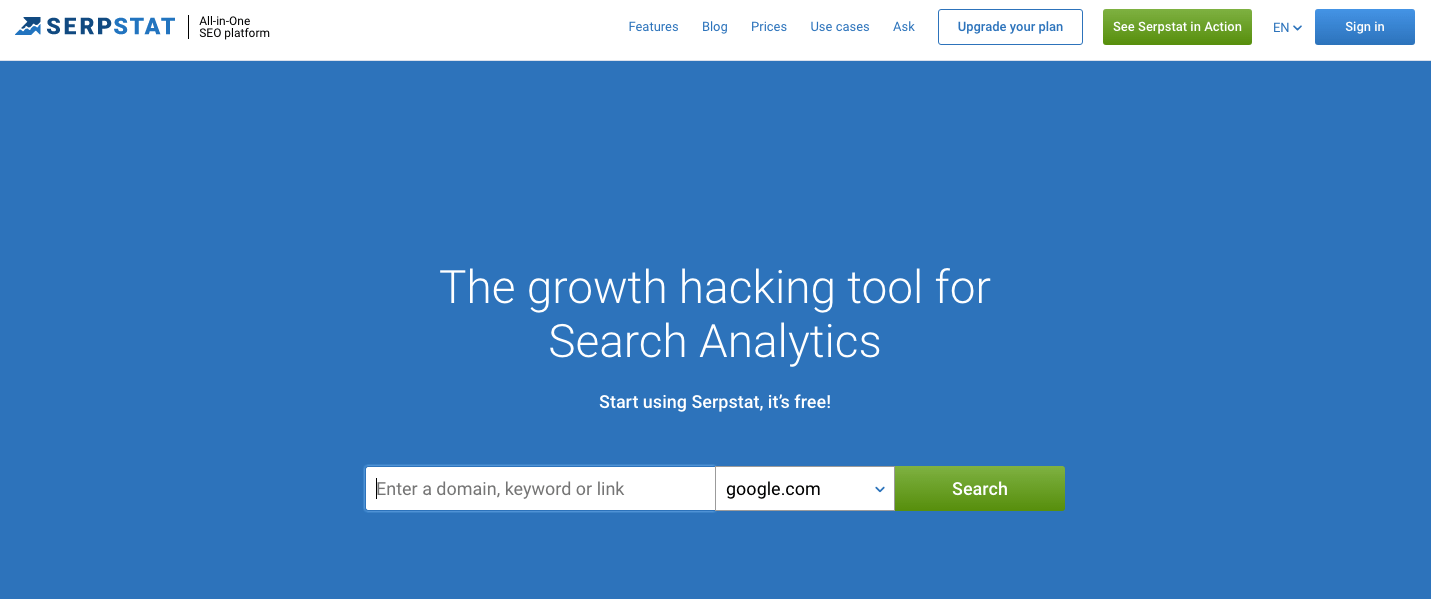
Launched in 2013, Serpstat is a relatively new player in the SEO market.
Serpstat allows you to do organic keyword tracking, spy on your competitor’s keywords, perform SEO site audits, PPC analysis, backlink analysis, and much more.
If you’re on a limited budget, but you need a good, reliable SEO tool which can help you find trending keywords in your niche and see what strategies your competitors are using, go with Serpstat.
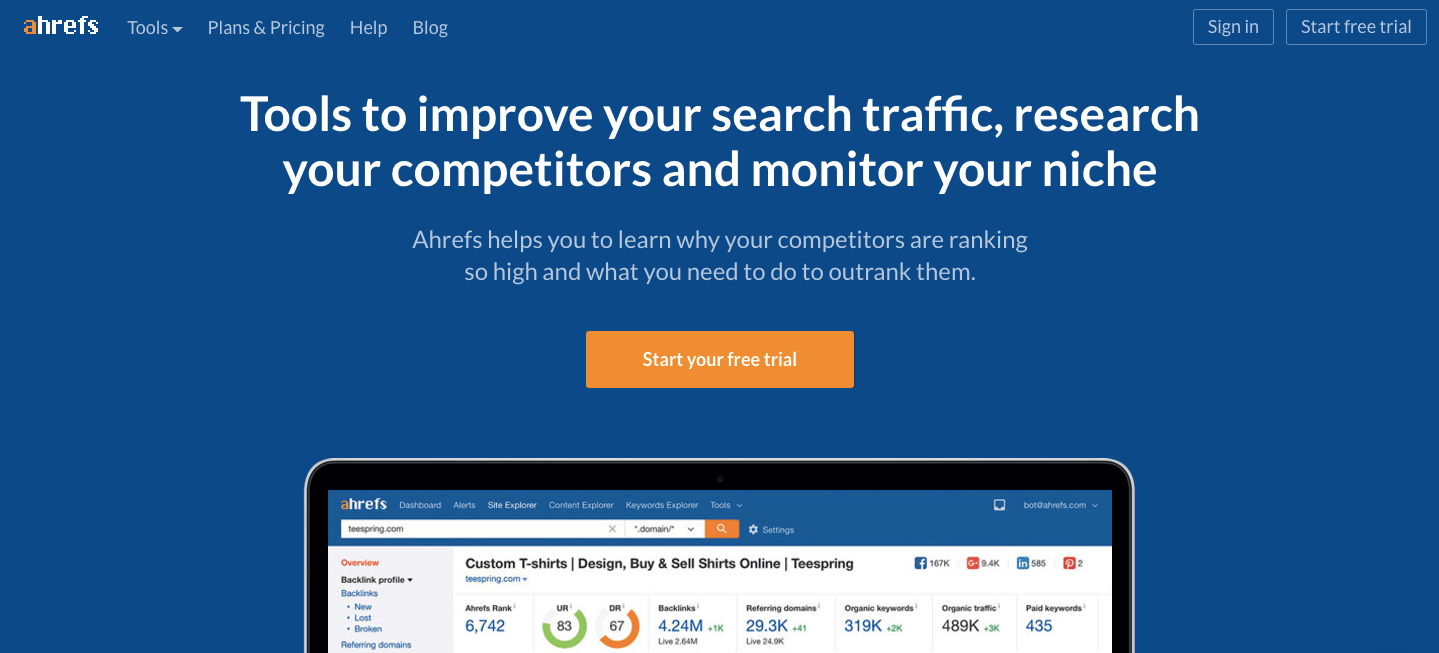
There are very few tools in the market which can match Ahrefs when it comes to backlink analysis. Ahrefs presents the most accurate link profile of your website and your competitors’ website.
Link building is important, and perhaps the most challenging aspect of SEO. If you’re serious about building authority links for your startup, you need a tool like Ahrefs by your side.
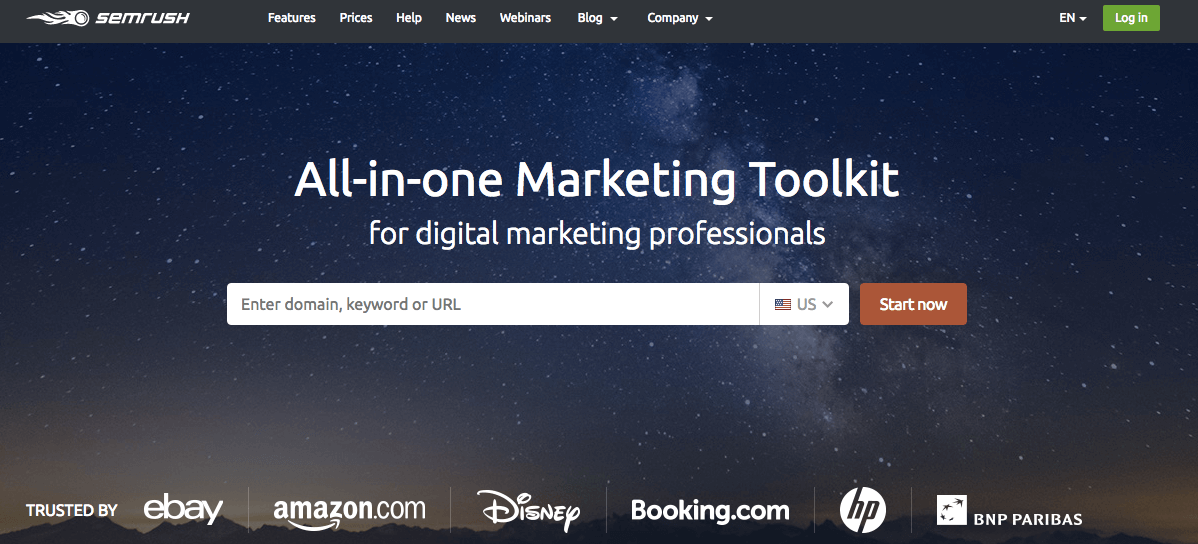
SEMrush is an all-in-one SEO and PPC tool which can help you do keyword research, competitors’ research, backlink analysis, PPC analysis, and much more.
It’s considered the swiss army knife of SEO tools of keyword research and competition analysis by marketing influencers. With SEMrush, you’ll be able to perform site audits to fix SEO errors on your website, track your rankings in SERPs for top keywords, unearth new keyword opportunities, and see what strategies your competitors are using to rank in search engines.
Started by Rand Fishkin back in 2004, Moz is one of the most popular SEO tools in the market. Moz’s keyword ranking tool helps you keep a track of fluctuations in search rankings and its site audit feature helps you identify SEO errors and fix them instantly.
Conclusion
Since it’s an ongoing battle between your startup and the competitors, you need to be consistent not just in implementing changes, but also in learning new stuff.
SEO, if done rightly on a startup website can turn out to be a successful lead generation medium, however, it requires a strategy, labor and patience to see the results. While you are educating yourself on a constant basis, you should also give your SEO expert at least 2 hours a week specifically for learning. The more he learns, the better he will perform!
Watch: 5 Ways to Upgrade Your SEO Techniques
For Curious Minds
Using black hat SEO tactics introduces significant risk that extends far beyond a simple rules violation, potentially leading to your site being banned from search engines. These disapproved practices are designed to manipulate search rankings, but they create a foundation for long-term failure.
While they might offer a temporary boost, search engines are adept at identifying and penalizing this behavior. Specific tactics that carry this risk include:
Keyword Stuffing: Overloading a page with keywords to manipulate rankings, which degrades user experience.
Cloaking: Showing different content to search engine crawlers than to users.
Sneaky Redirects: Sending users to a different URL than the one they initially clicked on.
Link Schemes and Link Farms: Creating a network of sites solely to build artificial links back to a primary site.
Ultimately, a strategy built on these methods is unsustainable because it ignores the core goal of search engines: to provide valuable, relevant content to users. To learn more about building a durable strategy, explore the full analysis of ethical SEO practices.
White hat SEO serves as a sustainable growth strategy by focusing on practices that align with search engine terms of service and enhance the user experience. This approach builds long-term authority and trust, which are rewarded with higher, more stable rankings, unlike the volatile results of black hat techniques.
These ethical tactics improve your search performance while maintaining your website's integrity. Key practices include:
Offering quality content and services: Providing genuine value that naturally attracts visitors and links.
Fast site loading times and mobile-friendliness: Ensuring a positive user experience on any device, which is a key ranking factor.
Using descriptive, keyword-rich meta tags: Helping search engines and users understand what your page is about.
Making your site easy to navigate: Creating a logical structure that allows users and crawlers to find content easily.
By focusing on the user, you inherently align your goals with those of search engines like Google. See how these practices create a compounding effect on traffic in our detailed breakdown.
Startup founders should select SEO tools based on their immediate needs and budget, recognizing that free and paid options serve different purposes. Free tools are excellent for foundational tasks, while paid platforms offer the depth required for a competitive edge.
For instance, Google Keyword Planner is a great starting point for discovering keyword ideas and monthly search volumes. However, a paid all-in-one tool like SEMrush provides a far more robust feature set, including deep competitor analysis, backlink tracking, PPC analysis, and comprehensive site audits. The primary trade-off is between the basic data from free tools and the actionable, competitive intelligence from paid subscriptions. To help you decide which investment is right for your startup, the full article provides a deeper comparison of top tools.
The comparison between white hat and black hat SEO is a classic case of sustainable growth versus high-risk shortcuts. White hat tactics, such as creating quality content, build genuine authority and a loyal audience, leading to stable, long-term rankings and business growth.
In contrast, black hat methods like link schemes or keyword stuffing aim to trick search engine algorithms for a fast, temporary ranking boost. However, these gains are almost always short-lived. Google's algorithms are continuously updated to detect and penalize such manipulative practices, which can result in your website being completely banned from search results. Choosing a white hat strategy is an investment in your brand's integrity and future viability, whereas a black hat approach jeopardizes your entire online presence. Uncover more on how ethical SEO builds a resilient online business in the complete guide.
For startups tackling link building, often considered the most challenging part of SEO, a tool like Ahrefs offers a distinct advantage with its industry-leading backlink analysis. Its core strength lies in presenting the most accurate and comprehensive link profile of both your website and your competitors' sites.
This capability is crucial because it transforms link building from guesswork into a data-driven strategy. With Ahrefs, you can identify where your competitors are getting their high-authority links, discover new link opportunities, and monitor your own backlink profile for any issues. This intelligence allows you to strategically replicate and improve upon your competitors' successful link-building efforts. Delve deeper into the specific tactics for using this data by exploring our full review of advanced SEO tools.
Since Google penalizes websites for duplicate content, maintaining originality is essential for ranking well and attracting customers. A tool like Copyscape serves a critical dual function in this area, acting as both a defensive and offensive measure for your content strategy.
First, you use it proactively to check your own content before it goes live, ensuring every page is unique and avoiding self-inflicted penalties. Second, it allows you to audit your published pages to discover if other websites have copied your content without permission. This helps you protect your intellectual property and take action to have the plagiarized content removed, thereby preserving your site's authority. Learn how to integrate this check into your content workflow by reading the full breakdown of essential SEO tools.
The Yoast SEO plugin is an invaluable tool for entrepreneurs on WordPress, especially those without deep technical SEO knowledge. It simplifies on-page optimization by providing a user-friendly interface to control crucial elements that influence search rankings.
Instead of needing to code, you can easily edit your page title, meta description, and URL slug directly within the post editor. The plugin's standout feature is its real-time analysis with a traffic light system (red, orange, green), which provides immediate feedback on how well your page is optimized for your target keyword. This system guides you through making specific improvements to content readability and keyword usage, empowering you to create pages that are more likely to rank well on Google. To see a step-by-step guide on its setup, explore the complete list of recommended startup tools.
A startup founder can conduct a powerful website health check using a suite of free tools provided directly by Google. This data-centric approach helps identify foundational issues without requiring a significant budget.
Follow this three-step process to get started:
1. Assess Site Speed: Use Google Page Insights to test your URLs. It provides a performance score out of 100 for both mobile and desktop, along with specific recommendations for improvement.
2. Identify Technical Issues: Set up Google Search Console. This tool is essential for monitoring how Google sees your site, identifying crawling errors, and understanding which queries are driving traffic.
3. Analyze User Behavior: Implement Google Analytics to track how users interact with your site, which pages are most popular, and where visitors are dropping off.
By combining insights from these three tools, you can create a prioritized list of technical fixes and content improvements. Dive into the full article for more advanced techniques using these free resources.
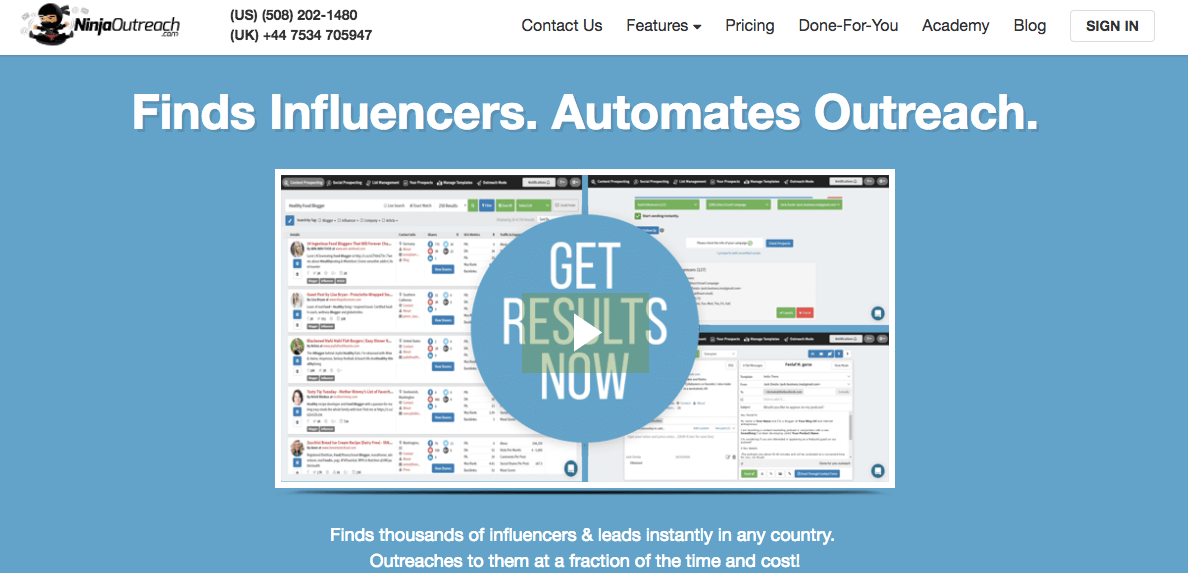
Blogger outreach is one of the most effective techniques for acquiring high-quality, contextual backlinks that boost your site's authority. An effective campaign involves identifying relevant bloggers in your niche, personalizing your communication, and offering them value in exchange for a link.
Specialized tools like Ninja Outreach are designed to streamline this process, particularly the time-consuming research phase. Instead of manually searching for influencers, this platform helps you quickly find relevant bloggers and their contact information, analyze their social following, and manage your outreach campaigns all in one place. Using such a tool transforms outreach from a manual grind into an efficient, scalable system for link building. For more on building these relationships, check out the full guide to off-page SEO tactics.
The role of an SEO expert has fundamentally shifted from a narrow, technical focus on keywords and meta tags to a broad, strategic one. This evolution is driven by Google's increasingly complex algorithms, which reward holistic user experience, brand authority, and high-quality content over simple technical optimizations.
Today, a successful SEO expert must take a holistic view of the process and all its moving parts. This means they need skills that extend far beyond traditional SEO, including:
Clear Communication: To align SEO goals with the broader marketing and development teams.
Project Management: To oversee complex initiatives that span content, design, and technical implementation.
Brand Strategy: To ensure SEO efforts support the company's overall positioning and messaging.
This strategic integration is what separates successful SEO from outdated tactical approaches. Learn more about how this role is changing in the full discussion.
Managing client expectations is a common challenge for SEO consultants, especially when faced with demands for quick fixes. The key is to educate the client from the start that SEO is a long-term investment, not a magic solution for underlying business problems like a poor product or bad customer care.
You should explain that while shady, quick-fix practices exist, they often lead to temporary success followed by severe penalties from search engines. Frame the discussion around sustainable growth by highlighting that white hat SEO builds a lasting asset for the business through authority and trust. Use an analogy: it's like building a strong foundation for a house rather than using cheap materials for a quick build that will eventually collapse. For more tips on client communication, see the full guide on common SEO problems.
When SEO is separated from web development, companies create significant and costly problems for themselves. A website designed without SEO in mind is expected to perform poorly in search rankings and often requires expensive, difficult changes to fix foundational issues later on.
Common problems include poor site architecture, slow page speeds, non-mobile-friendly design, and an inability for search engines to crawl the site effectively. The solution is to involve an SEO consultant from the very beginning of the planning phase. This ensures that the website is designed and developed with search engine best practices built into its core structure. This proactive approach saves money, accelerates results, and creates a much more powerful platform for long-term growth. To see a checklist for an SEO-friendly website build, explore the full article.
Amol has helped catalyse business growth with his strategic & data-driven methodologies. With a decade of experience in the field of marketing, he has donned multiple hats, from channel optimization, data analytics and creative brand positioning to growth engineering and sales.
Your buyers ask AI before they search. Run AI Answer Gap and see whether ChatGPT, Perplexity, Gemini and Google AI Overviews name your brand for the questions that matter in your category.