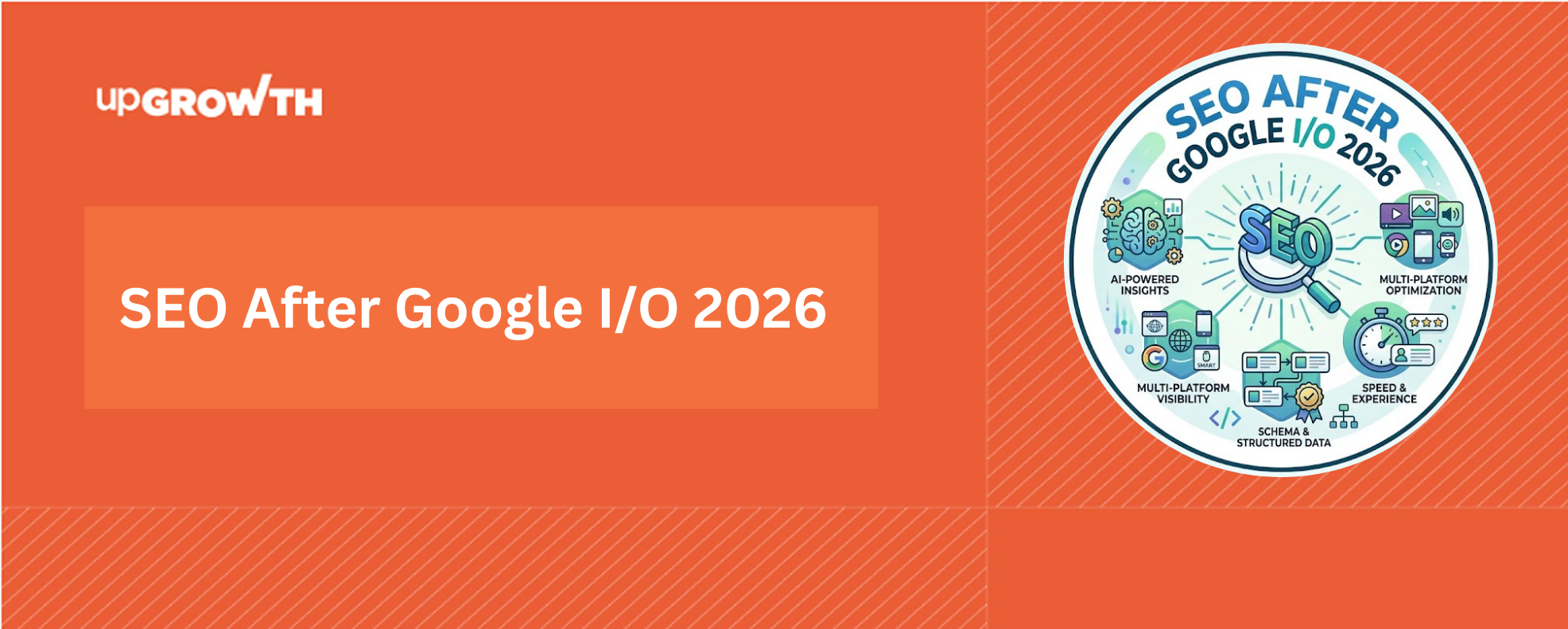
Google I/O 2026 did not kill SEO, but it fundamentally changed how search visibility works in an AI-first ecosystem.
This guide explains which SEO strategies still work, which outdated tactics are declining, and how Indian businesses can adapt using technical SEO, GEO, entity authority, and AI citation optimisation.
In This Article
Share On:
The honest, no-fluff breakdown every Indian marketer needs before they spend another rupee on search optimisation
Yes – but not the way most teams are currently doing it.
The announcements at Google I/O 2026 did not kill SEO. What they killed is a specific version of SEO — the version built around keyword volume, thin content, and ranking as the primary success metric. The fundamentals of what makes a website trustworthy, authoritative, and technically sound are not just still relevant; they are more important than ever. But the outcomes those fundamentals produce have changed. You’re no longer optimising purely to rank. You’re optimising to be read, trusted, and cited by AI systems that now mediate the majority of search interactions.
This article draws a clear line between what you should stop doing, what you should double down on, and what is new work that didn’t exist 18 months ago. It is written specifically for Indian businesses navigating a search landscape that is changing faster here than almost anywhere else in the world.
The New Job Description of SEO
Before breaking down what works and what doesn’t, it’s worth understanding how the job of SEO has changed at its core.
In the old model, SEO’s job was to get a page to rank in position 1–3 for target keywords, drive clicks to the website, and convert that traffic into leads or revenue. The feedback loop was: keyword research → content creation → technical optimisation → rankings → traffic → revenue.
That loop is intact but incomplete. A page can now rank in position 1 and receive significantly fewer clicks if an AI Overview resolves the query on the results page. Search Agents can visit your website and extract information without registering as a human visit in your analytics. Universal Cart can convert a customer who never saw your product page.
The new job of SEO is to make your website and brand legible to both humans and AI systems — to ensure that when Google’s AI is synthesising a response, your content is what it draws from. This means SEO is now upstream of visibility, not downstream. You don’t do SEO to rank and then get visibility. You do SEO so that the infrastructure is in place for AI systems to find, read, trust, and cite you.
That is a meaningful shift. And it changes almost every tactical decision.
What Still Works: The SEO Fundamentals That Became More Important
Technical SEO Is Now the Foundation for AI Accessibility
Technical SEO has always mattered. After Google I/O 2026, it matters more — and for a new reason. AI systems, including Search Agents that browse autonomously, need to be able to access, crawl, and parse your website cleanly. A site that is technically broken is not just invisible to humans through poor rankings; it is invisible to AI systems that may never successfully extract your content.
What this means in practice:
Core Web Vitals remain a ranking factor, but the more important frame is now AI accessibility. A JavaScript-heavy site that loads slowly or renders content only after complex client-side execution may be partially or fully invisible to AI agents. If your site requires JavaScript to render primary content, that content may not be read by AI crawlers.
Crawl budget management matters more for larger sites. If Googlebot and AI crawlers can’t efficiently access your important pages, those pages won’t be cited.
HTTPS, mobile usability, and structured internal linking remain non-negotiable. These are table stakes — not because they directly improve rankings, but because without them, nothing else works.
Specific technical checks every Indian business should run right now:
Render your key pages with JavaScript disabled and verify that the primary content is still visible. Run a crawl using Screaming Frog or Sitebulb and check for orphaned pages, broken internal links, and pages blocked in robots.txt that shouldn’t be. Review your Core Web Vitals in Google Search Console, paying particular attention to LCP (Largest Contentful Paint) on mobile — where the majority of Indian users access search.
E-E-A-T Signals Are the New Currency
Google’s E-E-A-T framework — Experience, Expertise, Authoritativeness, and Trustworthiness — is not new. But it has been elevated from a quality guideline to an active ranking and citation signal in the AI era.
Here’s why: AI systems that synthesise responses need to assess whether a source is worth citing. The signals they use to make that assessment are exactly the signals E-E-A-T is built on. A page written by a named expert with verifiable credentials, published on a domain with established topical authority, cited by other reputable sources, is significantly more likely to appear in an AI response than an anonymous piece of content on a new domain.
Every piece of content your brand publishes should have a named author with a detailed bio that includes relevant credentials, professional history, and links to their professional presence. This is not optional. Anonymous content will increasingly underperform in AI citation, regardless of how well it is keyword-optimised.
About pages, team pages, and founder pages need to be treated as SEO assets, not corporate formalities. Google’s knowledge graph actively uses these pages to build its understanding of who you are, what you do, and whether you are a trustworthy source on specific topics.
Domain authority through genuine backlinks from relevant, authoritative sources — trade publications, industry associations, reputable Indian media — remains important. The emphasis has shifted from quantity to relevance and authority.
Long-Form, Expert Content With Original Perspective
Long-form content has not died. What has died is long-form content that exists only to cover a topic comprehensively without adding any original perspective, proprietary data, or genuine expertise.
AI systems are trained on vast amounts of content across the web. When a user asks a question, the AI can synthesise a reasonably comprehensive answer from general knowledge. The only content that earns citation is content the AI cannot replicate — content that contains:
Original data: surveys, proprietary benchmarks, client anonymised case studies, platform-specific observations
First-person experience: “we tested this across 40 campaigns and here’s what actually happened”
Named expert opinion: attributed to a specific person with verifiable expertise
Unique frameworks or models: ways of thinking about a problem that are distinctly yours
This is not just a nice-to-have. It is the primary differentiator between content that earns AI citations and content that doesn’t. For Indian businesses, this is a significant opportunity — original data about the Indian market, Indian consumer behaviour, and India-specific industry dynamics is genuinely scarce on the global web. Brands that produce it become primary sources.
Structured Internal Linking Remains Powerful
Internal linking is one of the few SEO tactics that has not changed in its importance — and may have increased in relevance. A well-structured internal link architecture does two things in the new ecosystem: it tells AI crawlers how your content is organised and which pages are most authoritative, and it creates a content cluster that signals topical depth to Google’s knowledge systems.
For this content cluster specifically, every article in the Google I/O 2026 series — including this one — should be linked to the pillar and to relevant sibling articles. This is not just good SEO. It is the content architecture that allows Google to understand that upGrowth has comprehensive, interconnected expertise on AI search, and not just isolated pieces of content.
What No Longer Works: The SEO Tactics to Stop Investing In
Keyword-Volume-First Content Strategy
The question “what is the search volume for this keyword?” is no longer the right starting question for content strategy. It was useful when the goal was to rank for specific terms and capture click traffic. In an AI-mediated search environment, high-volume keywords are often exactly the queries that AI Overviews resolve fully on the results page — meaning high volume now frequently correlates with zero-click outcomes.
The better question is: “For which queries would a user need to visit a website, engage with an expert, or complete a transaction that cannot be handled on Google’s interface?” Those queries — complex, comparative, service-specific, or requiring human judgement — are where content investment should concentrate.
This doesn’t mean keyword research is dead. It means it needs to be filtered through the lens of AI Overview prevalence. For any target keyword, check whether Google currently serves an AI Overview for that query. If it does, ask whether your content would be the source that AI Overview cites — or whether it would compete with the Overview for clicks and lose.
Thin Cluster Content Built for Coverage
The traditional cluster model — a pillar page surrounded by dozens of thin supporting articles that each target a long-tail variant — is broken. AI systems don’t reward breadth for its own sake. A cluster of 30 thin, 600-word articles will generate fewer citations than five deeply researched, expert-authored pieces that genuinely exhaust a topic.
Quality has always been important in SEO theory. After Google I/O 2026, it is important in practice, because AI systems are effective at identifying genuine depth versus manufactured comprehensiveness.
The implication for Indian content teams: reduce publication frequency and increase editorial investment per piece. One well-researched, expert-authored article per week will outperform five keyword-targeted pieces with no original substance.
Link Building Through Low-Quality Directories and Guest Posts
Guest posting for the sake of link acquisition — particularly on low-authority, general-interest sites — has delivered diminishing returns for years. After I/O 2026, it is effectively a waste of budget.
AI citation systems assess entity authority, not link count. What matters is whether your brand is mentioned, cited, and associated with relevant expertise across credible, topically relevant publications. A single mention in an authoritative Indian industry publication — Economic Times, Inc42, YourStory, a sector-specific trade journal — is worth more for AI entity recognition than 50 links from generic guest post sites.
The link building strategy that works in 2026 is really a brand authority strategy: earn coverage through original research, strong founder voices, and genuine thought leadership. The links follow from that work, rather than being the work itself.
Tool and Calculator Pages as Traffic Moats
We covered this in the pillar article, but it is worth repeating in a technical context. Tool pages and calculator pages were SEO moats because they generated consistent, high-intent traffic for recurring queries. Google’s Generative UI now handles these query types natively on the results page.
If your SEO strategy is built on the traffic generated by calculator or tool pages — EMI calculators, ROI calculators, comparison tables, word count tools — that traffic will contract. Not immediately, not uniformly, but directionally and irreversibly.
The tactical response is to rebuild these pages around the expertise, advisory context, and proprietary insight that a Google widget cannot provide. Keep the tool. Build around it. Make the tool the entry point into a deeper relationship, not the destination itself.
Optimising Purely for Featured Snippets
Featured snippets — the boxed answers that appeared above organic results — were a major SEO objective for many Indian content teams. That objective is now largely absorbed by AI Overviews.
AI Overviews have replaced featured snippets as the primary zero-position content type for most informational queries. The technical approach to earning AI Overview citations is related to — but more demanding than — the approach to earning featured snippets. It requires not just answering a specific question directly, but answering it with sufficient authority, structured context, and entity clarity that an AI system trusts you as a source.
Optimising for featured snippets alone is no longer a meaningful goal. Optimising for AI citability, which subsumes featured snippet optimisation, is the right framing.
What Is New Work: SEO Priorities That Didn’t Exist Before
Schema Markup Is Now Strategic, Not Optional
Schema markup — the structured data code that tells search engines what type of content a page contains — was always recommended but often deprioritised. After Google I/O 2026, it is a first-order priority.
AI systems that synthesise responses need to understand not just the text of your content, but the entities, relationships, and content types it represents. Schema markup is the language that communicates this. Without it, your content may be readable but not trustworthy or classifiable to an AI system.
Priority schema types for Indian businesses:
Organization and Person schema on your homepage, about page, and team pages — this builds your entity in Google’s knowledge graph. Article and BlogPosting schema with author attributes on all editorial content — this connects your content to named experts. FAQPage schema on pages that answer specific questions — this is direct AEO optimisation that enables AI citation. HowTo schema on process or instructional content. Product and Offer schema on e-commerce and service pages. LocalBusiness schema for businesses with physical presence in India.
Each of these schema types signals to AI systems how to understand and use your content. A site with comprehensive, accurate schema markup is significantly more AI-readable than one without.
Entity SEO: Making Your Brand Legible to the Knowledge Graph
Entity SEO is the practice of ensuring that Google’s knowledge graph has a clear, accurate, and consistent understanding of who your brand is, what it does, and what expertise it is associated with.
This is different from traditional SEO, which focused on making individual pages rank. Entity SEO focuses on making your brand a recognised, trusted entity across the entire web — so that when AI systems encounter a relevant query, your brand is one of the entities they associate with the answer.
What entity SEO involves in practice:
Consistency of brand name, description, founding details, and service areas across every web presence — your website, Google Business Profile, LinkedIn, Crunchbase, Wikipedia (if applicable), industry directories, and media coverage. Any inconsistency in how your brand is described across these sources creates ambiguity in the knowledge graph, which reduces citation likelihood.
Building co-citation — being mentioned alongside recognised, authoritative entities in your space. If your brand regularly appears in content alongside well-known industry publications, credible research organisations, or established domain experts, Google’s AI associates you with that circle of authority.
Knowledge panel development. If your brand does not have a Google Knowledge Panel, that is a signal that your entity is not yet well-established in the knowledge graph. Building one — through consistent entity signals, Wikipedia entries where appropriate, and structured data — is a medium-term SEO objective that has outsized impact in the AI era.
Conversational and Question-Based Content Architecture
The redesigned search box — which now handles voice, image, and multi-modal queries — has changed how people phrase their searches. Queries are longer, more conversational, and more contextual. “Best digital marketing agency in Mumbai for a D2C brand with ₹50 lakh monthly revenue” is now a viable search query. Six months ago, most users would have searched “digital marketing agency Mumbai.”
This has an important implication for content architecture. Pages need to be structured to answer the specific, contextual questions that real users ask — not the stripped-down keyword versions of those questions.
Practically, this means adding explicit Q&A sections to key pages, using headers that mirror real question syntax (“How does [X] work for [specific context]?”), and building FAQ schema around the most specific, high-intent questions in your category.
This approach serves three goals simultaneously: it improves traditional keyword rankings by matching conversational query patterns, it increases AI Overview citation likelihood by providing extractable direct answers, and it aligns with voice search patterns driven by Gemini’s integration with Apple’s Siri and Google Assistant.
AI Citation Monitoring as a Reporting Metric
A year ago, no one was tracking how often their brand appeared in AI-generated responses. Today, it should be a primary KPI for any business that depends on search for customer acquisition.
Tools like Semrush’s AI Toolkit, Otterly, and Peec now allow you to track AI citation frequency — how often your brand, your content, or your named experts are cited in AI Overviews, Gemini responses, and other generative AI outputs.
This metric tells you something that rankings and organic traffic no longer tell you clearly: whether your brand is winning in the new search ecosystem. A brand whose AI citation frequency is growing, even if organic click traffic is declining, is building the right kind of visibility for the world that’s coming.
If your current SEO reporting does not include AI citation tracking, it is measuring the old game while the new one is already being played.
The Honest Assessment: How Much of Your Current SEO Still Applies?
Here is a direct breakdown — no hedging:
Still applies, no changes needed: Core technical SEO (crawlability, indexability, site speed, mobile usability, HTTPS). These remain table stakes.
Still applies, but the goal has changed: Keyword research (still useful, but filter for AI Overview prevalence). Long-form content (still valuable, but must contain original insight, not just comprehensive coverage). Backlink acquisition (still matters, but only from genuinely authoritative, topically relevant sources).
Partially applies, needs significant update: Content cluster strategy (the model works, but thin clusters don’t). Featured snippet optimisation (absorb into AEO/AI citation strategy). On-page SEO (title tags, meta descriptions, H1/H2 structure all still matter, but need to be rewritten with conversational query patterns in mind).
No longer effective as a primary strategy: Guest posting for link acquisition. Tool pages as traffic moats. Keyword-volume-first content planning. Anonymous, unattributed content. Short-form, thin articles targeting long-tail keywords.
New work with no precedent: Schema markup as a strategic priority. Entity SEO and knowledge graph management. AI citation tracking and reporting. Conversational content architecture. Agent-readiness auditing (ensuring your site is parseable by Search Agents).
The Indian market has three characteristics that make this transition both more urgent and more opportunistic than it is for businesses in other markets.
First, the India-specific content gap is enormous. Most of the authoritative content that AI systems currently draw from was created for Western markets. Data about Indian consumer behaviour, Indian regulatory contexts, Indian pricing dynamics, and India-specific use cases is scarce in AI training data. Indian businesses that produce high-quality, original content about their specific market contexts are not competing against a saturated field — they are filling a gap that AI systems actively need filled.
Second, the voice and vernacular search opportunity is underexplored. With Gemini now powering Siri on Apple devices, and with Indian consumers already using voice search at above-average rates, the opportunity to optimise for conversational, voice-first queries in Indian languages is both significant and largely uncaptured. Brands willing to invest in structured, schema-marked content in Hindi, Tamil, Telugu, Kannada, and Bengali will have a first-mover advantage that compounds over time.
Third, the competitive window is open. Most Indian businesses are still operating on the 2023 SEO playbook. The brands that begin the transition described in this article now — not after the full AI Mode rollout in India — will have a structural advantage that is extremely difficult for late movers to close.
The upGrowth Perspective: SEO Is Not Dead, It Has Levelled Up
At upGrowth, we have been tracking every Google search change across the past decade. Our honest assessment of Google I/O 2026 is this: SEO has not been disrupted, it has been elevated. The floor has been raised. The basics are now more important, not less. But the ceiling has also moved — the brands that go beyond the basics, into entity authority, AI citability, and genuine expertise, will build visibility that is more durable and more defensible than anything keyword rankings ever produced.
The businesses that treat this moment as a threat will spend the next 18 months trying to recover traffic that has permanently moved. The businesses that treat it as an elevation — an invitation to do the work at a higher level — will look back at this period as when they pulled decisively ahead.
The work is clearer than it has ever been. The question is whether you start it now or later.
Yes, SEO still works after Google I/O 2026, but the goal has changed. Instead of focusing only on rankings and clicks, SEO now helps AI systems crawl, understand, trust, and cite your content inside AI-generated search responses and AI Overviews.
2. What SEO strategies still work in 2026?
Technical SEO, structured data, expert-led content, internal linking, and E-E-A-T signals remain highly effective in 2026. However, success now depends more on AI citability, entity authority, and content quality than traditional keyword rankings alone.
3. What SEO tactics no longer work after Google I/O 2026?
Thin keyword-focused content, low-quality guest posting, traffic-only calculator pages, and mass-produced AI articles are losing effectiveness. Google’s AI systems prioritise trustworthy, structured, and experience-driven content instead of pages built only for search volume.
4. Why is technical SEO more important in AI search?
AI systems and Search Agents need clean, crawlable, machine-readable websites to extract information accurately. Fast-loading pages, structured schema markup, mobile optimisation, and strong internal linking help AI engines understand and cite your content more effectively.
5. What is entity SEO and why does it matter in 2026?
Entity SEO helps Google understand your brand as a trusted entity within its knowledge graph. Consistent brand information, expert attribution, authoritative mentions, and structured data improve your chances of being recommended and cited in AI-powered search experiences.
Disclaimer: As of May 2026, several features and updates referenced in this blog from Google I/O 2026 are yet to be rolled out in India, and their availability, functionality, and access timelines remain subject to Google’s region-wise release schedule.
For Curious Minds
The core function of SEO has pivoted from securing top rankings for human clicks to making your brand and website intelligible to AI systems. Your new primary goal is to become a citable, trusted source for AI-generated results, as these now mediate most search interactions. This shift is vital because visibility is no longer just about where you rank; it is about whether Google's AI synthesizes information from your content. For Indian businesses, ignoring this means becoming invisible to a growing majority of users who get their answers directly on the search results page. The new success metric is AI citation, not just human visitation.
Upstream Influence: SEO now acts upstream of visibility. You build a technically sound and authoritative foundation so AI systems can find and trust you.
Changed Feedback Loop: The old loop of keyword research to traffic is incomplete. Now, an AI can extract data without a "visit" registering in your analytics.
Strategic Imperative: Failing to optimize for AI is not just a missed opportunity; it is a direct path to being excluded from the primary way users will discover information and products.
To understand if your current strategy is prepared for this evolution, you must first audit how AI agents perceive your site.
AI accessibility refers to the technical optimization of your website to ensure autonomous AI systems, like Google's Search Agents, can easily access, crawl, parse, and understand your content. While user-centric metrics like Core Web Vitals remain important, the focus expands from human perception of speed to the raw machine-readability of your site. The key difference is that a site can feel fast to a user but be opaque to an AI. A JavaScript-heavy site, for example, might render content seamlessly for a human browser but present a blank or incomplete page to an AI crawler that does not execute complex scripts. Your technical foundation is now judged on its ability to serve clean, parsable data to machines. This means prioritizing server-side rendering, managing crawl budgets for AI agents, and ensuring all primary content is available in the initial HTML payload. A deeper dive into your site's technical structure is the first step.
The traditional SEO model was a linear funnel: rank high, get clicks, convert traffic. The new model is a web where AI systems are intermediaries, meaning a user can convert via Universal Cart without ever visiting your product page, or get an answer from an AI Overview sourced from your content, which you get no direct click for. Your goal is no longer just to attract a human visitor but to influence the AI that serves them. For an Indian e-commerce brand, this changes budget allocation priorities. Instead of focusing solely on category keyword rankings, you should invest more in structured data and technical soundness.
Factors to weigh include:
Technical SEO over Link Building: A flawless technical foundation for AI crawling is now more valuable than a high volume of low-quality links.
Content for Citation over Content for Keywords: Budgets should shift toward creating in-depth, authoritative content that an AI will cite, not thin pages for every keyword variation.
Structured Data Implementation: Ensuring product data is perfectly structured is critical for visibility in new search features.
Evaluating how your current budget aligns with these new priorities is essential for staying competitive.
A number one ranking no longer guarantees significant click-through traffic, as AI Overviews can resolve a user's query directly on the search page, using your content without sending the user to your site. This redefines the value of that top spot from a traffic driver to a mark of authority that gets your brand and information cited by Google's AI. For Indian B2B companies, tracking keyword rankings alone is a vanity metric. Success is now measured by your influence on AI-synthesized results and the brand visibility that creates.
New performance indicators to track:
Branded Mentions in AI Answers: Monitor how often your brand name appears as a source or recommendation within AI Overviews.
Citation Rate: Measure the frequency with which your specific data points, statistics, or definitions are used in generated answers.
Assisted Conversions: Analyze pathways where a user was exposed to your brand in an AI result before converting through another channel.
This new measurement framework provides a more accurate picture of your true search visibility and impact.
Foundational technical SEO is now the bedrock of AI visibility because AI systems, including Google's autonomous crawlers, must be able to access and parse your website's content cleanly. A technically flawed site is not just poorly ranked for humans; it is completely invisible to the AI agents that synthesize search results. For many Indian businesses, a common point of failure is a reliance on heavy client-side JavaScript to render primary content. This creates a significant problem: an AI crawler may not wait for the scripts to execute, effectively "seeing" a blank page where a human sees a fully rendered one. If your core information requires complex script execution, it might as well not exist for AI systems. This makes your expert content ineligible for citation in AI Overviews, crippling your visibility even if your user-facing site looks perfect. The full article explains how to diagnose this critical issue.
For an Indian D2C brand, ensuring your site is legible to AI is now a top priority for discovery and sales. A focused audit can reveal critical gaps in how systems like Google's Search Agents interpret your pages. The goal is to verify that your most important content is immediately available to machine crawlers, not just human visitors.
Here is a three-step plan to get started:
Conduct a JavaScript-Disabled Crawl: Use a browser extension or a crawling tool to view your key category and product pages with JavaScript turned off. Verify that all primary content is still visible in the raw HTML.
Validate Structured Data: Use Google's Rich Results Test to ensure your product schema, reviews, and pricing information are correctly implemented. This data directly feeds features like Universal Cart.
Analyze Server Logs for AI Agents: Review your server logs to identify and monitor the crawl patterns of Google's various user-agents. Ensure they are not encountering errors.
This initial audit will provide a clear roadmap for the technical adjustments needed to thrive in the new search environment.
The rise of features like Search Agents and Universal Cart fundamentally alters the customer journey, moving the point of conversion from your website directly onto the search results page. This means the traditional conversion funnel is becoming shorter and less reliant on your site's UX. For Indian businesses, this requires a strategic shift from optimizing landing pages for conversion to optimizing product data for direct integration with Google's ecosystem. Your focus must expand from on-site experience to off-site, platform-native commerce.
Strategic adjustments should include:
Perfecting Product Feeds: Your product data must be immaculate, with high-quality images, accurate pricing, and comprehensive descriptions.
Investing in Structured Data: Implementing robust product and offer schema is no longer optional; it is essential for being included in these new transactional features.
Rethinking Analytics: Your measurement must evolve to track impressions and conversions that happen outside your domain.
Adapting to this future means treating Google's search results page as your new storefront.
The most significant mistake is equating high rankings with guaranteed visibility and traffic. In the post-I/O 2026 landscape, a page can rank first yet receive minimal clicks because an AI Overview satisfies the user's intent on the SERP. Continuing to chase rankings as the primary KPI creates a dangerous blind spot where teams celebrate a "win" that generates no business value. The solution is to pivot from a ranking-centric model to one centered on AI legibility. This means ensuring your site's content and data are so clear, authoritative, and technically accessible that Google's AI chooses to cite you. This approach addresses the visibility gap by focusing on what actually drives value now: being the source of truth for AI-generated answers, which places your brand in front of users even without a click. True visibility is now about being cited by the machine.
Thin, keyword-stuffed content is now a major liability because AI systems are designed to synthesize information from authoritative, comprehensive, and trustworthy sources. Content that is shallow or written purely to rank for a keyword lacks the depth and credibility required to be selected for an AI Overview. It signals to Google that your site offers little unique value, making you a poor candidate for citation. The proper content strategy is to build topical authority through a hub-and-spoke model. This involves creating a central, in-depth pillar page on a core topic, supported by multiple detailed articles that answer specific user questions related to that topic. This approach demonstrates genuine expertise. For Indian businesses, this means investing in content that truly helps the user, not just targets a search term. This is how you become a trusted source for Google's AI.
The old strategy of creating thin content for every keyword variation is now obsolete. To be cited by AI systems, your content must demonstrate deep, trustworthy expertise on a topic. Your new objective is to own a topic, not just rank for a keyword.
Here is a process to guide this pivot:
Identify Core Expertise Clusters: Instead of a long list of keywords, define 3-5 core subject areas where your brand can be a genuine authority.
Develop Pillar and Spoke Content: For each cluster, create a comprehensive pillar page and surround it with spoke articles that answer specific questions.
Incorporate Verifiable Data: AI prioritizes content that is substantiated. Include original research, cite credible sources, and present information with clear structure.
Focus on Clarity: Use clear headings and lists to make your content easy for both humans and AI to parse.
This approach builds a library of assets that establishes your authority, making you a go-to source for Google's AI.
For large e-commerce sites, crawl budget management is no longer just about getting pages indexed by Googlebot; it is about ensuring both search and AI agents can efficiently access your most valuable pages. The old approach of simply blocking low-value faceted navigation via robots.txt is insufficient. The new strategy requires a more granular and proactive approach to guide all crawlers, human and AI, to high-priority content. You must actively direct crawling resources, not just passively block them.
Key evolutionary steps include:
Prioritize via Sitemaps: Use dynamic XML sitemaps to signal the importance and update frequency of your core category and product pages.
Strengthen Internal Linking: Build a logical site architecture that funnels crawler attention from the homepage down to your most important products.
Monitor Server Logs: Actively analyze your server logs to differentiate between Googlebot and various AI agents and identify if they are wasting resources on low-value URLs.
This ensures your critical inventory is always visible and available for inclusion in features like Universal Cart.
In the age of AI-driven search, 'authoritativeness' has evolved beyond a simple backlink profile. While links still matter, Google's AI now evaluates trust based on the depth, clarity, and verifiability of your content itself. It seeks to identify sources that demonstrate true expertise, not just good SEO. For an Indian brand, building this new form of trust means proving your expertise directly on your pages. Your content must be structured and written to be unambiguously expert and helpful.
Signals of this new authority include:
Content Depth and Comprehensiveness: Covering a topic thoroughly and answering related questions in a single, well-structured place.
Verifiable Claims: Citing data, linking to credible external sources, and presenting original research that can be substantiated.
Clarity and Readability: Using simple language, clear headings, and logical formatting that makes complex information easy for both humans and AI to parse.
Focusing on genuinely expert content signals to AI that you are a reliable source worthy of citation in AI Overviews.
Amol has helped catalyse business growth with his strategic & data-driven methodologies. With a decade of experience in the field of marketing, he has donned multiple hats, from channel optimization, data analytics and creative brand positioning to growth engineering and sales.
In This Article
Download The Free Digital Marketing Resources
[slide-anything id="15651"]
We plant one 🌲 for every new subscriber.
Want to learn how Growth Hacking can boost up your business?

 Growth Strategy and Planning
 Inbound Growth
 Growth Hacking
 Fractional CMO
 Search Engine Optimization
 Paid and Performance Marketing
 Social Media Marketing
 Demand Generation
 AI-Driven Growth Strategy
 AI-Native Workflow Automation
 Generative Engine Optimization
 Grove — AI Growth Strategist

 AI Automation
 Framework
 Case Study
 Tools
Tools Growth Tools
 Decision Tree
 Compare
 Custom GPT's
 AI Answer Gap
 Offer
Offer Webstories
 Quizzes
 Blog
Blog AI-powered Apps
 Social Media Tools
 Agency Fit Score