When to Walk Away from a Large Agency Deal: The Three-Test Screening Framework Indian Growth Agencies Use Before Signing Retainers Above Rs 5 Lakh Per Month [2026]
I walked from a Rs 12 lakh per month retainer last quarter. Term sheet signed, kickoff scheduled, and I killed it two weeks before the start date. The framework below is the exact three-test screen I now run on any agency retainer above Rs 5 lakh per month, with the math that turned a Rs 1.44 crore ARR headline into a Rs 68 lakh adjusted expected value. Walking is a discipline that protects agency margin, retention probability, and team capacity at scale.
In This Article
Share On:
The deal was a Series B D2C brand in Bengaluru, 12-month engagement at Rs 12 lakh per month across organic growth, paid acquisition, and fractional CMO support. Rs 1.44 crore ARR from one account.
Three things broke it in final negotiation. The head of marketing who was supposed to manage our team was leaving in six weeks and had not told the CEO. The brand had fired four growth agencies in the previous 18 months. Payment terms were 60-day net on the base fee with a 25 percent hold-back on every quarterly review. When I ran the numbers on retention-adjusted expected value, scope creep, and collection risk, the deal was worth Rs 68 lakh net over 12 months, not Rs 1.44 crore. A cleaner Rs 6 lakh per month client on the same senior team would produce Rs 52 lakh net in the same window at a quarter of the operational risk.
The delta between signing and walking was Rs 16 lakh over 12 months, at 4x operational risk, 3x team stress, and near-guaranteed reputational exposure if it ended badly. I walked, wrote the CEO a direct email, referred him to two better-suited agencies, and closed the file. Six weeks later one of the referred agencies told me the engagement had collapsed by week five. New head of marketing, cancelled scope, same pattern.
This is an operator-to-operator article for agency founders, growth leaders, and fractional CMOs running engagements above Rs 5 lakh per month. Our fractional CMO service page describes the engagement model. At upGrowth Digital we run this screen on every retainer above the threshold, across 150 plus clients.
Why Most Indian Growth Agencies Sign Deals They Should Walk From
The Indian growth agency market has a structural problem. Most sub-50-person agencies treat new business as the primary scarcity and treat retention as a downstream consequence of execution. That ordering is backwards. Retention is where the margin lives. New business is the cost of producing retention.
When a Rs 12 lakh per month deal lands in the pipeline of a 30-person agency, the default response is to sign, staff, and figure it out later. The CEO wants the headline. Sales wants the commission. The delivery head gets overruled because “we will manage it.” Six months later the client is in dispute and two senior people have quit.
I have watched this across three friends running agencies in Pune, Bengaluru, and Gurgaon. Each signed a large deal against their own instinct. Each lost between Rs 40 lakh and Rs 1.2 crore over 12 months in write-offs, attrition cost, and reputational damage.
Agencies that survive past year five walk consistently. The first time you walk, it costs you a headline number. The tenth time, it costs you nothing because the pipeline is structured around fit rather than volume.
Most founders cannot walk because they have never built a framework that separates the signing decision from the negotiation emotion. At month three of a sales cycle, you have already invested 40 hours of senior time. Sunk cost says sign. The framework has to be written down before the cycle starts.
The Hidden Math Behind a Rs 12 Lakh Per Month Retainer (And Why Rs 1.44 Crore ARR Is Not What It Looks Like)
Gross contract value is a vanity number. Adjusted expected value tells the truth about a retainer. Here is how the Bengaluru deal decomposed.
Gross. Rs 12 lakh per month for 12 months equals Rs 1.44 crore ARR. That is the sales dashboard number. It is also the distortion.
First adjustment. Retention probability. With a head of marketing leaving in six weeks and a CEO who had fired four vendors in 18 months, probability of completing the full 12-month engagement dropped from a baseline of about 85 percent to roughly 35 percent. That cut expected gross from Rs 1.44 crore to Rs 88 lakh. You do not collect contract value. You collect what gets invoiced before the relationship breaks.
Second adjustment. Payment friction. 60-day net put Rs 24 lakh of receivables on their balance sheet at any moment. The 25 percent hold-back meant up to Rs 3 lakh per month, or Rs 36 lakh over 12 months, could be parked at the client’s discretion. If the engagement soured in month four or five, Rs 36 lakh to Rs 60 lakh would be stuck in collection. Legal and finance recovery cost on that kind of dispute runs Rs 8 lakh to Rs 14 lakh, based on peer case data.
Third adjustment. Scope creep. Clients who cannot articulate a month-six scorecard expand scope by 22 to 35 percent over the first two quarters, based on pattern data across 40 plus retainers. That creep does not come with a matching fee increase. It comes out of team capacity.
Fourth adjustment. Senior team lock-up. A Rs 12 lakh per month retainer at our shape of delivery pulls 1.4 senior FTEs at an internal cost of Rs 4.5 lakh per month. Opportunity cost is the cleaner Rs 6 lakh per month client the team cannot work on, which would deliver Rs 52 lakh net over 12 months.
Net. Adjusted expected value was Rs 68 lakh over 12 months once retention, collection risk, recovery cost, scope creep, and team lock-up were applied. The clean Rs 6 lakh per month alternative would produce Rs 52 lakh net. The delta between walking and signing was Rs 16 lakh over 12 months at 4x the operational risk.
Rs 16 lakh is not a reason to accept 4x operational risk, 3x team stress, and high probability of reputation damage. Write the math out and the decision becomes mechanical.
The Agency Deal X-Ray
Page 1 / –
StartSlide ControlFinish
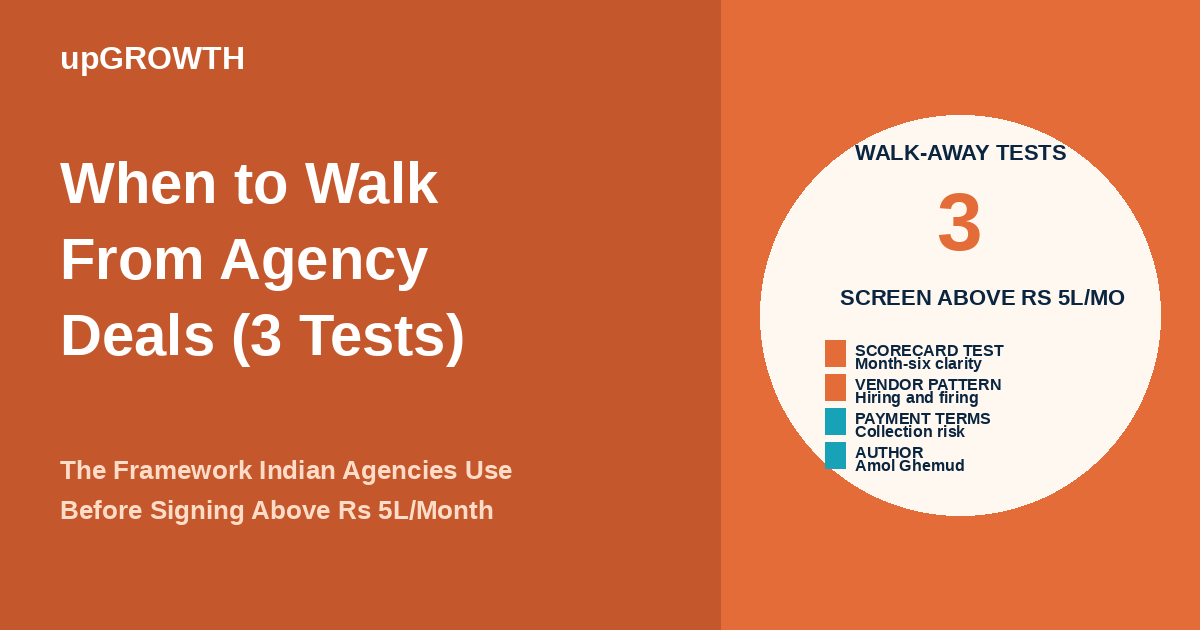
Test One: Can the Client Articulate the Month-Six Scorecard Today?
Before you sign any retainer above Rs 5 lakh per month, ask the founder or CMO to describe what success looks like in month six. Not month 12. Not “over the engagement.” Month six, specifically.
You are looking for measurable outcomes. Lead volume at a specific CPL. Organic traffic at a specific branded plus non-branded mix. Pipeline value attributable to marketing at a specific rupee figure.
If the answer comes back as “momentum,” “brand lift,” or “getting our story out,” the founder has not done the work of defining what they are buying. What is bad is signing a Rs 12 lakh per month retainer to someone who has not. You are guaranteed to disappoint them because their definition of success will crystallize in month four or five around whatever is not working, and you will be accountable for a metric you did not agree to in month zero.
When I asked the Bengaluru CEO what month six looked like, he talked about vision, brand perception, and “being the default choice in our category.” I asked him to attach a number. He could not. Not evasive, just genuinely had not done the work.
Founders who have done the work answer in under 60 seconds. They say “we need 400 qualified leads per month at a blended CPL of Rs 1,800, with 30 percent of pipeline from organic, by month six.” That founder is one you can make happy. Their success is a number you can hit or miss. The engagement has a clear renewal conversation in month 10.
Agencies that sign vague briefs invent the scorecard themselves in month three, then defend it to a client who will tell them the scorecard is wrong. The power dynamic breaks the moment the client realizes you are explaining your own success to them.
Test Two: What Does Their Previous Vendor Hiring and Firing Pattern Signal?
Ask the prospect how many growth agencies, performance marketing firms, or fractional leaders they have engaged in the previous 24 months, and why each engagement ended.
You are looking for pattern recognition, not whether the previous vendors were good or bad. That information is unreliable because it comes filtered through relationship damage. What is reliable is the cadence of hiring and firing and the language the founder uses to describe it.
The Bengaluru CEO had fired four agencies in 18 months. His framing was that agencies had failed to hit standards. The head of marketing, in a separate call, framed it as the CEO moving goalposts every quarter. Both describe the same reality. The founder wanted certainty no agency could deliver and was systematically disappointed.
Every vendor he brought in was going to fail. Not because they were bad, but because success had not been defined in a way any vendor could hit. Prior probability of being fired inside six months was closer to 65 percent than 20 percent.
If the prospect has worked with only one or two previous agencies over three plus years, use proxy questions. How long have their top three performance hires stayed? How long did their previous CMO stay? If both answers are under 14 months, the pattern is consistent with high churn.
The vendor pattern is the single most predictive variable in retention probability. Across 40 plus retainers above Rs 5 lakh per month at upGrowth, a prospect who has fired three or more agencies in 18 months has a 12-month retention probability of about 28 percent. A prospect who retained their previous agency for 18 plus months has a retention probability of about 81 percent. The spread is 3x.
Test Three: Do the Payment Terms Give Durable Collection Risk Above 30 Percent of Annual Contract Value?
Calculate the percentage of annual contract value that sits in active collection risk at any moment. Collection risk equals outstanding invoices, hold-back provisions, performance-linked deferrals, and claw-back clauses.
On the Bengaluru deal, 60-day net meant two months of outstanding invoices, or Rs 24 lakh, permanently on the field. The 25 percent hold-back added Rs 3 lakh per quarter, cumulatively Rs 12 lakh by year-end. Total durable collection risk was Rs 36 lakh, or 25 percent of annual contract value, before any acceleration if the relationship broke.
If the relationship had broken in month four or five, collection risk jumps to Rs 48 lakh to Rs 60 lakh, or 33 to 42 percent of annual contract value. At that level, legal recovery becomes a business activity, not an administrative one.
The 30 percent threshold is not arbitrary. It is the point at which recovering the cash requires dedicated senior management attention for three to six months, at which point recovery math itself becomes negative. Below 30 percent, you can absorb the friction. Above 30 percent, you cannot.
Healthy payment terms for a growth retainer in India: 30-day net or better on the base fee, performance-linked components clearly defined at signing with objective triggers that cannot be unilaterally deferred, hold-back provisions capped at 10 percent of any single month’s fee, advance payment on month one and month two fees.
Agencies that accept 60-day net, uncapped hold-backs, and subjective performance reviews on large retainers are not running an agency. They are running an unsecured short-term loan book with the worst possible credit quality and no risk adjustment in the price.
How to Calculate Adjusted Expected Value of Any Agency Retainer
The formula I run on a spreadsheet before any retainer above Rs 5 lakh per month.
Step one. Gross contract value. Monthly fee multiplied by engagement months. Rs 12 lakh times 12 equals Rs 1.44 crore.
Step two. Apply retention probability. Based on the three tests, assign a 12-month retention probability between 25 percent and 90 percent. In the Bengaluru deal, 35 percent retention gave expected gross of Rs 50 lakh to Rs 88 lakh.
Step three. Subtract collection risk. Expected unrecovered fees if the relationship breaks. In the Bengaluru deal, Rs 12 lakh to Rs 24 lakh depending on timing.
Step four. Subtract recovery cost. Legal and finance cost of pursuing unpaid invoices averages 15 to 25 percent of the disputed amount based on peer data.
Step five. Subtract scope creep cost. Clients who fail the first test expand scope by 22 to 35 percent without matching fee. Calculate the rupee cost at your fully loaded senior team rate.
Step six. Subtract opportunity cost. The next best use of senior team hours. In a 30-person agency, usually another retainer of Rs 4 lakh to Rs 8 lakh per month at higher probability of completion.
The final number is adjusted expected value. If it is less than 120 percent of the clean alternative, you walk. Below 120 percent, the incremental margin does not compensate for the risk premium.
What to Do When Two of Three Tests Fail: The Decline Email Template That Builds Future Trust
If two of three tests fail, you walk. If all three fail, you walk and help the prospect find a better fit. The decline email is the most important artifact of the walk-away decision. It either preserves or destroys the future relationship.
The template has four parts. Honest framing. Clear decline. Specific alternative recommendations. Open door.
Part one. State the concern in operator language. “Our process check does not give me confidence we can deliver the outcome you want over 12 months. The combination of the scorecard not being fully defined today, the previous vendor rotation pattern, and the payment structure creates a risk profile that does not serve either of us.”
Part two. Decline clearly. “I am declining the engagement. I am not proposing a smaller scope, a pilot, or a reduced fee. I am recommending you work with a different partner.”
Part three. Recommend two specific alternatives with reasoning. “Here are two agencies better suited to your situation. Agency A because they have deep experience in your category. Agency B because their model is structured around shorter sprints, which matches your stage better than a 12-month retainer.”
Part four. Open the door. “If the team and scorecard situation stabilizes in the next six to nine months, I am open to a different scope. My number is below.”
The Bengaluru CEO responded in three hours. “I appreciate the honesty. Most agencies would have signed and figured it out later. Let us keep in touch.” Nine months later he came back with a cleaner brief, a defined head of marketing, and a smaller pilot. That pilot runs now at Rs 6.5 lakh per month and is one of the cleanest engagements in our portfolio.
The decline email is not a rejection. It is a deposit. Written correctly, it compounds into future work on better terms.
The Compounding Cost of Bad Retainers: Why Walking Is a Margin and Team Capacity Decision
The surface cost of a bad retainer is direct financial loss. Unpaid invoices, legal fees, senior hours burned on recovery. Painful but quantifiable. The real cost is the compounding cost, and it lives in three places.
First. Team capacity distortion. A bad retainer pulls senior talent off good accounts. When a Rs 12 lakh per month account goes into crisis, the senior team stops serving the Rs 4 lakh and Rs 6 lakh accounts properly. Those smaller accounts churn. The churn loss across three mid-size accounts can exceed the value of the large account you were defending.
Second. Team attrition. Across 18 months of tracking at upGrowth, the single biggest predictor of senior attrition is assignment to a high-friction account for more than four months. Senior growth people do not quit over pay. They quit over engagements they cannot win. Each senior exit costs Rs 18 lakh to Rs 30 lakh in replacement and ramp.
Third. Reputational contagion. When an engagement ends badly, the prospect tells other founders in their network. The founder-to-founder reference graph in India is dense. One bad ending with a high-profile brand costs 4 to 6 warm inbound leads over the subsequent 12 months, based on pattern data from agency peers.
Total compounding cost of a bad Rs 12 lakh per month retainer, in the 35 percent of cases where it breaks in month four to six, runs Rs 45 lakh to Rs 95 lakh on top of the direct collection loss. A business-altering number for a 30-person agency.
Walking is not a conservative decision. It preserves the compounding assets of an agency: senior team capacity, portfolio quality, referral graph trust.
Can the Client Articulate the Month-Six Scorecard Today?
Measurable outcomes provided in under 60 seconds (e.g., specific lead volume, CPL, or organic traffic mix).
Vague answers like ‘momentum’, ‘brand lift’, or ‘getting our story out’; inability to attach numbers to vision.
What Does Their Previous Vendor Hiring and Firing Pattern Signal?
A history of retaining previous agencies for 18+ months or consistent long-term internal hires.
Firing three or more agencies in 18 months; pattern of moving goalposts or unrealistic expectations of certainty.
Do the Payment Terms Give Durable Collection Risk Above 30 Percent of ACV?
30-day net or better; hold-back provisions capped at 10%; clear objective triggers for performance pay.
Durable collection risk exceeding 30% of Annual Contract Value; 60-day net terms; uncapped hold-backs.
Agency Playbook
B2B Sales Strategy
The Art of Walking Away: High-Stakes Deals
How to identify toxic “Large Agency Deals” in India that threaten your profitability and team morale.
Vanity vs. Reality
The “Logo Trap”Chasing a Fortune 500 name at the cost of margins. Big logos often demand the most and pay the least.
Endless Free ConsultingIf the prospect asks for 3-4 rounds of “strategy decks” during the pitch, they aren’t looking for a partner; they’re looking for free ideas.
Resource Drain
Cost of Acquisition (CAC)Calculate the hours spent pitching. If the sales cycle exceeds 6 months for a low-margin deal, walk away.
Scope Creep PotentialLack of clarity in the MSA (Master Service Agreement) usually leads to “unlimited revisions” and 24/7 support expectations.
Partnership Health
Respect for ExpertiseDoes the client treat you like an order-taker or a strategic consultant? Order-taker relationships are high-churn.
Decision Maker AccessIf you are only talking to “procurement” and never the actual business owner, the value of your work is commoditized.
Payment & Terms
Extended Credit CyclesIn India, “Net 90” often turns into “Net 150”. Avoid clients who use you as a zero-interest bank.
The “Trial” BluffReject “Paid trials” that are effectively 3 months of full-throttle work at 50% pay.
Growing an agency isn’t about the deals you sign, but the bad deals you have the courage to refuse.
Common Questions About When to Walk Away from Agency Deals
Q: At what retainer size should I start applying the three-test framework?
A: I apply the full framework on any retainer above Rs 5 lakh per month. Below that threshold, operational risk of a bad engagement is contained enough that a lighter screen works. Above Rs 5 lakh per month, senior team lock-up is material enough that the math of walking needs to be written down before signing.
Q: What if only one of the three tests fails?
A: One failed test is a yellow flag, not a red flag. Proceed but negotiate the failing dimension explicitly. If the scorecard is not clear, put a 30-day scoping phase in the contract before the retainer starts. If the vendor pattern is concerning, reduce the initial commitment to a six-month term with a clean exit. If payment terms are unhealthy, renegotiate them specifically and decline if they refuse.
Q: How do I write a decline email without burning the relationship?
A: Use the four-part structure. Honest operator-language framing of the concern, clear decline without alternatives from you, two specific external referrals with reasoning, and an open door for future work on different terms. The Bengaluru CEO in my example came back nine months later with a cleaner brief. Agencies that decline well build future pipeline.
Q: What is the single most predictive test of the three?
A: The vendor hiring and firing pattern. Based on data tracked across 40 plus retainers at upGrowth, a prospect who has fired three or more agencies in 18 months has a 12-month retention probability of roughly 28 percent. A prospect who has retained their previous agency for 18 plus months has a retention probability of roughly 81 percent. The 3x spread is larger than the spread on the other two tests combined.
Q: Is walking away from Rs 1.44 crore ARR really justified by Rs 16 lakh of risk-adjusted delta?
A: The Rs 16 lakh is the direct math. The real number includes 4x operational risk, 3x team stress, probability of a senior exit costing Rs 18 lakh to Rs 30 lakh, and reputational contagion cost of 4 to 6 lost warm leads over 12 months if the engagement ends badly. When you add those compounding costs, walking is clearly the higher expected value decision.
Q: How do I get my sales team to accept the walk-away framework when it conflicts with commission incentives?
A: Restructure the commission. Pay commission on retained revenue at month six and month 12, not on signed revenue at month zero. The sales team will start screening better inside a quarter because their income depends on it. At upGrowth we restructured commission 14 months ago and average retention length on new signings moved from 7.2 months to 11.4 months.
When to Walk Away: Large Agency Deals (India)
0 of 8 deal-breakers identified0%
The Pitch Team
Opaque Billing
Ad Spend Bias
IP Ownership
Over-Promise
Lack of Depth
Exclusivity
Data Access
Your Next Move: Apply the Three-Test Framework to Your Next Three Retainer Conversations
Pull the three tests into a one-page document before your next three sales conversations above Rs 5 lakh per month. Month-six scorecard clarity. Vendor hiring and firing pattern. Payment terms with durable collection risk below 30 percent of annual contract value. Run the adjusted expected value math on every opportunity that clears the screen.
The GEO retainer model at upGrowth is built around these principles. We publish our payment terms, hold-back policy, and scope change process upfront. The walk-away framework works in both directions. Clients who cannot accept clean terms self-select out before we invest sales time.
If you are a founder evaluating agencies, run the same three tests on yourself first. Have you defined what month six looks like in a measurable way? Is your previous vendor history clean or churny? Are your payment terms competitive enough to attract the agencies you actually want? The agencies worth hiring are screening you too.
Relying on gross contract value is a path to poor decision-making because it ignores the hidden costs and risks that erode profitability. A retainer's true worth is its net value after accounting for potential issues, which is where adjusted expected value becomes a crucial tool. This calculation forces you to quantify risks that are often dismissed during negotiations. For the Bengaluru deal, the Rs 1.44 crore ARR looked great on a sales dashboard, but after factoring in a high probability of early termination, collection delays from 60-day net terms, and the 25 percent quarterly hold-back, its realistic 12-month value dropped to just Rs 68 lakh. This data-driven approach removes emotion and reveals whether a high-paying client is actually a high-profit client. Understanding this math is the first step toward building a more resilient and profitable agency.
The critical red flags emerged not in the initial pitch but during the final due diligence, revealing deep operational instability. These signs showed that the client's internal chaos would inevitably become the agency's problem, making the engagement unsustainable. The three primary warnings were:
Leadership Instability: The head of marketing, your key contact, was secretly planning to leave within six weeks.
High Agency Churn: The brand had fired four different growth agencies in the preceding 18 months, indicating a pattern of poor partnership.
Predatory Payment Terms: They demanded 60-day net terms with a 25 percent hold-back on quarterly reviews, creating significant cash flow risk.
This pattern was later validated when a referred agency, upGrowth Digital, noted the engagement collapsed within five weeks. These flags pointed to an unworkable partnership, not just a challenging project, making the decision to walk a strategic necessity.
Agency founders often sign bad-fit deals due to a combination of internal pressures and the emotional investment from a long sales cycle. The sunk cost fallacy is a major factor; after investing 40-plus senior hours, the urge to close the deal to justify the effort can overpower clear warning signs. This is compounded by internal pressures: the CEO wants a headline revenue number like Rs 1.44 crore ARR, the sales team wants their commission, and the delivery team's concerns are often overruled. The core discipline that separates resilient agencies like upGrowth Digital is the use of a pre-defined, unemotional framework to evaluate deals. By running every potential client through a standardized screen, the decision shifts from an emotional judgment to a logical, data-backed conclusion about long-term fit and profitability.
To avoid costly mistakes, you must build your evaluation framework before a high-stakes deal is even in the pipeline. This ensures objectivity when emotions and financial pressures are high. The process involves three key steps for any retainer over the Rs 5 lakh threshold. First, define your non-negotiable red flags, covering financial terms like payment cycles and hold-backs, as well as operational signs like high staff or agency turnover. Second, create a simple scoring system to quantify retention risk based on these factors. Third, use this score to calculate the retention-adjusted expected value, comparing it directly to the gross contract value. This formal process, as used by upGrowth Digital, transforms the decision from a gut feeling into a repeatable business discipline, protecting your margin, team, and reputation from volatile clients.
The comparison should shift from headline revenue to net operational value and opportunity cost. A high-value contract is only valuable if it generates profit without crippling your team or damaging your reputation. The key is to weigh the net financial gain against the operational strain. For instance, the Bengaluru deal offered a potential net gain of only Rs 16 lakh more than a much safer client over 12 months, but at four times the operational risk and near-guaranteed team stress. This safer client would produce Rs 52 lakh net with a fraction of the management overhead. By quantifying the risk and focusing on margin per unit of effort, you can see that chasing the larger number often leads to negative returns once hidden costs like attrition and reputational damage, which hurt future sales, are considered.
The structural problem is that most sub-50-person Indian agencies treat new business as the primary scarcity while viewing retention as a secondary outcome of execution. This ordering is fundamentally backward and is a primary driver of instability. The reality is that retention is where sustainable margin and profitability are built, while new business acquisition is the cost required to generate that retention. By flipping this mindset, an agency's entire qualification process changes. Instead of asking, "Can we close this deal?" you start asking, "Is this a client we can retain profitably for 18-24 months?" This shift forces you to screen for partnership fit, operational stability, and mutual respect, not just budget. Agencies that survive past the five-year mark master this, building a business on profitable relationships rather than a leaky bucket of high-churn accounts.
This trend will likely cause a market bifurcation, separating agencies that compete on volume from those that compete on value and partnership. As more agencies like upGrowth Digital adopt disciplined screening, a reputation for being selective will become a competitive advantage, attracting higher-quality clients and top talent who want to avoid burnout. Agencies that continue to sign any deal that meets a revenue threshold will face a vicious cycle of high churn, team attrition, and margin erosion. The key strategic adjustment for founders is to start building a pipeline structured around fit rather than volume. This means investing in marketing that attracts ideal clients and being prepared to walk away ten times to find one perfect long-term partner. This discipline builds a powerful brand reputation that transcends short-term revenue headlines.
The experiences of other agency founders provide stark evidence that a single bad-fit client can neutralize an entire year's worth of profit. The article cites three friends running agencies in Pune, Bengaluru, and Gurgaon, each of whom signed a large deal against their better judgment. The consequences were not minor setbacks but catastrophic financial events. These agencies lost between Rs 40 lakh and Rs 1.2 crore over a 12-month period. This staggering figure was not just from disputed invoices or write-offs. It also included the immense hidden costs of replacing senior team members who quit due to burnout and the reputational damage that made it harder to sign good clients in the future. This pattern proves that the risk of a bad deal is not linear but exponential, making a rigorous screening framework an essential tool for survival.
The sunk cost fallacy creates powerful emotional pressure to see a deal through, regardless of new, negative information. After investing significant time and resources, your focus shifts from "Is this a good future partnership?" to "We can't let this effort go to waste." This backward-looking mindset is a trap that leads to signing unprofitable, high-stress clients. The antidote is to shift to a forward-looking mental model: retention-adjusted expected value. This tool forces you to ignore past efforts and evaluate the deal based solely on its probable future outcome. By comparing the realistic net value of the contract (e.g., the Rs 68 lakh adjusted value) against the high operational risk, the decision becomes logical. It frames walking away not as a loss of past effort, but as a strategic decision to avoid a predictable future loss.
Offering fractional CMO services makes meticulous client screening exponentially more important because the engagement moves beyond execution into a deep strategic partnership. A bad fit is not just inefficient; it is actively destructive to both businesses. Unlike a performance marketing retainer, a fractional CMO engagement requires C-level alignment, trust, and organizational stability to succeed. Red flags like the client's high agency churn rate (four in 18 months) or an unstable marketing leadership team make it impossible to implement long-term strategy. For a fractional CMO, a bad partnership doesn't just result in a failed campaign; it can lead to flawed business decisions that damage the client and tarnish the agency's high-level strategic reputation. This makes the three-test screen an absolute necessity to protect the integrity of the service.
The communication strategy should be direct, professional, and helpful, turning a potentially negative interaction into a demonstration of integrity. The goal is not to burn a bridge but to reinforce your agency's principles. The article's approach provides a clear template. First, communicate directly with the ultimate decision-maker, the CEO, via a concise and honest email. Second, frame the decision around long-term partnership fit and mutual success rather than blame or accusation. Finally, and most importantly, offer genuine help by referring them to two other agencies that might be a better fit for their specific needs and culture. This act of goodwill, as practiced by upGrowth Digital, preserves the relationship and strengthens your reputation in the market, proving that your agency prioritizes successful outcomes over simply closing a deal.
The core difference lies not in the monthly fee but in the client's operational health and its impact on your agency's resources. A 'cleaner' client offers stability and partnership, which are far more valuable than a high fee from a volatile source. When evaluating, focus on these indicators:
Payment History and Terms: A good client offers fair, prompt terms, unlike the 60-day net with a 25 percent hold-back from the problem client.
Partnership History: Look for stable, long-term relationships with past vendors, not a history of firing four agencies in 18 months.
Leadership Stability: A strong, consistent point of contact is essential for strategic alignment.
A cleaner client projected to produce Rs 52 lakh net with low operational drag is vastly superior, as it preserves team capacity and morale, which are the true engines of long-term agency growth.
Amol has helped catalyse business growth with his strategic & data-driven methodologies. With a decade of experience in the field of marketing, he has donned multiple hats, from channel optimization, data analytics and creative brand positioning to growth engineering and sales.

 Growth Strategy and Planning
 Inbound Growth
 Growth Hacking
 Fractional CMO
 Search Engine Optimization
 Paid and Performance Marketing
 Social Media Marketing
 Demand Generation
 AI-Driven Growth Strategy
 AI-Native Workflow Automation
 Generative Engine Optimization
 Grove — AI Growth Strategist

 AI Automation
 Framework
 Case Study
 Tools
Tools Growth Tools
 Decision Tree
 Compare
 Custom GPT's
 AI Answer Gap
 Offer
Offer Webstories
 Quizzes
 Blog
Blog AI-powered Apps
 Social Media Tools
 Agency Fit Score