GCC D2C Performance Marketing Agency Fees: The Real Math on Flat Retainer vs Percentage of Ad Spend vs Hybrid Pricing for Dubai, Riyadh and Doha Brands [2026]
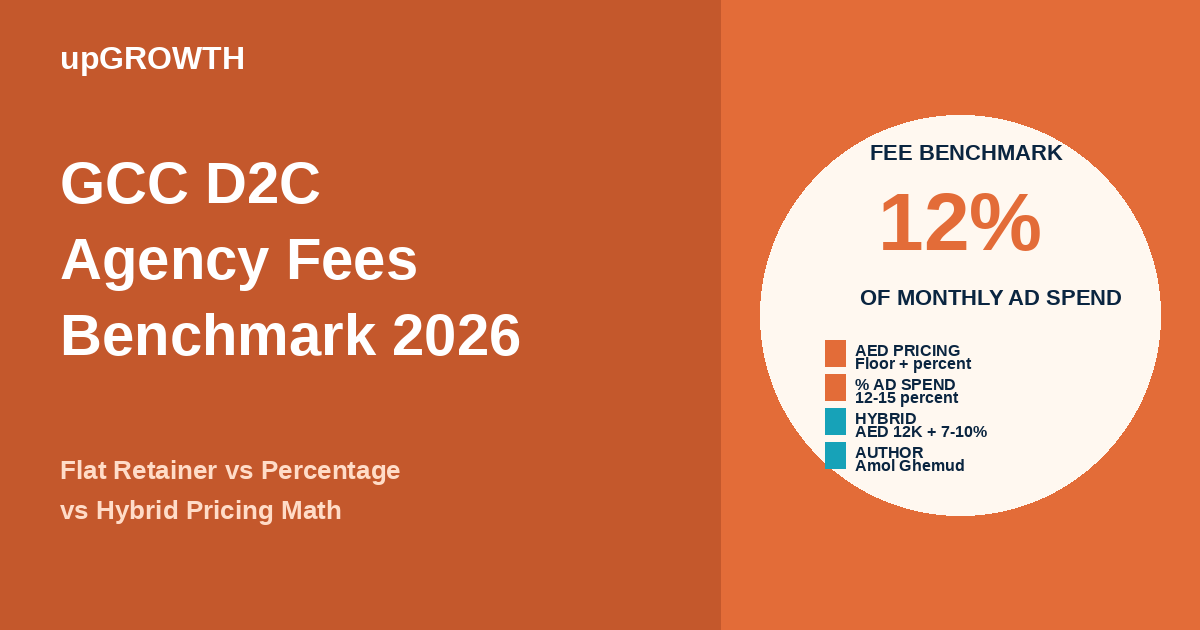
GCC D2C founders in Dubai, Riyadh, Doha and Kuwait consistently benchmark performance marketing agency fees in absolute AED instead of as a percentage of ad spend, and this single framing error is why most scaling D2C brands in the region end up under-resourced. The category benchmark for competent GCC performance marketing on spend above AED 100,000 per month is 12 to 15 percent of ad spend, not a flat fee. An agency charging 8 percent on AED 220,000 in spend is not a bargain, it is a structurally underpriced account that loses priority the moment creative fatigue shows up.
In This Article
Share On:
A Dubai D2C founder told me her agency was expensive at AED 18,000 per month. She was running AED 220,000 in monthly ad spend across Meta and Google. Her agency fee worked out to 8.2 percent of spend. The GCC category benchmark for her spend tier is 12 to 15 percent. She did not have an expensive agency. She had a structurally underpriced one, and that mispricing was the actual root cause of the account quality problems she was trying to fix.
This is the most common framing error I see across D2C brands in the UAE, Saudi Arabia, Qatar and Kuwait. Founders benchmark agency fees in absolute AED terms against what they paid last year, or against what a friend’s agency charges. The only benchmark that matters is fee as a percentage of ad spend, measured at your specific spend tier. Get that number wrong by four percentage points and your creative refresh cadence, attribution sanity and audience testing depth all silently collapse.
I run growth at upGrowth Digital, and we have watched this play out across the region for years. We have seen Delicut Dubai scale from AED 40,000 to over AED 2,000,000 in monthly sales, with fee as a percentage of revenue dropping from 14 percent to 4.2 percent as scale kicked in.
This article lays out how GCC D2C agency pricing actually works, why the 12 to 15 percent benchmark exists, where flat retainers break, and how to audit your current fee structure in under 30 minutes. For the operational side of how this ties to your paid search and performance marketing engine, the fee structure is the price of the creative, attribution and testing volume that keeps your ROAS durable, not fragile.
Why GCC D2C Founders Benchmark Agency Fees Wrong
GCC D2C founders benchmark agency fees wrong because they use absolute AED as the yardstick instead of percentage of ad spend, and they compare their fee against the wrong peer set. A D2C brand spending AED 220,000 a month is not in the same operational category as an AED 40,000 per month brand, yet founders routinely benchmark their fee against what smaller brands pay. This compresses fees into a range where the agency cannot profitably resource the account.
The second error is treating agency fees as a fixed cost to minimize rather than a variable input to optimize. Your fee buys creative testing volume, attribution infrastructure and refresh cadence. Cutting the fee by 30 percent rarely cuts the work by 30 percent. It cuts the work by 50 to 70 percent, because the fixed cost of senior strategist hours, paid media ops and creative production does not shrink linearly with retainer.
The third error is ignoring spend-tier break points where each pricing model stops working. A flat retainer of AED 20,000 is fine at AED 60,000 in monthly spend. It is actively harmful at AED 180,000 in monthly spend because your account becomes the agency’s lowest-margin engagement, and your requests get deprioritized behind accounts paying percentage fees.
Flat Retainer Pricing for GCC D2C: Where It Works and Where It Breaks
Flat retainer pricing for GCC D2C performance marketing agencies typically ranges from AED 8,000 to AED 25,000 per month and works best when monthly ad spend sits under AED 80,000. Above AED 100,000 in monthly spend, flat retainers structurally misalign the agency and client, because workload scales with spend but the fee does not.
The entry tier of AED 8,000 to AED 12,000 per month is where most Dubai and Riyadh D2C brands start. At AED 30,000 to AED 60,000 in ad spend, the agency can profitably staff one paid media specialist, one junior designer producing 8 to 12 creatives per month, and fractional strategist oversight. Attribution at this spend tier is mostly platform-native, because setting up server-side conversion API and incrementality testing does not pay back yet.
The mid tier of AED 15,000 to AED 25,000 per month is where the break point hides. A flat AED 20,000 fee on AED 120,000 in spend is 16.6 percent, which looks healthy. The moment the brand pushes spend to AED 180,000 the fee is 11.1 percent, and at AED 250,000 the fee is 8 percent. The agency’s gross margin collapses at exactly the moment the client needs more operational depth, and account quality follows. Above AED 100,000 in monthly spend, the cleaner structure is percentage of ad spend or hybrid floor-plus-percentage, not a flat retainer that quietly becomes unprofitable.
GCC D2C Agency Fee Blueprint
Page 1 / –
StartSlide ControlFinish
Percentage of Ad Spend Pricing: The 12 to 15 Percent Benchmark Explained
Percentage of ad spend pricing for GCC D2C agencies benchmarks at 12 to 15 percent of monthly spend for accounts above AED 100,000 per month, and 10 to 12 percent for accounts above AED 500,000. Below AED 80,000 in spend, agencies refuse the percentage model because the math underprices senior strategist and paid media specialist time.
The logic behind 12 to 15 percent is straightforward when you decompose the cost stack. A serious GCC D2C agency managing AED 200,000 in monthly spend staffs roughly two senior strategists at partial allocation, one paid media specialist, one performance designer producing 24 to 40 creatives per month, and a part-time data analyst running attribution. That team, loaded with Dubai salaries and overhead, costs the agency AED 18,000 to AED 22,000 per month in fully loaded labor. At 12 percent on AED 200,000, the agency collects AED 24,000. Gross margin is 10 to 25 percent. That is a working business.
At 8 percent of the same spend, the agency collects AED 16,000, which does not cover the team. Agencies pricing at 8 percent cover the gap by cutting the team. They remove the data analyst, drop the designer to freelance, reduce strategist hours by 60 percent, and skip attribution infrastructure. That is why a cheap agency at the same spend produces 6 to 10 creatives per month instead of 24 to 40, runs 2 audience tests instead of 8 to 12, and never ships landing page experiments.
At AED 350,000 in monthly spend, a 12 percent fee of AED 42,000 buys two senior strategists, a paid media specialist, a performance designer and a data analyst. Hiring that same team in-house in Dubai costs roughly AED 95,000 per month loaded. The agency amortizes senior talent across multiple accounts. You would not.
Hybrid Floor Plus Percentage: The Most Honest Model for Scaling Brands
Hybrid floor plus percentage pricing for GCC D2C agencies typically structures as AED 12,000 to AED 15,000 floor plus 7 to 10 percent of ad spend above AED 50,000. This model aligns incentives cleanly. The agency is not starved at low spend tiers, and the founder is not penalized for scaling. It is the structure we recommend for brands between AED 80,000 and AED 500,000 in monthly spend.
The floor protects the agency from absorbing fixed costs of senior strategist time during spend dips. D2C brands in the GCC experience real spend volatility tied to Ramadan, DSF, White Friday and summer travel. A pure percentage model penalizes the agency during these troughs, which creates pressure to under-resource the account. A floor of AED 12,000 to AED 15,000 keeps senior talent on the account year-round.
The percentage component scales variable cost in lockstep with spend. At AED 100,000 in spend, the fee is AED 12,000 floor plus 8 percent of AED 50,000, which is AED 16,000 total, or 16 percent of spend. At AED 300,000, the fee is AED 12,000 plus 8 percent of AED 250,000, which is AED 32,000 total, or 10.7 percent of spend. The effective percentage drops as spend scales, which is exactly what a founder wants to see. Economies of scale flow through to the P&L.
The hybrid model also creates a cleaner conversation about account resourcing. When the fee is broken into floor plus percentage, the founder and agency can agree transparently on what each portion buys. That transparency is where the cheap-agency trap fails, because the cheap agency cannot articulate what any portion of the fee buys beyond “managing your account.”
What the 12 Percent Actually Buys at AED 200K Monthly Spend
A 12 percent fee on AED 200,000 in monthly spend is AED 24,000, and what that buys at a competent GCC D2C agency is 24 to 40 creative variants per month, 8 to 12 audience tests, 4 to 6 landing page experiments, server-side conversion API, quarterly incrementality testing, and senior strategist hours on a weekly cadence. A cheap agency at 8 percent delivers roughly 30 percent of that operational depth.
Creative variant volume is the biggest profit lever in GCC D2C, because Meta and Google algorithms in the region hit creative fatigue inside 14 to 21 days on high-spend accounts. Top-quartile agencies refresh winning creatives every 14 to 21 days. Bottom-quartile agencies refresh every 60 to 90 days. On AED 200,000 in monthly spend, slow refresh wastes roughly AED 30,000 per month in reach served to saturated audiences. The AED 6,000 you saved by going from 12 to 8 percent is erased four times over by that wasted reach alone.
Attribution sanity is the second lever. Meta and Google reporting post iOS 14.5 is structurally unreliable for D2C, and the 2024 Apple ATT tightening made it worse. A competent GCC D2C agency sets up server-side conversion API through Meta CAPI and Google Enhanced Conversions, runs incrementality tests every 90 days, and tells you when your reported AED 2.10 ROAS in Meta is actually AED 1.40 incremental. Brands operating without incrementality measurement at this tier are flying on instrument error.
Audience testing depth is the third lever. At AED 200,000 in spend, you need 8 to 12 net-new audience tests per month across interest, lookalike, broad and retargeting segments. A cheap agency running 2 tests is rotating the same three audiences that worked last quarter, which is why their performance degrades exactly as the market saturates.
Landing page experiments are the fourth lever. At AED 200,000 in monthly spend, 4 to 6 landing page experiments per month routinely move conversion rate by 8 to 15 percent, which is an AED 30,000 to AED 60,000 monthly revenue swing on a typical GCC D2C account.
Real Numbers from Delicut Dubai: AED 40,000 to AED 2,000,000 Monthly
Delicut Dubai scaled from AED 40,000 in monthly sales to over AED 2,000,000 in monthly sales across a multi-year engagement, and agency fee as a percentage of revenue dropped from 14 percent in the early phase to 4.2 percent at scale. The fee scaled with spend, not with revenue, which is why the ratio improved so aggressively as unit economics hardened.
In the early phase, Delicut was spending roughly AED 15,000 to AED 20,000 per month on performance marketing against AED 40,000 in monthly sales. Fee as a percentage of revenue was roughly 14 percent. This is normal for an early-stage D2C brand in Dubai, and founders who flinch at this ratio end up with vendors who cannot build the operational foundation the brand needs to scale.
As Delicut scaled spend to AED 80,000, then AED 150,000, then AED 300,000 per month, the hybrid floor plus percentage structure kept the effective fee percentage inside the 10 to 13 percent band. Revenue scaled faster than spend because the operational depth the fee paid for started compounding. Creative refresh tightened to 14 to 21 days, audience testing expanded to 10 to 12 tests per month, attribution moved fully server-side, and landing page experiments added 12 to 14 percent to conversion rate over nine months.
By the time monthly sales passed AED 2,000,000, fee as a percentage of revenue had dropped to 4.2 percent. If Delicut had flinched at the early 14 percent ratio and switched to a cheaper agency, the brand would not have built the attribution, creative and audience infrastructure that let it scale. Cheap agencies optimize for looking affordable in month one, not for compounding margin over 24 months.
How to Audit Your Current GCC Agency Fee Structure in 30 Minutes
To audit your current GCC D2C agency fee structure in 30 minutes, pull three numbers from the last three months of invoices and ad spend, then measure against the 12 to 15 percent benchmark, the creative variant velocity benchmark and the incrementality testing benchmark. If your agency fails two of the three, the account quality issues you are seeing are a pricing problem, not an execution problem.
Step one, calculate fee as percentage of spend. Take three months of agency invoices, divide by three months of ad spend, express as a percentage. Anything below 8 percent on monthly spend above AED 100,000 is a red flag. Anything above 18 percent on monthly spend above AED 300,000 is also a red flag, because the agency should be seeing economies of scale at that tier. The healthy band is 10 to 15 percent for mid-tier D2C brands and 8 to 12 percent above AED 500,000 per month.
Step two, count creative variant output. Count net-new creatives in the last 30 days, not variations on the same base asset but genuinely new concepts, hooks and formats. On AED 100,000 in monthly spend you should see 15 to 25. On AED 200,000, 24 to 40. On AED 400,000, 40 to 70. If your agency is producing fewer than 60 percent of these benchmarks, the fee is underfunding creative.
Step three, audit attribution infrastructure. Ask your agency three questions. Is server-side conversion API live through Meta CAPI and Google Enhanced Conversions. When was the last incrementality test, and what was the delta between reported ROAS and incremental ROAS. If the answers are “we use platform pixels,” “we have not run one,” and “we do not measure incrementality,” your fee is underfunding attribution and you are flying on instrument error.
If your agency fails the fee percentage test and one operational test, the fee needs to move up or the agency needs to change. Paying your current cheap agency more rarely turns them into a competent agency, because team structure and internal processes are built around the cheap-fee model. The cleaner fix is to renegotiate with a capable agency through a hybrid floor plus percentage model.
GCC D2C Agency Fee Benchmarks by Pricing Model
Pricing Model
Fee Structure Details
Recommended Spend Tier
Percentage of Ad Spend
12% to 15% of monthly ad spend
Above AED 100,000 monthly ad spend
Percentage of Ad Spend (High Spend)
10% to 12% of monthly ad spend
Above AED 500,000 monthly ad spend
Hybrid Floor Plus Percentage
AED 12,000 to AED 15,000 floor plus 7% to 10% of ad spend above AED 50,000
Between AED 80,000 and AED 500,000 monthly ad spend
D2C Growth Report
GCC Performance Benchmarks 2024
GCC Agency Fee Benchmarks
A definitive guide for D2C brands in the UAE and KSA to evaluate agency pricing models, retainers, and performance incentives.
Pricing Models
Fixed Retainer$3,000 – $7,000/month. Best for stability, common among mid-tier GCC boutiques.
% of Ad SpendTypically 10% – 20%. Standard for high-spend brands to align agency efforts with scale.
Hybrid (Retainer + Bonus)Low base + % of revenue/ROAS. The “gold standard” for D2C alignment in Dubai/Riyadh.
GCC Specific Nuances
The KSA PremiumAgencies with localized Saudi “boots on the ground” often command 20-30% higher fees.
Bilingual Talent CostArabic copywriting and cultural nuance are non-negotiable and drive up specialist salaries.
Pricing Red Flags
Opaque Ad Account AccessIf the agency pays the platform directly without giving you view access, they may be hiding margins.
Vague DeliverablesRetainers without specified “Creative Refresh” frequencies lead to ad fatigue.
What to Look For
First-Party Data StrategyAgency must have a plan for CAPI (Conversions API) and post-iOS 14 tracking.
UGC Production CapabilitiesThe fee should ideally cover or facilitate local creator content, not just stock edits.
Cheap agencies in the GCC often prove expensive through inefficient ad spend. Prioritize expertise over the lowest retainer.
Q: What is the benchmark agency fee for D2C brands in Dubai spending AED 200,000 per month?
A: The benchmark is 12 to 15 percent of ad spend, which puts the fee at AED 24,000 to AED 30,000 per month. At this spend tier, competent GCC D2C agencies deliver 24 to 40 creative variants per month, 8 to 12 audience tests, server-side conversion API setup and quarterly incrementality testing. Anything below 8 percent on this spend tier signals structural underpricing, which manifests as slow creative refresh and weak attribution.
Q: Should a D2C brand in Riyadh pay flat retainer or percentage of ad spend?
A: Flat retainer works for monthly ad spend under AED 80,000, typically at AED 8,000 to AED 25,000 per month. Above AED 100,000 in monthly spend, percentage of ad spend or hybrid floor plus percentage is the honest structure. Percentage of ad spend at the 12 to 15 percent benchmark aligns the agency’s economics with scaling the account properly.
Q: How does the hybrid floor plus percentage model work for GCC D2C agencies?
A: Hybrid floor plus percentage typically structures as AED 12,000 to AED 15,000 floor plus 7 to 10 percent of ad spend above AED 50,000. The floor protects the agency during spend dips around Ramadan, DSF and White Friday, and the percentage scales variable cost of creative production and media ops with spend. The effective percentage drops as spend scales, delivering real economies of scale to the founder while keeping senior talent on the account.
Q: Why do cheap performance marketing agencies hurt D2C brands at higher spend tiers?
A: Cheap agencies price below the 8 to 10 percent floor needed to profitably staff senior strategists, performance designers, paid media specialists and data analysts on an account. They cover this by cutting creative variant output from 24 to 40 per month down to 6 to 10, skipping incrementality testing, and running 2 audience tests instead of 8 to 12. On AED 200,000 in monthly spend, the AED 6,000 saved on fees typically costs AED 30,000 in wasted reach from slow creative refresh alone.
Q: What case study proves that higher agency fees deliver better D2C outcomes in the GCC?
A: Delicut Dubai scaled from AED 40,000 to over AED 2,000,000 in monthly sales while agency fee as percentage of revenue dropped from 14 percent to 4.2 percent. The early-phase fee ratio looked high, but it funded the creative, attribution and audience infrastructure that let the brand compound margin over 24 months. A cheaper agency at the start would have optimized for looking affordable in month one rather than building the operational depth needed to reach AED 2,000,000 per month.
Q: How often should GCC D2C performance marketing agencies refresh creative assets?
A: Top quartile GCC D2C agencies refresh winning creatives every 14 to 21 days. Bottom quartile agencies refresh every 60 to 90 days, which is where slow-refresh fatigue waste accumulates. On AED 200,000 in monthly spend, slow creative refresh wastes roughly AED 30,000 per month in reach served to saturated audiences. Refresh cadence is the single biggest profitability lever in GCC D2C performance marketing.
GCC D2C Performance Marketing: Fees & Benchmarks
0 of 8 market insights explored0%
Retainer + % Spend
Pure Performance
COD Impact
KSA vs UAE CPC
Snapchat Growth
Creative Fees
Ramadan Peak
Retention Metrics
Your Next Move: Audit Your Agency Fee Structure Against GCC Benchmarks
If you are running AED 100,000 or more in monthly performance marketing spend across Dubai, Abu Dhabi, Riyadh, Doha or Kuwait, the single highest leverage audit you can run this quarter is a fee structure audit against the 12 to 15 percent benchmark, the creative variant velocity benchmark and the incrementality infrastructure benchmark. This takes 30 minutes of work and typically surfaces a six-figure AED annual misallocation.
The cost of inaction on a fee mispricing is not the AED 18,000 versus AED 24,000 per month you think it is. The real cost is the AED 30,000 per month in wasted reach from slow creative refresh, the AED 40,000 to AED 70,000 per month in budget misallocation from broken attribution, and the 8 to 15 percent conversion rate gap from skipped landing page experiments. On AED 200,000 in monthly spend, that compounds to AED 900,000 to AED 1,500,000 in annual gross contribution left on the table. The fee difference is a rounding error compared to the operational output it either funds or starves.
We run agency fee audits and GEO-integrated growth diagnostics for D2C brands across the GCC. The output is a clear view of where your current pricing structure is underfunding the work, and what the right model looks like for your specific spend tier and growth trajectory. Book your GEO audit here.
For Curious Minds
Focusing on a low absolute retainer fee creates a structurally underpriced account, which directly compromises the quality of work needed to sustain ROAS at scale. An agency fee is not a fixed cost to be minimized, but the price you pay for the creative volume, attribution modeling, and audience testing that prevents performance decay. When your fee falls below the industry benchmark, like the 8.2 percent seen in the example, your account becomes unprofitable for the agency, leading to deprioritization. This results in reduced creative refreshes, leading to ad fatigue, and less time spent on the deep analysis required to find new growth pockets. Your fee should be viewed as a variable investment aligned with your growth, ensuring your agency has the resources to drive durable results. Exploring the correct pricing model for your spend tier is the first step to fixing these hidden performance issues.
The 'percentage of ad spend' model is a pricing structure where the agency's fee is a direct percentage of the monthly advertising budget they manage. This model is the standard for scaled D2C brands because it aligns the agency's incentives with your growth objectives, directly linking their compensation to the scale of your marketing efforts. For brands spending above AED 100,000 monthly, the accepted GCC benchmark is 12 to 15 percent. This structure ensures that as your spend and the associated campaign complexity increase, the agency is properly compensated for the expanded workload, which includes:
Increased creative production and testing cadence.
More sophisticated audience segmentation and management.
Deeper attribution analysis and reporting.
A flat retainer breaks at this scale because the workload grows while the fee remains static, making your account the least profitable one for the agency. Understanding this pricing dynamic is essential for building a sustainable partnership.
The decision hinges on aligning agency resources with your growth trajectory. A flat fee retainer, typically ranging from AED 8,000 to AED 25,000, is suitable for spends under AED 80,000 because the campaign complexity is manageable. However, once you cross this threshold, you should transition to a percentage-of-spend model. The primary factor to weigh is workload scalability. At higher spends, the demands for creative refreshes, audience testing, and data analysis increase exponentially. A flat fee disincentivizes an agency from delivering this extra work, as their compensation does not grow with your investment. A percentage-of-spend model ensures that as your budget and needs expand, the agency's resources scale accordingly, keeping your account prioritized and well-serviced. This shift prevents the structural mispricing that causes performance to collapse just as you begin to scale.
This example perfectly illustrates how a seemingly 'good deal' is actually a primary cause of poor performance. The founder perceived her AED 18,000 fee as expensive in absolute terms, but at 8.2 percent of her AED 220,000 spend, it was nearly 4 to 7 percentage points below the GCC category benchmark of 12 to 15 percent. This underpricing creates a negative feedback loop. The agency, unable to profitably service the account, allocates fewer senior resources, reduces the frequency of creative updates, and spends less time on attribution analysis. Consequently, the account suffers from creative fatigue and untracked performance decay, which were the very problems the founder was trying to solve. This case study proves that the correct fee isn't about finding the lowest price, but about funding the necessary operational tempo to maintain a healthy ROAS at scale.
The key insight from Delicut Dubai is that the fee dropped as a percentage of revenue, not as a percentage of ad spend. This distinction is critical. They achieved this by maintaining a healthy fee-to-ad-spend ratio, likely within the 12 to 15 percent range, which funded the high-volume testing and optimization required to scale efficiently. This investment led to a disproportionately larger increase in sales, making the fixed agency fee a smaller piece of the overall revenue pie. To replicate this success, you must:
Invest adequately in your agency fee based on a percentage of ad spend to fuel growth.
Focus the agency's efforts on improving ROAS and conversion rates.
Measure agency cost against total revenue to track overall marketing efficiency.
This strategy, championed by firms like upGrowth Digital, frames the agency fee as an engine for efficiency, not just a line-item expense. It's this perspective that separates hyper-growth brands from those that stagnate.
To successfully support this growth, you must proactively transition from a flat retainer to a performance-aligned model. A static fee at AED 150,000 in spend will guarantee your account is under-resourced. Here is a clear, stepwise plan to present to your agency:
Acknowledge the Shift: Start the conversation by recognizing that the increased spend requires more strategic oversight, creative production, and analytical depth.
Propose a Tiered Percentage Model: Suggest moving to a percentage of ad spend, using the GCC benchmark of 12 to 15 percent as your starting point. You can propose a de-escalating tier, for example, 15% on the first AED 100,000 and 12% on the amount above that.
Define New Deliverables: Tie the new fee structure to specific outcomes, such as a higher creative refresh cadence, dedicated hours for attribution analysis, and more frequent performance reviews.
This approach reframes the discussion from a cost increase to a shared investment in growth, ensuring your agency has the incentive and resources to scale your brand effectively.
The most damaging error is benchmarking agency fees in absolute AED against smaller brands or past retainers, rather than as a percentage of current ad spend. This flawed comparison leads to a structurally underfunded marketing engine. Here are the three main errors and their consequences:
Using the Wrong Yardstick: Comparing a flat AED 18,000 fee for an account spending AED 220,000 to one spending AED 40,000 ignores the exponential increase in work required.
Viewing Fees as a Fixed Cost: Treating the fee as a cost to minimize rather than an investment in operational tempo starves your campaigns of the creative and analysis needed to thrive.
Ignoring Spend-Tier Breakpoints: A flat retainer that is profitable for an agency at AED 60,000 in spend becomes a low-margin burden at AED 180,000, causing your account to be silently deprioritized.
Correcting these framing errors is the first step to building a resilient performance marketing function.
The trend toward greater capital efficiency will accelerate the shift from flat retainers to performance-aligned pricing models. As investors and founders prioritize sustainable growth over growth-at-all-costs, the misalignment inherent in flat fees at scale becomes untenable. A flat retainer on a AED 200,000+ monthly spend does not incentivize the agency to maximize ROAS, only to maintain the account. We will see a rise in hybrid and percentage-of-spend models that tie agency compensation directly to key metrics. This means pricing structures will become more sophisticated, potentially including a lower base retainer plus a percentage of ad spend or even a bonus tied to achieving specific ROAS targets. For founders, this means you must become more adept at negotiating and managing contracts that create a true partnership, where the agency wins only when you do.
You can quickly diagnose if your fee structure is a hidden problem by calculating it as a percentage of ad spend and comparing it to the established GCC benchmark. This simple audit will reveal if your agency is financially equipped to deliver results. Follow these steps:
Calculate Your Fee Percentage: Divide your monthly agency retainer (in AED) by your total monthly ad spend. For example, an AED 18,000 fee on AED 220,000 spend is 8.2 percent.
Benchmark Against Your Spend Tier: If your monthly ad spend is over AED 100,000, compare your percentage to the GCC industry standard of 12 to 15 percent.
Assess the Gap: If your fee is significantly below this range, your account is likely under-resourced. This gap is the direct cause of issues like slow creative refreshes and shallow audience testing.
This quick analysis moves the conversation from subjective feelings about performance to an objective, data-driven assessment of your marketing investment.
An agency's workload scales non-linearly because higher ad spend requires exponentially more complexity in management, not just pushing a bigger budget through the same campaigns. A flat retainer fails because it treats this complex, expanding work as a static service. As spend increases from AED 60,000 to AED 180,000, the work does not triple; it grows in several dimensions:
Creative Volume: You need more ad variations to avoid audience fatigue across more segments.
Audience Complexity: You must manage more targeting, retargeting, and exclusion audiences across multiple platforms.
Attribution and Analysis: Data sets become larger, requiring more sophisticated analysis to find optimization opportunities.
A flat fee forces the agency to absorb these escalating operational costs, making your account increasingly unprofitable. This is why cutting a fee by 30 percent often cuts the effective work by 50 to 70 percent, as senior resources are pulled first.
When your account becomes underpriced and thus a low priority, the signs are often subtle declines in proactive management rather than a single catastrophic failure. The drop from the benchmark 12 to 15 percent fee to a lower number starves the account of the resources it needs to thrive. Key warning signs include:
Slowing Creative Refresh Cadence: You notice the same ad creatives running for weeks, leading to rising CPMs and declining click-through rates due to ad fatigue.
Reactive vs. Proactive Communication: Your agency stops bringing new ideas for audience testing or campaign structures and primarily responds to your requests.
Vague Performance Reporting: Reports become less detailed, with fewer insights into what is working and why, indicating less time spent on deep analysis.
These are symptoms of an agency that can no longer afford to allocate senior strategic time to your account. Recognizing them early is crucial to addressing the root cause.
A properly structured fee, benchmarked at 12 to 15 percent for scaled accounts, directly funds the operational inputs that create a durable ROAS. According to insights from teams like upGrowth Digital, the fee is not for 'managing ads' but for purchasing the volume of work needed to combat performance decay. Here is how it connects:
Creative Volume: The fee pays for a continuous pipeline of new ad creatives, which is the primary weapon against ad fatigue and rising customer acquisition costs.
Attribution Sanity: It funds the time for experts to set up and maintain sophisticated tracking, ensuring you are making decisions based on accurate data, not flawed platform metrics.
Testing Depth: It allows the agency to run structured experiments on new audiences, platforms, and messaging, which is how you discover new pockets of growth.
A lower fee directly translates to less volume in these three areas, making your ROAS fragile and prone to collapse over time.
Amol has helped catalyse business growth with his strategic & data-driven methodologies. With a decade of experience in the field of marketing, he has donned multiple hats, from channel optimization, data analytics and creative brand positioning to growth engineering and sales.

 Growth Strategy and Planning
 Inbound Growth
 Growth Hacking
 Fractional CMO
 Search Engine Optimization
 Paid and Performance Marketing
 Social Media Marketing
 Demand Generation
 AI-Driven Growth Strategy
 AI-Native Workflow Automation
 Generative Engine Optimization
 Grove — AI Growth Strategist

 AI Automation
 Framework
 Case Study
 Tools
Tools Growth Tools
 Decision Tree
 Compare
 Custom GPT's
 AI Answer Gap
 Offer
Offer Webstories
 Quizzes
 Blog
Blog AI-powered Apps
 Social Media Tools
 Agency Fit Score