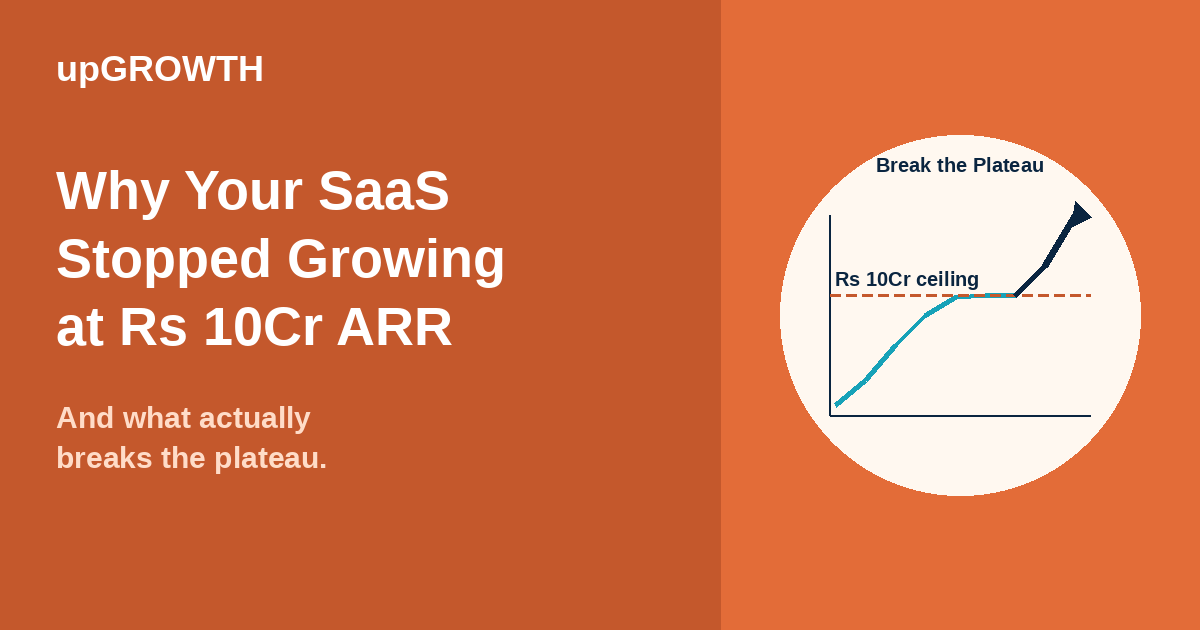
Indian B2B SaaS companies stall at Rs 10Cr ARR because the playbook that got them to Rs 10Cr (founder-led sales, inbound from 2-3 channels, one strong vertical) breaks at the next stage. Growth resumes when founders shift from operator to system designer, build a second acquisition channel before the first one decays, and stop confusing activity with traction. The plateau is structural, not effort-related.
In This Article
Share On:
Last quarter I sat across from three different SaaS founders in three different cities. Different products, different verticals, different team sizes. Same exact problem.
“We hit Rs 10Cr ARR. We’ve been stuck there for fourteen months. We’re shipping faster, hiring more, spending more on marketing. The needle won’t move.”
This is the most common founder conversation we have at upGrowth Digital. The Rs 10Cr ARR plateau is so consistent that I’ve started to think of it as a structural feature of B2B SaaS in India, not a bug. The companies that break through are not the ones that work harder. They’re the ones that recognize the plateau is telling them something specific.
Here’s what it’s telling them. And here’s what fixes it.
Why Rs 10Cr ARR Is the Natural Ceiling for Founder-Led SaaS
The first Rs 10Cr in B2B SaaS revenue almost always comes from a specific recipe. The founder personally closes the first 50-100 customers. Word of mouth from those customers feeds the next 100. One inbound channel (usually content + SEO, or one founder’s LinkedIn presence, or one strong partnership) carries 60-70% of new pipeline. The team is 15-25 people. Sales cycles are short because founders close fast.
This recipe scales beautifully from zero to Rs 10Cr. It hits a hard wall around Rs 10-15Cr because every component of it breaks simultaneously.
The founder runs out of hours in the day. They cannot personally close enough deals to keep growing at the same pace. The team they’ve hired to sell can’t replicate their close rate because the founder closed on trust, story, and product depth that nobody else has yet. The single inbound channel saturates. The early customers who fed referrals have all referred who they’re going to refer. New segments need new positioning, but the team is too busy executing to do positioning work.
What looks like a “growth problem” is actually four problems wearing one face: founder bandwidth, sales replication, channel concentration, and segment exhaustion. Treating it as one problem with one solution (usually “spend more on marketing”) makes it worse.
The Four Symptoms That Tell You the Plateau Has Arrived
Before fixing the plateau, you need to confirm you’re in it. These four symptoms appear together. If you’re seeing three or more, you’re not having a bad quarter. You’re at the structural ceiling.
Symptom one: pipeline coverage is degrading even as marketing spend increases. You used to need 3x pipeline to hit quarterly targets. Now you need 5x and you still miss. CPL is creeping up. Reps are working leads they would have qualified out a year ago because the top of funnel got thinner.
Symptom two: your strongest channel is delivering fewer qualified leads month over month. If SEO got you here, organic traffic is flattening or declining despite continued investment. If founder LinkedIn got you here, post engagement is dropping. If a specific partnership got you here, the partner’s referrals are slowing. The first channel always saturates first. The question is whether you noticed in time.
Symptom three: deal cycles are getting longer. Deals that closed in 30 days now take 60. Deals that closed in 60 take 90. This usually signals that you’re moving upmarket without realizing it (because your easier customer base is saturated) but you haven’t built the enterprise sales motion to handle it.
Symptom four: the team is busier than ever but revenue isn’t reflecting it. Engineering is shipping. Sales is calling. Marketing is publishing. The activity charts all look healthy. Revenue charts look flat. This is the most diagnostic symptom because it confirms the problem is structural, not effort-related.
If you’re nodding at three or four of these, the rest of this article is for you.
What Actually Breaks the Plateau (And What Doesn’t)
Most founders try the same three fixes when they hit the plateau. None of them work.
Fix one that fails: spending more on paid acquisition. If your CPL was Rs 2,500 at Rs 10Cr ARR and you double the spend, your CPL becomes Rs 4,000, not your lead count. Paid amplifies what’s working. It doesn’t fix what’s broken.
Fix two that fails: hiring a VP of Sales. A VP of Sales is supposed to scale a working sales motion. If your sales motion is “founder closes,” there is nothing for the VP to scale. Hiring this role before you’ve documented a repeatable sales process produces a Rs 60L+ annual cost with no measurable lift.
Fix three that fails: launching a second product. Founders convince themselves the existing product has hit a market ceiling. They launch a second product to expand TAM. This splits engineering and marketing across two products neither of which has reached real scale, and usually kills both.
What actually works is uglier and slower. It involves three moves, in order.
Move one: separate yourself from the close. Take 90 days to document what makes you close deals nobody else can. Pricing conversations, objection handling, decision-maker mapping, the specific stories you tell. Build a sales playbook from your own behavior. Then train two AEs on it and measure their close rates against yours. They will close at 40-60% of your rate initially. That’s fine. That’s the new baseline. The point is you can now grow without being in every deal.
Move two: build a second acquisition channel before the first one fully decays. If SEO got you here, the second channel might be partner-sourced (integration partners, agencies, consultants who recommend you). If founder LinkedIn got you here, the second channel might be paid LinkedIn or vertical events. The specific second channel matters less than the diversification. Companies with one channel above 60% of pipeline are fragile. Companies with two channels at 30-40% each are durable.
Move three: re-segment the customer base and pick a sharper ICP. The ICP you used at Rs 2Cr ARR is too broad for Rs 30Cr ARR. At Rs 10Cr you have enough customer data to see which segment is actually paying you, expanding fastest, and churning least. Double down on that segment with focused positioning, sharper messaging, and dedicated sales coverage. The fastest path through the plateau is almost always narrower, not broader.
If you’re stuck and want to move fast, here’s the sequencing that works.
Days 1-30: diagnostic and decision. Run a hard look at your last twelve months of pipeline. Source attribution. Win/loss by segment. Channel-level CAC. Cohort retention. The output is a one-page document that names the actual constraint. Most founders skip this step because they think they know the answer. They usually don’t. The constraint is rarely what feels broken; it’s what nobody is looking at.
Days 31-60: rebuild the highest-impact lever. Based on the diagnostic, pick one of the three structural moves (sales replication, second channel, ICP re-segmentation). Resource it properly. Don’t try to do all three. Sequence matters more than scope.
Days 61-90: measure, adjust, lock in. The first thirty days of any new motion will look worse than the old one. Resist the urge to revert. Measure the leading indicators (qualified leads from new channel, close rates from trained AEs, deal velocity in target segment) not the lagging indicators (revenue). Lagging indicators turn 60-90 days after leading indicators move.
This is what we run as our Rs 4L Growth Sprint at upGrowth. Not because we want to push the sprint, but because the diagnostic-then-rebuild loop is genuinely the only thing that works at the plateau. Founders who try to skip the diagnostic and jump to execution waste another six months.
Why Most SaaS Founders Never Break Through (And It’s Not Effort)
I’ve watched a lot of founders hit Rs 10Cr ARR and stay there for 24-36 months. The pattern of why is consistent.
They mistake the plateau for a market problem. They tell themselves the TAM is smaller than they thought, the market is harder than expected, the competition is too entrenched. They start looking at adjacent markets, second products, geographic expansion. Each of these dilutes the focus that got them to Rs 10Cr without addressing why the next Rs 10Cr isn’t coming.
Or they mistake the plateau for a team problem. They restructure sales, fire and replace VPs, change the marketing leadership. The team turnover destroys whatever institutional knowledge they had built up and resets the clock. Six months later the same plateau is back with a new team.
The founders who break through accept that the plateau is the natural consequence of the recipe that got them here. They stop trying to do more of what worked and start designing the system that needs to exist for the next stage. It’s an identity shift more than a tactical one.
Operator to system designer. Closer to coach. Channel exploiter to portfolio builder. Generalist ICP to focused ICP.
This is the actual unlock. Everything else is window dressing.
Symptoms and Fixes for the SaaS Growth Plateau
Symptom
Underlying Structural Problem
Recommended Fix
Pipeline coverage is degrading even as marketing spend increases.
Segment exhaustion or inefficient lead qualification due to top-of-funnel thinning.
Re-segment the customer base and pick a sharper Ideal Customer Profile (ICP).
The strongest channel is delivering fewer qualified leads month over month.
Channel concentration and saturation of the primary acquisition source.
Build a second acquisition channel before the first one fully decays to ensure diversification.
Deal cycles are getting longer.
Moving upmarket without an enterprise sales motion to handle it.
Document the founder’s sales process and build a repeatable sales playbook to train Account Executives.
The team is busier than ever but revenue isn’t reflecting it.
Founder bandwidth constraints and lack of scalable systems (operator vs. designer).
Separate the founder from the close and shift from operator to system designer.
Scale Strategy
The 10Cr ARR Breakthrough Framework
Breaking the 10Cr SaaS Plateau
Why what got you to 1Cr will keep you stuck at 10Cr—and the four systemic shifts required to reach the 50Cr milestone.
Messaging Dilution
The “Early Adopter” TrapMoving from high-intent visionaries to the “Pragmatic Majority” who require concrete ROI proof over features.
Feature vs. OutcomeShifting your marketing from “what the software does” to “the business metric it fixes” (e.g., LTV, CAC, or OpEx).
Revenue Operations
Killing Founder-Led SalesThe plateau happens when the founder is the only one who can close. You need a repeatable “Playbook” that 80% of AEs can execute.
Pipeline LeakageFixing the “Mid-Funnel” gap where MQLs stall. Requires tighter SLA between Marketing (Demand Gen) and SDRs.
Demand Generation
Moving Beyond “Capture”At 10Cr, you’ve exhausted existing search demand. You must shift to “Demand Creation” through thought leadership and cold outreach.
Customer Advocacy ScaleTurning your existing 10Cr base into a referral engine. Net Revenue Retention (NRR) must exceed 110% to sustain growth.
Market Defense
Category LeadershipBrands that stay stuck are “one of many.” Breaking through requires owning a specific sub-category or niche through content dominance.
Cost-to-Serve OptimizationImproving gross margins by automating onboarding, allowing you to reinvest 15% more into acquisition.
The 10Cr plateau isn’t a marketing failure; it’s a complexity failure. Simplify the engine to scale the result.
Four Questions SaaS Founders Ask About the Rs 10Cr Plateau
Q: How long does the average SaaS company stay stuck at Rs 10Cr ARR?
A: In our work with 60+ Indian B2B SaaS companies, the average plateau lasts 18-24 months for companies that don’t actively work on the structural fixes. Companies that engage the diagnostic-rebuild loop typically restart growth in 6-9 months. The longer you stay in the plateau, the harder it gets to break out because team morale, investor confidence, and channel decay all compound.
Q: Should I raise more capital to grow through the plateau?
A: No. Capital amplifies what’s working. If you raise at the plateau and your sales motion isn’t ready to scale, you’ll burn the capital on hires that can’t perform and ad spend that doesn’t convert. Raise after you’ve shown you can grow without the founder in every deal and after you’ve proven a second channel can deliver pipeline at acceptable CAC. Then capital is rocket fuel. Before that, it’s gasoline on a slow fire.
Q: Is the Rs 10Cr plateau specific to India, or is it a global SaaS pattern?
A: It’s a global pattern, but it’s sharper in India because most Indian B2B SaaS companies build founder-led sales motions early and rely heavily on inbound for the first phase. The cultural context (smaller addressable market, longer sales cycles, more relationship-driven selling) means the founder dependency is deeper here. The plateau hits at roughly the same revenue point but unwinds slower without active intervention.
Q: What if my SaaS is at Rs 5Cr ARR? Should I worry about this now?
A: Yes, but not panic. Rs 5Cr is the right time to start documenting your sales playbook and beginning to test a second channel. The companies that don’t hit a hard plateau at Rs 10Cr are the ones that started building the next stage’s infrastructure 12-18 months before they actually needed it. If you wait until you hit the wall, you’ve already lost a year.
Your Next Move: Get an Honest Diagnostic of What’s Actually Stuck
If you’ve been parked at Rs 10Cr ARR for more than nine months, the cost of staying stuck is bigger than the cost of any intervention. Every quarter at the same revenue means the team you hired to grow becomes the team you’re paying to maintain. Investor patience compounds against you. Your strongest performers start looking around because they came to scale, not to plateau.
The fastest path out is a real diagnostic. Not a strategy deck. Not a “growth audit” that tells you to do more content. A specific, founder-level look at where the actual constraint sits and what fixing it requires.
That’s what our Rs 4L Growth Sprint is built for. Three weeks. Founder + Bhaskar Thakur + me. Output: a one-page diagnostic with three sequenced moves, ranked by impact and effort, with success metrics for each. If we can’t surface a constraint worth Rs 50L+ in annual revenue impact, we refund the sprint.
Amol has helped catalyse business growth with his strategic & data-driven methodologies. With a decade of experience in the field of marketing, he has donned multiple hats, from channel optimization, data analytics and creative brand positioning to growth engineering and sales.

 Growth Strategy and Planning
 Inbound Growth
 Growth Hacking
 Fractional CMO
 Search Engine Optimization
 Paid and Performance Marketing
 Social Media Marketing
 Demand Generation
 AI-Driven Growth Strategy
 AI-Native Workflow Automation
 Generative Engine Optimization
 Grove — AI Growth Strategist

 AI Automation
 Framework
 Case Study
 Tools
Tools Growth Tools
 Decision Tree
 Compare
 Custom GPT's
 AI Answer Gap
 Offer
Offer Webstories
 Quizzes
 Blog
Blog AI-powered Apps
 Social Media Tools
 Agency Fit Score