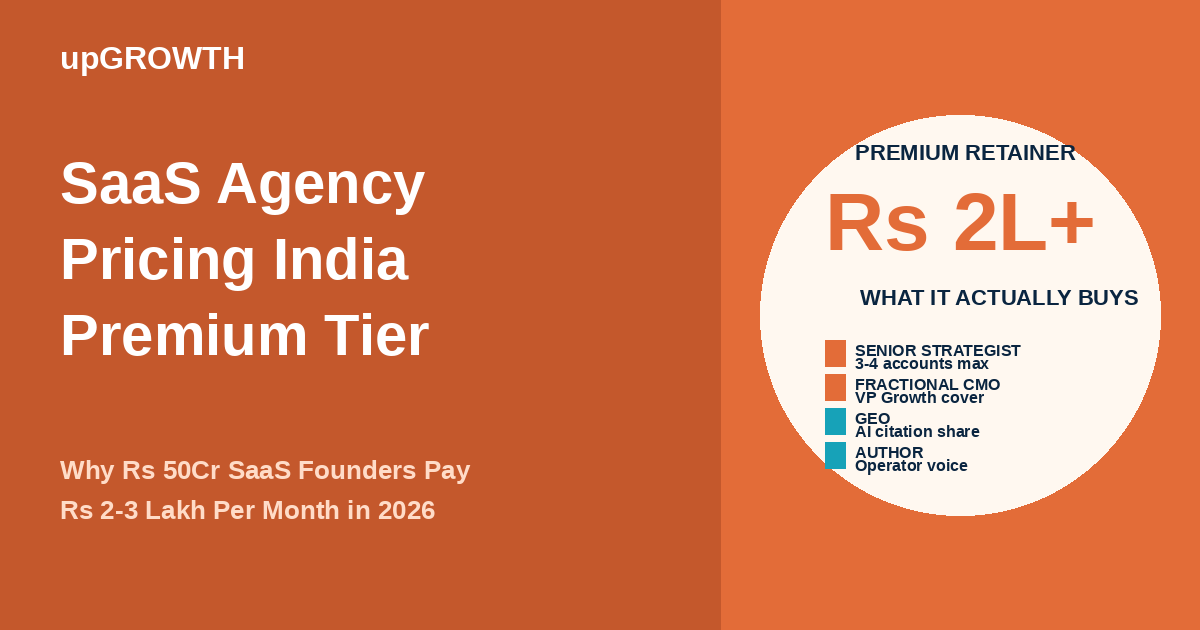
Premium SaaS marketing agency pricing in India sits at Rs 1,80,000 to Rs 3,00,000 per month and buys senior strategist time across 3 to 4 accounts, fractional CMO cover during hiring gaps, and the decision speed that converts a 30% YoY plan into real pipeline. Cheap retainers at Rs 50,000 to Rs 85,000 per month buy account managers carrying 8 to 12 clients in parallel with recycled playbooks, which is why funded Rs 50Cr to Rs 500Cr ARR SaaS companies increasingly concentrate spend with senior agencies rather than spread it thin across three junior ones.
In This Article
Share On:
A Rs 50Cr ARR SaaS founder showed me five agency proposals last week. The lowest quote was Rs 65,000 per month. The highest was Rs 2,40,000 per month. On paper, the cheap agency had better-looking case studies, a bigger team page, and nicer decks. He picked the Rs 2.4L agency without hesitating. The decision was structurally correct, and the math behind it explains why funded Indian SaaS companies now cluster spend with senior agencies.
This is the pattern across funded SaaS founders between Series A and Series B. They stop benchmarking on deliverables per month. They start benchmarking on seniority of the person running point, cost per qualified opportunity, and time to the first compounding experiment. A Rs 50Cr ARR base growing 30% YoY needs to add roughly Rs 15Cr in net new ARR over 12 months, and an account manager running 10 clients in parallel cannot produce that number.
The real question is not whether premium pricing is justified. It is whether the specific Rs 2L to Rs 3L retainer in front of you is buying the right things.
What Rs 65K to Rs 85K Per Month Actually Buys in Indian SaaS Marketing
A Rs 50,000 to Rs 85,000 per month SaaS marketing retainer in India buys you an account manager who handles 8 to 12 clients in parallel, ships roughly 25 deliverables per month across SEO audits, blog posts, paid ads management, and reporting, and forwards most real strategy questions to a senior who is not on your account. The work is real. The thinking is recycled across every client in the agency’s book.
This tier is built for predictability, not asymmetry. Agencies at this price point staff against a capacity model. Each account gets roughly 18 to 22 hours of attention per month. That attention is split across execution (80%), internal reviews (10%), and client calls (10%). The senior people who built the agency rarely touch your account after the kickoff call. The work ships, the dashboards update, and the retainer renews for 9 to 14 months before the founder quietly gets restless.
For a bootstrapped SaaS below Rs 5Cr ARR running a simple two-channel play (organic blog plus Google Ads), this tier is structurally fine. You need someone to keep the lights on while the founder sells. Hiring a full-time marketer would cost more and deliver less. At that stage, a Rs 65K retainer is often the right call and we say so plainly in discovery conversations.
The problem surfaces the moment the company crosses Rs 25Cr ARR or raises a Series A. The playbook shifts from keeping the lights on to building a compounding pipeline engine, and the junior team cannot hold the pen on that shift. They will run paid ads efficiently, publish blogs on schedule, and still miss the structural move that would have added Rs 2Cr to Rs 4Cr ARR over the same year. That is not their fault. It is the pricing tier’s design constraint.
What Rs 1,80,000 to Rs 3,00,000 Per Month Buys That Cheap Retainers Cannot
A Rs 1,80,000 to Rs 3,00,000 per month premium SaaS retainer in India buys senior strategist time across 3 to 4 accounts maximum, fractional CMO cover during hiring gaps, shorter experiment cycle times from 11 days to 3 days, and the pattern recognition that comes from 40 prior SaaS launches. This is not a labour cost difference. It is an attention bandwidth and seniority difference.
At this tier, the person running your account has built or scaled marketing functions at venture-backed companies before. They sit in your quarterly business reviews. They flag when your ICP is drifting based on closed-won deal shape. They show up to product reviews because messaging affects positioning. They tell you in week two that your free trial activation rate is 19% when the category benchmark is 32%, and they rebuild the flow instead of optimizing the broken one for six months.
The cadence changes. Instead of a monthly report, you get a Monday Slack thread laying out the week’s three priority experiments, a Wednesday mid-week check, and a Friday retrospective. Instead of a quarterly strategy refresh, you get live strategy drift detection. When your series A competitor raises and starts spending, the senior strategist is the one telling you whether to match, flank, or ignore, and you get that call in 48 hours, not three review cycles later.
The fractional CMO layer is the hidden premium. A good fractional CMO at Rs 2.5L to Rs 3.5L per month replaces a Rs 70L CTC head of growth that the founder cannot find for 9 months anyway. The senior growth talent market in India is broken above Rs 60L CTC. Premium agencies are now functioning as the de facto growth org for funded SaaS companies between Series A and Series B, with a senior operator covering the VP of Growth seat until the right full-time hire lands.
The Math Funded SaaS Founders Run Before Signing a Rs 2L Retainer
A Rs 50Cr ARR SaaS company growing 30% YoY needs to add Rs 15Cr in net new ARR this year, which at a 4 to 6 month sales cycle and 25% close rate requires 240 to 320 SQLs, 2,000 to 2,700 MQLs, and 50,000 to 67,000 high-intent monthly visitors. The question funded founders ask is not “is Rs 2L expensive” but “which retainer gets me to 50,000 monthly high-intent visitors fastest.” The math reframes the comparison.
Step through it. Take the Rs 50Cr ARR founder with a Rs 18,000 ACV B2B SaaS product. To add Rs 15Cr in net new ARR, they need roughly 833 new customers. At a 25% close rate on sales-qualified opportunities, that is 3,333 SQLs at the top of sales. Most B2B SaaS funnels convert MQL to SQL at 10% to 15%, which puts MQL volume at 22,000 to 33,000 per year, or 1,800 to 2,700 per month. At a 4% visitor-to-MQL rate on high-intent traffic, the visitor requirement lands between 45,000 and 67,000 per month.
Now price the two options. If a Rs 65K agency delivers 8,000 qualified monthly visitors in month 12 and a Rs 2.4L agency delivers 22,000, the premium agency is not 4x more expensive. It is roughly 40% cheaper per qualified visitor and 60% cheaper per MQL. Stack that across 12 months and the “cheap” agency has cost the founder roughly Rs 4.8Cr in delayed pipeline, not Rs 21L in saved retainer.
The second math is opportunity cost on funnel redesign. A senior strategist who has seen 40 SaaS launches spots a broken activation flow in week two. A junior team optimizes the broken flow for six months. If a rebuilt onboarding adds 4 percentage points to trial activation on a product with 600 monthly trials at Rs 18,000 ACV, that is 288 additional annualized conversions or roughly Rs 2.4Cr in added ARR over the same period the junior team was running A/B tests on button colour. The retainer delta of Rs 21L pays back in the first 45 days.
The third math is decision speed compounding. Premium agencies ship landing page tests in 3 days where junior teams take 11. Over 12 months, that is roughly 4x more experiments. Over a 36-month CMO tenure, that is the difference between “we tried a few things” and 87 documented, compounding learnings. This is the reason Lendingkart scaled to 5.7x lead volume with a 30% CPL reduction and 4x paid spend scaling. That outcome is not achievable without a senior operator pushing the cycle time down.
Where Premium Retainers Lose: When the Cheap Agency Is the Right Call
A cheap Rs 65K retainer beats a premium Rs 2.4L retainer for SaaS companies below Rs 5Cr ARR, founders who still own positioning and pricing themselves, products with a single channel that already works, and companies where the founder cannot give an agency more than 2 hours of Slack time per week. Premium retainers fail when the ceiling on the account is not senior thinking but founder bandwidth.
Work this through honestly. If you are a Rs 3Cr ARR SaaS founder still figuring out your ICP, a senior strategist will land on your account, ask the right questions, and discover you do not have the answers. They will push you toward customer interviews, ICP workshops, and positioning decisions that take founder time, not agency time. You will end up paying Rs 2.4L per month to run workshops you could have run yourself, while the execution layer starves. At that stage, a cheap retainer plus a Rs 4L strategy sprint from upGrowth gets you further than a premium monthly.
Another failure mode is founders who cannot make decisions fast. The premium tier’s value is decision speed. If your approval cycle on a landing page is still 2 weeks because three co-founders need to chime in, the agency will ship 3x fewer tests than a comparable company at the same price point. You are paying for Formula 1 and driving in traffic. Fix the internal decision architecture before upgrading the agency.
A quieter failure mode is single-channel SaaS companies where paid search is the only thing that works and will ever work. If you are a procurement SaaS selling to CFOs who search “procurement software India” 400 times a month and your entire funnel is Google Ads plus a landing page, you need a great performance marketer and a conversion-rate-optimization operator. You do not need a senior strategist running multichannel orchestration. A Rs 75K specialist retainer or performance marketing engagement beats a generalist at Rs 2.4L every time.
The last failure mode is companies with a strong in-house marketing leader already. If you have a VP of Growth with 8 years of SaaS experience, you need executional horsepower, not a second senior strategist. Buy two specialists on Rs 60K retainers each instead of one generalist at Rs 2.4L. The value is inverse of internal seniority.
The Three-Test Framework for Evaluating Any Rs 2L Plus Retainer
Before signing any Rs 2L plus SaaS marketing retainer in India, run three tests: the named operator test, the cost-per-qualified-opportunity test, and the experiment velocity test. If the agency cannot answer all three with specifics in a 30-minute call, the retainer is structurally overpriced regardless of the brand name on the proposal.
Test one is the named operator test. Ask the agency to name the specific senior strategist who will run your account, how many other clients that person is carrying, and show you three examples of landing pages, experiments, or frameworks that person personally owned. If the answer is “we have a team” or “our senior folks will be involved,” the retainer is buying seniority on the sales call and juniors on the execution layer. That gap is the single biggest reason premium retainers fail.
Test two is the cost-per-qualified-opportunity test. Ask the agency to walk through their last three SaaS engagements with these data points: starting monthly pipeline, monthly pipeline at month 6 and month 12, cost per SQL at month 12, and attribution method used. If they cannot quantify these for three prior accounts, they are selling activity, not outcomes. A premium retainer should be benchmarkable against roughly Rs 6,000 to Rs 14,000 cost per SQL for mid-market B2B SaaS in India depending on ACV and category.
Test three is the experiment velocity test. Ask the agency for the median cycle time from experiment proposal to live deployment on their SaaS accounts, and ask how many experiments they ran per account in the last quarter. Senior agencies land at 3 to 5 days cycle time and 18 to 30 experiments per quarter. Junior agencies sit at 9 to 14 days and 6 to 10 experiments per quarter. This single metric predicts 12-month pipeline outcomes better than any other signal in the proposal.
Run these three tests on every proposal in your stack. The answers sort quickly. Most Rs 2L retainers fail at least one of the three. The ones that pass all three are worth signing at Rs 2.4L even if a cheaper option exists, because the compounding math swings hard in their favour over 12 to 24 months.
How upGrowth Structures Senior Strategist Engagement for SaaS Companies
upGrowth structures senior strategist engagement for Rs 50Cr to Rs 500Cr ARR SaaS companies through a fractional CMO model at Rs 3L plus per month, a GEO-focused execution retainer at Rs 1.5L plus per month, and a Rs 4L strategy sprint for companies that need the senior thinking compressed into 6 weeks. Each engagement type solves a specific founder constraint rather than packaging deliverables as a generic retainer.
The fractional CMO engagement puts a senior operator with 12 plus years of SaaS experience in your weekly leadership meetings, your monthly board prep, and your quarterly strategy cycles. They carry 2 to 3 accounts at any given time. They are not writing blog posts. They are running your growth function while you hire the permanent VP of Growth over 9 to 12 months. Clients typically see the first compounding experiment land within weeks 3 to 5, not months 3 to 5.
The strategy sprint is for founders who are not ready to commit to a monthly retainer but need the senior thinking to shape the next 12 months. Over 6 weeks, a senior strategist runs a full growth diagnostic, rebuilds the funnel model, pressure-tests the ICP, and hands back a 90-day execution plan the founder can run with internal resources or hand to any agency. Roughly 40% of sprint clients convert to retainers after seeing the quality of the senior output. The other 60% execute internally, which is a good outcome.
Across all three engagement types, the commercial frame is flexibility over discounts. We do not discount retainers because discounting a senior strategist’s time breaks the capacity math. We do restructure the scope, sequence, and engagement type to match the founder’s actual constraint. That is the conversation worth having.
Common Questions About Premium SaaS Agency Pricing in India
Q: What is the typical price range for a premium SaaS marketing agency retainer in India in 2026?
A: Premium SaaS marketing retainers in India range from Rs 1,80,000 to Rs 3,00,000 per month in 2026, with fractional CMO engagements starting at Rs 3,00,000 per month. These retainers buy senior strategist time across 3 to 4 accounts maximum, weekly strategy cadence, and operators with 10 plus years of SaaS experience. Cheap SaaS retainers at Rs 50,000 to Rs 85,000 per month buy account managers carrying 8 to 12 clients with recycled playbooks.
Q: Why do funded Indian SaaS companies pay Rs 2L plus per month when Rs 65K agencies exist?
A: Funded Indian SaaS companies between Series A and Series B pay Rs 2L plus per month because the cost per qualified opportunity is 40% to 60% lower with senior operators, experiment cycle times drop from 11 days to 3 days, and the senior strategist covers the VP of Growth seat that takes 9 to 12 months to hire in India’s broken senior talent market. The retainer delta pays back in 45 to 90 days on funnel redesign alone.
Q: When is a cheap SaaS agency retainer actually the right call?
A: A cheap SaaS agency retainer at Rs 50,000 to Rs 85,000 per month is the right call for bootstrapped SaaS below Rs 5Cr ARR with a single working channel, founders still figuring out their ICP and positioning, and companies where the internal decision cycle on landing pages is longer than 2 weeks. At those stages, premium retainers fail because the ceiling is founder bandwidth, not agency seniority.
Q: What does a fractional CMO at Rs 3L per month actually replace?
A: A fractional CMO at Rs 3L per month replaces a Rs 60L to Rs 80L CTC VP of Growth that funded Indian SaaS companies typically take 9 to 12 months to hire due to the broken senior talent market above Rs 60L CTC. The fractional CMO sits in leadership meetings, board prep, and quarterly strategy cycles, and carries 2 to 3 accounts at a time. This is a covering role while the permanent VP hire is identified and onboarded.
Q: What three questions should a founder ask before signing a Rs 2L plus SaaS retainer?
A: Before signing any Rs 2L plus SaaS marketing retainer, ask the agency to name the specific senior operator on your account and their current client load, share cost per SQL data from three prior SaaS engagements at month 12, and disclose their median experiment cycle time from proposal to live deployment. Senior agencies answer with specifics in under 30 minutes. Junior agencies deflect to case studies without names or cycle times.
Q: How does upGrowth’s pricing compare to typical Indian SaaS marketing agency rates?
A: upGrowth’s SaaS marketing engagements start at Rs 1.5L per month for execution retainers, Rs 3L per month for fractional CMO, and Rs 4L for a 6-week strategy sprint. These prices sit at the premium end of the Indian SaaS marketing agency market and reflect senior strategist time across 3 to 4 accounts, not a capacity model spread thin. Clients include funded fintech, healthcare SaaS, and cross-border products, with results like 5.7x lead volume growth for Lendingkart and 70% traffic growth in 3 months for Vance.
Your Next Move: Audit Your Current Marketing Spend Against Pipeline
Pull your last 12 months of marketing spend and your last 12 months of closed-won ARR. Divide one by the other. If your blended cost per rupee of ARR is above Rs 0.35 at Rs 50Cr ARR scale, your current agency stack is leaking pipeline and the retainer price tag is not the problem. The seniority running point is the problem. This is the audit most founders skip because it feels uncomfortable, and it is exactly the one that surfaces whether a Rs 65K retainer is actually saving you money or costing you Rs 3Cr to Rs 5Cr in delayed ARR.
If you are a funded SaaS founder sitting on five proposals and unsure which to pick, do not decide on price. Decide on the three-test framework above. Name the operator. Quantify cost per SQL. Benchmark experiment velocity. The proposal that passes all three at Rs 2.4L beats the one that fails all three at Rs 65K by a factor of 10x over 24 months, regardless of how the decks compare.
If you want a senior operator to run the audit with you and model the pipeline math against your actual funnel, that is what we do at upGrowth. Book a diagnostic call, and we will tell you plainly whether your current stack needs a senior layer, a fractional CMO, or just better execution at the existing tier. Book your GEO audit here.
For Curious Minds
A premium retainer buys senior strategic direction and speed, not just more hours or deliverables. For a company at the Rs 50Cr ARR mark needing to add Rs 15Cr in new ARR, the critical factor is the quality of thinking, which is what a premium fee secures. You are paying for a senior strategist who handles only 3 to 4 accounts, allowing for deep, focused work on your business challenges. This contrasts sharply with a cheaper agency where one account manager juggles 8 to 12 clients using recycled playbooks.
The real value comes from three key areas:
Fractional CMO Cover: You get senior leadership to bridge hiring gaps, preventing the nine-month delay common when searching for a full-time VP of Growth.
Faster Decision Cycles: An experienced strategist can identify and execute on compounding growth experiments much faster than a junior team that needs constant oversight.
Pattern Recognition: This expertise, built from dozens of prior SaaS launches, produces outcomes like Vance's 70% traffic growth in three months, something a generic playbook cannot replicate.
The higher fee is an investment in achieving pipeline targets faster, not just managing marketing tasks. Understanding this distinction is key before you review your next agency proposal.
Decision speed refers to the agency's ability to quickly identify, validate, and scale a winning growth strategy without lengthy approval chains. This capability is the core product of a premium agency, as it directly shortens the time required to build a compounding pipeline engine. A junior team may produce 25 deliverables, but if they are based on a generic playbook, they will not create the structural shift needed to add Rs 2Cr to Rs 4Cr in ARR.
A senior strategist operating on a premium retainer achieves this speed because they are not capacity-constrained; they manage fewer clients and have the experience to act decisively. They benchmark success on metrics like 'time to the first compounding experiment', not on activity dashboards. This is what allows a company like Fi.Money to achieve AI Overview dominance for high-intent keywords. The premium price is justified because it buys the pattern recognition required to make the right strategic moves quickly, converting a growth plan into actual pipeline far faster than a high-volume, low-impact approach ever could. Exploring how this speed translates to ARR is the next logical step in your evaluation.
The operational model of a low-cost agency is built for predictable execution, not for creating asymmetrical growth, which causes the eventual dissatisfaction. An account manager at this tier handles 8 to 12 clients, allocating only 18 to 22 hours per month to your account. The vast majority of that time, roughly 80%, is dedicated to pure execution, with only 10% for client calls and 10% for internal reviews.
This structure means that any real strategic questions are forwarded to a senior person who is not actively managing your account. The work gets done, but the thinking is recycled across the entire client roster, leading to a plateau in results. The agency hits its deliverable quotas, but your company misses its pipeline targets because the 'keep the lights on' playbook is insufficient for a company that has crossed Rs 25Cr ARR. This misalignment between the agency's capacity-based model and your need for compounding growth is the fundamental source of the problem. Learning to spot these structural constraints during discovery is crucial.
Pattern recognition is the ability of a senior strategist to identify high-leverage growth opportunities based on experience from previous engagements. This is not a vague skill; it translates directly into measurable results because it allows them to bypass common mistakes and focus on proven strategies. For example, a junior team might see a keyword list and simply write blog posts, whereas a senior strategist, like those at upGrowth Digital, recognizes the specific content architecture needed to dominate a niche.
In the case of Vance, achieving 70% traffic growth in three months was not about publishing more content. It was about correctly identifying the right content types, link acquisition targets, and technical SEO fixes based on patterns observed in similar B2B fintech companies. A junior team, following a generic checklist, would not have the context to make those precise, impactful decisions. This expertise is what you pay a premium for: not more work, but the right work, executed with the precision that turns a 30% YoY growth plan into a tangible sales pipeline. Analyzing these successful case studies reveals the specific strategic choices that drive such outcomes.
For a founder under Rs 5Cr ARR, a lower-tier agency is often the correct and capital-efficient choice for maintaining momentum. The primary goal at this stage is to 'keep the lights on' with a simple two-channel play while you focus on sales and product. The key is to manage the engagement effectively.
Here is a practical plan:
Define a Narrow Scope: Focus the agency on 1-2 core channels like organic blog content and Google Ads management. Do not spread their limited hours thin across multiple initiatives.
Set Clear, Simple KPIs: Track basic metrics like organic traffic to key pages, number of demo requests from ads, and cost per lead. Avoid complex attribution models.
Own the Strategy: Recognize that you, the founder, are still the primary strategist. Use the agency for execution and reporting, not for defining your growth roadmap.
The transition to a premium model should be planned for when you cross Rs 25Cr ARR or raise a Series A. At that point, your growth needs shift from simple execution to building a scalable pipeline engine, a task for which the junior agency model is structurally unsuited. Acknowledging this inflection point is critical for your next growth phase.
The financial logic is rooted in opportunity cost and the high price of delayed growth for a funded company. A SaaS business with a Rs 50Cr ARR base aiming for 30% YoY growth must add Rs 15Cr in net new ARR. Spreading budget across three junior agencies creates management overhead and yields fragmented, low-impact execution because each agency operates with a recycled playbook and a resource-constrained team.
Conversely, consolidating that spend into one premium Rs 2,40,000 retainer buys a senior strategist who can architect a cohesive, compounding growth engine. The math is simple: if the senior agency's focused strategy adds even an extra Rs 2Cr in ARR over the year compared to the junior agencies, the return on investment is massive. The additional cost of the premium retainer (Rs 1.92L per year more than three cheap ones) is dwarfed by the multimillion-dollar revenue gain. Founders at this stage stop benchmarking on deliverables per month and start benchmarking on the cost per qualified opportunity, which is where senior agencies provide superior value. This financial perspective is reshaping how SaaS leaders build their marketing functions.
This trend is pushing funded SaaS companies to rethink the traditional marketing hiring timeline and team structure. Instead of rushing to hire a full-time VP of Growth, which can take up to nine months, founders are using premium agencies to provide fractional CMO cover. This allows the company to maintain high-level strategic momentum immediately post-funding while conducting a more patient and thorough search for the right internal leader.
Over time, this will likely lead to a new model where the in-house team is leaner and focused on execution, product marketing, and brand, while high-level growth strategy is initially outsourced to a specialized senior agency. The role of the first senior marketing hire might shift from a pure strategist to a strategic operator who can manage the agency relationship and translate their plans into internal action. This hybrid approach de-risks a critical hire and accelerates time-to-market, forcing a re-evaluation of how growth teams are built from the ground up. The future may see the fractional model become a standard part of the post-funding playbook.
To validate a premium proposal, you must look beyond the deck and case studies and scrutinize the agency's operational model. The core of what you are buying is access to a senior strategist with limited client load, so your questions should focus on verifying this specific arrangement. You need to confirm you are not just paying a premium for a fancier report from a junior account manager.
Ask these direct questions during your evaluation:
Who exactly will be the senior strategist running point on my account, and can I speak with them before signing?
How many other clients will this specific strategist be managing concurrently with our account? (The answer should be 3-4, not 8-12).
What percentage of this person's time will be dedicated to strategy for our account versus administrative tasks?
Can you walk me through a past example where your agency's pattern recognition led to a specific strategic pivot for a client similar to us?
Demand transparency on team structure and time allocation. A genuine premium agency like upGrowth Digital will be forthright about this, as their entire value proposition is built on providing that senior layer. This diligence separates the truly strategic partners from the expensive imposters.
These agencies fail because their operational structure is fundamentally misaligned with the needs of a scaling, post-Series A company. A cheap retainer of Rs 50,000 to Rs 85,000 is profitable for the agency only through high volume, meaning each account manager handles 8 to 12 clients. This model necessitates the use of recycled playbooks and checklists, which are effective for keeping the lights on at a smaller company but cannot generate the non-linear growth a funded company needs.
While their case studies may look impressive, they often reflect work done for smaller clients or are artifacts of the senior partners who are no longer involved in day-to-day execution. The large team page is misleading, as your account will be handled by a junior person with limited strategic capacity. A company at Rs 25Cr ARR needs a partner who can architect a compounding pipeline, a task requiring deep strategic thinking, not just efficient execution of a generic task list. This mismatch between your needs and their model is why the results stall. Understanding this structural problem is the first step to selecting the right partner for your growth stage.
A compounding experiment is a marketing initiative that, once proven successful, builds on itself to generate accelerating returns over time, rather than delivering a one-off result. Examples include creating a programmatic SEO engine, a scalable content moat around a high-value topic, or a viral loop within the product. This contrasts with linear activities like publishing one-off blog posts or running static ad campaigns.
The ability to design and run these experiments is a key differentiator for a senior strategist. Their value comes from pattern recognition gained from dozens of prior SaaS launches, enabling them to form better hypotheses about what will work for your specific business. A junior account manager, handling 10+ clients, is incentivized to execute a checklist of safe, predictable tasks. They lack the time, experience, and strategic mandate to pursue high-upside, experimental initiatives like those that helped Fi.Money establish market dominance. The premium you pay is for this ability to find and scale the 1-2 experiments that can truly change your growth trajectory.
A founder should reframe the evaluation from a cost-based decision to an investment-based one, centered on the speed and probability of hitting a critical revenue target. Instead of comparing a Rs 65,000 fee to a Rs 2,40,000 fee, you should compare the likely outcomes. The real math involves calculating the potential lost revenue from choosing the cheaper, slower path. For a company at Rs 50Cr ARR, every month of delayed pipeline acceleration has a significant financial impact.
Your evaluation should weigh these factors:
Speed to Impact: How long will it take each agency to launch its first compounding experiment? A senior team's pattern recognition drastically shortens this cycle.
Strategic Depth: Does the agency's core team have experience solving for a Rs 15Cr net new ARR problem, or is their expertise limited to smaller-scale execution?
Opportunity Cost: What is the monetary value of missing your annual growth target by 10-20% because your agency partner lacked the strategic capability to deliver?
This reframing makes it clear that the cheaper agency can be the more expensive choice in the long run. Focusing on the agency's ability to produce pipeline, not just deliverables, aligns your selection with your ultimate business goals.
This dynamic severely handicaps a scaling company's growth because it creates a permanent strategy vacuum. You sign the contract based on the expertise of the agency's partners, but the actual day-to-day work is executed by a junior account manager who lacks the experience to make high-stakes strategic decisions. This means your growth plan, which requires adding roughly Rs 15Cr in net new ARR, is being managed by someone who is structurally unable to deliver that outcome.
While the junior manager efficiently ships deliverables, they cannot hold the pen on the structural shifts needed for compounding growth. They will optimize ad campaigns within existing parameters but won't be able to identify the need for a completely new channel or positioning strategy. This results in months of stagnation where marketing activity is high, but pipeline impact is low, putting the entire 30% YoY growth target at risk. The premium paid to an agency like upGrowth Digital is essentially an insurance policy against this exact scenario, ensuring senior oversight is continuous, not just a sales tactic. Recognizing this common pitfall is vital for any funded founder.
Amol has helped catalyse business growth with his strategic & data-driven methodologies. With a decade of experience in the field of marketing, he has donned multiple hats, from channel optimization, data analytics and creative brand positioning to growth engineering and sales.

 Growth Strategy and Planning
 Inbound Growth
 Growth Hacking
 Fractional CMO
 Search Engine Optimization
 Paid and Performance Marketing
 Social Media Marketing
 Demand Generation
 AI-Driven Growth Strategy
 AI-Native Workflow Automation
 Generative Engine Optimization
 Generative AI Content Creation

 AI Automation
 Framework
 Case Study
 Tools
Tools Growth Tools
 Decision Tree
 Compare
 Custom GPT's
 Guides
 Offer
Offer Webstories
 Quizzes
 Blog
Blog AI-powered Apps
 Social Media Tools