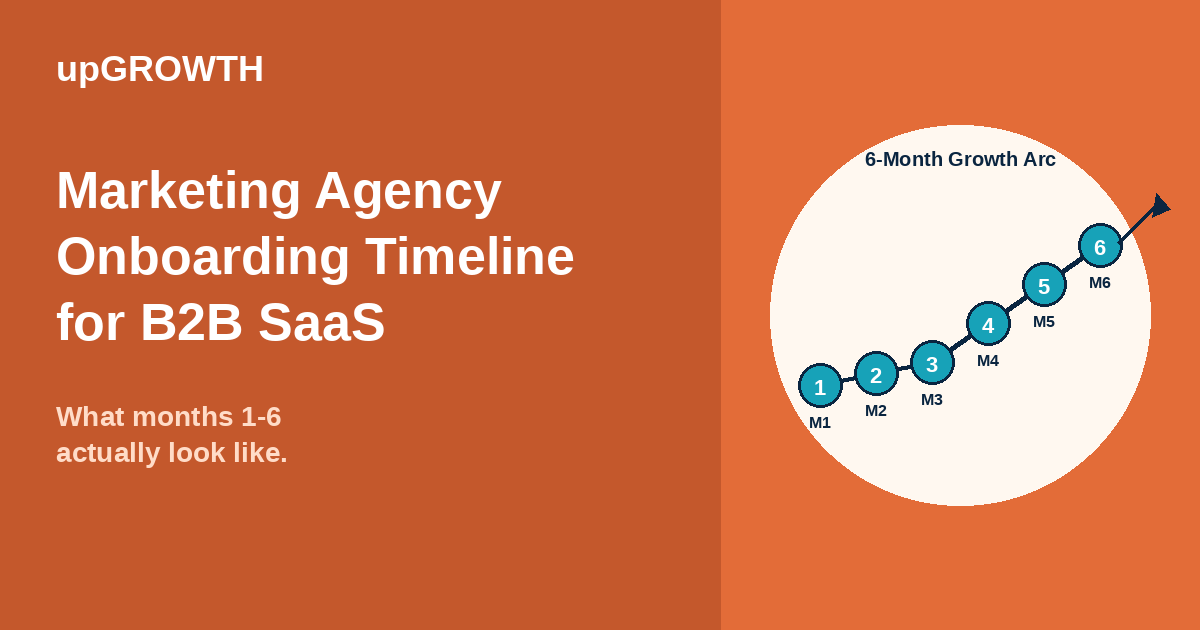
A B2B SaaS company hiring a marketing agency should expect months 1-2 to be foundation and audit work, month 3 to produce the first tangible output, month 4 to show early pipeline signal, and months 5-6 to deliver measurable qualified lead lift. Agencies that promise lead volume in month 1 are either lying, cutting corners on diagnosis, or running boilerplate plays that will break against your actual ICP.
In This Article
Share On:
Every founder we onboard asks the same question in week one. “When do we see results?” The honest answer is boring, and the boring answer is why most SaaS founders hate agencies.
Here’s the truth nobody puts in a proposal. A proper B2B SaaS agency engagement takes two months to stop being research, one month to ship the first real asset, and three more months to compound into pipeline you can actually forecast against. If anyone pitches you a timeline faster than that, they’re either running boilerplate plays from a template or they’re banking on your churn before the work catches up.
At upGrowth Digital, we’ve onboarded 150+ B2B clients across SaaS, fintech, and D2C. The pattern is consistent. Month 6 looks nothing like what the founder imagined in the kickoff call, and that’s usually good news. The founders who stay the course hit month 9 with a predictable pipeline. The ones who fire the agency in month 3 hit month 9 with another agency and another six months of onboarding tax.
This is what month 1 through month 6 actually looks like when you hire a real agency, and what to watch for at each checkpoint.
Month 1: Foundation, Not Execution
Month 1 is almost entirely non-public work. If your agency is shipping ads or blog posts in week two, something is wrong.
A proper month 1 includes an ICP deep-dive (not the one in your pitch deck, the one that actually converts), a GTM audit pulling data from your CRM, GA4, Search Console, and ad accounts, a competitive citation analysis against AI search engines for your category, and a positioning workshop with the founders. The output is a diagnostic document, not a campaign.
This is the month most founders get anxious. You’re paying an agency and seeing no ads run, no content shipped, no leads moving. That’s the sign of an agency doing the work correctly. The agencies that ship in month 1 are running playbooks designed for a generic SaaS company, not yours.
What to watch for in month 1: The agency should be asking you uncomfortable questions about churn reasons, why your last two campaigns failed, which customers are actually profitable, and what your sales team rejects from marketing. If they’re not asking these, they’re not diagnosing.
Month 2 is where the diagnostic becomes a plan and the plan becomes half-built assets. The strategy document from month 1 gets pressure-tested against the founder’s conviction and your sales team’s reality check.
By end of month 2, a B2B SaaS agency engagement should have a content calendar for months 3-6 with specific targets, landing pages for 2-3 core ICPs in draft or staging, paid campaign structures wireframed with creative briefs signed off, tracking infrastructure rebuilt if broken (and it’s almost always broken), and a 90-day lead forecast with ranges, not promises.
What you will NOT see yet: meaningful organic traffic lift, inbound leads that can be attributed to new work, or reduced CPL on paid. If someone’s reporting those in month 2, they’re taking credit for your existing momentum.
What to watch for in month 2: Strategy document should be specific enough that you could hand it to a competitor and they couldn’t execute it without your data. If it’s generic enough to apply to any SaaS company in your category, your agency is not doing strategic work.
Month 3: First Ship, First Signal
Month 3 is when the work goes live. Landing pages deploy. First paid campaigns launch with tight audience slices. First content assets publish. SEO foundations get re-indexed.
This is the month of first signal, not first scale. You should expect early click-through data, early ad performance within expected ranges (or flagged deviations), initial form fill volume, and pipeline entries from new content. The number that matters at end of month 3 is not conversions. It’s variance from hypothesis.
A good agency in month 3 will tell you “we hypothesized CTR of 2.4% on the core ICP ad set, we’re seeing 3.1%, so we’re doubling spend next week.” A bad agency will tell you “we got 47 leads this month” without telling you if that’s good or bad against anything.
What to watch for in month 3: Weekly reporting should now have hypothesis / result / decision structure. If you’re still getting vanity metric reports, the agency is stuck in vendor mode.
Month 4 is when you separate the agencies that know what they’re doing from the ones that shipped once and hoped. By now, every channel has enough data to make real decisions.
Paid campaigns should have winners killed and losers scaled, or vice versa. Landing pages should be in round 2 of CRO testing. Content that ranked in month 3 should be getting backlinked, schema-optimized, and layered with supporting pieces. The agency should also be proactively flagging which bets are not working and reallocating to what is.
This is also the month where pipeline signal becomes pipeline forecast. You should be able to look at the data and say “if we double spend on this channel and hold the rest, we’ll do X MQLs at Y CPL in month 6.” If you can’t, the agency is not doing the analytical work.
What to watch for in month 4: Reports should include a “what we’re killing” section. Agencies that only report wins and never report kills are either not testing hard enough or hiding losses.
Month 5: Compound Pipeline
By month 5, the foundational work from months 1-2 and the iteration from months 3-4 start compounding. This is where organic traffic starts lifting against baseline, paid campaigns hit target CPL ranges consistently, sales-qualified leads from the new pipeline show conversion rates comparable to or better than existing sources, and content published in month 3 is ranking, getting cited, and pulling in compounding traffic.
The most important shift in month 5 is psychological. The founder stops asking “is this working” and starts asking “where do we double down.” That shift from defensive to offensive is the real result.
Expect the first real demand for budget increase conversations in month 5. If paid is hitting CPL targets and pipeline is compounding, the next logical move is more spend. Your agency should be the one bringing that conversation to you with a business case.
What to watch for in month 5: The agency should be helping you model what Rs 5L more in monthly spend would produce, not waiting for you to ask. Proactive scale planning is a sign of operator thinking, not vendor thinking.
Month 6: The Review Moment
Month 6 is the honest checkpoint. This is where you and your agency sit down and answer three questions. What worked better than we expected? What worked worse than we expected? What’s the next 6 months going to look like?
By month 6, a B2B SaaS agency engagement should have delivered measurable MQL lift attributable to new work (10-30% typically, though this varies by starting base), reduced blended CPL by at least 15% if paid was in scope, new content ranking for core commercial-intent queries, a pipeline forecast the founder can defend to their board, and enough data to plan the next 6 months without guessing.
If any of those are missing, it’s a real conversation. Not a firing conversation necessarily, because sometimes the work needs more time. But an honest conversation about why they’re missing and what changes.
The agencies that don’t survive month 6 are the ones that can’t explain why. The ones that survive pivot cleanly and scale into month 9.
Six Common Questions About Marketing Agency Onboarding Timelines
Q: How long does it take for a marketing agency to show results?
A: For B2B SaaS, expect first signal in month 3, early pipeline lift in month 4, and meaningful compound results by month 6. Any agency promising measurable results in month 1 is either running boilerplate campaigns or banking on your churn before the work catches up. The two-month foundation tax is not optional if you want results that hold past month 9.
Q: What should month 1 of a marketing agency engagement look like?
A: Month 1 is almost entirely non-public work: ICP deep-dive, GTM audit, competitive analysis, positioning workshop, and tracking infrastructure review. The output is a diagnostic document, not a campaign. If your agency is shipping ads or content in week two, they’re skipping diagnosis and running a template play.
Q: Why does it take 6 months to see real results from a B2B SaaS marketing agency?
A: B2B SaaS sales cycles average 3-6 months. Even if marketing generates an MQL in month 3, the SQL and closed-won data lags by another 2-3 months. Six months is the minimum window to see the full marketing-to-revenue cycle play out. This is why retainer engagements shorter than 6 months almost always underperform.
Q: What’s the difference between onboarding a marketing agency and a marketing hire?
A: A marketing hire spends months 1-2 learning your product, your category, and your GTM context before contributing strategically. A good agency compresses that to 4-6 weeks because they’ve onboarded similar companies before. The trade-off: the agency will never have the same product depth as an internal hire. Best-in-class engagements pair an agency with an internal marketing lead who owns context, while the agency owns execution and channel expertise.
Q: How should a SaaS founder structure payment during agency onboarding?
A: A good onboarding engagement usually has three payment milestones tied to outputs, not time. Month 1 full retainer against the diagnostic document. Month 2 full retainer against the strategy and asset build. Months 3-6 retainer tied to ongoing execution with monthly reviews. Avoid agencies that won’t tie the first two months to specific deliverables. That’s how they hide the foundation work.
Q: What metrics should I watch weekly during agency onboarding?
A: In months 1-2, watch for depth of diagnostic questions the agency is asking, not output. In month 3, watch for hypothesis/result/decision framing in reports. In months 4-6, watch for CPL trends, MQL-to-SQL conversion rates, and the agency’s ability to forecast forward with math behind it. If reports are still vanity metrics in month 4, escalate.
Your Next Move: The Retainer That Actually Works
Most B2B SaaS agency engagements fail not because the work is bad, but because the timeline expectations are broken from the kickoff call. Founders hire an agency expecting month 3 results, fire them in month 4, and then repeat the onboarding cycle with a new agency. The sunk cost is ruinous.
If you’re evaluating agency proposals, or you’re three months into an engagement that feels off, the fix is usually not switching agencies. It’s calibrating expectations against what month 1-6 actually looks like when the work is done right. The diagnostic and strategy work in months 1-2 is where most founders panic. That panic is almost always misplaced.
Our execution retainers start at Rs 1.5L+/month and run 6-month minimum terms precisely because we’ve seen what happens when SaaS founders try to run shorter engagements. The math doesn’t work. The agency takes shortcuts to show month-3 results, and the work breaks in month 5 when there’s no foundation underneath.
Watch what a B2B SaaS marketing agency onboarding timeline really looks like from month 1 to 6
For Curious Minds
The initial month is dedicated to building a custom strategy, not executing generic plays. An agency that skips this diagnostic phase is essentially guessing about your ideal customer profile (ICP) and market position, which leads directly to wasted ad spend, low-quality leads, and friction with your sales team. A proper month one involves a deep diagnosis to create a go-to-market strategy tailored specifically to your business. This critical, non-public work includes:
ICP Deep-Dive: Moving past your pitch deck to identify the customer profiles that actually convert and deliver high lifetime value.
GTM Audit: Analyzing historical data from your CRM, GA4, and ad accounts to uncover what has truly worked and what has failed.
Competitive Analysis: Understanding how your competitors are positioned, especially against modern AI-powered search engines.
This process ensures every subsequent action is data-driven. An agency that launches ads in week two is signaling a reliance on a boilerplate approach that will inevitably fail to connect with your specific, nuanced audience. To see how this foundational work translates into a predictable pipeline, you must understand the full six-month journey.
The 'onboarding tax' is the cumulative cost of repeatedly starting over with new agencies. When a founder fires an agency in month three, they lose the two months of foundational work they paid for and must pay a new agency to repeat that same diagnostic process, effectively resetting the timeline to zero. This creates a cycle of paying for discovery without ever reaching the execution and compounding growth stages. The financial impact is significant; a founder who churns agencies twice in nine months will have paid for six months of onboarding and only three months of actual marketing execution. In contrast, founders who commit to a single agency for nine months, as observed by upGrowth Digital across 150+ B2B clients, benefit from six straight months of optimization and growth building on a solid foundation. This is the difference between having a predictable, forecastable pipeline and being stuck in a perpetual state of strategic planning with no tangible results to show for it. To avoid this tax, it is critical to understand what realistic progress looks like in the first quarter.
The key is to focus on the quality and specificity of the strategic deliverables, not the launch of public campaigns. A diligent agency provides concrete, custom outputs during this phase, while an inefficient one will offer generic plans and excuses. In month one, you should receive a detailed diagnostic document based on deep dives into your CRM, ad accounts, and customer data. In month two, this should evolve into a highly specific strategy document and tangible pre-launch assets. Look for these signs of a strong agency:
Strategic Specificity: The strategy should be so tailored that a competitor could not execute it without your proprietary data.
Asset Drafts: You should see wireframes or drafts for landing pages targeting core ICPs and creative briefs for paid campaigns.
A 90-Day Forecast: The agency should provide a lead forecast with ranges, demonstrating a plan rooted in your actual business metrics.
If an agency is not asking uncomfortable questions or producing these custom documents, they are likely following a template-based approach. Learning to identify these early checkpoints is crucial for a successful partnership.
The single most decisive trait is patience combined with a focus on strategic inputs over vanity outputs. Founders who achieve a predictable pipeline by month nine understand that the first quarter is for building the engine, not for racing the car. They treat the initial diagnostic and strategy phases as a collaborative investment. These successful founders engage deeply in the process, challenging the agency's assumptions and providing candid feedback on churn reasons and failed campaigns. In contrast, founders who churn agencies typically exhibit impatience, demanding lead volume in the first 90 days. They mistake the absence of live ads or immediate MQLs for a lack of progress. The experience at upGrowth Digital with over 150+ clients shows a clear pattern: those who trust the process of deep diagnosis and strategic alignment are the ones who build a sustainable marketing system. They value the uncomfortable questions and see the month one diagnostic document as the first major win. Understanding this distinction is key to setting your engagement up for long-term success.
A classic boilerplate play is immediately launching a Google Ads campaign targeting broad, high-volume keywords like "project management software." The agency pairs this with a generic landing page offering a free trial or a vague ebook. This approach is designed to generate activity and clicks quickly, making it seem like progress is happening. However, it fails because it completely ignores the nuances of a specific company's ideal customer profile (ICP). For example, your B2B SaaS might be perfect for enterprise construction firms, not for marketing agencies or tech startups. The boilerplate campaign attracts a high volume of low-quality traffic from unqualified industries, resulting in a low conversion rate, high cost-per-lead (CPL), and leads that the sales team immediately rejects. A proper agency would spend month one determining that the true ICP is construction project managers and that the best channel might be LinkedIn ads targeted by job title, not broad Google search. The failure to diagnose is a failure to strategize, a mistake that costs founders valuable time and money.
A strong agency will immediately probe the weaknesses and historical failures of your marketing and sales efforts. These uncomfortable questions are a clear sign that they are committed to a deep diagnosis rather than a superficial, template-based solution. You should welcome questions like: "Why did your last two campaigns fail to generate pipeline?", "Can you show me the data on customer churn from the last 12 months?", and "What specific feedback does your sales team give when they reject a marketing-qualified lead?" These questions signal that the agency is trying to understand the real-world business context, not just the marketing persona on a slide deck. As an agency that has onboarded 150+ B2B clients, upGrowth Digital finds these conversations are the bedrock of a successful strategy. An agency that avoids these topics is not diagnosing your business; it is simply preparing to run its standard playbook. The answers to these questions are what inform a truly custom GTM strategy that can deliver results.
This initial two-month phase is the foundation for creating a predictable and scalable growth engine. By meticulously auditing past performance, defining the true ICP, and mapping the GTM strategy to real data, the agency establishes reliable baseline metrics for everything that follows. This allows for highly accurate forecasting later on. When you know your true customer acquisition cost (CAC), conversion rates for specific ICP segments, and the average sales cycle length, you can model future growth with confidence. A strategy built on a generic or rushed foundation will produce volatile, unpredictable results, making it impossible to forecast pipeline accurately. The rigorous upfront work ensures that by month nine, you have a system, not just a series of campaigns. This system, proven through months of data, is what allows you to confidently tell your board how much pipeline will be generated by a specific marketing investment. It transforms marketing from a cost center into a predictable driver of revenue, a journey we have guided over 150+ B2B clients through.
Founders should manage this anxiety by shifting their focus from campaign launches to strategic milestones. The absence of public work in month one is a feature, not a bug, of a high-quality engagement. The single most important deliverable to demand by the end of this period is the diagnostic document. This document is the tangible proof of the agency's work. It should synthesize findings from your CRM, analytics, competitive landscape, and founder interviews into a coherent analysis of your market position, challenges, and opportunities. It is a strategic blueprint, not a simple report. If an agency cannot produce a detailed, data-backed diagnostic document that reveals new insights about your business, that is a major red flag. By treating this document as the key month-one deliverable, you can validate progress and build confidence in the process, ensuring the relationship starts on a solid, strategic footing before a single dollar is spent on ads. This approach provides the assurance needed to navigate the initial quiet period.
The most common mistake is measuring success with lagging indicators like lead volume instead of leading indicators like strategic depth. In the first 90 days, especially the first 60, judging an agency on MQLs is premature and counterproductive. This pressure often forces the agency to launch generic, high-volume campaigns that deliver poor-quality leads, poisoning the well with the sales team. The correct approach is to evaluate the quality of the foundational work. Did the agency produce a GTM audit that uncovered insights you didn't know? Is the month two strategy document specific enough to be a true playbook for your business? By focusing on these outputs, you are assessing the quality of the strategic foundation being built. A strong foundation is the best predictor of future success. The experience of upGrowth Digital shows that founders who scrutinize the strategy in month two are far more likely to be satisfied with the pipeline in month nine than those who demand leads in month one. This shift in focus aligns expectations with the reality of building a sustainable growth engine.
A custom strategy document is a detailed operational plan, whereas a generic one is a collection of high-level best practices. The key difference is specificity rooted in the diagnostic work from month one. A genuinely custom strategy cannot be executed by another company because it is built entirely on your unique data, ICP, and market position. To verify its quality, a founder should look for several key components:
Segmented ICP Targeting: Clear plans for 2-3 distinct customer profiles with tailored messaging and channel strategies for each.
Data-Driven Content Calendar: A content plan for months 3-6 with specific topics, formats, and distribution channels tied to your identified business challenges.
Detailed Campaign Wireframes: Outlines for paid campaigns that specify audience targeting, ad creative direction, and landing page structure.
Rebuilt Tracking Infrastructure: A plan to fix any identified issues in your analytics and CRM tracking to ensure accurate measurement.
If the document contains vague statements like "we will improve SEO" without detailing how, it is a boilerplate plan. A real strategy is a blueprint for action.
The initial six-month engagement acts as a structured process for building and validating a repeatable marketing playbook. By the end of this period, the agency has not only generated a predictable pipeline but has also created a full suite of documented strategic assets and operational workflows. This is invaluable for an eventual in-house transition. Instead of hiring a marketing leader who has to start from scratch, you can hand them a proven system. This includes a validated ICP, a content strategy that works, optimized paid campaign structures, and a fine-tuned marketing technology stack. The data from months four through six provides clear benchmarks and KPIs for an in-house team to build upon. This de-risks your first key marketing hires and dramatically shortens their ramp-up time. The agency's role transitions from building the engine to helping you hire the driver and crew. This structured handover, informed by months of real-world data, is the most effective way to scale your marketing function sustainably.
A forecast with ranges demonstrates a data-driven, realistic approach, while a fixed promise signals overconfidence or even dishonesty. A credible agency understands that marketing is about managing probabilities, not certainties. The ranges in the forecast are derived from the GTM audit and your historical data, accounting for variables like conversion rate fluctuations and market seasonality. This approach signals several positive traits about the agency: they are grounding their plan in your actual business metrics, they understand the complexities of your sales cycle, and they are setting honest expectations. An agency like upGrowth Digital uses this method to establish a baseline for performance that can be refined over time as new campaign data becomes available. Conversely, an agency promising exactly 50 MQLs in month three is likely using a one-size-fits-all model and hoping for the best. A forecast built on ranges is a sign of a true strategic partner focused on building a predictable system. To build that system, you need to understand the milestones along the way.
Amol has helped catalyse business growth with his strategic & data-driven methodologies. With a decade of experience in the field of marketing, he has donned multiple hats, from channel optimization, data analytics and creative brand positioning to growth engineering and sales.

 Growth Strategy and Planning
 Inbound Growth
 Growth Hacking
 Fractional CMO
 Search Engine Optimization
 Paid and Performance Marketing
 Social Media Marketing
 Demand Generation
 AI-Driven Growth Strategy
 AI-Native Workflow Automation
 Generative Engine Optimization
 Grove — AI Growth Strategist

 AI Automation
 Framework
 Case Study
 Tools
Tools Growth Tools
 Decision Tree
 Compare
 Custom GPT's
 AI Answer Gap
 Offer
Offer Webstories
 Quizzes
 Blog
Blog AI-powered Apps
 Social Media Tools
 Agency Fit Score