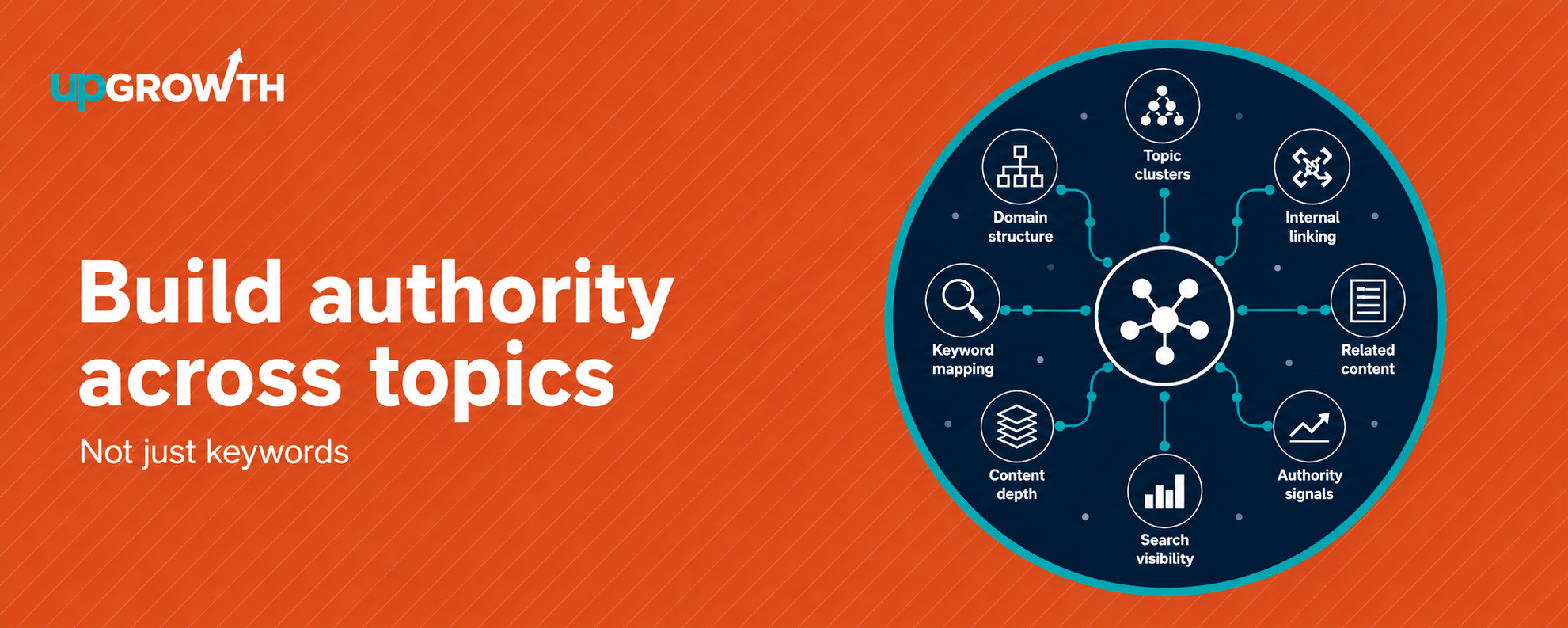
Topical authority is the reason two websites with similar domain strength rank completely differently for the same keyword. It’s not about how many backlinks you have or how often you publish. It’s about whether search engines and AI models see your site as a genuine authority on a subject, built through depth, structure, and consistency. This blog breaks down what topical authority actually is, why it now matters more for AI visibility than for classic SEO, and gives you a step-by-step plan to build it from scratch.
In This Article
Share On:
Backlinks and publishing frequency won’t save you if search engines and AI models don’t see you as an authority on your subject.
What topical authority actually means
Most founders hear the term “topical authority” in an SEO call and nod along without really knowing what it means. Here’s the plain version.
Topical authority is how confident Google, Perplexity, or ChatGPT are that your website is a reliable, complete source on a given subject. Not a single keyword. A subject. If you run a fintech company and you’ve published one strong article on “personal loan eligibility,” that’s a page. If you’ve published thirty interconnected articles covering eligibility, interest rates, documentation, comparison with other loan types, and calculators for each, that’s a topic you own.
Search engines don’t read one page in isolation. They look at your entire site’s coverage of a subject, how those pages connect to each other, and whether someone reading your content would leave with their question fully answered. AI models do something similar, except they’re even more sensitive to depth and structure because they’re trying to synthesise an answer, not just rank a list of links.
Why this matters more than backlinks or publishing frequency
For years, the two levers everyone pulled were backlinks and volume. Get more links, publish more often, rank higher. That still works to a degree, but it’s gotten a lot less reliable, and here’s why.
A site with fifty backlinks and deep, well-structured coverage of a niche topic regularly outranks a site with five hundred backlinks and scattered, shallow content. Google’s own guidance on creating helpful, reliable content directly confirms this: ranking systems are built to reward content that demonstrates real subject-matter depth, not just link volume.
Publishing frequency without a plan actually works against you. If you’re publishing three blogs a week on unrelated topics just to “stay active,” you’re diluting your site’s signal instead of building it. Each new page should add to a cluster your site already owns, not start a new, disconnected thread.
And this is where it gets more urgent. AI answer engines like ChatGPT, Perplexity, and Google’s AI Overviews don’t cite the page with the most backlinks. They cite the source that demonstrates the clearest, most complete coverage of the question being asked. If your site has one thin page on a topic and a competitor has a full cluster, the AI is going to cite the competitor, even if your domain is technically stronger.
The four building blocks of topical authority
Building block
What it means
Coverage depth
You’ve addressed the subject from every angle a reader or an AI model would expect, not just the obvious entry point.
Internal linking structure
Your pages on a subject are deliberately linked to each other, forming a cluster rather than sitting as isolated posts.
Content freshness
The cluster is updated as facts, rates, or regulations change, so it doesn’t go stale while competitors update theirs.
Entity consistency
The same terminology, definitions, and brand entities are used consistently across every page in the cluster.
Miss any one of these and the cluster weakens. A site can have excellent depth but no internal linking, which means search engines and AI crawlers never connect the pages into a single topic in the first place. Our Generative Engine Optimization service is built specifically to close that gap, structuring content so both crawlers and AI models can read it as one connected subject.
How to build topical authority from scratch
Step 1: Pick one subject, not five
Don’t try to build topical authority across your entire service list at once. Pick the one subject that matters most to your business right now, the one your best customers search for before they buy. Everything else comes later.
Step 2: Map the full question set
List every question a genuinely curious customer would ask about that subject, from beginner to advanced. Use tools like Semrush’s keyword research or Google’s “People also ask” panel to find the ones you’re missing. Our 7 Keyword Grouping Strategies guide is a useful starting point if you’re mapping this out for the first time. This map becomes your content cluster plan.
Step 3: Build a pillar page
Create one central page that gives a complete overview of the subject and links out to every supporting article you’re about to write. This pillar page is what ties the entire cluster together for both search engines and readers.
Step 4: Write the supporting cluster
Produce individual articles for each question or sub-topic from your map. Each one should link back to the pillar page and sideways to at least two or three related articles in the cluster. This is the step most teams skip, and it’s the one that actually creates the authority signal.
Step 5: Add structured data
Mark up your pillar and cluster pages with schema, FAQPage for question-based content, HowTo for process content, and BreadcrumbList to show the site hierarchy. This helps AI models parse and cite your content correctly.
Step 6: Update on a schedule, not randomly
Set a quarterly review for the cluster. Update statistics, add trending questions, and remove anything that’s gone stale. Topical authority isn’t a one-time project. It’s maintained.
Step 7: Measure by citation and ranking, not traffic alone
Track how often your cluster pages get cited by AI answer engines, alongside your traditional ranking data. As of 2026, citation share is becoming as important a metric as organic rank for brands trying to stay visible across both Google and AI search. You can use our SEO ROI Calculator to model how a stronger topical cluster translates into organic traffic value over time.
The bigger picture
Topical authority isn’t a trick or a shortcut. It’s the difference between a site that search engines and AI models trust as a reference point and a site that just happens to have a page that ranked once. Building it takes a real plan, consistent execution, and a willingness to say no to random content ideas that don’t fit the cluster.
The businesses that get this right aren’t publishing the most. They’re publishing the most complete picture of the subjects that matter to their customers, and connecting it all together so every crawler and every AI model can see it clearly.
Not sure where your gaps in topical authority are?
Every site has blind spots in its content coverage, and most founders can’t see them from the inside. Grove, upGrowth’s AI growth strategist, can walk you through a focused diagnosis in under 4 minutes and show you exactly which subjects your site lacks depth in.
If you’d rather go deeper with a live session on your actual content and rankings, our team is available for a 30-minute working session, no pitch, just your data. Start your diagnosis with Grove.
Amol has helped catalyse business growth with his strategic & data-driven methodologies. With a decade of experience in the field of marketing, he has donned multiple hats, from channel optimization, data analytics and creative brand positioning to growth engineering and sales

 Growth Strategy and Planning
 Inbound Growth
 Growth Hacking
 Fractional CMO
 Search Engine Optimization
 Paid and Performance Marketing
 Social Media Marketing
 Demand Generation
 AI-Driven Growth Strategy
 AI-Native Workflow Automation
 Generative Engine Optimization
 Grove — AI Growth Strategist

 AI Automation
 Framework
 Case Study
 Tools
Tools Growth Tools
 Decision Tree
 Compare
 Custom GPT's
 AI Answer Gap
 Offer
Offer Webstories
 Quizzes
 Blog
Blog AI-powered Apps
 Social Media Tools
 Agency Fit Score