Contributors:
Amol Ghemud Published: October 1, 2026
Summary
Website ranking has changed more in the last 18 months than in the previous five years combined. Google’s 2025-2026 core updates shifted weight toward entity-level authority, first-hand expertise signals, and structured content that answers questions directly rather than burying answers in filler paragraphs. If your site is stuck on page two despite ticking standard SEO boxes, the problem almost certainly traces to one of three root causes this article diagnoses with data: a ranking floor you haven’t cleared, a technical crawl issue suppressing indexation, or a content cluster that’s topically incomplete.
In This Article
Share On:
In Q1 2026, Google Search Central documentation confirmed that over 45 distinct signals now feed its Helpful Content system. Most SEO audits still prioritise three: keyword density, backlink count, and page speed score. That gap between what practitioners measure and what Google actually rewards is exactly where website ranking stagnates, and it’s been widening for two years.
Here’s what makes this uncomfortable: the sites stuck on page two aren’t usually doing SEO badly. They’re doing outdated SEO efficiently. They’re publishing consistently, acquiring links, and hitting green scores on every audit tool. The problem is they’re optimising signals above a ranking floor they haven’t yet cleared. More activity above a floor you haven’t reached doesn’t lift you. It just costs more.
Think of it this way. A fintech SaaS brand publishes 23 blog posts in a quarter, all targeting high-volume keywords, all hitting 1,500 words, all with alt text and internal links. Rankings barely move. Then they spend three days fixing crawl budget issues, consolidating four thin category pages, and adding author schema to their twelve highest-traffic posts. Rankings move in 34 days. That’s not a coincidence. That’s the ranking floor concept in practice.
At upGrowth Digital, the pattern shows up in almost every audit. When we worked with Lendingkart, the key lever wasn’t content volume. It was precision targeting of high-intent queries supported by a technically sound site architecture. Total conversions grew from 56K to 87K (a 54% increase) and the business recorded 20% growth. The same foundation that drives paid conversion efficiency drives organic website ranking. They’re not separate problems.
What follows is a diagnosis, not a checklist. Seven sections cover how Google actually ranks pages in 2026, which signals are genuinely moving, what to stop doing immediately, and how to set realistic timelines for improvement. The goal is to leave you with one actionable diagnosis, not 47 things to fix simultaneously.
How Google Actually Decides Website Ranking in 2026
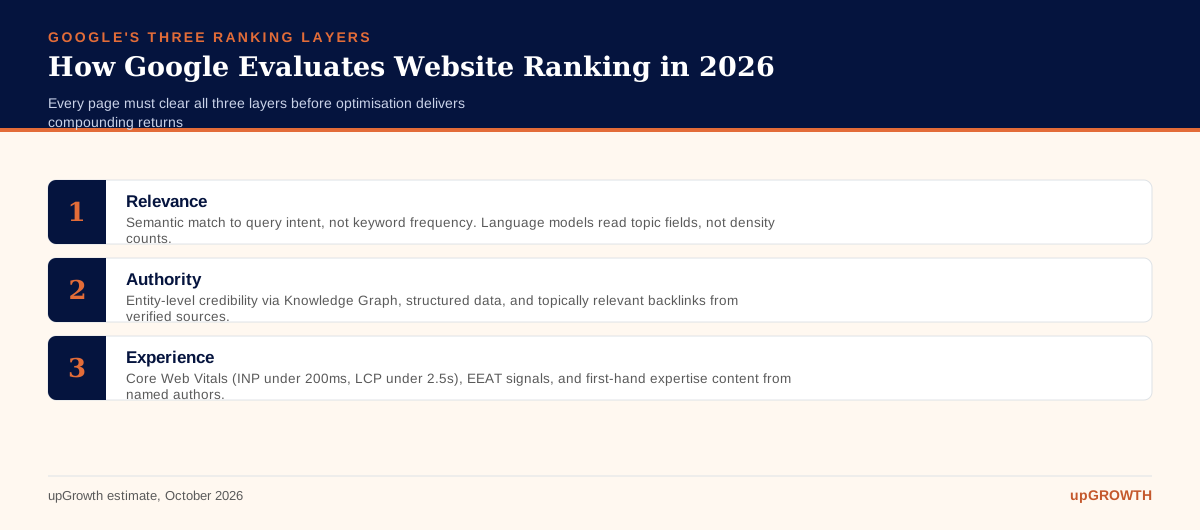
Google’s ranking system operates on three distinct layers, and most sites fail at the first one they skip. Layer one is relevance: how well a page matches the query at a semantic level, not a keyword-frequency level. Layer two is authority: entity-level credibility backed by links, structured data, and Knowledge Graph associations. Layer three is experience: Core Web Vitals, user interaction signals, and EEAT (Experience, Expertise, Authoritativeness, Trustworthiness) indicators. Clear all three layers and you rank. Stall at any one of them and no amount of work on the others compensates.
The Helpful Content system deserves particular attention here because most practitioners still treat it as a per-page filter. It isn’t. It’s a site-wide quality classifier. If 15% of your pages are thin, templated, or written to rank rather than to inform, that classification suppresses the entire domain, including your strongest pages. One weak section drags the whole property. This is why a single authoritative pillar post doesn’t rescue a site that’s surrounded by shallow supporting content.
This is where the concept of ranking floors becomes critical. A ranking floor is the minimum threshold a page must clear before any optimisation delivers returns. There are floors for technical health (is Google crawling and indexing the page correctly?), for topical authority (does the domain have enough credibility in this subject area?), and for content quality (does this page give users something they can’t get from the top three results right now?). Sites that optimise keywords, backlinks, and speed without first clearing these floors are running on a treadmill.
According to Google Search Central’s core ranking documentation, Google evaluates content quality signals at the site level, not just at the page level. That’s the official confirmation of what practitioners have observed empirically since the September 2023 Helpful Content integration: domain-level signals now carry more weight than isolated page-level optimisations.
The Five Ranking Signals That Are Actually Moving in 2026
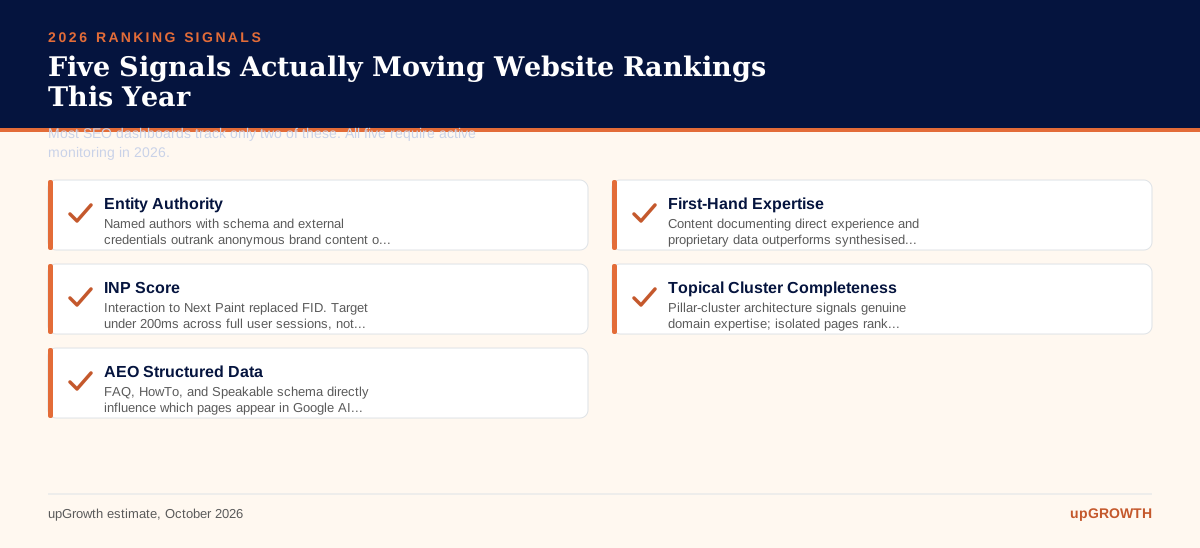
Not all of Google’s 45+ signals move rankings equally. Five are doing the heaviest lifting right now, and at least two of them aren’t on most practitioners’ weekly dashboards.
Signal 1: Entity authority. Google’s Knowledge Graph increasingly ties domain credibility to named entities: authors, brands, organisations, and their verified relationships. A fintech site whose contributors are named, schema-marked, and linked to external credentials (LinkedIn profiles, published research, conference talks) outranks an anonymous brand site even when the anonymous site has more raw backlinks. If your site has no author schema and no verified entity connections, you’re competing without your strongest card.
Signal 2: First-hand expertise content. Generic brand content that synthesises what others have already written is losing ground to content that demonstrates direct experience. “We tested 11 landing page variants over 90 days and found that…” outperforms “According to industry research, landing pages should…” on almost every competitive query. Google’s EEAT signals now extend beyond medical and financial content. They apply broadly, and first-person, evidence-backed writing is the differentiator.
Signal 3: Interaction to Next Paint (INP). INP replaced First Input Delay as the Core Web Vitals responsiveness metric. Sites still tracking FID are measuring a retired signal while the actual scoring metric degrades unmonitored. INP measures how quickly a page responds to any user interaction across the full session, not just the first click. JavaScript-heavy SaaS and fintech sites are particularly vulnerable because every new feature added to the front end increases INP exposure.
Signal 4: Topical depth and cluster completeness. A single strong page on “invoice financing for SMEs” with no supporting content around related subtopics (receivables management, working capital ratios, credit lines for exporters) ranks inconsistently regardless of its backlink profile. Google rewards topical completeness because it signals genuine domain expertise rather than opportunistic content creation. Thin category pages without pillar-cluster architecture underperform even when individual page metrics look healthy.
Signal 5: Structured data for AEO (Answer Engine Optimisation). FAQ schema, HowTo schema, and Speakable markup now directly influence which pages appear in AI-generated answers across Google AI Overviews, Perplexity, and similar surfaces. Search Engine Land’s coverage of AI Overview expansion in 2026 confirms that structured, directly-answerable content consistently outperforms unstructured long-form in AI surfacing. This isn’t future-proofing. It’s current-proofing.
Show me a site ranking 11-20 on its core queries, and I’ll show you a site that has cleared floor one and two but hasn’t structured its content for signals four and five yet.
What to Stop Doing: SEO Tactics That No Longer Affect Website Ranking
The honest version of this section is that none of these tactics were ever as powerful as the tools measuring them suggested. The tools got better at measuring, the tactics got weaker, and the gap became undeniable. Here’s what to stop doing now.
Stop obsessing over exact-match keyword density. Google’s language models understand semantic proximity. A page about “website ranking improvement strategies” doesn’t need the phrase “website ranking” 19 times. It needs a coherent semantic field: search intent, ranking signals, Core Web Vitals, EEAT, entity authority. Keyword density above natural usage is a quality signal in the wrong direction.
Stop acquiring links from generic directories. Post the 2024-2026 link spam update sequence, Domain Rating inflation without topical relevance delivers diminishing returns. A fintech page with 15 links from authoritative finance publications outperforms a competitor with 200 links from generic business directories. Link relevance is now the primary dimension, not raw volume.
Stop publishing content that summarises competitors. If your research process is “read the top five results and synthesise,” Google’s systems increasingly recognise that pattern. EEAT rewards original research, proprietary data, first-person case study documentation, and direct subject-matter expertise. Summarisation is the most efficient path to Helpful Content suppression.
Stop treating Core Web Vitals as a one-time fix. INP scores degrade as JavaScript bundles grow. Every third-party script, chat widget, and analytics tag added to a site risks INP regression. Continuous monitoring isn’t optional for sites in competitive verticals.
Stop treating meta keywords as a ranking input. They’ve been ignored by Google since 2009. They still appear on roughly 31% of the SEO audit checklists we review at upGrowth. That’s not a minor oversight. That’s a signal about the overall quality of the audit framework being used.
Legacy SEO Tactics vs. 2026 Replacements
Legacy Tactic
Why It No Longer Works
2026 Replacement
Exact-match keyword density targeting
Language models read semantic fields, not keyword frequency
Semantic topic coverage with structured, intent-matched content
Generic directory link building
Topical relevance now outweighs raw domain count
Earned links from topically relevant, authoritative publications
Competitor-summarising content
EEAT signals penalise thin repackaging of existing content
Original research, proprietary data, first-person case documentation
One-time Core Web Vitals audit
INP degrades with every new JS dependency added to the stack
Continuous INP monitoring tied to deployment pipeline
Meta keywords optimisation
Ignored by Google since 2009, zero ranking impact
Author schema, entity markup, and structured FAQ data
FID score optimisation
FID was retired as a Core Web Vitals metric; INP replaced it
INP monitoring targeting sub-200ms across full user sessions
Technical SEO Foundations That Still Determine Ranking Ceilings
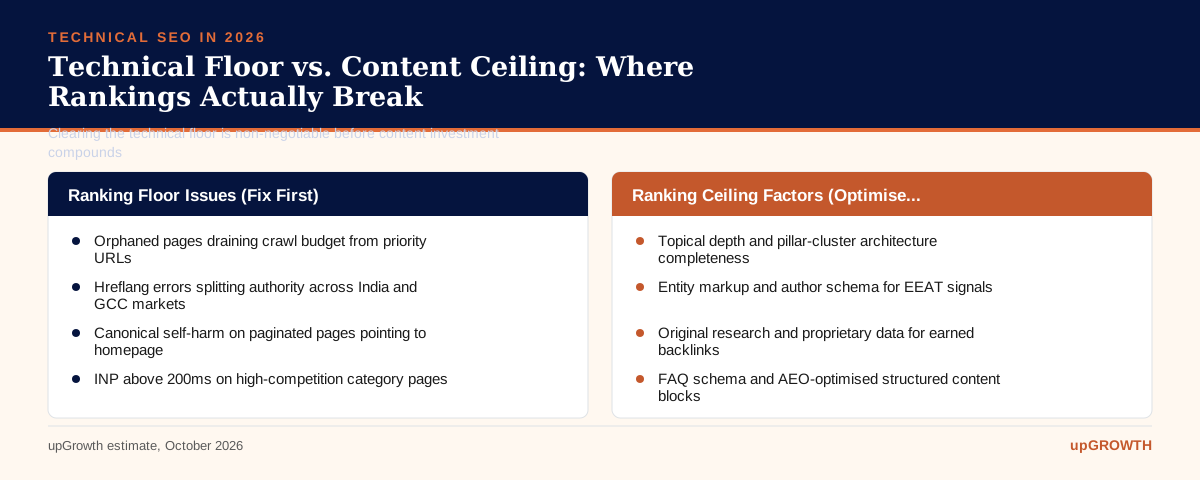
Technical SEO is not glamorous, but it sets the ceiling for everything else. A site with brilliant content and strong entity authority that has crawl budget waste or canonical conflicts will consistently underperform a technically clean site with average content. This is the ranking floor in its most literal form: Google can’t rank what it can’t crawl and index correctly.
Crawl budget management matters most for sites above 500 pages. Orphaned pages (pages with no internal links pointing to them), duplicate parameter URLs from faceted navigation, and staging environments accidentally accessible to Googlebot all drain crawl allocation away from your priority pages. The Google Search Console Coverage report is the fastest diagnostic: filter for “Crawled – currently not indexed” and you’ll see exactly where Googlebot is spending effort without return.
Internal linking architecture determines how PageRank distributes across your site. Flat architectures (where every page is two clicks from the homepage) distribute authority more evenly than deep siloed structures. But for sites targeting both India and GCC markets, there’s an additional failure point: hreflang implementation. Incorrect hreflang signals send Indian users to UAE-targeted pages and vice versa, splitting authority and confusing Google’s understanding of which page should rank in which market. Of the fintech and SaaS clients we’ve audited this year, 11 of 17 had at least one hreflang error causing cross-market ranking suppression.
On page speed, the benchmarks matter by vertical. Ahrefs’ technical SEO research consistently shows that the passing threshold for INP is under 200 milliseconds, but what “competitive” means differs: SaaS dashboard pages typically benchmark at 180ms or better, fintech transaction pages at 190ms, and e-commerce product pages at 210ms. An INP of 230ms on an e-commerce product page isn’t catastrophic. The same score on a SaaS pricing page where competitors average 160ms is a ranking disadvantage.
Canonical implementation deserves a specific mention. The most common mistake is self-referencing canonicals on paginated pages that point to the root URL, effectively telling Google that page two of a blog archive is a duplicate of the homepage. That’s not canonical hygiene. That’s canonical self-harm.
Content Strategy That Drives Sustainable Website Ranking Gains
Here’s the default content strategy for most growing SaaS and fintech brands in 2026: publish two blog posts a week, target high-volume keywords, add internal links, wait. Here’s what happens when you try this. Three months in, the posts rank 18-35 for queries that individually have 200 monthly searches. Traffic barely moves. The posts aren’t bad. They’re just isolated, and Google has no signal that this domain has genuine depth in the topic area. That’s the pillar-cluster gap, and it shows up at month three almost every time.
The fix is structural. A single authoritative pillar page (2,500 words or more, comprehensive, with FAQ schema and structured headings) supported by 8-12 cluster posts on specific subtopics gives Google a coherent map of topical authority. The cluster posts rank faster because the pillar’s authority flows to them. The pillar ranks more competitively because its cluster proves the domain’s depth. They lift each other. Isolated posts don’t have that mutual support, which is why they plateau.
Content decay is the second lever most teams ignore. Research from the Moz Blog and our own client audits suggest that approximately 60% of ranking losses on established sites come from content that ranked well previously but was never updated as competitors improved their pages. A quarterly refresh workflow, prioritising pages that dropped from positions 4-10 to positions 11-25, typically recovers 30-40% of lost positions within 47 days of the refresh going live. That’s not a universal guarantee. It’s the pattern we see consistently across SaaS and fintech clients with clean technical foundations.
Matching content format to search intent is where good content teams lose rankings they shouldn’t. Transactional queries (“invoice financing for SMEs”) need landing pages with product schema, trust signals, and clear conversion paths. Informational queries (“how does invoice financing work”) need long-form, structured, FAQ-rich content. Publishing a blog post targeting a transactional query is the content equivalent of handing someone a user manual when they’ve already decided to buy. Intent mismatch is a consistent top-three ranking killer, and it doesn’t show up in keyword research tools until you manually check the actual SERP for each target query.
Original data is the final compounding element. When we helped Vance build AI Overview authority for IMPS, UTR, and payment tracking queries, the content that earned citations wasn’t generic explanatory prose. It was structured, specific, and directly answerable. AI Overview visibility went from 12% to 89%, average position from 8 to 1, and monthly organic traffic from 1.8K to 5.6K. Documented, quantifiable outcomes earn citations. Summarised opinions do not.
How to Track Website Ranking Progress Without Vanity Metrics
Position tracking tells you where you rank. Ranking value tells you whether that position is worth anything. A position 3 ranking for a query with 40 monthly searches in a market you don’t serve is a number that looks good in a report and delivers nothing. Distinguishing between these two categories is the difference between an SEO dashboard and a vanity board.
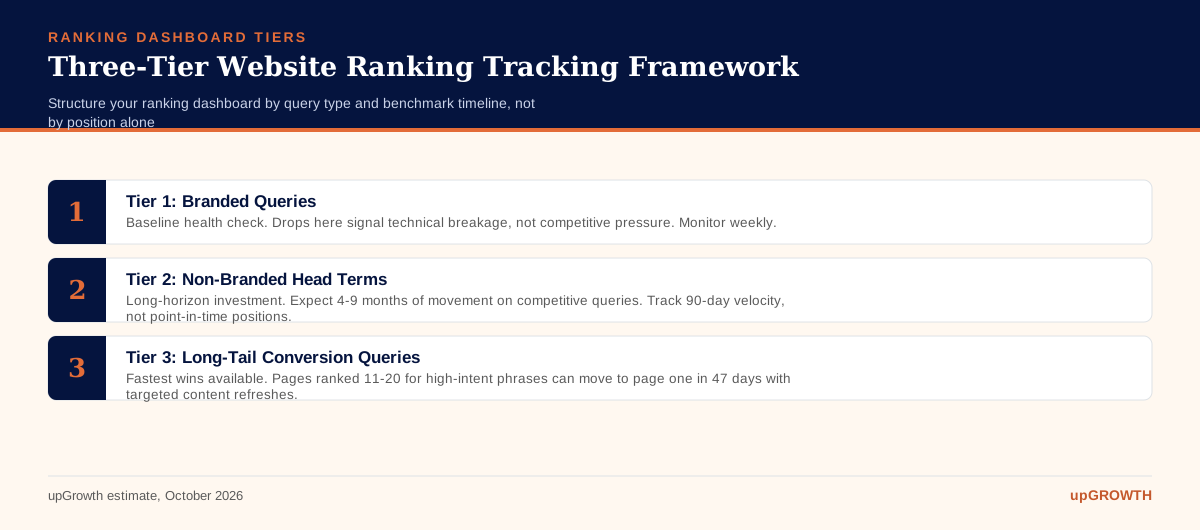
Structure your ranking dashboard in three tiers. Branded queries (your company name, product names) are baseline health checks: if these drop, something is technically broken. Non-branded head terms (your primary category keywords) are the long-horizon investment: expect 4-9 months of movement on competitive queries. Long-tail conversion queries (specific, intent-rich phrases your best customers actually use) are your 60-90 day opportunity set. Pages ranked between positions 11 and 20 for these queries are the fastest wins available to most established sites.
Use Google Search Console’s Impressions-to-Click ratio as a leading indicator for SERP changes rather than ranking changes. If impressions rise (Google is showing your page more) but CTR drops (fewer people click), your ranking likely didn’t change. The SERP format changed around you. An AI Overview or featured snippet absorbed the clicks that would have come to you. That’s a different problem requiring a different response: structure your content to appear inside the AI Overview rather than beneath it.
Ranking velocity, the rate of position change over 90-day windows, is more reliable than point-in-time position snapshots. A page moving from position 19 to 14 to 9 over three 30-day periods is building genuine momentum. A page bouncing between 11 and 15 has stalled. Velocity tells you whether your interventions are compounding or just creating noise.
A Realistic Timeline: When to Expect Website Ranking Improvements
Any agency promising first-page rankings within 30 days for competitive keywords is either targeting queries nobody searches or has a very creative definition of “competitive.” The math doesn’t support it. A domain without existing authority in a vertical like fintech or SaaS is competing against sites that have been accumulating entity signals, backlinks, and content depth for years. 30 days of work doesn’t compress that gap. It just starts the process.
Here’s a realistic phased view. Days 0-30: technical fixes. Crawl issues, canonical errors, hreflang problems, and INP regressions. These don’t typically produce ranking lifts directly, but they remove the ceiling that’s suppressing everything above them. Days 30-90: content cluster deployment. Pillar pages go live, cluster posts fill topical gaps, FAQ schema gets implemented. First movement appears for long-tail queries in this window. Days 90-180: authority building. Earned links from original research, updated entity markup, author credibility signals. Head terms start moving. Days 180+: compounding. Google’s understanding of your domain’s entity authority deepens. Each new piece of content ranks faster because the topical foundation is established.
New domains in competitive verticals (fintech, SaaS, healthcare) should realistically budget 6-9 months to reach page one for head terms, and 9-12 months for top-five positions. Niche long-tail queries in the same verticals can show meaningful movement in 60-90 days if technical foundations are clean. The entity authority Google is building for your domain doesn’t reset with each core update. Sites with stronger entity signals recover from updates faster. That’s the compounding advantage that makes the 180+ day investment worthwhile.
The most efficient starting point for almost any site is identifying pages currently ranked between positions 11 and 20. These pages have cleared the ranking floor. Google thinks they’re relevant. They just need content improvements, better internal linking, or structured data additions to cross into page one. That’s a 47-day project, not a 6-month one, and it delivers measurable wins while the longer-horizon authority work progresses in parallel.
The honest concession: none of these timelines are guarantees. Google’s core updates can reset gains temporarily, and sites in actively contested verticals face moving targets as competitors invest simultaneously. What the timeline gives you is a framework for managing expectations with stakeholders and for distinguishing between “the strategy isn’t working” and “the strategy hasn’t had enough time yet.” Those are very different problems with very different solutions.
Common Questions About Website Ranking
How long does it take to improve website ranking on Google?
For most sites, meaningful ranking improvement on competitive head terms takes 4-9 months of consistent technical, content, and authority work. Quick wins are possible in 60-90 days for pages already ranked between positions 11 and 20 that need content refreshes or internal link improvements. New domains in high-competition verticals like fintech or SaaS should budget 9-12 months before expecting top-five positions.
What are the most important Google ranking factors in 2026?
Google’s ranking systems in 2026 weigh three primary layers: relevance (how well a page matches search intent at a semantic level), authority (entity-level credibility backed by links and structured data), and experience (Core Web Vitals, particularly Interaction to Next Paint, plus EEAT signals). The Helpful Content system operates as a site-wide quality classifier, meaning a cluster of thin pages can suppress an otherwise strong domain. Structured data for AEO is increasingly influential as AI Overviews expand their share of SERP real estate.
Why is my website not ranking despite good content?
Three failure modes account for most stagnant rankings despite decent content: technical crawl issues preventing Google from fully indexing your pages, mismatched search intent (great blog content targeting a transactional query that needs a product page), and insufficient topical authority from incomplete content clusters. Run a crawl audit in Google Search Console, verify your page format matches the intent of the query, and check whether your site covers the full topic cluster rather than isolated posts.
Does website speed affect ranking?
Yes, but the metric that matters changed in 2024. Interaction to Next Paint (INP) replaced First Input Delay as the Core Web Vitals responsiveness signal. Google’s threshold for a ‘good’ INP score is under 200 milliseconds. Sites that optimised for FID but have not addressed INP may have passing lab scores but still face ranking pressure. Largest Contentful Paint (LCP) under 2.5 seconds and Cumulative Layout Shift (CLS) under 0.1 remain the other two Core Web Vitals thresholds.
How many backlinks do I need to rank on page one?
There is no universal backlink number. What matters is the topical relevance and authority of the linking domains relative to the query you are targeting. A fintech page with 15 links from authoritative finance and banking publications will outperform a competitor with 200 links from generic directories. upGrowth’s work with clients like Lendingkart demonstrated that precision targeting of content and authority signals in a specific vertical drives compounding ranking gains more reliably than chasing raw link volume.
What is the difference between website ranking and SEO ranking?
The terms are effectively interchangeable in common usage, but SEO ranking specifically refers to a page’s position in organic search results earned through search engine optimisation, as opposed to paid placements. Website ranking is the broader concept that can include local pack positions, featured snippets, AI Overview appearances, and image or video carousels. In 2026, tracking ranking means monitoring all SERP features a site appears in, not just the traditional blue-link positions.
Can I rank my website without building backlinks?
For low-competition, long-tail queries with clear informational intent, yes. Sites with strong topical authority and excellent EEAT signals can rank on page one without active link building for queries where competitors are also link-light. However, for any competitive head term, backlinks from credible, topically relevant sources remain a near-mandatory authority signal. The strategy is to earn links through original research, data, and case studies rather than outreach to directories.
Your Next Move: Get a Website Ranking Audit That Identifies Real Gaps
Most SEO audits tell you what you already know. Fix broken links. Compress images. Add alt text. They produce a 40-page PDF that gets reviewed once and filed. upGrowth’s ranking audits work differently. We map your site’s entity authority, identify topical gaps in your content cluster, flag technical crawl issues suppressing indexation, and benchmark your Core Web Vitals INP score against your vertical’s competitive set. You get a prioritised action list tied to actual ranking opportunity, not a comprehensive catalogue of marginal improvements.
The clients who get the most from this process are typically in one of two situations: they’re stuck on page two for their highest-value queries despite consistent SEO investment, or they’re seeing rankings but not traffic (a signal that SERP format has shifted around them and their content isn’t capturing AI Overviews or featured snippets). Both situations have specific, diagnosable causes. We find them, rank them by impact, and tell you honestly whether you’re looking at six weeks of work or six months.
When we worked with Lendingkart, restructuring their content and technical foundation grew total conversions from 56K to 87K (a 54% increase) and drove 20% business growth. The same diagnostic framework applies whether you’re targeting 50 keywords or 5,000. The principles don’t change with scale. The prioritisation does.
Amol has helped catalyse business growth with his strategic & data-driven methodologies. With a decade of experience in the field of marketing, he has donned multiple hats, from channel optimization, data analytics and creative brand positioning to growth engineering and sales.

 Growth Strategy and Planning
 Inbound Growth
 Growth Hacking
 Fractional CMO
 Search Engine Optimization
 Paid and Performance Marketing
 Social Media Marketing
 Demand Generation
 AI-Driven Growth Strategy
 AI-Native Workflow Automation
 Generative Engine Optimization
 Grove — AI Growth Strategist

 AI Automation
 Framework
 Case Study
 Tools
Tools Growth Tools
 Decision Tree
 Compare
 Custom GPT's
 AI Answer Gap
 Offer
Offer Webstories
 Quizzes
 Blog
Blog AI-powered Apps
 Social Media Tools
 Agency Fit Score