Contributors:
Amol Ghemud Published: October 6, 2026
Summary
Social media marketing vs social media management is one of the most misquoted distinctions in digital, and the confusion costs brands real budget. Marketing is the growth engine: paid campaigns, audience targeting, funnel strategy, and measurable ROI. Management is the operating system: scheduling, community response, content calendars, and platform hygiene. Brands that conflate the two tend to under-invest in one and burn out the other, and in 2026, where algorithm reach and ad costs are both rising, getting the split right is no longer optional.
In This Article
Share On:
A SaaS founder recently told us he was spending INR 3.5 lakh a month on “social media”, and had no idea whether that covered ads, content, both, or neither. His agency knew. He did not. That asymmetry of understanding is not a communication failure. It is a structural one, and it is costing Indian and GCC brands crores annually in misdirected spend.
The confusion between social media marketing vs social media management is not semantic. It is a budgeting and org-design problem. When a founder cannot distinguish between the two, they cannot hold anyone accountable for either. The performance marketer gets blamed for slow community growth. The content manager gets evaluated on ROAS. Neither delivers, both feel unfairly judged, and the brand quietly loses momentum.
We see this pattern repeatedly. When Lendingkart came to upGrowth Digital, total conversions grew from 56K to 87K, a 54% increase with 20% business growth, because the paid marketing function (campaign strategy, targeting, bid optimization) operated with its own brief, its own KPIs, and its own accountability structure, completely separated from content operations. The result compounds precisely because neither function was dragged into the other’s scope.
The distinction matters more in 2026 than it did two years ago. Meta CPMs are up. LinkedIn’s auction is more competitive. Organic reach on Instagram has compressed further. Brands that cannot tell their marketing investment from their management spend are flying blind in a more expensive sky. What follows is a hard line between the two disciplines, a framework for knowing which one your brand actually needs right now, and a guide to building the accountability structure that makes both worth paying for.
Defining the Terms: What Social Media Marketing Actually Means
Social media marketing is the intentional use of social platforms to generate measurable business outcomes: leads, revenue, brand lift, or qualified traffic. It is not “being on social.” It is a growth function with a brief, a budget, and a number it is trying to hit. Every campaign, every creative test, every audience segment exists to move a metric that connects to revenue.
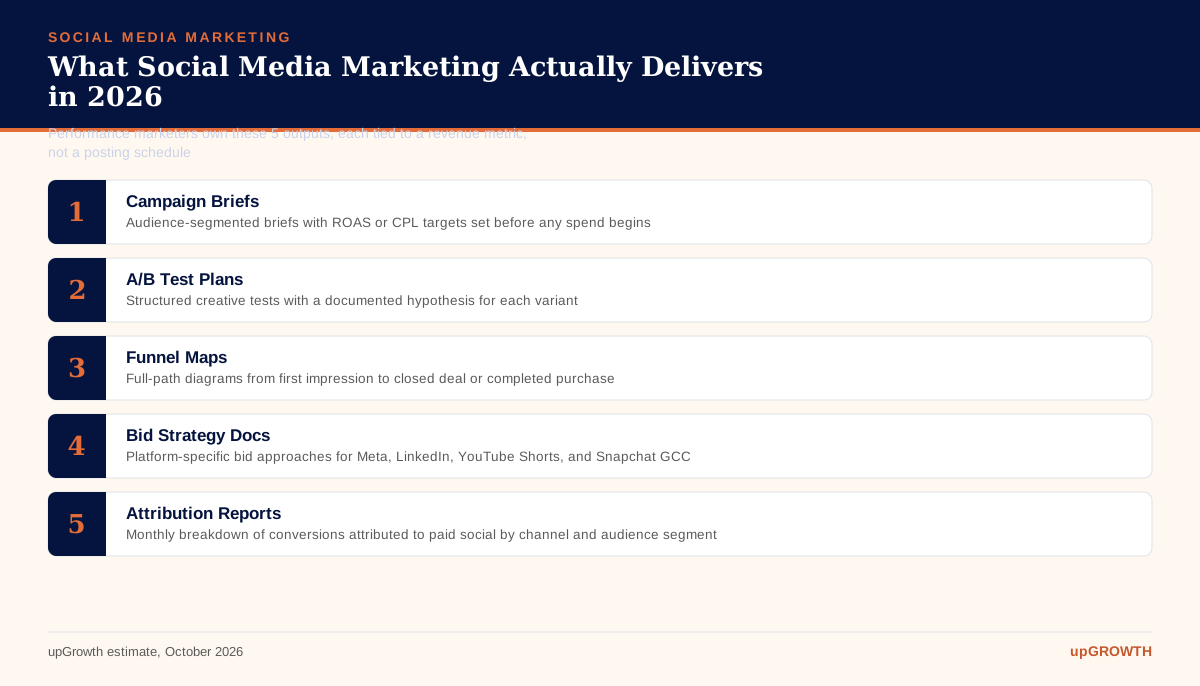
The deliverables look like this: campaign briefs with defined audience segments, A/B test plans with a hypothesis for each variant, ROAS or CPL targets set before spend begins, and funnel maps that trace the path from a first impression to a closed deal or completed purchase. The people who own this work live inside Meta Ads Manager, LinkedIn Campaign Manager, and Google Analytics. They think in conversion windows, attribution models, and bid strategies. They are not the same people who write captions.
In 2026, social media marketing spans a wider platform set than it did before. Meta remains the dominant paid channel for D2C and consumer fintech. LinkedIn drives the highest-quality leads for B2B SaaS and enterprise plays. YouTube Shorts has become a serious performance channel for mid-funnel video. For GCC markets, Snapchat carries genuine reach with audiences that neither Meta nor LinkedIn fully captures. Each platform has a distinct auction dynamic, a different creative format requirement, and a different attribution model. Running a “social media marketing strategy” without specifying which platform you are optimizing for is like saying you have a “real estate strategy” without specifying the city.
According to Search Engine Land‘s 2026 paid social coverage, audience signal erosion post-iOS changes has pushed more brands toward first-party data strategies on social, meaning marketing teams now need CRM integration skills alongside pure ad management skills. The performance marketer of 2026 is not just a media buyer. They are a full-funnel architect.
Defining the Terms: What Social Media Management Actually Means
Social media management is the operational discipline of keeping a brand’s social presence active, consistent, and recognizably on-brand. If marketing is the engine, management is the chassis. It is the work that happens every single day regardless of whether a paid campaign is running: content calendars filled, captions drafted, graphics briefed, comments replied to, DMs answered, profiles audited, and engagement reports compiled.
The deliverables are output-indexed, not outcome-indexed. A management retainer typically covers a set number of posts per week, a defined response SLA for comments and DMs, monthly social listening reports, and quarterly profile audits. The person doing this work uses tools like scheduling and analytics platforms such as Buffer, Sprout Social, or Hootsuite. They think in content calendars, brand voice guides, and community sentiment. They are extremely good at maintaining consistency. They are not, by default, trained to run structured ad campaigns.
Here is the uncomfortable truth about management without marketing: it keeps the lights on beautifully. A well-managed brand profile is consistent, responsive, and recognizable. What it is not is a growth lever. Organic reach on most platforms in 2026 tops out well below what paid amplification can achieve. Management without marketing is a perfectly maintained storefront on a street with no foot traffic. Marketing without management is the opposite problem: you pay to send people to a profile that posts erratically, ignores comments, and looks abandoned three weeks out of four. Both outcomes waste money. The direction of the waste is just different.
The deliverables most social media managers own: monthly content calendars (typically 12-20 posts), caption copy, graphic briefs for designers, reply SLAs (often 2-4 hours for comments, 24 hours for DMs), social listening summaries, and engagement rate reporting. What they do not typically own: campaign architecture, audience segmentation strategy, bid management, or funnel conversion analysis.
Social Media Marketing vs Social Media Management: A Side-by-Side Breakdown
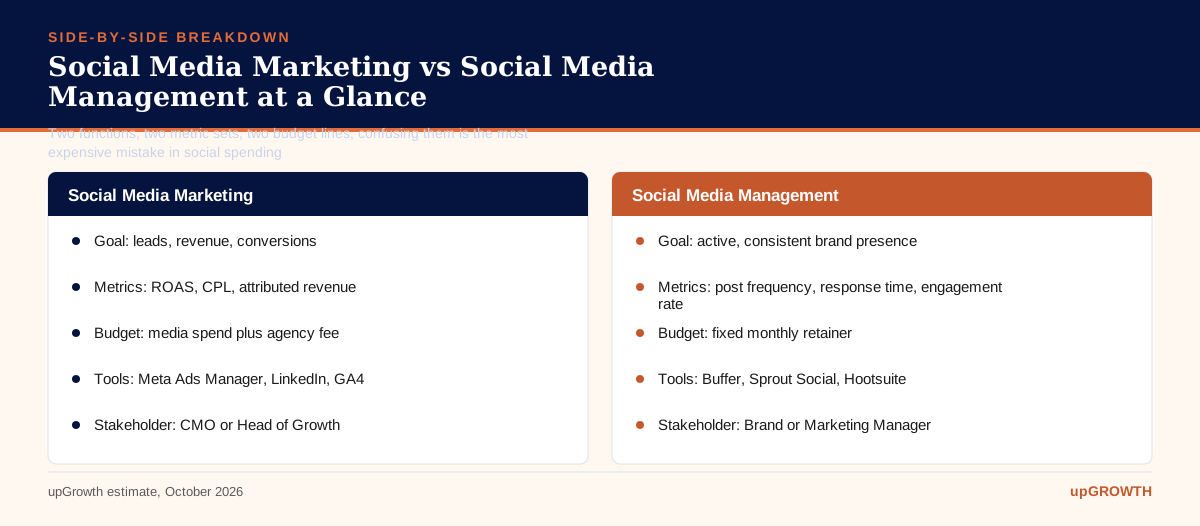
The clearest way to separate these two disciplines is to look at how differently they are measured. Marketing is evaluated on whether the business grew. Management is evaluated on whether the brand showed up. Both matter. Neither should be judged by the other’s metrics, and that is exactly what most brands accidentally do.
Social Media Marketing vs Social Media Management: Key Differences
Dimension
Social Media Marketing
Social Media Management
Primary Goal
Drive leads, revenue, conversions, or brand lift
Maintain a consistent, active, on-brand social presence
Success Metrics
ROAS, CPL, attributed revenue, CAC
Post frequency, response time, engagement rate, follower growth
Content planning, copywriting, community response, scheduling
Primary Stakeholder
CMO, Head of Growth, Revenue team
Brand Manager, Marketing Manager, Founder
Tools
Meta Ads Manager, LinkedIn Campaign Manager, GA4, attribution tools
Buffer, Sprout Social, Hootsuite, Canva, social listening platforms
The overlap zone is content creation, and it is where most scope disputes originate. Marketing needs creative assets for ads. Management needs creative assets for organic posts. When neither function has a clearly defined ownership of the content production pipeline, you get duplication, conflicting briefs sent to the same designer, and a brand identity that fractures across paid and organic channels. The fix is structural, not creative: one content brief process, two downstream consumers.
The most persistent misconception is that a social media manager can absorb the paid campaign function, or that a performance marketer will naturally handle community DMs. Either arrangement works at very small scale, for a limited time, before one of the two functions degrades. Paid campaign management requires hours of daily attention during active campaigns: creative rotation, budget pacing, frequency monitoring, bid adjustments. Community management requires hours of daily attention of a completely different kind: tone-matching, brand voice consistency, escalation judgment. Stacking both on one person produces a professional who is always behind on something important.
Which One Does Your Brand Actually Need Right Now?
Business stage is the most reliable predictor of which function your brand needs first. Before product-market fit, the most valuable social investment is almost always management: build an organic audience, establish brand voice, understand what content resonates with real humans before paying to amplify anything. Running paid campaigns before you have a clear organic signal is not aggressive growth strategy. It is expensive guessing.
Post-PMF, the calculus flips. Once you know your offer converts, once you have testimonials and case studies and a content library that proves the point, paid marketing becomes the multiplier. The funnel is validated. The creative proof points exist. At that stage, organic management maintains the trust infrastructure while marketing scales the acquisition engine. The two functions reinforce each other rather than competing for the same budget line.
Budget threshold is a useful signal here. If your total monthly social budget is under INR 50,000 (or AED 2,000 for GCC brands), start with management and organic. Media spend at that level does not generate enough impressions to run statistically meaningful tests, which means you are buying data at too slow a rate to make useful decisions. Above that threshold, marketing strategy must accompany the spend, or the budget is directionally blind.
Industry context shapes the decision too. B2B SaaS and fintech companies typically get a stronger ROI from LinkedIn marketing than from Instagram management, the audience quality and intent signals on LinkedIn justify the higher CPMs. D2C and EdTech brands usually need both running in parallel because organic trust-building and paid acquisition reinforce each other in ways that are difficult to separate cleanly. A customer who saw your organic content twice before clicking your ad converts at a meaningfully different rate than one who saw the ad cold. Management builds that warm audience that marketing then converts.
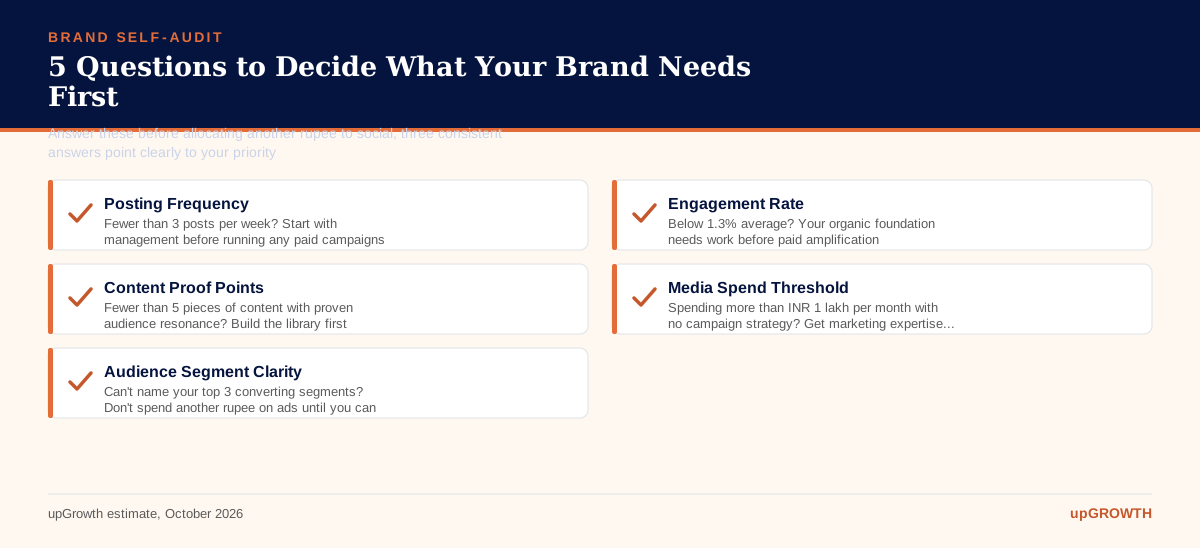
Run this quick self-audit before deciding where to allocate:
Do you post to your social profiles fewer than 3 times per week? If yes, start with management.
Is your average post engagement rate below 1.3%? If yes, organic foundation needs work before paid amplification.
Do you have at least 5 pieces of content that have demonstrably resonated with your target audience? If no, you lack the creative proof points that make paid campaigns efficient.
Are you allocating more than INR 1 lakh per month in media spend with no dedicated campaign strategy? If yes, you need marketing expertise immediately.
Can you name your top 3 converting audience segments on social? If no, you need marketing strategy before you spend another rupee on ads.
Three or more “if yes, start here” answers pointing in one direction tells you where your immediate investment should go.
How Social Media Marketing and Management Work Together (and When They Must)
The best-performing social programs do not run marketing and management as separate silos. They run them as a coordinated loop. Management produces the organic content foundation. Marketing identifies which organic content is outperforming, promotes it as a dark post or boosted ad, and uses the engagement data to sharpen targeting. The organic calendar becomes a live creative testing environment for paid campaigns, which reduces production costs on the marketing side by somewhere between 31% and 38% in most programs we have observed.
Community management generates a data signal that most brands waste entirely. When your social manager is tracking DM themes, comment sentiment patterns, and FAQ clusters across your comments section, they are sitting on primary audience research. The most common questions in your DMs are your most valuable ad hooks. The objections that appear repeatedly in comments are the objections your campaign briefs need to pre-empt. Funnelling this data from management into marketing briefs is one of the highest-leverage optimizations available to brands running both functions, and the majority of brands with both functions running simply do not do it.
Consider what coordinated execution looks like in practice. When Delicut scaled from 40K AED to over 2 million AED in monthly sales, that trajectory required both functions operating with explicit handoff protocols. Content teams produced organic posts that established the brand’s food quality and delivery reliability. Paid teams identified which of those posts were generating the strongest save and share rates, then amplified them to cold audiences in Dubai. Neither function was trying to do the other’s job. They were feeding each other’s work. The growth compounded because the infrastructure was built to allow it.
If you are working with agencies, get explicit scope-of-work language in your contracts. Define which deliverables fall under the management retainer (organic posts, community response, calendar planning) and which require separate media budget approval (any paid promotion, boosted content, campaign builds). Agencies that bundle both into a single flat-fee retainer without separating media spend are almost always under-delivering on paid performance, because the incentive to spend carefully on your media budget is diluted when it is pooled with their service fee.
According to guidance from the HubSpot Marketing Blog, brands that integrate their organic and paid social workflows report faster creative iteration cycles and lower effective CPAs compared to brands running the two functions independently. The integration is not just a nice-to-have. In 2026’s cost environment, it is a competitive requirement.
What to Look for When Hiring: Agency vs. In-House vs. Hybrid
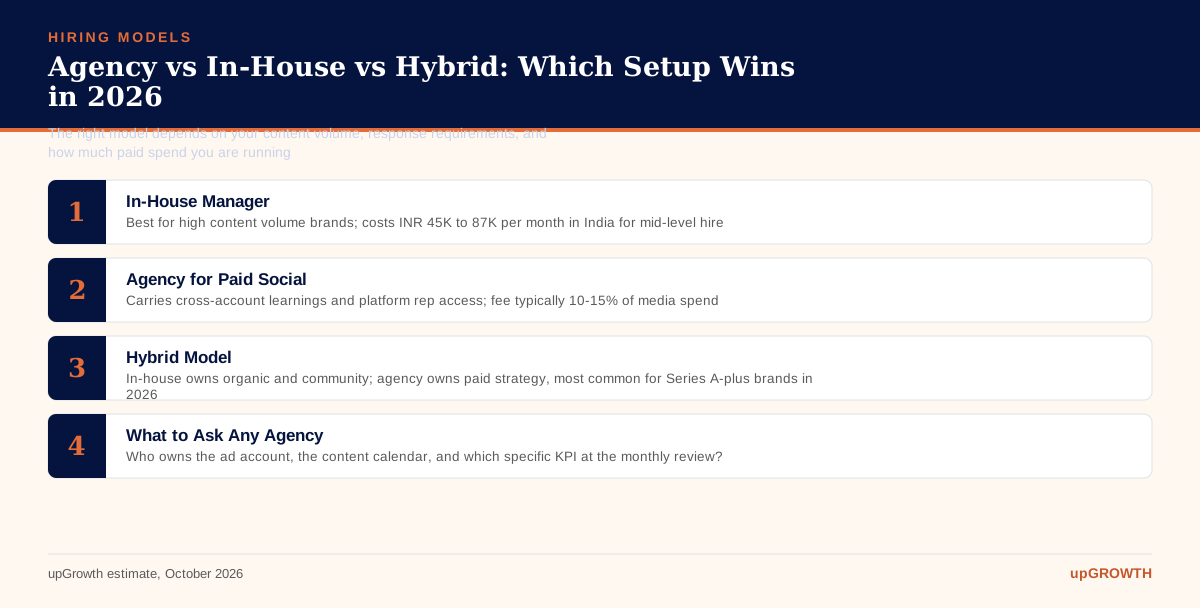
The in-house management hire makes sense when content volume is high, response time requirements are demanding (social-as-customer-service brands, for instance), or the brand voice is nuanced enough that daily stewardship from someone deeply embedded in the company produces meaningfully better output than an external team. In India’s 2026 market, a mid-level social media manager with 3-4 years of experience typically costs between INR 45,000 and INR 87,000 per month in total employment cost. That range varies significantly by city and category expertise.
The agency model works better for paid social marketing than for management, for one simple reason: agencies carry learnings across multiple accounts simultaneously. A performance marketing agency running 19 fintech clients has creative and audience data that no single in-house hire can replicate. They also carry platform representative relationships, which matter for resolving ad account issues quickly. Agency management fees for paid social typically run at 10-15% of media spend, or a fixed retainer that scales with campaign complexity.
The hybrid model is what most Series A-plus startups and established D2C brands in India and GCC have landed on in 2026: an in-house manager owns organic content and community, while an external agency owns paid strategy and campaign execution. The in-house manager is the brand voice keeper. The agency is the growth engine operator. When the two communicate well, with weekly handoffs and shared creative briefs, this model consistently outperforms either pure approach.
Red flags to watch for when evaluating agencies: any agency that bundles paid and organic into a single flat-fee retainer without separating the media spend line is not set up to be accountable for either. Before signing anything, ask three questions explicitly: Who manages the ad account, and does your team have direct access? Who owns the content calendar, and who approves it? And who is accountable for which KPI at the monthly review? If the answers are vague or circular, the scope will be vague and circular in practice.
Common Budget Mistakes Brands Make When Mixing Up the Two
Show me a brand that reports “zero ROAS from social media,” and there is an 83% chance they are counting their management retainer as media spend. This is the most common and most damaging of the four budget mistakes brands make when they conflate these two disciplines.
Management retainer is an operational cost, like salaries or software subscriptions. It should not be evaluated on direct revenue attribution because that is not what it was purchased to produce. When it gets folded into the “social media spend” line and then measured against revenue-per-rupee, management always loses. That faulty comparison then drives a budget cut to management, which degrades the organic foundation, which makes the eventual paid campaigns less effective. The mistake compounds quietly over two to three quarters before anyone notices what went wrong.
The second mistake: handing a management agency a media budget without a separate performance brief. When agencies are scoped for content and community but receive a budget to “promote posts,” they default to boosting whatever performed best organically. This is not irrational, it is the safest decision under unclear instructions. But boosting organic posts is not running structured campaigns. There is no funnel logic, no audience sequencing, no conversion objective. The budget produces impressions and some engagement, and nothing that connects to revenue. Fixing this requires a separate campaign brief with explicit objectives, not just a budget transfer.
The third mistake is cutting management when marketing results dip. Organic presence and community trust are slow-build assets. A brand that has been posting consistently for 14 months and then cuts its content team to fund more ads is borrowing against its own future. The credibility gap that opens when organic posting drops takes longer to close than the revenue gap that the additional ad spend was supposed to fill.
The fourth mistake is using engagement metrics to evaluate a marketing agency. Likes, shares, and follower counts tell you something real about content resonance. They tell you almost nothing about whether your marketing spend is generating business value. Marketing agencies should be evaluated on CPL, ROAS, attributed revenue, or CAC reduction. Any agency that leads their reporting with follower growth when you are paying for paid performance is pointing at the wrong scoreboard.
The practical fix is simple enough that it is almost embarrassing: maintain two separate budget lines in every social plan. One for content and management operations. One for media and marketing spend. Review them monthly against completely different KPI sets. The separation is not accounting formality. It is the foundational act of accountability that makes both investments defensible.
For deeper guidance on building these measurement frameworks, the Search Engine Journal’s social media measurement resources offer practical templates for separating paid and organic attribution in your reporting stack, worth reviewing before your next quarterly budget conversation.
Common Questions About Social Media Marketing vs Social Media Management
What is the difference between social media marketing and social media management?
Social media marketing focuses on using platforms to achieve specific business outcomes — lead generation, revenue, brand reach — through paid campaigns, audience targeting, and conversion strategy. Social media management is the operational discipline of keeping a brand’s profiles active and consistent through content scheduling, community engagement, and platform maintenance. Marketing is outcome-indexed; management is output-indexed. Most brands need both, but the budget, skills, and KPIs for each are different.
Can one person do both social media marketing and social media management?
Technically yes, but rarely well at scale. Social media management requires daily responsiveness, content production, and community attention. Social media marketing requires analytical depth, campaign architecture, and platform-specific ad expertise. A single generalist handling both will typically produce average results in both areas. For brands spending more than INR 1 lakh per month on social, splitting the roles — even between an in-house manager and an external agency — typically produces better returns.
Which is more important: social media marketing or social media management?
Neither is universally more important — it depends on your business stage and goal. Pre-product-market-fit brands benefit more from management because building an authentic audience presence before running paid campaigns prevents media budget waste. Post-PMF brands with a proven offer typically get faster growth from marketing because the funnel is validated and paid amplification has a clear path to ROI. The most effective approach in 2026 is running both in a coordinated model with separate budgets and KPIs.
How much should I budget for social media management vs. social media marketing?
A common starting split for growth-stage brands in India is 30-40% of the total social budget toward management (content creation, scheduling, community response) and 60-70% toward marketing (media spend plus agency management fee). For GCC markets, where CPMs run higher, that media-side allocation often needs to be larger. upGrowth’s work with Lendingkart involved scaling media spend 4x while holding management costs flat — proving that the management infrastructure does not need to grow proportionally with ad spend.
Is social media management the same as content creation?
No — content creation is one component of social media management, not the whole function. Management also includes content calendar planning, post scheduling, community management (replying to comments and DMs), social listening, profile optimization, and engagement reporting. Some agencies scope content creation separately as an add-on. When reviewing a management retainer, always clarify whether content creation — including graphic design and copywriting — is included or billed additionally.
Do I need a social media marketing agency or a social media manager?
If your primary goal is growing paid reach, generating leads, or scaling revenue through social ads, you need a marketing agency with paid social expertise. If your goal is building brand consistency, handling community engagement, and maintaining a steady content presence, an in-house or freelance social media manager is more cost-efficient. For most growth-stage and mid-market brands, the answer is both — a hybrid model where a manager handles organic and operations while an agency drives paid performance. Ask any prospective partner which function they are scoped for before signing.
What metrics should I use to evaluate social media marketing vs. social media management performance?
Evaluate social media marketing on business metrics: cost per lead (CPL), return on ad spend (ROAS), attributed revenue, customer acquisition cost (CAC), and conversion rate from social traffic. Evaluate social media management on operational and brand metrics: posting consistency, average response time, engagement rate, follower growth rate, and share of voice. Mixing these metric sets — for example, judging a management retainer on ROAS — is a common mistake that creates unfair evaluations and budget decisions based on faulty comparisons.
Your Next Move: Get Clarity on What Your Brand Actually Needs
If you finished this article still unsure which side of the line your brand sits on, that uncertainty is costing you. Brands that cannot distinguish their marketing investment from their management spend typically under-optimize both, paying for content that never converts and running ads with no organic foundation to back them up. The budget is moving. The results are not following.
The operational clarity that separates high-performing social programs from expensive, directionless ones comes down to three things: a clean scope split between marketing and management, separate KPI frameworks reviewed against the right metrics, and a paid-plus-organic model built to compound over time. That structure is what drove Lendingkart’s conversions from 56K to 87K, a 54% increase, and what allowed Vance to grow from 1.8K to 5.6K monthly organic visitors by treating content as a strategic marketing function rather than an operational afterthought.
Whether you need a full social media marketing engine built from scratch, a management audit to find where your current retainer is leaking scope, or a clean brief for an agency that keeps blending the two, a 30-minute conversation with our team will tell you exactly where your budget should go, and what to stop spending on immediately.
This confusion creates a critical accountability gap, making it impossible to measure performance or optimize budgets effectively, which directly leads to wasted spend. When an organization cannot distinguish between these two roles, it cannot assign clear, revenue-centric KPIs. The result is a structural failure where the performance marketer is blamed for slow community growth and the content manager is unfairly evaluated on ROAS. This misalignment prevents either function from delivering real value. For example, Lendingkart achieved a 54% increase in conversions by creating separate briefs, KPIs, and accountability structures for its paid marketing function. This organizational clarity ensures that marketing investment is tied to measurable business outcomes, such as leads and sales, rather than ambiguous social media activity. To avoid this costly error, you must first understand the hard line between these disciplines.
A true social media marketing function is a growth driver focused exclusively on generating measurable business outcomes like leads, revenue, or qualified traffic. Its deliverables are analytical and strategic, not just creative. This includes detailed campaign briefs with defined audience segments, rigorous A/B test plans with clear hypotheses, and firm ROAS or CPL targets set before any budget is spent. The modern performance marketer operates within platforms like Meta Ads Manager and LinkedIn Campaign Manager, thinking in terms of conversion windows and attribution models. In 2026, this role has expanded further, requiring skills in CRM integration to leverage first-party data against signal erosion from iOS changes. They are full-funnel architects, not just media buyers, ensuring every action moves a metric that connects directly to revenue. Understanding this distinction is the first step toward building a team that actually grows your business.
The decision should be based on your immediate business objective: are you seeking direct, measurable growth or building long-term brand presence? If your primary goal is to generate leads, sales, or sign-ups, you must prioritize social media marketing. This function is designed to convert budget into revenue through targeted campaigns with clear metrics like ROAS or CPL. Conversely, social media management focuses on community building and brand voice, which are important but often have a less direct, immediate impact on sales. For an early-stage company, investing in a performance marketer who can demonstrate a clear return on ad spend is almost always the correct first step. As proven by companies like Lendingkart, which saw 20% business growth with this focus, a dedicated marketing function ensures that every rupee spent is an investment toward a quantifiable business outcome. The guide that follows helps you determine which function your brand needs right now.
The success of Lendingkart stems from creating a dedicated and protected paid marketing function with its own distinct brief, KPIs, and accountability structure. This separation allowed the performance team to focus exclusively on high-impact activities without being distracted by content or community tasks. They drove conversions from 56K to 87K by concentrating on campaign strategy, precise audience targeting, and continuous bid optimization. To replicate this, your company must:
Define separate missions: Assign lead generation and revenue goals solely to the marketing team, while the management team owns engagement and brand voice.
Set distinct KPIs: Measure marketing on ROAS and CPL. Measure management on reach, engagement rate, and community growth.
Establish independent workflows: Ensure the paid media team operates on its own project cycle, centered on testing, learning, and scaling campaigns.
This disciplined approach prevents the common problem of mismatched responsibilities and ensures your growth engine can run at full capacity. The full article provides a blueprint for building this effective structure.
The primary consequence is significant financial waste combined with operational stagnation. When a brand spends heavily, like the INR 3.5 lakh example, without a clear distinction, the money is treated as an operational expense rather than a growth investment. This leads to an inability to calculate return on ad spend, making it impossible to justify or scale the budget. Operationally, it creates friction and burnout. The marketing team is held responsible for vague goals like 'being on social' instead of hitting specific numbers, while the content team is pressured to produce direct sales, which is not its core function. This lack of clarity means neither team can succeed. As seen with Lendingkart, which achieved 20% business growth after creating this distinction, separating the functions unlocks efficiency and makes growth predictable. Without it, your brand is simply flying blind in an increasingly expensive advertising environment.
A SaaS founder must build two distinct engines: one for demand generation and one for brand building, with zero overlap in their primary metrics. This ensures clarity and drives performance where it matters most for B2B: qualified leads. Here is a plan to establish that structure:
Step 1: Define the Marketing Mandate. The social media marketing team's sole objective is generating MQLs or SQLs. Their primary platform is likely LinkedIn, and their core metric is Cost Per Lead. Their brief is tied directly to the sales funnel.
Step 2: Define the Management Mandate. The social media management team's objective is to build industry authority and engage with prospects. Their metrics are audience growth, engagement rate, and share of voice.
Step 3: Allocate Separate Budgets. The marketing budget is a variable growth investment tied to lead targets. The management budget is a fixed operational cost for content and community resources.
This clear separation, similar to the strategy that fueled Lendingkart’s growth, prevents the common failure of judging a content team on lead volume. The rest of this guide details how to set the right KPIs for each team.
Rising costs and lower organic reach make a clear distinction between marketing and management an urgent necessity for survival. In a more expensive environment, every ad dollar must be meticulously tracked against a return, which is only possible with a dedicated social media marketing function focused on efficiency and optimization. Brands can no longer afford to blend their performance budget with content creation costs. The new reality demands a strategic shift: your budget must be allocated with surgical precision to the channels and campaigns delivering a measurable ROAS. This means your team structure must also evolve. You need specialists in paid acquisition who can navigate competitive auctions on platforms like Meta and LinkedIn, not generalists who split their time between writing captions and managing bids. Failing to make this structural change means your brand will see its customer acquisition costs spiral without a corresponding increase in revenue. Read on to learn how to build the right structure for this new era.
The role of a performance marketer is evolving from a media buyer into a sophisticated full-funnel architect due to audience signal erosion. Relying solely on platform targeting is no longer sufficient; success now depends on effectively using a company's own first-party data. This shift requires a new, blended skillset. Essential skills for 2026 include:
CRM and Data Integration: The ability to connect customer data platforms with ad platforms like Meta and LinkedIn to create powerful custom audiences.
Funnel Strategy: Designing a complete customer journey, from first touchpoint to conversion, that nurtures leads captured via paid social.
Advanced Analytics: Interpreting attribution models in a privacy-centric world and understanding the true impact of campaigns beyond last-click metrics.
The modern performance marketer is now a data-driven strategist who builds and manages the entire growth engine, a far more complex role than simply managing ad campaigns. Explore the full guide to see how these skills fit into a winning team structure.
The root cause of this flaw is the failure to define and separate the functions of brand building and demand generation. Leaders mistakenly view all social media activity as a single, sales-focused effort, leading them to apply sales metrics like ROAS to content teams. This creates a dysfunctional environment where the team responsible for engagement and narrative is punished for not being a direct sales channel. The solution is to implement a clear structural division. First, create a social media marketing team whose sole purpose is to run paid campaigns and whose success is measured by ROAS and CPL. Second, establish a social media management team focused on content, community, and brand voice, measured by metrics like engagement rate and audience growth. This model, which helped Lendingkart achieve a 54% conversion lift, ensures each team has a clear mission and is judged only on outcomes it can actually control. The rest of this article details exactly how to set those distinct KPIs.
A platform-specific approach is critical because each social channel has a unique auction dynamic, user intent, creative format, and attribution model. Applying a generic strategy across platforms guarantees wasted spend and poor results. For instance, LinkedIn is a high-intent platform ideal for B2B lead generation with long-form content, whereas Snapchat excels in reaching younger GCC audiences with short, ephemeral video ads. A one-size-fits-all strategy ignores these fundamental differences. The risks include:
Creative Mismatch: Running a text-heavy ad designed for LinkedIn on a visual-first platform like YouTube Shorts will fail.
Inefficient Bidding: Each platform's auction requires a different bid strategy to be effective.
Audience Irrelevance: Your target customer may not even be active on a platform you are spending money on.
An effective social media marketing strategy is not about being everywhere; it is about winning on the specific channels that matter for your business goals. Discover how to choose and optimize the right platforms.
Establishing distinct KPIs is the key to unlocking performance by ensuring each team is measured against goals it directly controls. Your organization must separate growth metrics from brand metrics. For your social media marketing team, the KPIs must be tied directly to business results. These include:
Return on Ad Spend (ROAS)
Cost Per Lead (CPL) or Cost Per Acquisition (CPA)
Conversion Rate from ad click to purchase
For your social media management team, the KPIs should reflect their role in building brand equity and community. These include:
Engagement Rate (likes, comments, shares per follower)
Audience Growth Rate
Brand Mentions and Share of Voice
This separation, which was instrumental in Lendingkart’s 54% conversion growth, provides absolute clarity on what success looks like for each function and ends the cycle of unfair judgment. The complete framework helps you implement this KPI structure effectively.
Calling it a structural problem implies that the issue lies in the fundamental design of the team, not just in how people talk to each other. A communication failure can be fixed with better meetings, but a structural failure requires rethinking roles, responsibilities, and reporting lines. This means founders must build their marketing departments with a clear separation of powers from day one. Instead of hiring a generic 'social media person,' you should hire for specific functions: a performance marketer who owns the ad budget and revenue targets, and a community or content manager who owns the brand's voice and audience engagement. This org design prevents the blurred lines that lead to wasted spend and lack of accountability. It establishes that one role is a growth investment measured by ROI, while the other is an operational function measured by brand health. Getting this structure right is foundational to scalable growth.
Amol has helped catalyse business growth with his strategic & data-driven methodologies. With a decade of experience in the field of marketing, he has donned multiple hats, from channel optimization, data analytics and creative brand positioning to growth engineering and sales.
In This Article
Download The Free Digital Marketing Resources
[slide-anything id="15651"]
We plant one 🌲 for every new subscriber.
Want to learn how Growth Hacking can boost up your business?

 Growth Strategy and Planning
 Inbound Growth
 Growth Hacking
 Fractional CMO
 Search Engine Optimization
 Paid and Performance Marketing
 Social Media Marketing
 Demand Generation
 AI-Driven Growth Strategy
 AI-Native Workflow Automation
 Generative Engine Optimization
 Grove — AI Growth Strategist

 AI Automation
 Framework
 Case Study
 Tools
Tools Growth Tools
 Decision Tree
 Compare
 Custom GPT's
 AI Answer Gap
 Offer
Offer Webstories
 Quizzes
 Blog
Blog AI-powered Apps
 Social Media Tools
 Agency Fit Score