Contributors:
Amol Ghemud Published: October 29, 2026
Summary
SEO visibility and AI visibility now measure 2 different parts of search performance. This blog explains how each score works, what strong performance looks like in 2026, why a brand can rank well on Google but still be absent from AI answers, and what marketers should include in a complete visibility report. It also shows how combining SEO rankings, AI mention rate, citation rate, and prompt coverage gives a clearer view of where your brand is actually being discovered.
In This Article
Share On:
In Q3 2026, a mid-market SaaS brand watched its SEO visibility score climb 18% quarter-on-quarter while inbound demo requests dropped 11%. The disconnect? Every high-intent query in its category was being answered inside a ChatGPT or Perplexity response that never linked back to the brand. The SEO dashboard looked healthy. The pipeline told a different story.
This is the split-screen problem of 2026. Two numbers, measuring two different realities, both real, neither complete on its own. Most marketing teams are reporting one. Their CMOs are confused by the gap between visibility metrics and revenue signals. Their CFOs are asking questions nobody can answer cleanly.
The work upGrowth Digital did with Vance made this gap concrete and measurable. The team tracked both a traditional SEO visibility score (share of voice across 1,400 keywords in Semrush) and an AI visibility score (brand mention rate across 12 prompt templates run weekly in ChatGPT, Perplexity, and Gemini). The delta between the two metrics revealed exactly which content gaps were costing Vance citations in AI answers. Closing those gaps contributed directly to AI Overview visibility climbing from 12% to 89%, average position moving from 8 to 1, and monthly organic traffic growing from 1.8K to 5.6K in just two months. That is what a dual-visibility lens makes visible that a single-score report cannot.
What follows is a precise comparison of both metrics: how each is calculated, what good looks like in 2026 with real benchmark ranges, and exactly what belongs in a report your CMO will act on rather than file.
What Does an SEO Visibility Score Actually Measure?
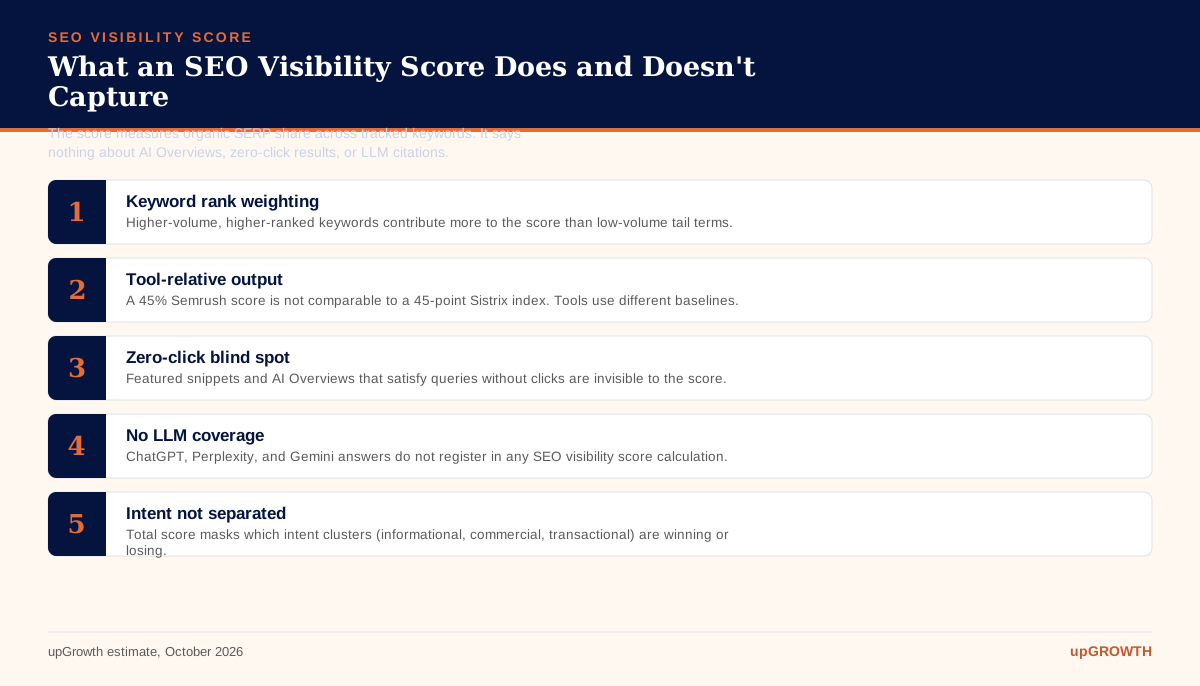
An SEO visibility score is a weighted metric showing what percentage of potential organic clicks a domain captures across a defined tracked keyword set. The core mechanic: rank #1 on a keyword with 10,000 monthly searches and that keyword contributes far more to your score than a keyword where you rank #8 with 500 searches. Higher rank plus higher search volume equals higher score contribution. Simple in concept, tool-dependent in practice.
The calculation differs meaningfully by tool. Semrush expresses visibility as a percentage of total traffic potential captured across your tracked set. Ahrefs uses traffic share as its proxy. Sistrix produces a visibility index measured in absolute points rather than percentages, calibrated against a reference domain. A 45% visibility score in Semrush is not the same thing as a 45-point Sistrix index. They are not comparable across tools, which matters enormously when you change reporting platforms mid-year or inherit a client with existing benchmarks.
What the score genuinely does not capture is where the real blind spots appear. Search Engine Land has documented the growing share of zero-click searches where a featured snippet satisfies the query without any click occurring. SEO visibility scores count your ranking position but not whether anyone actually clicked. More critically in 2026, they count nothing that happens inside a Google AI Overview, a ChatGPT response, a Perplexity answer, or a voice result. A domain can rank #2 for a high-volume query and still capture zero attention if an AI Overview sits above position 1 and answers the question completely.
That is not a flaw in the tool. It is a flaw in treating any single score as a complete visibility picture. The SEO visibility score is an excellent instrument. It just measures organic SERP share, and organic SERP share is now one of at least two distinct demand channels worth tracking.
What Is an AI Visibility Score and How Is It Calculated?
An AI visibility score (AIVS) measures the frequency and authority with which a brand or domain appears in AI-generated answers across a curated set of target prompts in ChatGPT, Perplexity, Gemini, Claude, and Google AI Overviews. Where SEO visibility score is built on crawl data and rank tracking, AIVS is built on prompt sampling: you ask the AI engines the questions your buyers are asking, and you record what comes back.
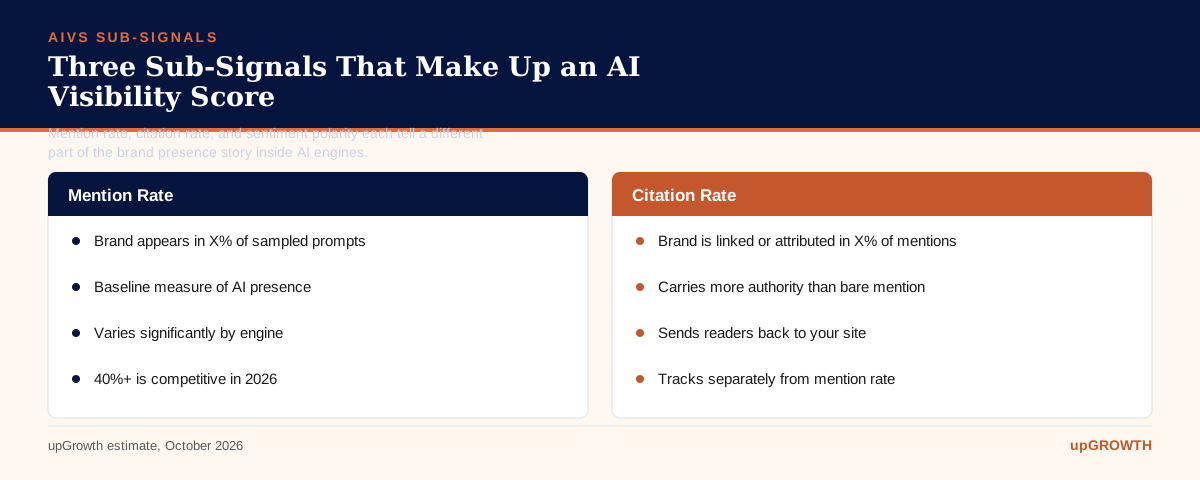
Three measurable sub-signals make up a complete AIVS. Mention rate: the brand appears in X% of sampled prompts. Citation rate: the brand is linked or attributed in X% of those mentions. A mention without attribution carries less authority signal because it does not send a reader anywhere. Sentiment polarity: positive, neutral, or negative framing when the brand does appear. A brand that surfaces in 60% of prompts but is consistently framed as “an alternative to consider” is in a different competitive position than one framed as “the standard.”
The methodology for measurement follows a prompt sampling protocol. Curate 20 to 50 prompts that mirror real buyer-journey questions in your category. Run them weekly across engines. Log brand appearance manually or via tools like Profound, Trackta, or Otterly. Aggregate by engine, by prompt intent stage, and by competitor co-appearance. That last one matters: if your brand appears in 43% of prompts but a competitor appears in 71% of the same prompts, your relative AIVS tells a sharper story than your absolute score alone.
There is no single industry-standard formula in 2026. That is not a temporary gap that will resolve itself next quarter. Different engines retrieve and rank sources differently. Perplexity uses real-time retrieval. ChatGPT blends training data with browsing. Gemini weights Google’s own entity graph heavily. Each engine rewards slightly different signals, which means a brand’s AIVS can vary significantly by engine even on the same prompt. For methodology detail, the brand AI visibility score methodology and entity signals framework covers the 7-step scoring protocol built for exactly this variability.
Methodology transparency is not optional in client reporting. If you present an AI visibility score without showing the prompt set, the engines tested, and the sampling frequency, the number means nothing and a skeptical CMO will say so.
SEO Visibility Score vs AI Visibility Score: A Side-by-Side Comparison
The two scores are not competitors. They measure the same underlying asset (brand visibility in search-driven demand) from two different angles. When they diverge, that divergence is itself the most important data point in the report. A brand with high SEO visibility and near-zero AIVS is generating awareness in a channel that is shrinking its share of first interactions. That is a quantifiable revenue risk, not a theoretical concern.
SEO Visibility Score vs AI Visibility Score (AIVS): Key Differences
Dimension
SEO Visibility Score
AI Visibility Score (AIVS)
What is measured
Weighted share of potential organic clicks across tracked keywords
Brand mention and citation rate across AI-engine prompt samples
Data source
Crawl data + SERP rank tracking
Live AI engine outputs from curated prompt sets
Update frequency
Daily or weekly (tool-dependent)
Weekly or bi-weekly (sampling cadence)
Tool dependency
High (Semrush, Ahrefs, Sistrix, Moz)
Emerging (Profound, Otterly, Trackta, manual)
What “good” looks like
Top-quartile share of voice in category keyword set (30%+ in competitive verticals)
Traditional SERP rankings, click-through data, keyword-level traffic
The Vance engagement illustrated the divergence dynamic precisely. Strong organic rankings across forex remittance keywords gave Vance a healthy SEO visibility score. But the brand was appearing in fewer than 17% of AI-engine prompts on the same topic cluster when the engagement started. Building entity-authority content to close that gap pushed AI Overview visibility from 12% to 89%, a pattern that tracking both scores made visible in a way that either score alone would have hidden.
What Is a Good SEO Visibility Score? Benchmark Ranges for 2026
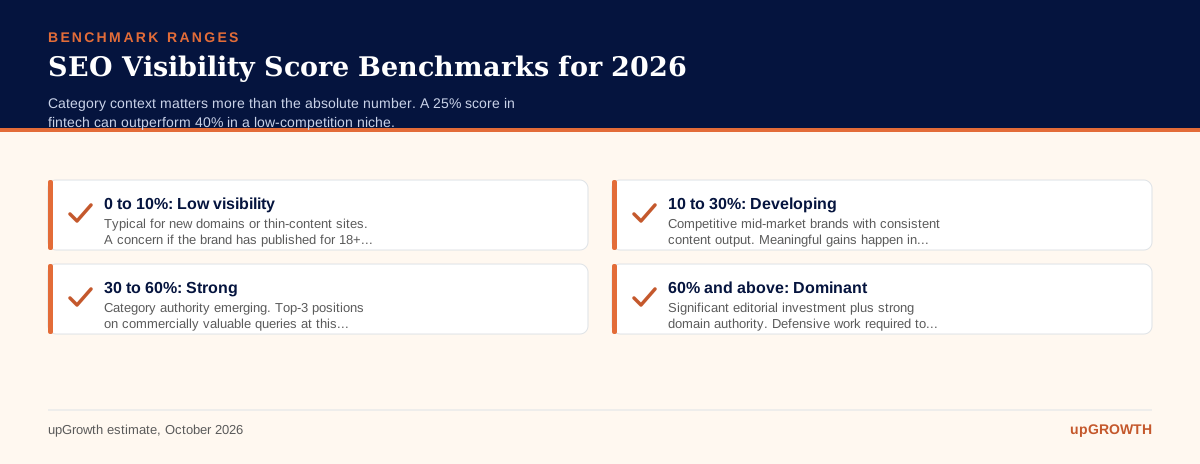
The honest answer is: it depends on the category, the tool, and the keyword set. That answer frustrates clients, so here are the ranges that give the question useful shape. Think of these as orientation markers, not absolute targets, because a 25% SEO visibility score in a YMYL fintech category outperforms a 40% score in a low-competition niche with weak incumbents.
0 to 10%: Low visibility. Typical for new domains, thin-content sites, or brands entering a category with established players. Not a crisis if you launched recently; a crisis if you have been publishing for 18 months or more.
10 to 30%: Developing. Competitive mid-market brands with consistent content production and some domain authority land here. Movement within this band is often where the real SEO work is felt most clearly, because each percentage point represents meaningful keyword coverage gains.
30 to 60%: Strong. Category authority is emerging. Brands at this level are winning multi-keyword clusters and holding top-3 positions on commercially valuable queries. This is where most well-run SEO programs target their 12-month horizon.
60% and above: Dominant. Usually brands with both significant editorial investment and strong domain authority. At this level, maintaining the score requires as much defensive work as offensive.
Tool-specific norms add another layer. According to guidance from the Semrush blog, a visibility score above 30% in a competitive tracked keyword set typically signals top-3 share of voice for at least a meaningful cluster of terms. In Sistrix, a visibility index above 100 is considered strong for a national brand. Below 10 Sistrix points is effectively below the noise threshold for category competition.
One nuance worth flagging: SEO visibility scores can drop sharply after a Google core update without a corresponding traffic drop. This happens when the lost rankings were already in positions 6 through 10 where CTR was near zero anyway. A 7-point score drop that costs you nothing in clicks is a different situation than a 7-point drop that comes from position 1 rankings moving to position 4. The score alone does not tell you which scenario you are in. Click-through rate data from Google Search Console does.
What Is a Good AI Visibility Score? Benchmark Ranges for 2026
Here is where most marketing teams are flying blind. SEO visibility benchmarks have 15 years of reference data. AI visibility benchmarks have, at most, 18 months of structured measurement from early movers. The ranges below reflect what upGrowth’s prompt-sampling programs across fintech, SaaS, and D2C categories have produced in 2026, combined with published research from Ahrefs on AI search citation patterns.
0 to 15% mention rate: Not appearing. High risk of being invisible in AI-assisted discovery for that topic cluster. This is the range where a brand can have a perfectly healthy SEO visibility score and still be absent from the channel that is intercepting an increasing share of high-intent queries. A brand with a 60%+ SEO score but under 20% AIVS should treat AI citation-building as its primary growth lever right now, not a future-roadmap item.
15 to 40%: Emerging presence. The brand surfaces in some category prompts, usually on branded queries or in listicle-style AI answers. This is where most mid-market brands sit in 2026 when they first measure AIVS.
40 to 65%: Competitive. The brand is a recognized option in LLM outputs. Appearing at this rate across a well-constructed 50-prompt template means buyers researching your category via AI engines are encountering you consistently.
65% and above: Authority. The brand is the default cited source for key category topics. This is what Vance achieved for IMPS, UTR, and payment tracking queries after the entity-authority build. At 89% AI Overview visibility, Vance was not one of several cited options. It was the answer.
Two important calibrations. First, mention rate and citation rate diverge. A brand can be mentioned in 50% of prompts but only attributed with a link or clear source credit in 23% of them. That gap matters because an unreferenced mention gives a reader no path back to your site. Tracking both numbers separately is not pedantic. It is operationally different. Second, ChatGPT tends to cite fewer brands per answer than Perplexity, which is more citation-heavy by design. A 40% mention rate in ChatGPT means something different from a 40% mention rate in Perplexity. Benchmark separately by engine, or your aggregate hides the story.
What to Include in a 2026 Dual-Visibility Report
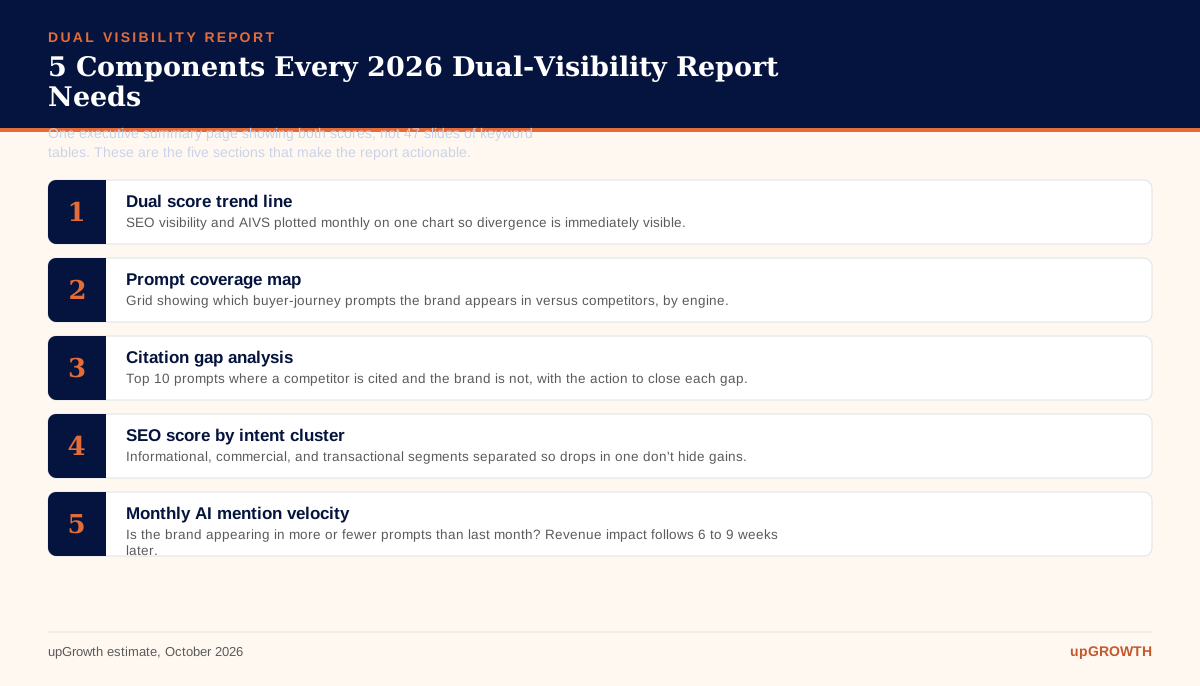
The report structure that works for a CMO or board audience is simpler than most teams make it. One executive summary page showing both scores side-by-side with a trend line. Not 47 slides of keyword tables. The scores are the signal; everything else is the explanation.
Specifically, a complete 2026 dual-visibility report should include these components:
Dual score trend line: SEO visibility score from your tool of record (Semrush, Ahrefs, or Sistrix) plotted monthly alongside AIVS (monthly mention rate and citation rate from your prompt sampling log). Showing both on one chart makes divergence immediately visible.
Prompt coverage map: A grid showing which buyer-journey prompts the brand appears in versus competitors, color-coded by engine. If your competitor surfaces in 11 of your 20 mapped prompts and you surface in 4, that is the most important single visual in the report.
Citation gap analysis: List the top 10 prompts where a competitor is cited and your brand is not, with the specific content or entity action needed to close each gap. This turns the report from a status update into an action plan.
SEO visibility by intent cluster: Break the SEO score into informational, commercial, and transactional segments. A total score that drops 4 points might mask a transactional cluster that dropped 19 points while an informational cluster gained. Intent-level segmentation catches the drops that matter.
Monthly AI mention velocity: Is the brand appearing in more or fewer prompts than last month? A brand that has held 38% AIVS for three consecutive months but is now at 31% is showing early erosion. Revenue impact will follow in 6 to 9 weeks if the pattern continues. Velocity catches it first.
For brands discovering that their AIVS sits below 20%, the diagnostic starting point is understanding why some brands score zero on AI visibility audits. The patterns are consistent enough across categories that the fix usually involves three to five specific content and entity actions rather than a full program overhaul.
How to Improve Both Scores Simultaneously Without Running Two Separate Programs
The most common mistake brands make when they discover their AIVS is low: they treat AI visibility as a separate initiative requiring a separate budget, a separate team, and a separate reporting track. That is the expensive version of the problem. The cheaper version is recognizing that entity-first content strategy improves both scores through the same mechanism.
Here is how that plays out in practice. The conventional approach is to build content around keyword clusters, optimized for position 1 in organic search, structured around what Semrush rank tracking rewards. Walk that approach forward 12 months and you get a strong SEO visibility score with a AIVS that lags badly, because LLMs do not retrieve based on keyword density. They retrieve based on entity completeness, topical authority, and the presence of structured Q&A content that answers questions directly. The failure point shows up the first time someone runs your category prompts through Perplexity and your brand is absent from the first three answers.
What actually works is building content at the intersection of both signals. Entity-first topical authority means publishing structured, interlinked content that establishes your brand as a recognized entity on a topic, not just a ranking URL. FAQ schema and structured Q&A blocks in every pillar article serve both objectives: they capture featured snippet positions in traditional SERP and they are the content units LLMs most frequently extract and cite. According to Google Search Central, structured data that accurately describes page content improves how Google systems understand and surface that content, which applies equally to AI Overview retrieval.
Third-party entity citations do double work too. Press mentions, Wikipedia references, Crunchbase entries, and authoritative backlinks all feed both Google’s traditional ranking algorithm and the training or retrieval signals LLMs use to select cited sources. A brand that appears in 47 authoritative external references on a topic is, all else equal, more likely to be cited by an LLM than a brand that appears in 11. That is not a GEO-specific strategy. It is the same authority-building that good SEO programs have always recommended, applied consciously to AI retrieval as well.
The practical starting point for any brand scoring under 20% AIVS: map your tracked SEO keywords against the prompt templates you use to measure AI visibility. Where a keyword cluster has no corresponding prompt coverage, you have identified a content gap that costs you on both scores. Close it with structured, entity-rich content and you move both needles with one investment.
Common Questions About SEO Visibility Score vs AI Visibility Score
What is an SEO visibility score?
An SEO visibility score is a weighted metric that shows what percentage of potential organic clicks a domain captures across a defined set of tracked keywords. Tools like Semrush, Ahrefs, and Sistrix each calculate it differently, but the core logic is the same: higher-volume and higher-ranked keywords contribute more to the score. The metric tells you your share of organic search attention but says nothing about how often your brand appears in AI-generated answers, which is now a separate and increasingly critical channel.
What is a good SEO visibility score in 2026?
A good SEO visibility score is highly category-dependent. In competitive verticals like fintech or SaaS, a score above 30% in your tracked keyword set signals strong share of voice. In lower-competition niches, 30% may indicate dominance. As a general benchmark: 0-10% is low, 10-30% is developing, 30-60% is strong, and 60%+ is category-dominant. When upGrowth scaled Lendingkart from sub-15% to over 40% SEO visibility in MSME lending keywords, it corresponded with a 5.7x increase in leads and a 30% reduction in cost per lead.
How do I measure AI visibility score?
AI visibility score is measured by running a curated set of 20-50 buyer-journey prompts weekly across AI engines (ChatGPT, Perplexity, Gemini, Claude) and logging how often your brand is mentioned and cited. The core metrics are mention rate (brand appears in X% of prompts) and citation rate (brand is linked or attributed in X% of those appearances). Tools like Otterly, Profound, and Trackta can partially automate this, but manual prompt sampling is still the most reliable method in 2026. See upGrowth’s full 7-step AI visibility scoring protocol for a repeatable measurement framework.
What is a good AI visibility score?
In 2026, an AI visibility score above 40% mention rate across your target prompt set is considered competitive. Below 15% means your brand is effectively invisible in AI-assisted discovery for that topic cluster. Between 15-40% is an emerging presence, and above 65% means your brand is the default cited source for key category prompts. Note that Perplexity tends to cite more sources per answer than ChatGPT, so benchmark separately by engine to get an accurate picture of where gaps exist.
Can my SEO visibility score be high while my AI visibility score is low?
Yes, and this is one of the most common misreads in 2026 marketing reports. A brand can rank well across hundreds of keywords (high SEO visibility) while being nearly absent from AI-generated answers if its content lacks structured Q&A formats, entity recognition signals, or third-party citations that LLMs use to select sources. The Vance growth engagement at upGrowth revealed exactly this pattern: strong organic rankings but low AI citation rate until entity-authority content was built to close the gap, contributing to 287% revenue growth.
What should a 2026 marketing report include for visibility metrics?
A complete 2026 visibility report should include both the SEO visibility score trended over time and an AI visibility score shown as monthly mention rate and citation rate across key engines. Add a prompt coverage map showing which competitor brands are being cited in prompts where yours is not, and break down SEO visibility by intent cluster (informational, commercial, transactional) rather than just a single aggregate number. Monthly AI mention velocity (are you appearing in more or fewer prompts than last month?) is the earliest warning signal of demand erosion.
Which tools measure AI visibility score in 2026?
In 2026, the most commonly used tools for tracking AI visibility are Otterly, Profound, Trackta, and Brandwatch’s AI mentions module. None of them yet offer the full standardization that Semrush or Ahrefs provide for SEO visibility, so most serious measurement programs combine a tool for automated prompt monitoring with manual prompt sampling for quality control. upGrowth’s AI visibility audit benchmarks clients against a 50-prompt template library built across fintech, SaaS, healthcare, and D2C categories.
Your Next Move: Get Your Dual Visibility Score Benchmarked
Most brands walking into 2026 planning cycles are reporting one visibility number when they need two. If you don’t know your AI visibility score alongside your SEO visibility score, you’re making budget and content decisions with half the data. A brand in your category is almost certainly being cited in AI answers for queries you think you own in organic search, and you won’t see it in your rank tracker.
upGrowth runs a structured dual-visibility audit that benchmarks your SEO visibility score against category peers using your tool of record, then runs 50 curated prompts across ChatGPT, Perplexity, and Gemini to calculate your AI mention rate and citation rate. You get a single-page scorecard, a prompt coverage gap map, and a prioritized action list within two weeks. Vance used this exact diagnostic process, and the gap it revealed between strong organic rankings and low AI citation rate became the foundation for the content strategy that drove AI Overview visibility from 12% to 89%.
If your next board report needs to explain why pipeline is softer than organic traffic suggests, this audit gives you the answer and the action plan. Don’t report the gap. Close it.
A traditional SEO visibility score primarily measures your potential share of clicks from organic search engine results pages, which is an increasingly incomplete picture. This metric misses all brand engagement happening within AI-generated responses, leading to a disconnect where visibility scores rise while actual business leads, like the 11% drop in demo requests cited, may fall.
The core issue is that these scores, whether from Semrush or Ahrefs, are blind to critical, high-intent interactions now occurring in new channels. This creates a 'split-screen problem' where your reporting dashboard tells a different story than your revenue pipeline. These scores do not account for:
Zero-Click Answers: When a user's query is fully satisfied by a Google AI Overview or featured snippet, no click-through occurs, yet your rank is still counted.
AI Chat Responses: Mentions or omissions of your brand within ChatGPT, Perplexity, or Gemini conversations are completely untracked.
Voice Search Results: Verbal answers delivered by smart assistants do not register in standard SEO visibility calculations.
This gap means you could be losing significant ground to competitors who are better optimized for AI citations. Understanding how to measure this new AI-driven channel is the first step toward correcting the imbalance.
An AI Visibility Score (AIVS) measures how often and how authoritatively your brand is cited within AI-generated answers, a direct reflection of your influence in this new channel. Unlike SEO scores based on crawling SERPs, AIVS is calculated through systematic prompt sampling across engines like ChatGPT, Perplexity, and Google AI Overviews.
The fundamental difference lies in the source of truth. Instead of measuring your potential to be clicked, AIVS measures your brand's actual presence as a trusted source inside the answer itself. The calculation is built on two key pillars:
Frequency of Mention: It tracks the percentage of relevant prompts where your brand, domain, or product is mentioned in the AI's response.
Authority of Mention: The prominence and context of the mention are evaluated; being the primary recommendation is weighted more heavily than a passing reference.
For example, the case study with Vance shows that actively monitoring and improving this score led to a jump in AI Overview visibility from 12% to 89%. This highlights a shift from optimizing for rank to optimizing for direct inclusion, a critical pivot for modern content strategies.
A CMO should view these two metrics as measuring separate but connected channels: the SEO visibility score reflects potential traffic from classic search results, while the AI Visibility Score (AIVS) reflects brand presence within direct-answer platforms. The former shows your visibility on the 'shelf' (the SERP), and the latter shows if you are the 'product' the AI assistant recommends.
For B2B lead generation, the AIVS is rapidly becoming more critical. High-intent, complex queries common in B2B are increasingly being answered directly by AI, making a brand mention in the answer more valuable than a link on a results page. When comparing them, consider:
SEO Score: A high score from Semrush is good for brand awareness and top-of-funnel traffic from users who still browse SERPs. It is a measure of your domain's broad authority.
AI Visibility Score: A high AIVS indicates your content is seen as authoritative and directly useful for solving problems, placing you in the consideration set for purchase-ready buyers. The 11% drop in demo requests despite a rising SEO score proves this point.
An ideal report uses both to create a complete picture, diagnosing whether a pipeline issue stems from poor SERP presence or a failure to be cited by AI.
The Vance case study provides clear evidence that a dual-visibility strategy directly impacts revenue-related metrics by pinpointing weaknesses a single score would miss. By tracking both SEO and AI visibility, the team identified exactly which content gaps were preventing Vance from being cited in AI answers, revealing a major blind spot in their strategy.
Closing these specific gaps led to a dramatic and rapid improvement in performance. The key was shifting focus from simply ranking for keywords to providing the definitive, citable answers that AI models prioritize. The most compelling outcomes included:
A massive increase in AI Overview visibility, which climbed from a mere 12% to 89%.
A jump in average keyword position from 8 to 1 for their target set.
A more than threefold increase in monthly organic traffic, growing from 1.8K to 5.6K in just two months.
This proves that when you align your content with the needs of AI answer engines, you not only gain visibility in that channel but also strengthen your authority in traditional SERPs. The full article explores how this targeted approach creates a powerful flywheel effect.
This scenario perfectly illustrates the 'split-screen problem' by showing how legacy metrics can create a false sense of security while the business pipeline erodes. The 18% rise in SEO visibility suggests a successful strategy, yet the 11% drop in demo requests signals a clear failure to connect with high-intent buyers, who are now getting their answers from AI without ever visiting a website.
The disconnect happens because the two metrics are measuring different user behaviors. An SEO score measures your potential to be seen in a traditional search listing, but it cannot measure whether anyone clicked or, more critically, whether an AI model answered the query before a user even saw your link. This growing gap is driven by:
AI as the New Top Funnel: Platforms like ChatGPT and Perplexity are intercepting user journeys, especially for comparison and recommendation queries.
SERP irrelevance: For many high-intent searches, the classic 'ten blue links' are becoming a fallback, not the primary interface.
This demonstrates that optimizing for SERP rank alone is no longer sufficient. Companies must now also optimize to be the source of truth for AI engines to protect and grow their inbound pipeline.
For a SaaS brand facing this exact problem, establishing an AI Visibility Score (AIVS) provides an actionable diagnostic tool. It moves you from suspecting AI is impacting your pipeline to measuring exactly where and why, enabling a targeted response instead of guesswork.
Here is a practical process to establish your baseline AIVS: The goal is to systematically query AI models with the same questions your prospects are asking and measure your brand's presence in the responses.
Curate Target Prompts: Identify 10-15 high-intent prompts your ideal customers use. These should include comparative queries ('best software for X'), problem-solution prompts ('how to solve Y'), and direct brand comparisons.
Select AI Platforms: Choose the engines most relevant to your audience, typically starting with Google AI Overviews, ChatGPT, and Perplexity.
Execute and Log Responses: Run each prompt weekly across the selected platforms. Document whether your brand is mentioned, the context of the mention (e.g., top recommendation, part of a list), and which competitors appear.
Calculate Your Score: Your initial AIVS is the percentage of total prompts where your brand was favorably mentioned. A score below 20% indicates a significant content gap that needs immediate attention.
This baseline, as seen with Vance, provides the data needed to build a business case for an AI-centric content strategy.
Marketing teams must fundamentally shift their strategic focus from winning clicks to winning citations within AI-generated answers. This requires evolving content from being simply 'SEO-friendly' to being 'AI-citable,' which means prioritizing clarity, authority, and structured data that AI models can easily parse and trust.
Your reporting framework must also evolve to reflect this new reality. The 'split-screen problem' where an SEO tool like Sistrix shows positive trends while leads decline is a clear signal that your measurement model is outdated. Key strategic evolutions include:
Content Strategy: Focus on creating definitive, well-structured content that directly answers specific user questions. Think less about keyword density and more about becoming the unambiguous source of truth for topics critical to your business.
Technical Optimization: Emphasize structured data, clear information architecture, and factual accuracy to make your content more appealing to AI data ingestion processes.
Reporting Framework: Adopt a dual-visibility model that tracks both a traditional SEO score and an AI Visibility Score. As the Vance case showed, the delta between these two scores is where your most valuable strategic insights now live.
This pivot is not just about adapting to a new technology; it is about re-aligning your entire content and measurement engine with modern user behavior.
The most common mistake is assuming that a high rank or visibility score automatically translates to business impact, like traffic and leads. This assumption is dangerously outdated in a world dominated by zero-click searches and AI-generated answers, as evidenced by the brand whose demo requests fell 11% despite positive SEO trends.
Integrating an AI Visibility Score (AIVS) directly solves this problem by measuring what truly matters in these new environments: brand citation. Instead of tracking your position on a list that fewer people are clicking, you begin tracking your inclusion in the answer itself. This provides a far more accurate gauge of your influence on high-intent buyers. An AIVS helps you:
Quantify Blind Spots: It makes the invisible visible by showing you exactly which valuable conversations your brand is missing from inside platforms like ChatGPT and Google AI Overviews.
Justify Content Investment: By correlating AIVS improvements with pipeline metrics, you can draw a straight line from creating AI-citable content to generating business results.
Gain a Competitive Edge: While competitors are still chasing rankings, you can focus on becoming the go-to source for AI, building a durable competitive advantage.
Adopting this metric moves your team from measuring legacy signals to measuring what drives modern customer acquisition.
The lack of a universal standard for calculating SEO visibility creates significant reporting challenges, especially when tools are changed or agencies are switched. Because each platform uses a proprietary formula—Semrush uses a percentage of traffic potential, while Sistrix uses an absolute index—a 45% score in one is not equivalent to a 45-point score in another.
This inconsistency complicates a brand's ability to track performance accurately over time. It forces you to re-benchmark your entire history whenever you switch platforms, making year-over-year comparisons unreliable and potentially misleading your leadership about your market position. The main challenges are:
Inconsistent Benchmarking: Inheriting a client's historical data or changing your own reporting tool means you cannot make direct, apples-to-apples comparisons.
Confusing Stakeholder Communication: Explaining why visibility 'dropped' after a tool migration can erode trust and create confusion about team performance.
Flawed Competitive Analysis: Comparing your score in one tool to a competitor's score reported from a different tool is a meaningless exercise.
This problem underscores the need for metrics that measure a more direct business outcome, like brand citations in AI, which are less tool-dependent. The full piece discusses how to build a more resilient reporting stack.
The two methods represent fundamentally different philosophies of measurement. An SEO visibility score is a passive, crawl-based calculation of potential, whereas an AI Visibility Score (AIVS) is an active, query-based measurement of actual inclusion in AI-generated answers.
This contrast has profound strategic implications for a content team. A workflow optimized for a traditional SEO score prioritizes ranking for high-volume keywords, while a workflow optimized for AIVS prioritizes becoming the definitive, citable source for answers to specific user problems. Consider the differences:
SEO Score Mechanic: Based on your rank for a keyword and that keyword's search volume, as tracked by tools like Semrush. The goal is to climb the rankings.
AIVS Mechanic: Based on sampling real-world prompts in ChatGPT or Perplexity and measuring brand mention frequency. The goal is to be featured in the response.
This shifts a content team's priorities from broad keyword targeting to creating highly structured, authoritative content that directly addresses specific user intents. As the Vance case shows, a 77-point jump in AI Overview visibility (from 12% to 89%) is the new success metric.
The data on zero-click searches, amplified by the dominance of AI Overviews, provides indisputable evidence that the value of a high organic ranking is diminishing. For years, Search Engine Land has documented how featured snippets and other SERP features answer queries directly, preventing clicks; AI Overviews are the supercharged evolution of this trend.
A high ranking is no longer the prize it once was. You can rank number one, but if a comprehensive Google AI Overview sits above your result and fully satisfies user intent, your visibility is effectively zero for that user. This new reality is confirmed by:
The case study's 'split-screen problem,' where a brand's SEO visibility rose 18% while inbound demo requests, a proxy for qualified traffic, fell 11%.
The fact that SEO visibility scores, by definition, measure rank and search volume but fail to account for whether a click actually occurred or if an AI answer intercepted the user.
This evidence forces a strategic re-evaluation: success is no longer about owning a position on the page but about owning the answer itself, wherever it is delivered. The rest of the article details how to make that critical shift.
The most effective approach is to frame the issue as a change in customer behavior and introduce a new metric that directly measures visibility in the channels where high-intent buyers now operate. Acknowledge the CFO's concern by confirming the disconnect, explaining that traditional SEO scores from tools like Semrush only measure one part of a fracturing landscape.
Propose a solution centered on a dual-visibility report. This demonstrates that you are not just aware of the problem but have a data-driven plan to measure and manage it, aligning marketing efforts with financial outcomes. The explanation should follow a clear, three-part structure:
The Problem: Explain that high-intent buyers are getting answers from AI like ChatGPT and Google AI Overviews, not from clicking links. Our SEO score is up, but it measures a channel (SERP clicks) that is losing relevance for conversions.
The Measurement Gap: Show how this leads to the 'split-screen problem'—the 18% SEO score increase vs. the 11% demo request drop is a perfect example. We are currently blind to our performance in this new AI channel.
The Solution: Introduce the AI Visibility Score (AIVS) as the missing piece. Explain that by tracking brand mentions in AI, we can directly measure our influence on buyers and optimize content to drive pipeline, not just rankings.
This reframes the conversation from defending a flawed metric to pioneering a more accurate and business-relevant measurement strategy.

 Growth Strategy and Planning
 Inbound Growth
 Growth Hacking
 Fractional CMO
 Search Engine Optimization
 Paid and Performance Marketing
 Social Media Marketing
 Demand Generation
 AI-Driven Growth Strategy
 AI-Native Workflow Automation
 Generative Engine Optimization
 Grove — AI Growth Strategist


 AI Automation
 Framework
 Case Study
 Tools
 Growth Tools
 Decision Tree
 Compare
 Custom GPT's
 AI Answer Gap
 Offer
 Webstories
 Quizzes
 Blog
 AI-powered Apps
 Social Media Tools
 Agency Fit Score