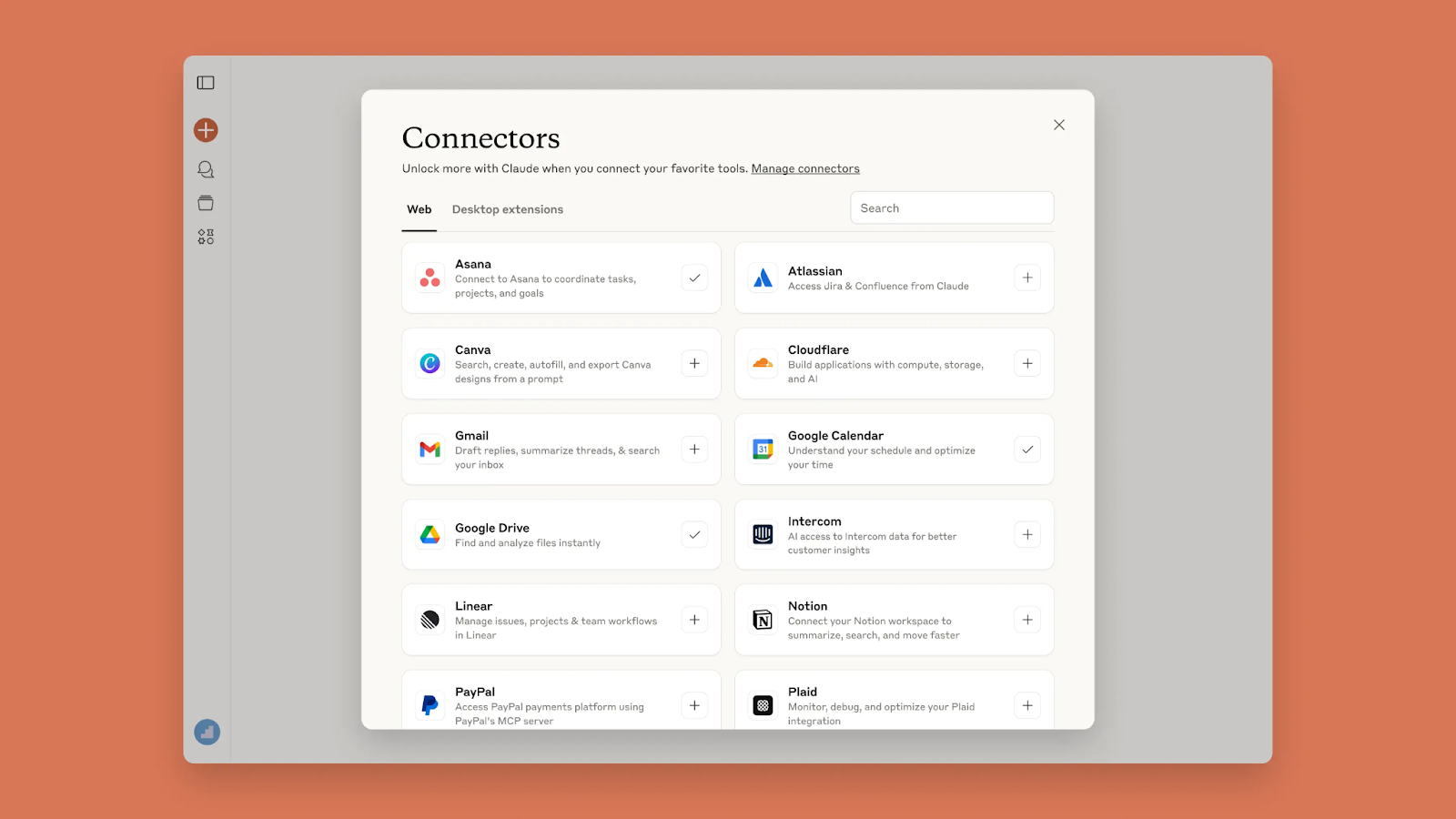
The Model Context Protocol (MCP) is redefining how large language models interact with software by enabling secure, structured, and universal integration between AI assistants and external tools. Through Claude’s Connectors, powered by MCP, AI is evolving from merely suggesting actions to executing real workflows across various apps, including Google Drive, Gmail, Canva, Asana, Figma, and Chrome.
This shift marks the beginning of LLM-native productivity, where natural language replaces UI as the main interface. Instead of copying and pasting or switching between tabs, users can now prompt Claude to manage end-to-end tasks within a single conversation. For marketers, product teams, and SaaS builders, this transition demands a move toward AI-orchestrated workflows, MCP-compliant tools, and intent-first design.
MCP is not just a new protocol—it’s a foundation for the agentic future of work, where AI assistants become workflow engines.
In This Article
Share On:
How Claude Connectors and MCP Are Turning AI Assistants Into Workflow Engines
The Shift from LLMs That “Answer” to LLMs That “Execute”
AI assistants have been intelligent for some time, but until recently, they remained fundamentally isolated. They could help draft emails, summarize long threads, or generate documents, provided you were willing to copy, paste, and manually direct them through each step.
However, we are now at a clear inflection point. Language models like Claude are beginning to move beyond passive suggestion and into direct execution. With Anthropic’s latest Claude Connectors update, powered by the emerging Model Context Protocol (MCP), AI assistants are no longer confined to the browser tab. They are becoming embedded, interactive participants in real workflows.
No more switching tabs.
No more exporting data between systems.
No more manual copy-paste workflows just to complete a simple task.
For example, consider the following prompt:
“Claude, summarize this folder from Google Drive, draft a proposal, schedule the review call, and generate the presentation in Canva.”
All of that can now be done in a single thread, through one request, without context switching or task fragmentation. This is not just a product update. It is the beginning of a broader architectural shift in how large language models interact with software ecosystems.
Let’s now dig deeper into the foundation and implications of this shift:
What is Model Context Protocol (MCP), and why is it gaining adoption from leaders like OpenAI, Microsoft, and Anthropic?
How are Claude’s Connectors redefining tools such as Asana, Google Drive, Canva, Gmail, and others as action-oriented endpoints?
Why is this the start of truly LLM-native productivity, where your AI assistant doesn’t just advise but acts?
What does this transition mean for your product strategy, marketing stack, or internal operations in an increasingly AI-integrated environment?
Whether you are building an AI-enhanced SaaS product, designing workflows around intelligent automation, or simply navigating the evolving landscape of generative technology, this is the moment to pay close attention.
What Is the Model Context Protocol and Why Does It Matter?
The Model Context Protocol (MCP) is an open standard that enables large language models to connect with and take actions through external tools. At its core, MCP defines how tools and applications can describe their capabilities in a structured way, allowing AI models like Claude, ChatGPT, Gemini, and many more to understand what those tools can do, request access, and then invoke actions, all securely and predictably.
In simpler terms, MCP is doing for AI assistants what APIs did for the modern web. It allows tools to expose specific functions (such as sending an email, retrieving a document, or creating a calendar event) in a format that language models can both understand and safely use. This eliminates the need for custom plug-ins, hard-coded integrations, or limited sandbox environments.
A Universal Adapter for AI
Traditionally, connecting tools to language models has been a fragmented process. Each LLM provider had its method for integrations, OpenAI used plug-ins, Google developed App Actions, and other platforms had extensions. This resulted in a patchwork of incompatible ecosystems and high development costs.
MCP changes that. It offers a universal adapter layer, meaning any tool that exposes an MCP-compliant “tool manifest” can be connected to any LLM that supports the protocol. This enables:
Interoperability across platforms, regardless of who built the tool or the model.
Faster time to integration, since tools no longer need bespoke adapters for each LLM.
Consistent security and governance, with OAuth and scoped permissioning built in.
Major players are already aligning behind MCP. Anthropic has taken the lead by integrating it directly into Claude’s Connectors architecture. OpenAI and Microsoft have signaled their support for open tool standards, while developers across various ecosystems, such as Java and Python, are actively building libraries to accelerate MCP adoption and simplify integration.
How does it work?
At a technical level, MCP relies on a few key components:
Tool Manifests: Structured JSON files that describe what a tool can do (functions, parameters, auth requirements).
JSON-RPC Interface: The standard mechanism for calling those functions, allowing models to interact with tools using familiar patterns.
OAuth Integration: Each tool utilizes OAuth 2.0 to ensure secure user authorization, ensuring the AI assistant has access only to what the user explicitly allows.
Execution Flow: Once authorized, the model can call specific functions based on user intent, using language as the orchestration layer.
This architecture enables Claude to perform end-to-end tasks, such as summarizing a document from Google Drive, pulling relevant data, drafting an email, and placing it directly into Gmail for review, all without leaving the interface.
Now that we understand how MCP works, let’s explore how Claude Connectors bring this protocol to life across fundamental tools and workflows.
While MCP provides the underlying standard, Claude’s Connectors are its first primary real-world application. Announced by Anthropic in late 2024 and rapidly expanded in 2025, Claude’s Connectors are built entirely on MCP, allowing the model to interact with dozens of popular tools in a secure and structured manner.
These are not shallow integrations. Each Connector turns a standalone app into an extension of Claude’s capabilities, enabling the model to execute complex, cross-tool workflows through natural language.
Claude as a Workflow Engine: From Productivity to Creativity
With Connectors, Claude is no longer just generating content; it’s also connecting with users. It’s now orchestrating workflows.
For example, Claude can:
Analyze Google Drive folders, extract insights, and compile content into structured outputs, such as proposals or reports.
Generate and send emails via Gmail, using context from uploaded documents or prior conversation threads.
Auto-design assets in Canva, filling templates with brand-compliant copy and visuals.
Organize and prioritize tasks in Asana, and follow up with status updates or changes to due dates as needed.
Summarize your meeting notes, whether stored in Notion, Google Keep, or Apple Notes, and turn them into action items.
Control Spotify, curating playlists based on your activity, mood, or workspace context, great for teams using sound to boost focus or set the tone.
Interact with Figma by retrieving design files, adding comments, and facilitating collaboration on visual projects among non-designers.
Parse Chrome tabs, extract content from websites, and take follow-up actions, such as drafting a response, saving insights, or creating tasks.
In each case, Claude uses the tool’s MCP manifest to understand what’s possible, obtains the required permissions via OAuth, and then completes the task —all from a single natural language prompt.
No More Context Switching
The most visible impact of Connectors is the elimination of context switching. Previously, AI workflows were still dependent on human handoffs. You could ask Claude to write an email, but you still had to copy it into Gmail, attach a file from Drive, and then send it.
Now, that entire flow can happen inside Claude.
“Claude, find the latest pitch deck in Drive, write a follow-up email to the client, and schedule a check-in next week.”
What used to be three disconnected steps across different tools is now a single, seamless request executed in one place, with no handoffs.
(Beta) Parse and organize notes, generate summaries
Chrome
(Planned) Read and act on open tabs
This ecosystem is expanding rapidly as more developers implement MCP into their products, making them “Claude-ready” by default.
These capabilities are part of Claude’s latest Connector rollout, available to users on Claude Pro and Max plans, enabling them to integrate directly with tools like Google Drive, Canva, Asana, and more.
We’ll gradually explore how tools like Notes, Spotify, Figma, and Chrome are being enhanced through Claude’s Connectors, uncovering new ways they support productivity, creativity, and seamless AI collaboration.
Note: These tool-specific deep dives will be especially useful if you’re looking to understand how AI assistants can embed directly into your daily stack.
Why This Is the Beginning of LLM-Native Productivity?
Most productivity tools today are designed for human operators. Interfaces are built around clicks, dashboards, dropdowns, and checklists. Even when AI is layered in, it often sits on top of a human-first architecture. However, with Claude’s Connectors and the underlying Model Context Protocol, this paradigm is shifting.
We are entering the era of LLM-native productivity, where tools are increasingly designed to be understood, interpreted, and controlled by language models first, and humans second.
From Interface to Intent
Traditionally, completing a task required navigating through interfaces. You had to open an app, locate the correct file, understand the workflow, and take action.
Now, with MCP-enabled integrations, the user simply states their intent, and the LLM translates it into actionable API calls across multiple tools. The interface is the conversation. The AI handles the orchestration.
This fundamentally changes:
How work gets done: Actions span tools but occur within a single interface.
Who can operate tools: Non-technical users can access advanced capabilities through natural language processing.
Where productivity happens: You no longer need to switch between apps or manage the friction between systems.
In this model, Claude becomes a front-end for your workflow stack, not just a chat tool.
The Productivity Stack Is Flattening
As more tools expose themselves via MCP, the traditional layered stack of apps, dashboards, and interfaces begins to flatten. Instead of switching between project management, design, and documentation tools, users engage in a single conversation thread that spans all of them.
This introduces several benefits:
Old Model
LLM-Native Model
Task-based UI interactions
Goal-based language prompts
Siloed tools and data
Unified, context-aware orchestration
Manual coordination between platforms
Automated, cross-tool execution
Complex onboarding and training
Instant access via conversation
Reactive workflows
Proactive suggestions and automation
In essence, LLMs become not just assistants, but team members capable of planning, executing, and optimizing workflows across your entire digital workspace.
Why It Matters Now?
This transformation is not a five-year vision. It is already underway. Claude’s Connectors represent the first scaled deployment of this approach, but others are following quickly. OpenAI’s function calling, Google’s App Actions, and Microsoft’s CoPilot integrations all signal a movement toward a model-first productivity architecture.
For organizations, this means:
SaaS tools must be designed with LLM-accessible endpoints, not just user dashboards.
Teams need to rethink workflows to leverage orchestration, not just automation.
Knowledge workers will shift from being doers to directors, guiding AI to execute across systems.
In short, this is not a feature trend. It’s a foundational shift, similar to the transition to digital work.
What does this mean for your Product Roadmap or Martech Stack?
MCP and Claude Connectors don’t just change how people use tools; they shift what tools need to be, how they integrate, and how they deliver value.
Whether you’re building a SaaS product, managing internal automation, or scaling growth workflows, this change demands a strategic response.
For Product and Engineering Teams
Your product needs to become LLM-ready.
That means:
Exposing core functions via structured, AI-readable interfaces (MCP or similar).
Enabling secure, scoped access for AI agents to perform tasks without compromising data.
Designing for intent-based interactions, not just user interfaces.
Products that support LLM orchestration will plug directly into ecosystems like Claude, GPT-4o, or CoPilot, reaching new users and unlocking workflow-level utility.
For Growth, Marketing, and Ops
This shift simplifies execution, but raises the bar on orchestration logic.
Content generation with real-time brand context (via Drive, Notes, or Canva).
Campaign operations and team coordination, all from a single thread.
To stay competitive, your martech stack must shift from tool-based automation to model-driven coordination. LLMs will become the new interface layer, routing work across the tools your team already uses.
Claude’s Connectors represent more than just a productivity boost; they offer a glimpse into the future direction of software. We’re entering a new phase where AI agents, rather than users, drive actions across various tools. In this agentic future, software will no longer compete through user interfaces, but by being helpful and accessible to language models.
Tools that are MCP-compliant will become part of the model’s operating environment, enabling instant access across platforms such as Slack, Chrome, Notion, or Figma. The model won’t just suggest actions; it will execute them. For product teams, this means the new challenge isn’t just designing for users; it’s also planning for the new reality. It’s making sure your product is usable by AI. Tools that can’t be orchestrated by a model risk being left out of tomorrow’s workflows altogether.
Final Thoughts
The rise of Claude’s Connectors and the Model Context Protocol marks a shift in how modern marketing teams operate. As AI advances in execution, the way we run campaigns, analyze insights, and scale content is being reshaped. This isn’t just about automation, it’s about working smarter, faster, and more collaboratively with AI woven directly into your workflow.
For growth marketers, the message is clear: the future isn’t just multichannel or data-driven, it’s AI-native and orchestrated. Those who adapt early will outpace those still relying on manual coordination and disconnected tools.
Supercharge Your Growth Marketing with AI-Driven Execution
At upGrowth, we help fast-moving teams scale smarter with AI-driven growth marketing. From SEO automation to full-funnel execution, we bring strategy and systems together to drive results that matter.
1. What is the Model Context Protocol (MCP)? MCP is an open standard that enables large language models (LLMs) to connect with external applications securely. It allows tools to expose their functionality in a manner that AI models can comprehend and act upon.
2. How do Claude’s Connectors work? Built on MCP, Claude’s Connectors enable the model to take action inside tools like Google Drive, Gmail, Canva, Asana, and more. Once authorized, Claude can perform tasks directly using natural language commands.
3. Which tools does Claude currently connect with? Claude supports integrations with Google Drive, Gmail, Asana, Canva, Intercom, Google Calendar, Notes, Spotify, Figma, and Chrome (beta), with more being added regularly.
4. Why should marketers care about MCP? MCP moves AI beyond static content generation. It empowers LLMs to execute growth workflows such as summarizing research, coordinating campaigns, or managing tasks, making marketing faster and more scalable.
5. How can I prepare my team or stack for this shift? Begin by auditing your current tools to identify potential areas for integration. Focus on reducing manual coordination and enabling AI to assist across content, operations, and execution. Consider partnering with an AI-driven growth company to accelerate the transition.
For Curious Minds
The Model Context Protocol (MCP) establishes a common language for AIs and software, moving beyond bespoke integrations to create a truly interoperable ecosystem. This is not just about adding features; it is about rebuilding the foundation so that any AI can securely and predictably interact with any compliant tool, turning assistants into autonomous agents. This architectural change is what allows an AI to execute multi-step tasks across different applications. Instead of siloed plugins, MCP offers a universal standard that major developers like Anthropic and Microsoft are adopting.
Universal Adapter: MCP acts like a universal power adapter for AI, allowing any compliant tool to connect with any supporting LLM without custom code.
Structured Capabilities: It requires tools to declare their functions in a "tool manifest," a structured format that models like Claude can read to understand what actions are possible.
Secure by Design: The protocol integrates standard security practices like OAuth and scoped permissions directly, ensuring data access is managed consistently.
This shift from a fragmented to a standardized model is the key to unlocking seamless, cross-application workflows. Understanding this protocol is essential for grasping the next generation of AI-powered productivity.
Claude Connectors represent the practical application of this new architectural shift, transforming Claude from an information source into an active workflow participant. The ability to directly manipulate data in Google Drive or create designs in Canva from a single prompt eliminates the manual "copy and paste" steps that previously fragmented user workflows. This is significant because it centralizes task management within the conversational interface, reducing cognitive load and saving time. The transition from answering to acting is powered by the Model Context Protocol (MCP).
From Isolation to Integration: Previously, an LLM was a separate tool. Now, it is an embedded engine that orchestrates actions across your entire software stack.
Single-Request Execution: Users can issue a complex command like "draft a proposal from this folder and schedule a review," and Claude can execute each step sequentially.
Action-Oriented Endpoints: Applications like Asana are no longer just data sources; they become endpoints for the AI to perform specific actions, such as creating a task or updating a project.
This evolution fundamentally redefines the role of an AI assistant from a helpful advisor to a productive doer. The full article explores how this change impacts your existing software ecosystem.
The Model Context Protocol (MCP) offers a unified, open standard, whereas older methods like OpenAI's original plugins created a closed, fragmented ecosystem. The primary difference is interoperability: an application with an MCP-compliant manifest can connect to any supporting LLM, like Claude or Gemini, not just one. This 'build once, connect many' approach drastically reduces development overhead and eliminates platform lock-in. For developers, this shift is analogous to the move from proprietary browser extensions to universal web APIs. The MCP approach provides three main advantages over the previous model:
Reduced Fragmentation: Instead of building a unique plugin for Claude, another for ChatGPT, and a third for another model, developers create a single MCP tool manifest.
Faster Integration: The standardized format accelerates the connection process, allowing new tools to join the ecosystem much more quickly.
Consistent Security: MCP standardizes security with OAuth and defined permission scopes, providing a predictable and trustworthy framework for both developers and users.
Choosing this open protocol over a closed system is a strategic decision for future-proofing integrations. The complete analysis details the long-term implications for SaaS product strategy.
The evidence lies in the AI's ability to execute a sequence of dependent tasks across multiple, independent applications from one command. This is not a simple shortcut; it is a demonstration of stateful, cross-platform task orchestration, a core function of a workflow engine. The AI must maintain context from the Google Drive summary to inform the proposal draft, then use that context to schedule the appropriate meeting. This interconnected process shows a system that understands and acts on workflow logic. Key indicators of this shift include:
Context Persistence: Information retrieved from one tool (e.g., a document from Google Drive) is used as input for an action in another (e.g., an email summary in Gmail).
Multi-Step Execution: The assistant autonomously moves from one action to the next without requiring additional user prompts for each step.
Interoperability: It seamlessly connects disparate services like Canva and a calendar app, which traditionally have no direct integration.
This ability to chain actions based on a single, high-level goal is what distinguishes a workflow engine from a simple tool. Explore the full content to see how this redefines productivity automation.
This industry alignment signals a definitive move away from siloed "walled gardens" toward a universal, interconnected AI ecosystem. When major, competing players like Anthropic and OpenAI agree on a standard, it indicates that the market sees immense value in interoperability over proprietary control. This suggests a future where the value of an application is determined not just by its features, but by its ability to act as an intelligent, connectable node in a broader AI-driven network. This convergence is creating a new competitive landscape for all software. The impact is already becoming clear:
Accelerated Innovation: A common standard allows developers to focus on creating unique tool capabilities rather than on building countless bespoke integrations.
Empowered Users: Users can assemble their own best-in-class toolchains, connecting preferred apps to their chosen AI assistant without being locked into a single provider's ecosystem.
Emergence of Orchestrators: The focus shifts to the AI assistants as the primary interface for orchestrating work across tools like Asana or Canva.
This collaborative adoption of MCP is a powerful indicator that the future of software is cooperative and interconnected. Discover more about how this trend is reshaping product strategies.
To make your SaaS platform accessible to AI assistants like Claude, you must create and expose an MCP-compliant "tool manifest." This structured file acts as your application's resume, telling any supporting LLM what your tool can do. The process involves defining your core actions, structuring them in the required format, and implementing secure authentication. A clear, well-defined manifest is the key to seamless integration and discoverability within the AI ecosystem. Here is a simplified plan to get started:
Identify Core Actions: Determine the most valuable functions your users would want an AI to perform, such as "create a project" or "retrieve a report."
Author the Tool Manifest: Create a JSON file that describes each action, including its purpose, required inputs, and expected outputs, following the MCP specification.
Implement OAuth 2.0: Set up a secure authentication flow so users can grant the AI assistant permission to act on their behalf without sharing their credentials directly.
Host and Register the Manifest: Make the manifest file publicly accessible at a stable URL and register it with LLM providers like Anthropic.
By following this plan, you position your product not as a standalone destination but as an essential component in your users' automated workflows. The full piece offers deeper technical considerations.
Product managers must shift their focus from building self-contained, destination products to creating embeddable, action-oriented services. In this new paradigm, your application's user interface may become secondary to its API, as users increasingly interact with your tool through an AI assistant like Claude. The strategic priority becomes making your service the best "verb" or "action" that an AI can call upon. This requires a fundamental re-evaluation of the product roadmap and user experience. Key adjustments include:
Prioritize "Tool-ification": Focus development on creating well-defined, atomic actions that an LLM can easily invoke via an MCP-compliant API.
Design for Conversational UX: Think about how your tool's functions would be described and requested in natural language and ensure the results are easily presented in a conversational format.
Rethink Onboarding: User acquisition may happen through an AI assistant's "skill store," so onboarding should focus on connecting your service to the user's preferred AI from a provider like Anthropic.
This shift means success is less about capturing user attention on your platform and more about providing indispensable functionality within theirs. Dive deeper into these strategic pivots by reading the complete analysis.
The widespread adoption of MCP will likely lead to a great "unbundling" of software features, fundamentally altering the competitive landscape. Standalone applications that do not integrate may become obsolete, as users will prefer tools that plug into their central AI workflow engine. Value will shift from all-in-one platforms to best-in-class, single-purpose tools that are easily orchestrated by an AI assistant. A company like Asana might compete not on its UI, but on how effectively its task-creation endpoint performs when called by Claude. The new competitive dynamics will be defined by:
Interoperability as a Key Feature: A tool's ability to connect seamlessly with other services via MCP will become as critical as its core functionality.
Focus on Core Competency: Companies can succeed by doing one thing exceptionally well and making that function available to the entire AI ecosystem.
The Rise of AI as the Interface: AI assistants will become the primary user interface, and software providers will compete for prominence within that conversational layer.
This creates both a significant threat for incumbents and a massive opportunity for nimble innovators. The full article explores which types of companies are best positioned to win.
The most common risks are over-permissioning, where an AI gets excessive access to user data, and insecure authentication, which can lead to account takeovers. Without a standard, each integration becomes a potential weak point. The Model Context Protocol (MCP) solves this by building modern security practices directly into its foundation. It mandates the use of proven standards like OAuth 2.0 and scoped permissions, ensuring that access is always explicit, granular, and user-consented. For a service like Gmail, this is non-negotiable. MCP's security-first approach provides a robust solution through several key mechanisms:
Scoped Permissions: Instead of granting blanket access, users authorize specific actions, like "read this one document," limiting the AI's reach.
Standardized Authentication: By enforcing OAuth 2.0, MCP ensures that user credentials are never shared with the LLM or the tool developer, relying on secure tokens.
User-Controlled Consent: The protocol requires a clear consent flow where the user sees exactly what permissions an AI assistant like Claude is requesting before granting access.
This built-in governance makes connecting tools significantly safer than ad-hoc methods. Learn more about how this framework establishes trust in the full analysis.
The fragmentation of the LLM market forces developers to build and maintain separate, bespoke integrations for each platform, from OpenAI's models to Anthropic's Claude. This creates immense technical debt and slows down innovation. The Model Context Protocol (MCP) directly solves this by acting as a "universal adapter." By adopting this single, open standard, developers can build one integration that works across any LLM that supports the protocol. This drastically reduces engineering costs and accelerates time-to-market. The solution lies in its core design principles:
A Common Language: MCP provides a standardized "tool manifest" that any model can read, eliminating the need for custom translation layers for each LLM's unique API.
Interoperability by Default: Tools that expose an MCP-compliant endpoint are automatically compatible with the entire ecosystem of supporting models, maximizing their reach with minimal effort.
Reduced Maintenance: Instead of updating multiple plugins every time an LLM provider changes its API, developers only need to maintain their single MCP manifest.
This shift from a one-to-one to a one-to-many integration model is a powerful unlock for the entire software industry. The article further explains the economic benefits of this approach.
An "action-oriented endpoint" refers to a specific function within an application that an AI can invoke to perform a task, rather than just retrieve data. This reframes software from a passive information source into an active tool that the AI can command. This is central to workflow automation because it allows an AI like Claude to directly manipulate business objects, like creating a task in Asana or generating an image in Canva, instead of just talking about them. This transformation is enabled by protocols like MCP. The key characteristics of these endpoints are:
Task-Specific: Each endpoint corresponds to a discrete action, such as "create_presentation" or "schedule_meeting."
Input-Driven: They are designed to accept structured data from the AI, like a title for a presentation or the attendees for a meeting.
State-Changing: Invoking the endpoint results in a change within the target application, creating a new object or updating an existing one.
Viewing applications as a collection of these endpoints is fundamental to building the next generation of LLM-native productivity. Discover how this changes software design in the complete piece.
This manual workflow persisted due to a lack of a standardized communication layer between language models and external software. Without a common protocol, every connection was a custom, hard-coded integration, making seamless, multi-app workflows nearly impossible to build at scale. Claude Connectors, built on the Model Context Protocol, finally solve this. They provide the universal "plumbing" that allows Claude to securely and reliably execute actions in other applications, eliminating the need for the user to act as the human API. This solves the fragmentation problem in three ways:
Centralized Orchestration: The AI assistant becomes the single point of contact for a complex task, managing the sequence of actions across tools like Google Drive and Gmail.
Elimination of Context Switching: Users can remain within a single conversational thread instead of juggling multiple browser tabs to complete their work.
Automated Data Transfer: Information generated in one step is automatically passed as input to the next, removing the error-prone process of manual data entry.
This integration is not just a convenience; it is a fundamental redesign of the user experience. The full article details how this shift impacts daily productivity.
Amol has helped catalyse business growth with his strategic & data-driven methodologies. With a decade of experience in the field of marketing, he has donned multiple hats, from channel optimization, data analytics and creative brand positioning to growth engineering and sales.

 Growth Strategy and Planning