Contributors:
Amol Ghemud Published: October 16, 2025
Summary
VEED.io monthly search volume runs to about 44,100 US searches a month across 4 brand spellings, all held at position 1 (Semrush, September 2026). That brand demand is small next to the 128,848 keywords its free tool pages rank for. This case study breaks down the numbers, the top queries and the programmatic SEO template that produces them.
In This Article
Share On:
If you’re here for VEED.io monthly search volume, start with this. In the US, people search the 4 main spellings of the brand about 44,100 times a month, and VEED ranks first for every one of them (Semrush, September 2026).
The brand number is the small one. VEED.io monthly search volume for its own name is dwarfed by the 128,848 keywords its tool pages rank for, and that gap is the point of its programmatic SEO strategy. Here are the current figures, the queries behind them, and the page system that earns them.
VEED.io Monthly Search Volume: The 2026 Numbers
VEED.io monthly search volume comes to roughly 44,100 US searches a month across 4 brand spellings: ‘veed’ at 22,200, ‘veed io’ at 12,100, ‘veed.io’ at 5,400 and ‘veedio’ at 4,400. VEED holds position 1 for all of them, which converts to about 35,280 brand visits a month (Semrush, US database, September 2026).
Brand spellings and what each one earns
Searchers reach for the domain in 4 different ways, and VEED’s homepage catches all of them from position 1. Even the misspelling ‘veed.oi’ pulls 2,400 searches a month, and ‘veed.io login’ another 1,900. Those are return-visit patterns, not discovery.
The site-wide organic footprint
Brand demand is small next to everything else. Semrush lists 128,848 organic keywords for veed.io in its US database, worth an estimated 378,592 organic visits a month. Buying the same clicks would run about $384,224 a month. Paid search barely features: 220 keywords and 6,572 visits.
Total visits and channel mix
Similarweb recorded 8.5M total visits to veed.io across the 3 months to August 2026 and names organic search the top source, ‘driving 52.33% of desktop visits last month’. VEED ranked #20 in the Graphics Multimedia and Web Design category and #4382 globally that month.
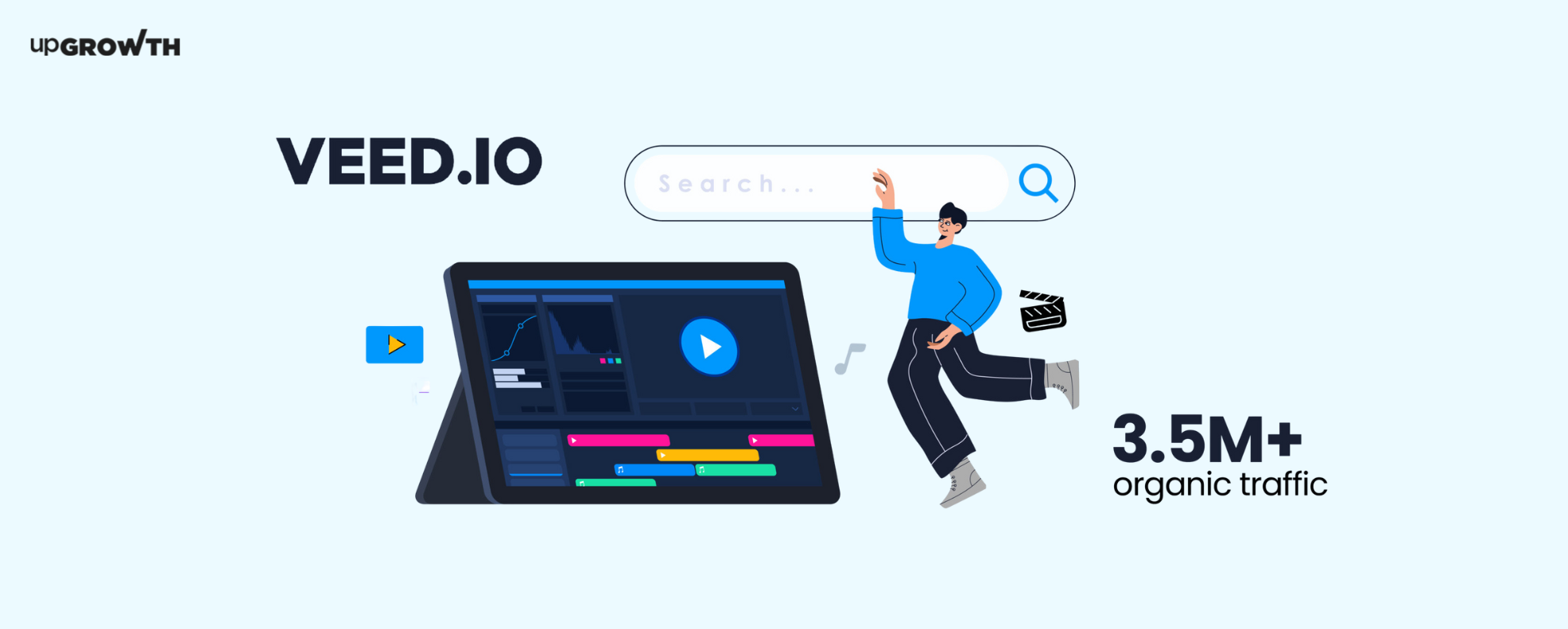
Our original 2024 write-up of VEED used a worldwide figure of 3.5M+ monthly organic visits. We’ve replaced it with numbers you can check today. The 2 tools above disagree with each other, which is normal, because each one models traffic its own way. Treat both as estimates.
Top Search Queries for VEED.io and What They’re Worth
The VEED keywords worth studying aren’t the brand terms. ‘gif maker’ (1,500,000 US searches a month), ‘video converter’ (1,000,000) and ‘audio editing’ (1,000,000) each send around 30,000 visits a month, because VEED runs a dedicated free tool page for every one.
This table is sorted by estimated visits, not by search volume, which shows the trade VEED makes. Position 9 on a keyword with 1.5M searches beats position 1 on any brand term it owns.
VEED.io top keywords by estimated monthly visits, with US monthly search volume (Semrush, US database, September 2026)
Keyword
US monthly search volume
VEED position
Estimated visits a month
VEED page
gif maker
1,500,000
9
33,000
/create/gif-maker
video converter
1,000,000
6
30,000
/convert/video-converter
audio editing
1,000,000
5
30,000
/tools/audio-editor
veed (brand)
22,200
1
17,760
homepage
video editor
110,000
6
3,300
/tools/video-editor
video compressor
74,000
7
1,776
/tools/video-compressor
webcam test
49,500
6
1,485
/tools/webcam-test
how to add subtitles to video
60,500
5
1,149
/tools/add-subtitles
2 patterns run through the VEED.io keyword search volume data. The head terms are generic verbs, the kind a template can scale into, and the tail is enormous: 128,848 ranking keywords means most pages carry a small cluster of terms rather than 1 big one.
How VEED’s Programmatic SEO Turns Keywords Into Pages
VEED picks a job people already search for, then ships a page that does that job free in the browser. The keyword becomes the URL, the heading and the tool itself, so the page matches the search instead of describing it.
Step 1: Find the job, not the topic
VEED starts from utility searches tied to a video editing task: add subtitles to a video, compress a file, turn a clip into a GIF. Each one has a clear finish line, which is what makes it templatable. Our guide to what programmatic SEO is and how to do it covers the research end.
Step 2: Ship a tool page per job
For each keyword, VEED builds a landing page with a working tool on it. ‘video compressor’ gets /tools/video-compressor, ‘gif maker’ gets /create/gif-maker. The URL, title and on-page copy all carry the target term, so relevance is structural rather than bolted on later.
Step 3: Back every tool with a guide
How-to pages matching each tool catch searches that aren’t ready to click a button yet, then link into the tool page. On a site with this many URLs, that internal link pattern is what decides which pages get crawled and which ones rank.
Inside a VEED Tool Page: The Data Points Behind Every URL
Every VEED tool page is built from the same slot list. We checked the live video compressor page in September 2026: tool name, a 1 line description, a single CTA, features, a 3-step how-to, a demo video, reviews and an FAQ.
That page leads with ‘Free video file compressor. Decrease video size by up to 90% with no visible quality loss’ and a ‘Compress a video’ button. It carries a 4.6-star rating from over 2,100 reviews and 6 FAQ entries covering file limits, formats and quality loss.
Fill the same slots with different data and you get a new page that still reads like someone meant it. That’s the line between programmatic and thin: the template changes what the page does, not just the words on it.
VEED’s International SEO, Built the Same Way
VEED runs localized subfolders off 1 domain rather than separate country sites, so every new market inherits the authority the domain already has.
The pt-BR homepage is a fully translated Brazilian Portuguese homepage, with its own headline (‘Criação de vídeos com IA, feita para as redes sociais’), navigation and tool names: AI video, auto subtitles, video translator, screen recorder. The template is identical, the language isn’t.
A fresh country domain starts from zero. A subfolder starts from whatever the root domain has already earned, which is why VEED can open a locale and rank in it quickly. Our guide to international SEO covers when that choice makes sense.
What VEED’s Programmatic SEO Gets Right, and Where It’s Weak
The strength is coverage: 128,848 keywords out of a small set of templates. The weakness is the same thing. Pages cut from 1 mould compete with each other, and engagement on a page whose job takes 30 seconds will always look thin next to an article.
Where it wins
Scale, and the ability to cover thousands of niche queries no editorial team could write by hand. Automation tools keep the build cheap once the template works, and every new tool ships with SEO already attached.
Where the risk sits
Near-identical pages invite duplicate content problems, and a page that exists only to hold a keyword adds nothing for the person who lands on it. Value per page is what keeps a set this size indexed.
Programmatic against traditional SEO
Programmatic suits large inventories where 1 template serves thousands of URLs. Manual optimization still wins for small service sites where a few pages carry the whole business. We compare both in programmatic SEO vs traditional SEO.
Watch: How VEED’s Programmatic SEO Works
Key Takeaways from VEED.io’s Search Data
Brand search is the output, not the input: 44,100 US searches a month for the brand, against 128,848 keywords earned by tool pages.
Head terms carry the traffic: ‘gif maker’, ‘video converter’ and ‘audio editing’ send about 30,000 visits a month each from positions 5 to 9.
1 template, filled properly: name, description, CTA, features, how-to, demo video, reviews and FAQ on every tool page.
Guides feed tools: informational pages catch the long tail and pass authority to the page that converts.
Organic does the heavy lifting: Similarweb puts organic search at 52.33% of desktop visits in August 2026, ahead of direct.
VEED.io Monthly Search Volume: FAQs
What is VEED.io’s monthly search volume?
VEED.io monthly search volume for brand terms is about 44,100 US searches a month, split across ‘veed’ (22,200), ‘veed io’ (12,100), ‘veed.io’ (5,400) and ‘veedio’ (4,400). VEED ranks first for all 4, which turns those searches into roughly 35,280 visits a month. The figures come from Semrush’s US database in September 2026 and cover Google US only.
How many keywords does VEED.io rank for?
Semrush’s US database lists 128,848 organic keywords for veed.io in September 2026, worth an estimated 378,592 organic visits a month. Buying the same clicks would cost about $384,224 a month. Almost all of it comes from free tool pages rather than the blog, and VEED runs only 220 paid keywords alongside that organic footprint.
What are the top search queries for VEED.io?
By estimated traffic, VEED’s top queries are ‘gif maker’ (1,500,000 US searches a month, position 9), ‘video converter’ (1,000,000, position 6) and ‘audio editing’ (1,000,000, position 5). Each sends around 30,000 visits a month. Brand searches for ‘veed’ come next at 17,760 visits. Every one of those queries has its own dedicated tool page.
How much traffic does VEED.io get in total?
Similarweb recorded 8.5M total visits to veed.io across the 3 months to August 2026 and reports organic search as the biggest channel, driving 52.33% of desktop visits. Semrush separately estimates 378,592 monthly organic visits from the US alone. The 2 tools model traffic differently, so treat both as estimates rather than logged visits.
How does VEED use programmatic SEO to rank for so many keywords?
VEED picks a job people search for, such as compressing a video or adding subtitles, then generates a landing page that does the job free in the browser. Each page follows 1 template: tool name, description, a CTA, features, a how-to, a demo video, reviews and an FAQ. Supporting guides link back to the matching tool page.
Does VEED.io rely only on organic traffic?
No. Similarweb lists direct traffic as VEED’s second biggest channel in August 2026, behind organic search at 52.33% of desktop visits, and Semrush records 220 paid keywords driving about 6,572 paid visits a month in the US. The brand pulls its own demand too: ‘veed’ alone gets 22,200 US searches a month.
How does VEED handle international SEO?
VEED uses localized subfolders instead of separate country domains. The Brazilian Portuguese homepage at veed.io/pt-BR is fully translated, with its own headline, navigation and tool names, and the same template drives other locales. A subfolder inherits the root domain’s authority, so a new market starts from a stronger position than a new domain would.
Your Next Move: Build a Keyword Set Like VEED’s
VEED.io monthly search volume is the result of a page system, not a lucky brand name. The repeatable part is the template: 1 job, 1 page, 1 set of slots filled with real data.
Want a second opinion on whether your site has the data to support pSEO? Book a strategy call with upGrowth and bring your keyword list.
For Curious Minds
VEED’s strategy treats programmatic SEO as a system for converting user intent into functional, tool-based web pages at scale. Instead of writing individual articles, they create templates that generate thousands of optimized landing pages, each targeting a specific, long-tail search query like “add subtitles to video.” This approach is highly effective because it provides an immediate solution, not just information, capturing users at the exact moment of need.
The success of this intent-driven content machine is built on a simple, repeatable process:
They identify high-volume keywords with clear transactional intent.
A dedicated landing page is generated featuring a free tool that directly addresses the user's task.
Each page is optimized with relevant content and structured data to maximize discoverability.
This model allowed VEED to build over 12,000 indexed pages, driving their impressive 3.5 million monthly organic visitors. To understand how these pages are structured for conversion, you need to analyze their core components.
This traffic distribution highlights a powerfully synergistic marketing strategy where SEO directly fuels brand strength. The high organic search percentage (53.08%) proves VEED’s programmatic approach successfully intercepts users actively looking for solutions, making their website a dominant presence in search results for relevant video-editing keywords. This organic growth is sustainable and far more cost-effective than relying on paid advertising.
Simultaneously, the substantial direct traffic (35.48%) indicates strong brand awareness and user trust. Users who discover VEED through a search and have a positive experience with a free tool are more likely to remember the brand and return directly for future needs. This flywheel effect, where initial organic discovery converts searchers into a loyal user base, demonstrates a mature digital strategy. The article further explores how this balance makes their growth model exceptionally resilient.
To mirror VEED's success, a SaaS company must shift its mindset from manual content creation to building a scalable content engine. The process centers on systematically identifying and solving user problems with targeted, automated landing pages. This is more about system design than just writing.
Here is a stepwise plan for implementation:
Identify Keyword Clusters: Group hundreds of long-tail keywords around a single user problem (e.g., compressing different file types).
Develop a Master Template: Design a single, highly optimized page template that includes a tool interface, instructional copy, and clear calls-to-action.
Create a Simple, Functional Tool: Build a free, single-purpose tool that effectively solves the core problem identified in your keyword research.
Automate Page Generation: Use the template and a database of keyword variations to programmatically generate unique landing pages for each term.
Implement Structured Data: Use schema markup to help search engines understand the page's utility, increasing its chances of earning rich snippets.
This template-and-tool methodology is precisely how VEED scaled to over 12,000 pages. The full article breaks down how to build these templates for maximum impact.
VEED effectively solves the scale-versus-quality problem by replacing manual, one-off content creation with a system of high-quality, reusable templates. Their approach ensures that every page maintains a consistent standard of optimization and user experience, even when producing thousands of variations. The quality is baked into the template design rather than relying on individual effort for each new page.
This system-driven content architecture avoids common pitfalls because the focus shifts from quantity of articles to the quality of the underlying system. Instead of writing 1,000 different blog posts, they design one excellent tool page template and programmatically deploy it 1,000 times with minor variations. This model guarantees that every page, from their “Video Compressor” to their “Meme Maker,” is built for performance from the ground up, turning content creation into a predictable engineering task. Learn more about designing these scalable systems in our complete analysis.
The strategy’s brilliance lies in its precise targeting of user intent. A long-tail keyword like “how to make a meme video” signals a user who is not just researching but is actively trying to complete a task. By building a dedicated landing page with a free “Meme Maker” tool, VEED directly serves this high-transactional intent, providing an immediate solution rather than a passive article.
This alignment of a specific problem with a specific tool is what drives the high engagement and conversion rates behind their 3.5 million monthly organic visitors. The user arrives, accomplishes their goal, and has a positive interaction with the VEED brand, all in a single session. This approach bypasses the traditional marketing funnel, turning searchers directly into product users. The full article details how to perform keyword research that uncovers these high-intent opportunities.
The primary difference between these two strategies is their position in the user journey; VEED's tool-based approach targets the bottom of the funnel, while a traditional blog targets the top. A blog educates and builds awareness over time, whereas VEED’s programmatic pages offer immediate utility, converting users who are ready to act now. This utility-first SEO is significantly more direct for a product-led company.
Here’s a direct comparison:
Tool Pages: Capture users with high transactional intent, offer instant value, and serve as a direct gateway to the core product.
Blog Posts: Attract users with informational intent, build topical authority, and nurture leads through a longer conversion path.
By focusing on tools, VEED ensures that a large portion of its 53.08% organic traffic is already pre-qualified. See how blending both approaches can create an even more powerful content ecosystem by reading the full story.
VEED’s high rankings are a result of a meticulously optimized and repeatable page template, not isolated SEO tricks. Their success stems from ensuring every programmatically generated page contains the essential elements for satisfying both users and search engines. For a page like their “Photo Video Maker,” these elements almost certainly include a perfectly matched H1 tag, a simple and functional tool interface placed above the fold, and concise, step-by-step instructions.
Beyond these basics, the strategy’s power comes from programmatic optimization at scale. Key components include:
Dynamic Keyword Insertion: Placing the target long-tail keyword in the title, headers, and URL.
Relevant Visuals: Including images or short videos that demonstrate the tool's use.
Structured Data: Using schema to signal to Google that the page is a specific type of tool, which can enhance its appearance in search results.
This formulaic approach, applied across all 12,000+ pages, creates a powerful and consistent signal of relevance. Dive deeper into their on-page SEO checklist in the complete analysis.
The rise of programmatic SEO signals a fundamental shift in the SEO profession from content artisan to system architect. Instead of writing one perfect blog post, the modern strategist's value lies in designing a machine that can generate thousands of perfectly optimized pages. This requires a blend of technical SEO, user experience design, and data analysis.
The future role of an SEO system architect will prioritize tasks like identifying scalable keyword patterns, designing flexible content templates, defining the data sources that populate them, and analyzing performance at a macro level. As VEED has shown by generating 12,000+ pages, the leverage comes from building the engine, not just operating it. This evolution moves SEOs from the content production line to the strategic design phase. The full article explores the skills needed to make this transition.
VEED’s approach masterfully sidesteps the classic traffic-versus-conversion dilemma by exclusively targeting keywords that signal an immediate need. A search for “how to compress a video” has a clear, actionable goal, unlike a broader search for “video marketing tips.” By creating a free tool that directly fulfills this need, VEED ensures the traffic it attracts is highly qualified and problem-aware.
This strategy of aligning content with utility-driven intent acts as a powerful filter. It guarantees that the user landing on the page has a problem that VEED’s core product is designed to solve. This pre-qualification is why their programmatic engine is not just a traffic generator but a highly efficient customer acquisition channel. The massive 3.5 million monthly organic visitor count is made more valuable because each visitor arrives with a purpose. Our deep dive shows you how to map keywords to user intent.
Structured data is essential because it allows VEED to communicate the specific function of each page to search engines in their own language. By using schema markup, they can explicitly label a page as a “SoftwareApplication” or a “HowTo” guide, which helps Google understand its utility beyond just the text on the page. This clarity is crucial for ranking for action-oriented search queries.
This enhanced semantic understanding enables Google to feature VEED’s pages as rich results, such as interactive tool snippets or FAQs directly in the search listings. This increased visibility drives a higher click-through rate, contributing to their dominant 53.08% organic traffic share. For a strategy operating at the scale of 12,000+ pages, structured data provides a scalable way to differentiate their content and capture user attention before they even click. The full piece explores the specific schema types that best support a tool-based strategy.
The high volume of direct traffic demonstrates that programmatic SEO, when focused on utility, is a powerful brand-building engine. Each of the 14.8 million organic visits is an opportunity for a positive brand interaction. When a user finds VEED via search and successfully uses a free tool to solve an immediate problem, it creates a memorable and valuable experience.
This positive utility-based association builds brand recall and trust far more effectively than passive content consumption. The next time a user needs to edit a video, they are more likely to remember the name “VEED” and navigate directly to the site. The programmatic strategy therefore acts as the top of a flywheel, where organic discovery systematically cultivates a loyal, direct-traffic audience over time. This shows how solving problems at scale is one of the most effective forms of marketing.
A startup can adopt VEED’s strategy by starting small and focusing on validation before scaling. The key is to prove the model with a single, high-potential use case and then expand from that proven foundation. This lean approach minimizes upfront investment while maximizing learning.
Here is a practical, phased plan:
Phase 1: Proof of Concept. Identify one core user problem with a clear, high-intent keyword cluster. Build a single, reusable page template and a minimum viable product (MVP) tool to solve that one problem.
Phase 2: Measure and Iterate. Launch the single page and closely monitor its organic traffic, rankings, and user engagement. Refine the template and tool based on this initial data.
Phase 3: Systematic Expansion. Once the template proves effective, compile a list of 20-50 similar keywords and use your validated template to programmatically generate pages for each one.
This iterative scaling model allows a small team to build a powerful content engine without the resources VEED now has. The full guide offers a checklist for launching your first programmatic page.
Amol has helped catalyse business growth with his strategic & data-driven methodologies. With a decade of experience in the field of marketing, he has donned multiple hats, from channel optimization, data analytics and creative brand positioning to growth engineering and sales.
In This Article
Download The Free Digital Marketing Resources
[slide-anything id="15651"]
We plant one 🌲 for every new subscriber.
Want to learn how Growth Hacking can boost up your business?

 Growth Strategy and Planning
 Inbound Growth
 Growth Hacking
 Fractional CMO
 Search Engine Optimization
 Paid and Performance Marketing
 Social Media Marketing
 Demand Generation
 AI-Driven Growth Strategy
 AI-Native Workflow Automation
 Generative Engine Optimization
 Grove — AI Growth Strategist

 AI Automation
 Framework
 Case Study
 Tools
Tools Growth Tools
 Decision Tree
 Compare
 Custom GPT's
 AI Answer Gap
 Offer
Offer Webstories
 Quizzes
 Blog
Blog AI-powered Apps
 Social Media Tools
 Agency Fit Score