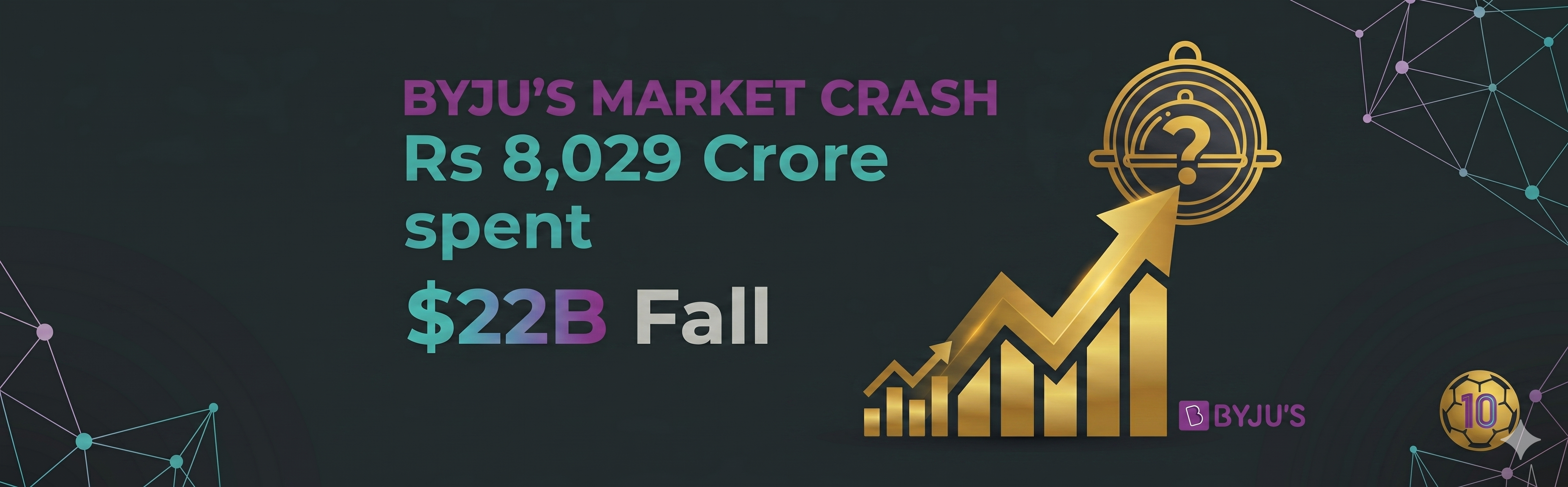
Byju’s spent Rs 8,029 crore on advertising and marketing between FY16 and FY22, which was 69 percent of its operating revenue during that period. In FY22 alone, the company spent Rs 4,134 crore on marketing, an 84 percent jump from FY21. Shah Rukh Khan served as brand ambassador from 2017 to 2023 at Rs 4 crore per year. The company signed Lionel Messi in November 2022 for $5-7 million annually, one month after laying off 2,500 employees. Byju’s paid Rs 1.51 crore per ICC cricket match for jersey sponsorship and spent $40 million to sponsor the FIFA World Cup 2022. The company reached a peak valuation of $22 billion in March 2022 with 150 million registered users. By 2024, the valuation crashed 92 percent to $1-3 billion. Byju’s defaulted on a $1.2 billion loan from Goldman Sachs and Rs 160 crore owed to BCCI. The company faced insolvency proceedings and closed all offices except Bengaluru. The marketing spend built massive brand awareness but could not compensate for product issues, aggressive sales tactics, and mounting debt.
In This Article
Share On:
When Byju’s signed Lionel Messi as its global brand ambassador in November 2022, the company positioned it as a masterstroke. The world’s most expensive footballer would help the edtech giant expand globally. One month earlier, Byju’s had laid off 2,500 employees. The optics were catastrophic. The math was even worse.
Between 2016 and 2022, Byju’s spent Rs 8,029 crore on advertising and marketing. That is 69 percent of its total operating revenue of Rs 11,792 crore during the same period. The company spent more on celebrity endorsements, cricket sponsorships, and FIFA partnerships than most Indian startups raise in their entire lifetime. By March 2022, Byju’s reached a $22 billion valuation and 150 million registered users. By 2024, the valuation collapsed to $1-3 billion. A 92 percent crash.
This is the story of how marketing built a $22 billion brand and how the same marketing machine could not save a company from near-total collapse.
Key stats at a glance
Metric
Value
Total marketing spend FY16-FY22
Rs 8,029 crore
Operating revenue FY16-FY22
Rs 11,792 crore
Marketing as % of revenue
69%
FY22 marketing spend
Rs 4,134 crore
FY21 marketing spend
Rs 2,251 crore
Peak valuation
$22 billion (March 2022)
Current valuation
$1-3 billion (92% crash)
Registered users at peak
150 million (2022)
SRK endorsement fee
Rs 4 crore/year (2017-2023)
Messi deal
$5-7 million/year (Nov 2022)
FIFA World Cup sponsorship
$40 million (Rs 330 crore)
BCCI cricket sponsorship
Rs 1.51 crore per ICC match
Loan default
$1.2 billion (Goldman Sachs)
BCCI dues unpaid
Rs 160 crore
The setup: Messi while the office burned
November 2022. Byju’s announced Lionel Messi as its global brand ambassador for three years. The campaign was called Education for All. The timing was called tone-deaf.
One month earlier, in October 2022, the company had laid off 2,500 employees. More layoffs would follow in 2023. The optics were disastrous. A company cutting jobs to stay afloat was simultaneously signing the world’s most expensive footballer for an estimated $5-7 million per year.
Founder Byju Raveendran defended the move in an internal email. He told employees there was a lot to learn from Messi and the company was privileged to have him. The defense did not land. Critics pointed out that Byju’s was spending millions on brand building while employees were being shown the door.
This was not an isolated incident. It was a pattern. Byju’s had built a reputation for aggressive marketing spend even as financial fundamentals deteriorated. The Messi deal was just the most visible example of a larger problem.
The numbers that tell the real story
According to regulatory filings analyzed by afaqs, Byju’s total advertising expenditure from FY16 to FY22 was Rs 8,029 crore. During the same period, the company’s total operating revenue was Rs 11,792 crore. That means Byju’s spent 69 percent of every rupee it earned on advertising and marketing.
In FY21, when most edtech companies were cutting costs, Byju’s spent Rs 2,250.94 crore on marketing. That was three times more than the combined marketing spend of Unacademy, Vedantu, and upGrad, which together spent Rs 793.5 crore.
In FY22, Byju’s increased its marketing budget by 84 percent to Rs 4,134.94 crore. This was during a year when the company was already facing questions about profitability and unit economics.
The breakdown of where this money went reveals a celebrity-first, visibility-obsessed strategy.
Marketing spend breakdown by year
Fiscal year
Marketing spend
Year-on-year change
FY16
Data not disclosed
–
FY17
Data not disclosed
–
FY18
Data not disclosed
–
FY19
Data not disclosed
–
FY20
Data not disclosed
–
FY21
Rs 2,251 crore
–
FY22
Rs 4,135 crore
+84%
Total FY16-FY22
Rs 8,029 crore
–
Source: afaqs analysis of regulatory filings
What they actually spent money on
Byju’s marketing machine had three pillars. Celebrity endorsements, cricket sponsorships, and global visibility campaigns. All three cost a fortune. None of them fixed the underlying business issues.
Shah Rukh Khan: The family man
In 2017, Byju’s signed Bollywood superstar Shah Rukh Khan as its brand ambassador. The annual fee was approximately Rs 4 crore. The deal ran until 2023 and was not renewed.
Khan was chosen for his family-friendly image. A father figure. A celebrated communicator. An aspirational icon for parents and children. The campaigns positioned Byju’s as a trusted learning partner. The persona congruence was strong.
But in 2021, Khan’s son Aryan was arrested in a drug-related case. The case later collapsed and Aryan was acquitted in May 2022. But the damage to Khan’s image affected Byju’s brand perception during a critical period. This is a structural risk of celebrity endorsements in high-trust categories like education. The brand’s reputation becomes inseparable from the celebrity’s personal circumstances.
Cricket: The jersey and the debt
In July 2019, Byju’s won the sponsorship rights for the Indian cricket team jersey. The deal ran until 2023. The company paid Rs 1.51 crore for every ICC match. For bilateral matches, the fee was Rs 4.61 crore per match.
In 2022, Byju’s extended the deal until the end of 2023 for $55 million. The company then defaulted on Rs 160 crore in sponsorship payments. In November 2023, the Board of Control for Cricket in India dragged Byju’s to the National Company Law Tribunal for non-payment.
The cricket sponsorship gave Byju’s visibility during every India match. Millions of viewers saw the Byju’s logo on player jerseys. But visibility does not equal viability. The company could not afford to pay what it had committed.
Messi and FIFA: The global bet
In March 2022, Byju’s became the first Indian company to sponsor a FIFA World Cup. The Qatar 2022 sponsorship reportedly cost $40 million, or approximately Rs 330 crore.
Eight months later, in November 2022, the company signed Lionel Messi as its global brand ambassador for three years. The deal was worth an estimated $5-7 million per year. The contract was put on hold after the first year due to liquidity issues.
The timing of the Messi deal drew widespread criticism. It came one month after Byju’s laid off 2,500 employees. The company was simultaneously cutting costs and signing one of the world’s most expensive brand ambassadors.
Founder Byju Raveendran later defended the decision in a May 2025 interview with News24. He said the deals were not impulsive. They were made when the company was at its best. He argued that aggressive marketing is normal for startups seeking rapid scale.
Why it worked initially
The marketing blitz was not irrational. It was deliberate. And for a while, it worked.
Byju’s went from 15 million registered users in 2018 to 150 million by March 2022. The growth was explosive. The brand became a household name. Parents saw Shah Rukh Khan promoting Byju’s. They saw the logo on Team India’s jersey. They saw Messi’s face in FIFA ads. The repeated exposure created trust.
The COVID-19 pandemic accelerated adoption. Schools shut down. Parents scrambled to find online learning solutions. Byju’s offered free classes during the lockdown. App usage increased by 60 percent. The company captured nearly 50 percent of all edtech sector funding during the boom.
The aggressive marketing created a perception of legitimacy. If Shah Rukh Khan trusted Byju’s for his kids, why shouldn’t you? If the Indian cricket team wore the Byju’s logo, the company must be credible. The brand building worked because it tapped into emotional trust, not rational evaluation.
Investors rewarded this growth. Byju’s raised billions in funding. The valuation climbed from $1 billion in 2018 to $8 billion in 2020 to $22 billion in March 2022. The company became India’s most valuable startup.
But growth is not the same as sustainability.
Where it broke: When brand could not save the business
Marketing creates awareness. It does not fix a broken product. It does not solve unit economics. It does not compensate for aggressive sales tactics or mounting debt.
Byju’s faced multiple structural problems that no amount of celebrity endorsements could solve.
The disconnect: What they built vs what broke
What They Spent On
Rs 8,029 Cr
Shah Rukh Khan
Brand ambassador, 2017–2023
Rs 4 Cr/yr
Lionel Messi
Global brand deal, Nov 2022
$5–7M/yr
Cricket sponsorship
Indian team jersey + ICC matches
Rs 1.51 Cr/match
FIFA World Cup 2022
Official sponsor
$40M (Rs 330 Cr)
TV & digital ads
Total media spend, FY22
Rs 4,135 Cr
69% of revenue spent on marketing (FY16–FY22)
What Actually Happened
$22B → $225M
Aggressive sales tactics
Customer trust collapsed
1.3/5 Trustpilot
Expensive acquisitions
Epic, WhiteHat Jr., Aakash
$500M loss on Epic
Debt default
Term loan B, bankruptcy filed
$1.2B default
Governance failures
Board exits, delayed financials
Auditor resigned
Layoffs & closures
Offices shut nationwide
4,000+ let go
99% valuation crash in 22 months
Aggressive sales tactics
Former employees reported that the sales team was under immense pressure. Targets were unrealistic. Sales calls often pushed products on parents who could not afford them. Refund promises were made but not always honored. The company faced lawsuits from customers claiming mis-selling and hard sales tactics.
WhiteHat Jr, a Byju’s subsidiary acquired for $300 million, was asked by the Advertising Standards Council of India to remove five TV advertisements for being misleading. The ads made exaggerated claims about children securing high-paying jobs after completing coding courses.
Customer reviews on Trustpilot gave Byju’s a rating of 1.3 out of 5 stars by 2023. Complaints focused on refund delays, aggressive sales, and poor customer service. The brand awareness was high. The brand trust was collapsing.
Expensive acquisitions and mounting debt
Between 2020 and 2022, Byju’s spent more than $2.5 billion acquiring startups globally. WhiteHat Jr cost $300 million. Aakash Institute cost $1 billion. Other acquisitions included Tynker, Toppr, Great Learning, and Epic.
The acquisition spree was funded by debt. In 2021, Byju’s took a $1.2 billion term loan from overseas investors when interest rates were low. When rates rose, the debt became expensive. The company struggled to service the loan and eventually defaulted.
In January 2024, lenders initiated bankruptcy proceedings against Byju’s. In February 2024, Byju’s US division filed for Chapter 11 bankruptcy in Delaware. The company sold Epic, originally acquired for $1 billion, for $500 million. A $500 million loss.
Regulatory scrutiny and governance issues
Byju’s delayed filing audited financial statements for 17 months. When the FY22 results were finally released, they showed a consolidated loss of Rs 8,245.2 crore. Investors Prosus, Peak XV Partners, and the Chan Zuckerberg Initiative resigned from the board in 2023. Five top executives exited.
The Enforcement Directorate accused Byju’s of Rs 9,000 crore FEMA violations in October 2023. The company faced government scrutiny for lapses in corporate governance. The regulatory heat made fundraising nearly impossible.
The fall: From $22 billion to near zero
In March 2022, Byju’s was valued at $22 billion. It had 150 million registered users, 58,000 employees, and was preparing for an IPO. By January 2024, the valuation had crashed to $225 million. A 99 percent decline.
The company closed all offices except its Bengaluru headquarters. Layoffs continued in waves. Acquiring new paid customers became nearly impossible. The offline tuition centers failed. Most acquired companies except Aakash were operating at losses.
Byju’s owed Rs 160 crore to BCCI and had defaulted on a $1.2 billion loan to Goldman Sachs. The company faced insolvency proceedings from multiple creditors. The marketing machine that built the brand could not save it from collapse.
Valuation timeline
Date
Valuation
Milestone
2018
$1 billion
Became India’s first edtech unicorn
March 2020
$8 billion
40 million users
October 2021
$16.5 billion
Series F funding
March 2022
$22 billion
Peak valuation, 150M users
June 2023
$2.7 billion
Investor markdown
January 2024
$225 million
99% crash
2024-2025
$1-3 billion
Current range
The lesson: Marketing cannot fix fundamentals
Byju’s story is a masterclass in what happens when brand building becomes a substitute for business building. The company spent Rs 8,029 crore creating awareness. It signed Shah Rukh Khan, Lionel Messi, and sponsored the FIFA World Cup. It put its logo on Team India’s jersey. It became a household name.
But awareness is not the same as trust. And trust is not the same as a viable business model. Byju’s aggressive sales tactics destroyed customer goodwill. Its expensive acquisitions created unsustainable debt. Its delayed financials and governance lapses scared away investors. No amount of celebrity endorsements could fix these problems.
The Messi deal in November 2022 symbolized the disconnect. The company was laying off thousands of employees while spending millions on global brand ambassadors. The message was clear. Optics mattered more than operations. Growth mattered more than sustainability.
Marketing works when it amplifies a good product. It fails when it becomes a distraction from a broken business. Byju’s built a $22 billion brand. But it could not build a profitable company. That is the difference between valuation and value.
What this means for edtech and growth-stage startups
Byju’s collapse has implications for any startup prioritizing growth over unit economics. The lessons apply beyond edtech.
First, celebrity endorsements create awareness but not loyalty. Shah Rukh Khan and Lionel Messi helped Byju’s reach millions of households. But when product quality and customer service failed, the celebrities could not save the brand. Loyalty is earned through consistent product experience, not borrowed through celebrity association.
Second, aggressive marketing cannot compensate for poor fundamentals. Spending 69 percent of revenue on advertising is sustainable only if the underlying business generates strong margins and repeat customers. Byju’s customer acquisition cost was high, retention was weak, and refund requests were frequent. The marketing spend masked these issues temporarily but could not solve them.
Third, debt-fueled growth works only in a low-interest environment. Byju’s $1.2 billion loan was taken when rates were near zero. When rates rose, the debt became a noose. Companies that rely on cheap capital to fund expansion are vulnerable when the cost of capital increases.
Fourth, governance matters more than valuation. Byju’s delayed its financial disclosures, faced regulatory scrutiny, and lost investor confidence. The valuation collapsed not just because of financial losses but because stakeholders no longer trusted the management. Governance failures are harder to recover from than revenue misses.
For startups in edtech, fintech, healthtech, or any category where trust is critical, the Byju’s playbook is a cautionary tale. Marketing builds visibility. Product builds trust. Operations build sustainability. All three need to work together. Overinvesting in one at the expense of the others creates a fragile business.
upGrowth works with edtech and growth-stage startups to build marketing strategies that align with business fundamentals. Our approach focuses on sustainable customer acquisition, retention-focused campaigns, and performance marketing that delivers measurable ROI. We help companies avoid the trap of growth at all costs and instead build marketing systems that scale profitably.
If you are building an edtech platform, SaaS product, or consumer business and need a marketing strategy that works beyond the next funding round, talk to our team.
Related strategies and services
Building a marketing strategy that scales sustainably requires expertise across multiple areas. upGrowth offers specialized services for edtech, SaaS, and growth-stage startups.
Our edtech marketing practice helps education companies acquire users through performance marketing, content-led growth, and community building. We focus on long-term retention and reducing customer acquisition costs, not just driving signups.
For companies preparing to launch or scale, our GTM strategy service builds market entry plans that align marketing, sales, and product. We help startups avoid the mistakes Byju’s made by ensuring that go-to-market execution matches business fundamentals.
Our fractional CMO service provides strategic marketing leadership without the cost of a full-time executive. For startups that need experienced guidance on marketing spend, channel mix, and brand positioning, this service offers senior-level oversight and accountability.
For companies running paid campaigns, our performance marketing service optimizes ad spend across Google, Meta, LinkedIn, and other platforms. We track CAC, LTV, payback period, and ROAS to ensure every rupee delivers measurable return.
Explore our case studies to see how we have helped fintech and edtech companies build sustainable marketing systems. FlexiLoans, Fi.Money, and Scripbox are examples of clients who prioritized fundamentals over vanity metrics.
Conclusion
Byju’s spent Rs 8,029 crore between 2016 and 2022 to build one of India’s most recognizable brands. The company signed Bollywood’s biggest star, the world’s most expensive footballer, and sponsored the FIFA World Cup. It reached 150 million users and a $22 billion valuation.
None of it saved the company from collapse. By 2024, the valuation had crashed 92 percent. The company defaulted on loans, faced insolvency, and closed nearly all offices. The marketing machine built awareness. But it could not build a sustainable business.
The lesson is simple. Marketing amplifies what already works. It does not fix what is broken. Byju’s prioritized growth, valuation, and visibility. It deprioritized profitability, governance, and customer trust. The result was predictable.
For startups in any category, the Byju’s story is a reminder that fundamentals matter more than optics. Build a product people trust. Serve customers honestly. Manage finances responsibly. Market aggressively, but only after the foundation is solid. Anything else is just expensive noise.
Frequently asked questions
1. How much did Byju’s spend on marketing?
Byju’s spent Rs 8,029 crore on advertising and marketing between FY16 and FY22, which was 69 percent of its total operating revenue of Rs 11,792 crore during the same period.
2. Why did Byju’s sign Lionel Messi during layoffs?
Byju’s signed Lionel Messi in November 2022 as part of its global expansion strategy. The deal came one month after the company laid off 2,500 employees. Founder Byju Raveendran defended the move by saying it was planned when the company was performing well and that aggressive marketing is common for scaling startups.
3. What was Byju’s peak valuation and how much did it fall?
Byju’s reached a peak valuation of $22 billion in March 2022. By January 2024, the valuation had crashed to $225 million, a 99 percent decline. Current estimates place the valuation between $1-3 billion, representing a 92 percent fall from the peak.
4. How much did Byju’s pay Shah Rukh Khan?
Byju’s paid Shah Rukh Khan approximately Rs 4 crore per year as its brand ambassador. The deal ran from 2017 to 2023 and was not renewed after it expired.
5. Why did Byju’s default on its BCCI sponsorship?
Byju’s agreed to sponsor the Indian cricket team until 2023 and extended the deal for $55 million. However, the company defaulted on Rs 160 crore in payments. In November 2023, BCCI took Byju’s to the National Company Law Tribunal for non-payment as the company faced a severe cash crunch and liquidity crisis.
6. What happened to Byju’s FIFA World Cup sponsorship?
Byju’s became the official sponsor of the FIFA World Cup Qatar 2022 for approximately $40 million or Rs 330 crore. The sponsorship was completed as planned. However, the Lionel Messi brand ambassador deal signed during the same period was put on hold after the first year due to financial constraints.
7. How many users did Byju’s have at its peak?
Byju’s had 150 million registered users at its peak in March 2022. The company grew from 15 million registered users in 2018, representing tenfold growth in four years.
8. What were the main reasons for Byju’s collapse?
Byju’s collapsed due to multiple factors. Aggressive sales tactics and mis-selling destroyed customer trust. Expensive acquisitions funded by debt created financial strain. A $1.2 billion loan default to Goldman Sachs triggered insolvency proceedings. Delayed financial disclosures and governance lapses caused investor exits. The company also faced regulatory scrutiny, including Rs 9,000 crore in alleged FEMA violations.
Watch how BYJU’S spent ₹8,029 Cr on marketing
For Curious Minds
Byju's Messi deal highlighted a growth-at-all-costs philosophy, prioritizing high-visibility branding over internal financial stability and employee morale. This approach, while aiming for global expansion, appeared tone-deaf and signaled a profound disconnect between the company's public image and its operational realities. The strategy was built on the assumption that massive brand recall, fueled by celebrity power, could sustain momentum indefinitely. However, the timing created a narrative of mismanagement. Spending an estimated $5-7 million per year on an ambassador while citing financial distress for layoffs exposed a critical flaw: the belief that marketing could solve fundamental business problems. This event became a symbol of the company's excessive cash burn, where spending on sponsorships and endorsements like the $40 million FIFA deal was decoupled from sustainable financial metrics. Explore the full story to see how this pattern of expenditure led to a 92% valuation collapse.
A marketing spend that constitutes 69% of operating revenue is an exceptionally high and unsustainable figure, indicating that the company's growth was almost entirely dependent on paid acquisition rather than organic demand or product value. This ratio suggests that for every rupee earned, 69 paise were immediately spent on marketing, leaving little for operations, product development, or profitability. This is a classic sign of hyper-growth obsession at the expense of healthy unit economics. For investors, this signals several risks:
Negative Unit Economics: The cost to acquire a customer likely exceeded the lifetime value derived from them.
Lack of Profitability Path: With such high fixed costs in marketing, achieving profitability becomes nearly impossible without constant external funding.
Vulnerability to Market Shifts: The model is fragile and cannot withstand downturns in funding or shifts in consumer spending.
Byju's total spend of Rs 8,029 crore on marketing against Rs 11,792 crore in revenue starkly illustrates this imbalance. Discover how this financial strategy directly contributed to its staggering valuation drop.
Byju's marketing spend in FY21 was vastly more aggressive than its closest competitors, showcasing a strategy focused on market dominance through overwhelming brand presence. The company's Rs 2,251 crore budget was three times larger than the combined marketing spend of Unacademy, Vedantu, and upGrad, which together spent only Rs 793.5 crore. This disparity reveals an all-out offensive to capture market share by drowning out competitors in advertising noise, from television to digital platforms. While competitors were likely pursuing more measured growth, Byju's was operating on a different scale, using its venture capital funding to build a brand moat. This approach assumed that market leadership achieved through high spending would eventually lead to profitability. However, it also locked the company into a high-burn model that became its Achilles' heel when the market shifted. Uncover the full breakdown of this high-stakes strategy and its ultimate consequences.
The evidence of a severe disconnect is found in the direct contradiction between Byju's public spending and private financial struggles. The company projected an image of global dominance while simultaneously failing to meet its basic financial obligations, a classic case of prioritizing optics over operations. Key examples that highlight this gap include:
The Messi Deal vs. Layoffs: Announcing a multi-million dollar deal with Lionel Messi just one month after laying off 2,500 employees was the most glaring instance.
Global Sponsorships vs. Loan Defaults: Byju's committed $40 million to be an official sponsor of the FIFA World Cup but later defaulted on a $1.2 billion loan payment.
Cricket Deals vs. Unpaid Dues: The company sponsored the Indian cricket team, a deal costing Rs 1.51 crore per match, yet it left Rs 160 crore in dues to the BCCI unpaid.
These actions show that capital was allocated to high-visibility, long-term brand plays while immediate, critical financial health was neglected. Learn more about how these decisions eroded trust and accelerated the company's collapse.
The dramatic collapse of Byju's valuation serves as a pivotal moment for the Indian startup ecosystem, likely ushering in an era of greater scrutiny and fiscal discipline. The growth-at-all-costs model, once celebrated, is now viewed with deep skepticism. Investors are expected to shift their focus from vanity metrics like user numbers (Byju's had 150 million) to core fundamentals. Key implications for the future include:
Emphasis on Profitability: Investors will demand a clear and realistic path to profitability, moving away from funding indefinite cash burn.
Scrutiny of Marketing ROI: Marketing budgets will be intensely scrutinized, with a preference for performance marketing over expensive, hard-to-measure brand campaigns like celebrity endorsements.
Down Rounds and Valuation Corrections: The 92% valuation crash normalizes the idea of down rounds, encouraging more realistic valuations from the outset.
This event will likely force founders to build more resilient, efficient businesses rather than chasing valuation milestones through unsustainable spending. The full article explores how this shift will redefine startup success in India.
The core problem was that Byju's strategy conflated brand visibility with business health, pouring capital into expensive endorsements with unclear returns while core financial issues mounted. This celebrity-as-a-silver-bullet approach created a high-cost, inflexible marketing machine that was unsustainable. A more balanced, data-driven approach could have helped avert the crisis by reallocating resources more efficiently. For instance, instead of increasing marketing spend by 84% to Rs 4,135 crore in FY22 amid profitability questions, a stronger company would have focused on product-led growth and performance marketing to improve unit economics. A better model would involve: focusing on customer retention, investing in organic acquisition channels, and scaling brand campaigns in line with revenue growth, not just funding rounds. This would have built a more resilient foundation, preventing the kind of financial distress that led to a $1.2 billion loan default. Delve deeper into the alternative strategies that could have offered Byju's a different fate.
A growth-stage startup must implement a marketing budget that is directly tied to business fundamentals, a lesson learned from Byju's failure to do so. The goal is to avoid a situation where marketing spend, like Byju's 69% of revenue, cripples the company's finances. A sustainable plan involves several key steps:
Link Budget to Unit Economics: Ensure your Customer Acquisition Cost (CAC) is significantly lower than your Customer Lifetime Value (LTV). Marketing spend should scale only as this ratio remains healthy.
Adopt a Phased Approach: Initially, prioritize performance marketing and channels with clear ROI. Reserve large-scale brand campaigns, like celebrity endorsements, for a stage when profitability is in sight.
Set Guardrails: Cap marketing spend as a percentage of revenue. Unlike Byju's, a healthy tech company might aim for 20-40%, not nearly 70%.
Measure Everything: Attribute value to every campaign, including brand-focused ones, through metrics like brand search lift and sentiment analysis, not just vanity metrics.
Following these steps ensures marketing serves as a growth engine, not a cash incinerator. Explore the full analysis for a deeper guide on building a resilient marketing function.
The timing of the Messi deal was the moment when simmering doubts about Byju's financial discipline boiled over into a full-blown crisis of confidence. It crystallized the narrative that the company's leadership was out of touch with reality, creating disastrous optics that were impossible to defend. While founder Byju Raveendran claimed the deal was a privilege, the public saw a company spending millions on a global superstar while thousands of employees lost their livelihoods. This single event perfectly illustrated the brand-over-balance-sheet mindset. It wasn't just about the estimated $5-7 million annual cost; it was the symbolic bankruptcy of its decision-making process. For investors and the public, this action signaled that management was unable to make tough, responsible choices, accelerating the erosion of trust that ultimately contributed to its 92% valuation crash. Read on to understand how this one move became emblematic of a much larger strategic failure.
The evolution of Byju's endorsement strategy marks a clear shift from strategic brand building to a high-stakes gamble on global fame. The initial partnership with Shah Rukh Khan, reportedly costing Rs 4 crore per year, was a calculated move to build trust and credibility within the Indian market. It was relatively cost-effective and highly successful. However, the later deals represented a different philosophy entirely. The $40 million FIFA sponsorship and the multi-million dollar Lionel Messi contract were not about building a brand from scratch but about projecting an image of global dominance, even as the company's finances weakened. This transition reflects a move away from ROI-focused marketing to ego-driven branding. The spending escalated dramatically, with the FY22 marketing budget hitting Rs 4,135 crore, an 84% increase from the previous year. This shows a company chasing a $22 billion valuation with spending it could not afford. The article details how this strategic pivot from domestic icon to global superstars mirrored its financial unraveling.
The primary mistake is assuming that brand equity can substitute for a sound financial foundation, a belief that directly led to Byju's troubles. Companies fall into this trap by using venture funding to purchase brand recognition, hoping it will solve underlying issues with their product or business model. This 'fake it till you make it' approach to branding is extremely risky, as seen with Byju's, which defaulted on a $1.2 billion loan while being a globally recognized sponsor of FIFA. To prevent this, startups must establish clear financial guardrails. These should include:
Profitability Timelines: Have a clear, board-approved timeline for reaching profitability that is not contingent on future funding rounds.
Budgeting Discipline: Tie marketing spend directly to revenue or contribution margin, not valuation.
Cash Flow Management: Prioritize maintaining a healthy cash runway over speculative, high-cost brand initiatives.
By treating brand as an outcome of a healthy business rather than its cause, companies can avoid the path that led to Byju's collapse. Explore how to build these financial controls in our complete analysis.
Byju's 'celebrity-first, visibility-obsessed' strategy was a model centered on using massive, expensive partnerships to create an aura of inevitability and market dominance. This approach involved three pillars: high-profile celebrity endorsers like Shah Rukh Khan and Lionel Messi, premium sports sponsorships with the BCCI and FIFA, and aggressive, omnipresent advertising campaigns. The data shows this was no small effort, with a total marketing spend of Rs 8,029 crore from FY16-FY22. This strategy was highly effective at building its peak $22 billion valuation because it created powerful social proof and investor FOMO (fear of missing out). The visibility made the company seem like a blue-chip giant, attracting capital and users (150 million registered). However, its unsustainability was its downfall. The strategy required ever-increasing cash injections to maintain, and when funding dried up, the massive cost structure collapsed on itself. The full piece examines this double-edged sword in detail.
In the wake of Byju's collapse, venture capitalists will adopt a far more rigorous and skeptical due diligence process for startups with high-burn, marketing-centric models. The era of accepting massive cash burn in exchange for top-line growth and vanity metrics like its 150 million users is over. Investors will now prioritize efficiency and sustainability from the earliest stages. Adjustments to due diligence will include a much deeper analysis of:
Unit Economics: A forensic look at Customer Acquisition Cost (CAC) vs. Lifetime Value (LTV).
Organic vs. Paid Growth: Deconstructing growth sources to see if the business has a core, organic appeal.
Marketing ROI: Demanding clear attribution models for large marketing expenditures, especially for brand campaigns.
Capital Efficiency: Evaluating how much growth the company generates for every dollar burned.
The 92% crash from a $22 billion peak valuation serves as a permanent scar on the investment landscape, pushing VCs to favor sustainable, profitable growth over blitzscaling. Read our analysis to understand the new playbook for startup evaluation.
Amol has helped catalyse business growth with his strategic & data-driven methodologies. With a decade of experience in the field of marketing, he has donned multiple hats, from channel optimization, data analytics and creative brand positioning to growth engineering and sales.
In This Article
Download The Free Digital Marketing Resources
[slide-anything id="15651"]
We plant one 🌲 for every new subscriber.
Want to learn how Growth Hacking can boost up your business?

 Growth Strategy and Planning
 Inbound Growth
 Growth Hacking
 Fractional CMO
 Search Engine Optimization
 Paid and Performance Marketing
 Social Media Marketing
 Demand Generation
 AI-Driven Growth Strategy
 AI-Native Workflow Automation
 Generative Engine Optimization
 Grove — AI Growth Strategist

 AI Automation
 Framework
 Case Study
 Tools
Tools Growth Tools
 Decision Tree
 Compare
 Custom GPT's
 AI Answer Gap
 Offer
Offer Webstories
 Quizzes
 Blog
Blog AI-powered Apps
 Social Media Tools
 Agency Fit Score