Contributors:
Amol Ghemud Published: August 14, 2018
In This Article
Share On:
Is your startup in search of new avenues for growth and expansion? Then you’ll want to read the blog further on which types of growth hack ideas growth hack techniques as popularly known will be needed to achieve this growth.
Each technique mentioned in the article serves a different purpose and to achieve this purpose, your business will need the right tools in place.
From growth hacking techniques such as customer feedback to user testing and from email marketing to lead generation, there’s no doubt digital marketers have a lot on their plates when it comes to prioritizing and selecting the right approach, including which tools aid in that approach. So we’ve made it easier for you… In this overview, we will analyze the different growth hacking techniques and tools that you can apply to achieve growth.
Key growth hacks for startups are not reserved only for professionals and companies belonging to a certain sector. Any startup can use the skills mentioned and anyone who has the right skills, tool stack and drive can build upon these tactics to increase a product’s reach and subscribers.
But what exactly is Growth Hacking?
Otherwise known as growth hacking marketing, Sean Ellis, CEO and Founder of GrowthHackers, first came up with the term growth hacker. According to him, “A growth hacker is a person whose true north is growth.”
Want to talk to an experienced growth hacker and pick his brains?
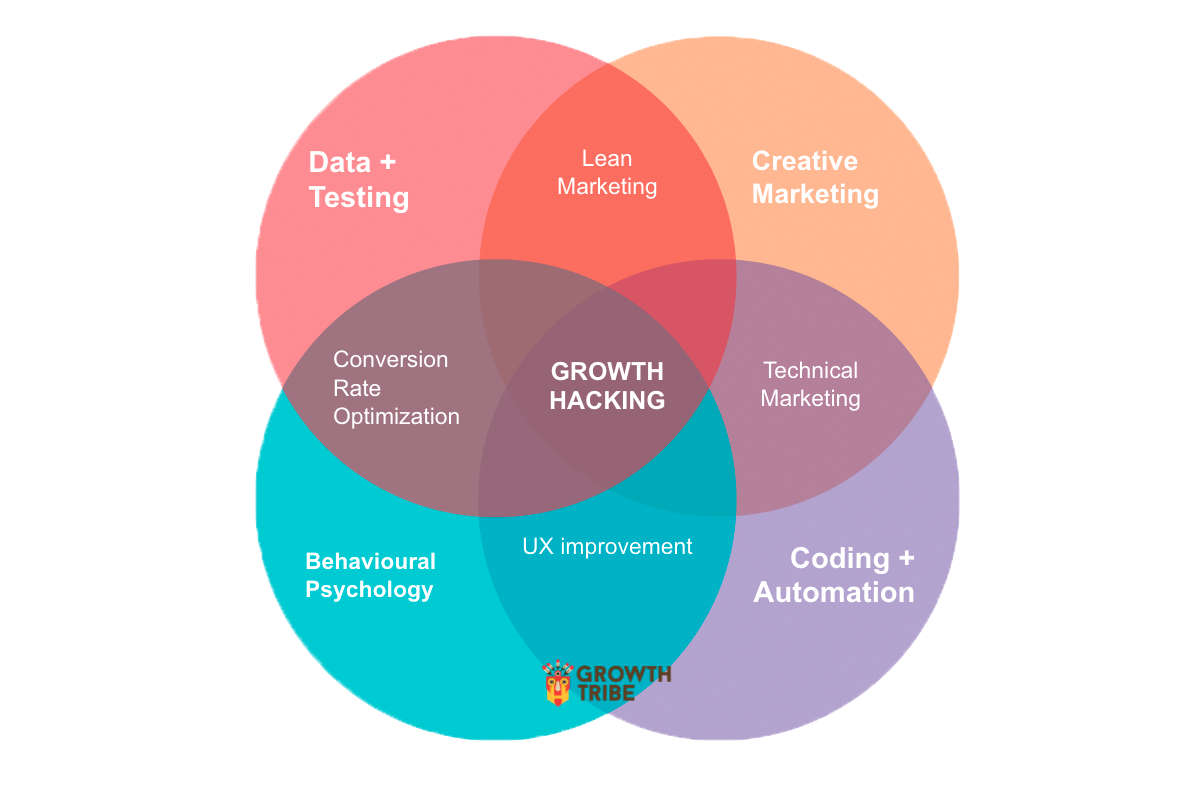
Everything a growth hacker does is aimed towards a uniform, single goal –growth. A growth hacker uses all initiatives, tools, and techniques to achieve consumer growth. This professional needs to be both a marketer and an engineer who seeks out the best marketing ideas through testing and analyzing results. The end game for any growth hacker is finding scalable strategies to bring in more users. A growth hacker ignores everything else to focus on infiltrating the market through product innovations, new distribution channels, and technology-based features. Growth hacking tricks for startup need to be precise, concise and achievable in nature.
We’ve mentioned 6growth hacking techniques in particular:
Customer Insight and Feedback
Traffic Generation
User Testing
Lead Generation
Email Marketing
Inbound Marketing
Consumer Insight and Feedback
Having a better understanding of your customers (on a deeper level than any web analytics tool provides) is pivotal to having a successful digital business strategy. In other words, knowing what your customers want, how they arrive at their decisions online and how they are interacting with your brand can shape this strategy tremendously – so how do you access these insights?
These insights can be extracted in two different ways depending on how ‘in-depth’ you want to go. The first growth hack technique is the customer feedback. There are several different customer feedback tools on the market that collect data from your customers, whether that’s via online feedback forms, surveys, reviews, etc. The feedback is gathered directly from your customer base and reflects their opinion about your brand and website.
Some examples of customer feedback tools include Mopinion, PollDaddy and WebEngage. Source: Mopinion Feedback Analytics software
Alternatively, you can focus on another growth hacking technique: generic consumer insights. Tools in this area are often geared towards the e-commerce industry and collect insights from the perspective of an entire market. They are focused on insights collected from metadata level, such as how consumers search online, their purchase behaviour, device usage, etc. A good example of this is Consumer Barometer.
Traffic Generation
Traffic Generation is all about maximizing the engagement and relationships by inserting yourself in relevant conversations with your customers and sharing content amongst potential customers/visitors. This is a very useful growth hack idea and is very critical to the growth of your company, tools that use this growth hacking technique help businesses establish a strong online presence.
When the question of successful growth hacking techniques for startups is asked, generating traffic with consumer engagement pops up. They also provide insight into how your competitors are performing in regards to incoming traffic and which parts of your website need optimizing to achieve higher traffic levels. Source: Colibri.io
Online communities, in particular, are a powerful source of traffic and can significantly aid in facilitating online engagement. Also the members of a community are encouraged to interact within the community and can do things like vote on an idea or provide a suggestion. Alternatively, online communities also provide a lot of insight from a customer service perspective. These communities provide a usable platform for members to indicate that they have encountered a problem on the website, which may be a problem shared by other users. An example of this is Colibri.
In addition to online communities, there are many other ways of generating traffic. Some of the growth hack ideas are mentioned here. Users can implement spy tools which allow them to research their competitors and gain insights into which traffic sources, text ads or banner ads they are using – e.g. MixRank. Alternatively, there are tools more geared towards content promotion such as PayWithATweet that allow users to access your content only if they’ve tweeted or posted about it.
User Testing
Another important growth hacking trick for startups is user Testing techniques. It is also known as user experience (UX) techniques, are very beneficial in terms of boosting user interaction. Variety of tools are available within this category that will help to achieve improved website usability as well as provide you with insight into how visitors experience a website or mobile app. These tools include heatmapping, A/B testing, session recording, event-tracking and design & wireframing tools. Source: Clicktale
Heatmapping and session recording tools, for example, shows how your visitors are interacting with your website based on factors such as clicks, scrolls and mouse movement. To use this growth hacking technique, tools such as Hotjar and Clicktale can be applied.
A/B Testing, on the other hand, is focused more so on testing different versions of websites and/or landing pages. Examples of these tools include Visual Website Optimizer (VWO) and Optimizely.
Lead Generation
One of the best growth hacks is growing your customer base, and for obvious reasons, an important goal if you want to achieve growth. Which is why many growth hackers choose to use various lead generation techniques. Tools that use this type of growth hack techniques are intended to help businesses improve in areas that will promote growth such as Search Engine Optimisation (SEO), Conversion Rate Optimisation (CRO) content visibility and of course, customer acquisition. As you might’ve guessed, this can cover a wide range of tools.
Lead gathering techniques are among the most popular amid growth hacks for startups who are looking to build up a list of prospects. This growth hacking technique is demonstrated using tools such as SalesForce, LeadCrunch and Lead Genius. Alternatively, in terms of SEO, tools such as Google Keyword Planner are also very helpful in making sure you score high in keyword rankings within digital content.
Email Marketing
Once the leads are gathered, you’ll need a way of ‘reaching out’ to these prospects. The best growth hacks usually used in this are to do with email marketing. A very effective and long withstanding growth hacking technique, email marketing tools are a great way of targeting both existing and potential customers with relevant content (such as blogs, newsletters, updates, etc).
Email marketing is still considered the most targeted and valuable channel for contacting potential customers. And what’s interesting about this field is that many marketers just kind of ‘stumble’ into it, which makes choosing the right tool all the more essential. Some of the well-known growth hack examples for email marketing are toolsinclude, MailChimp, CampaignMonitor and AWeber.
Inbound Marketing
Last but not least we have a growth hacking trick for startup which was the best growth hacks in past and continues to be the best growth hacking techniques in 2018; inbound marketing. A lot of tools that are focused on bringing in new customers are available for this growth hacking technique. It is usually done by way of relevant content creation and sharing. Creating content that entices your readers can help you quickly build up trust among them. Without having to fight for their attention (bonus!). And in addition to trust, these tools also help build awareness of your brand and what it has to offer. This includes introducing new solutions to your readers’ problems.
Many inbound marketing tools have multiple capabilities. Take HubSpot, for example. This tool is not only tracks and measures blogging activities, social media marketing and email marketing. But it can also help you create landing pages and offers a content management system that assists you in optimizing your content. There are also tools that serve as content discovery platforms, such as Outbrain. With these tools, companies can increase their reach in terms of readers – a great growth hacking technique.
To skyrocket your inbound marketing results, diversify your inbound marketing tactics by using more than one marketing channel.
Conclusion
The growth hacking strategies you decide to use largely depend on. The type of business you have, your current situation, and what you intend to achieve.
It’s worth noting that growth hacking only works when you invest your time and resources on the right strategy. For optimal results, try out different growth hacking techniques to see what gives you the best ROI. Then put all your efforts into what works and abandon what doesn’t.
For Curious Minds
Growth hacking is a disciplined methodology where every action is obsessively oriented toward a single goal: growth. Unlike traditional marketing's broader focus, a growth hacker, whose true north is growth, uses a rapid, iterative cycle of testing and analysis across product, engineering, and marketing channels to find scalable acquisition strategies. This approach prioritizes data-driven experiments over conventional marketing campaigns.
A growth hacker focuses on infiltrating the market by using precise, achievable tactics. This might involve:
Product Innovation: Embedding viral loops or referral mechanics directly into the user experience.
Distribution Channels: Identifying and exploiting unconventional channels where target users congregate.
Technology-Based Features: Building tools or features that attract users organically.
This multi-disciplinary mindset, blending marketing creativity with engineering prowess, is what enables startups to achieve explosive growth. To fully understand how this approach redefines marketing, explore the foundational principles in our complete guide.
The choice depends on whether your immediate goal is to optimize the current user experience or to identify new market opportunities. Direct feedback tools provide granular insights into how existing customers interact with your brand, while market data reveals macro trends in consumer behavior. A balanced strategy integrates both, using direct feedback for tactical improvements and market data for strategic pivots.
Consider these factors when allocating resources:
Direct Feedback (e.g., Mopinion, WebEngage): Best for understanding specific pain points, improving website usability, and validating new features with your active user base. It directly answers why users behave a certain way on your site.
Market Insights (e.g., Consumer Barometer): Ideal for understanding purchase behavior, device usage trends, and how consumers search online across the entire market. It helps you discover new audiences or product categories.
Strong companies use insights from Consumer Barometer to shape their high-level strategy and then deploy tools like PollDaddy to test and refine the execution. Learn more about balancing these approaches by examining the full analysis.
A systematic customer insight loop allows a SaaS startup to make data-informed product decisions without a large budget. The key is to start small, collect targeted feedback on the most critical user journey, and act on it swiftly. This process turns user opinions into a powerful engine for improving retention and product-market fit.
Here is a four-step plan to establish an effective feedback loop:
Identify Critical Touchpoints: Map your user onboarding flow and pinpoint key moments, such as sign-up, first feature use, or a trial conversion point.
Deploy Feedback Tools: Implement simple, non-intrusive feedback mechanisms. Use a tool like PollDaddy to create short surveys that trigger after a user completes a key action.
Analyze and Categorize: Collect and tag feedback to identify recurring themes, bugs, or points of confusion. Focus on high-impact issues that affect the most users.
Iterate and Communicate: Make product changes based on the feedback, then notify the users who provided it. This closes the loop and builds customer loyalty.
This iterative cycle ensures your product development is always aligned with what customers actually want. Discover more advanced techniques for applying these insights by reading the complete article.
Successful companies treat customer feedback not as a suggestion box but as a core driver of their product roadmap. They use tools like WebEngage to systematically capture user sentiment at key moments in the customer journey and transform that qualitative data into quantitative priorities for development. This ensures that engineering efforts are focused on changes that will have the greatest impact on user satisfaction and retention.
The strategy involves creating a structured process to operationalize feedback. For instance, a company might use an online feedback form from Mopinion to discover that 30% of users abandon their cart due to confusing shipping options. This specific, actionable insight allows them to prioritize a redesign of the checkout flow, directly addressing a major friction point and leading to a measurable increase in conversion rates. By connecting feedback directly to business metrics, these companies build a growth engine powered by their own users. Find more examples of data-driven product strategies in the full text.
The growth hacker's role is shifting from a pure acquisition focus to a more holistic responsibility for the entire customer lifecycle. In a crowded digital landscape, sustainable growth depends less on one-off hacks and more on building a product that deeply understands and adapts to user needs. This requires a sophisticated, dual-lens approach to data analysis.
Future-focused growth strategies will rely on integrating two distinct types of insight:
Micro-Level Insights: Direct feedback from tools like online surveys reveals the why behind user actions on your platform, enabling you to optimize the existing experience.
Macro-Level Insights: Broad market data on purchase behavior and device usage helps you anticipate market shifts and identify new growth channels before competitors do.
A growth hacker who can synthesize these data streams, using market trends to inform strategic direction and direct feedback to refine execution, will be positioned to build more resilient, customer-centric products. Explore how to build this capability within your team by diving into our complete analysis.
The primary reason for collecting vague feedback is asking overly broad questions at the wrong time in the user journey. A generic "How can we improve?" prompt yields unhelpful responses. In contrast, successful growth strategies rely on gathering specific, contextual feedback that is directly tied to a user's recent actions or goals.
To avoid this pitfall, adopt a more disciplined approach by separating feedback collection into distinct categories:
General Sentiment: Use simple rating surveys to gauge overall satisfaction without expecting detailed solutions.
Task-Specific Feedback: After a user completes a key workflow, use a targeted online feedback form to ask, "Did you find everything you were looking for during checkout?"
Feature Validation: Employ tools like WebEngage or PollDaddy to present new feature ideas to specific user segments and gauge their interest before building.
This structured method ensures you collect high-quality, actionable data that can be used to make precise product improvements. Learn how to design effective feedback prompts in the full article.
Web analytics tell you *what* users are doing, but deep customer insights explain *why*. This understanding is the bedrock of growth hacking because it allows you to move beyond generic tactics and create highly resonant campaigns and product features. Knowing your customers' motivations, decision-making processes, and pain points enables you to craft messaging and build distribution strategies that feel personal and relevant.
This deeper knowledge, gathered through feedback tools and market analysis, directly shapes key growth activities. For instance:
Traffic Generation: Instead of broadly sharing content, you can insert yourself into the specific online conversations and communities where your ideal customers are already active.
Lead Generation: Your value propositions and calls-to-action can be tailored to address the exact problems your target audience is trying to solve.
Without this foundational insight, your growth efforts are essentially guesswork. To build a strategy based on a true understanding of your market, you must first master the art of gathering these deeper insights.
Effective traffic generation is not about broadcasting content everywhere but about strategically participating where potential customers are already engaged. Data shows that targeted engagement builds trust and authority, which are key drivers of sustainable traffic. Instead of chasing vanity metrics, a growth hacker focuses on building relationships within niche communities.
Proven methods for inserting your brand into relevant conversations include:
Monitoring Social Keywords: Use tools to track mentions of specific problems your product solves and engage with users discussing them.
Value-Added Forum Participation: Actively contribute helpful advice in relevant communities or industry forums without overt promotion.
Content Collaboration: Partner with influencers or other brands in your space to create content that provides genuine value to their existing audience.
This approach shifts the focus from interruption to valuable contribution, establishing your brand as a helpful resource and naturally attracting qualified visitors. Explore more advanced traffic generation tactics in our detailed overview.
A cohesive growth strategy uses customer insights as the central hub that informs all other activities. Instead of launching disconnected campaigns, a growth marketer should build a system where learnings from one technique feed directly into the next. This creates a powerful feedback loop that continuously optimizes for growth across the entire funnel.
To build an integrated strategy, follow this sequence:
Start with Customer Insight: Use surveys and feedback to define your ideal customer profile and their core problems.
Inform Inbound and Traffic Generation: Create content that addresses these specific problems and distribute it in the channels your customers frequent.
Optimize for Lead Generation: Use the insights to craft compelling offers and landing pages that convert traffic into leads.
Refine with User Testing: Test your conversion funnels and product features to eliminate friction points identified through user feedback.
Nurture with Email Marketing: Use what you've learned about customer needs to deliver personalized and valuable email campaigns.
This systematic approach ensures each tactic builds upon the last, creating a unified and highly effective growth engine. Dive deeper into how these elements connect in the complete guide.
The most common failure is believing that great content will promote itself. Startups often fall into the "build it and they will come" trap, dedicating most of their effort to creation and little to distribution. A growth hacking mindset inverts this, understanding that distribution is equally, if not more, important than creation itself.
A growth hacker solves this problem by systematically focusing on getting the content in front of the right audience. This involves:
Pre-Launch Promotion: Building anticipation and involving influencers or communities before the content is even published.
Targeted Outreach: Manually sharing the content with individuals and communities who would find it most valuable.
Repurposing Content: Adapting a single piece of content into multiple formats to maximize its reach across different channels.
This relentless focus on maximizing engagement and relationships ensures that every piece of content achieves its maximum potential impact. Uncover more strategies for effective content distribution in the full analysis.
A true growth hacker's focus on scalability acts as a filter for all potential marketing and product initiatives. While short-term tactics can provide initial boosts, the primary goal is to discover and build repeatable, cost-effective systems that drive continuous growth. This means prioritizing initiatives that can be automated or have compounding returns over time.
A growth hacker evaluates every idea based on its potential for scale. For example:
A one-time press mention is a short-term win.
Building a strong SEO foundation is a long-term, scalable system that generates traffic passively.
Manually onboarding every new user is not scalable.
Creating a viral referral loop within the product is a scalable engine for user acquisition.
This mindset forces a constant search for channels and product features that grow more efficient as the user base expands. Discover how to identify and build these scalable growth engines in our complete guide.
Automation and AI will not replace the growth hacker but will instead become powerful force multipliers, automating repetitive tasks and uncovering insights at scale. This allows the growth hacker to focus less on manual execution and more on high-level strategy, creative experimentation, and interpreting complex data. The core principle of hypothesis-driven testing remains central.
To remain effective, growth professionals must cultivate skills in:
Strategic Thinking: The ability to formulate insightful hypotheses and design clever experiments that AI cannot devise on its own.
Data Interpretation: The skill to look beyond the surface-level metrics provided by tools and understand the deeper why behind user behavior.
Cross-Functional Leadership: The capacity to work with product and engineering teams to implement complex, technology-driven growth initiatives.
The future growth hacker will be less of a tactical "hacker" and more of a strategic "growth scientist." Learn how to prepare for this evolution by reading our complete analysis.
Amol has helped catalyse business growth with his strategic & data-driven methodologies. With a decade of experience in the field of marketing, he has donned multiple hats, from channel optimization, data analytics and creative brand positioning to growth engineering and sales.

 Growth Strategy and Planning
 Inbound Growth
 Growth Hacking
 Fractional CMO
 Search Engine Optimization
 Paid and Performance Marketing
 Social Media Marketing
 Demand Generation
 AI-Driven Growth Strategy
 AI-Native Workflow Automation
 Generative Engine Optimization
 Grove — AI Growth Strategist

 AI Automation
 Framework
 Case Study
 Tools
Tools Growth Tools
 Decision Tree
 Compare
 Custom GPT's
 AI Answer Gap
 Offer
Offer Webstories
 Quizzes
 Blog
Blog AI-powered Apps
 Social Media Tools
 Agency Fit Score