Contributors:
Amol Ghemud Published: August 14, 2018
Summary
In This Article
Share On:
Let’s face it. It’s not an easy time to be a social media marketer. After all, it’s hard to build a social media marketing plan with all of the uncertainty that we face.
So you need to create a social media strategy plan. Many of us struggle to iron out exactly what that is, let alone figure out how to build one from scratch.
Put simply, every action you take on social networks should be a part of a larger social media strategy plan. That means every post, reply, like, and comment should all be guided by a plan that’s driving toward business goals. It might sound complicated, but if you take the time to answer the question how to plan social media strategy, and create a communication plan, the rest of your social efforts should follow naturally. Everyone can do this if they approach it correctly.
Want to create a successful social media strategy for your business?
What is a social media strategy plan?
A social media strategy plan is the marketing summary of everything you plan to do and hope to achieve for your business using social networks. This plan comprises of an audit of where your accounts are today, goals for where you want them to be in the near future, and all the tools you want to use to get there.
In general, the more specific you can get with your plan, the more effective you’ll be in its implementation. In social media content strategy plan, the businesses need to be concise in their approach. Don’t make your social media strategy plan so lofty and broad that it’s unattainable.
The plan will guide your actions, but it will also be a measure by which you determine whether you’re succeeding or failing. You don’t want to set yourself up for failure from the outset.
Well it’s 2018 and not much of the same logic applies today. With 30% of millennials saying they engage with a brand on social media at least once a month, your strategy can’t be only about existence. Brands must be fully invested in their social media marketing strategies and focus on engagement. Otherwise, you’ll lose out on real customers, which means serious effects on your bottom line.
Social Media Goals
Goal setting is the basis of all marketing and business strategies. Social media marketing strategy is no exception. Of course, with a wide range of social capabilities, it can be difficult to determine exactly what your objectives should be. For guidance, here are some common social media goals to consider:
Increase brand awareness: You must create authentic and lasting brand awareness, avoid a slew of promotional messages. Instead, focus on meaningful content and a strong brand personality through your social media channels.
Higher quality of sales: Digging through the various social media channels employed by you is nearly impossible without monitoring or listening to specific keywords, phrases or hashtags. Through more efficient social media targeting, you reach your core audience much faster.
Drive in-person sales: Some retailers rely on social media marketing efforts to drive in-store sales. Is your brand promoting enough on social media to reward those who come to you? What about alerting customers to what’s going on in your stores?
Improve ROI: There’s not a single brand on social media that doesn’t want to increase its return on investment. But on social media, this goal is specific to performing a thorough audit of your channels and ensuring cost, advertisements and design to stay on track.
Create a loyal fan base: Does your brand promote user-generated content? Do your followers react positively without any initiation? Getting to this point takes time and effort with creating a positive brand persona on social.
Better pulse on the industry: What are your competitors doing that seems to be working? What strategies are they using to drive engagement or sales? Having a pulse on the industry could simply help you improve your efforts and take some tips from those doing well.
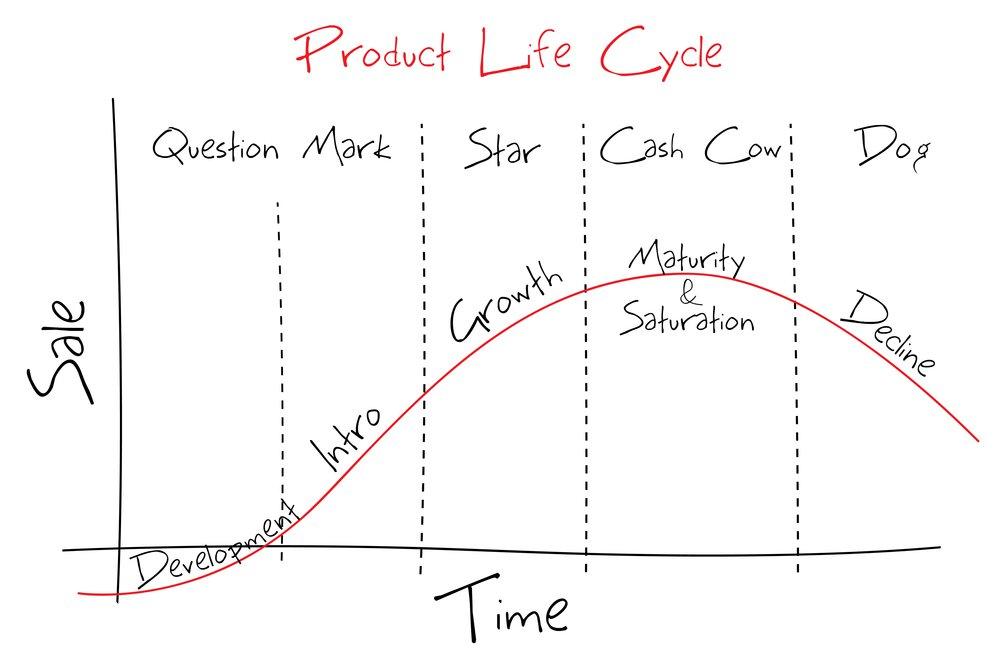
“Product life cycle” (PLC) refers to the stages a product goes through, from beginning to end. It’s a rise and fall story, that, if all goes well, will lead to a lot of profit before the journey is over. Let’s take a closer look at the different stages of the cycle to and get insights into integrating it to social media strategy plan.
Stage 1: Introduction
The product life cycle stages begin with the often difficult “introduction.” During this stage, the assumption is that returns will be negative. You’ve just spent a ton of money developing your product, and now you’ve got to spend even more to get the word out. Think, for example, of how many marketing dollars Kellogg’s will spend to introduce a new breakfast cereal in the hope that it will eventually catch on.
So in this stage: For social media marketers, one should participate in early stage of the launch and understand the opportunities. One should at least give initial attention and keeps their eye on the growth of the brand. If you start participation at early stage, your brand will also get advantage of early adaption and grow social media website.
Grab the attention of target audience by organizing online contest or free give away.
Stage 2: Growth
The growth stage is critical in the life cycle of all successful products, and the same can be said for a successful piece of content.
At this point, social media marketers can see whether a given piece of content is gaining traction on the social media platforms. “Early adopters” (or educated opinion leaders) will start sharing the content with their networks thus building the reach of it.
When you see the tweet promoting your content retweeted by an industry expert with a large following, you know the growth stage has started and that it’s time to own the content and invest in distribution.
Social media strategy 2018 mandates the marketers to advertise their product on those social media which are having increasing or high mass. Being an advertiser you must get benefits from this growing audiences and should heavily promote your products and brand. Most of the brands spend their social media marketing budget to websites which are in Growth stage.
In the growth stage, several changes ensure that the users always find something new to talk about and spread the news. Facebook said to be in the growing stage as it introduces newer elements regularly.
Stage 3: Maturity
If your product or content has made it this far, you can finally start to enjoy the fruits of your labor.
When it comes to the social media plan cycle, the maturity stage is when you know your content has been consumed and shared by “early and late majority” adopters. This means that your mainstream readers are seeing and sharing your content. Typically, you’ll stop running advertising and rely on the network effect on social media.
For marketer, they should decline the spending and divert their budget on social media websites which are in Introduction or Growth stage. If you are getting good ROI from the website, you should keep promoting there but rather than relying on single website, you should start searching for alternative.
Stage 4: Decline
In the PLC, the decline stage can be painful. The Kellogg’s cereal has been around so long that kids now associate it with their parents and there are two generic rip-offs sitting right next to it on the supermarket shelf.
In other words, the competition has caught up and the market has become saturated.
Conclusion
Creativity and research is the key to enabling any social media platform go through a long product life cycle stages. The wise social media markers must keep their eyes on product life cycle strategies of the social platform. This information can help you to better understand the performance of platform and can help you to strategize your future social media marketing endeavors.
Watch How Social Media Strategy Adapts to the Product Life Cycle
For Curious Minds
A social media strategy plan is your business's definitive roadmap, detailing not just what you will post but why. It moves beyond a simple schedule of content to encompass a complete audit of your current social standing, clearly defined business goals, and the specific tools you will use to achieve them. The documentation is critical because it provides the framework to measure success or failure, ensuring every single action is deliberate and aligned with your overarching objectives. A well-defined plan ensures you are proactive, not reactive.
For a plan to be effective, it must be specific and include:
Goal Alignment: Tying every social media objective, such as increasing brand awareness or driving sales, directly to larger business goals.
Audience Definition: A clear profile of your target audience on each platform to tailor your content and tone effectively.
Competitive Analysis: A continuous pulse on what competitors are doing, what works for them, and where you can differentiate.
Metric Tracking: Identifying the key performance indicators (KPIs) that will determine your return on investment.
This level of detail turns your social media from a daily chore into a strategic asset. A documented plan allows you to guide your actions with precision and provides the clear measures by which you will determine your actual success. Explore the full guide to see how these elements combine into a cohesive strategy.
Defining specific, measurable goals transforms your social media presence from a passive existence into an active growth engine. Without clear objectives, your posts, replies, and comments lack direction, but when guided by a goal like improving ROI, every action becomes a calculated step toward a tangible business result. This focus ensures that your efforts, from ad spend to content creation, are efficient and justifiable, directly impacting your bottom line. It's the difference between merely being present and being present with a purpose.
Your strategic goals should be detailed and actionable, focusing on areas such as:
Higher Quality of Sales: Using social listening for specific keywords to connect with your core audience faster.
Increased Brand Awareness: Building a strong brand personality with meaningful content, not just promotional messages.
Loyal Fan Base: Encouraging user-generated content to foster a community that advocates for your brand organically.
By setting these concise targets, your plan becomes a powerful tool that guides your actions and measures your success. Learn more about how to set goals that align perfectly with your business's unique needs.
The decision between cultivating a loyal fan base and driving immediate in-person sales depends entirely on your long-term business objectives and brand identity. Focusing on a loyal fan base is a brand-building play that yields sustained, organic growth and word-of-mouth marketing, while prioritizing sales promotions delivers more immediate, measurable revenue spikes. Neither approach is inherently better, but the right choice aligns with your specific market position and growth stage. A new brand may need quick wins, while an established one may seek deeper loyalty.
Consider these factors when choosing your primary focus:
Business Model: E-commerce brands might prioritize fan loyalty for online advocacy, whereas retailers with physical stores may need to drive foot traffic.
Product Lifecycle: New product launches often benefit from sales-focused promotions to gain initial traction and market share.
Brand Persona: A community-oriented brand persona naturally lends itself to fostering user-generated content and long-term engagement.
Ultimately, a balanced strategy often integrates both, using community engagement to build a foundation for high-impact sales events. Discover how to blend these objectives by reading the full content.
To build authentic brand awareness, you must shift your focus from selling to connecting. With 30% of millennials engaging brands monthly, the opportunity lies in creating meaningful content that reflects a strong, relatable brand personality. This means prioritizing value and conversation over direct promotion. Successful brands achieve this by sharing content that educates, entertains, or inspires their audience, making their social media channels a destination rather than just a digital billboard.
Effective tactics for authentic awareness include:
Showcasing brand values through stories about your company culture, mission, or community involvement.
Promoting user-generated content, which acts as powerful social proof and builds a community around your brand.
Engaging in conversations by responding to comments and messages promptly, showing there are real people behind the logo.
Partnering with influencers who align with your brand's personality and can share your message with their established, trusting audience.
This approach fosters a genuine connection, turning passive followers into active fans. See more examples of how to craft this type of content in the complete article.
Leading brands measure social media ROI by connecting social activities directly to business outcomes like lead generation, conversions, and customer lifetime value. They move beyond vanity metrics to focus on tangible returns. A thorough audit is a systematic review that ensures all resources, including financial spend and creative effort, are optimized for maximum efficiency and impact. This process involves a deep analysis of what's working, what is not, and where adjustments need to be made to stop wasting budget and effort.
A practical audit for improving ROI includes these key steps:
Performance Review: Analyzing the engagement, reach, and conversion rates of past posts to identify top-performing content themes and formats.
Ad Spend Analysis: Scrutinizing the cost per click (CPC), cost per acquisition (CPA), and overall return on ad spend (ROAS) for all paid campaigns.
Audience Alignment: Verifying that your current followers match your target customer profile and adjusting targeting parameters if they do not.
Competitor Benchmarking: Comparing your performance metrics against key competitors to identify gaps and opportunities.
This rigorous evaluation ensures your social media strategy is not just active, but financially accountable. To learn how to conduct your own audit, check out the full analysis.
For a local restaurant, an effective social media strategy to drive in-store sales must be timely, targeted, and engaging. The goal is to create a sense of immediacy and exclusivity that encourages followers to visit in person. This requires a plan that goes beyond just posting a menu; it should build a local community and provide clear incentives for participation. A successful approach combines hyperlocal targeting with compelling, time-sensitive content.
Here is a four-step implementation plan:
Optimize Your Profiles: Ensure your address, hours, and phone number are correct on all social profiles. Use location-based hashtags (e.g., #yourcityfoodie) in your posts.
Create "In-Store Only" Offers: Post daily specials or secret menu items available only to social media followers who show the post at the counter. This creates exclusivity and tracks conversion.
Use Geo-Targeted Ads: Run low-cost ads on platforms like Facebook and Instagram targeting users within a few miles of your restaurant, promoting a limited-time offer.
Encourage User-Generated Content: Run a contest asking customers to post a photo of their meal and tag your restaurant for a chance to win a gift card, generating social proof and visibility.
This focused plan turns your social channels into a direct driver of foot traffic. For more detailed tactics on local marketing, explore the complete guide.
The evolution from passive presence to active engagement fundamentally changes the resource allocation for social media. Businesses must now invest in creativity and community management, not just scheduling tools. A strong brand personality requires skilled content creators who can craft a consistent and authentic voice, while fostering engagement demands dedicated community managers who can interact with audiences in real time. This means budgets will likely shift toward talent and content production rather than just advertising spend.
Future-focused businesses should adjust their strategies by:
Hiring for creativity and empathy, not just technical platform knowledge.
Allocating time for proactive engagement, including responding to comments, initiating conversations, and monitoring brand mentions.
Investing in higher-quality content creation, such as video, high-resolution imagery, and interactive formats like polls and Q&As.
Integrating social media teams more closely with customer service and product development to ensure a cohesive brand experience.
This strategic realignment ensures your brand can build the lasting relationships that drive long-term value. Read the full post to understand how to prepare your team for this future.
The most common mistake is setting vague, unmeasurable goals like "increase brand awareness" without defining what success looks like. This leads to a broad, unfocused strategy that is impossible to execute or evaluate effectively. A plan becomes unattainable when it lacks the specific key performance indicators (KPIs) and tactical details needed to guide day-to-day actions and measure progress toward a clear destination. To avoid this, you must anchor your strategy in concrete, quantifiable objectives from the start.
To build a realistic and measurable plan:
Start with an Audit: Analyze your current performance to set a realistic baseline for future growth.
Define SMART Goals: Ensure every objective is Specific, Measurable, Achievable, Relevant, and Time-bound (e.g., "increase engagement rate by 15% in Q3").
Break Down Goals into Tactics: Connect each goal to specific actions. For brand awareness, tactics could include a weekly influencer collaboration or a bi-weekly live video series.
Assign Responsibility: Clearly define who on your team is responsible for each tactic and metric.
This approach grounds your strategy in reality and provides a clear path to success. Learn more about how to set up a framework for success in the full article.
Failing to generate quality leads often stems from broadcasting messages to a wide, uninterested audience. Targeted keyword and hashtag monitoring solves this by shifting your strategy from broadcasting to listening. By actively tracking conversations relevant to your industry, product, or customer pain points, you can identify and engage potential customers who are already expressing interest or need, dramatically improving the quality of your leads. This proactive approach ensures you connect with your core audience much faster than passive posting.
Implementing a monitoring strategy involves:
Identifying high-intent keywords and phrases your potential customers use when searching for solutions (e.g., "looking for a new CRM," "recommendations for project management software").
Using social listening tools to track mentions of these terms, your brand, and your competitors in real-time.
Engaging directly with users in these conversations by offering helpful advice or resources, rather than a hard sales pitch.
This method allows you to enter the sales conversation at the perfect moment. Dive deeper into the techniques for effective social listening by reading the complete article.
Analyzing competitors provides a powerful playbook of proven strategies and potential pitfalls within your specific market. It allows you to benchmark your performance and identify opportunities you may have missed. By systematically tracking what your competitors post, how their audience responds, and the campaigns they launch, you can gain actionable insights that inform your own content strategy, ad targeting, and engagement tactics, helping you avoid their mistakes and replicate their successes.
Key insights you can gain from competitor analysis include:
Top-Performing Content: Identify the formats (e.g., video, carousels, polls) and topics that generate the highest engagement for them.
Audience Overlap: Discover new audiences you could be targeting by analyzing who follows and interacts with your competitors.
Untapped Keywords: Find relevant hashtags and keywords they are using successfully that you can incorporate into your own posts.
Customer Pain Points: Monitor their comments section to understand common questions or complaints from customers in your industry.
This intelligence enables you to refine your strategy with data-backed decisions. Explore the full content to learn more about conducting an effective competitive analysis.
For a startup, the key is to be focused and deliberate, not to try and be everywhere at once. Building a foundational strategy around a single, clear goal like creating a loyal fan base prevents you from spreading your limited resources too thin. This approach prioritizes deep engagement with a core group of early adopters, who can then become powerful brand advocates. The plan should be simple, measurable, and centered on providing value to this initial community.
Here is an efficient four-step process:
Choose One Primary Platform: Research where your target audience is most active and concentrate all your efforts on mastering that single channel first.
Define Your Brand Persona: Decide on your brand's tone of voice and personality. Will it be witty, helpful, authoritative, or playful? Consistency is key.
Develop Value-Driven Content Pillars: Instead of just promoting your product, create three to four content themes that educate, entertain, or solve problems for your audience.
Engage Proactively: Dedicate time each day to not only respond to comments but to also start conversations, ask questions, and interact with potential fans.
This lean strategy ensures every action contributes to your primary goal. For more on how to scale this plan as you grow, read the full article.
While both B2B and B2C companies aim for brand awareness, their approaches and metrics must differ significantly to match their distinct audiences and sales cycles. A B2C fashion brand can focus on building a large, visually engaged community, measuring success through follower growth, user-generated content, and influencer mentions. In contrast, a B2B software company must prioritize establishing thought leadership and credibility within a niche professional audience, tracking metrics like share of voice, content downloads, and engagement from key industry leaders.
Key differences in their strategies include:
Content Focus: The B2C brand will use visually appealing content like lifestyle photos and video lookbooks, while the B2B company will create informative content such as whitepapers, case studies, and webinars.
Platform Choice: The fashion brand would likely dominate on Instagram and TikTok, whereas the tech company would find more value on LinkedIn and Twitter.
Success Metrics: The B2C brand tracks reach and engagement rate, while the B2B company measures lead quality from social sources and website clicks to technical documentation.
Tailoring your approach to your specific industry is crucial for meaningful results. Discover how to adapt your strategy for any business model in the complete guide.
Amol has helped catalyse business growth with his strategic & data-driven methodologies. With a decade of experience in the field of marketing, he has donned multiple hats, from channel optimization, data analytics and creative brand positioning to growth engineering and sales.

 Growth Strategy and Planning