Google’s AI Overview, evolving from the Search Generative Experience (SGE), offers quick, concise search summaries using advanced machine learning. It efficiently condenses information into easy-to-read snippets, enhancing user experience by reducing browsing time and tailoring results to queries. For content creators and SEO professionals, it emphasizes the need for clear, structured content. This advancement significantly improves search technology, prioritizing clarity, speed, and user satisfaction.
In This Article
Share On:
If you’ve ever marvelled at how search engines seem to read your mind, you’re not alone. Google has once again pushed the boundaries with its latest innovation, AI Overview, which has grown from the roots of the Search Generative Experience (SGE).
This advanced feature transforms the way we interact with information, making searches faster, smarter, and more intuitive.
In this blog post, we’ll dive deep into the workings of AI Overview, exploring how it simplifies finding information by distilling complex data into concise, easy-to-digest summaries.
Join us as we explore how this feature is an improvement and a complete transformation of the search landscape, promising to make our digital interactions more efficient and our everyday inquiries more productive.
Exploring AI Overview in Google SERP
While the Search Generative Experience is like having a deep conversation with Google, AI Overview serves as your quick, knowledgeable summary card.
It’s designed to simplify your search by distilling the essence of information into easy-to-digest snippets right on your search results page.
What is AI Overview?
AI Overview, the latest iteration in Google’s search technology evolution, offers a refined method of quickly accessing the crux of vast information.
By synthesizing key data from diverse sources into concise, actionable summaries, AI Overview enables users to grasp essential facts and figures at a glance, significantly reducing the need to sift through multiple pages.
How Does AI Overview Work?
At its core, AI Overview utilizes advanced machine learning algorithms to scan and pull relevant information from a vast array of content across the web.
It then processes this data to highlight the most relevant facts, figures, and points related to your search query.
What makes AI Overview stand out is its ability to distill complex data into manageable bits that are easy to understand and quick to read.
Summarization: AI Overview picks out the key elements of information, presenting them in a simplified format. This is particularly useful for quick fact-checking or getting a brief overview of a topic without delving into detailed articles.
Contextual Awareness: The system smartly identifies the context of your query, ensuring that the summaries it generates are accurate and highly relevant to what you’re looking for. This means you get more tailored information that feels surprisingly intuitive.
Efficiency: By reducing the need to sift through multiple web pages, AI Overview saves you time, making your search experience significantly more efficient.
Why is AI Overview a Game-Changer?
AI Overview transforms the search process by making it faster, more accessible, and incredibly user-friendly. For anyone from students to professionals or just the casually curious:
Speed: Get quick answers to questions without the need for extensive searching.
Accessibility: Information is presented in a way that’s easy for everyone to understand, breaking down barriers to knowledge.
Engagement: The feature encourages users to explore topics further without feeling overwhelmed by too much information at once.
The Transition from SGE to AI Overview
As Google’s search technology advances, understanding the transition from SGE to AI Overview is crucial. Rather than viewing them as distinct entities, it’s more accurate to see AI Overview as the natural progression and enhancement of the capabilities initially introduced by SGE.
Evolution of Features
From Detailed to Concise: Where SGE provided detailed, conversational responses suited for in-depth exploration of topics, AI Overview refines this approach by offering concise, to-the-point summaries that are easier to digest and quicker to access.
Enhanced Interactivity: SGE’s interactive elements allowed users to engage in a dialog with Google’s search. AI Overview takes this further by enhancing the fluidity of interaction, making it more intuitive and predictive of the user’s search intent.
Visual and Functional Integration: The visual design and placement of AI Overview are more integrated and less obtrusive than SGE, providing a smoother and more cohesive user interface that enhances rather than interrupts the user experience.
Improved Use Case Adaptability
Broadened Application: While SGE was particularly beneficial for users requiring deep dives into complex topics, AI Overview extends its utility to quick fact checks and overviews, making it versatile for both rapid information retrieval and detailed research.
Forward-Looking Adaptations
Anticipating User Needs: AI Overview not only addresses the queries posed but also anticipates follow-up questions and related topics, offering a more proactive and context-aware search experience.
Streamlined Information Delivery: The feature optimizes how information is presented, focusing on efficiency and relevancy, which enhances usability for all types of search queries, from simple factual questions to complex research needs.
Practical Examples of AI Overview in Action
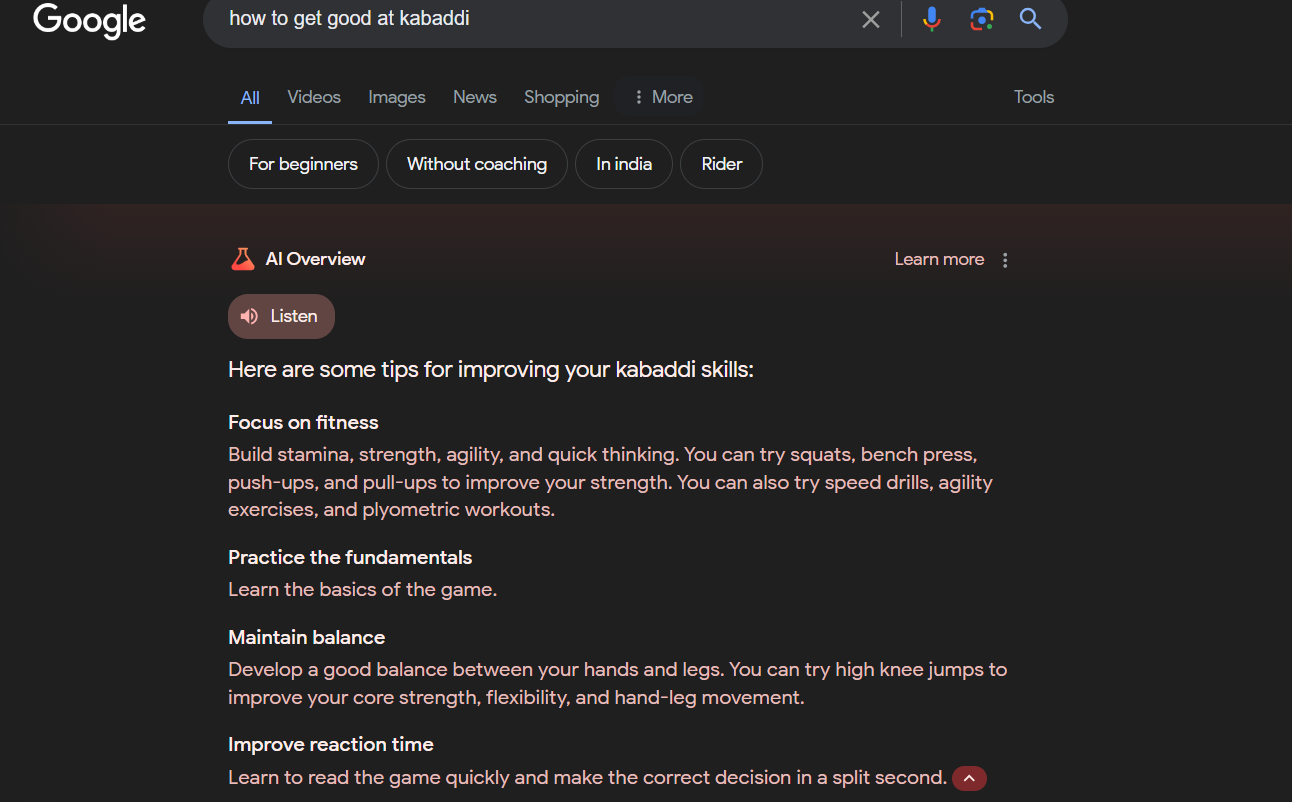
Search “how to get good at Kabaddi,” and you won’t just get generic advice.
Instead, AI Overview offers specific exercises like squats and bench presses that are perfect for Kabaddi players. It goes beyond to suggest agility drills and balance exercises—everything you need to boost your game performance.
It doesn’t stop at fitness. The tool dives into Kabaddi’s essential skills, advising on maintaining balance and quick decision-making.
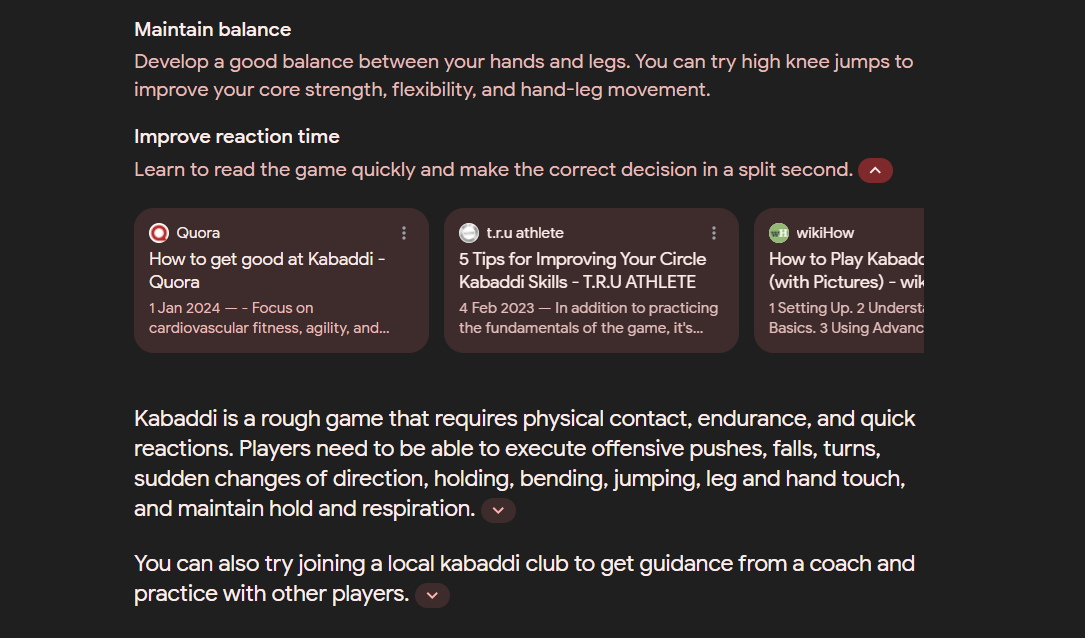
Practical tips, like doing high knee jumps to enhance flexibility, show AI Overview’s knack for understanding what really helps players improve.
After delivering its insights, AI Overview points you to extra resources from sites like Quora and WikiHow. It smartly integrates these resources right into the search results, making it a breeze to find comprehensive information in one go.
The way AI Overview presents this info is also slick. It uses an interactive layout that’s easy to navigate, with expandable sections for more depth.
This approach caters to various learning styles, making your quest to master Kabaddi more engaging and less overwhelming.
Impact on User Experience: Enhancing Interactions with AI Overview
As Google shifts from the Search Generative Experience (SGE) to the more refined AI Overview, the impact on user experience is both significant and positive.
Let’s explore how this technological evolution enhances the way users interact with search, improving accessibility, efficiency, and satisfaction.
1. Streamlined Information Access
Quick and Efficient
AI Overview condenses complex information into concise summaries, which means users spend less time sifting through lengthy content to find the answers they need.
This is especially beneficial in our fast-paced world, where quick access to information can make a big difference in both personal and professional contexts.
User-Centric Design
The design of AI Overview is intentionally streamlined to integrate seamlessly with the user’s search experience. This thoughtful integration reduces cognitive overload and makes the information easier to scan, understand, and remember.
It’s not just about finding information; it’s about making that information work for you in the most efficient way possible.
2. Enhanced Interaction Quality
Predictive and Proactive
Unlike the more reactive nature of SGE, AI Overview anticipates the user’s needs.
Based on the initial query, it not only answers the direct question but also provides additional related information that might be of interest.
This predictive approach ensures that users are offered a broader perspective on their queries, often illuminating aspects they hadn’t considered initially.
Dynamic Engagement
AI Overview’s ability to handle follow-up questions dynamically makes it feel like a conversation with a knowledgeable guide.
This aspect of interactivity keeps users engaged with the search process, often leading to deeper exploration and a better understanding of the subject matter.
3. Increased Accessibility
For Everyone
AI Overview’s concise summaries are a boon for all users, including those who might find long articles or dense academic papers challenging.
It democratizes information by making it accessible to users of varying ages, educational backgrounds, and even those with limited time to dedicate to research.
Language and Localization
With improvements in language processing, AI Overview can offer more nuanced and locally relevant responses, enhancing the usability for non-native speakers and providing a more personalized search experience globally.
4. Satisfaction and Trust
User Satisfaction
The efficiency and enhanced engagement provided by AI Overview lead to higher user satisfaction. People appreciate when technology meets their expectations and exceeds them by delivering information in smarter, quicker ways.
Building Trust
By consistently providing accurate, relevant, and easy-to-digest summaries, Google’s AI Overview builds trust with users. Trust is fundamental in user retention and turning occasional users into regular searchers.
Implications for SEO and Content Creation
As Google transitions from the Search Generative Experience (SGE) to the more streamlined AI Overview, the implications for SEO and content creation are profound and wide-reaching.
1. Prioritizing Conciseness and Clarity
Focus on Core Information:
With AI Overview emphasizing concise summaries, content creators must ensure their articles or web pages get straight to the point.
High-value information should be presented clearly and early in the content.
This shift encourages the crafting of well-structured pieces where the most important facts are highlighted or bulleted, making them easy for AI to identify and summarize.
Structured Content for Better Understanding:
Using headings, subheadings, lists, and bullet points becomes increasingly crucial.
These structures help AI Overview easily parse and extract the key elements of your content, potentially boosting your visibility in search results.
2. Enhancing Content for Featured Snippets
Optimize for Quick Answers:
AI Overview’s ability to pull direct answers into the search results means that websites must optimize their content to be the source of these answers.
This involves answering potential questions directly and clearly within your content, using question-based headings and straightforward answers that AI can easily interpret and use.
Leverage Schema Markup
Implementing schema markup remains a best practice, helping Google’s AI understand the context of the content it crawls.
By clearly defining your content’s nature and structure using schema, you increase the chances of being featured in AI Overview summaries.
3. Adapting Keyword Strategies
Long-tail Keywords Become More Valuable:
As AI Overview caters to more specific queries, the importance of long-tail keywords grows.
Content tailored to specific, often more conversational queries can capture the nuanced search intent that AI Overview is designed to satisfy.
Semantic Search Optimization:
It’s not just about keywords; it’s about context and relevance.
Content creators need to ensure their content covers topics comprehensively, integrating related terms and concepts that build a cohesive theme.
This holistic approach helps AI Overview understand and deliver the content as a reliable answer to related queries.
4. Increasing Reliance on AI and Analytics Tools
Leverage AI Tools for Content Optimization:
Tools that analyze how well content is likely to perform in AI-driven search environments become essential.
These tools can provide insights into structuring and presenting content in a way that aligns with AI Overview’s programmed priorities.
Regular Analytics Review:
Keeping an eye on how changes in search algorithms affect your site’s traffic and engagement is more crucial than ever.
Regular reviews can help you adapt your strategies in real-time, ensuring that your content remains aligned with how AI Overview and other AI-driven tools interpret and prioritize content.
Embracing the Future of Search with AI Overview
As we conclude our journey through the evolution of Google’s AI Overview from the Search Generative Experience (SGE), it’s evident that we’re stepping into a transformative era for search technology.
AI Overview isn’t just enhancing how we access information; it’s revolutionizing our interaction with knowledge itself, making it quicker and more accessible for everyone.
It brings a new focus on clarity and precision, challenging content creators and SEO professionals to not only meet SEO standards but also craft content that truly engages and informs.
This shift fosters creative opportunities to produce content that is both optimized and deeply valuable to readers.
By continually learning and adapting to updates in AI Overview, we can fully leverage its capabilities to enhance digital interactions, whether we’re seeking information or creating content.
Let’s embrace these tools, experiment, and share our insights as we contribute to the future of search.
Watch: The Evolution of Google Search — From SGE to AI Overview
Google's AI Overview fundamentally changes your search interaction by directly providing synthesized answers, moving beyond its traditional role as a simple gateway to other websites. This evolution prioritizes immediate comprehension and efficiency, presenting you with distilled knowledge directly on the search results page. The significance of this change lies in its ability to transform search from a research task into a quick Q&A session, saving valuable time.
The system's core strengths include:
Summarization: It processes vast amounts of web content to extract and present only the most crucial information, which is ideal for quick fact-checking.
Contextual Awareness: The feature analyzes the intent behind your query to deliver summaries that are highly relevant and tailored to your specific needs.
Efficiency: By providing a direct overview, it can reduce the need to open and evaluate multiple web pages, streamlining your workflow.
This pivot toward direct information synthesis reflects a deeper understanding of user behavior and the growing demand for immediate, accessible knowledge. Discover how this change in search philosophy impacts content creators and SEO strategies in the full analysis.
AI Overview operates on advanced machine learning algorithms that scan, interpret, and consolidate information from a wide index of web content related to your query. It then presents the most relevant facts and figures in a concise, structured summary at the top of the search results. This process is a critical advancement because it makes complex topics more accessible and accelerates the path from question to understanding for every type of user.
The effectiveness of Google's AI Overview is built upon its ability to handle data with precision and relevance. It focuses on three key operational pillars: picking out key informational elements for simplification, identifying the query's context to ensure accuracy, and boosting efficiency by presenting consolidated data upfront. This saves you the effort of manually piecing together information from different sources, making it an indispensable tool for everything from academic research to quick daily inquiries. Explore the technical underpinnings of this feature to better grasp its capabilities.
The primary functional difference between SGE and Google's AI Overview is the depth and format of the response. SGE was designed for a detailed, conversational interaction, almost like a dialogue, whereas AI Overview delivers a concise, to-the-point summary card. You should think of SGE as a research partner for deep exploration and AI Overview as a quick-reference tool for immediate answers.
Consider these key distinctions when evaluating their use cases:
Response Style: SGE provided expansive, chat-like responses that encouraged follow-up questions, making it ideal for exploring the nuances of a topic. AI Overview offers a distilled summary for rapid consumption.
Use Case: If your goal is to understand a complex subject from multiple angles, the conversational depth of SGE's original concept is superior. For fact-checking or getting the gist of a topic, AI Overview is more efficient.
Interactivity: While SGE's foundation was interactive dialogue, AI Overview enhances this by integrating the summary directly and seamlessly into the standard search results page.
Understanding this evolution helps clarify how Google is refining its AI to serve different user intents more effectively. Learn more about this strategic transition by examining the feature's development.
Google's transition from the more detailed Search Generative Experience to the concise AI Overview signals a clear vision: to become an answer engine, not just a search engine. This strategic move shows that the company is prioritizing speed and clarity, recognizing that most users prefer immediate, easy-to-digest information over engaging in a longer dialogue. It reflects a market-wide trend where efficiency is the ultimate measure of user experience.
The AI Overview feature embodies this vision by making information more accessible and engaging without overwhelming the user. By delivering curated summaries, Google keeps users on the results page longer and provides instant value, which aligns perfectly with the behavior of modern digital consumers. This evolution is not just an upgrade but a re-imagination of the search results page, turning it from a list of links into a dynamic information hub. Delve deeper into the implications of this shift for digital marketing and content strategy.
To be featured in Google's AI Overviews, you must create content that is clear, authoritative, and directly answers common user questions. The AI algorithms prioritize information that is well-structured and easy to synthesize, so focusing on clarity and factual accuracy is paramount. Think of your content as a direct source for the AI to quote, meaning it needs to be concise and unambiguous.
Here is a stepwise plan to optimize your content for AI Overview visibility:
Answer Questions Directly: Structure articles with clear headings and subheadings that pose common questions, then provide direct, succinct answers.
Use Structured Data: Implement schema markup to help Google's crawlers understand the context of your content, such as facts, figures, and key points.
Prioritize Factual Accuracy: Ensure your data is up-to-date and reference authoritative sources, as the AI is designed to pull from trustworthy domains.
Focus on Key Entity Recognition: Clearly define the key people, places, and concepts in your content so the AI can easily identify and connect relevant information.
By adopting this structured and user-centric approach, you align your content with the operational logic of AI Overview. Discover more advanced techniques for optimizing for generative AI in our complete guide.
The increasing integration of AI Overview will likely shift user behavior toward expecting instant, summary-level answers, reducing clicks to individual websites for simple queries. This means the value of ranking number one organically may diminish for informational keywords, as Google provides the answer directly. Your focus must evolve from just driving traffic to establishing brand authority and visibility within the AI-generated snippets.
To adapt, you should adjust your digital strategy in several key areas:
Focus on Complex Queries: Create in-depth content that addresses complex topics AI Overview cannot easily summarize, driving traffic from users who need more than a brief synopsis.
Build Brand Recognition: Invest in branding so that users specifically seek out your website, even after seeing a generic AI summary.
Optimize for Being a Source: Structure your content to be the definitive, citable source for AI Overviews, which can still provide brand visibility.
This trend represents a fundamental change in the search landscape, where success depends less on rank and more on becoming an authoritative source for the AI. Learn how to prepare for this future by exploring long-term SEO and content planning.
A common pitfall is creating overly complex or verbose content that is difficult for Google's AI to parse and summarize, causing it to be overlooked. Many creators also fail to use structured data, making it harder for algorithms to identify key information. The solution is to adopt a mindset of clarity and conciseness, structuring your content as a direct, authoritative answer to a user's question.
Stronger companies avoid these mistakes by implementing a focused content strategy:
Problem: Vague or long-winded writing. Solution: Use the inverted pyramid style, putting the most important information first, followed by supporting details.
Problem: Lack of structured data. Solution: Integrate schema markup to explicitly define entities, facts, and figures within your content.
Problem: Neglecting user intent. Solution: Research the specific questions your audience is asking and build content pages dedicated to answering them thoroughly but succinctly.
By avoiding these common errors and focusing on creating algorithm-friendly content, you can significantly improve your chances of being featured. Gain a deeper understanding of these solutions in the full article.
Google's AI Overview is a masterclass in user-centric design because it directly addresses the user's primary goal: to get accurate information as quickly as possible. By placing a synthesized answer at the top of the page, it removes friction from the search process. This exemplifies the principle of reducing cognitive load and delivering immediate value, which is a core tenet of effective user experience design.
Other companies can learn valuable lessons from this model. For instance, the feature demonstrates how presenting complex information in a simplified format boosts accessibility and encourages users to explore topics further without feeling overwhelmed. The success of AI Overview is tied to its speed and clarity, proving that in a fast-paced digital world, users reward platforms that respect their time. This approach to information delivery sets a new standard for how technology can make knowledge universally accessible and engaging. Uncover more lessons from Google's design philosophy in our detailed analysis.
For a small business, aligning with Google's AI Overview means focusing on clear, direct, and locally relevant content. Your goal is to become the go-to source for answers related to your services in your specific area. A targeted content plan can achieve this by preemptively answering the most common questions your potential customers are asking.
Here is a simple plan to get you started:
Identify Core Customer Questions: List the top 5-10 questions customers ask about your products, services, hours, or location.
Create a Dedicated FAQ Page: Build a comprehensive FAQ page on your website with concise, clear answers to each of those questions. Use a question-and-answer format.
Optimize Google Business Profile: Keep your Google Business Profile updated with accurate information, and use the Q&A feature to post and answer common questions there as well.
Write Niche Blog Posts: Create short blog posts that expand on each question, using titles like "How to Choose the Best [Your Service] in [Your City]."
This approach positions your business as an authority and makes it easy for AI Overview to pull your information for relevant local searches. See how this strategy can be expanded in our complete guide.
A significant challenge for Google's AI Overview is the risk of inheriting and amplifying biases present in its source web content. If the top-ranking pages for a topic contain inaccuracies or a one-sided perspective, the AI-generated summary may present that skewed information as objective fact. This creates a potential for misinformation and reinforces dominant narratives while marginalizing alternative viewpoints.
Another issue is the risk of oversimplification. In its effort to be concise, AI Overview might strip crucial context from complex subjects, leading to a superficial or even misleading understanding for the user. For example, a summary of a nuanced scientific debate might present one theory as definitive truth. As these systems evolve, addressing these ethical considerations will be critical for maintaining user trust and ensuring the responsible dissemination of information. Explore the broader implications of AI in content curation in the full article.
AI Overview's contextual awareness is a major leap because it interprets the intent and nuances behind your query, not just the keywords used. Traditional search matches keywords to documents, but AI Overview understands relationships between concepts, enabling it to provide a far more relevant and precise answer. This is a game-changer for complex searches because it can synthesize information from multiple sources to answer a question that may not be explicitly stated on any single webpage.
For example, instead of just searching for "electric car range," you could ask, "Which electric car has the best range for cold weather driving under $50,000?" Google's AI can parse these constraints and synthesize a tailored summary from various reviews and data sheets. This move from keyword matching to contextual understanding makes search more intuitive and powerful, transforming it into a true knowledge engine. Learn more about the technology behind this contextual leap in the complete analysis.
The rise of definitive summaries from Google's AI Overview poses a significant risk to content diversity by potentially creating an information monoculture. If users increasingly rely on a single AI-generated answer, they will be less likely to explore different sources and perspectives, leading to a reduction in traffic for niche or alternative viewpoints. This could inadvertently homogenize the information ecosystem, elevating mainstream narratives and suppressing diverse voices that are essential for a healthy public discourse.
The long-term implication is that content creators may be incentivized to produce content that strictly conforms to what they believe the algorithm will favor, rather than creating unique or challenging material. This could stifle innovation and critical thinking. As we move forward, it is crucial to consider how to balance the convenience of AI summaries with the need to preserve a rich and varied web. Explore the debate on AI's role in shaping our digital world in the full post.
Amol has helped catalyse business growth with his strategic & data-driven methodologies. With a decade of experience in the field of marketing, he has donned multiple hats, from channel optimization, data analytics and creative brand positioning to growth engineering and sales.

 Growth Strategy and Planning