Contributors:
Amol Ghemud Published: October 16, 2025
Summary
What: Kapwing’s programmatic SEO strategy, generating over 2.2 million monthly organic visitors through targeted landing pages for specific content creation needs like memes, videos, and collages. Who: Content creators, marketers, and SEO professionals aiming to attract users searching for creative tools and templates. Why: This approach highlights how aligning content with high-volume, intent-driven keywords enhances visibility, engagement, and organic reach. How: By automating landing page creation and optimizing for search intent, Kapwing efficiently scales its content strategy—balancing organic and direct traffic to strengthen brand authority and user acquisition.
In This Article
Share On:
Kapwing’s programmatic SEO strategy creates targeted landing pages for specific content creation needs, driving significant organic traffic and solidifying its position as a leading creative platform.
Overview of Kapwing
Kapwing is a cloud-based creative platform that empowers users to produce video content, animated GIFs, and graphic design elements. Its comprehensive feature set encompasses video trimming, text and caption overlays, and flexible video resizing and cropping functionalities.
A brief overview of Kapwing’s programmatic SEO strategy
Leveraging user search trends, kapwings programmatic SEO has implemented a strategic approach by creating dedicated landing pages for popular content creation formats like memes, videos, and collages.
This caters directly to the needs of their target audience, which primarily consists of content creators and gamers. Notably, their “Red Shirt Belly Dancing Guy Greenscreen Video Meme” template exemplifies the success of this strategy, generating significant organic traffic (thousands of visitors monthly).
Kapwing leverages programmatic SEO to capture organic traffic by creating dedicated landing pages for various user needs. Here’s a breakdown:
Focus on User Intent: They identify high-volume keywords with modifiers, like specific video editing tasks (e.g., “add text to video”).
Targeted Landing Pages: Individual landing pages are built for each keyword, catering directly to that user intent.
Content Optimization: These landing pages prominently feature the target keyword and include relevant content (text and visuals) that addresses the specific user need.
This strategy allows Kapwing to rank for a wider range of long-tail keywords, attracting users searching for solutions to specific creative tasks.
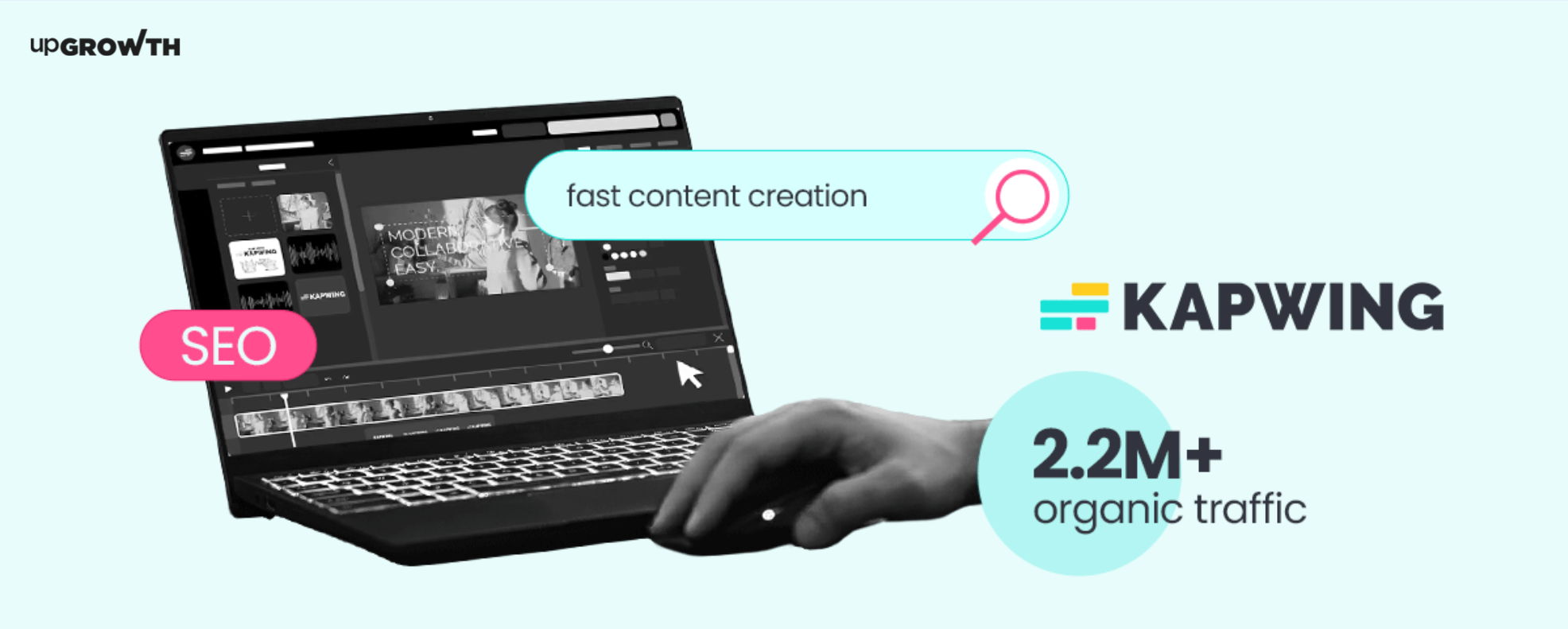
Kapwing’s Programmatic SEO Drives 2.2M+ Monthly Organic Traffic
Page 1 / –
StartSlide ControlFinish
Segregation of traffic numbers behind Kapwing’s programmatic SEO strategy
Direct: 29.77% (3.3M)
Organic Search: 52.85% (5.8M)
Here’s why Kapwing’s traffic distribution (almost equal parts direct and organic) is impressive:
High Brand Awareness: A significant portion (nearly 30%) of traffic coming directly indicates strong brand awareness. People know Kapwing exists and can access it directly, suggesting a loyal user base or successful brand recognition efforts.
Effective SEO Strategy: The high organic search traffic (over 50%) demonstrates a successful SEO strategy. Kapwing likely ranks well for relevant keywords, making them easily discoverable for potential users searching for video editing, GIF creation, or design tools.
Balanced Traffic Sources: Having a healthy mix of direct and organic traffic shows a well-rounded online presence. Kapwing isn’t solely reliant on search engines to attract visitors, but they’re also capturing users who already know about them.
In essence, Kapwing’s traffic breakdown suggests a strong brand with a loyal user base, coupled with a successful SEO strategy that attracts new users actively searching for solutions.
A Deep Dive into the Structure of Kapwing Pages/Section
This section delves into the structure of Kapwing’s webpages, specifically focusing on two key categories: Tools Pages and Template Pages. We’ll explore the data points utilized on each page type.
Kapwing strategically employs programmatic SEO techniques. To gain further insight, let’s explore the detailed case study (link can be provided here).
Tools Pages
In this section, Kapwing strategically targets keywords related to {utility tool name}, a functionality with a clear transactional intent. The programmatically generated pages for these tools function essentially as dedicated landing pages, showcasing the application of seo optimization techniques. By capturing high-intent search traffic, these pages effectively drive organic visits.
To illustrate the effectiveness of this approach, let’s explore some examples of these pages and analyze the organic traffic they generate on a monthly basis.
Example page
Monthly organic traffic
PNG Maker
7.8k
GIF Maker
14.7k
Convert Video
24.9k
Data Points
To optimize these programmatically generated pages, Kapwing leverages several key data points, including…
Tool name with a short description
Call to action (CTA) buttons
3 steps guide for How to Use
Other Tools
User testimonials
FAQs
Key features of Kapwing
Template Pages
Example page
Monthly organic traffic
Parental Advisory Sticker Template Album Maker
6.7k
Meme Template with White Impact Text on Top and Bottom
8.8k
Spotify Wrapped Meme Template
9.1k
Data Points
When constructing these programmatically generated pages, Kapwing focuses on incorporating elements such as…
Title of the template page
A short description of the template collection
Call to action buttons
List of all trending templates
3 steps guide for How to Use
Other related tool
User testimonials
FAQs
Key features of Kapwing
Programmatic SEO Success Stories and Case Studies
Company Name
Estimated Monthly Organic Traffic
Estimated Number of Pages
Tripadvisor
200M+
74M+
Canva
100M+
190K
Wise
92M+
90M+
G2
6.6M+
1M+
Veed
3.5M+
12K+
Zapier
2.6M+
500K+
Kapwing
2.2M+
4.3K+
Payscale
1.3M
2M+
Calendly
1.1M+
6K+
Product Hunt
792K+
515K
Make
282.9K+
175K+
in2013dollars
105K+
124K+
Failory
103K+
4.9K+
moveBuddha
70K+
45K+
MentorCruise
44.5K+
17K+
Delightchat
11.2K+
6K+
Build a programmatic SEO Strategy with uG
This exploration of Kapwing’s success with programmatic SEO (pSEO) highlights the power of this approach in driving organic traffic. For businesses seeking to replicate these results, partnering with experienced SEO specialists can be highly beneficial.
upGrowth, a seasoned SEO expert team, possesses the in-depth knowledge of pSEO to craft a customized strategy tailored to your specific goals. Their expertise can empower your brand to achieve long-term, sustainable growth through organic search.
Key Takeaways
Kapwing focuses on identifying high-volume keywords related to specific video editing and creative tasks, ensuring their landing pages meet precise user needs.
By building individual landing pages for each keyword and prominently featuring relevant content, Kapwing successfully ranks for a wide range of long-tail keywords, attracting users searching for specific solutions.
Nearly 30% of Kapwing’s traffic comes directly, indicating a loyal user base and successful brand recognition efforts, showcasing the platform’s strong market presence.
With over 50% of traffic from organic search and a significant portion from direct visits, Kapwing demonstrates a well-rounded online presence, effectively capturing both new and returning users through its robust action plan for SEO strategy.
Created a massive library of single-purpose, simple video editing tools (e.g., “Meme Generator,” “Add Subtitles”). Each tool targeted a distinct, high-volume “how-to” keyword.
2. Scalable Template Generation
Generated thousands of niche-specific templates (e.g., “Twitch Banner Template”) that serve as high-utility content, solving the user’s need directly on the SERP.
3. Direct Product Integration
The programmatic pages were designed as launchpads to the actual editor. Users complete the immediate task (e.g., generating a meme) and are seamlessly pulled into the full product ecosystem for editing and saving.
The Kapwing Insight
Programmatic SEO success in SaaS comes from making your product the direct answer to a high-volume “how-to” search query.
FAQs: Kapwing’s Programmatic SEO
1.What are the key elements of Kapwing’s programmatic SEO strategy?
Kapwing’s programmatic SEO strategy includes targeting long-tail keywords, generating numerous landing pages for specific tools and templates, and optimizing content for user search intent. They employ structured data and internal linking to enhance search engine visibility. This strategy ensures high relevance and scalability, driving substantial organic traffic.
2.How does Kapwing target specific content creation tasks like video editing in its SEO efforts?
Kapwing targets specific content creation tasks like video editing by creating dedicated landing pages optimized for keywords related to these tasks. These pages provide detailed information, tutorials, and tools relevant to video editing, capturing users searching for specific solutions. This approach effectively attracts high-intent traffic seeking video editing capabilities.
3. What types of content does Kapwing focus on for its programmatic pages?
Kapwing focuses on content related to digital tools and templates for various creation tasks, such as video editing, meme creation, and image editing. These programmatic pages are designed to address specific user queries and provide step-by-step guides, tools, and resources. This targeted content helps meet user needs and boosts organic traffic.
4. How does Kapwing ensure the relevance of its SEO content to user intent?
Kapwing ensures relevance to user intent by conducting thorough keyword research and analyzing user behavior to understand search queries. They create content that directly addresses these queries with practical solutions and tools. Regular updates and optimizations align the content with evolving user needs and search engine algorithms.
5. What role do keywords related to specific digital content creation tools play in Kapwing’s SEO?
Keywords related to specific digital content creation tools are crucial in Kapwing’s SEO strategy. They attract users with high intent who are looking for specific functionalities. By optimizing pages for these keywords, Kapwing ensures they rank highly for searches related to their tools, driving targeted organic traffic and enhancing user engagement.
Programmatic SEO (pSEO): A method of automating content creation for large-scale, keyword-targeted pages. Kapwing uses pSEO to efficiently generate landing pages for various content creation tools and templates.
Targeted Landing Pages: Programmatically generated pages designed for specific keywords or user intents, such as video editing tasks, meme creation, or GIF making.
High-Intent Keywords: Search terms that indicate a user is actively looking for a solution, like “convert video” or “GIF maker.” Kapwing targets these keywords to attract qualified traffic.
Long-Tail Keywords: Detailed and specific keyword phrases that often have lower competition but high relevance, e.g., “Red Shirt Belly Dancing Guy Greenscreen Video Meme template.”
Tools Pages: Programmatically generated pages for individual tools, such as “Convert Video,” “GIF Maker,” or “PNG Maker,” optimized for search visibility and user intent.
Template Pages: Pages focused on digital templates, including memes, collages, or social media designs, optimized to capture organic traffic from users seeking creative assets.
Indexed Pages: Pages recognized and stored by search engines. Kapwing has 4,300+ pages indexed on Google, covering various creative tools and templates.
Direct Traffic: Visitors arriving by typing the URL or using bookmarks. Kapwing receives 29.77% of traffic this way, reflecting brand awareness and loyalty.
Organic Search Traffic: Visitors who find Kapwing through search engines. Kapwing receives 52.85% of traffic this way, showing strong search visibility for creative content queries.
Call to Action (CTA): Buttons or prompts on pages that guide users to take action, such as using a tool, trying a template, or exploring tutorials.
User Intent: The goal or purpose behind a search query. Kapwing designs landing pages to match specific user intents, such as editing a video or creating a meme.
Three-Step Guide (“How to Use”): Step-by-step instructions included on programmatic pages to assist users in using a tool or template effectively.
User Testimonials: Feedback from users integrated into pages to enhance credibility and demonstrate real-world application of tools and templates.
Content Optimization: Adjusting page elements—like titles, descriptions, CTAs, and visuals—to improve search engine ranking and user engagement.
Structured Data: Organized information on a webpage, such as titles, CTAs, guides, and testimonials, that improves SEO and page clarity.
Balanced Traffic Sources: Having a healthy mix of direct and organic traffic. Kapwing’s traffic reflects both strong brand recognition and effective SEO strategies.
Digital Content Creation Tools: Software or platforms that enable users to create videos, GIFs, memes, or social media content. Kapwing’s programmatic pages focus on these tools to attract relevant searches.
For Curious Minds
Programmatic SEO is a method of creating pages at scale to capture highly specific, long-tail search queries. For Kapwing, this means instead of a single blog post about video editing, it creates thousands of unique landing pages for tasks like “add text to video” or “make a collage,” directly matching what a user is searching for. This approach is powerful because it meets users at their exact moment of need, significantly boosting conversion potential. The strategy's success is evident in its ability to generate over 2.2M monthly organic visitors. This model works by:
Identifying high-volume keyword patterns with modifiers.
Creating a template for a specific page type (e.g., a tool or a meme).
Populating these templates with data to generate thousands of optimized pages.
This granular targeting turns search engine users into active platform users by providing an immediate solution, not just information. To see how these pages are structured, explore the full analysis.
By focusing intently on user intent, Kapwing translates a user’s specific search query into a direct solution, which is the cornerstone of its high organic traffic. Instead of generic guides, the platform provides a functional tool or template page, like the “Red Shirt Belly Dancing Guy Greenscreen Video Meme” page, that immediately solves the user's problem. This signals a deep understanding of its audience of content creators and gamers, who seek immediate, task-oriented results. This intent-driven strategy is more effective than broad content marketing because it minimizes friction between discovery and creation. The platform’s success, with organic search accounting for 52.85% of its traffic, is built on this foundation of utility. It proves that for a modern SaaS tool, being the answer is more powerful than just writing about the answer. Delving into their page structure can reveal more about this tactical execution.
A programmatic SEO strategy, like Kapwing's, prioritizes scale and specificity, while a traditional blog strategy focuses on authority and depth. Kapwing’s method creates thousands of targeted landing pages for long-tail keywords ("GIF Maker," "Meme Templates"), directly answering a user's need with a tool. A blog, conversely, would address broader topics ("Top 10 Video Editing Tips"). The key factors to weigh are:
Scalability: Programmatic SEO scales much faster, covering thousands of niches.
User Intent: Programmatic pages often capture users with higher, more transactional intent.
Resource Allocation: A programmatic approach requires engineering resources, while blogging needs writers and editors.
Brand Authority: Blogs are excellent for building thought leadership, which programmatic pages do not directly accomplish.
Kapwing's 4300+ indexed pages demonstrate a commitment to covering every possible user need, a feat impossible with manual blogging alone. Choosing between them depends on whether your goal is to provide immediate utility at scale or build a reputation through expert commentary. A deeper look at the case study shows how they blend both.
The success of hyper-specific pages like the “Red Shirt Belly Dancing Guy Greenscreen Video Meme” template is a powerful testament to Kapwing’s agile and data-driven strategy. It reveals that the company is not just programmatically creating pages based on static keywords but is also actively monitoring and responding to emerging cultural trends and viral content. This proactive trend-jacking approach allows them to capture waves of organic traffic from users searching for the latest meme formats. By turning a fleeting trend into a permanent, high-ranking asset, they convert ephemeral interest into sustained user acquisition. This tactic is a core reason organic search constitutes 52.85% of their total traffic. It demonstrates a sophisticated system for identifying, creating, and ranking content that meets the zeitgeist, ensuring a continuous flow of new, engaged users. Understanding how they structure these template pages is key to grasping this dynamic strategy.
The primary evidence lies in the consistent, optimized structure of Kapwing's 4300+ landing pages, which are clearly designed for search engine crawlers and user intent. Each page, whether for a tool like “Convert Video” or a meme template, is built around a specific long-tail keyword that appears prominently in the title, headings, and body content. The pages are not just text, they are functional applications that directly solve the user’s query, leading to higher engagement and lower bounce rates, which are positive ranking signals for Google. This utility-first design philosophy is the engine behind their 52.85% organic traffic share. Key structural elements include:
A clear, action-oriented headline matching the search term.
The functional tool or template placed above the fold.
Concise, relevant text that reinforces the page's purpose.
This repeatable, scalable structure is what allows Kapwing to dominate thousands of distinct search results pages. A full breakdown of these page templates can offer more precise insights.
The balanced traffic figures for Kapwing powerfully illustrate a mature digital strategy where brand awareness and search visibility work in tandem. The 52.85% of traffic from organic search proves their programmatic SEO is exceptionally effective at acquiring new users who are actively looking for solutions. Simultaneously, the significant 29.77% share from direct traffic indicates that Kapwing has built a strong brand and a loyal user base that no longer needs a search engine to find them. This symbiotic relationship is ideal: SEO acts as the primary acquisition engine, feeding the top of the funnel, while positive user experiences build brand loyalty, which in turn creates a resilient base of direct visitors. This dual success de-risks their growth, making them less vulnerable to algorithm changes or shifts in search behavior. Analyzing their brand marketing efforts alongside their SEO tactics reveals the full picture.
A SaaS platform can begin replicating Kapwing's success by systematically turning its features into search-optimized landing pages. This approach focuses on capturing high-intent users looking for specific solutions, a method that drives their impressive 2.2M monthly organic visitors. The initial plan should be:
1. Identify Core Patterns: Analyze your product's features to find repeatable user tasks. For a photo editor, this could be {action} + {image type}, like "add filter to PNG" or "resize JPEG."
2. Keyword Research: Use tools to find high-volume, low-competition variations for these patterns.
3. Create a Page Template: Design a single, reusable page layout that includes the tool itself, a clear H1 tag using the keyword, and concise instructional text.
4. Programmatic Generation: Use a script or CMS to generate pages for all keyword variations.
5. Internal Linking: Ensure all new pages are linked from a central hub or gallery to help with indexing.
This foundational, utility-driven approach creates valuable assets that answer specific user needs, forming the bedrock of a scalable organic growth engine. The next steps involve monitoring and refining these pages.
A programmatic strategy as extensive as Kapwing’s must evolve from pure scale to scaled value to remain resilient against future algorithm updates. While its current model excels at capturing long-tail intent, Google is moving towards rewarding deeper, more authoritative content. This means Kapwing will likely need to enrich its programmatically generated pages. Potential evolutions include:
Integrating user-generated content, such as examples or tutorials, onto template pages.
Adding unique, contextually relevant copy beyond the basic template.
Connecting individual tool pages to more comprehensive guides or blog posts.
The goal is to enhance the user experience on each page, signaling to search engines that these are not just thin landing pages but valuable destinations. Their current success with 52.85% organic traffic is strong, but future-proofing this will require blending their scalable page generation with elements that demonstrate deeper expertise and user engagement. Exploring how they might do this offers a glimpse into the future of SEO.
B2C software companies in any vertical can adapt Kapwing's model by deconstructing their product's functionality into a set of user "jobs to be done" that can be targeted at scale. The principle remains the same: map every specific user need to a dedicated, tool-based landing page. For example:
A personal finance app could create pages for "calculate mortgage for {city}" or "budget template for {profession}."
An educational platform could generate pages for "practice quiz for {subject} {grade level}" or "flashcard maker for {exam name}."
The key is to identify the modifiers and patterns unique to their audience's search behavior. By doing so, they can intercept users with high transactional intent, just as Kapwing captures creators searching for specific meme templates. This strategy shifts the focus from broad brand advertising to precise, utility-driven acquisition, a powerful lesson from their 2.2M monthly organic visitors. Examining your own product's features through this lens is the first step.
Kapwing avoids the primary pitfall of programmatic SEO by ensuring every page offers genuine, immediate utility, solving the problem of creating "thin" content. While failed attempts often just spin text around keywords, each of Kapwing’s 4300+ pages provides a functional tool or a usable template. A page for a "GIF Maker" does not just talk about making GIFs; it *is* the GIF maker. This utility-first approach provides inherent value to the user, which search engines reward with higher rankings and sustained traffic, evidenced by its 5.8M monthly organic visitors. The solution to the low-quality problem is to build the programmatic strategy around the product itself, not just around content. By making each page an interactive experience, they ensure high user engagement and satisfaction, sidestepping penalties associated with spammy, low-value generation. The case study reveals more about how this product-led SEO is executed.
Kapwing effectively mitigates the risk of traffic channel dependency by cultivating two powerful, complementary streams of visitors. This balanced composition solves the problem of vulnerability that plagues businesses reliant on a single source, such as paid ads or a volatile search algorithm. Their strong organic search performance (5.8M visitors) acts as a consistent and scalable new customer acquisition engine. At the same time, the substantial direct traffic (3.3M visitors) represents a moat of brand loyalty and user retention. This diversified traffic portfolio creates resilience:
If a Google update temporarily affects organic rankings, the direct user base provides a stable foundation.
The continuous influx of new organic users feeds the pool of future direct visitors.
This model shows that true online strength comes not just from mastering one channel, but from building a brand that users seek out directly while also excelling at being discoverable. Understanding this synergy is crucial for long-term digital growth.
Kapwing directly addresses the common user experience problem of friction by designing its programmatic pages as instant solutions rather than gated portals. When a creator lands on a page from a search like "add text to video," they are immediately presented with the functional tool, not a sign-up form. This "tool-as-the-landing-page" approach solves the user's need instantly, building trust and demonstrating the product's value upfront. This is a critical factor in converting search traffic into active users and contributes to their impressive growth, including over 2.2M monthly organic visitors. By removing barriers to entry and letting the product speak for itself, Kapwing aligns its SEO strategy with a superior user experience. This model reduces bounce rates and encourages users to explore the platform further after their initial task is complete, turning a single search query into a potential long-term customer. The structure of these pages is a masterclass in product-led growth.
Amol has helped catalyse business growth with his strategic & data-driven methodologies. With a decade of experience in the field of marketing, he has donned multiple hats, from channel optimization, data analytics and creative brand positioning to growth engineering and sales.

 Growth Strategy and Planning