Contributors:
Amol Ghemud Published: October 16, 2025
Summary
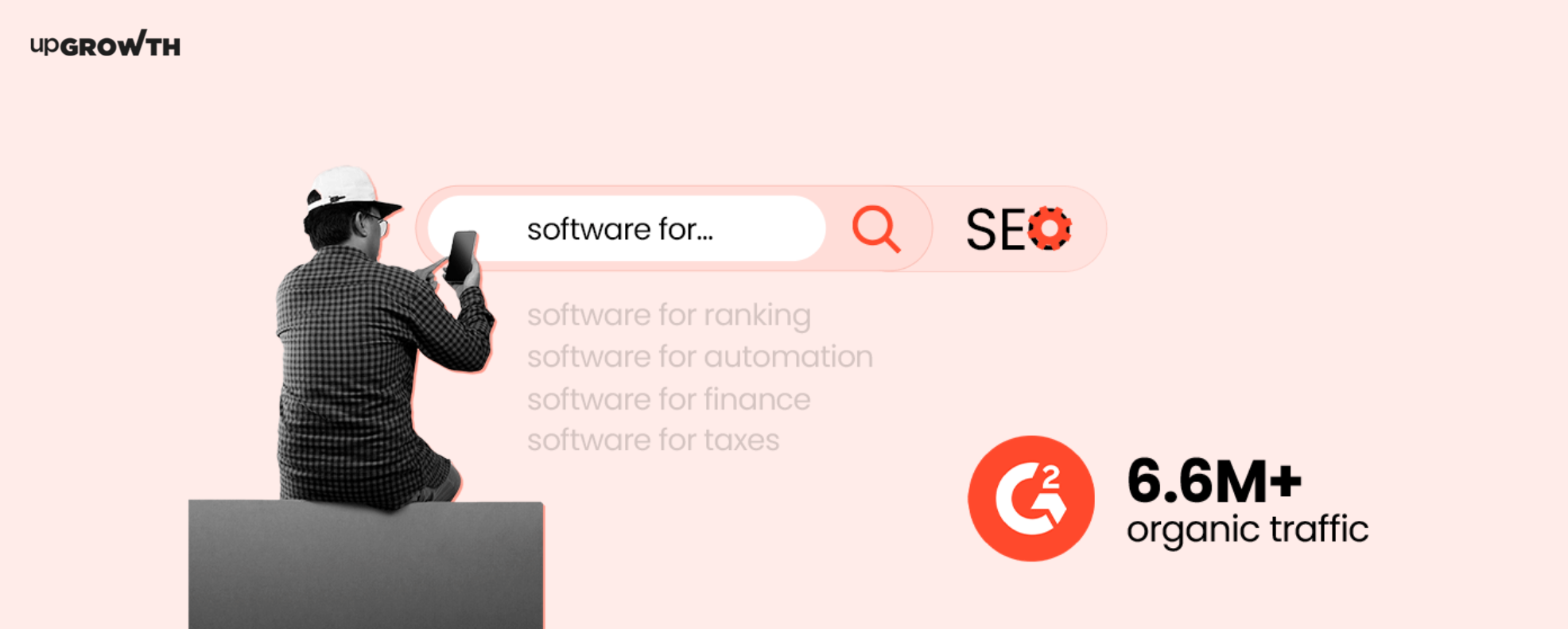
What: G2’s programmatic SEO strategy that drives over 6.6 million monthly organic visits through automated content creation for software comparisons and “best of” lists. Who: SaaS companies, marketers, and digital businesses looking to attract high-intent users through data-driven, scalable SEO content. Why: This approach allows G2 to efficiently capture users searching for specific software solutions while strengthening brand credibility and visibility. How: By leveraging automation to generate keyword-targeted pages comparing software tools, using real user data and reviews to create valuable, SEO-optimized content that balances organic and direct traffic growth.
In This Article
Share On:
G2’s programmatic SEO strategy efficiently generates targeted content, driving substantial organic traffic and establishing G2 as a go-to resource for business software reviews and comparisons.
Overview of G2
G2 is a leading online platform for business software evaluation. It empowers users to make informed software decisions by aggregating user-generated ratings and reviews, with a specific focus on enterprise and business solutions.
This comprehensive resource allows for product comparisons and insights from real-world user experiences.
A brief overview of G2’s programmatic SEO strategy
G2 utilises programmatic SEO to create a massive collection of content targeting specific software comparisons and “best of” lists within the business software category. This approach allows them to:
Generate Content at Scale: Programmatic SEO automates content creation, enabling G2 programmatic SEO to publish many pages efficiently.
Target User Needs: They focus on content that directly addresses user needs, like comparing specific software options or highlighting top choices in a particular software category.
Leverage Data: This strategy likely relies on data sources to populate content with relevant information and comparisons.
This approach allows G2 to capture organic traffic for various software-related searches, ultimately driving users towards valuable reviews and comparisons.
Segregation of traffic numbers behind G2’s programmatic SEO strategy
Direct: 18.09% (1.1M)
Organic Search: 72.6% (4.2M)
Direct Traffic (18.09%, 1.1M visits):
This refers to website visits where the user arrived directly at G2’s website without clicking a link from another source. Here’s how they might have landed on G2:
Typing the URL directly into their browser bar.
Clicking a bookmark they saved for G2.
Clicking a link from an email or document that doesn’t track the referring source.
Organic Search Traffic (72.6%, 4.2M visits):
This refers to website visits where users found G2 through search engines like Google or Bing. These visits likely happened because:
G2 ranks well for relevant keywords related to business software reviews and comparisons.
Users searched for terms like “best marketing software” or “CRM software comparison” and landed on a G2 page that addressed their search query.
Why This Traffic Breakdown is a Success for G2?
A high percentage of organic search traffic (72.6%) is a strong indicator of G2’s successful SEO (Search Engine Optimization) strategy. Here’s why:
Organic traffic is typically considered high-quality traffic. Users who find G2 organically are likely actively searching for information about business software solutions, making them more likely to be potential customers.
A significant portion of direct traffic (18.09%) suggests brand awareness. This means users know G2 and trust it enough to visit directly, indicating a strong brand reputation.
Combined, this traffic mix demonstrates a well-rounded strategy. G2 attracts users who are actively researching (organic search) and those already familiar with the brand (direct).
In essence, G2’s traffic breakdown suggests they’re capturing both new users searching for software solutions and existing users returning for more information. This combination is a strong foundation for continued growth and user engagement.
A Deep Dive into the Structure of G2 Pages/Section
This section delves into the structure of G2’s pages, focusing specifically on Software Comparison Pages and Best Agencies/Software Pages. We’ll explore the data points used on each page type to provide a comprehensive understanding of how G2 presents information.
Software Comparison Page
Within this category, G2 utilises programmatic SEO website optimisation to generate targeted landing pages that compare specific commercial software products. These pages leverage the {software 1} vs. {software 2} format to address user needs directly.
To illustrate the effectiveness of this approach, let’s explore some examples of software comparison pages and their corresponding monthly organic traffic figures
Example page
Monthly organic traffic
Compare Freckle and i-Ready Learning
567
Compare Elead and VinSolutions Connect CRM
962
Compare Asana and monday.com
2.2k
Data Points
Here are some of the key data elements G2 incorporates into these programmatically generated pages:
A title containing name of softwares {Software1} and {Software2}
A quick answer and a short description of the comparison
Feature and pricing comparison as tables of both software
Links to the individual software review pages
Some information about software reviewers
Alternatives of each software
CTA buttons
Best Agencies/Software Pages
Within this section, G2 curates content highlighting leading commercial software and service providers within specific business verticals. These programmatically generated pages, categorized as “best software/service” listings, function similarly to blog posts, offering in-depth comparisons and user insights.
Following this section, we will examine a selection of these “best software/service” pages to analyze their monthly organic traffic volume.
Example page
Monthly organic traffic
Best ERP systems
28k
Best CRM software
20k
Best recruitment agencies
28k
Data Points
To deliver valuable insights to users, G2 leverages these data points on its programmatically generated pages:
A long description of the category
A list of software in the categories that can be compared
A name and logo of each software in the list
A short description of each software
Information about users, industries, and market segments of each software
Other similar Categories
Build a programmatic SEO Strategy with upGrowth
This exploration of G2’s success with Programmatic SEO (pSEO) demonstrates this approach’s power to scale organic traffic and brand awareness. Partnering with a seasoned pSEO expert like upGrowth can be transformative for businesses seeking to replicate this success. upGrowth’s deep understanding of pSEO strategies can help you develop targeted content that attracts your ideal customers and drives sustainable business growth.
Watch Now: How G2’s Programmatic SEO Strategy Drives 6M+ Monthly Organic Visits
Key Takeaways
With 72.6% of traffic coming from organic search, G2’s SEO strategy effectively captures users searching for business software reviews and comparisons, highlighting their strong search engine presence.
G2 utilises a programmatic SEO framework to automate the generation of many pages, enabling them to efficiently produce content that targets specific software comparisons and “best of” lists.
The content generated focuses on directly addressing user needs, such as comparing specific software options or highlighting top choices in a particular software category, ensuring relevance and value for users.
The mix of direct (18.09%) and organic search traffic reflects a well-rounded strategy, indicating strong brand recognition and the ability to attract new users through effective SEO efforts. This balance helps G2 capture returning users and new visitors, contributing to sustainable growth and user engagement.
G2’s Comparison & Categorization Funnel
G2 dominates software search by programmatically creating pages that capture every stage of the buyer’s journey, from broad discovery to final comparison.
1. CATEGORY PAGES (TOP OF FUNNEL)
Generates content for broad search terms (e.g., ‘Best CRM Software’). Pages are built using aggregation of user reviews.
2. FEATURE/NICHE PAGES (MIDDLE FUNNEL)
Targets users with specific requirements (e.g., ‘Free CRM for Small Business’ or ‘Lead Management Software’).
3. COMPARISON PAGES (BOTTOM OF FUNNEL)
Programmatic creation of high-intent, head-to-head pages (e.g., ‘Salesforce vs. HubSpot’).
1. How does G2’s programmatic SEO address ranking challenges for competitive business software keywords?
G2’s programmatic SEO targets long-tail keywords and niche queries related to software comparisons. They automate content creation for detailed “best of” lists, ensuring comprehensive coverage. This approach helps G2 rank for specific, less competitive terms while capturing significant search traffic.
2. What metrics does G2 monitor to measure the success of their SEO efforts?
G2 monitors organic traffic volume, keyword rankings, and conversion rates. They also track user engagement and the number of backlinks to evaluate content effectiveness. These metrics provide insights into their SEO strategy’s overall impact and success.
3. How does G2 tailor its content to meet the needs of different user segments looking for software reviews?
G2 customises content by creating specific comparison pages and “best of” lists tailored to various software categories. They address distinct user needs by providing detailed information relevant to different business sizes and industries. This targeted content approach ensures relevance and engagement for diverse user segments.
4. What SEO tools and platforms does G2 use to optimise their website traffic?
G2 utilises SEO tools like Ahrefs, SEMrush, and Google Analytics to optimise its website traffic. These tools help it track keyword performance, analyse backlinks, and monitor site health. By leveraging these platforms, G2 continuously refines its SEO strategy for better results.
5. How does G2 integrate user feedback into its programmatic SEO content?
G2 incorporates user feedback by regularly updating its software reviews and comparison pages. It uses user-generated content, such as ratings and reviews, to enhance the authenticity and accuracy of its pages. This integration ensures that its content remains relevant and valuable to users.
Programmatic SEO (pSEO): A strategy that automates the creation of large volumes of keyword-targeted pages. G2 uses pSEO to efficiently generate comparison and “best of” software pages, scaling content production.
Software Comparison Pages: Programmatically generated landing pages comparing two or more software products. G2 uses this format ({Software1} vs. {Software2}) to meet user intent and capture search traffic.
Best Software/Service Pages: Curated pages listing top software or service providers in a specific category. These pages act like blog posts, providing detailed comparisons and insights to users.
Long-Tail Keywords: Specific, often less competitive search terms. G2 targets these keywords to capture niche audiences searching for particular software solutions.
User-Generated Content: Content such as reviews and ratings submitted by real users. G2 integrates this content to add credibility, relevance, and value to programmatically generated pages.
Organic Search Traffic: Visitors who arrive via search engines. G2 receives 72.6% of its traffic this way, showing strong visibility and relevance for targeted software search queries.
Direct Traffic: Users who access a website by typing the URL directly or via bookmarks. G2’s 18.09% direct traffic indicates strong brand awareness and returning visitors.
Indexed Pages: Webpages recognized and stored by search engines like Google. G2 has over 1M pages indexed, ensuring extensive coverage of software comparisons and categories.
Transactional Keywords: Search terms indicating user intent to take an action, such as evaluating or purchasing software. G2’s content targets high-intent queries to attract qualified traffic.
Calls to Action (CTA): Buttons or prompts encouraging users to take an action, like reading a full review or exploring alternative software. G2 places CTAs on its programmatic pages to enhance engagement.
Data-Driven SEO: SEO strategies informed by metrics like traffic, keyword rankings, and engagement. G2 uses analytics to measure page performance and refine content strategies.
Content Personalization for Segments: G2 tailors content to different user groups by creating software comparisons and lists suitable for various industries, business sizes, and user needs.
SEO Tools & Platforms: Software used to optimize and monitor SEO performance. G2 leverages tools like Ahrefs, SEMrush, and Google Analytics to track rankings, backlinks, and site health.
Feature & Pricing Comparison Tables: Structured data within software comparison pages showing differences between products. G2 uses these tables to provide clear, actionable insights for users.
Alternatives Section: A part of G2 pages showing similar software options. This increases content relevance and helps users explore additional solutions.
For Curious Minds
Programmatic SEO is an automated content creation method that allows platforms like G2 to generate thousands of highly targeted pages at scale. This strategy is effective because it systematically covers a vast number of specific, long-tail search queries that manual content creation could never address efficiently. The success of this approach hinges on a few core components:
Data-Driven Templates:G2 uses structured templates, such as “Compare {software1} and {software2},” which are programmatically populated with user review data, ensuring consistency and relevance across its 1M+ pages.
Targeting High-Intent Keywords: By creating pages for specific comparisons like “Elead and Vinsolutions Connect CRM,” they capture users at the final stages of the decision-making process, driving high-quality traffic.
Scalable Authority Building: This immense volume establishes G2 as a comprehensive authority, signaling to search engines that it is the most relevant resource for a wide range of software queries.
This automated system transforms user review data into a powerful SEO asset, driving a significant portion of its traffic. To see how they translate this traffic into conversions, you should analyze the detailed structure of their comparison pages.
This high percentage of organic traffic is a powerful indicator of a successful strategy because it means G2 is capturing users who are actively looking for solutions, not just passively browsing. This traffic is inherently high-quality and directly supports their model of providing software reviews to informed buyers, as evidenced by their 4.2M monthly organic visits. Their programmatic approach underpins this achievement by systematically targeting these valuable search queries. Instead of competing on broad, expensive keywords, G2 wins by answering millions of specific questions at scale. This model is not just about volume, it is about precision, allowing their system to automatically generate pages for niche comparisons that a manual team would never prioritize. The result is a highly efficient and sustainable customer acquisition engine built on meeting specific user needs. To fully appreciate how they convert this traffic, explore the specific page layouts they use.
Programmatic SEO excels at scale and specificity, while traditional content creation is better for depth and brand voice on a smaller set of topics. A platform like G2 uses a programmatic approach because its goal is to cover every conceivable software comparison, a task impossible for human writers. This strategy is ideal when you have access to a large, structured dataset and need to target thousands of long-tail keywords. Your choice depends on:
Scale: Do you need to create thousands of pages like G2's 1M+ indexed pages or a few dozen high-impact articles?
Data Availability: Do you have a structured database, such as user reviews or product specs, to populate templates?
User Intent: Are your users searching for specific, data-driven comparisons or broad, educational topics?
Programmatic is about breadth and precision, while manual is about depth and narrative. For a business with a large inventory or data set, a programmatic strategy can unlock massive organic growth. To determine the best fit, you must first analyze your available data assets and primary user search behaviors.
This template-driven approach is the core engine of G2's success, directly matching the structure of user search queries to deliver hyper-relevant content. When a user searches for a specific comparison like “Elead vs Vinsolutions Connect CRM,” G2 has a dedicated, programmatically generated page ready to answer that exact question. This perfect alignment between user intent and content is why search engines reward them with high rankings. By creating millions of these targeted pages, they capture a massive volume of long-tail traffic that competitors, focused on broader keywords, miss entirely. This strategy is a key reason they achieve over 4.2M monthly organic visits. The structure of these pages, which combines user reviews with structured data, ensures both relevance and authority, creating a powerful flywheel for sustained organic growth. Discover how they source and display data on these pages to understand the full picture.
Generating over 1M+ indexed pages creates a formidable competitive moat by establishing unmatched topical authority in the eyes of search engines. A competitor cannot simply replicate this success with a small team of writers; it requires a sophisticated, data-driven, programmatic infrastructure. This massive content library ensures that for almost any business software search, G2 has a relevant page, making them the default destination for users and search algorithms alike. This scale leads to a virtuous cycle: more pages attract more of their 6.6M+ monthly visitors, which generates more user reviews, which provides more data to create even more pages. This self-perpetuating system solidifies G2's dominance and raises the barrier to entry for any new player trying to compete for organic search traffic in the B2B software space. Understanding their page-level architecture reveals how they maintain quality across this vast inventory.
Replicating G2's model begins with a solid data foundation and well-structured templates. The goal is not just to create pages, but to create pages that are genuinely useful and systematically address user queries. A practical implementation plan involves three key stages:
Identify Page-Generation Opportunities: Analyze search query data to find repeatable patterns, such as “compare product A vs product B” or “best X for Y,” just as G2 does with software.
Build a Structured Database: Source and organize the data points needed to populate your templates. For G2, this is user reviews and software features; for your marketplace, it could be product specifications or pricing.
Design Dynamic Templates: Create page templates with designated fields for your data. The template for “Compare Elead and Vinsolutions Connect CRM” likely includes sections for ratings and features that are populated from your database.
Successfully executing these steps is fundamental to scaling content generation effectively and driving the kind of organic growth—72.6% of total traffic—that defines market leaders.
The primary risk for a massive programmatic site like G2 is being flagged for thin or repetitive content by evolving search algorithms. While their current model driving 72.6% organic traffic is effective, a future Google update could devalue pages that are perceived as being too formulaic. To mitigate this, G2 must continuously enhance the uniqueness and value of each programmatically generated page. This means going beyond simple data tables. Potential adaptations include:
Integrating more unique user-generated content, such as specific pros and cons from reviews.
Using AI to generate unique summaries or insights for each comparison.
Improving page-level user experience signals, such as load times and interactivity.
The challenge for G2 is to maintain scale while deepening the quality of each of its 1M+ pages. See how their current page structure already incorporates some of these elements to stay ahead of algorithm changes.
G2’s traffic breakdown provides a clear blueprint for a balanced growth strategy, effectively solving the acquisition versus retention dilemma. The massive 72.6% of traffic from organic search (4.2M visits) acts as a powerful top-of-funnel acquisition engine, constantly introducing new users who are actively researching software solutions. Once these users find value in the platform, they are more likely to return directly for future needs, which is reflected in the strong 18.09% direct traffic figure. This creates a virtuous cycle: organic search acquires new users, a positive experience converts them into a loyal audience, and that loyal audience builds brand equity, which in turn strengthens their search authority. This dual-channel strength shows that a company like G2 doesn't have to choose between acquisition and retention; an effective SEO strategy can powerfully drive both. The key is understanding how their on-page experience converts first-time visitors into repeat users.
G2's strategy transforms user-generated reviews from a simple feature into the foundational asset for its entire SEO engine. This approach goes far beyond basic automation by using real-world user experiences to create authentic and highly relevant content at scale. Each new review is a piece of data that can be programmatically integrated into comparison pages, “best of” lists, and category summaries, ensuring the content is constantly fresh and reflective of user sentiment. This constant influx of unique data helps their 1M+ pages avoid appearing generic. By structuring this user-generated content, G2 builds deep topical authority across thousands of software categories, signaling to search engines that it is the most credible source. This data-first approach is central to attracting 4.2M organic visitors monthly. To learn more, analyze how they structure review data on their comparison pages.
The “Best Recruitment Agencies” example perfectly illustrates how G2 intercepts users at a critical point in their buying journey. Instead of targeting a broad term like “recruiting,” they create a dedicated page that serves a user with a very specific, high-intent need. This is the essence of a successful long-tail strategy: answering a precise question better than anyone else. Programmatic SEO allows them to replicate this model for thousands of categories and locations. Manually creating and maintaining thousands of “best of” lists would be impossible, but G2's system can generate them automatically using its database of reviews and ratings. This precision at scale allows them to attract a significant portion of their 4.2M monthly organic visitors who are past the initial research phase and are ready to make a decision, showcasing a deep understanding of user search behavior.
G2’s strategy is firmly rooted in structured, data-driven content, which differs significantly from narrative-driven programmatic approaches that might generate simple news summaries. G2’s pages, comparing products like Elead and Vinsolutions Connect CRM, are valuable because they synthesize complex, proprietary user review data into a clear, comparable format. This data-rich approach is generally more defensible against algorithm updates because it provides unique value that is difficult to replicate and directly serves a user’s informational need. A narrative approach can more easily be flagged as low-quality if it lacks unique substance. By grounding its 1M+ pages in real user data, G2 creates content that is not just scalable but also authoritative and genuinely helpful, a combination that search engines are built to reward. The key to their defensibility lies in the proprietary data powering the templates.
G2 avoids the “thin content” trap by ensuring its programmatic pages are built upon a foundation of unique, user-generated data. Unlike strategies that just re-spin existing information, each G2 page offers genuine value through aggregated ratings, detailed reviews, and direct comparisons that cannot be found elsewhere. The authenticity of real user feedback is the key differentiator that builds trust and prevents their scaled content from feeling generic. This perceived value and credibility are why they not only attract 4.2M organic visitors but also retain an audience large enough to generate 1.1M direct visits. Users trust the G2 brand and return because they know the programmatically generated content is powered by authentic human experience. This blend of automation and authenticity is the solution to scaling content without sacrificing quality.
Amol has helped catalyse business growth with his strategic & data-driven methodologies. With a decade of experience in the field of marketing, he has donned multiple hats, from channel optimization, data analytics and creative brand positioning to growth engineering and sales.

 Growth Strategy and Planning