ChatGPT is here, and it is here to revolutionalize the good’ol ways of SEO strategies.
Consider it your friendly colleague who can assist you in various pursuits such as answering follow-up questions, challenging incorrect premises, and rejecting inappropriate requests. This AI uses Reinforcement Learning from Human Feedback (RLHF) which adds the human touch.
Whether it is dealing with clients or conversing with customers,
ChatGPT can be relied on to seamlessly perform the above tasks without sounding like a sad Chatbot. Its zero-cost utility adds to the charm and makes it a widely used tool.
Its ability to follow instructions makes it possible for SEO specialists to use it to generate SEO-related content.
Here are some other ways to use ChatGPT for SEO
1. Generate the Latent Semantic Indexing (LSI) Keywords
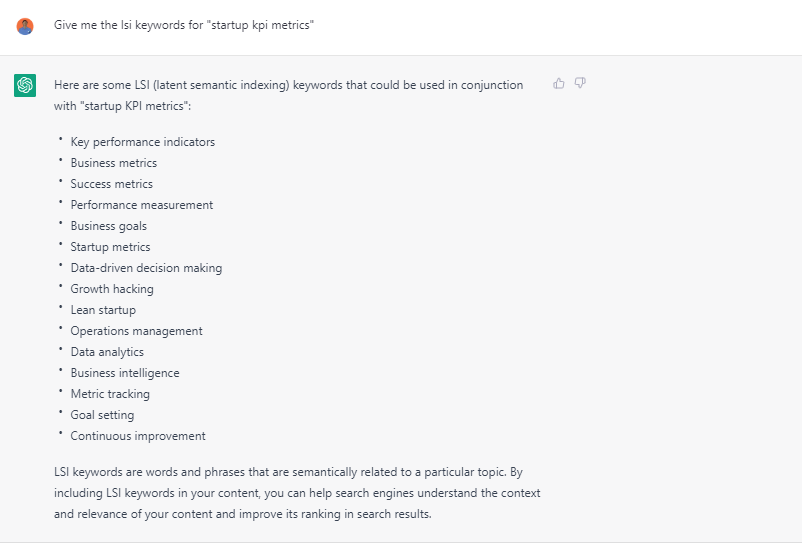
ChatGPT makes it easy to identify semantically-related keywords for your primary topics. Simply input your primary keywords and request LSI keywords to receive a list of closely related terms.
Query – “Give me the LSI keywords for “startup KPI metrics”
With the brand new feature of Chat GPT Plus – the Custom GPT, you can build a customized Chat GPT that is tailored to your SEO needs.
For instance, this custom Keyword Explorer is an expert in keyword research and SEO strategy. Consider this your go-to tool for keyword research that will save you time and efforts.
2. Suggest SEO Strategy for Any Industry
ChatGPT suggests an effective SEO strategy specific to any industry. Simply insert the industry name you are looking for and ask for a strategy suggestion.
Query – “How to create an effective SaaS SEO Strategy”
Take a look at how upGrowth implemented a successful Saas SEO strategy for a Coaching Platform. Check out our SEO strategy here. Our strategy increased the organic leads of the brand by +80% and paid leads by +120% in just forty-eight days.
3. Understanding Advanced SEO Factors
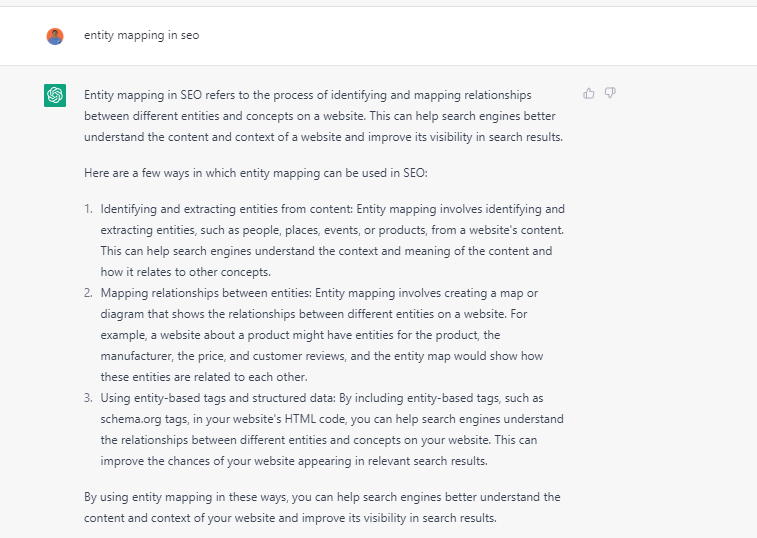
ChatGPT will help you to identify advanced SEO factors and provides guidance on optimizing them.
Query – “Entity mapping in SEO”
upGrowth created a successful SEO strategy using advanced SEO techniques that helped Fi.Money (a leading fintech brand), to upscale its organic traffic. Check out the tried and tested SEO strategies here.
4. FAQ Generation Based on Content
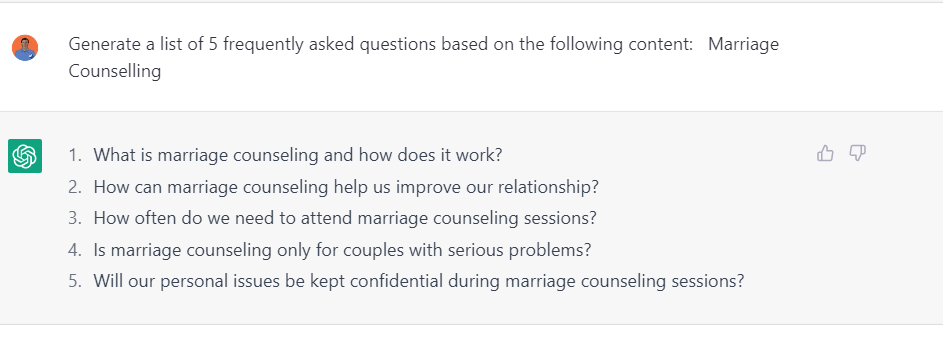
Easily create a custom FAQ based on your content, or generate a list of multiple FAQs as per your content requirement.
Query- “Generate a list of 5 frequently asked questions based on the following content: Marriage Counselling”
5. Get Compelling Call-to-Action Ideas
ChatGPT helps to create effective call-to-actions and can provide customized options based on your desired word limit.
Query – “10 CTA for digital marketing course in 5 words”
6. Find Relevant Keywords for Your Targeted Themes
Get theme-based keywords that are relevant. It will list the number of keywords that are related to your query.
Query – “Give me the keywords associated with “startup KPI”
7. Craft Catchy Titles for Blogs
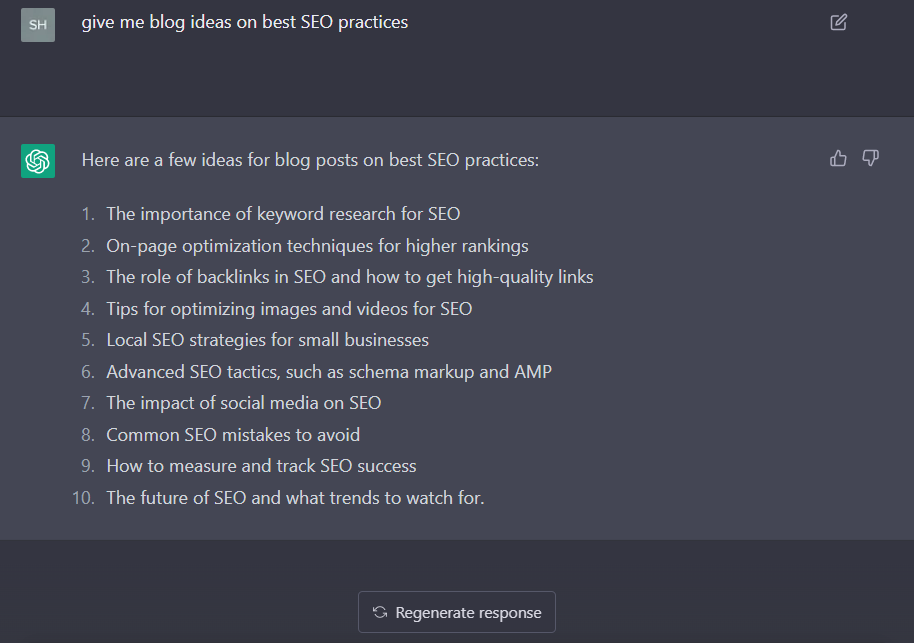
Titles that grab the reader’s attention can increase the click-through rate of your website. With ChatGPT, you can get ideas for blog titles by simply providing themes or keywords.
Query – “Give me blog ideas on best SEO Practices”
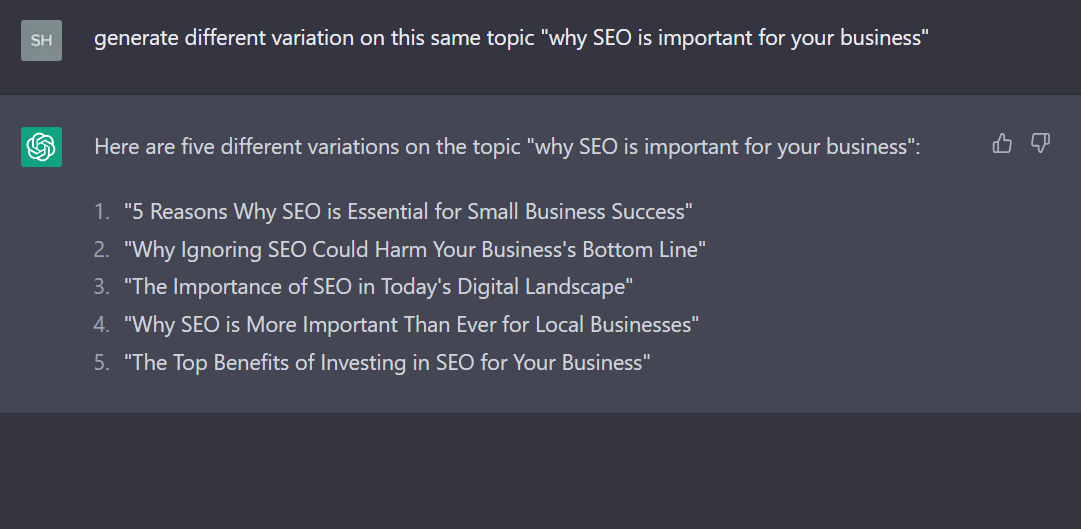
8. Generate a Variety of Titles on a Topic
ChatGPT can help writers generate new versions of titles with any intent, positive, negative, or neutral. It has proven to be proficient in this task.
Query – “Generate different variations on this same topic ‘why SEO is important for your business”
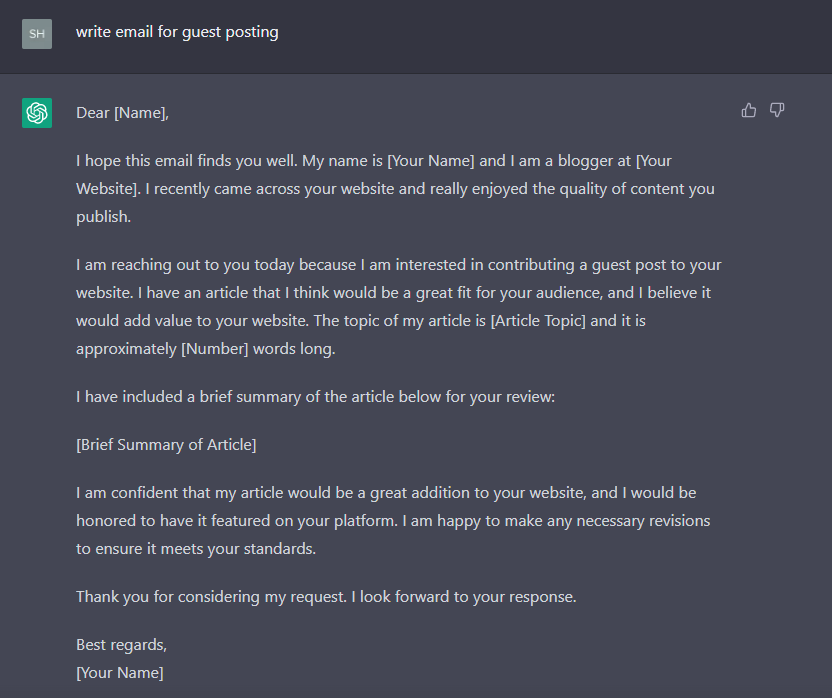
9. Writing a Successful Email Pitch for Guest Posting
Create appealing email templates for outreach by using ChatGPT and get noticed by the top guest posting websites.
Query – “Write email for guest posting”
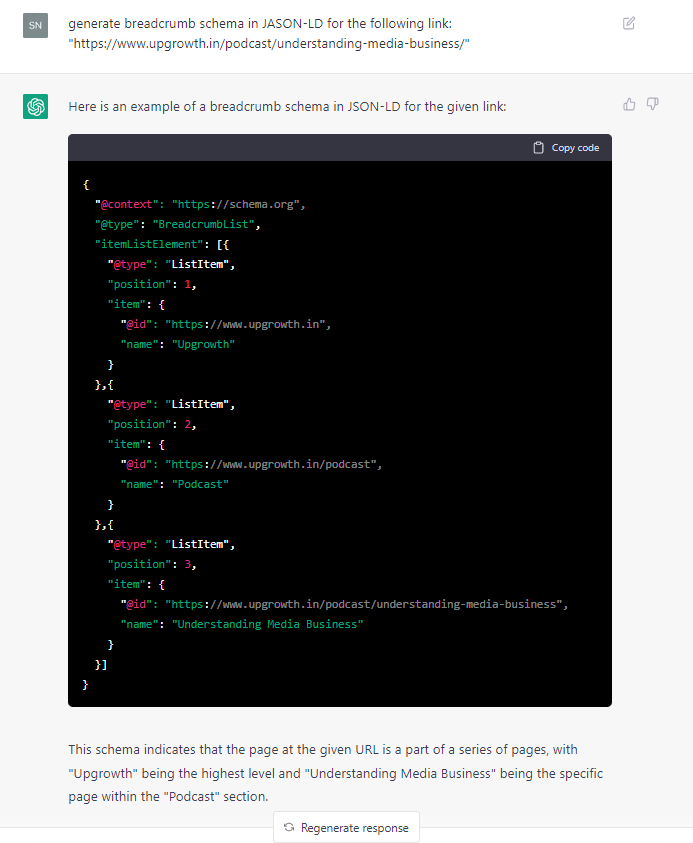
10. Create Schema with Links
ChatGPT also helps with your technical SEO by allowing you to generate schema for any link or page.
Query – “Generate breadcrumb schema in JASON-LD for the following link: <link>”
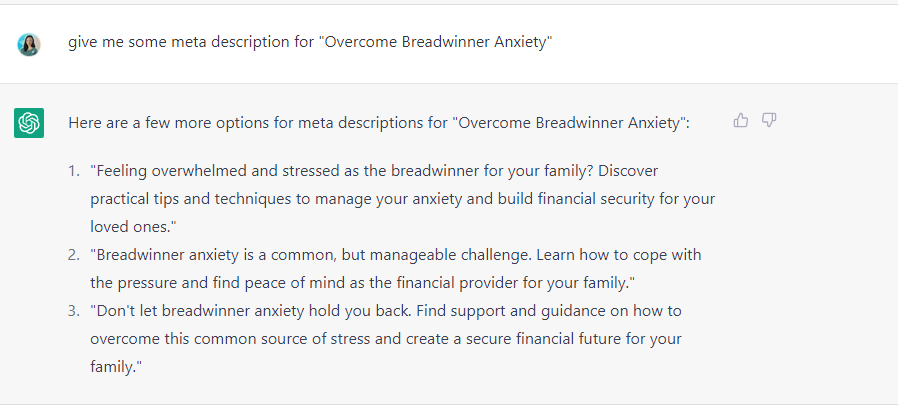
11. Generate Meta Descriptions Effortlessly
Create compelling meta descriptions for pages which attract clicks and drive traffic to your site.
Query – “Give me some meta descriptions for “Overcome Breadwinner Anxiety”
12. Get Suggestions on Your SEO Activities
ChatGPT suggests various helpful points that could be used in order to get desired results through SEO. It can be also used to improvise strategies.
Query – “Generate rule for creating web stories”
13. Act as a Guide for Audits
ChatGPT will provide an outline of what should be included in an SEO audit report and how to put it into action.
Query – “Explain how to develop and what metrics to include in an SEO report”
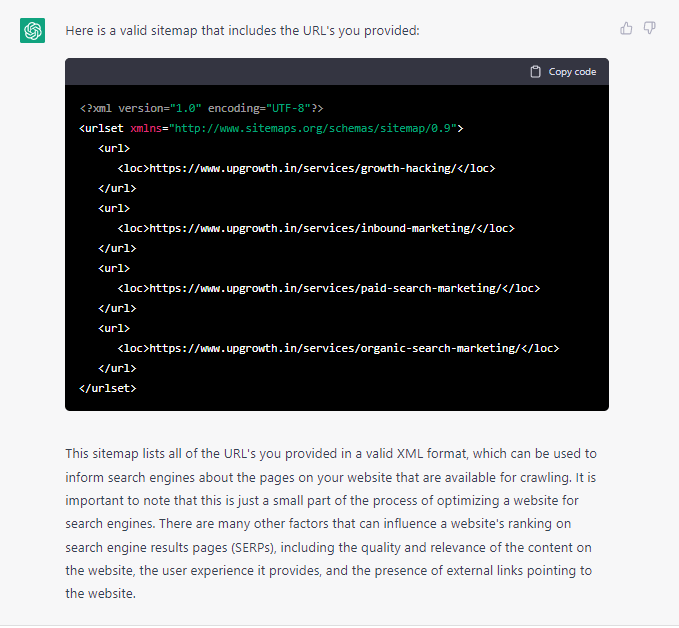
14. Generate XML Sitemap
ChatGPT is also designed to help us with sitemaps. Just enter the links and a valid sitemap will be ready.
Query – “Generate a XML Sitemap for these URLs: List of <URL>”
15. Analyze the Sentiment of Content
ChatGPT can help to identify the sentiment of the content that has been written. We can take a number of titles in one go! You can also manage the results by giving it the command to show results in the table.
Query – “Give the sentiment analysis on the topics as positive, negative, and neutral. Provide answers in a table format. The topics to analyze are:”
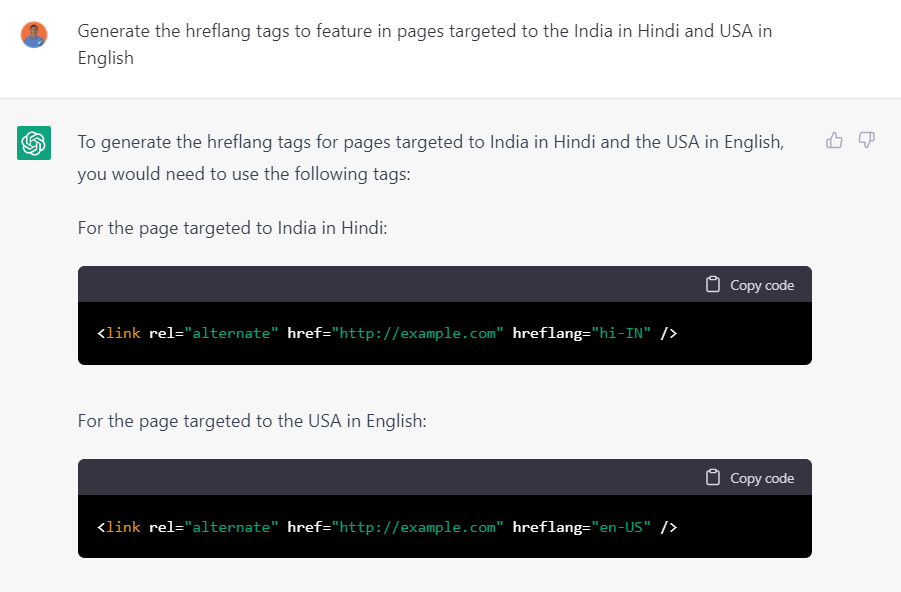
16. Generate hreflang Tags for International SEO
Implementing hreflang tags can be an important part of a successful international SEO strategy. Here ChatGPT helps us in generating this hreflang tags effortlessly.
Query – “Generate the hreflang tags to feature in pages targeted to the India in Hindi and USA in English”
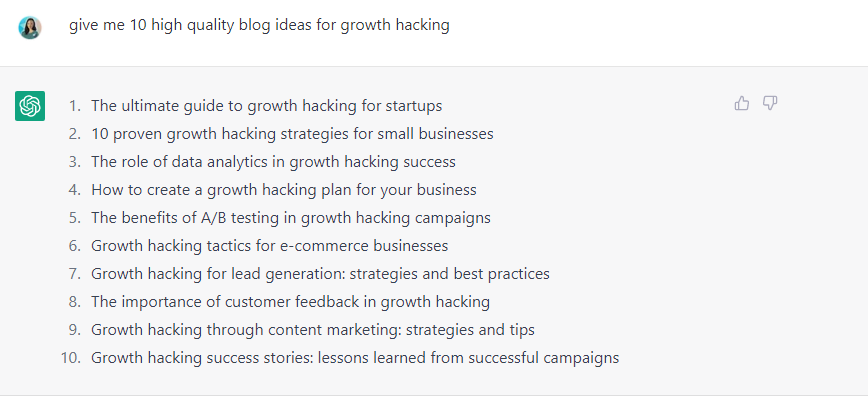
17. Generate Creative Blog Ideas
In recent times, finding the right topic to share with our audience can be challenging, but this ChatGPT gives so many creative ideas for blog topics.
Query – “Give me 10 high-quality blog ideas for growth hacking”
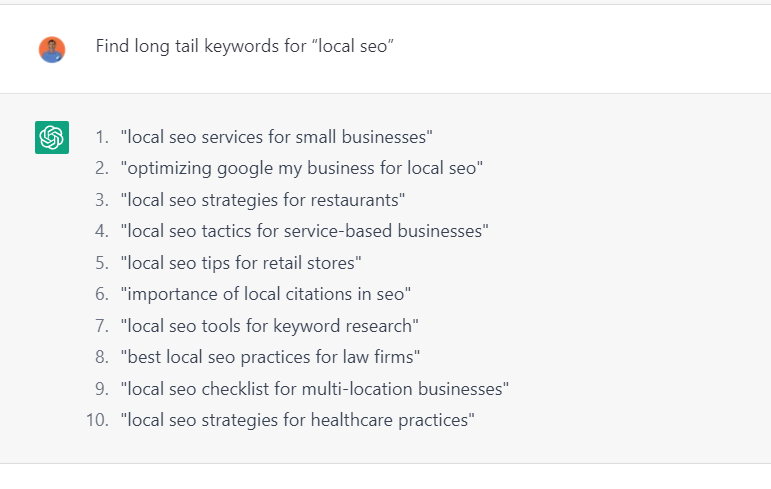
18. Discover Long-Tail Keywords
Using long-tail keywords can benefit SEO because they are often easier to rank and less competitive. Here ChatGPt can help you find some great long-tail keywords
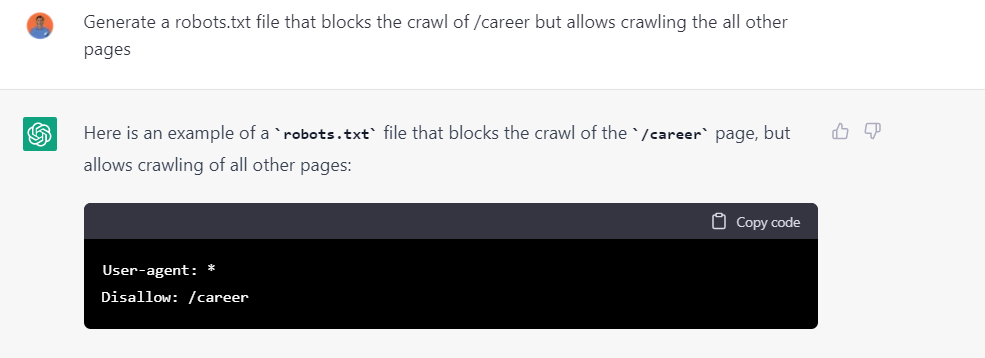
With ChatGPT we can easily generate robots.txt file that specifies which website pages should be excluded from indexing by search engines.
Query – “Generate a robots.txt file that blocks the crawl of /career but allows crawling the all other pages”
20. Discover High-Quality Websites for Link Building
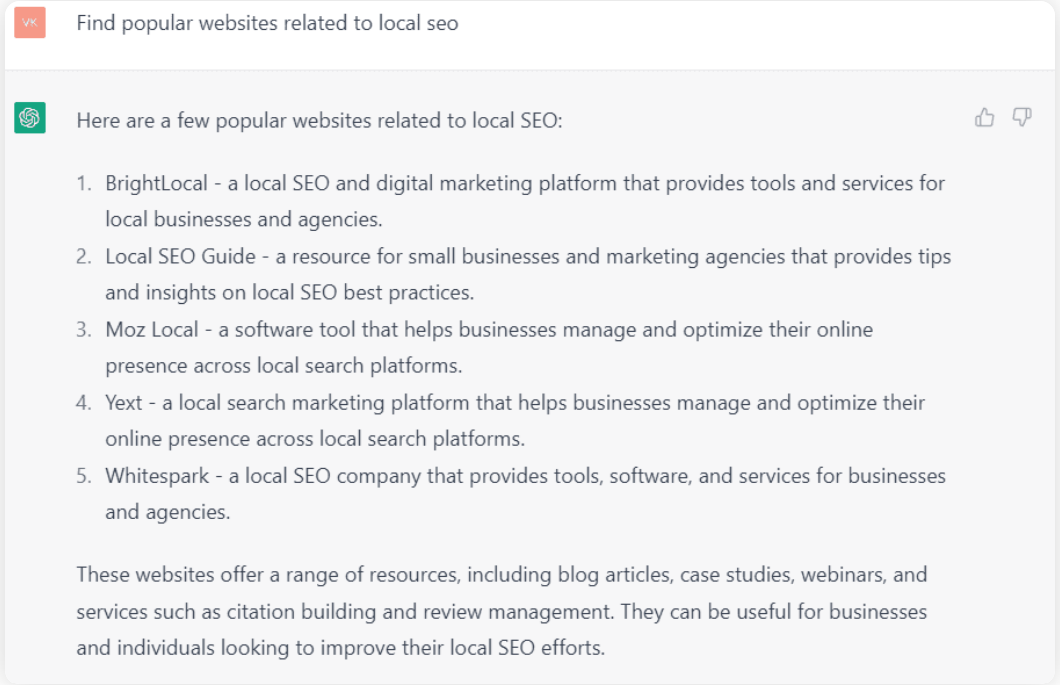
The use cases of ChatGPT for SEO are not just limited to content optimization & keyword research; you can also use it to build backlinks to your site. The tool can aid you in finding websites relevant to your niche for link-building purposes.
Query – “Find popular websites related to local SEO”
21. Efficiently Summarize Content
You can use ChatGPT to generate concise summaries for your articles and website pages. This can save time in promoting the content across multiple channels.
Query – “Write short summary on growth hacking”
22. ChatGPT for Effortlessly Rephrasing Content
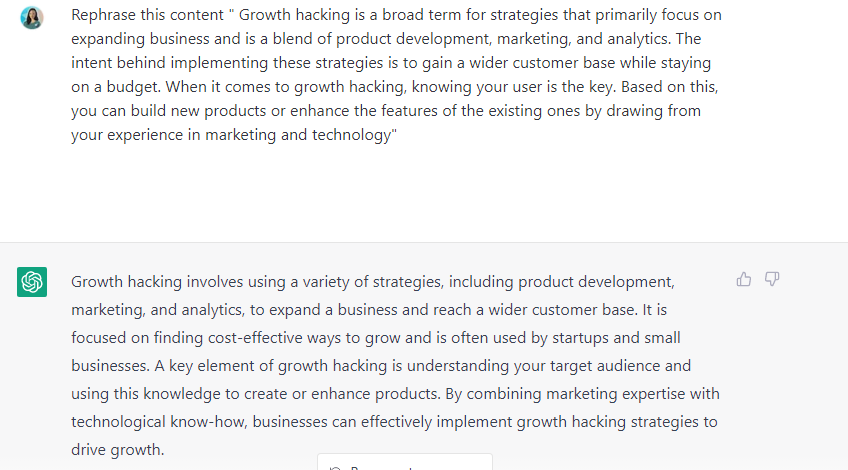
ChatGPT can be an excellent paraphraser! It can re-write or rephrase content to avoid plagiarism issues. This can be pretty useful for content submissions for link-building purposes.
Query – “Rephrase this content <content>”
23. Creates a content Brief for a Given Keyword
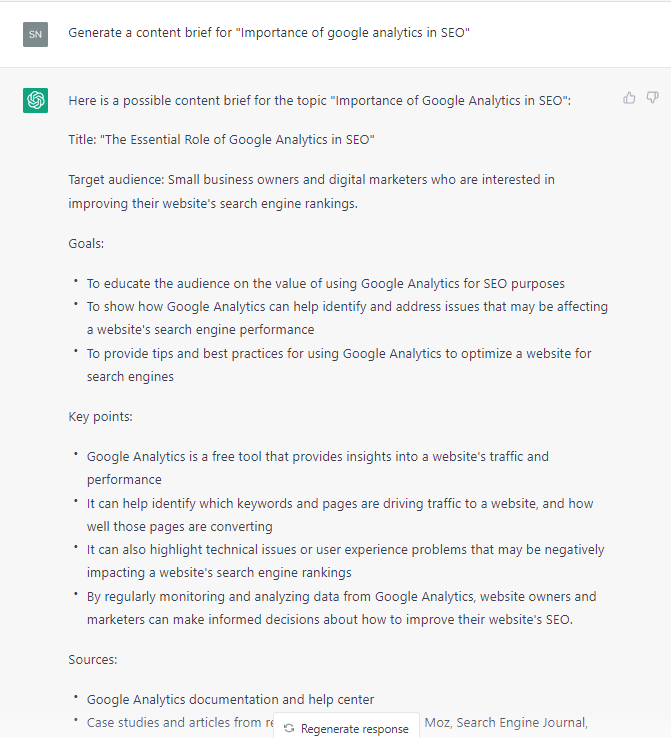
ChatGPT helps in giving a rough idea or plan for creating content around a desired keyword in a way that includes information about the target audience and goals for the content.
Query – “Generate a content brief for “Keyword”
24. Organize Keywords by Topic or Theme
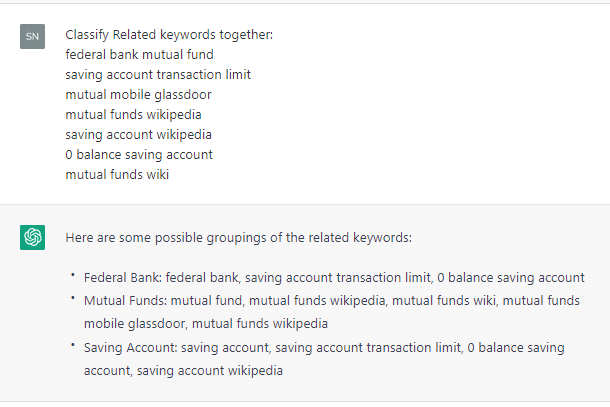
Using ChatGPT we can effortlessly categorize a given set of keywords which will make our work much lesser while doing deep research and writing blogs for a particular theme.
Query – “Classify related keywords together:
<List of keywords>
25. Generate Effective Journo Response for HARO
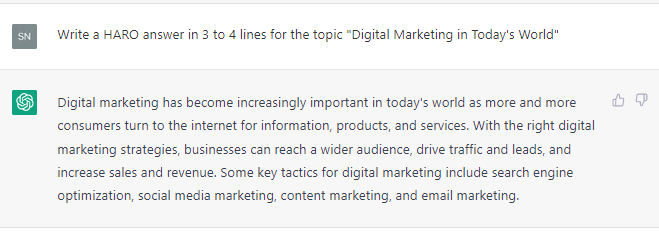
ChatGPT helps in generating a well-written and informative journo response through which businesses can increase their chance to gain valuable exposure for their products, ideas and services.
Query – “Write a HARO answer in 3 to 4 lines for the topic <Topic name>”
26. Ease your Wokflow with Automated Formatting
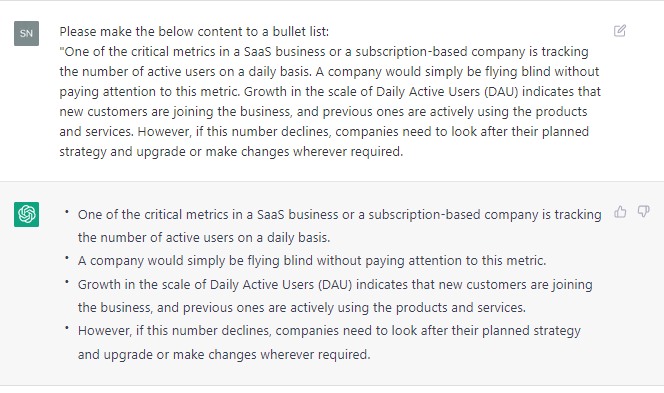
With ChatGPT streamline your content creation process by formatting your texts automatically.
Query – “Please make the below content to a bullet list”
<Content>
27. Emphasize Important Keywords
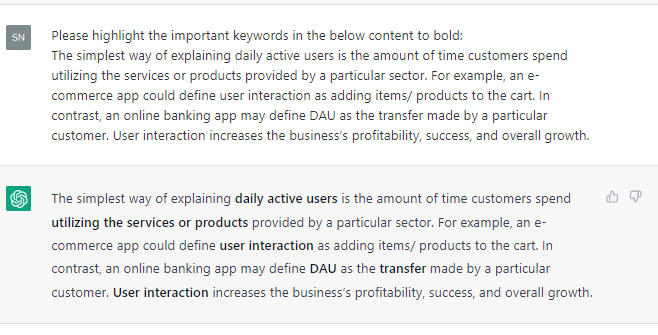
ChaptGPT helps in highlighting important keywords in a given content which helps direct readers to specific information or making it easier to understand the content.
Query – “Please hightlight the important keywords in the below content to bold:”
<content>
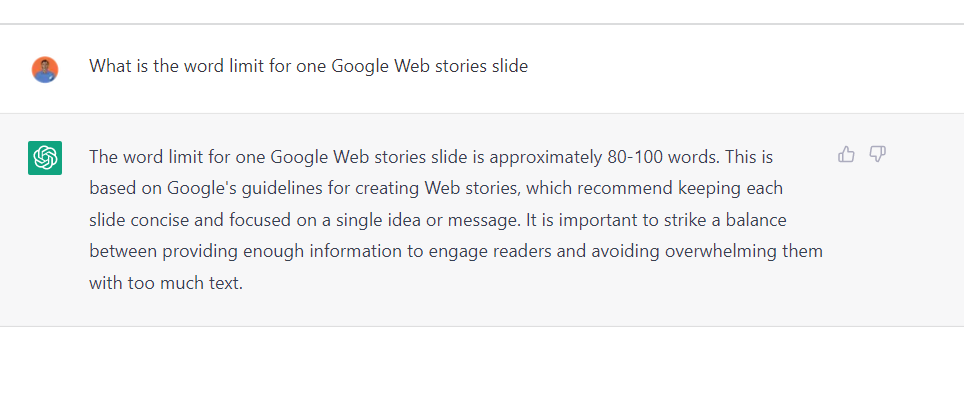
28. Find information regarding character limitations
Through ChatGPT we can get information regarding character limit or restrictions that apply to different types of content or platforms.
Query – “What is the word limit for one Google Web stories slide”
Conclusion
In conclusion, ChatGPT emerges as a game-changer in the realm of SEO strategies, offering a revolutionary and user-friendly approach. Acting as a versatile assistant, it navigates various tasks with a human touch, making it a valuable ally for client interactions and content generation. Its cost-effectiveness and zero-hassle utility contribute to its widespread adoption. upGrowth, a pioneer in the digital industry is revolutionising the paid versions of Chat GPT by creating custom GPTs that will help digital marketers and founders make a mark.
Watch: ChatGPT for SEO — In-Depth Tips & Tricks
For Curious Minds
ChatGPT's effectiveness stems from its training on Reinforcement Learning from Human Feedback (RLHF). This advanced AI model refinement process involves human trainers who rank and guide the AI's responses, ensuring its output is more natural, helpful, and contextually aware than older automated systems. This human touch is what allows it to go beyond simple text generation. For SEO, this means the tool can grasp user intent and produce content that genuinely resonates. Instead of just stuffing keywords, you can use it to craft content that addresses user pain points, answers follow-up questions, and mirrors conversational language, which search engines increasingly favor. This human-aligned training is the key differentiator that elevates its utility from a basic chatbot to a strategic SEO assistant, as detailed further in the full analysis.
ChatGPT generates Latent Semantic Indexing (LSI) keywords by analyzing its vast dataset to find terms and concepts that are semantically related to your primary keyword. It does not just look for synonyms; it identifies contextual words that frequently appear alongside your main topic, helping search engines understand the broader context of your content. This is critical for establishing topical authority. By incorporating these LSI keywords, you signal to Google that your content is a comprehensive resource on the subject. This moves your strategy beyond single-keyword optimization toward creating holistic content clusters that cover a topic in-depth. For example, a query for “startup KPI metrics” yields related terms that help you build a more robust piece, which is a foundational element of a modern SEO strategy explored in the article.
A targeted SEO strategy, like the one upGrowth implemented for a coaching platform, is a prime example of what AI-assisted planning can achieve. The strategy resulted in a remarkable +80% increase in organic leads and a +120% rise in paid leads within just forty-eight days by focusing on a holistic approach. You can use ChatGPT to accelerate this process by:
Identifying high-intent keywords specific to the coaching industry.
Generating content outlines for blog posts and landing pages that address client challenges.
Crafting compelling ad copy and call-to-action phrases for paid campaigns.
The key is using the AI to scale content creation and strategic planning, allowing your team to focus on execution and analysis. This case study demonstrates that a well-defined plan, amplified by modern tools, delivers tangible business outcomes, a theme we expand on throughout the guide.
For a SaaS company, you can use ChatGPT to construct an effective SEO strategy by following a clear, multi-stage process. This structured approach ensures all bases are covered from discovery to execution, directly supporting business growth. Start by defining your goals and then proceed with these steps:
Keyword and Competitor Analysis: Prompt ChatGPT with “Suggest an SEO strategy for a [your SaaS niche] company.” Ask it to generate LSI keywords, long-tail questions, and theme-based keywords related to your core features.
Content Pillar Creation: Use the keyword analysis to ask for blog ideas and catchy titles. Prompt it to create detailed outlines for pillar pages and supporting blog posts.
On-Page and Technical SEO: Request FAQs based on your content, generate schema markup for key pages, and create compelling meta descriptions and CTAs.
This structured workflow transforms ChatGPT from a simple tool into a strategic partner, helping you build a cohesive plan that attracts and converts your target audience, as shown in the examples in our complete guide.
A Custom GPT offers a significant advantage over the standard ChatGPT for specialized SEO tasks by operating on a pre-defined set of instructions and knowledge. While the standard model is a powerful generalist, a custom version like a “Keyword Explorer” is an expert fine-tuned for a specific purpose, providing more relevant and structured output with less prompt engineering. Consider these factors when deciding:
Efficiency: A Custom GPT saves time by embedding your strategic needs directly into the tool, eliminating the need to repeat complex instructions for every query.
Consistency: It provides a standardized output format, which is crucial for scalable tasks like generating meta descriptions or schema markup across hundreds of pages.
Expertise: It can be fed specific SEO frameworks or internal data to act as a specialized consultant.
The standard model is excellent for ad-hoc creative tasks, but a Custom GPT is superior for repeatable, expert-level SEO functions. Understanding this distinction is key to integrating AI into your workflow, a concept we explore further.
The integration of AI like ChatGPT is fundamentally shifting SEO workflows from manual creation to strategic supervision. In the long term, this means the value of an SEO specialist will be less in writing every word and more in guiding AI to produce high-quality, strategically aligned content at scale. To adapt, teams must prioritize developing skills in prompt engineering, critical evaluation of AI output, and integrating AI into a human-centric review process. The competitive edge will belong to those who use AI as an accelerator, not a replacement for human expertise and creativity. This means focusing on unique brand voice, proprietary data, and experiential content that AI cannot replicate. The evolution of these roles and strategies is a central theme of our complete analysis.
ChatGPT solves the challenge of generic, ineffective outreach by enabling the rapid creation of personalized and compelling email pitches. The common mistake is sending a one-size-fits-all template, which high-authority sites easily ignore. By using a specific prompt, you can generate an email that feels authentic and tailored to the recipient. You can instruct ChatGPT to:
Reference a recent article on the target blog to show you have done your research.
Suggest three specific, relevant, and catchy guest post titles.
Adopt a professional yet conversational tone that matches the blog's style.
This approach transforms a time-consuming task into an efficient process for building high-quality backlinks. By generating a strong first draft, it frees you up to focus on personalization and relationship-building, a crucial tactic for SEO success discussed in the article.
Replicating the success of brands like Fi.Money involves mastering advanced SEO, and ChatGPT serves as an accessible expert to guide this process. The fintech brand's growth was driven by a sophisticated strategy, and you can use the AI to understand and apply similar techniques. For example, to tackle entity mapping, you can prompt ChatGPT with “Explain entity mapping in SEO and provide a step-by-step guide to implement it for a [your industry] website.” The AI can break down this complex topic, explain how Google connects concepts, and suggest how to structure your content to build strong entity associations. By using ChatGPT as a learning and implementation tool, you can bridge the knowledge gap and execute advanced tactics that were once reserved for top-tier agencies, a pathway to growth we detail in the full post.
To achieve significant lead growth, your content must directly address user intent, and ChatGPT can help you craft the perfect conversion elements. For a B2B coaching platform, focus on prompts that solve specific user problems and guide them toward a conversion. For effective CTAs, use a prompt like: “Generate 10 compelling call-to-action ideas in 5-7 words for a landing page offering a free B2B leadership coaching consultation.” For a targeted FAQ section, prompt: “Create a list of 5 frequently asked questions a CMO would have before signing up for a coaching platform. Base the answers on addressing budget, ROI, and implementation time.” This targeted approach ensures your content resonates with your ideal customer profile, which is a critical step in turning traffic into tangible leads like the +80% growth seen in the case study.
ChatGPT directly addresses the problem of narrow keyword focus by acting as a powerful brainstorming partner that reveals the full spectrum of a topic. Marketers often get stuck on high-competition head terms, but true authority comes from comprehensive coverage. By prompting ChatGPT for “LSI keywords for ‘startup KPI metrics’” or “keywords associated with the theme ‘SaaS SEO strategy’,” you unlock a wider net of related subtopics and long-tail queries. This helps you:
Build content clusters that cover a subject from all angles.
Target lower-competition keywords with high purchase intent.
Satisfy Google's preference for in-depth, expert content.
This method shifts your strategy from targeting single keywords to owning entire conversations, leading to more resilient and diverse organic traffic streams. The full article explores how to build these content moats.
ChatGPT's ability to automate technical tasks like schema generation will shift the role of a technical SEO specialist from a manual implementer to a strategic overseer. While the AI can create the code, human expertise is still required to ensure it is accurate, correctly implemented, and strategically aligned with business goals. The most valuable skills for technical SEOs in the future will be:
Strategic Auditing: Identifying which schema types will have the most impact and diagnosing complex implementation issues.
AI Prompting and Validation: Crafting precise prompts to get the right output and verifying the AI-generated code for errors.
Data Analysis: Connecting technical improvements to performance data to prove ROI.
The focus will move from 'how to write the code' to 'why and where this code should be used for maximum impact'. This evolution demands a more analytical and strategic mindset, a trend we discuss further.
ChatGPT moves beyond tactical tasks to assist in building a full-funnel SEO strategy by providing industry-specific insights at each stage of the customer journey. A generic approach fails because user intent varies drastically from awareness to decision. You can use ChatGPT to map this out by prompting it for content ideas tailored to different funnel stages. For example: “For a SaaS company, suggest top-of-funnel blog topics (awareness), middle-of-funnel comparison guides (consideration), and bottom-of-funnel case study ideas (decision).” This ensures you create a cohesive content ecosystem that nurtures leads from initial discovery to final conversion. This strategic, industry-specific alignment, which helped a client achieve a +80% lift in organic leads, is the cornerstone of a successful SEO program. The full article provides more examples.
The SEO wizard, Rohit is keen on sharing his experiences and expertise with his readers. An ardent SEO follower, his blogs are up-to-date with the latest gossip & news of the SEO world.

 Growth Strategy and Planning