Contributors:
Amol Ghemud Published: September 25, 2023
Summary
Here’s an in-depth analysis of SEMrush and Moz, focusing on their key features, differences, and overall value for SEO. It covers aspects like keyword research, site auditing, backlink analysis, ease of use, pricing, and customer support. The article aims to help readers choose the right SEO tool based on their specific needs, highlighting the strengths of each platform.
In This Article
Share On:
Choosing the right SEO tool can be a major decision for your website or agency. While both SEMrush and Moz Pro offer strong foundations for search‑engine optimisation, they serve different types of users and priorities. SEMrush presents a full‑suite platform covering keyword research, competitor analysis, content optimisation and more. Moz Pro focuses more on core SEO functions, like link metrics, domain authority, crawl audits and simpler keyword tracking, typically with a lower starting cost. In this article, we compare SEMrush vs Moz Pro across features, value, usability and suitability so you can decide which tool fits your SEO goals.
SEMrush and Moz: What are they?
A significant difference between SEMrush vs Moz is that while SEMrush only provides access to Google data, Moz provides ranking information based on Google, Bing, and Yahoo search results. SEMrush and Moz are well-known and renowned SEO (Search Engine Optimization) software platforms that give users access to various tools and features to help companies and website owners raise their online exposure and search engine rankings. An overview of each platform is given below:
SEMrush:
Keyword Research: SEMrush provides comprehensive keyword research tools that let users find and evaluate keywords, monitor rankings, and spot opportunities.
Competitor Analysis: SEMrush focuses on competitor analysis to help users comprehend the techniques, keywords, backlinks, and general online performance of their rivals.
Site Audit: To assist customers in optimizing their websites for search engines, the platform offers a site audit tool that analyzes on-page and technical SEO concerns.
Backlink Analysis: Backlink analysis capabilities in SEMrush enable users to analyze their backlink profiles, keep track of new backlinks, and remove harmful links.
Content Marketing: SEMrush provides content marketing solutions for content research, subject ideation, and content optimization to raise search ranks.
PPC Advertising: The platform also has Pay-Per-Click (PPC) advertising management, analysis, and optimization tools.
Pricing: SEMrush offers numerous pricing tiers to meet the demands of users, from freelance writers and microbusinesses to significant corporations.
Moz:
Keyword Research: Moz offers keyword research tools to find and track keywords, evaluate keyword difficulty, and rank keyword targets.
Site Audit: The platform provides site audit tools to find technical SEO problems, optimize on-page optimization, and improve website performance.
Backlink analysis: The backlink checker that comes with Moz enables users to keep track of their backlinks and evaluate the authority and quality of their link profile.
Local SEO: Moz focuses on local SEO and provides tools and services to help companies improve their online visibility for local search results.
Content Marketing: Moz offers tools and resources for content production, optimization, and strategy in its content marketing section.
Pricing: Moz offers pricing tiers appropriate for a range of users, including startups and agencies.
Differences:
Focus: SEMrush is renowned for having an extensive toolkit for SEO and digital marketing, including powerful tools for competitor analysis. On the other hand, Moz greatly emphasizes local SEO and offers tools made just for local companies.
Backlink Analysis: SEMrush and Moz provide backlink analysis, although SEMrush is sometimes regarded as being more thorough in this area because it offers a broader range of backlink-related capabilities.
Pricing Models: Although all platforms include pricing levels, there may be differences in the specific pricing structure and plans. Users should assess the features and costs that correspond to their demands.
SEMrush vs Moz Pro: How Do Their Domain Analysis Tools Compare?
SEMrush:
SEMrush’s Domain Overview feature allows users to enter a domain name (either their own or a competitor’s) to get a comprehensive overview of its SEO performance. This includes metrics such as organic search traffic, organic keywords, backlinks, and referring domains.
SEMrush provides insights into a domain’s top organic competitors, helping users understand which websites they compete with in search results.
SEMrush offers a Backlink Analytics tool that enables users to explore a domain’s backlink profile, including details about referring domains, anchor text, and the authority of those backlinks.
Users can view the domain’s top organic keywords and track their rankings over time. This helps in understanding which keywords are driving traffic to the domain.
Moz:
Moz’s Link Explorer tool provides a detailed analysis of a domain’s backlink profile. Users can explore metrics such as Domain Authority (DA), Page Authority (PA), and spam score for both their domain and competitors’ domains.
Moz offers a Keyword Explorer tool that helps users identify valuable keywords for their domain and assess their competitiveness. This includes keyword difficulty scores and SERP analysis.
Moz Pro users can set up campaigns to track their domain’s SEO performance over time. This includes tracking keyword rankings, site health, and technical SEO issues.
Moz provides on-page SEO recommendations and a site crawl tool to identify and fix technical SEO issues that may affect a domain’s performance.
SEMrush vs Moz Pro: How Do Their Keyword Research Features Compare?
SEMrush
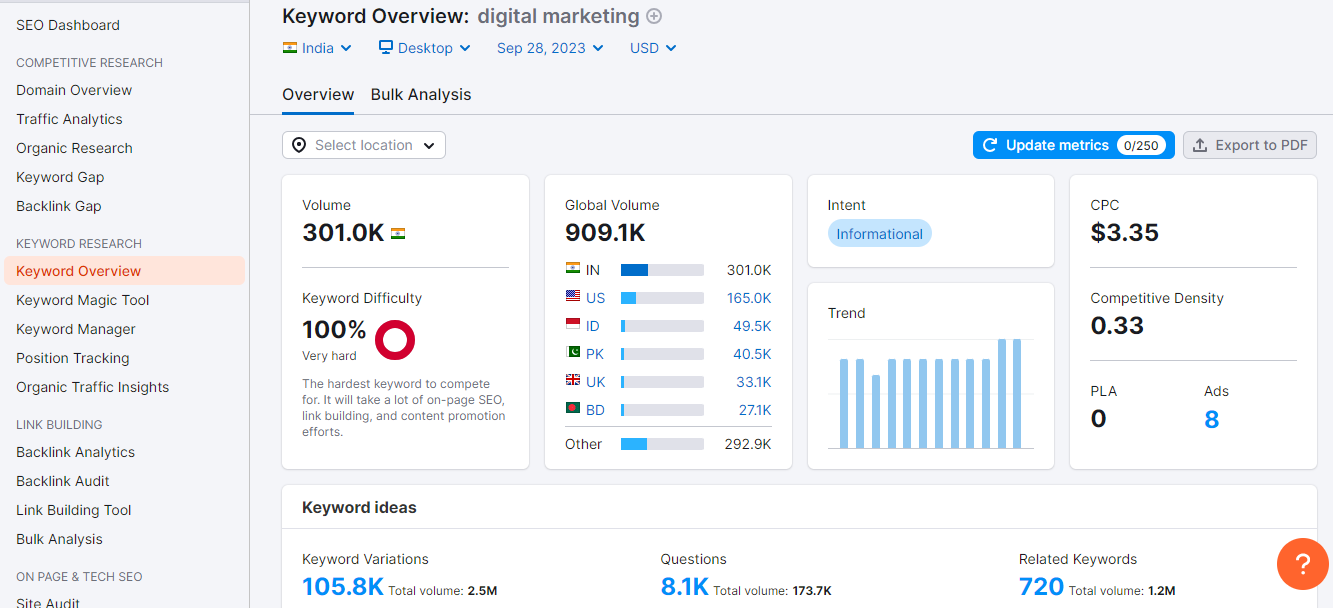
Keyword Magic Tool: SEMrush’s Keyword Magic Tool is a comprehensive keyword research tool allowing users to discover relevant keywords, analyze trends, and identify long-tail and related keywords. It provides keyword difficulty scores to assess competitiveness.
Keyword Analytics: SEMrush offers detailed keyword analytics, including CPC (Cost Per Click), search volume, and competition metrics. Users can track keyword rankings and monitor keyword performance over time.
Keyword Gap Analysis: SEMrush’s Keyword Gap tool allows users to compare their domain’s keywords with those of competitors. This helps identify keyword opportunities and gaps in content.
Keyword Trends: SEMrush provides historical keyword trend data, helping users track changes in keyword popularity over time.
Local SEO Keywords: SEMrush offers features for local SEO, allowing users to find location-specific keywords and track local search trends.
Moz
Keyword Explorer: Moz’s Keyword Explorer tool provides in-depth keyword research capabilities. It offers keyword suggestions, search volume data, keyword difficulty scores, and estimates of click-through rate (CTR). Users can prioritize keywords based on these metrics.
Keyword Lists: Moz allows users to create keyword lists for organized keyword management and analysis.
SERP Analysis: Moz’s Keyword Explorer includes a SERP analysis feature that shows the search engine results page (SERP) features for specific keywords, helping users understand the search landscape.
Rank Tracking: Moz offers rank-tracking features to monitor keyword rankings and track changes over time.
SEMrush vs Moz Pro: How Do Their Backlink Analysis and Link-Building Tools Compare?
SEMrush
SEMrush provides a Backlink Analytics tool allowing users to explore and analyze backlinks to their domain or competitors’ domains. This tool provides insights into referring domains, anchor text, follow vs. nofollow links, and more.
SEMrush’s Backlink Gap tool helps users identify backlink opportunities by comparing their backlink profiles with those of competitors. This allows users to discover potential sources for building high-quality backlinks.
SEMrush offers a Backlink Audit tool to identify and disavow toxic or spammy backlinks that may harm a website’s SEO. Users can proactively manage their backlink profile for better rankings.
SEMrush provides link-building tools and resources to help users plan and execute effective link-building strategies. This includes finding guest posting opportunities, outreach tools, and content ideas for linkable assets.
Moz
Moz’s Link Explorer is a powerful tool for backlink analysis. It provides detailed information about a website’s backlinks, including Domain Authority (DA), spam score, anchor text, and more. Users can explore backlinks to their domain or competitors’ domains.
Moz offers backlink tracking features that allow users to observe changes in their backlink profile and assess the impact on their website’s SEO performance.
Moz’s Link Intersect tool helps users identify websites that link to their competitors but not to their site. This information can be valuable for building new backlinks.
SEMrush vs Moz Pro: How Do Their Site Auditing Tools Compare?
SEMrush
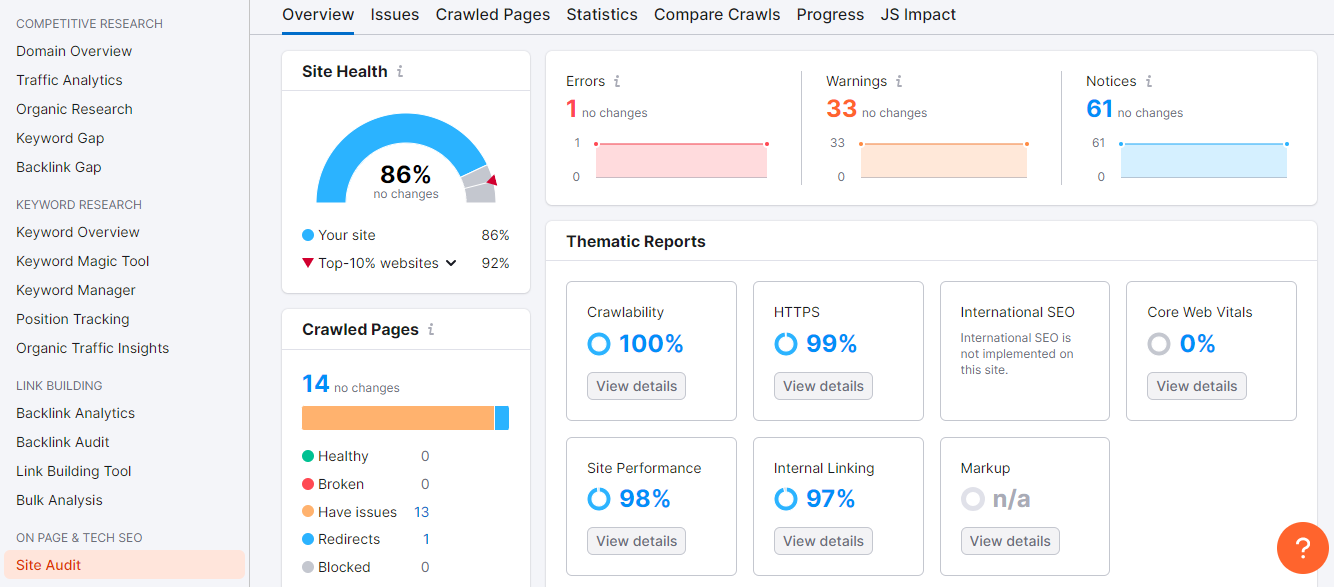
Site Audit Tool: SEMrush’s Site Audit tool is designed to identify on-page and technical SEO issues that may affect a website’s performance. It scans websites for broken links, duplicate content, crawlability problems, and more.
Health Score: SEMrush assigns a health score to websites based on the severity of issues found during the site audit. Users can prioritize and address critical issues first to improve overall site health.
Recommendations: The tool provides detailed recommendations and suggestions for fixing identified issues. This includes guidance on optimizing meta tags, improving site speed, and enhancing mobile-friendliness.
Crawlability Analysis: SEMrush’s site audit tool also offers crawlability analysis, helping users understand how search engines crawl and index their websites.
Moz
Site Crawl: Moz’s Site Crawl tool scans websites for on-page and technical SEO issues. It provides insights into issues like broken links, missing meta tags, and duplicate content.
Site Health: Moz assigns a Site Health score to websites based on the number and severity of issues detected during the crawl. Users can track changes in site health over time.
Prioritization: Moz’s Site Crawl tool offers issue prioritization, helping users focus on critical issues that may have the most significant impact on SEO performance.
Recommendations: Users receive recommendations for resolving identified issues, explanations, and guidance on best practices.
SEMrush vs Moz Pro: How Do Their Broken Link Analysis Tools Compare?
SEMrush
Site Audit Tool: SEMrush’s Site Audit tool includes a broken link analysis feature that scans websites for broken links or 404 error pages. It identifies internal and external broken links.
Broken Link Report: SEMrush provides users with a detailed broken link report, indicating the pages on which broken links are found and the URLs of those links. This helps users quickly locate and fix broken links.
Impact on SEO: The broken links that can have a detrimental effect on user experience and search engine results are also highlighted by SEMrush’s tool.
Moz
Site Crawl: Moz’s Site Crawl tool includes a broken link analysis component that identifies broken links, redirects, and other issues on a website.
Crawl Report: Moz provides a crawl report that lists broken links, redirect chains, and other crawl issues. Users can access detailed information about each broken link.
SEO Impact: Moz’s tool helps users understand the SEO impact of broken links and redirects by providing insights into how search engines and users experience the website.
SEMrush vs Moz Pro: Which Tool Is Easier to Use?
SEMrush
User-Friendly Interface: SEMrush is known for its user-friendly and intuitive interface. The dashboard is organized with easy-to-navigate menus and clear icons, making it accessible for beginners and experienced users.
Onboarding Resources: SEMrush provides onboarding resources such as video tutorials and webinars to help new users get started quickly. These resources guide users through the tool’s features and functionalities.
Customization: SEMrush allows users to customize their dashboards and reports, tailoring them to their specific needs and preferences.
Learning Curve: Many users find SEMrush relatively easy to learn and use, especially for keyword research and competitive analysis tasks.
Moz
User Interface: Moz’s interface is designed to be user-friendly and straightforward. It offers clear navigation menus and tooltips to assist users in finding the features they need.
Guides and Resources: Moz provides guides, educational resources, and tutorials, on its website to help users understand how to use its tools effectively. Users can access in-depth documentation and support materials.
Keyword Research: Moz’s Keyword Explorer tool is designed to be accessible for users looking to perform keyword research and find valuable keywords for their SEO strategy.
Site Crawl and Site Audit: Users may find Moz’s site audit and site crawl features intuitive for identifying and addressing on-page SEO issues.
SEMrush vs Moz Pro: How Do Their Pricing Plans and Value Compare?
SEMrush Pricing
SEMrush offers multiple pricing tiers, including Pro, Guru, and Business plans, with different levels of features and usage limits.
The pricing for SEMrush Pro plan starts at $129.95/month, SEMrush Guru plan starts at $249.95/month, and SEMrush business plan starts at $499.95/month.
Pricing is based on the number of projects, keywords, and users. Higher-tier plans offer more extensive capabilities, including additional projects and historical data.
SEMrush often provides a free trial period for users to explore its features before committing to a subscription.
The plan choice depends on the user’s specific needs, budget, and the scale of their digital marketing efforts.
Moz Pricing
Moz offers pricing plans such as Standard, Medium, Large, and Premium, with features and usage limit variations.
Moz Standard plan starts at $99/month, medium plan starts at $179/month, large plan starts at $299/month, and premium plan starts at $599/month.
Pricing is based on the number of tracked sites and keywords. Higher-tier plans provide more significant capabilities, including additional site crawl limits.
Moz also offers a free trial period to allow users to test its tools and features.
Depending on their demands, the size of their website, and their SEO objectives, users can choose a plan.
Value for Money Comparison
The value for money that users receive from SEMrush and Moz depends on their specific needs and how effectively they can leverage the tools.
Users looking for a full range of digital marketing tools, such as SEO, PPC, and content marketing, may find SEMrush’s pricing to be competitive.
Moz’s pricing may be attractive to users primarily focused on SEO and site analysis, especially those with smaller websites or local businesses.
Users should evaluate both platforms’ features, capabilities, and pricing to determine which offers the best value based on their unique requirements.
SEMrush vs Moz Pro: How Does Their Support Stack Up?
SEMrush Support
Customer Support Channels: SEMrush offers customer support through various channels, including email, live chat, and phone support where users can reach out to the support team with questions or issues.
Knowledge Base: SEMrush provides a comprehensive knowledge base with articles, tutorials, and guides that cover various aspects of using the tool. This resource can help users find answers to common questions and learn how to use SEMrush effectively.
Webinars and Training: SEMrush regularly conducts webinars and training sessions to educate users about the tool’s features and best practices. These sessions are valuable for both beginners and advanced users.
Community: SEMrush has an active user community where members can share insights, ask questions, and discuss digital marketing topics. This community can be a useful resource for networking and knowledge sharing.
Moz Support
Customer Support Channels: Moz offers customer support through email and a ticketing system. Users can submit support requests for assistance with technical issues or questions.
Moz Q&A: Moz has a Q&A section where one can ask questions and get answers from the Moz community and experts. It’s a forum for discussing SEO-related topics and challenges.
Moz Academy: Moz provides an educational platform called Moz Academy, offering courses and training resources on SEO and digital marketing. These resources help users improve their skills and knowledge.
Help Hub: Moz’s Help Hub contains articles and guides that cover various aspects of using Moz’s tools. Users can find answers to common queries and troubleshooting tips.
Key Differences
Support Channels: SEMrush offers a broader range of customer support channels, including live chat and call support, which can provide more immediate assistance. Moz primarily relies on email and ticketing for support.
Knowledge Base vs. Academy: SEMrush’s knowledge base and Moz’s Academy serve similar purposes, providing educational resources, but SEMrush also offers webinars and has a more extensive library of articles.
Community: With a more vibrant user base, SEMrush offers a forum for discussion and knowledge sharing.
Customer Support Accessibility: SEMrush’s customer support channels are known for their accessibility and responsiveness, which may appeal to users seeking prompt assistance.
FAQs
1. What is SEMrush and Moz, and why are they important for SEO?
SEMrush and Moz are two well-known and highly regarded SEO (Search Engine Optimization) software platforms used by digital marketers, website owners, and SEO professionals. They are essential for SEO for several reasons:
Comprehensive SEO Tools:
SEMrush: A variety of tools for SEO, PPC, content marketing, social media, and more are available with the flexible digital marketing platform SEMrush. Its SEO capabilities include rank tracking, backlink analysis, competition analysis, and keyword research.
Moz: Moz primarily focuses on SEO and explicitly provides tools for keyword research, site analysis, backlink analysis, and rank tracking. It offers a more concentrated set of SEO features.
Keyword Research:
SEMrush and Moz offer powerful keyword research tools that allow users to discover relevant keywords, assess keyword difficulty, track keyword rankings, and identify new keyword opportunities. This is crucial for optimizing content and targeting keywords to improve search engine visibility.
Site Analysis:
SEMrush and Moz provide site auditing tools that help identify on-page and technical SEO issues on websites. These tools scan for broken links, duplicate content, site speed issues, mobile-friendliness, and other factors impacting a site’s SEO performance.
Backlink Analysis:
Backlink analysis is a critical aspect of SEO, and both SEMrush and Moz offer tools to analyze a website’s backlink profile. Users can assess the quality of backlinks, identify new link-building opportunities, and monitor changes in their backlink profile.
Competitive Analysis:
Both platforms allow users to analyze their competitors’ websites, uncover their strategies, and identify areas where they can gain a competitive advantage. This competitive intelligence is valuable for developing effective SEO strategies.
Rank Tracking:
Monitoring keyword positions on search engine results pages is crucial for evaluating the success of SEO campaigns. Tools for tracking rank that keep track of keyword performance over time are offered by SEMrush and Moz.
Education and Resources:
In order to assist users in honing their SEO abilities and expertise, Moz provides Moz Academy, which consists of training tools and courses. Additionally, SEMrush offers webinars, tutorials, and a vibrant user community where industry experts can share best practices.
Pricing:
SEMrush and Moz offer pricing plans to accommodate various budgets and needs, making their tools accessible to businesses of all sizes.
2. How do SEMrush and Moz differ in terms of features and capabilities?
SEMrush and Moz differ in features and capabilities, impacting which platform is better suited to specific SEO needs. Here’s a comparison of their key distinctions:
Comprehensive vs. SEO-Focused:
SEMrush: SEMrush offers many tools beyond SEO, making it suitable for users with diverse digital marketing needs.
Moz: Moz primarily focuses on SEO and provides tools designed explicitly for keyword research, site analysis, backlink analysis, and rank tracking. It offers a more concentrated set of SEO features.
Keyword Research:
SEMrush: SEMrush is known for its robust keyword research capabilities. It provides detailed keyword data, including search volume, competition, difficulty, and related keyword suggestions. Users can perform in-depth competitor keyword analysis.
Moz: Moz’s keyword research tool, Keyword Explorer, also offers valuable keyword insights, but SEMrush tends to provide more extensive keyword-related data.
Site Analysis:
SEMrush: SEMrush’s site audit tool covers on-page SEO issues, technical SEO problems, and mobile-friendliness. It provides detailed recommendations for improving site health.
Moz: Moz’s site crawl tool is focused on identifying on-page SEO issues and crawl errors. While it covers essential aspects of site analysis, SEMrush’s tool may offer a more extensive range of features.
Backlink Analysis:
SEMrush: SEMrush’s backlink analysis tool is known for its depth and accuracy. It provides detailed insights into backlinks, including referring domains, anchor text, and authority metrics.
Moz: Moz’s backlink analysis tool, Link Explorer, offers valuable information about a site’s backlink profile but may not provide as extensive backlink data as SEMrush.
Competitive Analysis:
SEMrush: SEMrush excels in competitive analysis, allowing users to compare their websites to competitors and uncover strategies in areas like organic search, advertising, and content marketing.
Moz: Moz also offers competitive analysis features but may not provide the same breadth of data and insights as SEMrush.
3. Which tool is better for keyword research, SEMrush or Moz?
SEMrush and Moz are both reputable platforms for keyword research, but each has its own strengths and capabilities in this area. Your own demands and priorities will determine which one you choose:
SEMrush for Keyword Research:
Extensive Keyword Database: SEMrush is known for its vast keyword database, which includes millions of keywords from various regions and languages. This extensive database is valuable for discovering new keywords and assessing their potential.
Competitive Analysis: SEMrush excels in competitor keyword analysis. Your competitors’ strategies might be better understood if you know the keywords they are ranked for. This can help you find keyword opportunities and gaps in your content.
Keyword Difficulty: SEMrush provides a keyword difficulty metric that helps you gauge how challenging it will be to rank for a particular keyword. This helps you prioritize keywords based on their competitiveness.
Topic Research: SEMrush offers a topic research tool that allows you to explore related topics and find content ideas based on your target keywords.
Moz for Keyword Research:
Keyword Explorer: Moz’s Keyword Explorer is a user-friendly tool that provides valuable keyword data, including search volume, keyword difficulty, and click-through rate (CTR) estimates. It also offers features like keyword lists and prioritization.
SERP Analysis: Moz’s Keyword Explorer provides detailed SERP (Search Engine Results Page) analysis, showing you the top-ranking pages for a keyword. This can help you understand the competition and identify opportunities.
Keyword Lists: Moz allows you to create and manage keyword lists, making it easier to organize and track your keyword research efforts.
Which One Is Better for Keyword Research?
If you prioritize access to a vast keyword database and robust competitive analysis, SEMrush may be the better choice. It’s particularly useful if you’re in a competitive industry and want to stay ahead of your competitors.
If you prefer a user-friendly interface and in-depth SERP analysis, Moz’s Keyword Explorer may be more suitable. It’s a great option for users who want a straightforward keyword research experience.
4. Can you compare the backlink analysis features of SEMrush and Moz?
SEMrush and Moz both offer backlink analysis features, but they have differences in their capabilities and approaches. Here’s a comparison of their backlink analysis features:
SEMrush Backlink Analysis
Extensive Backlink Database: SEMrush boasts one of the most extensive backlink databases in the industry, making it a powerful tool for discovering and analyzing backlinks.
Backlink Overview: SEMrush provides a comprehensive overview of a website’s backlink profile, including metrics like referring domains, backlinks, anchor text distribution, and authority scores.
Competitive Analysis: SEMrush excels in competitor backlink analysis. Users can examine the backlink profiles of competing websites to find opportunities to create high-quality backlinks for their own website.
Backlink Audit: SEMrush’s backlink audit tool helps users identify and disavow toxic or low-quality backlinks, essential for maintaining a healthy backlink profile.
Historical Data: SEMrush offers historical backlink data, allowing users to track changes in their backlink profile over time.
Moz Backlink Analysis:
Link Explorer: Moz’s Link Explorer provides detailed insights into a website’s backlink profile, including metrics like domain authority (DA) and page authority (PA). It also offers information about the anchor text used in backlinks.
Competitor Backlink Analysis: Moz allows users to analyze their competitors’ backlink profiles and identify potential link-building opportunities.
Spam Score: Moz provides a Spam Score metric that helps users identify potentially spammy backlinks. This can be useful for backlink quality assessment.
Link Tracking Lists: Moz offers link tracking lists, allowing users to monitor specific backlinks and track changes in their backlink profile
5. Which tool is more user-friendly for beginners, SEMrush or Moz?
Moz and SEMrush are both user-friendly platforms, but they have some differences in terms of ease of use, especially for beginners. Here’s a comparison:
SEMrush for Beginners
User-Friendly Interface: SEMrush has a user-friendly and intuitive interface that is relatively easy for beginners to navigate. Key features are accessible from the dashboard, making it easy to start.
Guided Tutorials: SEMrush offers guided tutorials and onboarding tips, which can benefit beginners new to SEO tools. These tutorials help users understand how to use various features.
Topic Research: SEMrush’s Topic Research tool is designed to simplify content planning and idea generation, making it beginner-friendly for content-related tasks.
Comprehensive Knowledge Base: SEMrush provides a broad knowledge base with articles, guides, and webinars, which can be valuable for users looking to learn more about digital marketing and SEO.
Moz for Beginners:
User-Friendly Interface: Moz’s interface is straightforward and user-friendly, making it accessible to beginners. Key features are easily accessible from the dashboard.
Moz Academy: Moz offers Moz Academy, which includes educational courses and resources to help beginners improve their SEO skills and knowledge.
Keyword Explorer: Moz’s Keyword Explorer tool provides valuable keyword insights in a user-friendly format, making it easier for beginners to perform keyword research.
Which One Is More User-Friendly for Beginners?
For beginners looking for a well-rounded tool that is relatively easy to use and offers a wide range of features beyond SEO, SEMrush may be a better choice due to its user-friendly interface and educational resources.
However, beginners with a specific focus on SEO may find Moz’s interface equally user-friendly, and Moz Academy can be a valuable resource for learning about SEO best practices.
6. Can SEMrush and Moz be used together, or is it better to choose one over the other?
Yes, SEMrush and Moz can be used together, and in some cases, it can be beneficial to use both tools to complement each other’s features. Here are some considerations for using SEMrush and Moz together:
Comprehensive SEO Strategy: SEMrush and Moz offer unique features and strengths. SEMrush provides extensive competitive analysis and keyword research capabilities, while Moz offers in-depth site auditing and link analysis. Combining both tools can provide a more comprehensive SEO strategy.
Keyword Research: You can use SEMrush for initial keyword research and competitor analysis to identify high-potential keywords. Moz’s Keyword Explorer can then be used to dive deeper into keyword metrics and difficulty scores.
Backlink Analysis: SEMrush is known for its extensive backlink analysis, but Moz’s Link Explorer can provide additional insights, especially regarding spam score analysis. Both tools can help you get a complete picture of your backlink profile.
Site Auditing: SEMrush’s site audit tool can identify technical SEO issues on your website. You can use Moz’s site auditing tool as a second opinion to ensure no critical issues are overlooked.
Content Planning: SEMrush’s Topic Research tool can generate content ideas and identify trending topics. Moz’s keyword research features can help you refine your content strategy based on these ideas.
7. Which tool offers better support and resources for learning SEO techniques?
Both SEMrush and Moz offer valuable resources for learning SEO techniques, but there are some differences in the types of support and educational materials they provide:
SEMrush:
Academy: SEMrush offers the SEMrush Academy, which includes a wide range of free courses and certification programs covering SEO, PPC, content marketing, and more. This resource is suitable for beginners and advanced users alike.
Webinars: SEMrush regularly hosts webinars on various digital marketing topics, including SEO techniques and best practices. These webinars often feature industry experts and can provide valuable insights.
Blog: SEMrush maintains a blog that covers SEO news, trends, and in-depth guides.
Community: SEMrush has an active user community where you can ask questions, share experiences, and learn from other digital marketers and SEO professionals.
Moz:
Moz Academy: Moz offers the Moz Academy, which provides a variety of courses and resources focused on SEO and inbound marketing. It’s an excellent resource for individuals looking to deepen their SEO knowledge.
Whiteboard Friday: Moz is known for its “Whiteboard Friday” video series, hosted by Rand Fishkin and other SEO experts. These videos cover various SEO topics and techniques in an accessible and engaging format.
Blog: Moz maintains a blog that regularly publishes SEO-related content, including how-to guides and industry insights.
Q&A Forum: The Moz community, which includes workers from the company and seasoned SEO experts, can be consulted in the Q&A forum.
8. What are the pricing models for SEMrush and Moz, and do they offer free trials?
SEMrush and Moz offer different pricing models and plans, and both platforms provide free trials. Here’s an overview of their pricing structures:
SEMrush Pricing:
SEMrush offers three main pricing plans:
Pro Plan: This plan suits individuals, freelancers, and startups.
Guru Plan: The Guru plan is designed for small and medium-sized businesses.
Business Plan: The Business plan is suitable for agencies and larger enterprises.
SEMrush also offers a custom Enterprise plan for large organizations with specific needs.
SEMrush Free Trial: SEMrush offers a 7-day free trial that provides access to many features and tools. You can explore the platform’s capabilities during the trial and determine which plan suits your needs.
Moz Pricing:
Moz offers four pricing plans:
Standard Plan: The Standard plan is suitable for individuals and small businesses.
Medium Plan: The Medium plan is designed for growing businesses.
Large Plan: The Large plan is suitable for agencies and larger organizations.
Premium Plan: Moz also offers a Premium plan for advanced users and enterprises. Pricing is custom and tailored to specific requirements.
Moz Free Trial: Moz offers a 30-day free trial of its Moz Pro plan. This trial allows you to explore Moz’s features, including the backlink checker, site audit, and keyword research tools.
Watch: SEMrush vs Moz — Which SEO Tool Drives Better Success?
SEMrush positions itself as a complete digital marketing suite, extending far beyond core SEO to cover the full spectrum of online visibility. Its value lies in providing a single platform where you can manage and analyze interconnected activities like SEO, PPC, content marketing, and competitive intelligence. This integrated approach is critical because search performance is rarely isolated; it is influenced by paid advertising, content quality, and competitor actions. Using SEMrush allows you to:
Analyze competitor ad copy and keywords to inform your organic content strategy.
Use the site audit tool to find technical issues that may be hindering your top-performing content.
Track keyword rankings alongside your backlink acquisition efforts to see direct correlations.
By unifying these data points, you can make more strategic decisions, ensuring every part of your marketing works in concert. Explore the full comparison to see how this contrasts with more specialized tools.
Moz Pro excels by concentrating on the foundational pillars of search engine optimization, particularly link authority and local search. Instead of offering a wide array of digital marketing tools, it provides deep, specialized features that are essential for building a strong and trustworthy online presence from the ground up. This focus is highly beneficial for businesses that need to master core SEO before expanding, as a strong foundation is non-negotiable for long-term success. Moz Pro's approach helps you:
Master local visibility with tools designed to improve rankings in specific geographic areas.
Analyze the quality of your backlink profile using trusted metrics like Domain Authority.
Conduct thorough site audits to fix on-page and technical issues that directly impact rankings.
This dedication to core SEO makes it an excellent choice for companies needing to build authority and relevance methodically. Discover if this targeted approach aligns with your business goals in the detailed breakdown.
Both platforms offer robust backlink analysis, but they approach it with different philosophies. SEMrush is often recognized for its vast backlink database and comprehensive toolset, allowing for deep dives into competitor link strategies and identifying new link opportunities. In contrast, Moz Pro is renowned for its proprietary quality metrics, especially Domain Authority, which provides a powerful way to gauge the strength of a link profile. The choice depends on your objective: SEMrush provides the raw data for granular analysis, while Moz Pro offers an authoritative score for strategic evaluation. An agency might prefer SEMrush for forensic competitor takedowns but choose Moz Pro for high-level client reporting where an understandable metric like Domain Authority is more effective. Evaluate which tool’s output better aligns with your strategic needs in the complete feature comparison.
The difference in data sources presents a critical strategic choice based on your target audience's behavior. SEMrush provides deep, comprehensive data exclusively from Google, which is ideal if your audience predominantly uses that search engine. However, Moz Pro's inclusion of data from Bing and Yahoo offers a more diversified view of the search landscape. This broader perspective is crucial for understanding your total addressable search market, not just a segment of it. Relying on Google-only data can create blind spots if a significant portion of your customers use other platforms. For example, users of certain Microsoft products often default to Bing. Moz Pro helps you capture these opportunities, ensuring your strategy is not overly dependent on a single search engine's algorithm. Consider the full analysis to determine which data set best reflects your customer base.
SEMrush's strength in competitor analysis allows you to reverse-engineer a rival's entire online strategy, providing a clear roadmap for outmaneuvering them. The platform moves beyond simple keyword comparisons to reveal the intricate details of their digital footprint, effectively turning their marketing budget into your research data. This evidence-based approach enables you to build a strategy based on proven success rather than guesswork. Specifically, you can:
Identify Keyword Gaps: Discover valuable keywords your competitors rank for that you are missing.
Analyze Top Content: See which of their pages attract the most traffic and backlinks.
Examine Ad Strategies: View their PPC ad copy and landing pages to understand conversion funnels.
Map Backlink Sources: Uncover high-authority domains linking to them and target those same sources.
This level of intelligence is invaluable for creating a targeted plan to win valuable search traffic. See more examples in the full article.
Moz Pro's specialized focus on local SEO gives small, location-based businesses a significant competitive edge where it matters most: in their immediate service area. While general SEO tools offer broad insights, Moz Pro provides actionable features tailored to the unique challenges of local search, such as managing business listings and tracking geo-specific rankings. This targeted functionality translates directly to measurable business outcomes, helping you dominate the local search results page. Using Moz Pro, a local business can:
Improve rankings on Google, Bing, and Yahoo for geographically-modified searches.
Ensure consistency across online directories, a critical local ranking factor.
Track local search performance accurately to see what strategies are driving foot traffic and calls.
This focus helps small businesses compete effectively against larger brands with bigger budgets. Learn more about how to apply these features by reading the full comparison.
For a budget-conscious startup, Moz Pro offers a clear path to building a strong SEO foundation by focusing on critical, high-impact tasks first. The platform simplifies technical SEO, allowing you to quickly find and fix issues that could be holding back your site's performance without getting lost in overly complex data. The ideal process is to prioritize fixes that deliver the greatest return on effort.
Run a Full Site Crawl: Start by using the Site Crawl feature to get a complete diagnostic of your website's health.
Focus on Critical Issues: Filter the results to address the most severe problems first, such as broken links and missing title tags.
Optimize On-Page Elements: Use the Page Optimization feature to score key pages against target keywords and get specific recommendations.
Track Keyword Rankings: Set up a campaign to track a small set of high-intent keywords to measure the impact of your changes over time.
This methodical approach ensures your limited resources are spent on what truly matters. See how this compares to other platforms in our detailed review.
An agency can use SEMrush to create a powerful, unified strategy by breaking down the silos that often exist between SEO, content, and PPC teams. The platform's integrated design allows data from one channel to directly inform and improve the others, leading to more efficient and effective campaigns. A step-by-step implementation involves creating a data feedback loop across channels.
Start with Keyword Research: Use the Keyword Magic Tool to identify target keywords with both organic and paid potential.
Inform Content with PPC Data: Analyze winning ad copy to find high-converting headlines for organic content.
Boost Organic Content with Ads: Promote top-performing blog posts via targeted PPC campaigns to accelerate backlinks.
Close the Loop with Audits: Regularly run a Site Audit to ensure landing pages for all traffic are technically sound.
This integrated workflow ensures all digital efforts are aligned. Dive deeper into the specific tools that make this possible in our complete analysis.
Moz Pro's multi-engine data aggregation is a forward-thinking feature that could become increasingly valuable as the search market diversifies. While Google maintains dominance, shifts in technology, such as the integration of AI search into operating systems like Microsoft Edge, are giving engines like Bing renewed relevance. This means an SEO strategy focused solely on Google may miss a growing segment of valuable traffic. For marketers, this has clear implications: choosing a tool with multi-engine data is a hedge against market concentration and future-proofs your strategy. Relying on Moz Pro allows you to build a more resilient SEO program that is less vulnerable to the algorithmic whims of a single provider and better positioned to capture opportunities across the entire search ecosystem. This foresight should be a key consideration in your decision-making process.
A frequent and costly mistake is choosing a tool based on the sheer number of features rather than on its alignment with specific business objectives and team capabilities. Businesses are often drawn to the extensive toolkit of a platform like SEMrush, only to use a fraction of its capabilities. The solution is to conduct a thorough needs assessment before comparing platforms. Instead of asking "which tool is better?", you should ask "which tool is right for our primary goal right now?". To avoid this pitfall:
Define your immediate priority: Is it local search, competitor research, or technical SEO?
Assess your team's expertise and bandwidth to manage a complex suite.
Match the tool to the task: If your goal is improving local visibility, Moz Pro is likely a better fit. If it is an integrated marketing assault, SEMrush is the stronger choice.
This goal-oriented approach ensures you invest in a solution that provides immediate value. Read the full analysis to map your needs to the right tool.
Many teams operate in silos, with technical specialists fixing site errors and content marketers creating articles, without connecting their efforts. SEMrush helps solve this problem by housing both its Site Audit tool and its Content Marketing solutions within a single platform. This structure allows you to see how technical issues, like slow page speed, directly impact the performance of your most important content. Integrating these two functions is crucial because great content on a technically flawed website will never reach its full potential. By using SEMrush, you can:
Run a site audit to identify technical errors on high-value blog posts.
Use the On Page SEO Checker to get recommendations that blend technical and content-based fixes.
Track the ranking improvements of content after both technical and on-page optimizations are applied.
This holistic view ensures your efforts are not wasted. Discover more about this integrated approach in the complete comparison.
Focusing on the sheer quantity of backlinks is a common mistake that can lead to low-quality, spammy link profiles. Moz Pro directly addresses this by championing a quality-over-quantity approach, centered on its well-regarded Domain Authority (DA) metric. DA provides a single, reliable score to evaluate the strength and trustworthiness of a linking domain, solving the problem of how to measure link quality at a glance. This focus is essential for building sustainable search engine credibility, as search engines like Google prioritize links from authoritative sources. By using Moz Pro, you can:
Quickly assess the quality of potential link opportunities using the DA score.
Monitor your own DA over time as a key performance indicator of link-building success.
Disavow or remove toxic links that could be harming your site's reputation.
This disciplined, quality-focused methodology helps ensure your link-building efforts contribute positively to your long-term rankings.
Amol has helped catalyse business growth with his strategic & data-driven methodologies. With a decade of experience in the field of marketing, he has donned multiple hats, from channel optimization, data analytics and creative brand positioning to growth engineering and sales.

 Growth Strategy and Planning