Contributors:
Amol Ghemud Published: October 27, 2026
Summary
Your ai visibility prompt set is only as useful as the buying signals it captures. Most SaaS brands in 2026 are tracking prompts borrowed from keyword lists, which means they are measuring what search engines indexed, not what buyers actually type into ChatGPT or Perplexity. This guide gives you a five-step framework to choose, tier, and validate prompts so your AI visibility tracking program produces signal, not noise.
In This Article
Share On:
A SaaS growth lead in Bangalore types 17 prompts into a spreadsheet, runs them through ChatGPT, and declares their brand has “good AI visibility.” Two months later, pipeline hasn’t moved. The prompts they picked were keyword-flavored, not buyer-flavored, and they were tracking answers nobody was actually asking for. The tracking infrastructure worked perfectly. The prompt list was the problem.
This is the part of AI visibility that most guides skip. Everyone wants to talk about tools, dashboards, and mention-count metrics. Nobody wants to say the uncomfortable thing: if you seed your ai visibility prompt set from your existing keyword research, you have built a measurement program that tells you about search engine behavior, not buyer behavior. Those two things are increasingly divergent in 2026, and the gap is widening every quarter as more B2B buyers shift discovery to conversational AI interfaces.
When upGrowth Digital built the content and entity architecture for Vance, one of the first things the team discovered was that the prompts buyers used to find forex and remittance tools in AI chat looked almost nothing like the transactional keywords Vance had historically ranked for. Words like “IMPS,” “UTR,” and “payment tracking” were showing up in buyer prompts with full contextual sentences around them, not as isolated head terms. Aligning prompt tracking to that real buyer language, before any GEO or content investment was made, is what allowed the program to produce signal from day one. Vance went from 12% to 89% AI Overview visibility as a result, with monthly organic traffic climbing from 1.8K to 5.6K. The prompt selection step came first.
What follows is a five-step framework for building a prompt set that reflects how your buyers actually describe their problems to AI systems. It covers intent tiering, buyer language sourcing, volume proxy scoring, persona and geography layering, and set sizing. It won’t give you a template to copy. It will give you a repeatable decision process you can run every quarter.
Why Your Current Prompt List Is Probably Wrong
Most teams seed their ai visibility prompt set by copying existing keyword research into a spreadsheet and wrapping each keyword in a thin question shell. “Best project management software” becomes “What is the best project management software?” and the team calls it a prompt. It isn’t. It’s a keyword wearing a trench coat.
The structural problem is category-awareness bias. When you build prompts from your keyword list, you’re selecting for prompts where your brand already has an answer somewhere in the content corpus. You’re measuring presence in queries where you’ve already invested. That feels validating. It produces no useful information about where buyers are actually forming decisions, which is almost always in adjacent, constraint-heavy, contextual queries your keyword research never surfaced.
AI language models respond to intent-shaped natural language. A prompt like “best project management SaaS for remote teams under 50 people where the ops manager doesn’t have a technical background” behaves differently from “project management software” even though both map to the same broad SEO cluster. The longer prompt triggers different source weighting, different entity associations, and a different competitive set inside the model’s response. They are not the same measurement.
The result is false confidence at precisely the wrong moment. Your brand appears in prompts nobody is actually sending, while you have zero visibility into the prompts driving real pipeline. You feel covered. You’re not.
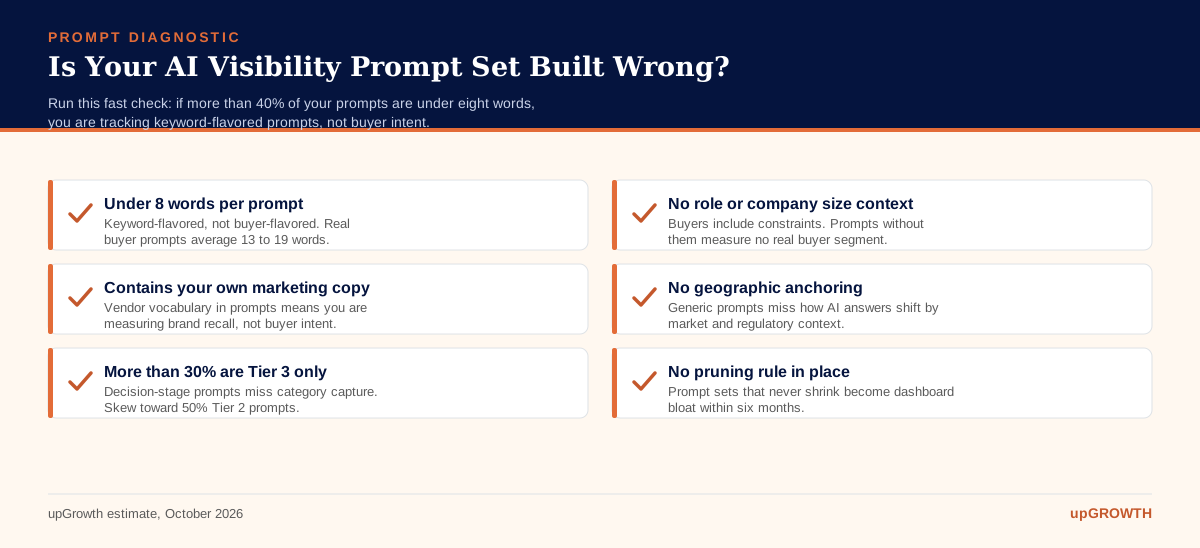
Here’s a fast diagnostic. Pull your current prompt list and count words. If more than 40% of your prompts are under eight words, you’re tracking keyword-flavored prompts. Real buyer prompts average 13 to 19 words. They include role context, company size constraints, geographic anchors, and outcome language. If your prompts are short, they’re wrong, and the data they produce will tell you very little about what’s actually happening in AI-assisted buying journeys.
The fix isn’t to add words to bad prompts. It’s to rebuild from buyer intent, which starts with understanding tier architecture.
Intent Tiers: The Architecture Your Prompt Set Needs
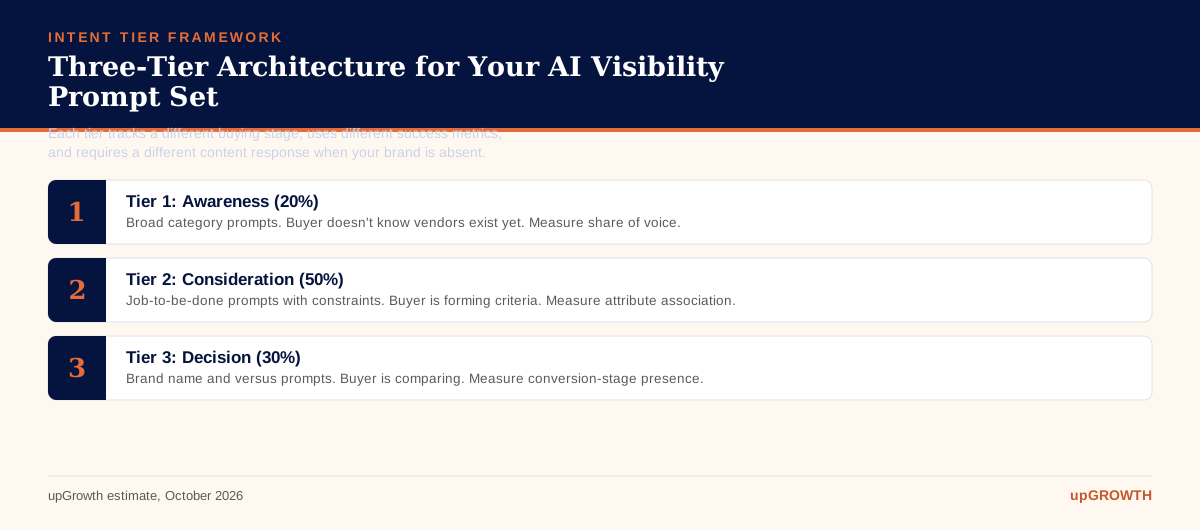
A well-built ai visibility prompt set isn’t a flat list. It’s a three-tier architecture where each tier tracks a different stage of buying intent, uses different success metrics, and requires a different content response when your brand is absent.
Tier 1 (Awareness) prompts are broad category queries from a buyer who doesn’t yet know which vendors exist. They’re describing a problem, not shopping for a solution. “How do businesses manage cross-border payments when they have contractors in multiple countries?” is a Tier 1 prompt. Your success metric here is share of voice: are you in the answer at all, and is the category framing in the AI’s response one you can credibly own?
Tier 2 (Consideration) prompts name a job to be done, include constraints, or reference comparison criteria. “What should I look for in a multi-currency payment platform for a 200-person company that needs audit trails for finance?” is a Tier 2 prompt. These are the highest-value prompts in your tracking set because they reflect active evaluation. The buyer knows solutions exist; they’re forming criteria. Your success metric here is attribute association: does the AI answer associate your brand with the criteria the buyer just named?
Tier 3 (Decision) prompts include brand names, pricing signals, or direct versus queries. “Vance vs Wise for Indian startups paying overseas contractors in USD” is a Tier 3 prompt. These tell you about brand recall and conversion-stage presence. They’re important, but they’re a lagging indicator. Winning Tier 3 without winning Tier 2 means you’re only visible to buyers who already knew your name.
Recommended distribution for a mid-market SaaS brand: 20% Tier 1, 50% Tier 2, 30% Tier 3. Most teams invert this ratio because Tier 3 prompts are easy to write (just use your brand name and a competitor’s). Skewing toward Tier 3 too early tells you about brand recall and nothing about category capture. You’re measuring the bottom of the funnel while the top is invisible.
Each tier also requires a different tracking cadence. Tier 1 prompts move slowly; the AI’s framing of a category shifts over months, not weeks. Check them monthly. Tier 2 prompts shift with market events, new competitor launches, and regulatory changes. Check them biweekly. Tier 3 prompts shift fastest because they’re sensitive to content changes, press mentions, and review volume. Weekly tracking is appropriate here.
Buyer Language vs Keyword Language: How to Tell the Difference
Keyword language is optimized for search engine crawlers: short, noun-heavy, stripped of context, designed to match index patterns. Buyer language is conversational, includes constraints, roles, and desired outcomes. These two vocabularies overlap less than most SaaS marketers assume, and the gap is exactly where AI visibility programs break down.
A CFO at a 300-person SaaS company doesn’t type “expense management software” into Perplexity. They type something closer to “I’m a CFO at a B2B SaaS company trying to cut our SaaS spend by 20% without disrupting engineering workflows, what tools actually work and which ones are oversold.” That prompt contains five data points that keyword research never captures: role, company type, specific outcome target, functional constraint, and a signal of skepticism about vendor claims. Each of those dimensions changes the AI’s answer.
According to Search Engine Land‘s coverage of conversational AI search behavior in 2026, LLMs weight contextual specificity when determining which sources and brands to surface. A brand that has built content answering constraint-heavy buyer questions outperforms generic category content in AI-generated responses, even when the generic content has higher traditional authority signals.
Three sources reliably produce genuine buyer language. Customer success call recordings, especially the objection and discovery moments, are the richest source most teams ignore completely. Sales discovery call transcripts surface how buyers describe problems before a vendor vocabulary has been introduced. Community threads on Reddit, Slack groups, and LinkedIn comment sections capture buyer language without any vendor influence at all. The common thread: these are all places where buyers describe problems before they know the solution exists.
Watch for the vendor vocabulary trap. If your prompts contain your own marketing copy, category labels, or product feature names as buyers wouldn’t know them yet, those prompts are measuring vendor awareness, not buyer intent. “What are the best AI-native accounts payable automation platforms?” contains category language your marketing team invented. A real buyer types “how do I stop my finance team from chasing invoice approvals manually.”
A practical technique: take your five highest-converting case study titles and rewrite them as questions a buyer would type before they knew the solution existed. Those rewrites are your strongest Tier 2 prompt candidates. They already have proof of commercial relevance built in.
Volume Signals: How to Prioritize Prompts When There Is No Search Volume Data
Traditional SEO gives you monthly search volume as a prioritization proxy. AI visibility tracking gives you nothing equivalent. There’s no public database of prompts sent to ChatGPT, no Ahrefs for Perplexity queries, no keyword planner for LLM interfaces. This creates a prioritization problem: you have 200 prompt candidates and no clear signal about which 40 to track weekly.
The answer is proxy signals, and there are four that work reliably in 2026.
First, Google Search Console query data for question-format queries. Filter your GSC queries for those starting with “how,” “what,” “which,” “should I,” and “is there a.” These question-format queries from traditional search are the closest available proxy for conversational AI intent. High-impression, low-click-rate question queries are especially valuable: they signal that a buyer is asking the question but not finding a satisfying answer in search results, which means they’re likely pivoting to AI chat.
Second, Reddit and Quora thread velocity. A subreddit thread that generated 47 comments in 11 days on a specific problem statement is telling you that problem is actively alive in buyer conversations. The thread title is often a near-perfect Tier 2 prompt candidate.
Third, LinkedIn poll and post engagement on problem statements. A post that frames a specific business problem (not a solution) and generates above-average engagement is a signal that the problem resonates widely enough to be worth tracking.
Fourth, “People Also Ask” boxes in Google SERPs for adjacent keywords. PAA boxes are Google’s attempt to surface conversational intent from search data. They’re imperfect but directionally useful for identifying how buyers phrase problems in natural language.
Assign each prompt candidate a priority score using three inputs: proxy signal strength (scored 1-3), commercial relevance to a buying stage (scored 1-3), and gap score, meaning how rarely your brand appears today, scored 1-3 where 3 means your brand never appears. Prompts scoring 7 or above make the core weekly tracking set. Prompts scoring 5-6 go into a monthly test rotation. Prompts scoring below 5 get shelved for quarterly review.
Tools like Scrunch.ai and Profound can surface prompt-level mention frequency across AI platforms, giving a directional volume proxy that manual tracking can’t replicate at scale. The minimum recommended core tracking set is 31 to 53 prompts weekly, with a rotating test pool of 21 to 29 additional prompts run monthly to surface emerging intent patterns.
Persona and Geography: Why One Prompt Set Does Not Fit Every Market
The same product problem gets described very differently by a CTO in Mumbai, a growth lead in Dubai, and an ops manager in Singapore. Geography shapes vocabulary, regulatory context, and the comparison set a buyer considers as credible. A generic prompt set misses all three dimensions and produces averaged data that’s accurate for no one in particular.
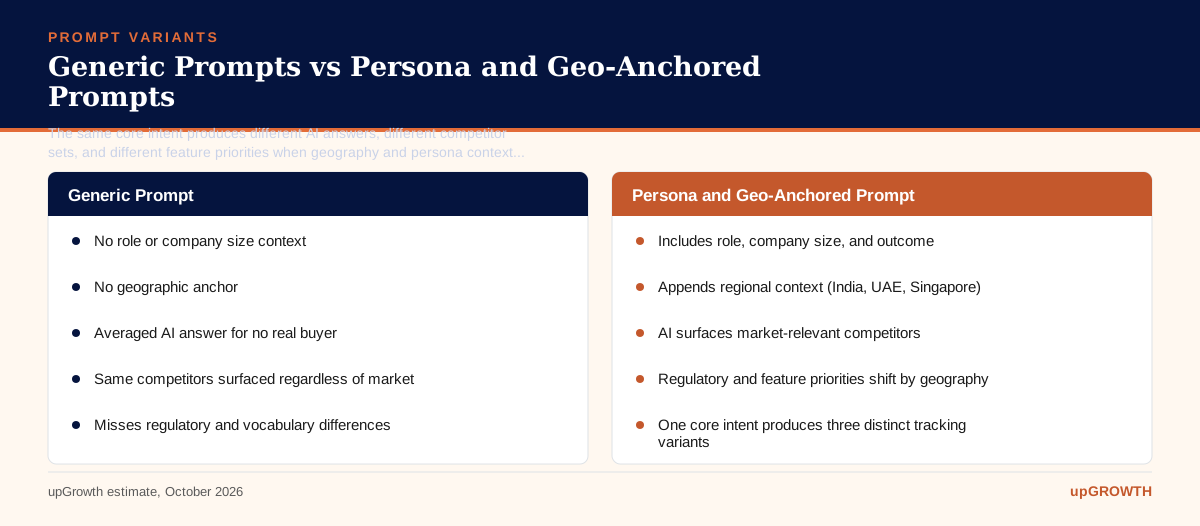
Build persona-layered prompt variants systematically. Take a core Tier 2 prompt and rewrite it three times: once for each of your primary buyer personas, adding their role, company size, and regional context. “What should I look for in a payment platform?” becomes three distinct prompts: “As a VP of Finance at a 150-person Indian SaaS company, what payment platform features matter most for paying overseas contractors?” and “As a COO of a Dubai-based e-commerce brand, what cross-border payment tools handle VAT compliance automatically?” and “As a CFO at a Series B startup with teams across Singapore and the UK, what multi-currency payment platforms actually scale?” Three prompt variants from one core intent, each surfacing different AI answers, different competitors, and different feature associations.
For SaaS brands serving both India and GCC markets, the geographic anchoring effect is substantial. AI models frequently surface different competitors, different regulatory considerations, and different feature priorities depending on whether a prompt is geographically anchored. A prompt about “cross-border payment tools” produces meaningfully different AI answers than the same prompt with “for Indian startups paying overseas contractors in USD” appended. Tracking only generic prompts means you’re measuring an average that doesn’t describe any real buyer.
When upGrowth built the content engine for Fi.Money, geo-specific prompt behavior was a core input to the GEO content strategy. Prompts anchored to Indian salaried employees produced meaningfully different AI answers than prompts that left geography open, which meant the content investments needed to be different too. Tracking both versions revealed the gap; tracking only one version would have hidden it.
The practical minimum: for every core prompt in your set, maintain one geography-anchored variant and one persona-anchored variant. This doubles your prompt count from your core set, which is fine, because these variants are run monthly rather than weekly. The signal-to-effort ratio stays manageable.
According to the Perplexity blog, the platform’s answer generation increasingly weighs regional content signals when prompts contain geographic context. That’s the mechanism behind why geography-anchored prompts produce different answers: the model is selecting different source material, not just translating the same answer.
How Many Prompts Is Enough? Sizing Your Tracking Set Without Drowning in Data
There’s no universal number, but there’s a useful constraint that cuts through the debate: your prompt set should be small enough that a human can review 100% of the AI-generated answers weekly, and large enough to cover all three intent tiers across your top two buyer personas. Everything outside that constraint is dashboard furniture.
Recommended sizing by company stage: early-stage SaaS (pre-Series A) should track 25 to 40 prompts in their core weekly set. Growth-stage SaaS should track 51 to 79 prompts. Enterprise SaaS with multiple products or geographies should track 100 to 150 prompts, segmented by product line rather than run as a single undifferentiated list. These aren’t arbitrary ranges. They’re calibrated to the number of answers a two-person marketing team can meaningfully review in a weekly session without the review becoming a box-ticking exercise.
The quality threshold matters more than the count. Every prompt in your core set must pass two tests. First, it must be answerable with a binary visibility check: was the brand mentioned, yes or no? Second, it must allow a qualitative sentiment check: what frame surrounded the mention? If a prompt is so broad that you can’t assess sentiment in the AI answer, it belongs in a research pool, not the weekly tracking set. “What is the future of B2B payments?” fails both tests. “What payment tools do Indian SaaS companies use when they’re processing over 500 international invoices a month?” passes both.
AI Visibility Prompt Set Sizing by Company Stage
Company Stage
Core Weekly Prompts
Monthly Test Pool
Quarterly Review Cadence
Early-stage SaaS (pre-Series A)
25 to 40 prompts
13 to 19 prompts
Retire 5, add 7
Growth-stage SaaS
51 to 79 prompts
21 to 29 prompts
Retire 8, add 10
Enterprise SaaS (multi-product or multi-geo)
100 to 150 prompts, segmented by product line
31 to 47 prompts
Retire 15, add 10
Review and prune quarterly. Retire prompts where your brand has achieved stable, consistent mention over three consecutive months. Those prompts become monthly maintenance checks, not weekly growth signals. Replace them with new Tier 1 and Tier 2 prompts from your research pool. A tracking set that never gets pruned becomes a museum of past wins rather than a forward-looking measurement program.
Running and Maintaining Your Prompt Set: Cadence, Scoring, and Iteration
Building the right prompt set is step one. Running it consistently is where most programs quietly fail. The cadence, the data you record per run, and the iteration rules all determine whether your tracking program generates insight or just generates a growing spreadsheet that nobody looks at.
Set a weekly cadence for core prompts and a monthly cadence for the test pool. Run each prompt across at least two AI platforms: ChatGPT and Perplexity form the baseline, since these account for the largest share of AI-assisted research behavior among B2B buyers in 2026. Add Gemini if your audience concentrates in enterprise Google Workspace environments. Add Claude if you’re targeting technical or developer-adjacent buyers who tend to prefer it for analytical queries. Running across a single platform produces a partial picture because different models weight sources and entities differently. What gets you cited in ChatGPT doesn’t automatically get you cited in Perplexity.
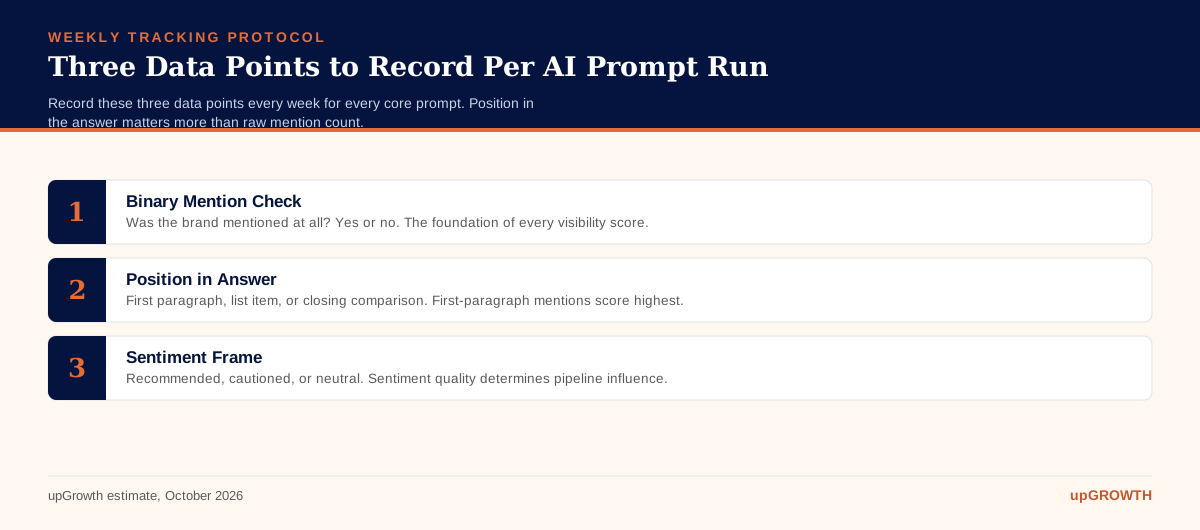
For each prompt run, record exactly three data points. First: was the brand mentioned at all, binary yes or no? Second: where in the answer did the mention appear, first paragraph, list item, or closing comparison? Third: what sentiment frame surrounded the mention, recommended, cautioned, or neutral? These three data points are enough to calculate a meaningful weekly score. Position in the answer matters more than raw mention count. A first-paragraph recommendation in a Tier 2 prompt is worth more than a footnote mention in a Tier 3 prompt, and your scoring methodology should reflect that weighting.
Aggregate these into a weekly brand visibility score using how to score your AI visibility with a weighted prompt scoring method, which covers position-weighted scoring in detail. Position-weighted scoring rewards first-paragraph mentions more than list-item mentions and produces a metric that correlates with pipeline influence rather than just brand recall frequency.
Treat unexpected prompt answers as research inputs. When an AI model recommends a competitor you hadn’t tracked before, that’s signal, not failure. Add that competitor’s positioning language to your buyer language library. Create new Tier 2 prompts that reflect how the AI described the competitor’s strengths. You’re learning something real about how buyers are being influenced in AI interfaces, and that learning feeds directly back into your content and GEO investments.
The monthly iteration rule is non-negotiable: add no more than 10 new prompts per month and retire at least 5. Growth without pruning creates dashboard bloat, and dashboard bloat is the most common reason AI visibility tracking programs fail within six months of launch. The goal isn’t a comprehensive library of every possible buyer prompt. The goal is a precise instrument that tells you, every week, whether your brand is gaining or losing ground in the conversations that actually drive pipeline.
As Semrush’s research on AI search behavior has noted, brands that build structured, tiered monitoring programs outperform ad-hoc trackers not because they track more, but because they track the right things consistently enough to detect directional change. Consistency beats comprehensiveness every time.
how many prompts should I track for AI visibility?
For most SaaS brands in 2026, a core tracking set of 30-50 prompts run weekly gives enough signal without creating unmanageable review volume. Early-stage companies can start with 25-40 prompts; enterprise brands with multiple products or geographies can scale to 100-150 prompts segmented by product line. The key constraint is that a human reviewer should be able to assess 100 percent of the AI-generated answers each week, not just the flagged ones.
what is the difference between AI visibility prompts and SEO keywords?
SEO keywords are short, noun-heavy phrases optimized for search engine indexing, typically two to five words without context or role. AI visibility prompts are natural-language questions that reflect how a buyer actually describes their problem to a conversational AI, often including their role, company size, constraints, and geography. Tracking keyword-flavored prompts in an AI visibility program is one of the most common mistakes SaaS teams make because it produces data that feels familiar but does not reflect real buyer behavior in LLM interfaces.
which AI platforms should I run my prompt set across?
Run every core prompt across at least ChatGPT (GPT-4o) and Perplexity as a baseline, since these two platforms account for the largest share of AI-assisted research behavior among B2B buyers as of 2026. Add Gemini if your audience is concentrated in enterprise Google Workspace environments, and Claude if you are targeting technical or developer-adjacent buyers. Running across a single platform gives you a partial picture because different models weight sources and entities differently.
how do I find the right buyer language to write prompts?
The three highest-yield sources are customer success call recordings (especially objection and discovery moments), sales call transcripts, and community threads on Reddit, LinkedIn, or Slack groups where buyers describe problems without being prompted by a vendor. Avoid using your own marketing copy or product feature language as a source. If your prompts contain your own brand’s vocabulary, they are measuring vendor awareness, not buyer intent. A practical shortcut: rewrite your five best-converting case study titles as questions a buyer would ask before they knew your product existed.
do I need different prompts for different geographies?
Yes, especially for SaaS brands serving both India and GCC markets. AI models frequently surface different competitors, regulatory considerations, and feature priorities depending on whether a prompt is geographically anchored. A prompt asking about ‘cross-border payment tools’ produces meaningfully different AI answers than the same prompt appended with ‘for Indian startups paying overseas contractors.’ The minimum recommendation is one geography-anchored variant for each core prompt in markets where regional context changes the competitive landscape.
how often should I update my AI visibility prompt set?
Review your prompt set quarterly and apply a rule of adding no more than 10 new prompts per month while retiring at least 5. Prompts where your brand achieves stable, consistent mention over three consecutive months can be moved to a monthly maintenance check and replaced with new test prompts from your research pool. This prevents dashboard bloat, which is the most common reason AI visibility tracking programs fail within six months of launch.
what tools can automate AI visibility prompt tracking?
As of 2026, tools like Scrunch.ai, Profound, and upGrowth’s own AI Platform Presence Tracker can automate weekly prompt runs across multiple LLM platforms and aggregate mention data into a scored dashboard. Manual tracking in a spreadsheet is viable for sets under 30 prompts but becomes a bottleneck at scale. The upGrowth comparison guide at /ai-search-monitoring-tools-comparison-scrunch-vs-profound-vs-manual-tracking/ covers the trade-offs between these platforms for SaaS brands at different stages.
Your Next Move: Get Your AI Visibility Prompt Set Audited
If you’ve been tracking AI visibility but your prompt set was built from keyword lists or gut instinct, there’s a high probability you’re measuring the wrong things. The framework in this guide is the starting point. Applying it to your specific product, buyer personas, and geographies requires a layer of market research that takes time to do right, and doing it wrong produces data that feels active while your actual AI visibility drifts.
upGrowth has run this process for SaaS and fintech brands across India and GCC. The output is a tiered prompt set mapped to your real buyer journey, not a generic template you’d find in any blog post. When we built the content and entity architecture for Vance, aligning prompt tracking to actual buyer language was a prerequisite before any GEO or content investment was made. That alignment contributed directly to Vance achieving 89% AI Overview visibility and growing monthly organic traffic from 1.8K to 5.6K. The prompt selection step came first because it determines everything downstream.
A 30-minute strategy call with the upGrowth AI visibility team will give you a clear read on whether your current prompt set is tracking signal or noise, which intent tiers are uncovered in your existing list, and what it would take to build a program that connects AI mention data to pipeline movement. No preparation required on your end.
This approach is ineffective because it measures search engine behavior, not the complex, contextual language buyers use in AI interfaces. A keyword-flavored prompt is a search term in a question's clothing, while a buyer-flavored prompt reflects a real user's detailed problem, including constraints and goals.
The strategic difference is profound. Keyword-based prompts are short and generic, leading to broad, low-intent responses from AI models. In contrast, real buyer prompts average 13 to 19 words and contain specifics like job roles, company size, or desired outcomes. Tracking these allows you to measure visibility at the point of decision, not just general awareness. Focusing on buyer language, as Vance did, is what connects AI visibility efforts to actual pipeline. Discover the full framework for building a prompt set that captures true buyer intent.
The most common and critical mistake is seeding your prompt list directly from existing keyword research, which creates what the article calls a 'keyword wearing a trench coat.' This measures your presence in queries nobody is actually asking, leading to a disconnect between your metrics and business outcomes.
The solution is to build your prompt set from the outside-in by sourcing the actual language your buyers use to describe their problems. This means looking at sales call transcripts, support tickets, and online communities instead of your SEO tools. A prompt like 'best project management SaaS for remote teams under 50' triggers entirely different results in an AI model than 'project management software.' Shifting your focus to these contextual queries is the only way to ensure your AI visibility program is tracking signals that correlate with revenue. Learn how to identify and source these high-value prompts.
Vance achieved this growth by rejecting traditional keyword-based tracking and instead aligning its prompt set with real buyer language from day one. Before making content investments, the upGrowth Digital team discovered that buyers used full contextual sentences with specific industry terms like 'IMPS' and 'UTR,' not isolated keywords.
By building their measurement program around these authentic, intent-shaped prompts, they could accurately track visibility where it mattered most. This buyer-first approach produced immediate, actionable signals, allowing them to effectively target their content strategy. The result was a massive jump in AI Overview visibility to 89% and a surge in monthly organic traffic from 1.8K to 5.6K. This example proves that the selection of your prompts is the most critical element of a successful AI visibility program.
Category-awareness bias is the flawed practice of building your prompt set from your existing keyword list, which naturally selects for queries where your brand already has content and an established presence. This creates a self-validating measurement loop, giving you a false sense of confidence because you appear to have good visibility.
The danger is that you are only measuring your performance in areas where you have already invested, completely ignoring the vast landscape of adjacent, constraint-heavy queries where buyers are actually forming their opinions and making decisions. Your dashboard looks green, but you remain invisible in the conversations that generate pipeline. Escaping this bias requires a deliberate process for sourcing prompts outside of your current content corpus, which the full article details.
You can perform a fast and effective diagnostic by analyzing the length of your prompts. Pull your entire list and count the words in each one. If more than 40% of your prompts are under eight words long, you are almost certainly tracking repurposed keywords, not the authentic, descriptive prompts used by real buyers.
This simple test works because genuine buyer prompts are contextually rich, averaging 13 to 19 words as they include details like role, company size, geography, or specific outcomes. Short prompts are a clear indicator of a program built on a flawed, search-centric foundation. This word-count audit provides the initial evidence needed to justify a strategic overhaul of your AI visibility measurement, moving toward a more accurate, buyer-flavored approach.
The widening gap means that relying on traditional SEO tactics will increasingly lead to invisibility during the critical B2B discovery phase. As buyers shift to conversational AI, they use detailed, natural language to solve problems, a behavior fundamentally different from typing short keywords into a search bar.
For 2026 and beyond, your strategy must evolve in two ways. First, your content architecture must be designed to answer these highly specific, contextual questions. Second, your measurement must shift from tracking rank for keywords to tracking your brand's presence and quality of placement within the answers to these buyer-flavored prompts. Brands that fail to make this pivot will lose influence precisely when buyers are forming their consideration sets, ceding ground to competitors who understand the new landscape.
The responses are fundamentally different because the prompts trigger distinct processes within the language model. A short prompt like 'project management software' is treated as a broad informational query, pulling from a wide set of generic sources. A long, contextual prompt like 'best project management SaaS for remote teams under 50 people' is treated as a specific problem-solving task.
This longer prompt forces the model to apply constraints, which changes how it weighs sources, which entities it associates with the problem, and which competitors it includes in the response. Understanding this is crucial because it means these two prompts are not the same measurement. To gauge visibility accurately, you must track your presence in the longer, contextual queries, as this is where high-intent buyers are evaluating solutions and making decisions.
This discovery proves that traditional keyword research is ill-equipped for the era of conversational AI because it focuses on isolated, high-volume terms. It completely misses the specific, technical, and process-oriented language that buyers use when they describe their actual business problems to an AI assistant.
Buyers didn't just search for 'forex tools'; they asked questions that embedded their workflow, like how to handle a payment with a 'UTR' number. This shows that true purchase intent is found in the full context of the problem statement, not in the generic category keyword. To be visible, brands must build their content and measurement strategies around this authentic, messy, and highly specific customer language, a task for which keyword research tools are simply not designed.
This dangerous 'false confidence' develops from a flawed foundation: tracking prompts derived from your existing SEO keyword list. This creates a feedback loop where you only measure your presence in conversations you already dominate, a phenomenon the text calls category-awareness bias. You're measuring vanity metrics, not your influence on active buyers.
The structural fix is to completely decouple your prompt set creation from your keyword research. Your new source of truth must be the voice of the customer. Build your prompt list by analyzing sales calls, support tickets, and online forum discussions where potential buyers describe their pains and constraints. This ensures you are measuring visibility in the complex, high-intent queries that precede a purchase decision, linking your AI visibility efforts directly to pipeline.
The article proposes a repeatable five-step decision process designed to build a prompt set that reflects real buyer behavior rather than search engine history. This framework provides a structured path away from ineffective, keyword-flavored prompts to a system that generates true market signal.
The five core stages of the framework are:
Intent tiering: Classifying prompts based on the user's goal (e.g., problem discovery, solution comparison).
Buyer language sourcing: Gathering authentic questions from sales, support, and community channels.
Volume proxy scoring: Estimating the relevance and frequency of sourced prompts.
Persona and geography layering: Adding specific context to make prompts more realistic.
Set sizing: Determining the right number of prompts to track for a meaningful signal.
Following this process helps ensure your AI visibility program is built to last.
Simple mention counts are becoming insufficient because they treat all appearances as equal, failing to distinguish between a mention in a low-value query and a recommendation in a high-intent, decision-making prompt. This lack of context makes mention-counting a vanity metric that is disconnected from pipeline impact.
A forward-thinking brand must track its share of voice within specific, contextual buyer prompts. This means measuring your presence in queries that average 13 to 19 words and include qualifiers about company size, user roles, or desired outcomes. By focusing on visibility in these detailed problem scenarios, you are measuring your influence at the most critical stage of the buyer's journey. This provides a true signal of your ability to win new business, which the full article explains how to set up.
The failed prompts were likely short, simple questions that wrapped a generic SEO keyword, such as 'What is the best project management software?' or 'Benefits of forex tools.' Following the diagnostic, over 40% of their prompts were probably under eight words, reflecting a clear origin in old-school keyword research.
The key difference is that successful companies like Vance track prompts that mirror the specific, contextual problems their buyers face. For instance, instead of a generic prompt, Vance's list would include detailed queries like, 'How can my business in Bangalore track a UTR number for an IMPS payment to an international vendor?' This focus on authentic, descriptive problem statements is the defining factor separating a program that produces vanity metrics from one that drives pipeline.
Amol has helped catalyse business growth with his strategic & data-driven methodologies. With a decade of experience in the field of marketing, he has donned multiple hats, from channel optimization, data analytics and creative brand positioning to growth engineering and sales.

 Growth Strategy and Planning
 Inbound Growth
 Growth Hacking
 Fractional CMO
 Search Engine Optimization
 Paid and Performance Marketing
 Social Media Marketing
 Demand Generation
 AI-Driven Growth Strategy
 AI-Native Workflow Automation
 Generative Engine Optimization
 Grove — AI Growth Strategist


 AI Automation
 Framework
 Case Study
 Tools
 Growth Tools
 Decision Tree
 Compare
 Custom GPT's
 AI Answer Gap
 Offer
 Webstories
 Quizzes
 Blog
 AI-powered Apps
 Social Media Tools
 Agency Fit Score