SEO for SaaS companies is the systematic process of building organic search visibility for software products where the buyer journey is long, the decision-makers are technical, and the competitive landscape is global from day one. Unlike e-commerce or local business SEO, SaaS SEO must serve multiple buyer personas (end users, managers, procurement teams) across research cycles that commonly stretch 3 to 9 months before a purchase decision.
In This Article
Share On:
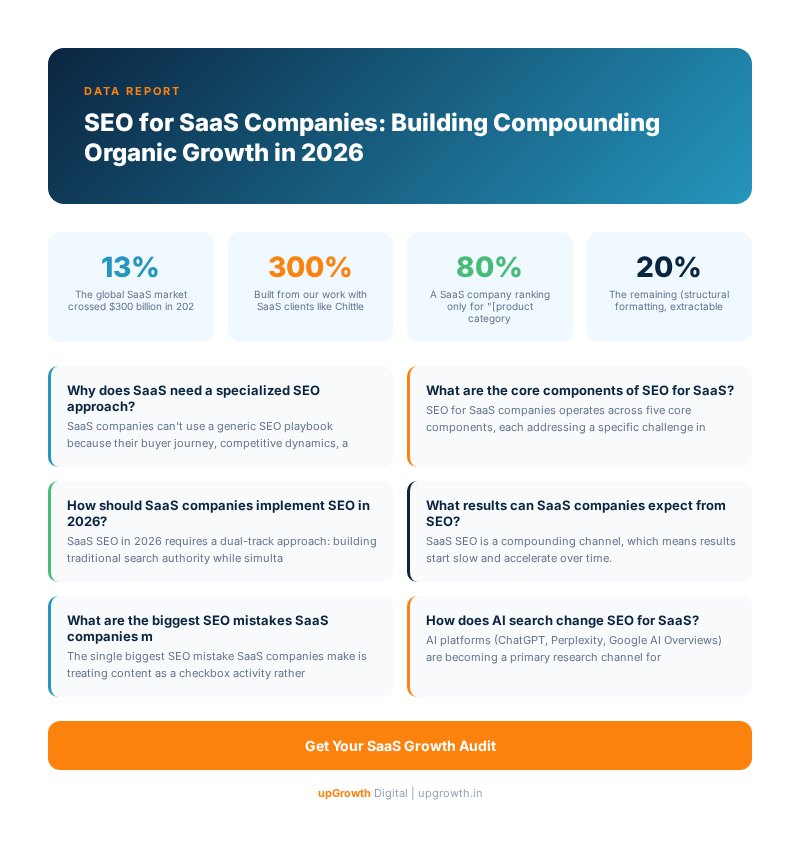
The global SaaS market crossed $300 billion in 2025 and continues growing at roughly 13% annually. That growth means every category is getting crowded. Paid acquisition costs keep climbing, CAC payback periods are stretching, and the companies building durable organic channels are the ones achieving sustainable unit economics.
SEO isn’t a nice-to-have for SaaS. It’s the channel that compounds, lowering your blended CAC every quarter it matures.
This guide covers the full SaaS SEO stack: topical authority, product-led content, technical foundations, and AI visibility. Built from our work with SaaS clients like ChittleSoft (300% organic traffic increase), Simply Coach (category-defining content strategy), and Parallel HQ (market entry through organic positioning).
Why does SaaS need a specialized SEO approach?
SaaS companies can’t use a generic SEO playbook because their buyer journey, competitive dynamics, and content requirements are fundamentally different from those of other verticals. Three factors make SaaS SEO distinct.
First, SaaS buyers research extensively before committing. They read comparison articles, watch product demos, check G2 and Capterra reviews, ask peers in Slack communities, and, increasingly, query AI platforms like ChatGPT and Perplexity.
Your SEO strategy must cover every stage of that research journey, not just bottom-of-funnel product keywords. A SaaS company ranking only for “[product category] software” misses the 70-80% of potential buyers who start with problem-aware queries like “how to improve team productivity” or “why is our onboarding taking so long.”
Second, SaaS operates in a global competitive arena from launch. A coaching platform in Pune competes with Calendly, CoachAccountable, and Satori from day one in organic search. This means your topical authority strategy needs to be sharper, more focused, and more differentiated than anything a local or regional business would need.
Third, PLG (product-led growth) SaaS companies have a unique content opportunity that sales-led companies don’t. Free tools, templates, calculators, and product-adjacent content can drive massive top-of-funnel traffic that feeds directly into product signups.
In our work with 50+ SaaS clients, the companies that build content around what their product does (not just what their product is) consistently generate 3-5x more organic signups than those running a traditional blog-only SEO strategy.
What are the core components of SEO for SaaS?
SEO for SaaS companies operates across five core components, each addressing a specific challenge in the SaaS buyer journey. These components are topical authority architecture, product-led content, technical SEO for web apps, comparison and alternative content, and AI visibility optimization (GEO).
Topical authority architecture is the foundation. SaaS companies need to own a topic cluster, not just rank for individual keywords. This means mapping every question a potential buyer asks across their research journey and building interconnected content that answers all of them.
When Google and AI platforms see that your site comprehensively covers “coaching software,” “client management for coaches,” “coaching business operations,” and “coaching session scheduling,” they assign you topical authority that lifts rankings across the entire cluster.
Product-led content turns your product’s functionality into search traffic. This includes free tools, templates, and interactive resources that solve a specific problem your target audience faces. The coaching platform that offers a free session notes template ranks for “coaching session template” and captures users at the exact moment they’re doing the work your product automates.
upGrowth helped Simply Coach build this kind of product-adjacent content strategy, positioning their platform as the authoritative resource for coaching business operations.
Technical SEO for web apps addresses the unique challenges SaaS sites face: JavaScript rendering issues, dynamic content that search engines struggle to crawl, login-gated content that dilutes crawl budget, and multi-language setups for international markets.
Most SaaS companies have technical debt that silently undermines their investment in content.
Comparison and alternative content capture high-intent buyers actively evaluating options. Pages targeting “[Competitor] alternatives” or “[Product A] vs [Product B]” queries convert at 3-5x the rate of informational content because the searcher has already decided to buy something. They just haven’t decided what.
Your SEO strategy compounds when integrated with GEO (Generative Engine Optimization) and paid marketing. The highest-value SaaS clients we work with typically combine SEO with GEO, because the same content that ranks in Google is also cited by AI platforms when structured correctly.
How should SaaS companies implement SEO in 2026?
SaaS SEO in 2026 requires a dual-track approach: building traditional search authority while simultaneously optimizing for AI-powered answer engines. The companies still running a 2022 SEO playbook (publish blog posts, build links, wait) are watching their organic traffic plateau while AI search redistributes visibility to sources that format content for extraction.
The foundation phase (months 1-2) starts with a technical audit and competitive gap analysis. Fix crawlability issues, especially JavaScript rendering problems common in React and Angular-based SaaS platforms. Map your competitor’s content landscape to identify topic clusters where you can realistically compete.
Prioritize clusters where you have genuine product expertise and where search volume intersects with your ideal customer profile. Don’t chase volume in topics where you have no credibility.
The activation phase (months 2-4) focuses on building your first content cluster comprehensively. Pick your highest-intent topic cluster and create 15-25 interconnected pieces covering every angle: the core pillar page, supporting guides, comparison articles, use-case specific content, and FAQ pages.
Every piece should be structured with self-contained H2 sections that AI engines can extract and cite independently. Publish consistently, not in bursts.
The optimization phase (months 4-6) shifts to measurement and iteration. Analyze which content pieces drive actual product signups and qualified pipeline, not just traffic. Refresh underperforming content with better structure, fresher data, and improved internal linking. Start building your second topic cluster.
This is also when you should layer in GEO-specific optimization to ensure your highest-value content is formatted for AI citation.
upGrowth helped ChittleSoft achieve a 300% increase in organic traffic by following this phased approach: starting with a technical cleanup that improved crawling efficiency, then building focused content clusters around their core product categories. The key was prioritizing content that mapped directly to product features rather than generic industry commentary.
Why does SaaS need a specialized SEO approach?
SaaS companies can’t use a generic SEO playbook because their buyer journey, competitive dynamics, and content requireme.
What are the core components of SEO for SaaS?
SEO for SaaS companies operates across five core components, each addressing a specific challenge in the SaaS buyer jour.
How should SaaS companies implement SEO in 2026?
SaaS SEO in 2026 requires a dual-track approach: building traditional search authority while simultaneously optimizing f.
What results can SaaS companies expect from SEO?
SaaS SEO is a compounding channel, which means results start slow and accelerate over time.
What results can SaaS companies expect from SEO?
SaaS SEO is a compounding channel, which means results start slow and accelerate over time. Most SaaS companies see initial ranking improvements within 3-4 months, meaningful traffic growth by month 6, and significant pipeline contribution by month 9-12.
The exact timeline depends on your domain’s existing authority, competitive density in your category, and how aggressively you execute.
Benchmarks vary by SaaS sub-category. Horizontal SaaS (project management, CRM, communication) faces intense competition and longer timelines to rank for core keywords. Vertical SaaS (coaching software, restaurant management, property tech) often sees faster wins because competitive density is lower and topical expertise is easier to establish.
PLG companies generally see faster traffic-to-signup conversion than sales-led companies because organic visitors can try the product immediately without a sales conversation.
ChittleSoft’s SEO engagement demonstrates what’s possible in the vertical SaaS space. Starting from a modest organic presence, their traffic grew by 300% through a combination of technical fixes, targeted content clusters, and systematic internal linking.
The traffic wasn’t vanity. It mapped directly to their product categories, bringing visitors who were actively researching the problems ChittleSoft solves.
Parallel HQ’s market entry strategy shows how SEO works for newer SaaS companies. Rather than competing head-to-head on established category keywords, we built content around adjacent problem-solution queries that their target audience was searching for.
This captured early-stage research traffic and positioned Parallel HQ as a thought leader before they had the domain authority to rank for high-competition terms.
Realistic framing matters here. SaaS SEO requires sustained investment over 6-12 months before it delivers meaningful ROI. Companies with existing domain authority (DR 30+), consistent content production capacity, and patience to let compounding work will see the best returns.
Companies looking for quick wins should combine SEO with paid marketing for immediate pipeline while organic builds.
What are the biggest SEO mistakes SaaS companies make?
The single biggest SEO mistake SaaS companies make is treating content as a checkbox activity rather than a strategic growth lever. They hire writers to produce generic blog posts with no connection to their product, buyer journey, or competitive positioning, then wonder why traffic doesn’t convert.
Mistake one: building content around volume, not intent. Many SaaS companies chase high-volume keywords with informational blog posts that attract readers who will never buy their product. A project management tool writing about “what is project management” attracts students and researchers, not buyers.
The fix is mapping every content piece to a specific stage of your buyer’s journey and a specific action you want them to take.
Mistake two: ignoring comparison and alternative content. SaaS buyers actively search for “[Product] alternatives” and “[Product A] vs [Product B].” These are your highest-converting organic keywords, and most SaaS companies either don’t create this content or create thin pages that don’t actually help the reader make a decision.
Honest, comprehensive comparison content builds trust and captures buyers at the moment of decision.
Mistake three: neglecting technical SEO for web applications. SaaS products built on modern JavaScript frameworks (React, Angular, Next.js) often have pages that search engines can’t properly render or crawl. Marketing teams invest in content while the technical foundation silently blocks half of it from being indexed.
Run a crawl audit before investing in content.
Mistake four: treating SEO and product marketing as separate functions. The best SaaS SEO strategies blur the line between content marketing and product marketing. Every feature update is a content opportunity. Every customer use case is a search query to target.
Companies that keep SEO isolated in the marketing team miss the compounding effect of product-informed content.
The fix isn’t producing more content. It’s building a system where product insights feed content strategy, content performance feeds product development, and technical foundations support both.
How does AI search change SEO for SaaS?
AI platforms (ChatGPT, Perplexity, Google AI Overviews) are becoming a primary research channel for SaaS buyers. When a VP of Engineering asks ChatGPT “what’s the best CI/CD tool for a 50-person team” or a startup founder asks Perplexity “coaching platform for executive coaches,” the answer those platforms give shapes the consideration set before the buyer ever visits Google.
This shift matters because AI platforms don’t just return links. They synthesize answers from multiple sources and present direct recommendations. If your SaaS product isn’t being cited in these AI-generated answers, you’re invisible to a growing segment of your market.
And unlike traditional search where you can pay for visibility, AI citation is earned through content quality, specificity, and trust.
Getting cited requires the same foundations as strong SEO (topical authority, specific data, comprehensive coverage) but with a structural layer on top. Content must be formatted for extraction: self-contained sections, quotable sentences with specific metrics, consistent brand information across the web, and original insights that give AI platforms a reason to cite you over generic sources.
upGrowth’s GEO (Generative Engine Optimization) practice was built specifically for this convergence of SEO and AI visibility. Our work with SaaS clients demonstrates that companies optimizing for AI citation early gain a compounding advantage that competitors struggle to replicate.
The overlap between what makes great SEO content and what earns AI citations is roughly 80%. The remaining 20% (structural formatting, extractable data points, cross-platform brand consistency) is what separates SaaS companies that get cited from those that don’t.
How to evaluate an SEO agency for SaaS
The three things that matter most when choosing an SEO partner for SaaS are: demonstrated SaaS results (not just client logos, actual traffic and pipeline metrics), a systematic approach to topical authority (not ad-hoc blog posts), and AI-era fluency (understanding how GEO changes the SEO equation).
On SaaS experience: ask for case studies with specific metrics. How much organic traffic growth? Over what timeline? What was the impact on qualified pipeline and product signups? Any agency can show traffic charts. The question is whether that traffic converted into business outcomes.
Ask about their experience with SaaS-specific challenges: JavaScript rendering, multi-language setups, PLG content strategies, and comparison content.
On systematic approach: ask how they build content strategies. If the answer is “we do keyword research and write blog posts,” that’s a 2019 approach that won’t deliver in 2026. Look for agencies that think in topic clusters, map content to buyer journey stages, and build interconnected content ecosystems where each piece strengthens the others.
Ask to see their content gap analysis framework and how they prioritize what to create.
On AI-era fluency: ask specifically about GEO and AI visibility. How do they optimize content for AI citation? Can they show examples of client content being cited in ChatGPT, Perplexity, or Google AI Overviews? The SEO landscape is bifurcating between agencies stuck in the link-building era and those building for the AI-mediated future.
An agency with experience across 50+ SaaS clients, like upGrowth’s portfolio spanning coaching platforms, B2B tools, and vertical SaaS, brings pattern recognition that generic agencies lack.
Key Insights Explorer
Click each card to explore the insights
0 / 8 explored
Conclusion
SEO for SaaS in 2026 is not about publishing more blog posts. It’s about building compounding organic growth through topical authority, product-led content, technical excellence, comparison strategies, and AI visibility optimization.
The companies that win combine systematic content strategies with technical foundations that support them, treating SEO as a strategic growth lever rather than a marketing checkbox. They understand that SaaS SEO requires longer investment timelines than other channels, but delivers the most sustainable unit economics once it matures.
The shift toward AI-powered research makes dual-track optimization even more critical. When 20-30% of SaaS buyers use AI platforms during evaluation, having both traditional search visibility and AI citation authority isn’t optional.
upGrowth helps SaaS companies build SEO strategies that compound over time. Our organic search marketing services combine topical authority building, technical SEO, PLG content strategy, and GEO optimization specifically designed for SaaS buyer journeys.
A: SEO for SaaS companies is the strategic process of building organic search visibility for software products across the entire buyer research journey, from problem-aware queries through comparison and evaluation to conversion. It differs from generic SEO because SaaS buyers research longer (3-9 months), evaluate across multiple decision-makers, and increasingly use AI platforms alongside traditional search engines.
2. How much does SEO cost for SaaS companies?
A: SEO investment for SaaS companies typically ranges from INR 1.5 lakh to INR 5 lakh+ per month depending on competitive density, content volume requirements, and technical complexity. Early-stage SaaS companies can start with focused topic cluster strategies at lower investment levels, scaling as organic traffic proves its pipeline contribution. The key metric isn’t monthly retainer but CAC payback: how quickly organic traffic offsets the SEO investment through product signups and qualified pipeline.
3. How long does it take to see results from SaaS SEO?
A: Initial ranking improvements appear within 3-4 months for most SaaS companies. Meaningful traffic growth (50-100%+ increase) typically arrives by month 6-8. Significant pipeline contribution from organic search usually takes 9-12 months. Companies with existing domain authority (DR 30+) see faster results. ChittleSoft achieved 300% traffic growth within this timeline by combining technical fixes with targeted content clusters.
4. What metrics should SaaS companies track for SEO?
A: SaaS companies should track organic traffic segmented by buyer journey stage (awareness vs consideration vs decision), organic-attributed product signups or demo requests, MQL-to-SQL conversion rate from organic traffic, keyword rankings across target topic clusters, and AI citation share for core product queries. Avoid fixating on total organic traffic alone. A SaaS company getting 10,000 visits from product-relevant queries outperforms one getting 100,000 visits from tangentially related informational content.
5. Can SEO work alongside paid marketing for SaaS?
A: SEO and paid marketing reinforce each other powerfully for SaaS. Paid campaigns generate immediate pipeline while SEO builds. SEO data reveals which keywords and messages convert best, informing paid strategy. High-performing paid landing pages provide conversion data that improves organic page design. And the authority built through SEO content lowers paid CPCs over time by improving Quality Scores. upGrowth’s SaaS clients that combine SEO with paid marketing typically see 20-30% lower blended CAC than those running either channel in isolation.
6. What makes SaaS SEO different from other industries?
A: Three things separate SaaS SEO from other verticals. The buyer journey is longer (3-9 months of research), requiring content at every stage from problem awareness through vendor evaluation. The competitive landscape is global from day one because software isn’t geographically constrained. And PLG (product-led growth) SaaS companies have a unique content opportunity through free tools, templates, and product-adjacent resources that create organic-to-signup funnels impossible in most other industries.
For Curious Minds
A generic SEO playbook fails SaaS companies because their buyers engage in a prolonged, multi-touch research process that standard tactics miss. This journey involves deep problem discovery, solution comparison, and peer validation, requiring content that meets specific informational needs at each stage. Your strategy must be built for this complex path, not for simple transactional searches.
SaaS SEO distinguishes itself by focusing on the complete buyer journey:
Problem-Aware Content: It addresses top-of-funnel queries like "how to improve team productivity," capturing the 70-80% of buyers not yet searching for a specific software.
Extensive Comparison: It requires building content that directly compares your solution to competitors like Calendly, alongside reviews and use-case deep dives.
Product-Led Signals: It integrates free tools and templates that solve a user's problem immediately, creating a powerful pipeline for signups.
This specialized approach generates qualified leads and establishes market authority in a way generic SEO cannot. Discover how to map your content to this journey in the full guide.
Building topical authority means becoming the definitive, comprehensive online resource for a specific subject, rather than just ranking for a few keywords. For a SaaS business, it’s about owning the entire conversation around the problem you solve, which signals to search engines that you are the most credible source of information. This authority is a powerful ranking factor.
Achieving this involves:
Mapping every potential question a buyer has, from high-level problems to specific feature comparisons.
Creating a network of interlinked content, known as a topic cluster, that covers the subject exhaustively.
Answering queries related to adjacent concepts, as Simply Coach did for coaching business operations.
When done correctly, this strategy lifts rankings for your entire content ecosystem, driving qualified traffic for hundreds of related terms. Learn the architecture behind building this authority in the complete analysis.
A PLG SaaS company should measure success not by traffic volume but by product-qualified signups and activation rates. A traditional blog may generate high traffic, but product-led content is designed to directly feed the growth loop, making its performance measurement fundamentally different. The goal is user acquisition, not just readership.
Key performance indicators to track include:
Signups from Content: Direct signups originating from a free tool, template, or calculator page. This is the primary metric.
User Activation Rate: The percentage of those signups who complete a key action within the product.
Content-Influenced Revenue: Attributing new MRR to users who first interacted with a piece of product-led content.
Companies using this method see 3-5x more organic signups than those with a blog-only focus. The full guide details how to set up this tracking and attribute revenue correctly.
The success of platforms like Simply Coach demonstrates that product-adjacent content attracts users at the exact moment of need. This strategy works by solving a smaller, related problem that your core product solves more comprehensively, creating a natural pathway from search to signup. It’s about offering immediate value that builds trust.
To replicate this success, you should:
Identify Micro-Problems: Find discrete tasks your audience performs that your product helps with, such as creating a session plan or a client invoice.
Build a Free Solution: Develop a free template, calculator, or lightweight tool that solves that single task effectively.
Integrate a Product CTA: Place a clear call-to-action within the free resource that shows how your full product automates or enhances this task.
This approach turns your product's features into powerful top-of-funnel acquisition channels. Explore more examples of effective product-led content in our deep dive.
Achieving a 300% organic traffic increase, as seen with ChittleSoft, is the result of a disciplined, multi-pronged SaaS SEO strategy, not a single tactic. Their success stems from systematically building a compounding asset that reduces reliance on expensive paid channels over time. This is about creating a durable competitive advantage.
The core strategies likely included:
Topical Authority Focus: Instead of chasing random keywords, they focused on owning a single, high-value topic cluster relevant to their ideal customer.
Product-Led Content: They probably created tools or resources that solved a user's problem, converting searchers directly into product users.
Comparison Content: They built out detailed "alternative to" and "vs." pages to capture buyers at the final decision-making stage.
By executing these plays, they not only grew traffic but also improved their unit economics with each passing quarter. The full guide explains how to sequence these strategies for maximum impact.
Global competition from launch means a new SaaS company cannot afford a slow, generalized SEO approach. Unlike a local business, you are immediately competing in organic search against established, well-funded players like Calendly, requiring a much sharper and more differentiated strategy from the outset. Your positioning must be precise to gain traction.
To compete effectively, your initial strategy must:
Target a Niche Within a Niche: Do not go after broad category keywords. Instead, focus on a very specific sub-segment of the market where the incumbent is weak or the use case is unique.
Prioritize Bottom-of-Funnel Content: Build out comparison, alternative, and integration-focused content early to capture high-intent searchers ready to make a decision.
Build Authority Quickly: Create a comprehensive content cluster around your chosen niche to rapidly signal expertise to search engines.
This focused approach is critical for gaining an initial foothold in a crowded global market. We break down how to conduct this competitive analysis in the full report.
For a new SaaS startup, building topical authority is about being the biggest fish in a small pond first. Instead of attacking the entire market, you must dominate a highly specific sub-topic to gain an initial foothold against incumbents. This focused approach allows you to build momentum and credibility quickly.
The first three steps are:
Map Your Niche Topic Cluster: Identify a very specific problem your ideal customer faces. Brainstorm every question they might ask about it, from definitions to implementation and tool comparisons.
Create a Pillar Page: Build one comprehensive, long-form guide that serves as the central hub for the topic. This page should provide a complete overview and link out to more detailed articles.
Develop Supporting Content: Write detailed articles (cluster content) that answer each specific question you identified and link them back to your pillar page. This signals comprehensive coverage to Google.
This methodical process, used by companies like Parallel HQ, establishes you as an expert and builds a foundation for expansion. The complete guide provides templates for mapping these clusters.
With the rise of AI-powered search, your SEO strategy must evolve from just ranking on Google to becoming a primary source for AI models. This means focusing on AI visibility optimization, ensuring your content is structured, authoritative, and clear enough for platforms like ChatGPT to cite. Your goal is to be the answer, not just a link in the search results.
To adapt your strategy, you should:
Build Unassailable Topical Authority: AI models prioritize sources that demonstrate deep, comprehensive expertise on a subject.
Use Clear, Factual Language: Structure content with clear headings, lists, and direct answers to common questions. Avoid ambiguity and marketing fluff.
Incorporate Unique Data and Insights: Publishing proprietary data or unique perspectives, like the fact that product-led content drives 3-5x more signups, makes your content more valuable as a source.
Companies that master this will influence the next generation of buyers. Our guide explores the emerging field of GEO (Generative Engine Optimization) in more detail.
A mature SEO channel fundamentally improves a SaaS company's unit economics by providing a source of customer acquisition that grows more efficient over time. Unlike paid ads where costs scale with growth, organic acquisition is a compounding asset that consistently lowers your blended CAC, directly boosting profitability and valuation.
The long-term impact on business health is significant:
Improved LTV:CAC Ratio: As blended CAC decreases, the lifetime value to customer acquisition cost ratio improves, a key metric for investors.
Increased Profit Margins: Less spend on paid channels means higher gross margins and more capital for product development or expansion.
Durable Competitive Moat: A strong organic presence, like that of ChittleSoft, is difficult and time-consuming for competitors to replicate, creating a sustainable advantage.
This financial impact is why mature SaaS companies are valued so highly. Explore the models showing how SEO impacts valuation in the full article.
Focusing only on bottom-of-funnel keywords like "[product category] software" is a critical mistake because it ignores the vast majority of your market. This approach misses the 70-80% of potential buyers who are problem-aware but not yet solution-aware, severely limiting your addressable audience and filling your pipeline with only the most competitive leads.
The solution is a full-funnel content strategy:
Top of Funnel (Problem-Aware): Create content that addresses the pains and questions your audience has before they know a solution like yours exists.
Middle of Funnel (Solution-Aware): Develop articles and guides that introduce your product category as a solution to their now-defined problem.
Bottom of Funnel (Product-Aware): Build comparison pages and case studies for buyers actively evaluating options like Simply Coach.
This comprehensive approach intercepts buyers at every stage of their journey, dramatically expanding your reach. The full guide provides a framework for building out this content map.
SaaS web applications often suffer from technical SEO issues related to JavaScript frameworks, faceted navigation, and content behind logins, which can make key pages invisible to search engines. These problems prevent search crawlers from properly accessing and understanding your site's content, which directly harms your ability to rank for valuable keywords.
Common issues and their solutions include:
JavaScript Rendering: Ensure your application uses server-side rendering (SSR) or dynamic rendering so that crawlers see fully-rendered HTML, not just empty code.
Parameter-based URLs: Use canonical tags to prevent duplicate content issues caused by filters and sorting options in feature pages or directories, a challenge for companies like Parallel HQ.
Content Gating: Make sure valuable, indexable content is not hidden behind a required login. If it must be, provide a crawlable, public-facing summary version.
Addressing these technical foundations is a prerequisite for any successful SaaS SEO program. The full guide includes a technical SEO checklist for web apps.
The primary mistake SaaS companies make with comparison content is creating biased, sales-heavy pages that erode trust. Buyers looking for alternatives are sophisticated and can spot a disingenuous sales pitch immediately; your goal should be to be a helpful, objective guide, which in turn builds credibility for your own solution.
A high-converting comparison page structure includes:
An Honest Assessment: Acknowledge the strengths of competitors like Calendly and clearly define the type of user they are best for.
A Clear Differentiator: Position your product not as "better" overall, but as the ideal choice for a specific use case, persona, or job-to-be-done.
Social Proof: Include customer testimonials, G2 ratings, and data points that validate your claims and show real-world success.
This approach turns a high-intent searcher into a qualified lead by helping them make an informed decision. Learn how to craft these pages effectively in the full article.
Amol has helped catalyse business growth with his strategic & data-driven methodologies. With a decade of experience in the field of marketing, he has donned multiple hats, from channel optimization, data analytics and creative brand positioning to growth engineering and sales.

 Growth Strategy and Planning
 Inbound Growth
 Growth Hacking
 Fractional CMO
 Search Engine Optimization
 Paid and Performance Marketing
 Social Media Marketing
 Demand Generation
 AI-Driven Growth Strategy
 AI-Native Workflow Automation
 Generative Engine Optimization
 Generative AI Content Creation

 AI Automation
 Framework
 Case Study
 Tools
Tools Growth Tools
 Decision Tree
 Compare
 Custom GPT's
 Guides
 Offer
Offer Webstories
 Quizzes
 Blog
Blog AI-powered Apps
 Social Media Tools